




Abstract
This work develops a theoretical model for photo-thermoelastic wave propagation in a two-dimensional double-porosity semiconductor medium, incorporating fractional-order heat conduction and a spatially decaying heat source. The classical Lord–Shulman generalized thermoelasticity model is extended by employing a Caputo-type fractional time derivative to better capture memory-dependent and nonlocal heat transport phenomena commonly observed in micro- and nano-structured materials. The coupled system considers mechanical deformation, heat conduction, and diffusion of photogenerated carriers. Using the normal mode method, analytical solutions are derived, and numerical results for silicon are presented. The analysis is conducted in a 2D elastic half-space, with spatial and temporal field variables governed by harmonic wave assumptions. The findings indicate that increasing the fractional order enhances thermal memory, resulting in delayed diffusion and stronger stress responses, whereas higher decay parameters intensify thermal gradients and localize wave effects. These findings demonstrate the critical role of memory-dependent heat conduction and porosity architecture in controlling wave propagation characteristics, with potential applications in the design and optimization of semiconductor-based optoelectronic devices, thermal sensors, and energy harvesters.
Keywords
Introduction
The interaction of thermal, mechanical, and photoexcitation effects in semiconductor media has gained considerable interest for applications in optoelectronics, micro-electromechanical systems (MEMS), and micro-scale devices. Conventional thermoelastic models often fail to capture complex behaviors such as delayed thermal responses and heterogeneous porosity effects. To address this, fractional-order heat conduction models with memory effects and double-porosity mechanics offer a more accurate framework. Double porosity, initially applied in geomechanics, is now relevant in semiconductors due to engineered porous structures that enhance thermal and electrical properties. Recent advances have explored photo-thermoelastic wave behavior in such media, but the combined impact of fractional derivatives and decaying heat sources remains underexplored. This work develops a unified model integrating these aspects to analyze wave propagation in a 2D semiconductor half-space, providing insights into the thermal and mechanical response of next-generation porous materials. Conventional thermoelastic theories often fail to account for time-dependent memory effects and microstructural heterogeneities, such as porosity, which are crucial in real-world semiconductor applications. To address these challenges, fractional-order models and double-porosity frameworks have been increasingly adopted. The present study integrates these fields into a unified model to explore wave propagation in such complex media, addressing key challenges in the design of next-generation semiconductor systems with enhanced performance and durability. This investigation provides theoretical insights that can inform the design of advanced optoelectronic and thermo-mechanical systems.
The foundational principles of modeling interactions between fluids and solids in porous materials were established by Biot, 1 whose theory of poroelasticity has become a cornerstone in the field. Building on this framework, Barenblatt et al. and Warren and Root2,3 introduced the concept of double porosity, providing an essential theoretical basis for capturing the behavior of materials that contain both matrix pores and fissures. These advancements enabled more accurate descriptions of coupled mechanical and flow phenomena in complex porous structures. In double-porosity systems subjected to thermal gradients, the role of thermoelasticity becomes especially significant, as temperature changes induce variations in pore pressure and stress, influencing the mechanical response of the medium. The works of Coussy and Cleary4,5 expanded poroelastic models by incorporating thermoelastic coupling, allowing for more realistic simulations of deformation under thermal loading. Further development came with the unified approach of Berryman and Wang, 6 who linked fluid flow with mechanical strain in dual-porosity frameworks, emphasizing the temperature dependence of permeability and stress fields. Applications of these models are prominent in fields such as geothermal and petroleum engineering, where studies like those by Chen et al. 7 explore thermal effects in fractured geological formations. The numerical implementation of such models has been advanced by Khalili and Selvadurai, 8 who employed finite element and finite difference techniques to simulate thermo-mechanical responses in porous systems. Experimental investigations, such as those conducted by Cheng and Detournay, 9 validate these theoretical models through precise measurements of stress and thermal variations using advanced imaging and sensing technologies. Despite these achievements, several complexities remain, including the need to capture interactions across scales and to address nonlinearities under extreme conditions, particularly in applications like geothermal storage and CO2 sequestration.
A major leap in thermoelastic theory was made with the introduction of the generalized thermoelasticity model by Lord and Shulman, 10 which modified classical formulations by incorporating a finite thermal relaxation time to account for finite-speed heat conduction. This overcame the paradoxical infinite-speed prediction inherent in Fourier’s law. The Lord–Shulman (LS) framework 11 has since been widely adopted in analyzing thermal wave behavior, including in isotropic and composite media, where it is applied to problems involving dynamic loading and thermal shocks. Compared with other models, such as the Green–Lindsay and three-phase-lag theories, which introduce multiple relaxation parameters, the LS model 12 maintains a balance between physical fidelity and mathematical tractability by using a single relaxation time. Researchers have developed various analytical and computational strategies for solving LS-based problems, including eigenfunction expansions and Laplace transform techniques. 13 More recently, extensions of the LS theory have incorporated spatial nonlocality, dual-porosity structures, and fractional-order derivatives, enhancing its applicability to novel materials like porous composites and nano-scale systems. 14
Recent studies have increasingly emphasized the intricate interplay between thermal, mechanical, and electronic processes in semiconductor and porous media. Raddadi et al. 15 proposed a comprehensive model to describe photoacoustic and thermal-electronic wave phenomena in semiconductors, focusing on the effects of light-induced excitation. Building upon this, El-Sapa et al. 16 examined how moisture diffusion alters thermal transport and electronic behavior during photothermal excitation, highlighting the sensitivity of semiconductor performance to environmental factors. Lotfy et al. 17 advanced this direction by introducing a photo-elasto-thermodiffusion model that considers electron-hole interactions, shedding light on the complex coupling mechanisms influencing wave motion in such materials. The propagation of acoustic waves in structures with hierarchical porosity has also been explored. Olny and Boutin 18 characterized how dual-porosity networks modify acoustic responses, demonstrating that double-porous materials exhibit unique dispersive and attenuative characteristics.
The use of fractional-order derivatives in the heat conduction equation reflects memory-dependent thermal behavior, where the heat flux at a given time depends not only on the current temperature gradient but also on its historical evolution. This captures the delayed response observed in micro- and nano-structured materials, porous media, and semiconductors, where internal scattering, trapping, or complex carrier dynamics hinder instantaneous thermal conduction. Further insights into wave behavior in complex porous structures were offered by Jiang et al., 19 who applied a frequency-domain finite-element method to simulate two-dimensional seismic wave propagation through dual-porosity media. Their work provides a basis for analyzing subsurface wave mechanics in heterogeneous geological settings. Mahato et al. 20 contributed to this line of research by proposing a novel model based on a nonlocal three-phase-lag diffusion theory coupled with thermoelasticity, where fractional-order dynamics are implicit in the delayed heat conduction behavior, marking a departure from classical models and moving toward time-fractional frameworks. Lastly, Khatri et al. 21 extended the understanding of thermoelastic behavior in engineered materials by examining wave propagation in fiber-reinforced, double-porosity media with rotational effects and spatially varying thermal conductivity. These developments collectively point to the growing necessity of multiphysics modeling that includes fractional heat conduction, especially in the context of miniaturized or functionally graded materials, where classical heat transport assumptions fail to capture essential time- and space-dependent phenomena.
Recent studies have explored various thermo-mechanical and elastodynamic interactions in rotating micropolar solids and magneto-micropolar media using advanced thermoelastic models. Kumar and Nazir 22 examined thermo-mechanical interactions in rotating micropolar elastic solids under the influence of two temperatures, incorporating memory-dependent derivatives to capture thermal effects. In another study, Kumar and Nazir 23 analyzed the elastodynamic responses of magneto-micropolar isotropic media subjected to gravitational forces. Nazir and Kumar 24 further extended their work by investigating photo-thermo-elastic interactions within the framework of Green–Naghdi generalized thermoelasticity theory. Additionally, Kumar, Nazir, and Lotfy 25 studied the interactions of magneto-micropolar thermoelastic rotating media using a memory-dependent derivative, offering insights into the coupled effects of rotation and magnetic fields on thermal waves. Recent research has focused on the influence of thermal conductivity and magnetic fields on photo-thermoelastic wave propagation in semiconductor materials. Ibrahim et al. 26 explored the effects of variable thermal conductivity and magnetic fields on photo-thermoelastic waves in hydro-microelongated semiconductors, presenting a comprehensive analysis of these factors in wave propagation. El-Sapa et al. 27 also contributed to the field by modeling the bioheat transfer equation within the framework of thermoelasticity, incorporating a relaxation time approach to better understand thermal and elastic interactions. These studies provide valuable insights into the complex behavior of semiconductor materials under varying thermal and electromagnetic conditions.
While earlier studies have focused primarily on thermoelastic wave propagation in homogeneous or single-porosity semiconductors, most have overlooked the combined impact of memory-dependent heat conduction and complex microstructural features like double porosity. Additionally, the role of spatially decaying heat sources, relevant in laser-excited materials, has not been comprehensively addressed within a fractional-order framework. This study bridges that gap by developing a unified model that integrates fractional-order heat conduction, double-porosity mechanics, and photothermal excitation in a two-dimensional semiconductor half-space. This approach captures both the nonlocal thermal memory effects and the porous microstructural influences on wave propagation, which are crucial in modern applications such as MEMS, optoelectronic devices, and thermally stressed semiconductor systems. Thus, the present work fills a critical gap in the literature and provides new insights into the coupled thermal, mechanical, and carrier dynamics in porous semiconductors with realistic surface excitation.
This manuscript offers several novel contributions compared to previous works in the field of photo-thermoelastic wave propagation in semiconductor materials. While earlier studies have primarily focused on the effects of thermal conductivity, magnetic fields, and external forces on wave behavior in homogeneous or single-porosity semiconductors, the current study introduces a more complex model that incorporates double-porosity structures and fractional-order heat conduction. This combination offers a more accurate representation of the memory-dependent heat flux and the complex thermal and elastic interactions within semiconductor materials. The results obtained demonstrate that the presence of double porosity significantly influences wave propagation, with distinct variations in wave speed and attenuation observed under different thermal and magnetic conditions. These findings are graphically presented, showing that the wave characteristics, including the amplitude and frequency, are notably affected by the varying porosity and fractional-order heat flux, which has not been adequately addressed in prior studies. The scientific importance of this work lies in its potential applications in advanced semiconductor devices where heat and stress interactions are crucial. However, existing studies have overlooked the interplay of double porosity and memory-dependent heat effects, limiting their ability to fully capture the complexity of real-world materials. Despite the significant advancements made, this study has limitations, including the assumption of idealized boundary conditions and the exclusion of potential nonlinear effects that may arise in more complex, real-world scenarios. Further investigations that account for these factors would provide a more comprehensive understanding of wave propagation in semiconductor media.
Formulation of the problem and basic equations
The current study aims to investigate the photo-thermoelastic wave propagation in a double-porosity homogeneous semiconductor medium, incorporating fractional-order heat conduction and memory-dependent heat flux effects. The system under consideration consists of a two-dimensional Cartesian coordinate Schematic of the 2D problem.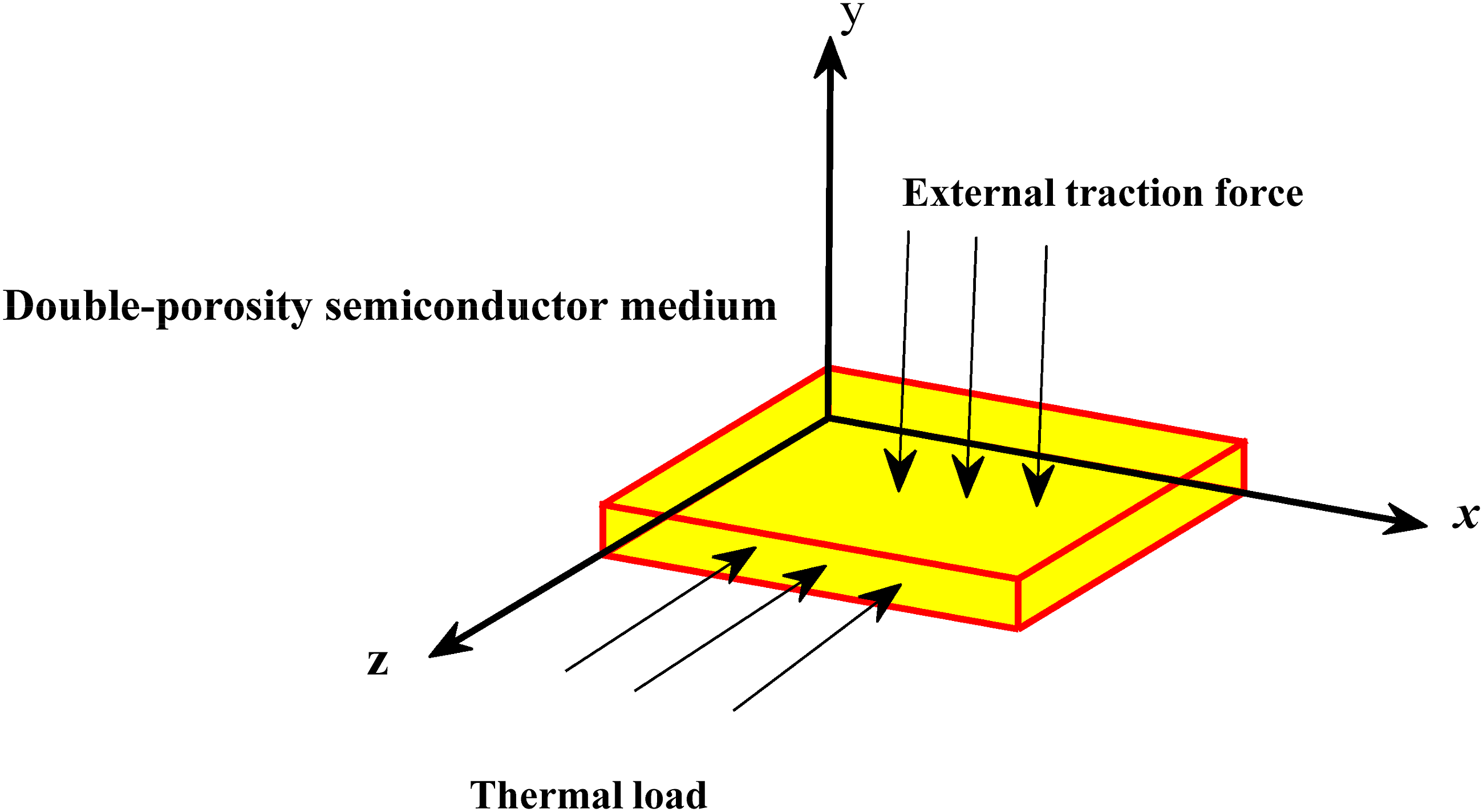
Governing Equations of Motion: The motion of the semiconductor medium is governed by the following equations28–31:

Fractional-order derivatives offer significant advantages over classical integer-order models, particularly in capturing memory effects and nonlocal behavior inherent in many physical systems. Unlike integer-order derivatives, which assume instantaneous response and local interactions, fractional derivatives allow the modeling of history-dependent processes, where the current state is influenced by the entire past evolution. This is especially important in micro- and nano-scale materials, such as porous semiconductors, where thermal diffusion, mechanical relaxation, and carrier transport exhibit anomalous or sub-diffusive behavior. Additionally, fractional models provide greater flexibility in fitting experimental data and have been shown to yield more accurate and realistic predictions in systems with complex geometries or internal microstructures.
Fractional-order Heat Conduction: Incorporating fractional-order derivatives, the heat conduction equation is modified as follows27,30:

Equation (2) is derived by modifying the classical Fourier heat conduction equation to incorporate time-fractional behavior using a Caputo derivative of order
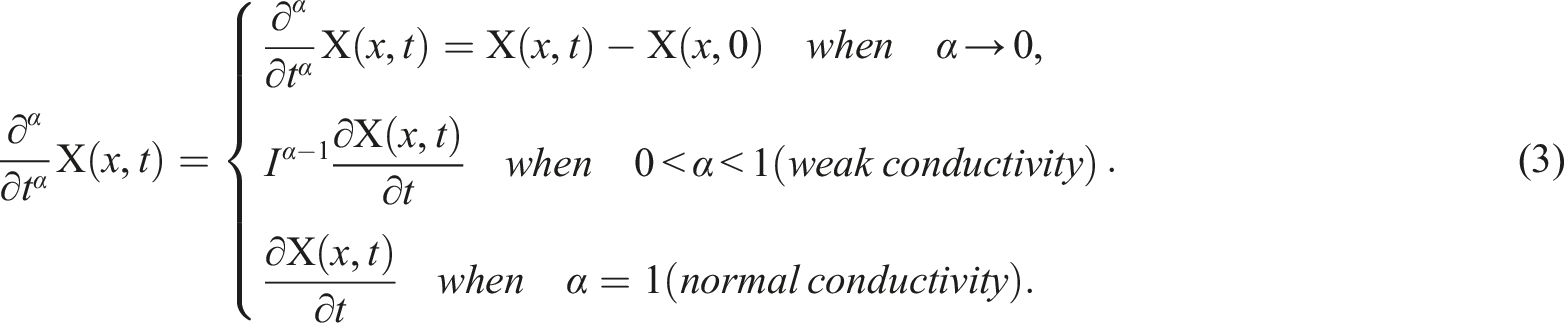
According to equation (3), different cases of diffusion can be classified as follows: weak diffusion (sub-diffusion) when

Photothermal Excitation: The excitation source, induced by laser or optical stimulation, is modeled as a heat source term that acts within the material31,32:

Motion equilibrated stress equations are8,9:


Stress-Strain Relationship: The stress-strain relationship for a micropolar semiconductor medium is described by the generalized thermoelasticity theory, considering the influence of the double porosity33–35:

Constitutive Equations for Double Porosity: In a double-porosity medium, the total strain is the sum of strains in the solid and fluid phases. The constitutive relations for such a medium are19,20:


Equations (1) and (8) can be reformulated in 2D when the displacement vector is expressed in 2D as





Assuming the two potential functions

Introducing scalar potentials

The dimensionless quantities equation (17) is used in the main governing equations in 2D, yielding:











Here, the parameters
Harmonic wave analysis
Harmonic wave analysis, also known as the normal mode method, is a powerful mathematical technique used to study wave propagation in the













Using the elimination method between

The main coefficients in equation (41) are put in the Appendix.
The factorization method was applied to simplify the principal ordinary differential equation (ODE) (41) as follows:






The solution to equation (35) can be expressed as follows:

To determine the stress components, the displacement components and constitutive relations for double porosity are first expressed in terms of the relevant parameters:







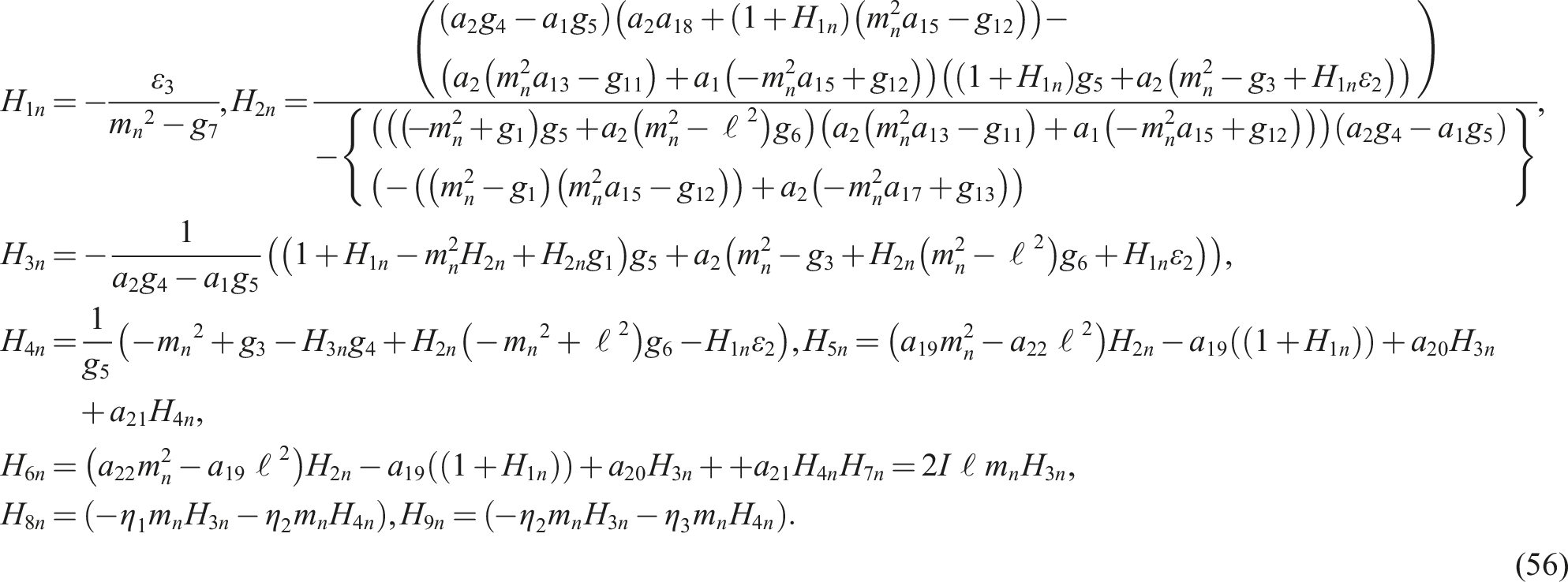
The main coefficients of the above equations are as follows:
Applications
The accurate formulation of boundary conditions is essential for capturing the true physical behavior of wave propagation in complex media, particularly in the context of photo-thermoelastic interactions within double-porosity semiconductor structures. In this study, the boundary conditions are carefully designed to reflect the coupled effects of thermal excitation, carrier diffusion, mechanical deformation, and memory-dependent heat conduction. These conditions play a crucial role in ensuring that the mathematical model aligns with realistic physical scenarios, such as laser-induced surface heating, pore pressure-driven stress, and fractional relaxation phenomena. By incorporating advanced and generalized boundary conditions, such as those involving fractional-order time derivatives and dynamic recombination kinetics, this framework accounts for the delayed and nonlocal responses observed in modern semiconductor applications. Such formulations are vital not only for the theoretical consistency of the model but also for its applicability to practical engineering problems, including optoelectronic device design, thermal stress analysis, and high-frequency wave control in porous materials. The constants (i) At the surface of the half-space (e.g.,

The stress condition in equation (62) models a traction-free surface, reflecting the physical scenario where the semiconductor medium is exposed to thermal excitation (e.g., laser heating) without any external mechanical loading. (ii) The tangential stress boundary condition for a traction-free surface on a half-space (usually taken at

This boundary condition is crucial in problems involving wave propagation or thermoelasticity in a semi-infinite (half-space) domain, as it influences the reflection and mode conversion of waves at the free surface. (iii) The thermal boundary condition (decaying heat source) at the surface exposed to laser irradiation (a thermal shock) assumes that the heat flux is continuous and spatially distributed according to a Gaussian profile with a decaying parameter

This boundary condition ensures a smooth and physically realistic distribution of laser energy across the surface, consistent with the nature of laser excitation in photo-thermoelastic semiconductor systems. It also implies no abrupt changes or discontinuities in the heat transfer process at the surface. (vi) The boundary condition for the carrier density at the surface, accounting for the possibility of carrier recombination, is given by
42
: (vii) The two equilibrated stress boundary conditions at the free surface (i.e., the surface is traction-free) are given as
43
:


These conditions state that no normal or tangential mechanical traction acts on the boundary, reflecting the physical reality of a traction-free surface in elastodynamics, thermoelasticity, or photo-thermoelastic wave propagation.
Applying equations (62)–(66), we obtain a reduced system of equations that governs the coupled dynamics of the photo-thermoelastic field variables. These substitutions lead to a simplified form that incorporates the effects of laser excitation, carrier diffusion, and mechanical deformation, allowing for further analytical or numerical solution using the normal mode analysis or Laplace transform technique. In this case, yields
44
:






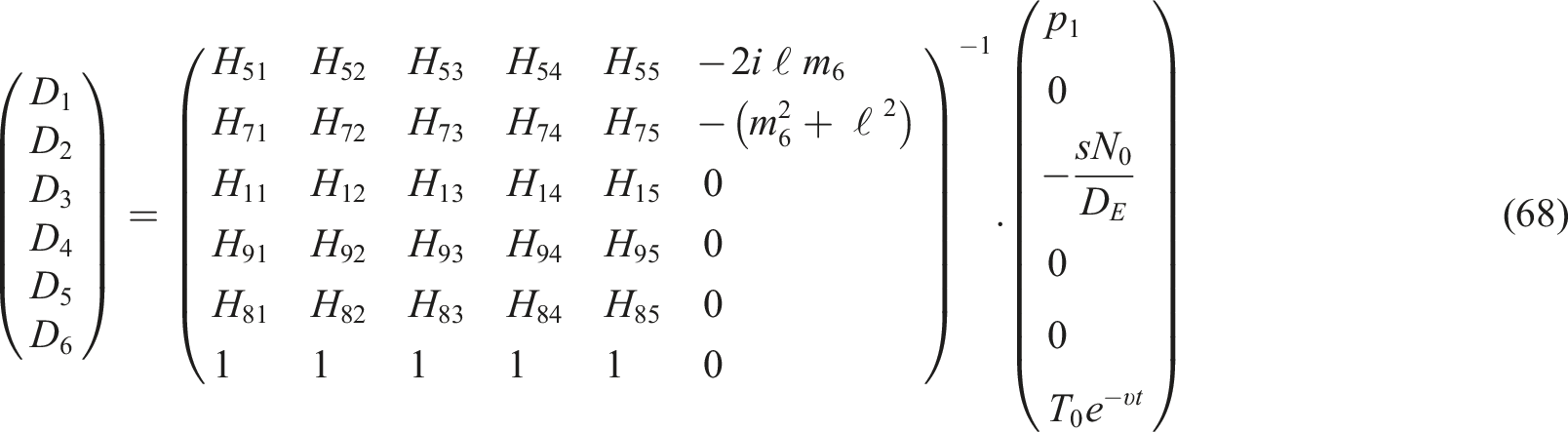
To obtain the desired solution form, we substitute equations (67)–(72) into the following matrix formulation:
Numerical results and discussions
The numerical values of the physical quantities in this study are evaluated over a short time duration. The numerical simulation is carried out using the material properties of a silicon semiconductor. All physical constants are expressed in the International System of Units (SI), and the computational analysis is performed using MATLAB software for plotting the results. Silicon is chosen as the representative thermoelastic material, and the corresponding physical constants used in the simulation are adopted from Refs. 45–48. The numerical results based on these parameters are presented and discussed accordingly.


Effect of fractional-order heat conduction parameters
Figure 2 displays the effect of fractional-order heat conduction (with Spatial distributions of various physical fields along the vertical distance x under different values of the fractional-order parameter, in the presence of a decaying heat source.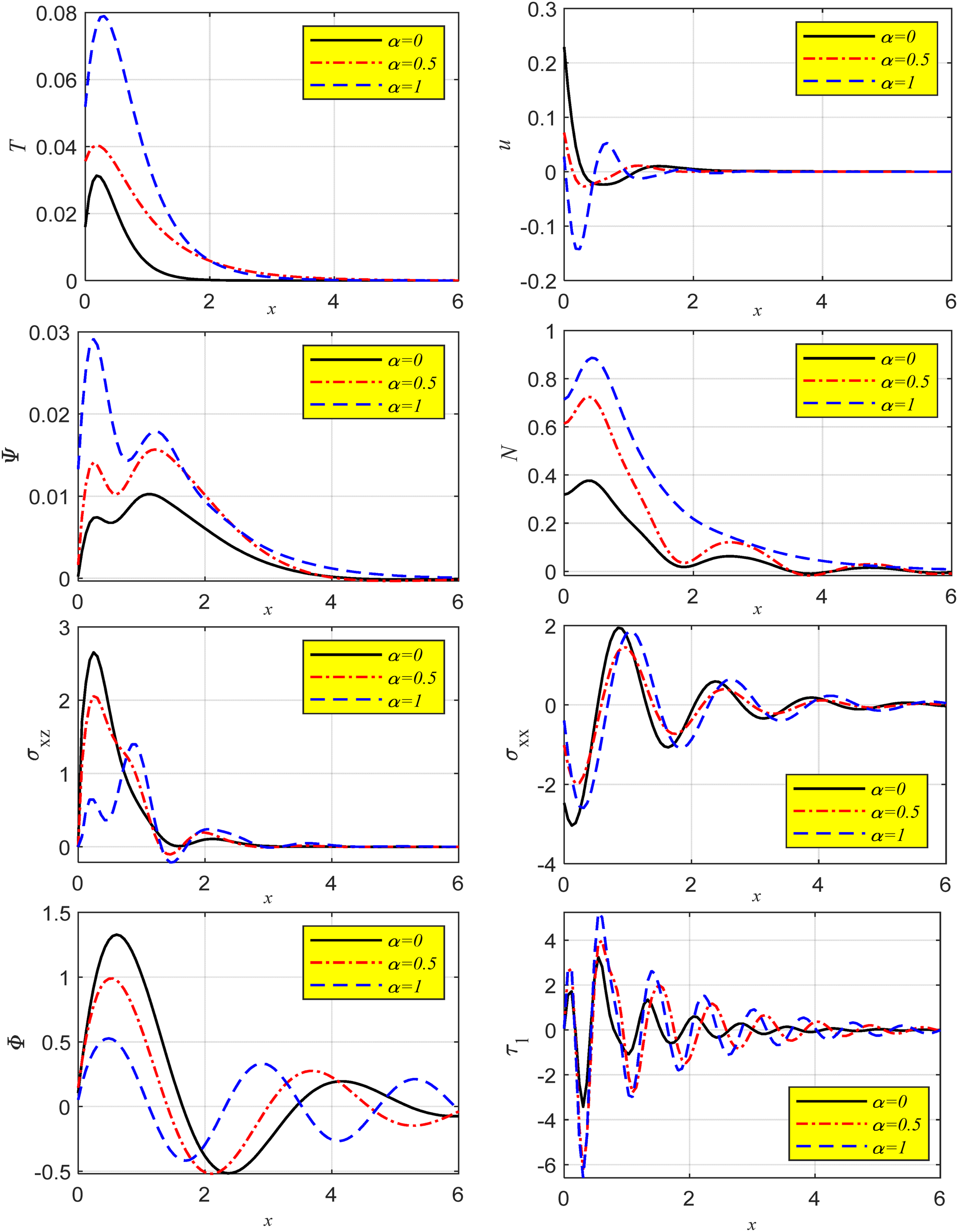
The effect of decay heat parameters
Figure 3 demonstrates the influence of the decaying heat source parameter ν\nuν on wave propagation in a double-porosity semiconductor medium under a fractional-order heat conduction model with fixed Effect of the decaying heat source parameter ν = 0,0.2,0.4 on the spatial distribution of physical fields in the presence of a fractional-order heat parameter α = 0.5.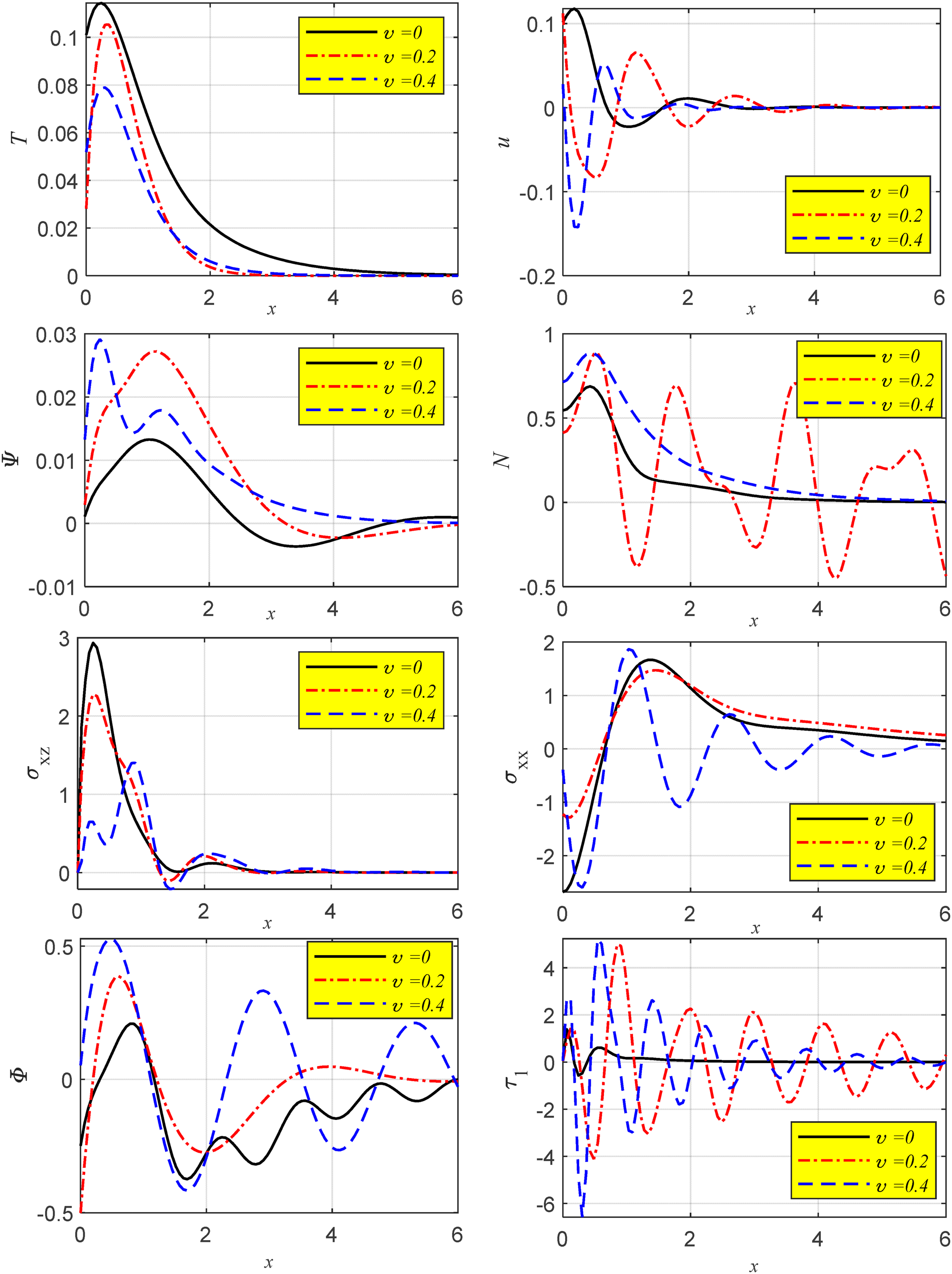
The numerical results not only validate the mathematical formulation but also offer physical insight into how memory-dependent heat conduction and porosity interact to influence wave behavior. In particular, the fractional-order parameter α\alphaα simulates nonlocal thermal memory, which is relevant in nano- and microstructured semiconductors where phonon scattering, carrier trapping, and delayed heat flow are dominant. As
Model validation and physical consistency
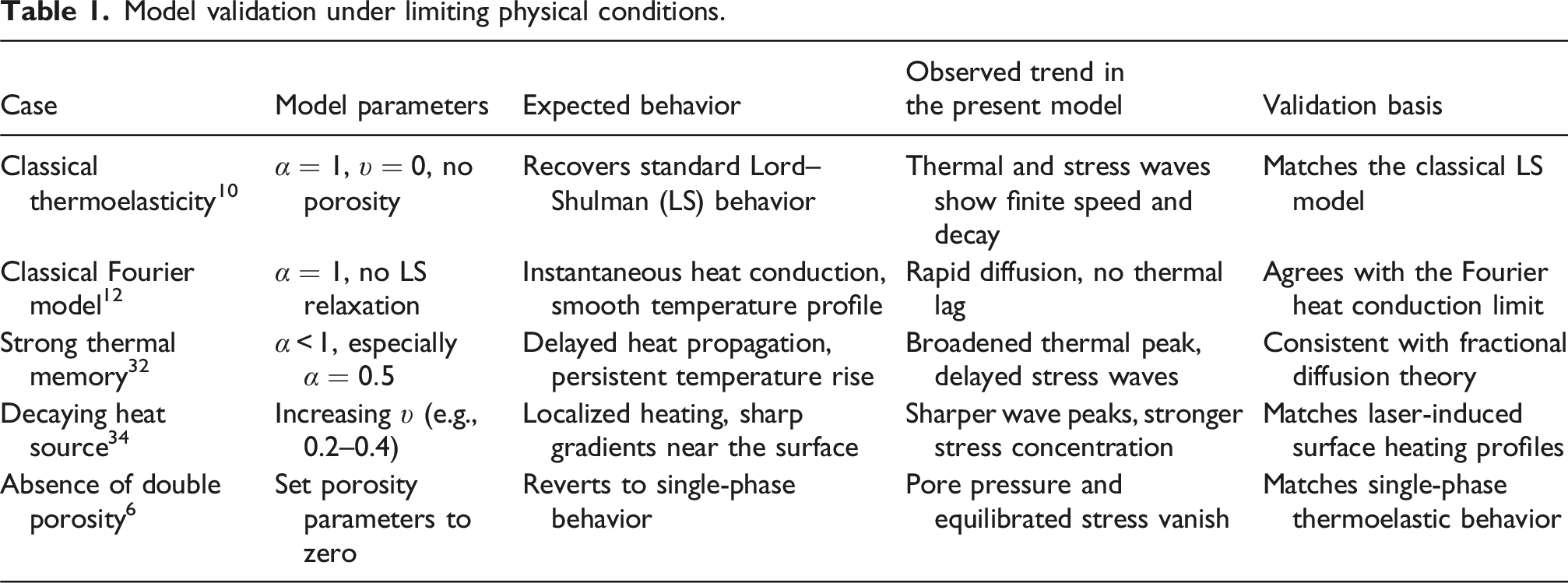
Although direct experimental data for the specific combination of fractional-order conduction, photothermal excitation, and double porosity are limited, we validate the model qualitatively by recovering classical behavior in limiting cases. For instance, when the fractional parameter
Conclusion
This work addresses a significant gap in the literature by developing a unified theoretical model for photo-thermoelastic wave propagation in a double-porosity semiconductor medium incorporating fractional-order heat conduction and a spatially decaying heat source. This combination has not been previously analyzed in a comprehensive framework. By applying the normal mode method to a two-dimensional elastic half-space, the model reveals how fractional thermal memory and porous microstructure influence wave dispersion, stress distribution, and carrier dynamics. By extending the classical Lord–Shulman thermoelastic framework with a Caputo-type fractional time derivative, the model successfully captures the effects of thermal memory and nonlocal heat transport, which are essential for accurately describing energy transfer in porous and microstructured semiconductors. Analytical solutions were derived using the normal mode method, enabling the analysis of coupled mechanical, thermal, and carrier field behaviors. The numerical results, based on the physical properties of silicon, demonstrated that increasing the fractional-order parameter leads to delayed thermal diffusion, enhanced thermal wave persistence, and stronger mechanical responses, effects directly attributable to memory-dependent conduction. Similarly, the decay parameter of the heat source was shown to localize thermal and mechanical waves more sharply, influencing stress distribution and carrier dynamics near the surface. The novelty of this work lies in bridging the gap between fractional heat transport and porous media mechanics under laser-induced thermal excitation, a combination not adequately addressed in previous models. These findings are particularly relevant to the design and thermal management of advanced optoelectronic devices, MEMS sensors, and semiconductor-based photothermal systems, where porous structures and non-instantaneous thermal behavior must be considered. However, the current model is subject to some limitations, including idealized boundary conditions, linear material assumptions, and two-dimensional simplifications. Future work will aim to extend this analysis to three-dimensional domains, incorporate nonlinear and temperature-dependent material properties, and validate the theoretical predictions through experimental or numerical simulation, further enhancing the model’s practical applicability. This study is limited by idealized boundary conditions, linear material assumptions, and two-dimensional modeling; future work will address nonlinear effects, temperature-dependent properties, and experimental validation to enhance practical applicability.
Footnotes

Author contributions
All authors have equally participated in the preparation of the manuscript during the implementation of ideas, findings results, and writing of the manuscript.
Funding
This work was supported by Princess Nourah bint Abdulrahman University Researchers Supporting Project number (PNURSP2025R899), Princess Nourah bint Abdulrahman University, Riyadh, Saudi Arabia
Declaration of conflicting interests
The author(s) declared no potential conflicts of interest with respect to the research, authorship, and/or publication of this article.
Data Availability Statement
Current submission does not contain the pool data of the manuscript but the data used in the manuscript will be provided on request.
Appendix