This paper investigates the behavior of a magneto-microstretch nonlocal semiconductor elastic medium under photo-thermal excitation. A theoretical model is formulated and analyzed within a two-dimensional (2D) framework, incorporating the microstretch and nonlocal effects to address wave propagation in the medium. The governing equations are transformed sequentially using the Laplace and Fourier transforms to facilitate their solution in the frequency domain. The system of coupled equations is systematically reduced to derive exact solutions for various physical parameters. Numerical results are presented to examine the influence of nonlocal parameters, initial magnetic field strength, and other contributing factors on the behavior of the medium subjected to laser pulse heating. Graphical representations illustrate the interdependencies among parameters and highlight their influence on the material’s photo-thermal and mechanical behavior, offering deeper insights into the complex dynamics of semiconductor materials. The findings provide valuable insights into the interplay of magneto-microstretch and nonlocal effects on semiconductor materials, with implications for advanced material design and wave propagation analysis.
The study of magneto-microstretch nonlocal semiconductor elastic media is essential for understanding wave propagation in modern semiconductor applications, particularly at micro and nanoscale dimensions where classical elasticity theories fail to capture observed phenomena accurately. This research contributes to the development of semiconductor materials with enhanced performance in optoelectronics, photonics, and energy harvesting devices. Moreover, the incorporation of photo-thermal effects and nonlocal interactions allows for more accurate modeling of wave propagation and stress distributions in such media, which is essential for designing sensors, actuators, and materials subjected to extreme environments. This study paves the way for tailoring material properties to meet specific engineering and technological requirements by exploring the effects of key parameters like nonlocality and magnetic fields.
The incorporation of nonlocal elasticity significantly influences wave propagation by altering wave dispersion, attenuation, and interaction with other physical fields. Unlike classical elasticity, which assumes that the stress at a point depends only on the strain at that point, nonlocal elasticity introduces long-range interatomic interactions that modify wave behavior. These effects are particularly crucial in semiconductor materials subjected to photo-thermal excitation and magnetic fields, where microstructural interactions further complicate wave motion. The classical theory of thermoelasticity which was introduced in 1, then modified in 2 is based on characterizing the interplay in elastic medium between thermal and mechanical phenomena. Micropolar thermoelasticity is a highly developed method that studies the effects of microstructure in elastic materials. Eringen et al.3,4 introduced the nonlinear and linear theories, respectively of simple micropolar solids. Sherief et al.5 studied the theory of micropolar thermoelasticity in an axisymmetric half-space. Kumar et al.6 studied the interactions of the laser beam with micropolar thermoelastic solids in two dimensions. Hilal7 studied the effect of rotation and hall current on energy dissipation and thermal shock. His problem used Fourier and Laplace transform in 2D to solve the problem. Abouelregal et al.8,9 solved micropolar problems with two temperature and higher-order time derivatives.
Nonlocality plays a critical role in influencing the propagation speed and attenuation of elastic and thermal waves in semiconductors. The ability to predict and control these effects is vital for optimizing semiconductor devices used in optoelectronics, photonics, and high-frequency signal transmission. This study systematically analyzes the influence of nonlocal parameters on wave propagation by examining displacement, stress distribution, microstretch characteristics, and carrier density under various conditions. Through analytical and numerical approaches, we establish how nonlocal interactions contribute to the complex dynamical behavior of semiconductor materials, providing a deeper understanding of their physical properties. Eringen10 introduced the theory of thermo-microstretch elastic solids. This theory is a very progressive extension of classical thermoelasticity, because of its large applications in many fields. Aouadi11 introduced some theorems in the microstretch isotropic theory at some micro-temperatures. Othman and Lotfy12 studied the generalized thermo-microstretch elastic plane waves under three theories of thermoelasticity. Othman and Jahangir13 discussed the temperature-dependent properties of a microstretch thermoelastic solid which is affected by some fields. Chirila and Marin14 studied the micro-temperatures and concentrations in a diffusion microstretch thermoelastic material. Lotfy et al.15 solved a mode-I crack problem in a microstretch elastic solid with harmonic waves. Chirila and Marin16 and Singh et al.17 showed some wave propagation in a diffusive microstretch thermoelastic plate.
Photoacoustics according to the thermoelasticity theory is a very useful way that relate the optics of the material with its mechanism. It also can investigate the reactions of the thermoelastic material in case of thermal loads. Applications of photoacoustic sensing techniques were investigated in 18. Liu et al.19 discussed the effect of laser on signal background in a photoacoustic cell. The stability of the nanostructure impact of a semiconductor material was studied in the presence of a magnetic field.20 Al Shehiri et al.21 discussed a new model of microelongation semiconductor material with thermomechanical photoacoustic waves. Samer et al.22 investigated the response of the thermoelastic component of photoacoustic in the fractional context of dual-phase lag.
Photo-thermal is a technique used in investigating the behavior of materials. In this technique, laser-induced heating is used to study the thermal and mechanical properties of the elastic mediums. This method has wide applications in many fields which include material sciences, structure, and medical engineering. Tam23 investigated the behavior of photo-thermal in solids and fluids. Lotfy24 discussed the wave motions of a photo-thermal medium infected by an internal heat source and gravitational field. Lotfy and Gabr25 studied the behavior of an infinite semiconducting medium with two-temperature and laser pulses. Lotfy26 studied a model of photo-thermal diffusive polymer nanocomposite semiconducting. A model for a photo-thermal excited semiconducting elastic plate subjected to mechanical ramp type with two-temperature and magnetic field was discussed in 27. The photo-thermal excitation processes were discussed in the context of the phase-lag model in 28. The orthotopic rotational semiconductor material with piezo-photo-thermal plasma waves with moisture plasma diffusion and laser pulse was studied by Adel et al.29
Nonlocal thermoelasticity is a modern technique that expands the classical theory. Kaur and Singh30 studied the plane wave in nonlocal semiconducting rotating media with hall effect and three-phase lag fractional-order heat transfer. Hobiny et al.31 found the analytical solution of nonlocal thermoelastic interaction on Semi-infinite mediums induced by ramp-type heating. Sardar et al.32 studied the photo-thermal effects of semiconductors in the context of nonlocal theory. Raddadi et al.33 used the nonlocal theory to show the effect of moisture diffusivity on semiconductors. Aboelregal et al.34 solved the nonlocal magneto-thermoelastic infinite half-space due to a periodically varying heat flow under Caputo–Fabrizio fractional derivative heat equation. The incorporation of nonlocal elasticity significantly influences wave propagation in semiconductor media by enhancing attenuation rates and modifying oscillatory behaviors. This effect is particularly critical in accurately modeling the responses of microstretch semiconductor materials subjected to photo-thermal and magnetic excitations. By considering long-range interatomic interactions, the nonlocal model provides a more realistic description of wave dispersion and energy dissipation, which are essential for designing advanced optoelectronic and photonic devices.
Salvo et al.35 studied the effect of magnetic fields on two proton transitions in semiconductors. Lotfy et al.36 studied the behavior of ramp-type heating micro-temperature of a magneto-rotating semiconductor. Kilany et al.37 established and solved a thermoelastic magneto plate problem in the context of four theories. Lotfy et al.38 applied laser pulses with two temperatures through a photo-thermal process and studied the response of a semiconductor medium of variable thermal conductivity. Ibrahim et al.39 established a phase-lag model for a rotational diffusive plate with the emission of laser pulses. Al Shehri et al.40 studied the nonlocal photoacoustic impact according to the variable thermal conductivity of semiconductors under the impact of a laser heat source. Abouelregal et al.41 investigated photo-thermal-induced interactions in a semiconductor solid with a cylindrical gap under the influence of laser pulse duration, employing a fractional MGT heat conduction model to analyze the effects comprehensively. Recent studies have explored various aspects of nanofluid flow and its applications in thermal and energy transmission. For instance, Imran et al.42 investigated the stagnation-point flow of Reiner–Rivlin fluid from a stretched cylinder for energy and matter transmission. Basit et al.43 presented an efficient partial differential equations model for nanofluid flow through a wedge, considering energy and thermal radiation effects. In another study, Basit et al.44 focused on the role of nanofluidics in renewable energy systems through a numerical approach. Chaudhry et al.45 analyzed nanofluid flow through stagnation points, incorporating factors such as thermal radiation and activation energy, while Chaudhry et al.46 also examined magnetized nanofluid flow influenced by motile microorganisms and thermal radiation. Additionally, Basit et al.47 presented a thermal analysis of heat and mass transfer in bioconvective Carreau nanofluid flow over an inclined cylinder, and Basit et al.48 proposed a novel numerical approach to study nonlinear oscillators in low-frequency noise and vibration applications. Recent studies have made significant contributions to the understanding of wave propagation, acoustic insulation, and vibroacoustic behavior in complex structures, which are relevant to the present investigation of wave dynamics in semiconductor materials. Jafari et al.49 explored broadband acoustic insulation in doubly curved truss core composite shells, demonstrating the impact of structural geometry on diffuse acoustic fields. Talebitooti and Zarastvand50,51 investigated the acoustic transmission and vibroacoustic response of aerospace composite structures, considering the influence of porous materials and advanced shear deformation theories. Their findings highlight the importance of material composition and geometric configuration in controlling wave transmission characteristics. Additionally, Zarastvand et al.52–54 provided comprehensive reviews on sound propagation and acoustic insulation in multi-layered plate constructions and shell structures, emphasizing numerical and analytical methods for predicting wave behavior in composite materials. These studies provide valuable insights into wave interactions, material design, and structural optimization, aligning with the present work’s focus on nonlocal wave propagation in semiconductor media under thermoelastic and magnetoelastic coupling.
The motivation for this study arises from the growing demand for precise modeling of semiconductor materials under multi-physics interactions, especially at small scales where nonlocal effects are pronounced. Understanding these interactions is crucial for developing advanced materials used in optoelectronics, photonic devices, and other cutting-edge applications. The inclusion of microstretch properties and magnetic field effects provides a more comprehensive framework for predicting the behavior of these materials, which is vital for designing sensors, actuators, and energy-efficient devices.
This study presents a novel theoretical framework that integrates nonlocal elasticity, microstretch effects, and magneto-thermoelastic interactions to analyze wave propagation in semiconductor materials. Unlike previous works, which often consider these effects separately, our model systematically examines their combined influence on wave dispersion, attenuation, and energy dissipation under laser-induced heating. The integration of photo-thermal excitation with a magnetoelastic framework provides a unique perspective on the dynamic interactions within semiconductor materials at micro and nano scales. The governing equations are formulated using the theories of microstretch elasticity, nonlocal continuum mechanics, and coupled thermo-magnetic dynamics. Laplace transform is applied to convert the time-domain equations into the frequency domain. Fourier transform is utilized to address the spatial variables, simplifying the system to solvable forms. By employing a coupled Laplace-Fourier transform approach and conducting a detailed numerical analysis, this work provides new insights into the role of nonlocal parameters, microstretch constants, and external fields in tailoring wave behavior. The resulting equations are solved analytically to obtain exact solutions for displacement, stress, temperature, and magnetic field variations. Graphical representations reveal complex interdependencies among the parameters, providing valuable insights for optimizing material properties. Numerical methods are employed to compute and visualize the results, showcasing the effects of varying nonlocal parameters, microstretch constants, and magnetic field intensity on the material’s response. These findings contribute to the advancement of semiconductor material design, with potential applications in optoelectronics, photonics, and high-precision sensing technologies.
Mathematical model and main equations
To formulate this problem, consider the medium is modeled as a two-dimensional, isotropic, homogeneous semiconductor elastic body with microstretch properties. Nonlocal elasticity theory is applied to account for long-range interatomic interactions, which are significant at smaller scales. The photo-thermal excitation induces mechanical and thermal responses that are coupled within the governing equations. The magnetic field is assumed to have a uniform initial value, and its interaction with the material is governed by magnetoelastic coupling. In this case, consider that the material is surrounded by an outer magnetic field directed in y- axis with initial magnetic field , which causes an induced magnetic field creating with magnitude . The current density vector can be taken in the direction (parallel to) of the electric field . Carrier charges will also be generated as a result of interactions occurring on the outer surface. Finally, the medium is proposed in a slowly moving.
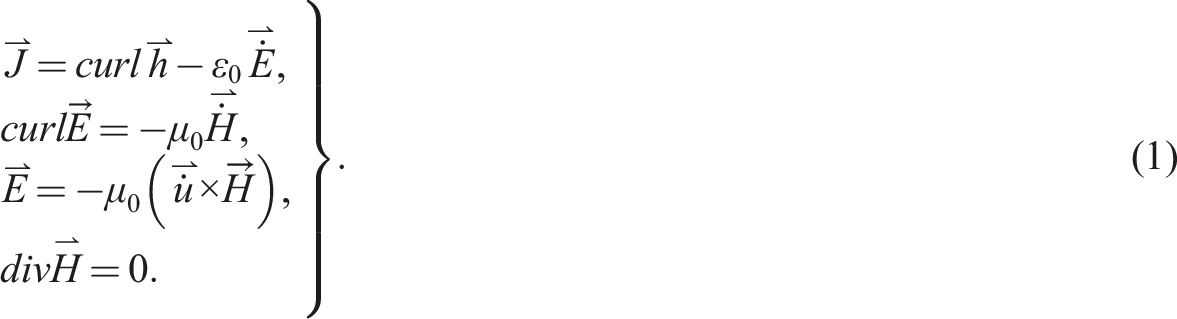
The Maxwell’s equations that present the relations of electromagnetic field) the density of charge is ignored) see 35–37:
The physical quantities considered in this problem are in the cartesian coordinates, that is , the displacement, and the strain components can be written as respectively,
To illustrate the problem, we will introduce the governing equations that describe this theoretical model, which can point out as the following:
(I) The plasma-thermal equation is:
(II) The equations of motion with the nonlocality effect take the form36:
where, is a scalar quantity defined as .
(III) The micro rotation inertia equations are:
where the microstretch vector is defined as and
(IV) The heat conduction equation during the nonlocal photo-thermal-elastic with the effect of the microstretch with microinertia process for the elastic semiconductor sample can be written as31:
(V) The constitutive equations for the nonlocal thermo-microstretch components can be introduced as:
(VI) The constitutive equations in the context of the generalized nonlocal thermoelasticity theory
where the coupling thermal , is the change of w. r. t. time, that is , .
In 2D displacement, the equations (3)–(7), can be rewritten in the -plane as
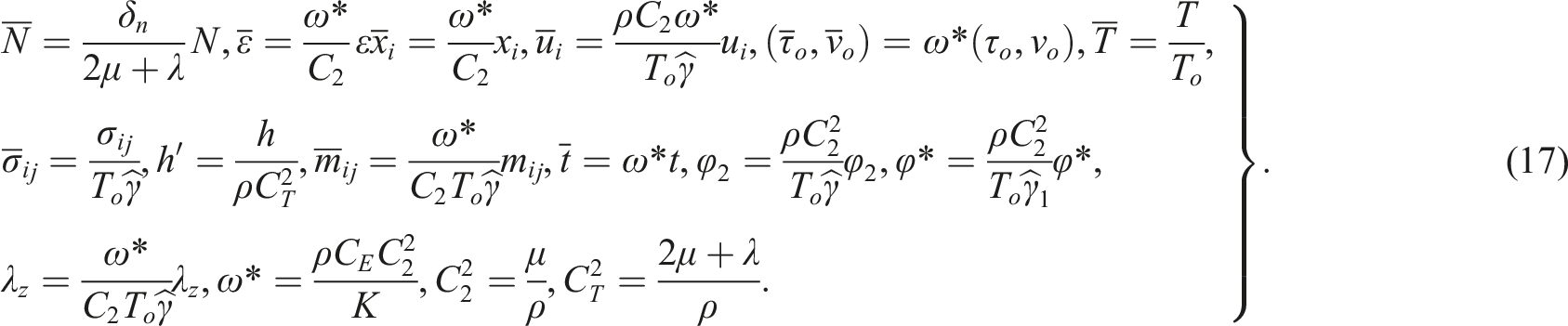
To make the solution easier, we introduce the following dimensionless quantities:
Applying the dimensionless quantities defined in equation (17) into equations (8)–(10), the stress-strain relations and the constitutive equations for the microstretch photo-thermoelastic semiconductor medium can be rewritten as:
here
For more simplifications, the displacement functions can be defined in terms of two potential scalar functions , as follows:
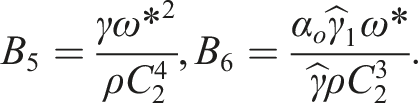
Using the dimensionless quantities defined in equation (17) on the main 2D equations (for more simplifications drop the primes), yields:
where
Solution of the problem
The Laplace and Fourier transformations play a critical role in the study of photo-thermoelasticity by enabling the mathematical simplification of complex coupled equations governing thermal, optical, and elastic wave interactions. These transformations convert partial differential equations in the time and spatial domains into simpler differential equations in transformed domains, facilitating analytical or numerical solutions. Together, they allow for the precise analysis of wave dispersion, attenuation, and synergetic effects in materials under photo-thermal excitation. In this section, the Laplace and Fourier transform is introduced to find the solution to the problem. Define the Laplace transform as6,7:
On the other hand, the Fourier transform takes the form:
Applying the Laplace and Fourier transforms on equations (25)–(30), yields:
where,
Eliminating equations (33), (34), (36), (37), which are coupled to each other, we get the following 10th-order ODEs:
Eliminating the other two coupled differential equations, we can get from equations (35) and (38) the following 4th ODEs:
where
Then, the solutions of the ODEs equations (39) and (40) can be reformulated in linear form as, respectively:
where, the quantities , and are the basic real roots of the characteristic equations of equations (39), and (40), respectively, and main coefficients ,and take the form:
Now, with aid of equations (24), (31) and (32), the displacement components can be written as
Furthermore, the stress and the microstretch photo-thermoelastic relations defined in equations (18)–(23), are
where
Boundary conditions
In this section, we seek to get the undetermined parameters , and , so we applied some conditions to the physical quantities defined previously. All conditions are applied to the external free surface, that is, () of the nonlocal medium.
I) When laser pulses with an exponential heat pattern are applied to a material, they create a steady flow of heat characterized by a gradual spatial and temporal temperature distribution. The laser energy is absorbed within the material, generating a heat source that decays exponentially over time, depending on the specific pattern of the laser pulse. This results in a heat flux that evolves to reach a quasi-steady-state condition, where the energy input from the laser balances the thermal conduction within the material. In materials like semiconductors, where thermal conductivity and heat capacity are significant, this steady heat flow influences the photo-thermoelastic response. A steady flow of heat is generated as a result of laser pulses heat with an exponential pattern as33:
where is constant, while is the time of pulse of the heat flux.
After applying the Laplace transform to equation (55), yields:
Which leads to:
II) When a carrier plasma density in a semiconductor is subjected to laser excitation with an exponential pattern, the response is characterized by a dynamic redistribution of charge carriers (electrons) influenced by the temporal nature of the laser pulse. The exponential excitation pattern can be time-dependent, depending on how the laser energy interacts with the medium. In this case, the laser intensity decays exponentially with time, represented as
where is constant. Using Laplace transform, we have:
Which leads to
III) The stress function is supposed to be constant at the external surface, while, and is supposed to be free, that is,
Solving these equations, give the values of the parameters , and .
Inversion of Laplace and Fourier transforms
To complete the solution of the problem, we have to convert the physical functions defined in equations (41)–(54). Numerical inversion methods approximate the inverse transform through algorithms based on series expansions.
Firstly, we will use the inversion formula of the Fourier transform, which given as
Now, for fixed values of , we will use the Laplace inversion form to get the functions as functions of instead of , that is,
where c is an arbitrary real number greater than all parts of singularities of .
All transforms of functions were made by Mathematica 14.
Discussion and numerical results
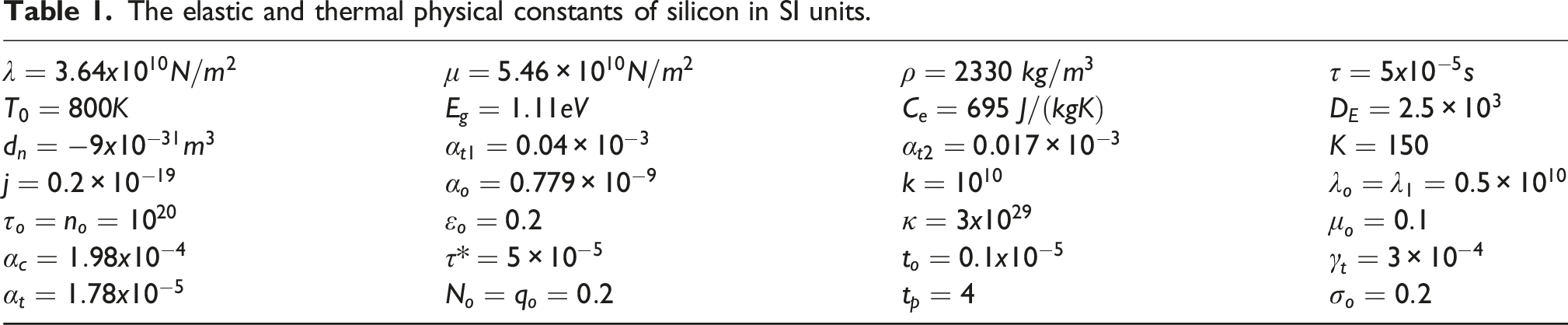
To get the numerical comparisons between various quantities, we defined the physical quantities for the Silicone (Si) material (Table 1). The material constants and quantities for Silicon (Si) can be categorized as follows, with all values provided in SI units27:
The elastic and thermal physical constants of silicon in SI units.
After substituting the above constants in the physical quantities’ equation, we used the Mathematica 14 program to get the behavior of the quantities under different fields. The comparisons were made with 8 different quantities in different values of magnetic field, nonlocal parameter, vertical distances, and times .
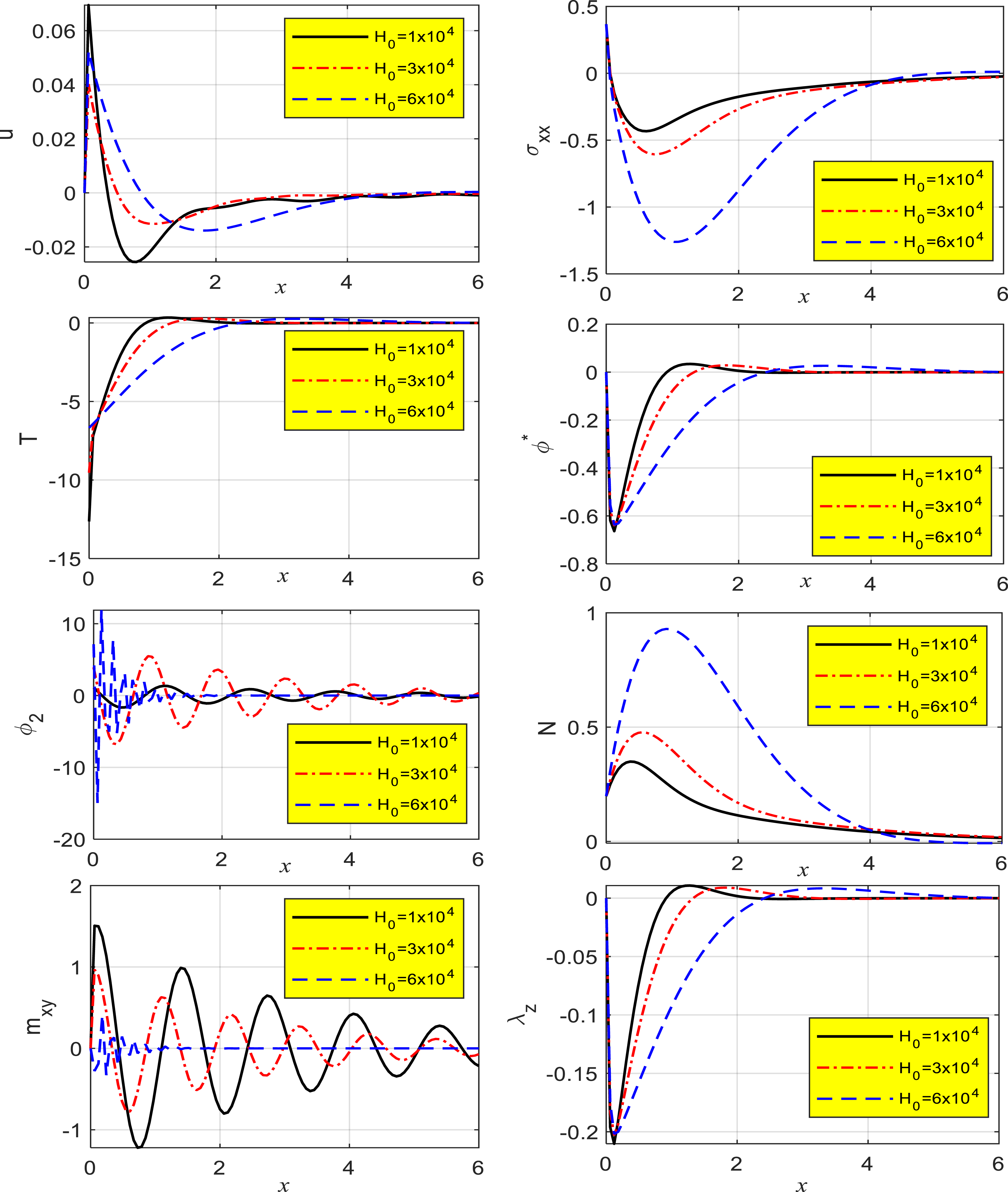
All calculations in Figure 1 are carried out when the the nonlocal parameter , the horizontal distance and the time . The behavior of the physical quantities illustrated in Figure 1 provides insight into the effects of varying the initial magnetic field strength (, and ) on the thermoelastic and microstructural properties of the nonlocal semiconductor medium. The phenomenon is studied under the effect of laser excitation. In this case, a short-duration pulse induces steep thermal gradients, resulting in sharper stress waves and pronounced oscillations. A long-duration pulse leads to gradual heating, causing smoother wave propagation and reduced oscillations. The analysis focuses on eight key parameters: horizontal displacement (), temperature (), stress (), scalar microstretch function (), tensor microstretch function (rotation inertia) (), carrier density (), The microstress (first moment) tensor (), and couple stress function (). The horizontal displacement exhibits a pronounced peak near , followed by a decay and stabilization as the distance increases. A clear dependence on the initial magnetic field is observed: For , the amplitude of is highest, indicating that lower magnetic fields allow greater elastic deformation. Increasing ( and ) reduces the amplitude of displacement, suggesting that stronger magnetic fields constrain material deformation due to enhanced magnetoelastic coupling. The stress component exhibits oscillatory behavior with decaying amplitude: for , the oscillations are broader and dampen gradually, reflecting weaker magnetoelastic constraints. At , the oscillations are sharper and more frequent, showing the dominant influence of the magnetic field on the stress distribution. The temperature profile shows steep initial gradients at smaller distances, which diminish as increases. Higher magnetic fields () lead to reduced temperature gradients, demonstrating the magnetic field’s suppressive effect on heat diffusion. The stabilization of at larger distances occurs more rapidly for stronger magnetic fields, indicating efficient thermal regulation.
Graphical representation of the effects of varying initial magnetic field strengths on the wave propagation of the physical fields of a microstretch nonlocal semiconductor medium under photo-thermal excitation.
The temperature profile exhibits steep initial gradients at smaller distances due to the rapid absorption of laser-induced heating. This sharp rise in temperature is primarily caused by the high energy input at the surface, leading to an intense localized thermal response. As increases, thermal diffusion dominates, redistributing the heat over a larger region, thereby smoothing out the temperature variations. Additionally, the presence of thermal relaxation effects influences the rate at which heat propagates through the medium, contributing to the gradual decline of temperature gradients. The observed trend is consistent with the governing heat conduction equation, where nonlocal and microstructural interactions further regulate the dissipation of thermal energy. The scalar microstretch function demonstrates a steep rise near and stabilizes as increases. Larger values result in quicker stabilization, indicating a reduction in the microstretch effects with stronger magnetic coupling. The rotation inertia function () exhibits oscillatory behavior with a dependence on . For , the oscillations are wider and less frequent, whereas higher values produce tighter, more frequent oscillations. This trend suggests that stronger magnetic fields enhance microstructural interactions within the medium. The carrier density () shows an exponential decay with distance . The decay rate increases with larger , indicating a stronger magnetic field’s ability to stabilize the carrier distribution in the medium. The couple stress function () demonstrates significant oscillations, whose amplitude and frequency are influenced by . Lower magnetic fields () result in broader oscillations with slower damping, while higher fields () lead to faster, tightly packed oscillations. The microstress tensor () responds strongly to the initial magnetic field. For , shows slower attenuation and broader oscillations. As increases, the function stabilizes more rapidly, suggesting enhanced magneto-mechanical effects. From Figure 1, the initial magnetic field () is a critical factor influencing all physical parameters. Stronger fields enhance the damping of oscillatory behavior and promote faster stabilization in all quantities. Oscillatory patterns in stress, microstretch functions, and rotation inertia vector become more pronounced with increasing , highlighting the magnetic field’s impact on the dynamic properties of the medium. Temperature and carrier density profiles reveal a stabilizing effect of the magnetic field on thermal and electrical properties.
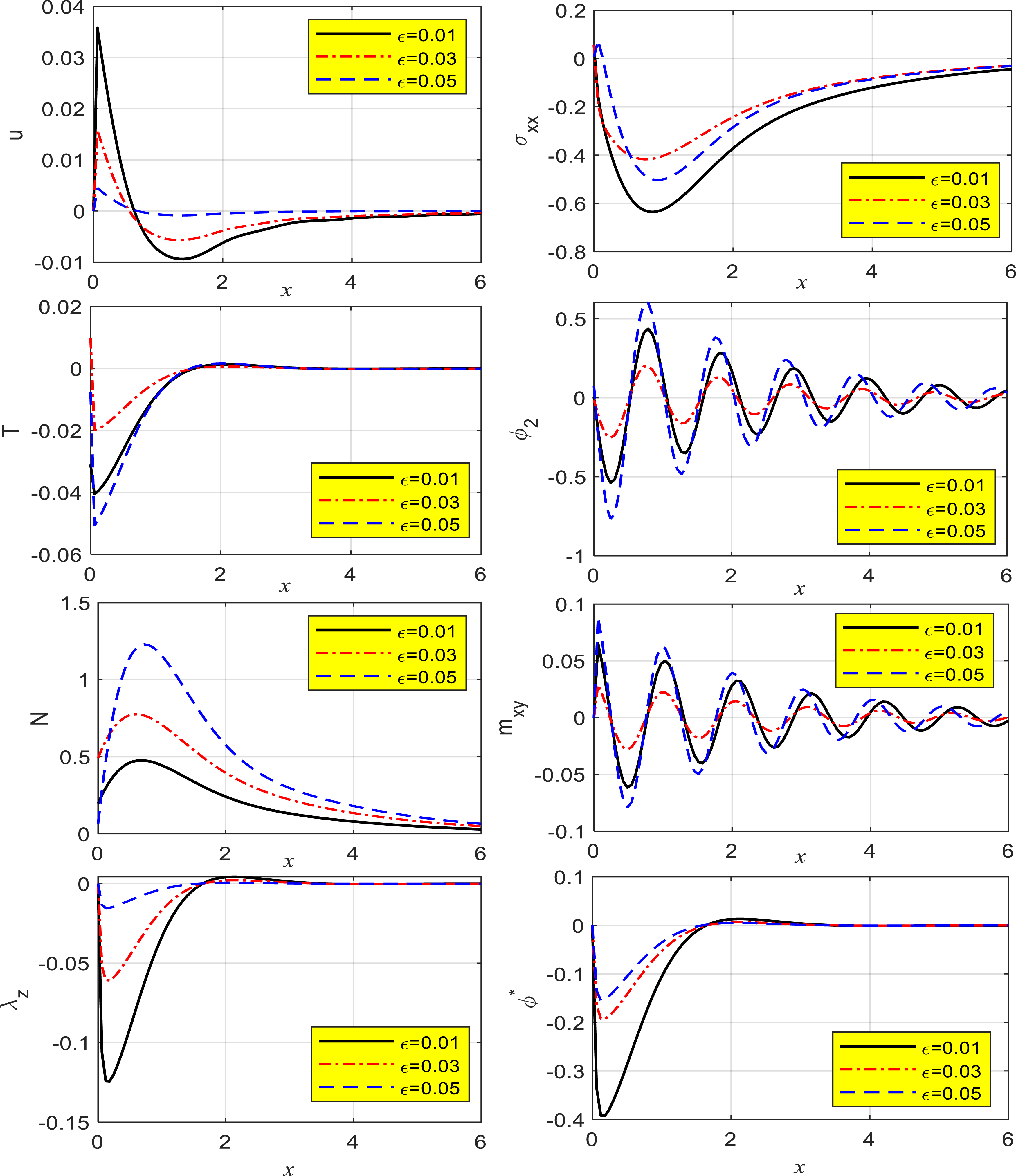
Figure 2 illustrates the influence of varying nonlocal parameters (, , ) on the behavior of the key physical quantities in a microstretch semiconductor medium under photo-thermal excitation and the presence of a magnetic field. The analyzed quantities include horizontal displacement (), temperature (), stress (), scalar and tensor microstretch functions (), carrier density (), rotation inertia vector (), and couple stress function (). The horizontal displacement shows a sharp initial peak near and subsequently stabilizes over distance. Larger nonlocal parameters () reduce the magnitude of the displacement, reflecting the suppressive effect of increased nonlocal interactions on elastic deformation. The results suggest that higher nonlocality introduces additional resistance to wave propagation, leading to faster attenuation. The horizontal displacement exhibits a sharp initial peak near due to the localized nature of the applied laser-induced heating and the subsequent elastic wave response. The laser excitation introduces a sudden and intense thermal gradient at the surface, leading to rapid thermal expansion in the material. This expansion generates an immediate mechanical response, causing a sharp peak in displacement near . The presence of nonlocal elasticity leads to a redistribution of stresses over a finite region rather than at a single point, influencing the shape of the displacement profile. The microstretch interactions allow for additional deformations at small scales, enhancing the initial peak before stabilizing. As the wave propagates through the medium, elastic and thermal diffusion mechanisms cause the displacement to gradually decrease and stabilize. The combined influence of material damping, wave dispersion, and magnetoelastic coupling results in a smooth decay of the displacement amplitude over distance. The imposed boundary conditions play a crucial role in shaping the displacement behavior, with the strongest initial response occurring at the surface where excitation is highest. Over distance, stress relaxation and energy dissipation mechanisms contribute to the stabilization of displacement values. The temperature profile demonstrates an initial rise, followed by stabilization at larger distances. As (nonlocal parameter) increases, the temperature attenuation occurs more rapidly, indicating enhanced thermal diffusion in the presence of strong nonlocal effects. Larger nonlocality () reduces thermal gradients, suggesting an improved homogenization of heat transfer. This implies that in nanoscale semiconductors, nonlocal effects contribute to more efficient heat dissipation, which is critical in applications requiring precise thermal management, such as laser-based semiconductor devices. The stress profile () exhibits oscillations that decay with distance. These oscillations become less pronounced as increases. Higher nonlocal parameters reduce the stress amplitude and cause quicker damping, showcasing the influence of nonlocal effects in mitigating stress concentrations. Both microstretch functions display oscillatory behavior, with showing more pronounced oscillations compared to . Increasing reduces the amplitude and frequency of these oscillations, highlighting the suppression of microstructural effects by nonlocality. The stabilization of and at higher nonlocal parameters indicates stronger internal coupling between microstretch and elastic fields. The carrier density shows a steep rise near , followed by an exponential decay. Larger nonlocal parameters enhance the decay rate, suggesting improved stability of the carrier distribution under stronger nonlocal interactions. This behavior reflects the interplay between nonlocality and charge carrier dynamics in the medium. The carrier density follows a similar trend, where larger nonlocal parameters promote a faster decay, stabilizing charge distributions more efficiently. This is a crucial factor in semiconductor applications where carrier mobility and stability directly impact device performance. The rotation inertia vector demonstrates oscillatory behavior with amplitude and frequency diminishing as increases. This damping effect indicates that higher nonlocality reduces rotational inertia effects, promoting a smoother wave propagation. The couple stress function () shows a sharp initial drop, followed by stabilization over distance. Larger values cause quicker stabilization and reduce the amplitude of , indicating that nonlocality limits stress interactions in the medium. In general, the nonlocal parameter () is a critical factor that influences all physical quantities. As increases, wave amplitudes decrease, oscillations dampen more rapidly, and stabilization occurs faster. Nonlocality introduces enhanced coupling between thermal, mechanical, and microstructural effects, leading to more efficient energy dissipation and wave attenuation. Higher nonlocal effects suppress stress and deformation while improving thermal homogenization and carrier stability. Additionally, the influence of laser pulse parameters on wave behavior is significant. A short-duration pulse generates steep thermal gradients, leading to sharp stress waves and pronounced oscillations, whereas a long-duration pulse results in smoother wave propagation with reduced oscillations. Higher laser intensity enhances photo-thermoelastic coupling, increasing wave amplitudes, while lower intensity produces weaker wave motion. The spatial distribution of the laser pulse also plays a crucial role uniform heating leads to smooth stress propagation, whereas localized heating induces sharp thermal discontinuities, generating strong localized stress waves. These variations illustrate how wave propagation characteristics in the nonlocal semiconductor medium can be tailored by adjusting laser pulse parameters. In summary, nonlocal effects significantly modify wave propagation behavior by increasing wave attenuation, reducing oscillation amplitudes, and enhancing the homogenization of stress, thermal, and microstretch distributions. The direct comparison with classical models highlights the necessity of incorporating nonlocal elasticity to accurately describe the behavior of semiconductor materials, particularly in nanoscale applications. These results underscore the necessity of incorporating nonlocal elasticity in modeling semiconductor materials for advanced applications.
Graphical representation of the effect of varying nonlocal parameters on the wave propagation characteristics of a microstretch semiconductor medium under photo-thermal excitation and an applied magnetic field.
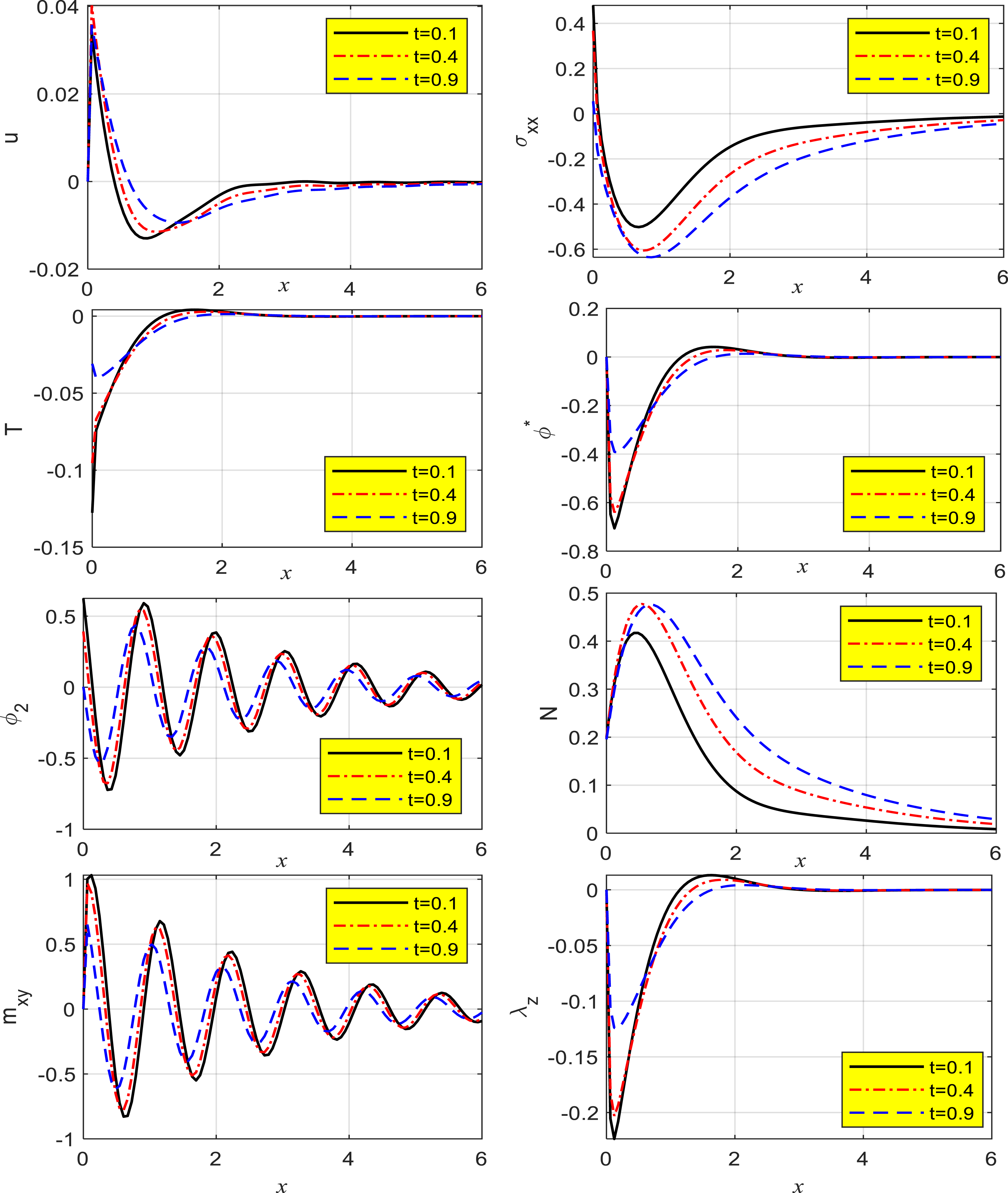
Figure 3 explores the influence of time (, and ) on wave propagation in a nonlocal microstretch semiconductor medium subjected to photo-thermal excitation and a magnetic field. Key physical parameters, including horizontal displacement (), temperature (), stress (), scalar microstretch function (), tensor microstretch function (), carrier density (), rotation inertia vector (), and couple stress function (), are examined as functions of horizontal distance (). At early times (), the horizontal displacement shows a pronounced peak near , followed by rapid decay. As time progresses ( and ), the peak magnitude decreases, and the displacement stabilizes over distance, indicating the gradual dissipation of wave energy over time. The temperature function increases with distance, stabilizing at larger . At later times ( and ), the temperature profile is smoother, suggesting that thermal energy disperses more evenly with time. Early times exhibit steeper gradients, reflecting the initial rapid heat transfer caused by photo-thermal excitation. Stress exhibits oscillatory behavior that decreases in amplitude with time. Larger values lead to faster damping, implying that the stress in the medium relaxes more efficiently as time progresses. The magnetic field and nonlocal effects likely play a role in this stabilization. Both and display oscillatory patterns, with being more pronounced. The amplitudes of these oscillations decrease over time, suggesting the dominance of nonlocal effects in dampening microstretch phenomena. For later times (), and stabilize more significantly, indicating reduced microstructural activity. Carrier density peaks sharply near and decays exponentially with distance. At earlier times, the peak is more pronounced, while later times () result in smoother profiles, reflecting charge redistribution and stabilization over time. The interplay of thermal excitation and nonlocal interactions accelerates the equilibration process. The couple stress function demonstrates significant oscillations, particularly at early times (). These oscillations diminish with time, indicating that rotational inertia is strongly influenced by the dissipation mechanisms within the medium. The rotation inertia vector shows a steep drop near , followed by stabilization over distance. As time progresses, the function stabilizes more quickly, demonstrating how the internal stress field adapts to the evolving wave dynamics. In general, time () significantly impacts the behavior of all physical fields. Early times exhibit sharper gradients and higher oscillation amplitudes, while later times result in smoother and stabilized profiles. The combination of magnetic, photo-thermal, and nonlocal effects enhances wave energy dissipation and stabilization over time. Microstretch and rotational behaviors are prominent at early times but are effectively dampened as time increases, underscoring the influence of nonlocal coupling on medium dynamics.
Graphical representation of the effect of varying time parameters on the wave propagation characteristics of a nonlocal microstretch semiconductor medium under photo-thermal excitation and an applied magnetic field.
While this study primarily focuses on the effects of magnetic field strength and nonlocal parameters, future research should explore the role of additional material and geometrical parameters such as microstretch constants, carrier diffusion coefficients, and thermal relaxation times in a more controlled manner. These factors play a crucial role in governing wave dispersion, attenuation, and energy dissipation, particularly in semiconductor materials subjected to photo-thermal and magnetoelastic interactions. A systematic investigation of these parameters would provide a more comprehensive understanding of their influence on wave behavior, enabling further advancements in the design and optimization of semiconductor materials for high-precision applications.
Comparison with previous studies
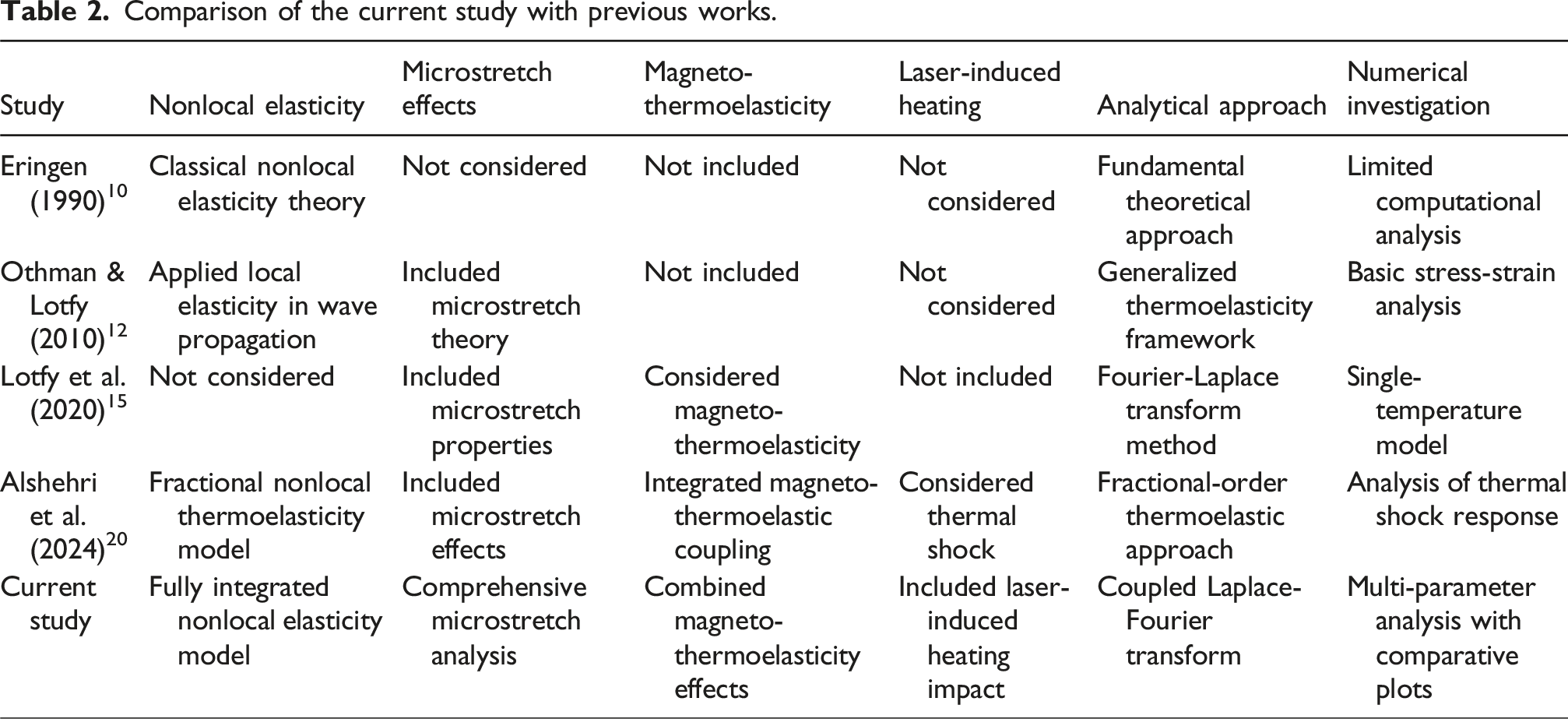
To highlight the novelty and new achievements of our approach, we provide a comparative analysis of key features with previous studies, as shown in Table 2 below:
Comparison of the current study with previous works.
Table 2 demonstrates that our study is the first to integrate nonlocal elasticity, microstretch effects, magneto-thermoelasticity, and laser-induced heating into a unified analytical and numerical framework. Moreover, our approach extends prior research by conducting a comprehensive multi-parameter numerical investigation, which includes comparative plots to highlight trends in wave propagation behavior.
From the analysis of figures, we conclude that: by setting the nonlocal parameter to zero, our equations reduce to the classical thermoelastic wave equations, which are well-documented in previous works. Similarly, removing the microstretch and magneto-thermoelastic effects yields a formulation that aligns with classical results from Fourier-based thermoelasticity theory. When eliminating the effects of the magnetic field and microstretch interactions, our model produces results that match those in conventional photo-thermoelasticity studies, confirming its consistency. The dimensionless numerical results are validated by checking that they converge to previously published solutions in the appropriate limits which appear in Table 2.
Conclusion
This study presents a novel investigation into the effects of nonlocal elasticity on wave propagation in a magneto-microstretch semiconductor medium under photo-thermal excitation. The findings highlight the critical influence of nonlocal parameters on wave dispersion, stress distribution, and thermal response, demonstrating that nonlocality leads to increased attenuation, reduced oscillatory behavior, and enhanced energy dissipation. Furthermore, this study advances classical thermoelastic models by incorporating microstretch interactions and magneto-thermoelastic coupling, which are essential for accurately predicting wave behavior in nanostructured materials. The problem was solved in plane using Laplace and Fourier transform, and get the exact solution. Many comparisons were made to obtain the importance of magnetic field, nonlocal effect and time on various quantities. It is clear from the previous investigation the intricate interplay between magneto-microstructural and nonlocal effects in a semiconductor medium. The ability to tailor wave propagation and material responses through magnetic field variations provides valuable opportunities for advanced material design and semiconductor applications, such as in sensors, actuators, and wave-guiding devices. This study highlights the significant role of nonlocality in shaping the dynamic response of a microstretch semiconductor medium under photo-thermal excitation and a magnetic field. Increasing nonlocal parameters enhances the attenuation of waves and suppresses oscillatory behaviors across all physical quantities. These findings provide valuable insights for designing advanced semiconductor materials with tailored wave propagation properties, particularly in applications requiring precise thermal, elastic, and electrical control. The temporal evolution of physical fields in a nonlocal microstretch semiconductor medium. Over time, wave oscillations and energy amplitudes are progressively dampened, leading to stabilized profiles for displacement, stress, temperature, and microstructural fields. These findings underscore the critical role of time in regulating the coupled thermomechanical and electromagnetic responses of semiconductor materials, paving the way for optimized material performance in photo-thermal and magnetoelastic applications. Moreover, the influence of nonlocality on thermal diffusion suggests potential applications in thermal management strategies for semiconductor devices subjected to laser excitation. To further validate the findings of this study, we acknowledge the importance of empirical verification through experimental techniques such as photoacoustic measurements or laser-induced thermomechanical analysis. Future research should explore experimental setups that can capture the wave dispersion and attenuation effects predicted by our model, providing real-world confirmation of the theoretical framework. Additionally, investigating fractional-order nonlocal models and multi-layered semiconductor structures will help extend the applicability of nonlocal elasticity in wave propagation studies.
Footnotes
Acknowledgments
The authors extend their appreciation to Princess Nourah bint Abdulrahman University Researchers Supporting Project number (PNURSP2025R229), Princess Nourah bint Abdulrahman University, Riyadh, Saudi Arabia.
ORCID iD
Khaled Lotfy
Statements and declarations
Author contributions
KL: Conceptualization, Methodology, Software, EI and AE: Writing—Original draft preparation. WA and KL: Supervision, Visualization, Investigation, Software, Validation. All authors: Writing—Reviewing and Editing, Data curation.
Funding
The authors disclosed receipt of the following financial support for the research, authorship, and/or publication of this article: Princess Nourah bint Abdulrahman University Researchers Supporting Project number (PNURSP2025R229), Princess Nourah bint Abdulrahman University.
Conflicting interests
The authors declared no potential conflicts of interest with respect to the research, authorship, and/or publication of this article.
Use of AI tools declaration
The authors declare they have not used Artificial Intelligence (AI) tools in the creation of this article.
Data Availability Statement
The information applied in this research is ready from the author at request.*
Appendix
References
1.
BiotM. Thermoelasticity and irreversible thermodynamics. J Appl Phys1956; 27: 240–253.
2.
LordHWShulmanY. A generalized dynamical theory of thermoelasticity. J Mech Phys Solid1967; 15: 299–309.
3.
EringenACShuhubiES. Nonlinear theory of simple micropolar solids. Int J Eng Sci1964; 2: 1–18.
4.
EringenAC. Linear theory of micropolar elasticity. J Math Mech1966; 15: 909–923.
5.
SheriefHHHamzaFAEl-SayedAM. Theory of generalized micropolar thermoelasticity and an axisymmetric half-space problem. J Therm Stress2005; 28: 409–437.
6.
KumarRKumarASinghD. Interaction of laser beam with micropolar thermoelastic solid. Adv Phys Theor Appl2015; 40: 10–15.
7.
HilalMIM. Fourier and Laplace transforms in micropolar thermoelastic solid with rotation and Hall current in the case of energy dissipation and thermal shock. Indian J Phys2020; 94: 1515–1525.
8.
AbouelregalAEMarinMAlsharaariF. Thermoelastic plane waves in materials with a microstructure based on micropolar thermoelasticity with two temperature and higher order time derivatives. Mathematica2022; 10(9): 1552.
9.
AbouelregalAEMoaazOKhalilKM, et al.Micropolar thermoelastic plane waves in microscopic materials caused by Hall-current effects in a two-temperature heat conduction model with higher-order time derivatives. Arch Appl Mech2023; 93: 1901–1924.
10.
EringenAC. Theory of thermo-microstretch elastic solids. Int J Eng Sci1990; 28(12): 1291–1301.
11.
AouadiM. Some theorems in the isotropic theory of microstretch thermoelasticity with micro temperatures. J Therm Stress2008; 31(7): 649–662.
12.
OthmanMLotfyKH. On the plane waves of generalized thermo-microstretch elastic half-space under three theories. Int Commun Heat Mass Tran2010; 37(2): 192–200.
13.
OthmanMIJahangirANadiaA. Microstretch-thermoelastic solid with temperature dependent elastic properties under the influence of magnetic and gravitational field. J Braz Soc Mech Sci Eng2018; 40: 332.
14.
ChirilăAMarinM. Diffusion in microstretch thermoelasticity with micro temperatures and micro concentrations. In: FlautCHošková-MayerováŠFlautD (eds) Models and theories in social systems. Studies in systems, decision and control. Springer, 2019, Vol. 179, pp. 149–164.
15.
LotfyKEl- BaryAAAllanM, et al.Generalized thermal microstretch elastic solid with harmonic wave for mode-I crack problem. Arch Therm2020; 41(2): 147–168.
16.
ChirilaAMarinM. Wave propagation in diffusive microstretch thermoelasticity. Math Comput Simulat2021; 189: 99–113.
17.
SinghSDemnathSOthmanMI. Thermoelastic theories on the refracted waves in microstretch thermoelastic diffusion media. Int J App Mec2022; 14: 342–352. DOI: 10.1142/S1758825122500089.
18.
TamAC. Applications of photoacoustic sensing techniques. Rev Mod Phys1986; 58: 381–431.
19.
LiuLHuanHZhangX, et al.Laser induced thermoelastic contributions from windows to signal background in a photoacoustic cell. Photocoustics2021; 22: 100257.
20.
AlshehriHMLotfyKMahdyAMS, et al.Photoacoustic impact of nanostructure magneto-semiconductor material with stability study. Results Phys2024; 63: 107803.
21.
AlshehriAMLotfyKIbrahimE. A novel model of microelongation thermomechanical photoacoustic waves in excited semiconductor materials. Results Phys2024; 63: 107881.
22.
SamerAGalavicSPopovicMN, et al.Thermoelastic component of photoacoustic response calculated by the fractional dual-phase-lag heat conduction theory. Int J Heat Mass Tran2024; 223: 125233.
23.
TamAC. Photothermal investigations in solids and fluids. Academic Press, 1989, pp. 1–33.
24.
LotfyK. The elastic wave motions for a photothermal medium of a dual-phase-lag model with an internal heat source and gravitational field. Can J Phys2016; 94: 400–409.
25.
LotfyKGabrM. Response of a semiconducting infinite medium under two temperature theory with photothermal excitation due to laser pulses. Opt Laser Technol2017; 97: 198–208.
26.
LotfyK. A novel model of photothermal diffusion (PTD) for polymer nano-composite semiconducting of thin circular plate. Physica B- Condenced Matter2018; 537: 320–328.
27.
LotfyK. A novel model for photothermal excitation of variable thermal conductivity semiconductor elastic medium subjected to mechanical ramp type with two-temperature theory and magnetic field. Sci Rep2019; 9(ID): 3319.
28.
KhamisAEl-BaryALotfyK, et al.Photothermal excitation processes with refined multi dual phase-lags theory for semiconductor elastic medium. Alex Eng J2020; 59(1): 1–9.
29.
AdelMLotfyKYadavAK, et al.Orthotropic rotational semiconductor material with piezo-photothermal plasma waves with moisture plasma diffusion and laser pulse. Z Angew Math Mech2024; 105: e202301004. DOI: 10.1002/zamm.202301004.
30.
KaurISinghK. Plane wave in non-local semiconducting rotating media with Hall effect and three-phase lag fractional order heat transfer. Int J Mech Mater Eng2021; 16: 14.
31.
HobinyAAbbasIAlshehriH, et al.Analytical solutions of nonlocal thermoelastic interaction on semi-infinite mediums induced by ramp-type heating. Symmetry2022; 14: 864.
32.
SardarSDasBGhoshD, et al.Photothermal effects of semiconducting medium with non-local theory. Waves Random Complex Media2023; 1–22. DOI: 10.1080/17455030.2023.2216788.
33.
RaddadiMHMahdyAMSEl-BaryAA, et al.A rotating magneto photothermoelastic effect with moisture diffusivity of nonlocal semiconductor medium. J Strain Anal2024; 59: 309–322.
34.
abouelregalAEAhmadHAldahlanMA, et al.Nonlocal magneto-thermoelastic infinite halfspace due to a periodically varying heat flow under Caputo–Fabrizio fractional derivative heat equation. Open Phys2022; 20: 274–288.
35.
De SalvoEGirlandaRQuattropaniA. Two-photon interband transitions in semiconductors in a static magnetic field. Nonlocal effects. Il Nuovo Cimento D1985; 5: 63–76.
36.
LotfyKEl-BaryAEl-SharifA. Ramp-type heating micro-temperature for a rotator semiconducting material during photo-excited processes with magnetic field. Results Phys2020; 19: 103338.
37.
KilanyAAAbd- allaANAbd- AllaAM, et al.On thermoelastic problem based on four theories with the efficiency of the magnetic field and gravity. J Ocean Eng Sci2024; 9: 338–347.
38.
LotfyKTantawiRAnwerN. Response of semiconductor medium of variable thermal conductivity due to laser pulses with two-temperature through photothermal process. Silicon2019; 11: 2719–2730.
39.
IbrahimEEl-SapaSChteouiR, et al.Four-phase lags in a generalized thermoelastic rotational diffusive plate with laser pulse emission. Mech Solid2023; 58: 2412–2423.
40.
AlshehriHMLotfyKRaddadiMH, et al.A nonlocal photoacoustic effect with variable thermal conductivity of semiconductor material subjected to laser heat source. Results Phys2024; 61: 107715.
41.
AbouelregalASedighiHMegahidS. Photothermal-induced interactions in a semiconductor solid with a cylindrical gap due to laser pulse duration using a fractional MGT heat conduction model. Arch Appl Mech2023; 93: 2287–2305.
42.
ImranMZeemamMBasitM, et al.Exploration of stagnation-point flow of Reiner–Rivlin fluid originating from the stretched cylinder for the transmission of the energy and matter. Sci Rep2025; 15: 6515.
43.
BasitMBashirMImranM, et al.Analysis of efficient partial differential equations model for nano-fluid flow through wedge involving minimal energy and thermal radiation. J Radiation Res App Sci2025; 18(2): 101331.
44.
BasitMImranMAnwar-Ul-HaqT, et al.Advancing renewable energy systems: a numerical approach to investigate nanofluidics’ role in engineering involving physical quantities. Nanomaterials2025; 15(4): 261.
45.
ChaudhryMBasitMImranM, et al.Numerical analysis of mathematical model of nanofluid flow through stagnation point involving thermal radiation, activation energy, and living organisms. AIP Adv2025; 15(1): 015220.
46.
ChaudhryMBasitMAkhtarT, et al.Computational heat and mass transfer analysis of magnetized nanofluid flow under the influences of motile microorganisms and thermal radiation. Mod Phys Lett B2025; 2550111.
47.
BasitMImranMMohammedW, et al.Thermal analysis of mathematical model of heat and mass transfer through bioconvective Carreau nanofluid flow over an inclined stretchable cylinder. Case Stud Therm Eng2024; 63: 105303.
48.
BasitMTahirMShahN, et al.An application to formable transform: novel numerical approach to study the nonlinear oscillator. Vib Active Control2024; 43(2): 729–743.
49.
Asadi JafariMZarastvandMZhouJ. Doubly curved truss core composite shell system for broadband diffuse acoustic insulation. J Vib Control2023; 30(17-18): 4035–4051.
50.
TalebitootiRZarastvandM. The effect of nature of porous material on diffuse field acoustic transmission of the sandwich aerospace composite doubly curved shell. Aero Sci Technol2018; 78: 157–170.
51.
TalebitootiRZarastvandM. Vibroacoustic behavior of orthotropic aerospace composite structure in the subsonic flow considering the third order shear deformation theory. Aero Sci Technol2018; 75: 227–236.
52.
ZarastvandMGhassabiMTalebitootiR. Prediction of acoustic wave transmission features of the multilayered plate constructions: a review. J Sandw Struct Mater2021; 24(1): 218–293.
53.
ZarastvandMGhassabiMTalebitootiR. A review approach for sound propagation prediction of plate constructions. Arch Comput Methods Eng2021; 28: 2817–2843.
54.
ZarastvandMGhassabiMTalebitootiR. Acoustic insulation characteristics of shell structures: a review. Arch Comput Methods Eng2021; 28: 505–523.