




Abstract
This study investigates the influence of Hall currents on thermoacoustic wave propagation in rotating nonlocal hydrodynamic semiconductors, incorporating the photo-thermoelasticity theory within a two-dimensional framework. The coupled governing equations according to the Helmholtz vector for charge carriers, temperature, displacement, and stress are formulated to account for nonlocal effects, rotation, and Hall current phenomena. The normal mode analysis is employed to decouple and solve these equations, leading to an in-depth exploration of the wave propagation characteristics. Numerical computations are performed, and the results are graphically represented to demonstrate the effects of Hall currents and rotation parameters on thermal, acoustic, and mechanical responses. The findings provide valuable insights into the dynamic interactions within hydrodynamic semiconductor systems under the combined influences of these factors, highlighting their significance in advanced material and device applications.
Keywords
Introduction
The study of wave propagation in hydro-semiconductors has garnered significant attention over the years due to its applications in various advanced materials and devices, particularly in the realms of photonic and electronic systems. A growing body of research has explored how external fields, such as magnetic fields, temperature gradients, and mechanical stresses, influence wave dynamics in these media. Among these, the impact of Hall currents, rotation, and nonlocal effects on wave propagation in hydrodynamic semiconductors has become a crucial subject of study, with implications for enhancing the performance of semiconductor-based devices. In the early studies of wave propagation in semiconductor media, much of the focus was placed on traditional models involving local effects. These models, which considered simple interactions between charge carriers and lattice vibrations, were foundational but lacked the depth required for understanding complex phenomena observed in modern nanostructured materials. The introduction of nonlocal effects, which take into account the spatial spread of interactions, significantly improved the accuracy of these models, offering a more realistic depiction of wave propagation.
The inclusion of Hall current in semiconductor modeling is crucial due to its significant influence on charge carrier dynamics in the presence of external magnetic fields. In many practical semiconductor devices, such as Hall effect sensors, magneto-resistive elements, and photonic systems subjected to pulsed laser excitation, the interaction between electric and magnetic fields gives rise to a transverse Hall voltage, modifying carrier trajectories and inducing Lorentz forces. These electromagnetic interactions strongly affect stress and displacement distributions in the material, especially at nanoscale dimensions where carrier–lattice coupling becomes pronounced. Furthermore, Hall currents are relevant in high-frequency environments, where photothermal and magnetothermal coupling influence wave attenuation and thermal management. Therefore, understanding Hall current effects is not only theoretically important but also essential for designing advanced MEMS, optoelectronic, and energy conversion devices that rely on coupled thermo-electromagnetic responses.
Thermoelasticity (TE) theory has been extensively applied to investigate the coupling between thermal and mechanical fields in various materials, particularly elastic media. Early developments in TE theory, such as those by Lord and Shulman, 1 introduced the concept of generalized thermoelasticity with temperature-dependent stress and strain relationships. 2 Since then, the theory has been extended to include more complex effects such as phase lags, fractional derivatives, and anisotropic materials.3–5 More recent studies, including those by Ezzat et al. 6 and Lata, 7 have expanded on these models by incorporating fractional order derivatives and phase lags to describe the behavior of heat and mechanical waves in complex, often rotating systems. These advancements have significantly improved the accuracy of predictions for material behavior under dynamic thermal loading.8,9 Abbas and Kumar 10 studied the response of thermal sources according to void properties in the generalized thermoelastic half-space medium. Bachher et al. 11 used the generalized thermoelastic model to investigate instantaneous heat sources in the context of the fractional order of the heat equation. The Moore–Gibson–Thompson theory is applied according to the thermoelasticity theory to study dipolar bodies. 12 Lotfy and Hassan 13 applied the rotational field according to the two-temperature TE theory under the thermal shock influence. The effects of the magnetic field and rotation field are applied in the context of some thermoelastic theories. 14 On the other hand, the semi-analytical meshless method is used to study porous elastic materials. 15 The thermo-mechanical interactions are investigated during the porous generalized thermoelastic material under the impact of a heat source. 16 Sherief and Hussein 17 introduced a mathematical model during short-time filtration to study the poroelastic media. The fractional order of heat equation and the reflection and refraction of waves in two-dimensional (2D) is applied to a thermoelastic porous medium.18,19 The poroelastodynamics during a linear model is investigated according to some numerical methods. 20
Photothermal theory in semiconductor materials has evolved significantly, beginning with early studies on the interaction of light and heat in solid-state devices.21–23 Initial research focused on laser-induced thermal effects, where the absorption of light caused localized heating, leading to thermally induced stresses and carrier redistribution in semiconductors.24,25 These models laid the groundwork for understanding photothermal effects in optoelectronic devices. 26 Later, researchers integrated thermal diffusion equations with semiconductor carrier dynamics, which included generalized heat conduction laws for nanostructured material.27–29 Incorporating the photo-thermoelastic effect, researchers extended these models to account for mechanical deformation under thermal and optical excitation. 30 Some studies examined how photothermal responses influence stress and wave propagation in anisotropic and nonlocal semiconductors, addressing advanced applications such as high-precision sensors and thermal management in microelectronics.31–33 These advancements highlight the growing importance of photothermal theory in optimizing semiconductor performance and device efficiency. 34 The role of Hall currents in semiconductor media has been extensively studied, with significant contributions from magneto-hydrodynamics. 35 Hall effects, which arise due to the perpendicular interaction between the electric current and magnetic field, modify carrier dynamics and, consequently, wave propagation. 36 However, previous studies have largely focused on the linear effects of Hall currents without addressing their coupling with other dynamic phenomena, such as rotation and thermal effects, in a unified framework.37,38 Rotation, a relatively underexplored factor in semiconductor wave propagation, has become a focal point in recent research. 39 When semiconductors are subjected to rotational forces, the Coriolis effect introduces new dynamics in both carrier motion and wave behavior. 40 This effect, especially in nanostructured and hydrodynamic semiconductors, can significantly alter the propagation characteristics of thermal, optical, and acoustic waves.
Building on foundational research in fluid-saturated media, this study delves into the complex interactions within anisotropic materials. 41 Biot’s pioneering work on isotropic poroelasticity provided a theoretical basis for understanding elastic porous materials, forming the cornerstone of modern investigations into saturated media. 42 Subsequent contributions analyzed thermal loading effects on soils, 43 while Biot 42 developed a thermodynamic framework for porous elastic materials. Xiong et al. 44 advanced these theories through normal mode analysis of generalized thermoelasticity, and Marin et al.45,46 examined microstructural expansions and principles like Saint-Venant’s relaxation. Extending these foundations, Zakaria et al. 47 applied the rotation field to analyze plasma-thermal-mechanical effects in semiconductors, bridging porous media studies with advanced semiconductor applications.
The inclusion of nonlocal effects in the modeling framework is essential for accurately capturing the wave propagation behavior in porous silicon-based semiconductor systems. At the nanoscale, where the characteristic dimensions of the microstructure, such as pore size and grain boundaries, approach the mean free path of carriers and phonons, classical local continuum theories become inadequate. In such scenarios, stress and strain at a point are influenced not only by the local deformation but also by the deformation in a surrounding neighborhood, which is rigorously described by nonlocal elasticity theory. This is particularly relevant in the context of high-frequency thermal and acoustic wave propagation, as induced by laser excitation, where the spatial resolution of wave interactions matches the nonlocal length scale. As demonstrated in works by Eringen 48 and later applied in semiconductor modeling, 49 incorporating nonlocality enables accurate representation of size-dependent effects, enhanced oscillations, and delayed attenuation, phenomena that cannot be captured using classical models. The incorporation of nonlocal effects into thermoelasticity theory marked a significant advancement in understanding wave propagation and thermal stresses in semiconductor materials. Traditional thermoelasticity assumed local interactions, which were later expanded to account for nonlocal behaviors essential for describing phenomena at the nanoscale. 48 These nonlocal models, such as those introduced by Eringen, captured the spatial dependency of stress and strain, making them pivotal for studying semiconductors with nanoscale features. 49 Subsequent works explored microstructural interactions and advanced boundary conditions, bridging the gap between theoretical predictions and real-world applications in nanoelectronics and photonic devices. These advancements highlight the synergy between thermoelasticity and photo-thermoelasticity, advancing our understanding of nonlocal semiconductor materials.50,51
Recently, advanced thermoelastic models have been applied in a variety of coupled systems and device-level analyses. Kumar et al. 52 developed a thermoelastic framework incorporating dual porosity and fluid interactions, highlighting the role of structural heterogeneity in dynamic wave behavior. Similarly, Abouelregal and Sedighi 53 investigated the interaction between thermoelasticity and mass diffusion in the context of the Moore–Gibson–Thompson thermodiffusion theory. These works underscore the expanding application of generalized thermoelastic models in complex environments and motivate the present study, which combines photo-thermoelastic effects with hydrodynamic, nonlocal, and electromagnetic phenomena in a rotating semiconductor medium. In addition to nonlocal interactions, material discontinuities such as microstructural interfaces, pores, or inclusions can further influence wave propagation in nanostructured hydrodynamic semiconductors. These discontinuities act as scattering boundaries, modifying stress and displacement fields and contributing to localized energy concentration or dispersion. The interplay between nonlocality and discontinuities requires careful numerical treatment, as highlighted in studies using mixed finite element methods and interface modeling.54,55 These approaches are essential when modeling interface problems with strong gradients or elastic heterogeneities, which are common in real-world porous and nanostructured semiconductors. While our current work assumes a continuous medium, future extensions may incorporate these discontinuities for even more accurate modeling of physical behavior. 56
Despite the advancements in understanding wave propagation in semiconductors, several key aspects remain inadequately explored. Existing studies often neglect the combined effects of Hall currents, rotation, and nonlocality on thermoacoustic wave propagation. Furthermore, while photo-thermoelasticity theory has been used to investigate thermal effects in semiconductors, its integration with hydrodynamic models and Hall currents in a rotating framework has not been sufficiently addressed in the literature. The gap lies in the lack of a comprehensive model that incorporates all these factors to explore their combined impact on wave propagation in semiconductor systems. This study uniquely addresses these gaps by developing a coupled framework that integrates Hall currents, rotation, and nonlocal effects within a two-dimensional hydrodynamic semiconductor model. The novelty of this work lies in the application of photo-thermoelasticity theory to a rotating hydrodynamic semiconductor medium, which has not been previously investigated in the context of thermoacoustic wave propagation. A simple theoretical exploration by performing numerical simulations illustrates the effects of Hall currents and rotational parameters on the wave propagation characteristics. By employing normal mode analysis, we derive solutions to the governing equations, providing new insights into the dynamic behavior of acoustic, thermal, and mechanical waves under the influence of these complex factors. These simulations reveal the intricate interactions between these factors and their significance in practical semiconductor applications, such as in the design of advanced materials and devices that rely on efficient wave control.
Mathematical model and basic equations
The Hall current is the fundamental phenomenon behind the


In this research, the propagation of coupled thermal, acoustic, and optical waves in a nonlocal hydrodynamic semiconductor medium is explored, considering the significant effects of Hall current and rotational fields. Rotation induces Coriolis (i) Charge carrier density equation
The diffusion coefficient (ii) Nonlocal equation of motion with rotation

The nonlocal equation of motion under the influence of a rotational field and a magnetic field considers the interactions between mechanical, magnetic, and rotational effects. In the hydro-semiconductor material, this equation can be given as36,42 (iii) The heat equation

The heat equation describes the temperature distribution in a material over time, accounting for heat conduction, generation, and other thermal effects. For a generalized system, the heat equation can be expressed as31,36,44 (iv) Fluid flow equation:

The poroelastic equation describes the coupled interaction between fluid flow and the deformation of a porous medium. This framework integrates the principles of mass conservation and mechanics, capturing the influence of fluid pressure on the solid matrix and vice versa. This equation integrates hydrodynamic principles with semiconductor physics36–38: (v) The nonlocal stress–strain relations

The nonlocal stress–strain relation incorporates spatial interactions over a finite region, extending classical elasticity to account for the effects of carrier density, pore water pressure, and microstructural or nanoscale features in materials. This is particularly significant in highly heterogeneous or size-dependent systems, such as nanostructured semiconductors or porous media32,36:

In this model, nonlocality is introduced through the stress–strain relationship [equation (7)] and the equation of motion [equation (4)], where the nonlocal parameter
In 2D deformation, the equation of motion can be reformulated in the





In particular,

By reducing to dimensionless form, we simplified the main equations and made them more general, allowing for easier analysis and comparison across different systems. Applying the dimensionless quantities (equation (13)) to the main equations ((3), (5), (6), and (8)–(12)) yields (omitting the primes for more simplification):








To make the analysis more tractable, the Helmholtz decomposition rule can be applied. The Helmholtz decomposition is a method used to express a displacement vector field as the sum of two components: a divergence-free (solenoidal) part

Using the above Helmholtz decomposition, the two equations of motion ((15) and (16)) can be rewritten using some derivatives properties, resulting in


These equations describe the interplay between mechanical deformation, heat generation, and carrier dynamics in poroelastic rotational nonlocal semiconductors under the impact of Hall current, enabling the study of advanced wave propagation phenomena in such media.
Solution to the problem
The normal mode approach is a mathematical method widely used to analyze and simplify the behavior of systems governed by partial differential equations (PDEs), especially in wave propagation, vibrations, and oscillations. For a field variable








The elimination technique for the coupled differential equations of the quantities

The coefficients





The characteristic equation of equation (32) can be factored as

The terms


The quantities
The displacements


The dimensionless nonlocal stress–strain relations can be rewritten as


Boundary conditions
Boundary conditions are essential in determining the unknown parameters (1) The rapid temperature fluctuations caused by pulsed lase stimulation lead to negligible heat loss to the surrounding environment, making this method highly effective for studying absorption properties. When a laser beam interacts with the surface of a nanostructured poroelastic solid, it sets off a cascade of intricate physical phenomena, many of which are strongly influenced by the laser’s energy. A portion of this energy is absorbed by the material and converted into heat, initiating a series of transformations within the medium. These include pronounced photothermal effects, such as variations in temperature, induced stress, and changes in the material’s properties. This synergy of effects underscores the utility of pulsed laser techniques for analyzing energy absorption and exploring the fundamental physical mechanisms in solid and porous structures. In this context, the temperature distribution can be defined as (2) At the free surface, it is possible to impose a constant excess pore water pressure (3) During the diffusion process, carriers penetrate the sample surface with minimal likelihood of recombination with equilibrium carrier concentration (4) Mechanical boundary conditions are usually defined by the traction force




By implementing the boundary conditions (43)–(46) and applying normal mode analysis to the primary fields, the resulting solutions can be obtained as follows:




Numerical results and discussions
The physical constants of the PSi material.
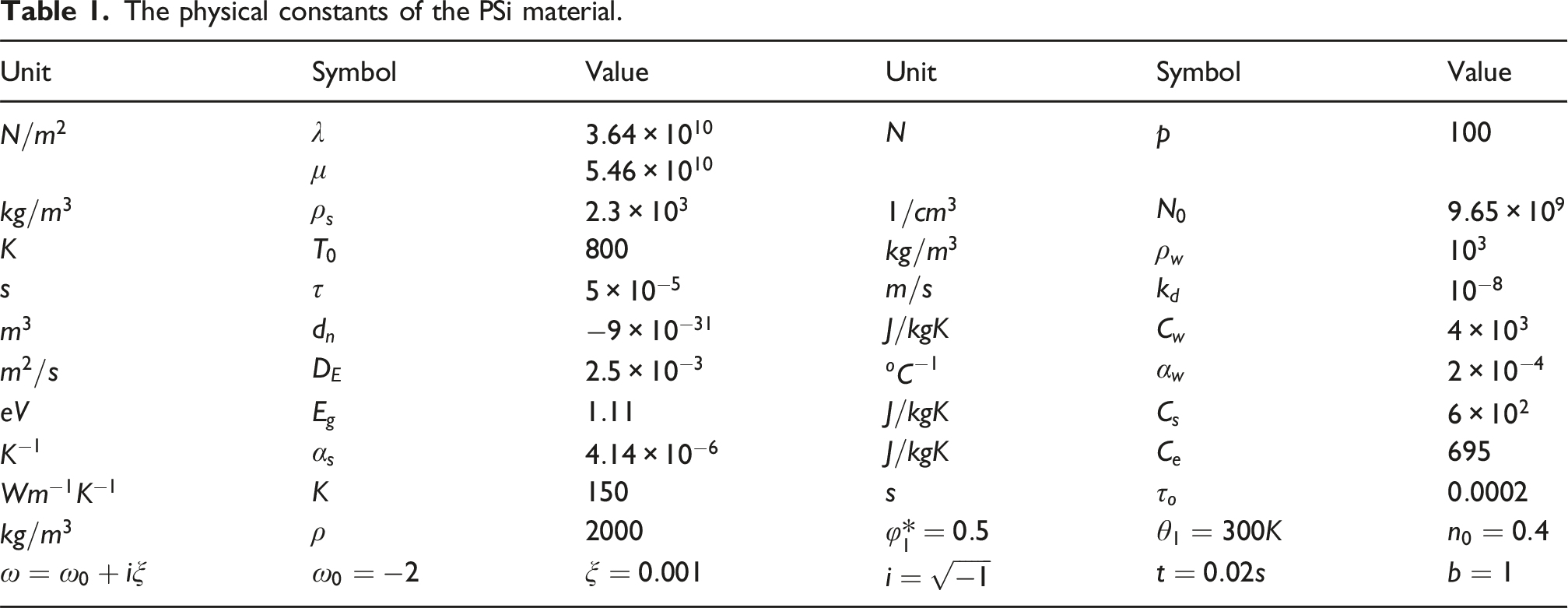
The laser excitation constants are
Porous silicon (PSi) is selected as the base material due to its widespread use in photonic and thermo-mechanical devices, particularly in applications involving laser excitation and porous architecture. The material properties listed in Table 1 are drawn from validated experimental studies,52–54 representing typical PSi with intermediate porosity levels, which aligns with the hydrodynamic and porous assumptions in our model.
The effect of Hall current parameter
Figure 1 presents graphical representations of various physical fields such as temperature, displacements, stress, carrier density, and excess pore water pressure as functions of distance ( Wave propagation characteristics of the main physical fields in a rotating porous silicon semiconductor medium under the DPL nonlocal model, comparing the cases without Hall current effects (WOHCE) and with Hall current effects (WHCE).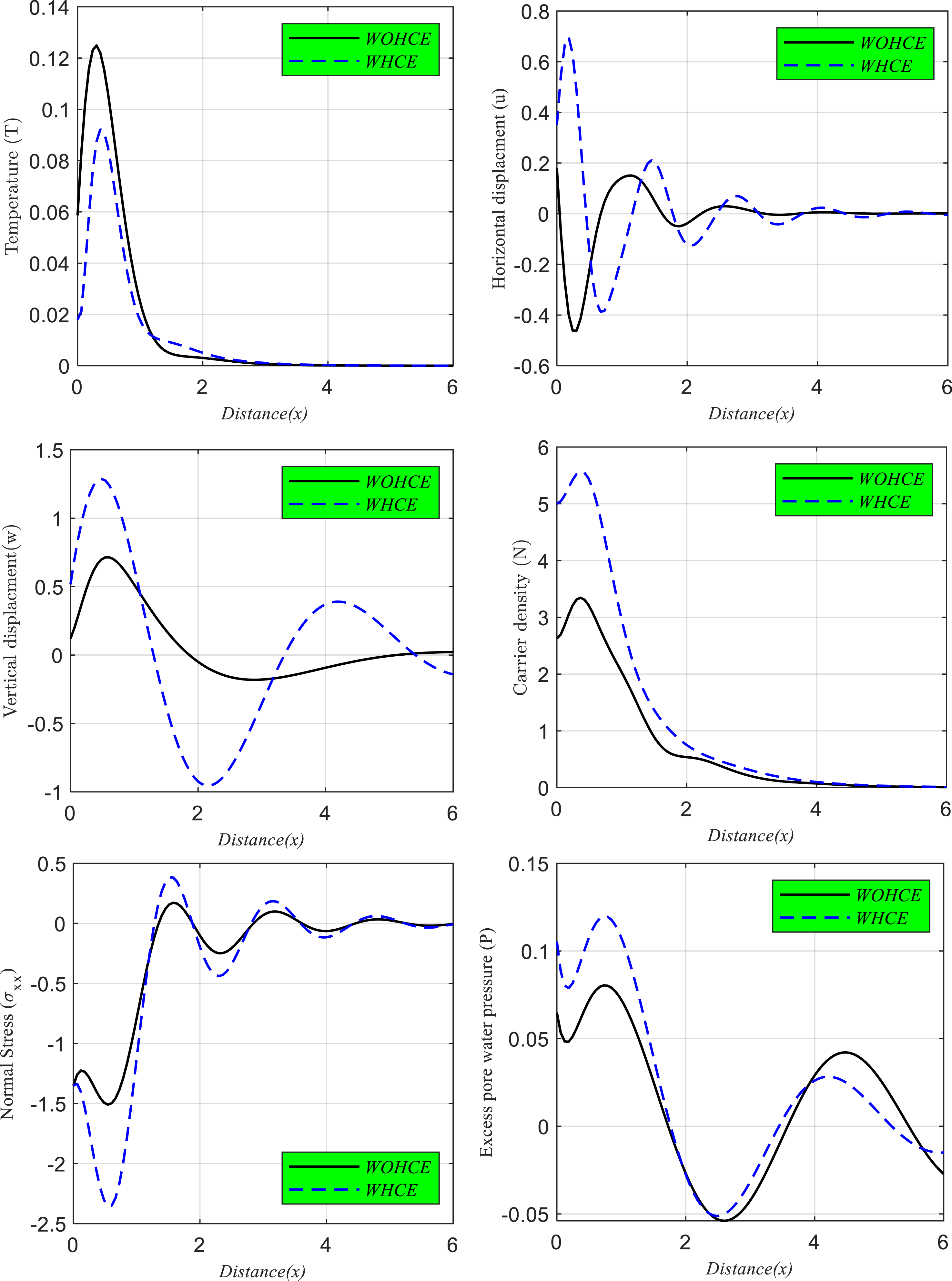
The reduction in displacement amplitudes and modulation of the stress field due to the Hall current can be attributed to the Lorentz force generated by the interaction of charge carriers with the external magnetic field. This electromagnetic force introduces an additional stress component perpendicular to the motion of charge carriers, opposing thermal expansion-induced mechanical deformation. Furthermore, the presence of charge-lattice coupling in the semiconductor medium alters local stiffness, especially near the laser-illuminated region where photo-generated carriers are concentrated. The Hall current also affects the energy exchange between the thermal and mechanical fields, as part of a broader electro-thermo-mechanical coupling, leading to a redistribution of stress and thermal energy across the material. This results in enhanced damping, altered wave speeds, and shifts in the oscillation peaks, which are captured in our simulation results.
The influence of heat conduction models
Figure 2 illustrates the impact of two heat conduction models, the Lord–Shulman (LS) model, and the dual-phase-lag (DPL) model, on the wave propagation of the main physical fields (temperature, displacements, carrier density, stress, and excess pore water pressure) in a rotating porous silicon semiconductor medium under the influence of Hall current and nonlocal effects. These numerical results highlight the distinct characteristics of wave behavior introduced by the differences in thermal conduction assumptions within the models. Comparison of wave propagation characteristics of the main physical fields in a rotating porous silicon semiconductor medium under the influence of Hall current and nonlocal effects, modeled using the Lord–Shulman (LS) and dual-phase-lag (DPL) heat conduction theories.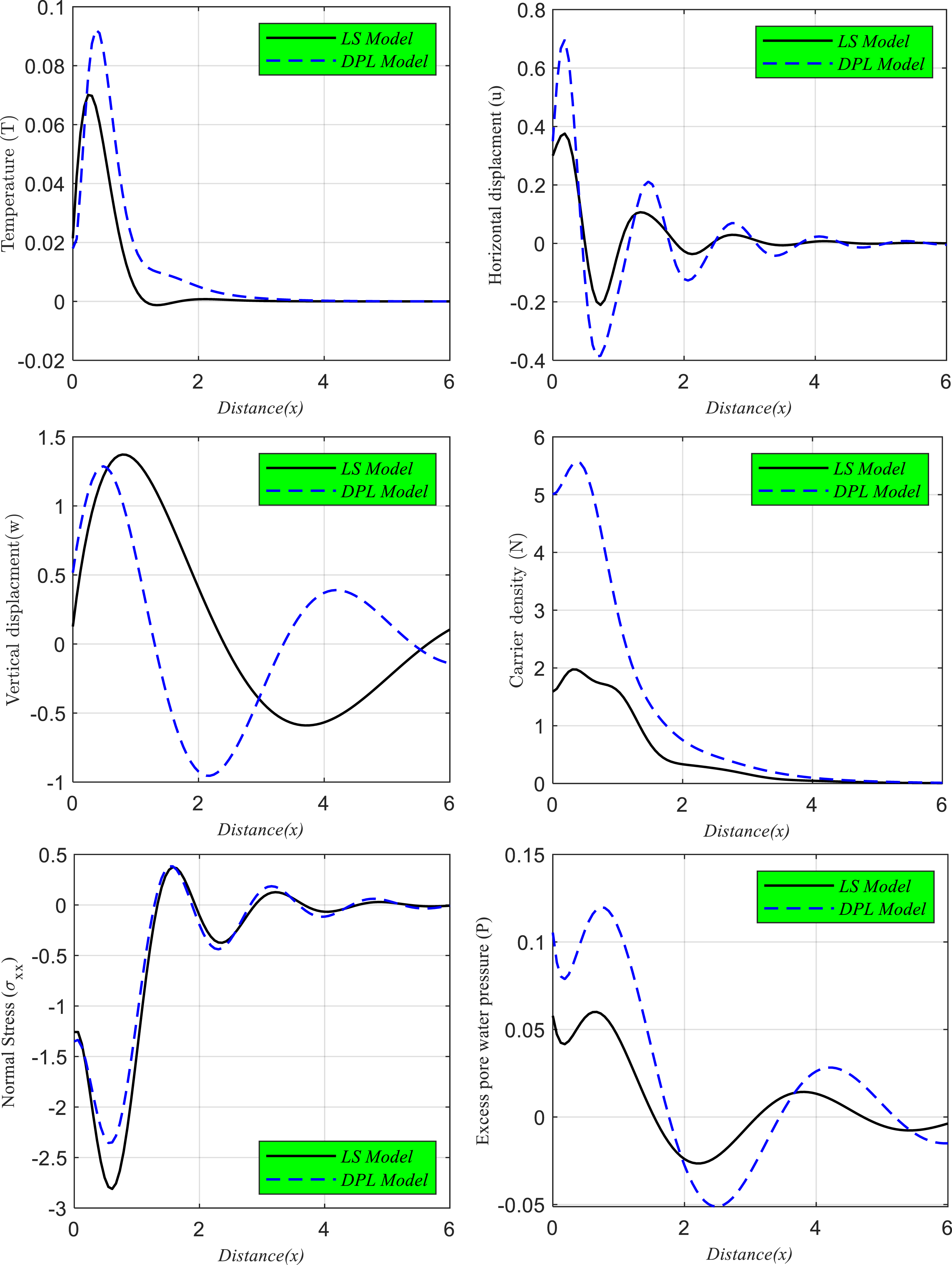
Effect of rotational field
Figure 3 illustrates the influence of rotation on the wave propagation of key physical fields in a porous silicon semiconductor medium under the combined effects of Hall current and the DPL nonlocal model. The comparison between the scenarios with rotation field effects (WRF) and without rotation field effects (WORF) highlights the significant role of rotational dynamics in modifying wave behavior. Wave propagation characteristics of the main physical fields in a porous silicon semiconductor medium under the influence of Hall current and the DPL nonlocal model, with and without rotation field effects (WRF and WORF, respectively).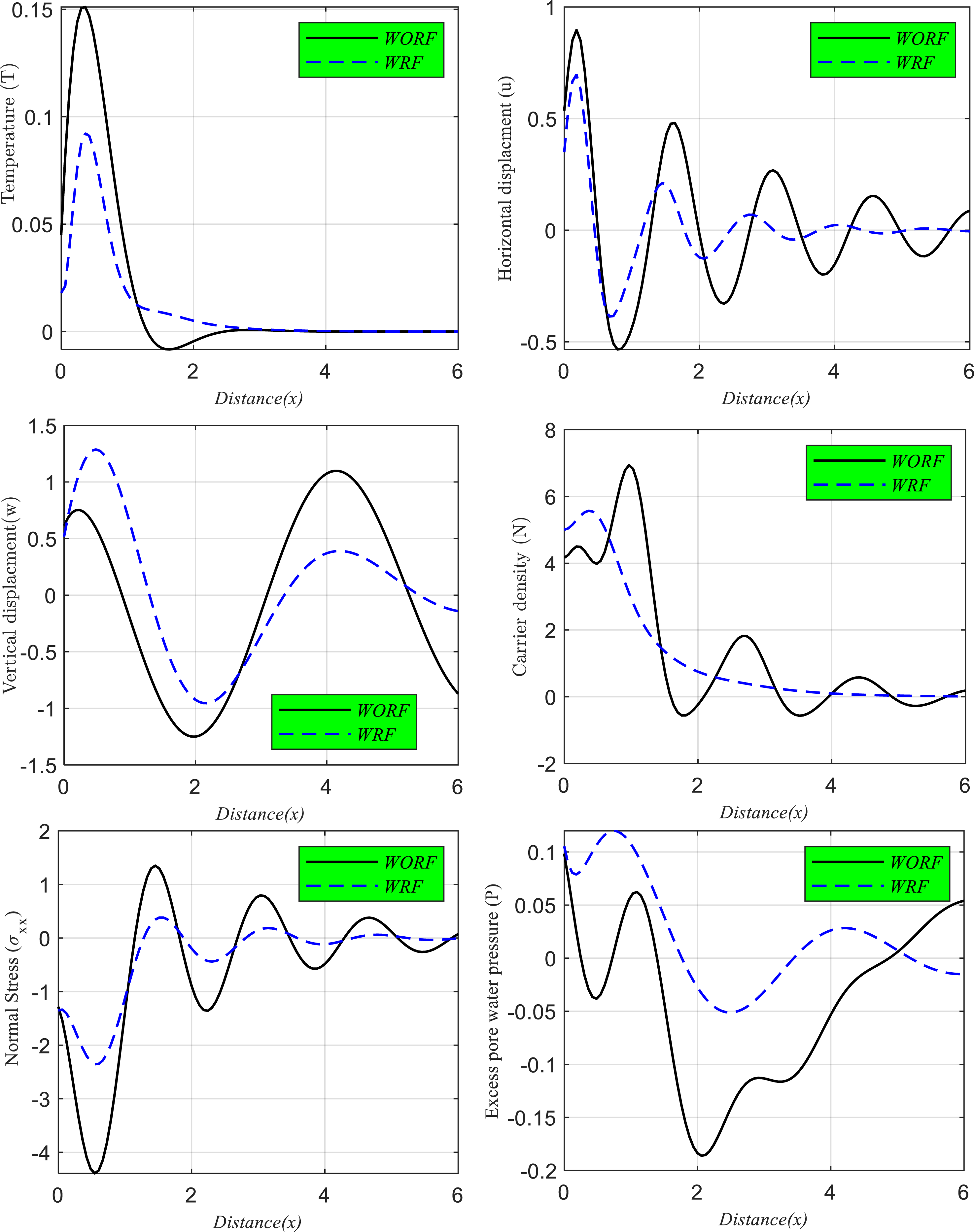
The nonlocal effects
Figure 4 displays the effect of nonlocal parameters on wave propagation in the main fields (temperature, displacements, carrier density, normal stress, and excess pore water pressure) which is evident in their enhanced oscillatory behavior and delayed attenuation under the DPL model with Hall current. The temperature in the nonlocal medium shows a more pronounced initial peak and slower attenuation than the local medium, indicating enhanced thermal effects due to nonlocal interactions. The oscillatory behavior is minimal but becomes evident as the wave propagates further. The horizontal displacement exhibits significant oscillations in both media. Still, the nonlocal medium demonstrates delayed attenuation and more oscillatory patterns, showing that nonlocality amplifies the elastic response and energy transfer over longer distances. Similar to horizontal displacement, the vertical displacement shows enhanced oscillations in the nonlocal medium, with higher amplitude in the early propagation stages. This suggests a stronger coupling of the nonlocal effects with mechanical deformations. The carrier density shows fluctuations that are more prominent in the nonlocal medium, with slower decay. This reflects the influence of nonlocal interactions and Hall current on the semiconductor’s charge distribution. The nonlocal medium significantly amplifies the oscillatory behavior of normal stress, with slower decay compared to the local medium. This highlights the combined effect of nonlocality and DPL thermal relaxation on the stress field. For excess pore water pressure, the nonlocal medium shows more sustained oscillations and slower attenuation, indicating enhanced interaction between thermal, mechanical, and pore fluid dynamics. In general, the The wave propagation characteristics of the main physical fields in a porous silicon semiconductor medium, under the influence of Hall current and the DPL model, highlight the effects of nonlocal parameters.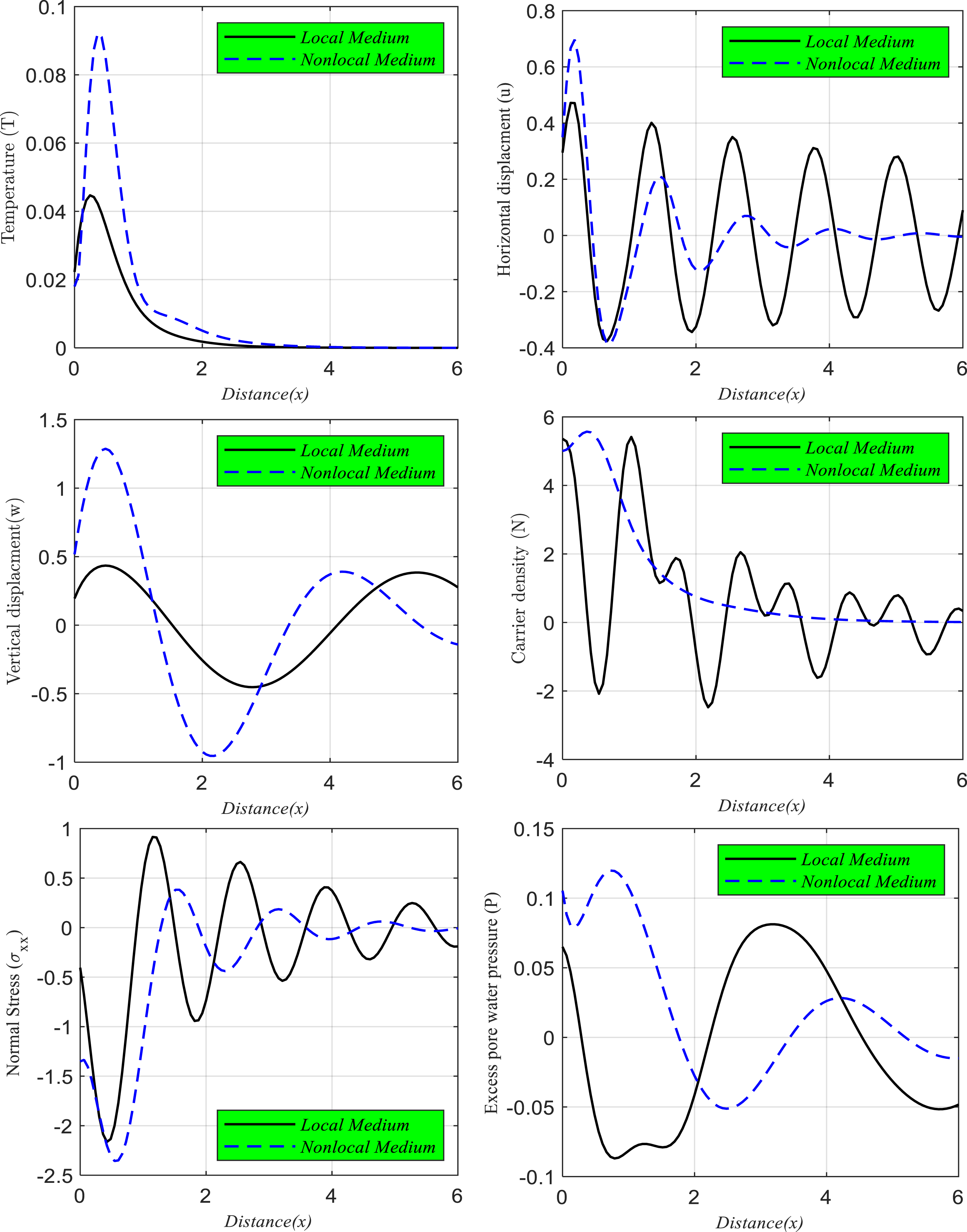
The influence of nonlocality is most pronounced in the wave attenuation and oscillation patterns. As seen in Figure 4, increasing the nonlocal parameter α\alphaα leads to slower attenuation and more pronounced oscillations in temperature, displacement, stress, and pore pressure fields. This behavior arises because the nonlocal formulation introduces spatial memory—the stress at a given point is influenced by the strain distribution over a finite region. Physically, this reflects the interaction of elastic and thermal waves with the microstructure and carrier scattering mechanisms of the porous semiconductor, which are not captured by classical local models. Therefore, nonlocality enables the model to describe size-dependent dispersion and energy redistribution, which are essential for simulating realistic wave behavior in nanostructured hydrodynamic semiconductors.
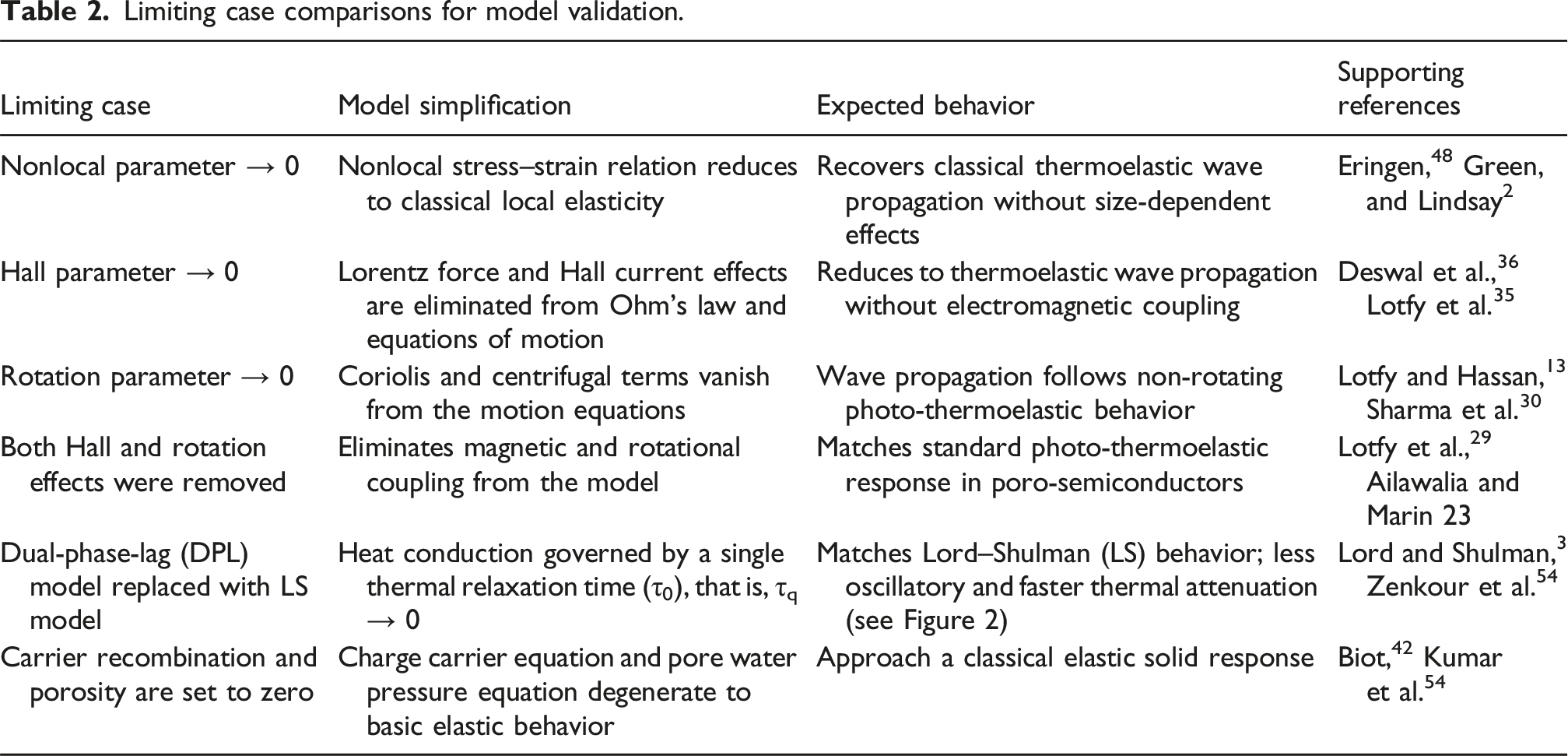
Limiting case comparisons for model validation.
Conclusion
The observed variations under the influence of Hall currents can be attributed to the Lorentz force, which modifies the distribution and dynamics of charge carriers. This, in turn, affects the thermal and mechanical responses due to the coupled nature of the governing equations. The presence of rotation further complicates this interaction by introducing Coriolis forces, which alter the propagation pathways of the waves. The results highlight the more dynamic and oscillatory behavior of the DPL model compared to the LS model, emphasizing the role of phase lags in thermal and mechanical interactions. The LS model, with its single relaxation time, assumes an instantaneous relationship between the heat flux and temperature gradient, leading to a more localized and faster thermal response. This results in smoother and less dynamic wave propagation. The DPL model, on the other hand, incorporates two phase lags, one for the temperature gradient and one for the heat flux introducing delays in the thermal response. These delays enhance the coupling between thermal, mechanical, and electromagnetic fields, resulting in more oscillatory and prolonged wave behavior. The inclusion of rotation introduces Coriolis forces, which act as a stabilizing factor in the system. These forces redistribute energy within the medium, resulting in enhanced damping of thermal and mechanical waves. Increased oscillatory behavior reflects the gyroscopic influence of rotation on the medium’s response. Delayed wave attenuation occurs due to the combined effects of nonlocal interactions and rotational dynamics. The rotation and Hall current further amplify these effects by introducing Coriolis and Lorentz forces, which interact with the nonlocal thermal and mechanical responses. The rotation adds gyroscopic effects to the wave dynamics, while the Hall current modifies the charge carrier distribution and stress responses. Together, these factors create a complex interplay of forces that is more pronounced in the DPL model, making it more suitable for capturing realistic wave behavior in advanced semiconductor applications. These findings underscore the importance of Hall’s current effects in engineering applications, particularly for materials and devices operating in rotational environments with strong electromagnetic interactions, such as in sensors, actuators, and energy devices. The DPL nonlocal model successfully captures the nuanced interplay between these factors, providing a robust framework for studying such complex systems. The influence of rotational dynamics in semiconductor systems has become increasingly relevant in modern applications such as MEMS gyroscopes, rotating microsensors, laser-based scanning systems, and orbital semiconductor devices. In these environments, rotation induces Coriolis and centrifugal forces, which can alter the motion of charge carriers and modify the propagation of thermal and mechanical waves. These effects are particularly pronounced in nanostructured materials, where the interaction between rotational inertia and elastic fields becomes critical to wave attenuation, damping, and signal integrity. Therefore, incorporating rotation in the theoretical framework is essential for capturing real-world behavior in semiconductor systems operating under dynamic or angular motion.
The application of photo-thermoelasticity theory is critical in semiconductor technologies that involve localized optical excitation, such as laser diodes, thermal sensors, photodetectors, and MEMS-based thermal actuators. In these devices, the absorption of laser energy leads to rapid heating, generating both thermal gradients and mechanical deformations. Accurately modeling this interaction helps in predicting stress-induced failures, optimizing heat dissipation, and improving signal fidelity in nanoscale systems. The present study provides theoretical insights into these coupled effects under the influence of Hall currents and rotational dynamics, offering potential benefits for the design of high-precision optoelectronic and photothermal semiconductor components.
Footnotes
Acknowledgment
The authors extend their appreciation to Princess Nourah bint Abdulrahman University for funding this research under Researchers Supporting Project number (PNURSP2025R154), Princess Nourah bint Abdulrahman University, Riyadh, Saudi Arabia.

Author contributions
All authors have equally participated in the preparation of the manuscript during the implementation of ideas, findings, results, and writing of the manuscript.
Funding
The authors extend their appreciation to Princess Nourah bint Abdulrahman University for funding this research under Researchers Supporting Project number (PNURSP2025R154), Princess Nourah bint Abdulrahman University, Riyadh, Saudi Arabia.
Declaration of conflicting interests
The author(s) declared no potential conflicts of interest with respect to the research, authorship, and/or publication of this article.
Data Availability Statement
Current submission does not contain the pool data of the manuscript, but the data used in the manuscript will be provided on request.