




Abstract
Fractional oscillators can effectively deal with noise in the vibration. This paper adopts He’s fractional derivative, which is defined through the variational iteration algorithm. Ji-Huan He’s amplitude–frequency formulation is used to solve the fractional Duffing equation.
Introduction
Noise arises everywhere in nonlinear vibration, for example the stock trend oscillates stochastically with time; a bridge vibrates random with winds. The noise occurs when it is measured in macroscales; however, when it is observed in an extreme small scale, i.e. time becomes discontinuous, noise disappears. Discontinuous time appears widely in microphysics1–3 and tsunami motion,4,5 and a fractional model can describe a phenomenon in discontinuous time.
In this paper, we will use the fractional model to study the fractional Duffing equation. There are various definitions on fractional derivatives.6–12 This paper uses He’s fractional derivative,13–16 which is defined through the variational iteration algorithm. 17
We consider the following linear equation of nth order

By the variational iteration method,6,17 we have the following exact solution

Introducing an integration operator

We have the following definition on fractional derivative
6

Fractional Duffing equation
In microphysics, time is discontinuous, and the Duffing oscillator in the discontinuous time can be written in the form

Liu et al. 18 found jump phenomena in a fractional Duffing equation, which is forbidden in classic Duffing equation.
Equation (5) reveals that amplitude varies discontinuously with time in microphysics and tsunami motion.4,5
The tsunami wave, in any macroscales of time, is continuous. It can travel, for example, from some a place in the Pacific to some a coast; the motion can be tracked by the satellite positioning. However, what we observe is the main wave of the tsunami motion, which can be described approximately by the continuum mechanics. The tsunami motion always causes many water drops, this phenomenon cannot be exactly modeled by the continuum mechanics, but the drop can be modeled using Lagrangian frame instead of Eulerian frame which is widely used in fluid mechanics. Additionally, the wave surface might oscillate due to the interaction with air. The surface oscillation of the tsunami wave can be described in Lagrangian frame. As the time scale is smaller than that used in the continuum mechanics, so it becomes discontinuous and a fractional model is needed. 6
In this paper, we will use Ji-Huan He’s19,20 amplitude–frequency formulation to solve equation (5). The steps are given below.
By the fractional complex transform6,12,21


To solve the nonlinear Duffing equation, we consider first a linear oscillator

The square of its frequency can be immediately obtained, which is

Alternative formulae for equation (9) are listed below


Now we extend above formula to nonlinear cases. For equation (7), we have

Hereby
Finally, we obtain the following solution

The
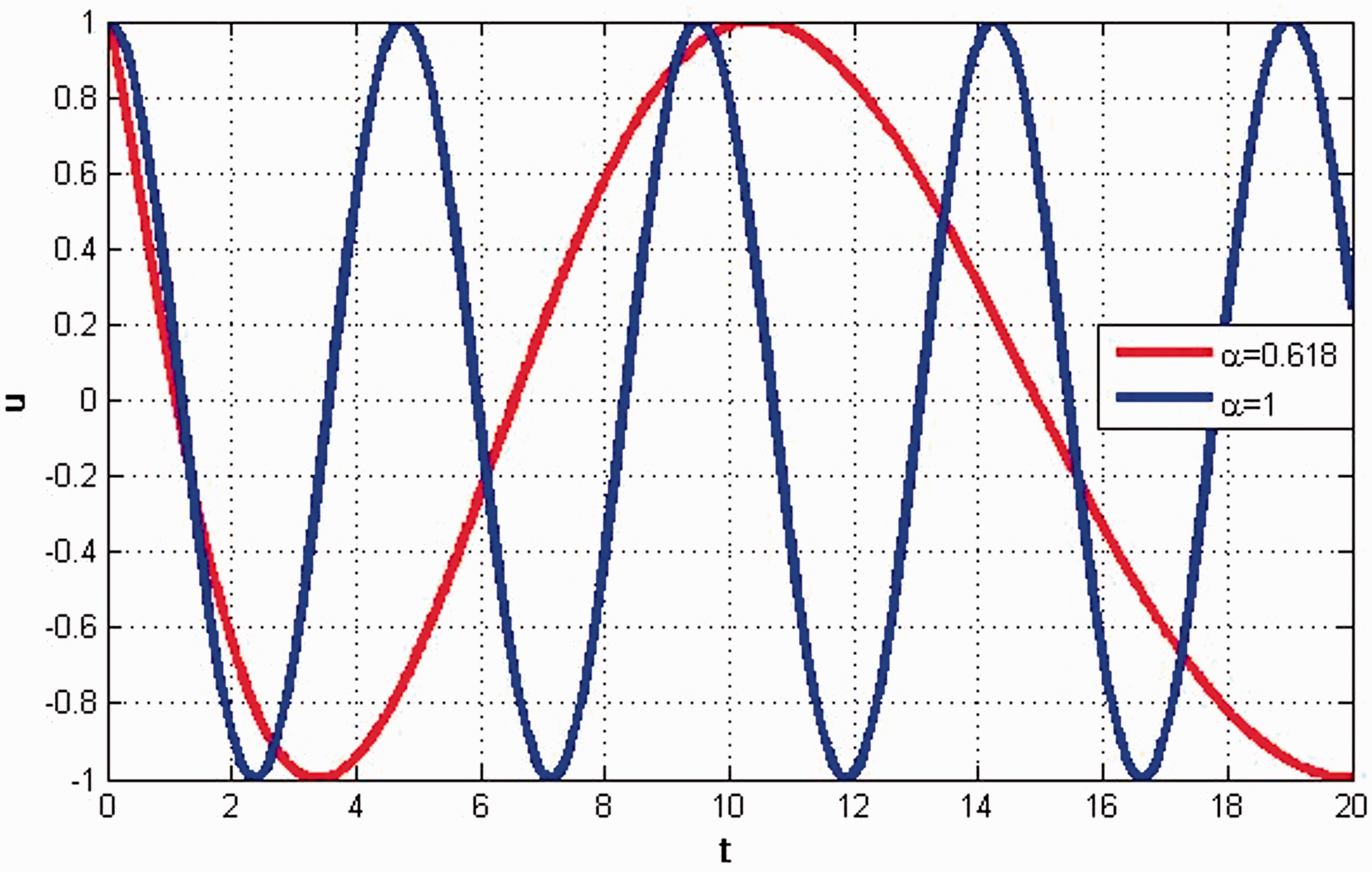
Effect of the fractional order on the frequency (
Discussion and conclusions
This paper, for the first time ever, suggests a fractional oscillator to describe noise in nonlinear vibration systems. The fractional nonlinear oscillators can be also solved by the homotopy perturbation method22–26 and other methods. Tian and Liu 27 summarized some other amplitude–frequency formulas for classical nonlinear oscillators, and our technology can easily be extended to all amplitude–frequency formulas for their fractional partners.
In this paper, we introduce a fractional derivative defined in equation (4) to describe a nonlinear vibration in microphysics. Bridge vibration or beam vibration with random perturbations, or the vibration of a trapped molecule, ions, nanoparticle on a nanofiber membrane 28 can be considered as a discontinuous time model, and the noise can be modeled with fractional calculus.
Footnotes
Declaration of conflicting interests
The author(s) declared no potential conflicts of interest with respect to the research, authorship, and/or publication of this article.
Funding
The author(s) received no financial support for the research, authorship, and/or publication of this article.