




Abstract
The stochastic nonlinear Kodama (SNLK) equation forced in the Stratonovich sense by multiplicative noise is considered here. New elliptic, hyperbolic, trigonometric, and rational stochastic solutions are acquired using (G′/G)-expansion method and mapping method. Because the SNLK equation is extensively used in is extensively used in nonlinear optics, fluid dynamics, and plasma physics, the obtained solutions may be used to study a broad range of relevant physical phenomena. In order to interpret the effects of multiplicative noise, the dynamic performances of the various obtained solutions are displayed utilizing 3D and 2D graphs. We infer that multiplicative noise impacts and stabilizes the solutions of SNLK equation.
Keywords
Introduction
Stochastic partial differential equations (SPDEs) are used to analyze the dynamics of random systems that show nonlinearity. SPDEs have various applications in a wide range of areas.1,2 In engineering, these equations are employed to simulate systems where uncertainty and randomness play a large role, such as signal processing, communication systems and control systems. In physics, they are utilized to examine the behavior of complex systems including biological systems, quantum mechanics, and turbulence. Furthermore, SPDEs are widely employed in finance to describe and forecast the behavior of stock prices, interest rates, and other financial variables that exhibit both randomness and nonlinearity.
Solving SPDEs is a challenging task due to the presence of randomness in the system. Numerical methods, analytical methods, stochastic calculus, and machine learning techniques are commonly used approaches to solve SPDEs. Further research in this area is needed to develop more efficient and accurate techniques for solving SPDEs and to better understand the behavior of stochastic systems. Recently, there are some analytical methods, including improved (G′/G)-expansion method, 3 mapping method,4,5 qualitative theory of dynamical systems, 7 tanh–coth method, 6 Riccati equation mapping, 8 and F-expansion technique, 9 have been created to acquire the exact solutions for SPDEs.
In this study, we focus on the stochastic nonlinear Kodama (SNLK) equation forced by multiplicative noise:


The nonlinear Kodama equation (2) exhibits interesting phenomena such as solitons, which are self-reinforcing solitary waves that maintain their shape and speed as they propagate. Solitons are a common feature of nonlinear dispersive systems and have important applications in telecommunications and information processing. By using the nonlinear Kodama equation, researchers can study the properties of solitons and other nonlinear wave phenomena to gain insights into the dynamics of complex systems. Overall, the equation plays a crucial role in advancing our understanding of wave propagation in nonlinear dispersive media. Because of the significance of the nonlinear Kodama equation (2), many researchers have obtained its solutions using various approaches such as Lie symmetries group and planar dynamical system, 10 modified Jacobi method, 11 ansatz method, 12 generalized Jacobi elliptic method, 13 etc.
The originality of this article is that we get exact stochastic solutions for the SNLK equation (1). To the best of our knowledge, this is the first time such solutions have been obtained. The (G′/G)-expansion method and mapping method are two different methods that used to find various types of solutions. We further investigate the influence of the stochastic term on the obtained solutions by presenting many 3D and 2D graphs.
The paper is arranged as follows: In next section, we introduce the definition of SWP, while the wave equation of the SNLK equation (1) is deduced in Section 3. In Section 4, we employ the modified mapping method to attain the solutions of SNLK equation (1). In Section 5, we display the effect of BM on the obtained solutions of SNLK equation (1). Finally, the paper’s conclusion is introduced.
Standard Wiener process
The Standard Wiener process (SWP), also known as the Brownian motion, is a fundamental concept in mathematics and physics. It is named after the mathematician Norbert Wiener who first introduced it in the early 20th century. The process is characterized by the random motion of a particle in a fluid due to the collisions with the molecules of the fluid. This motion is continuous, stochastic, and exhibits certain statistical properties that make it a valuable tool in various fields of science.
From this point, let us define the SWP
The stochastic process 1. 2. 3. 4.
The following lemma is required for our results 15 :
In probability theory and stochastic analysis, many kinds of the stochastic integral have been produced. 16 One of the most well-known kinds is the Itô integral. The Itô integral is employed to construct a stochastic integral in terms of continuous semimartingales that are a type of stochastic processes that includes Wiener process.
The Stratonovich integral is another kind of the stochastic integral. The Stratonovich integral is an alternate formulation that varies from the It ô integral in principles of stochastic calculus. The Stratonovich integral is widely utilized in physics and engineering since it is independent of the stochastic process’s specific description.
Modeling problems typically decide which form is acceptable; nevertheless, once one is chosen, an equivalent equation of the other kind can be generated with the same solutions. Thus, it is possible to change between Stratonovich (denoted by

Traveling wave equation for SNLK equation
We utilize



Plugging equations (5) and (6) into equation (1), we get for imaginary part










Exact solutions of SNLK equation
We use two distinct methods to get the solutions of equation (14). These methods are (G′/G)-expansion method 17 and mapping method. 18 After that we use the transformation (4) to get the solutions of the SNLK equation (1).
The (G′/G)-expansion method
Supposing the solutions of the equation (1) take the form









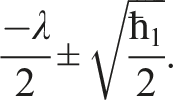
Family I: If ℏ1 = 0, then


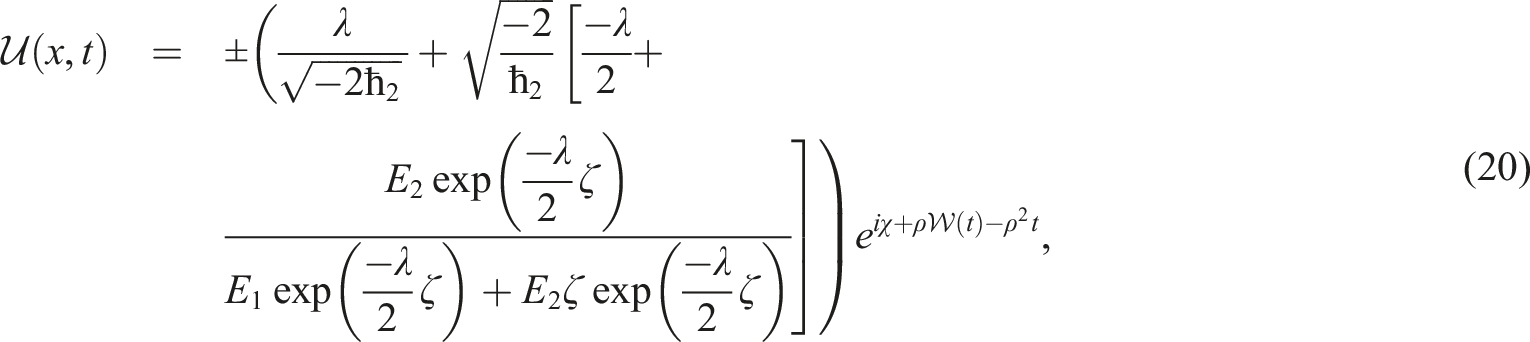
where ζ = ζ1x + ζ2t.
Special Case: If we set λ = 0 in equation (20), then we get


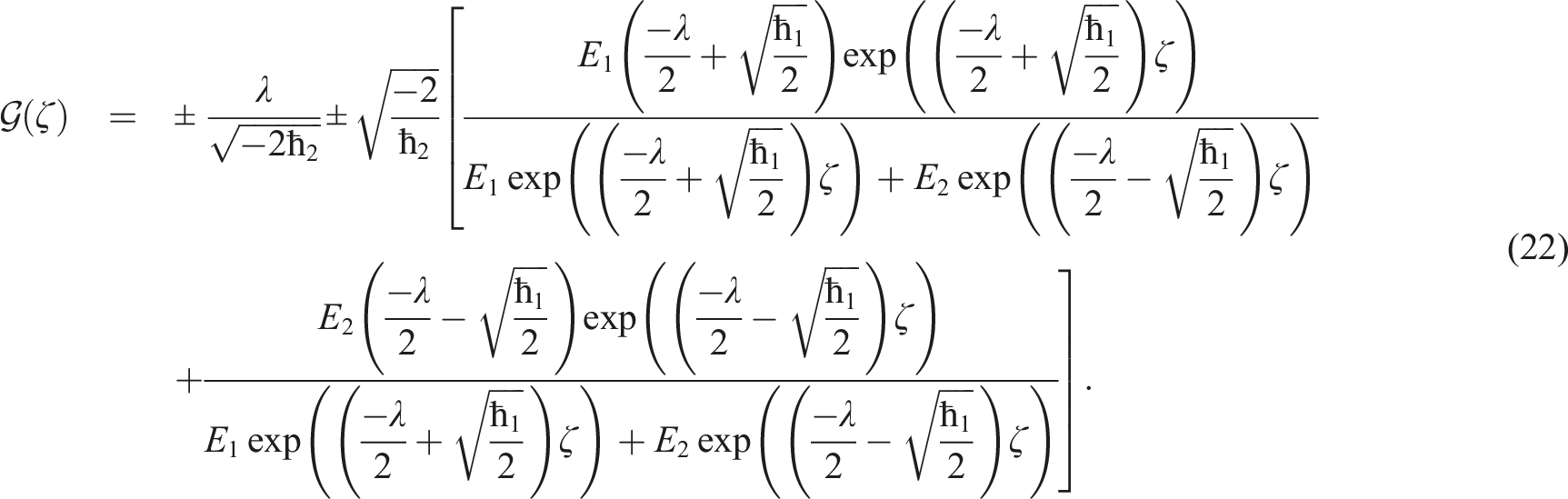
As a result, the solutions of the SNLK equation (1) are
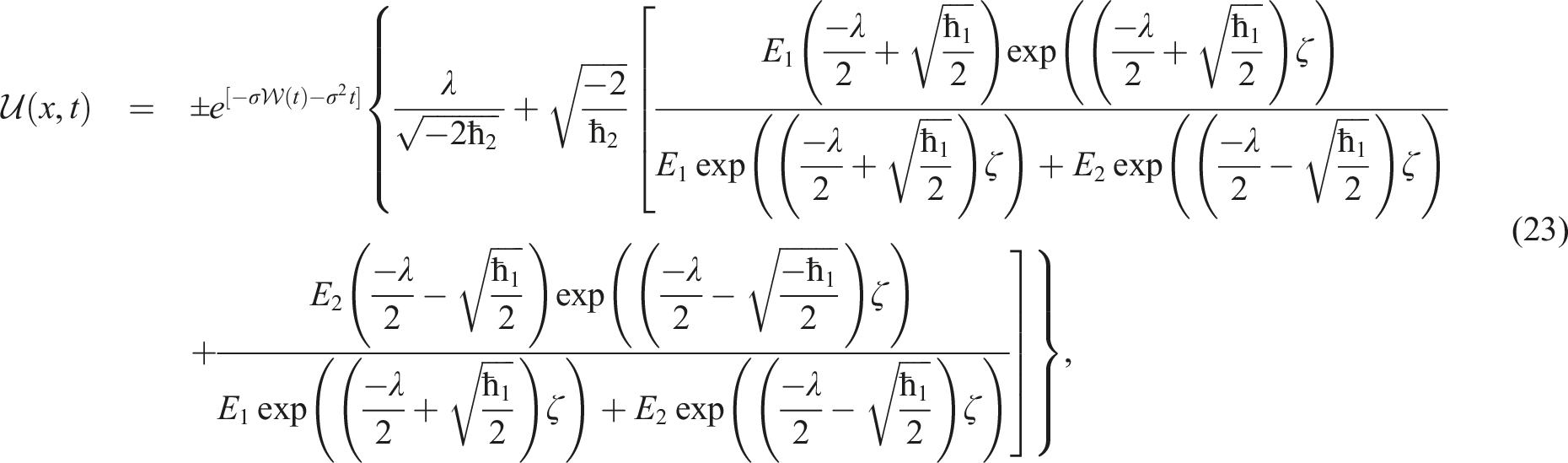
where ζ = ζ1x + ζ2t.
Special Cases:
Case 1: If we set E1 = E2 = 1 and λ = 0 in equation (23), then for ℏ1 > 0 and ℏ2 < 0, we have

Case 2: If we set E1 = 1, E2 = −1 and λ = 0 in equation (23), then for ℏ1 > 0 and ℏ2 < 0, we have



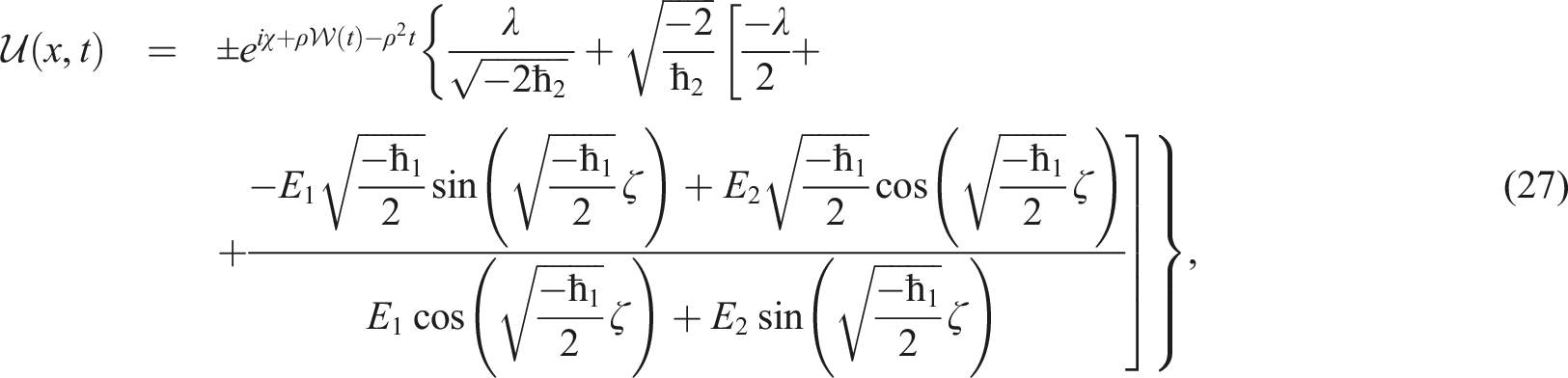
where ζ = ζ1x + ζ2t.
Special Cases:
Case 1: If we set E2 = 0 and λ = 0 in equation (27), then we attain for ℏ1 < 0

Case 2: If we choose E1 = 0 and λ = 0 in equation (27), then, for ℏ1 < 0 and ℏ2 < 0, we get

Case 3: If we choose E1 = E2 = 1 and λ = 0 in equation (27), then, for ℏ1 < 0 and ℏ2 < 0, we have

Case 4: If we choose E1 = E2 = 1 and

Case 5: If we choose E1 = E2 = 1 and

Mapping method
Here, we implement the mapping method mentioned in 18. Considering the solutions of equation (14) with M = 1 as follows





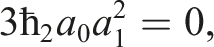



Hence, by using equations (4), (32), and (35), the solution of equation (1) is

Case 1: If

When

Case 2: If



Case 3: When



Case 4: If


Case 5: If


Case 6: If


Case 7: If

Case 8: If



Case 9: If


Case 10: If


Case 11: If



Case 12: If


Case 13: When α1 = 1, α2 = 0 and α3 = 0, hence

Impacts of noise
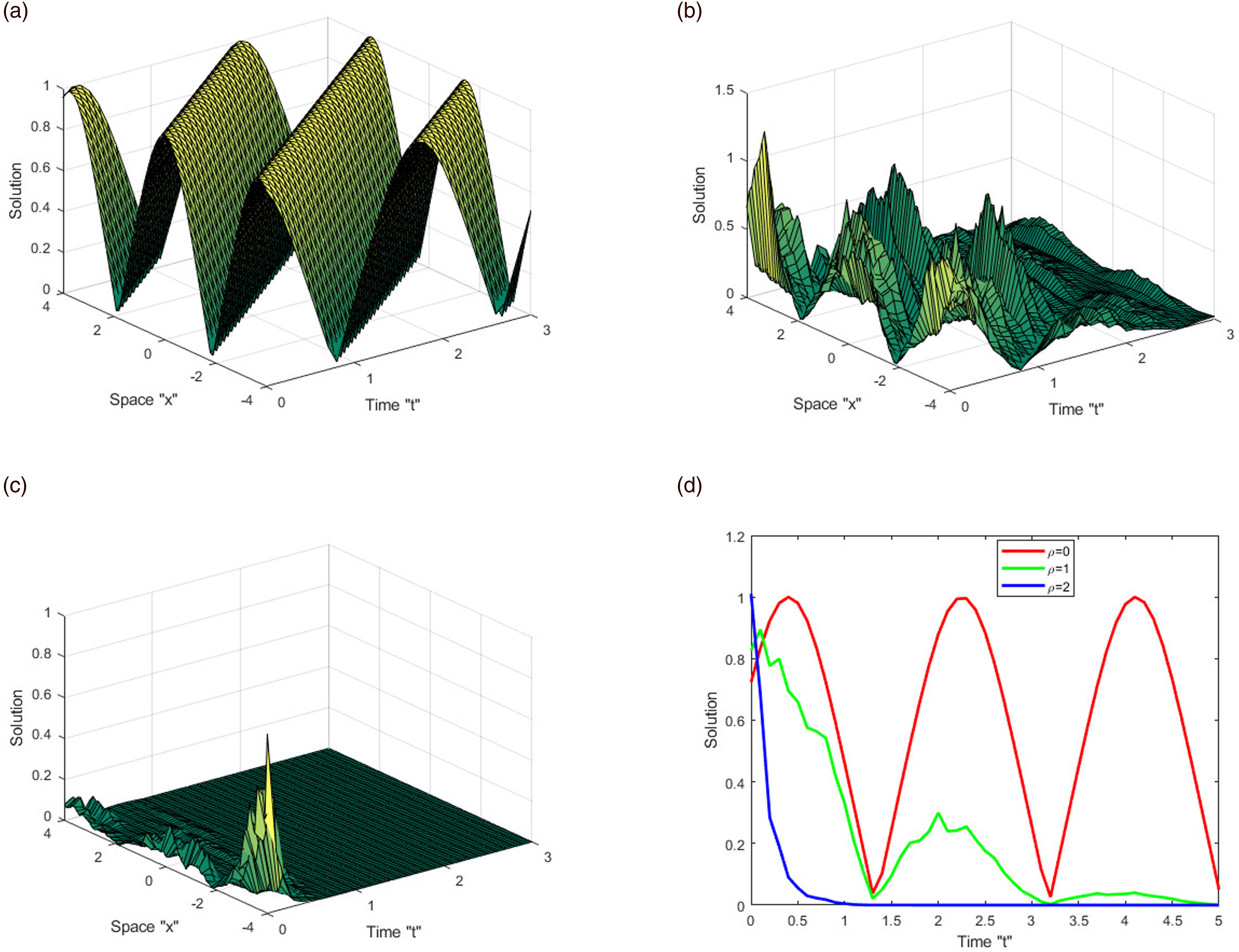
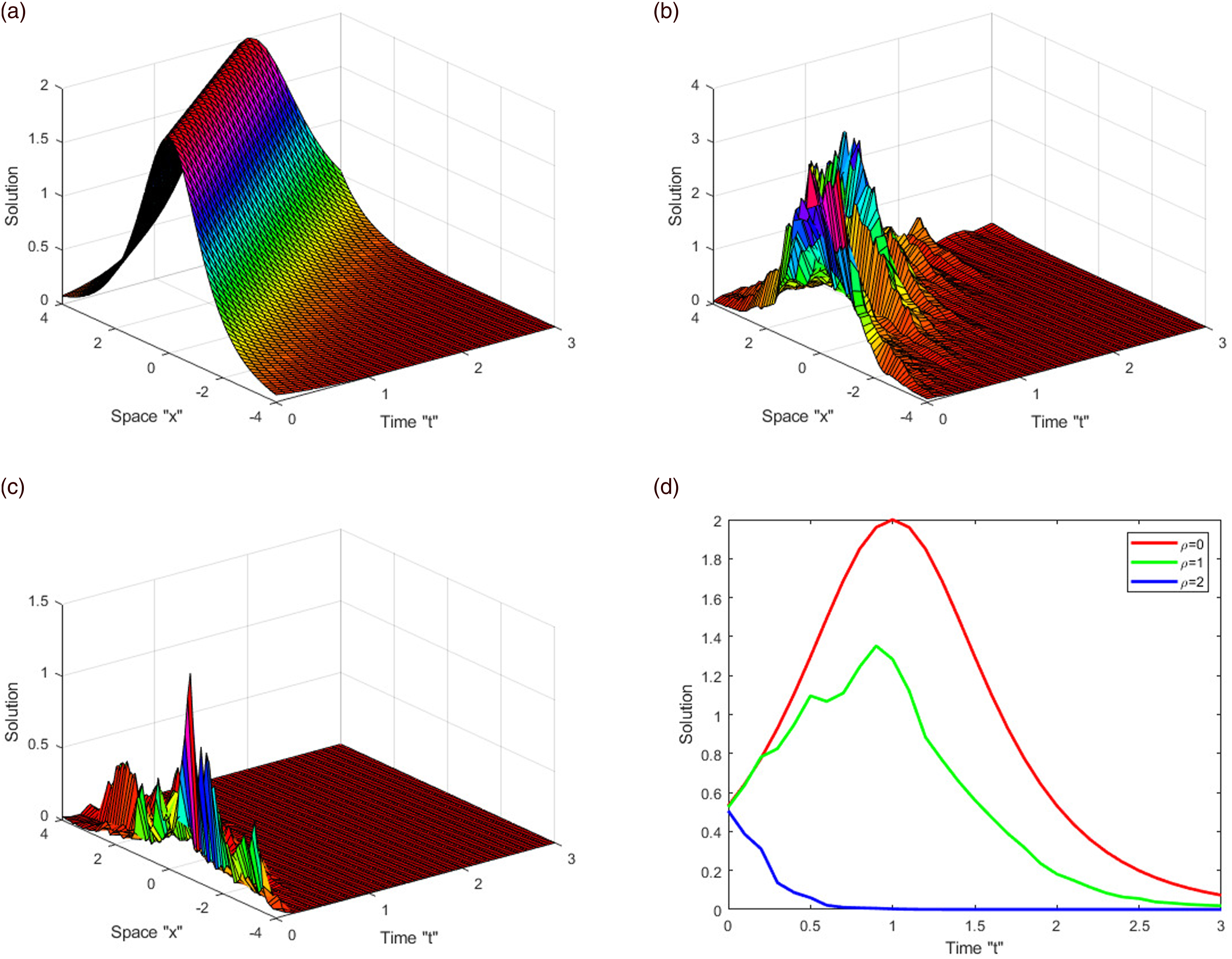
Brownian motion’s influence on the exact solution of the SGNLSE (1) is examined in this section. A number of diagrams, for instance, (37), (38), and (62), are presented in order to visually depict the behavior of certain solutions that were obtained. We use MATLAB tools (see, for instance, (19) to plot our figures. First, let us fix the constants γ1 = 2, ζ1 = χ1 = 1, ζ2 = −2, x ∈ [−4, 4] and t ∈ [0, 3] to plot these figures as follows:
Now, we can see from Figures 1−3 that there are many kinds of solutions exist when SWP is ignored (i.e., when ρ = 0), including kink solutions, periodic solutions, singular solutions and so on. When noise is added and its noise intensity is increased to ρ = 1, 2, the surface becomes flatter after some transit patterns. This result indicates the influence of multiplicative noise on the solutions of SNLK equation (1), whose effects keep the solutions stable around zero.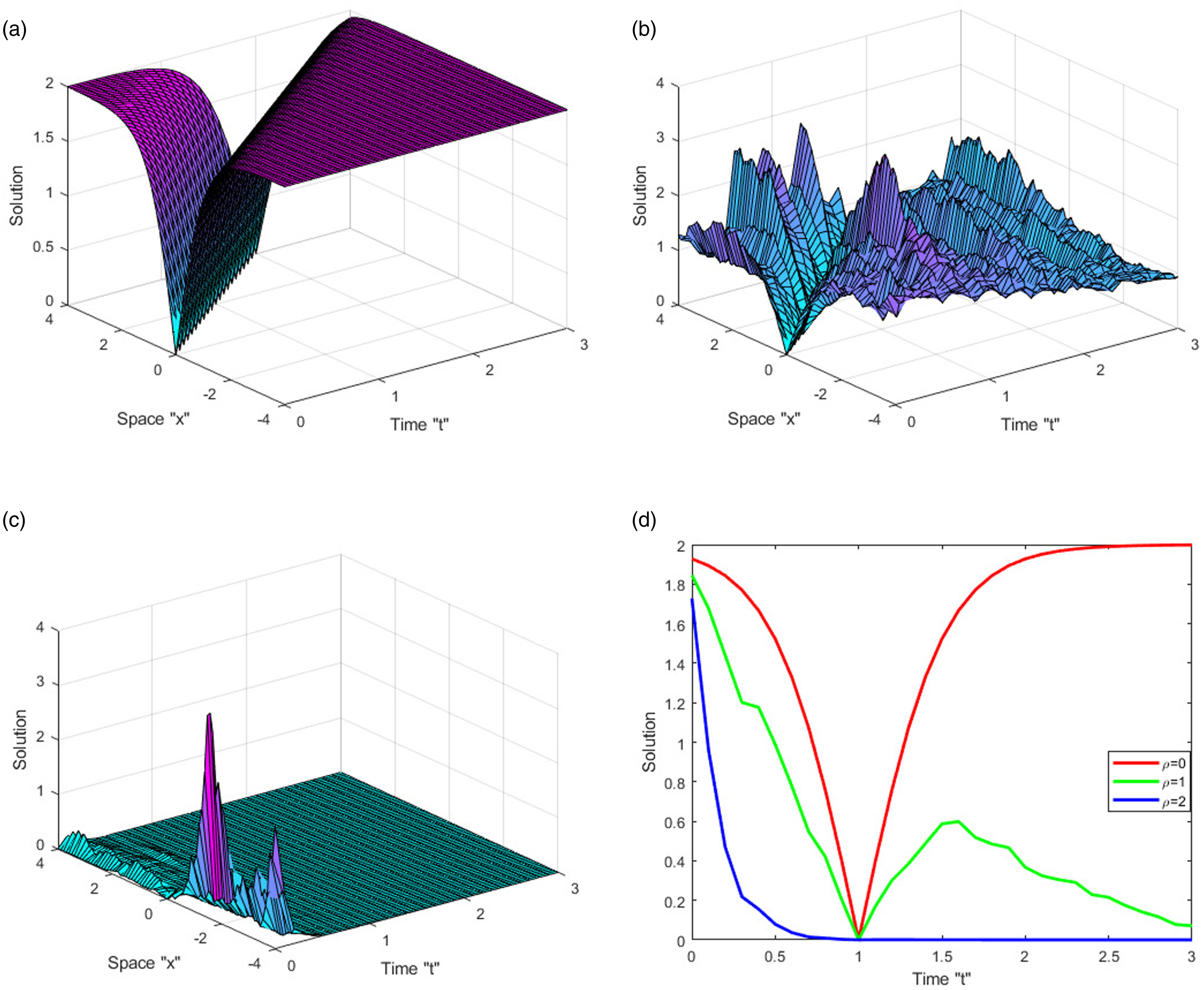
Conclusions
In this study, we looked at the stochastic nonlinear Kodama (SNLK) equation forced by multiplicative noise in the Stratonovich sense. By using (G′/G)-expansion method and mapping method, exact stochastic solutions of SNLK equation were obtained. These methods are effective and simple. Also, they give us different kinds of solutions, such as elliptic, hyperbolic, trigonometric, and rational solutions. Because the SNLK equation is extensively used in nonlinear optics, fluid dynamics, and plasma physics, the obtained solutions may be utilized to study an extensive number of relevant physical phenomena. Furthermore, the Wiener process impacts on the exact solutions of SNLK equation (1) were shown using the MATLAB software. We investigated that the standard Wiener process stabilized the solutions at zero.
Footnotes
Acknowledgments
This research has been funded by the Scientific Research Deanship at the University of Ha’il-Saudi Arabia through project number RG-23237.
Declaration of conflicting interests
The author(s) declared no potential conflicts of interest with respect to the research, authorship, and/or publication of this article.
Funding
The author(s) disclosed receipt of the following financial support for the research, authorship, and/or publication of this article: This work was supported by the University of Ha’il-Saudi Arabia (RG-23237).
