




Abstract
The nonlinear Schrödinger’s equations (NLSEs) is a famous model used to investigate the propagation of optical solitons via nonlinear optical fibers. We applied the unified solver method in order to extract some new stochastic solutions for three types of NLSEs forced by multiplicative noise in Itô sense. The acquired solutions describe the propagation of solitons in nonlinear optical fibers. We exhibit the influence of presence of noise term on the solution for the NLSEs. The theoretical analysis and presented solutions illustrate that the proposed solver is powerful and efficient. Finally, the wave amplitudes may be controlled by the effects performance of physical parameters of the NLSEs in the presence of noise term in Itô sense. Finally, we present He’s frequency formulation.
AMS subject classifications: 35A08, 35A22, 35C08, 60H10, 60H15, 35Q55, and 35Q60
Introduction
The nonlinear wave phenomena plays a fundamental role in different fields of natural sciences, like nonlinear optics, superfluid, high-energy physics, biology, nuclear physics, gravitation, engineering, solid state physics, and so on.1–6 Noise (randomness) is of great importance in many phenomena, thus it has become important to involve random effects when explaining different physical phenomena in chemical engineering, physics, economy, digital simulation, robotics control, networked systems, and many others.7,8 The nonlinear partial differential equations (NPDEs) that consider time-dependent randomness are called stochastic NPDEs. The nonlinear wave phenomena exist for solutions of deterministic and stochastic NPDEs.9–11 Various studies focused on the nonlinear wave in NPDEs and their applications.12–19
Consider nonlinear partial differential equation for

Utilizing wave transformation:



Various models in natural sciences presented in form of equation (1.1), converted to the following duffing ODE
20
:

The nonlinear Schrödinger equations (NLSEs) mainly describe the dynamics of optical soliton promulgation in optical fibers, electromagnetic wave propagation, deep water, plasma physics, super conductivity, quantum electronics, magneto-static spin waves, optoelectronics, and photonics.24–28 Many real circumstances of media have given various forms of the NLSEs, such as cubic nonlinear term; cubic-quintic-septimal nonlinear terms; derivative nonlinear term and other more. Lebowitz et al.
29
investigated the statistical mechanics of a complex field whose dynamics is determined by NLSE. Such fields characterize in suitable idealizations, Langmuir waves in a plasma and a propagating laser field in a nonlinear medium. Recently, the NLSEs have acquired significant attention and have been a point of discussion of various studies, like auxiliary equation approach; sine-Gordon expansion approach;
This article is organized as follows. The closed-form structures introduces the closed-form solutions for a wide range of NPDEs. Nonlinear Schrödinger’s equations forced by multiplicative noise in Itô sense presents some new stochastic solutions for the NLSE forced by multiplicative noise in Itô sense. Results and discussion gives the explantation for the acquired solutions for the stochastic NLSEs. We also introduce He’s frequency formulation for the duffing equation. Finally, conclusion is provided in Conclusions.
The closed-form structures
We give closed-form solutions for the following equation:

In view of the unified solver technique introduced in ref. 21, the solutions for equation (2.1) are





Nonlinear Schrödinger’s equations forced by multiplicative noise in Itô sense
The proposed closed-form of solutions is tested through a range of applications. Namely, we applied this solver to different forms of the NLSEs in presence of noise term in Itô sense.
NLS +
We first consider the NLSE given by:

Using wave transformation
34


The solutions for equation (3.1) are:










NLS −
We second consider the NLSE given by:









The solutions of equation (3.16) are




The complex cubic NLSE with δ-potential
The complex cubic NLSE with repulsive δ-potential forced by multiplicative noise in Itô sense is

Utilizing wave transformation


The solutions for equation (3.29) are:










1. The proposed solver in this work can be applied for the large classes of nonlinear stochastic partial differential equations (NSPDEs). 2. The presented solver can be easily extended for solving nonlinear stochastic fractional partial differential equations (NSFPDEs).38–40 3. The proposed solver avoids complex and tedious calculations and presents vital solutions in an explicit way.
Even the presented solver can be utilized to solve all classes of NPDEs reduced to form (2.1), it is fail to solve other classes of NPDEs, which considered a disadvantage of the proposed approach.
Results and discussion
To illustrate the propagations of optical profiles in appropriate fiber environments modes, it is indispensable to solve NLSEs. We present the solutions for different forma of NLSEs forced by multiplicative noise in Itô sense. The closed-form structure of waves has been efficiently introduced to construct various new solutions involving rational, trigonometric, hyperbolic functions in the explicit form. These solutions represented the nonlinear wave propagation in optical fibers communications. These optical features emerge from rational, trigonometric, and hyperbolic function properties along with complex structures. In this respect, from physical and mathematical points of views, the presented results play a crucial role in explaining wave propagation of NLSEs arising in optical fibers. For example, Kerr law nonlinearity of NLSE emanates when a light wave in an optical fiber faces nonlinear responses from nonharmonic motion of electrons bound in molecules, caused by an external electric field. 41 Indeed, the behavior of acquired solutions are soliton, periodic, explosive, rough or dissipative, is an indication for the physical parameters in the NLSEs. For example, the behavior of wave varies from compressive to rarefactive at critical points and stability regions varies to unstable regions at certain values of wave number called critical values.42–44 The shock and periodic solutions produced in stability regions. The instability regions are represented in presence of waves increase extremely like huge waves see.45–49 The presented solutions realize very significant fact for investigation the qualitative interpretations for various phenomena in our nature. It was expected that the acquired profiles can be interpret the fundamentals of Bloch, capillary profiles, plasma physics, nonlinear optics, spatiotemporal pattern, modeling of deep water, femtosecond pulse, and switching techniques.50–53 Moreover, the presented solver is a straightforward sturdy and efficient.
The amplitude (strength) of a wave is its height, which is, half the distance from trough to crest. Amplitude can be measured for sound wave traveling through air, water waves, or for any other kind of wave through a liquid or a gas. Even waves traveling through a solid have an amplitude, as in waves shaking the earth due to an earthquake. The amplitude of a quantum wave is also called the probability amplitude. The output of the key equation of quantum mechanics, the NLSE, is probability densities. In sequel we present the effect of the noise term on the amplitude of the waves. Also, it was spotted that our new forms are concerning to the real observed physics that depends on the nonlinearity coefficients.
The effect of γ
One of the fundamental aims of this work is to clarify the effect of γ on the properties of the wave modes. Figure 1 depicts the profile of solution (3.12) for distinct values of γ. In Figure 1 the variation of solutions with x has been plotted. By increasing γ the amplitude of optical soliton solution (3.12) is decreased. Also, no any shift or direction reverse in this amplitude. Variations of solution (3.12) for γ = 2, 4, 6, 8.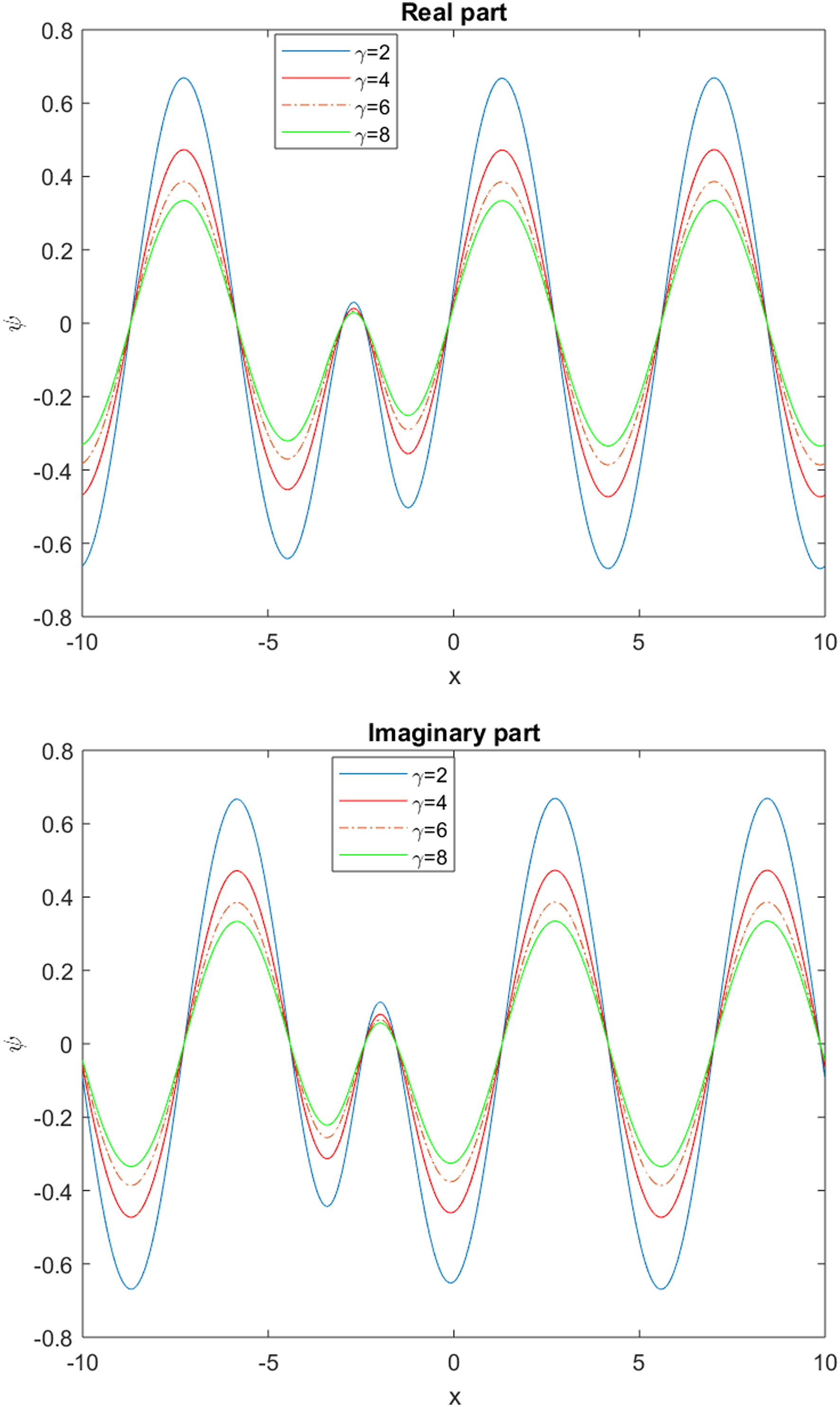
He’s frequency formulation
For the sake of completeness of this article, we present He’s frequency formulation. We noted that there are so many types of partial differential equation (1.1) transferred to the ODE (1.5). Equation (1.5) is equal to autonomous planar dynamical system

The above system of equations

A necessary and sufficient condition for planar system (4.1) to be a Hamiltonian system is

Our system (4.1) is a Hamiltonian system with Hamiltonian function

Equation (1.5) looks like the equation
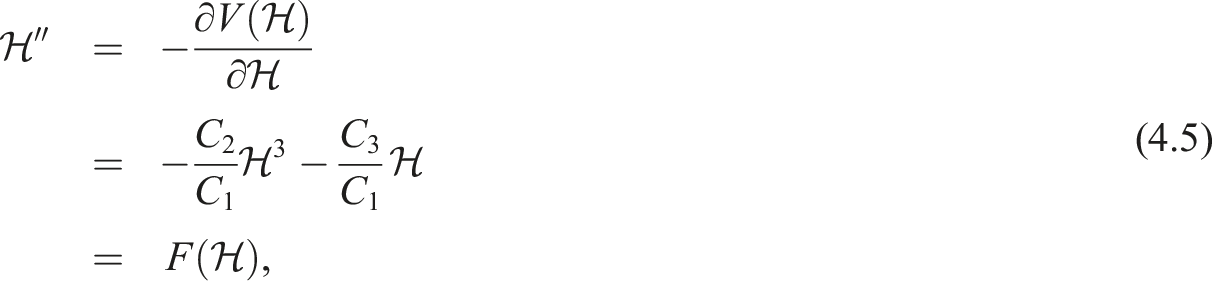
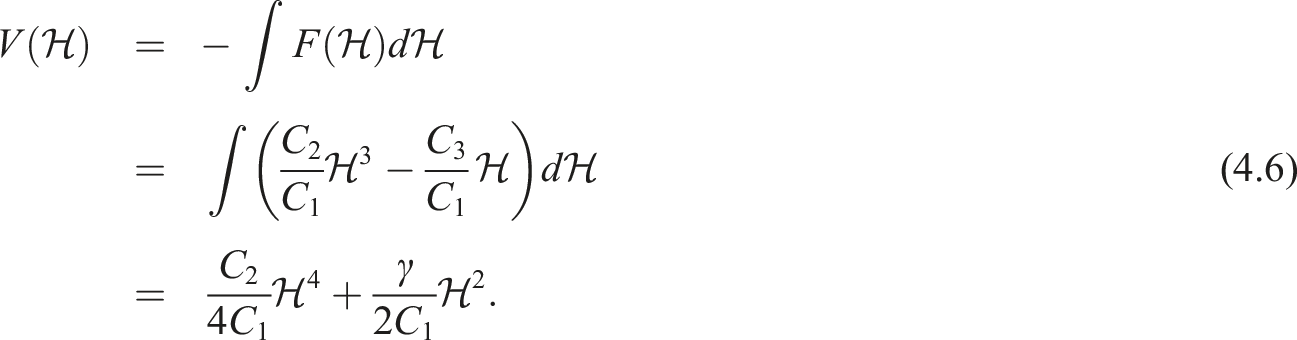

Also He’s frequency formulation
54
is accessible and extremely simple. Equation (4.5) can be written in the form:


Conclusions
The current work involves three families of stochastic NLSEs forced by multiplicative noise in Itô sense. We implemented the closed-form wave structures, as an efficient technique for extracting solutions of stochastic NLSEs. We successfully obtained optical solitons for the proposed three equations. Special values of the physical parameters were used to draw the profiles pictures of acquired soliton solutions. Our work shows that the proposed closed-form structures is effective in dealings with NPDEs to construct various classes of new stochastic solutions. Finally, the proposed solver can also be applied to further models arising in natural science.
Footnotes
Authors’ contributions
All authors contributed equally to the writing of this paper. All authors read and approved the final manuscript.
Declaration of conflicting interests
The author(s) declared no potential conflicts of interest with respect to the research, authorship, and/or publication of this article.
Funding
The author(s) received no financial support for the research, authorship, and/or publication of this article.
Availability of data and materials
Data sharing not applicable to this article as no datasets were generated or analyzed during the current study.
