




Abstract
Numerical methods in the area of nonlinear systems are extensively implemented for computing their approximate solutions because these systems are very difficult to tackle analytically. There are various numerical techniques available in the literature to find the solutions of nonlinear oscillators. Variational iteration method (VIM) is one of these approaches which is convenient to implement for these kinds of problems. In this work, our study aims to identify the numerical solution of nonlinear oscillator by making use of variational iteration method associated with Formable transformation. For the smooth utilization of this approach, we have to formulate the Lagrange multiplier through variational theory. Furthermore, we develop a new unified iterative scheme for the correction functional of VIM, considering the Formable transformation. Several new schemes of correction functional can be deduced from the newly proposed method considering the duality relation of Formable transform. In support of our primary finding, we discuss numerical example as application. A number of Physical applications of nonlinear oscillators are available in the field of vibrations and oscillations but in recent times nonlinear oscillators are used to describe complicated systems or to address mechanical, electrical, and other engineering phenomenon.
Keywords
Introduction
The idea of nonlinear oscillator systems 1 originated from the term “sustained oscillation”; these are controlled and designed by an external power. It also referred to self-sustaining oscillations created in singing arcs, series-dynamo machines, and triode-like systems. Carinena et al.2,3 discussed classical nonlinear oscillator; they used a position-dependent mass system and proved it to be super integrable under bounded motion. The position-dependent mass system, one-dimensional quantum nonlinear oscillator, and periodic motions are used in the paper; during this work, we noticed it helps not only in generalization but also preserves the super-integrability property. In another work, they showed the Lagrangian description of the nonlinear oscillator for this mode and they took a generalized Riccati equation with constant preserved energy function and used suitable parameters for showing the behavior of solutions and proved that the orbits of the system represent a nonlinear oscillator. Durmaz et al. 4 worked on the approximate mathematical results of the physical model which is developed by considering stretched wire’s coupled mass. Most importantly, equation of motion was already discussed in depth at the beginning of the study. Efficient results were found by comparing the estimated analytical results and numerical results of high and low amplitude oscillations. Approximate errors are also calculated to show how much the numerical and approximate analytical results are associated. Qie et al. 5 illustrated the approach to compute the approximate outcome of the system having a large amplitude and of a highly nonlinear nature. He et al. 6 discussed the variational principle regarding nano-electro-mechanical mechanisms, especially in the case of nonlinear oscillators. J. He 7 purported various asymptotic approaches regarding highly nonlinear systems. Lu and Sun 8 utilized the new approach for solving time dependent Burgers equation. Lu and Chen 9 put forward the fractals approach for dealing with the nonlinear oscillators, especially Yao-Cheng oscillator. Lu and Ma 10 reported the fractional numerical proceedings on the mass-dependent coordinate. Wang and Liu 11 studied the mass-dependent coordinate of nonlinear oscillator. He 12 proposed a scheme for formal amplitude-period from the study of un-conserved oscillators by considering both scenarios. He et al. 13 analyzed the behavior of nonlinear oscillators over the fractal space; this case emphasized the fractal Duffing-Van der Pol oscillator. Tian 14 performed a study on the vibrational systems and reported the frequency formula subject to the fractal vibrational class. Ma 15 investigated nonlinear vibrational systems and purported a simplified formulation which is Hamiltonian-based frequency amplitude. This formulation is implemented easily on highly complex nonlinear models. He et al. 16 utilized the formulation of frequency amplitude which is Hamiltonian-based to the complex mechanical phenomenon for the quick determination of frequency of nonlinear oscillators. Li et al. 17 considered the model of a weld line in polymer processing and the multi-scale numerical approach implemented to tackle the problem numerically. He 18 expounded the nano-electro-mechanical model comprised of the fractal space and its behavior by using the variational principle.
Researchers use iteration methods for finding the solutions to nonlinear problems, mostly they use Newton’s method for solving ordinary problems but for higher-order problems, they implement variational iteration techniques and many more. He et al.’s 19,20,21,22,23,24 variational iteration technique, a novel technique to solve problems analytically, especially nonlinear issues, is described in this paper and utilized to get approximate solutions of various well-known nonlinear problems like nonlinear oscillators. The problems are first approximated with probable unknowns in this manner. A general Lagrange multiplier is then used to create a correction functional, which may be found optimally using variational theory and approximations obtained using VIM converge to its exact solution quickly. Its application to higher-order nonlinear systems like heat transfer and porous media equations, higher-order nonlinear boundary value problems, and generalized equilibrium equations shows accurate results. Fractal calculus is a straightforward yet powerful tool for dealing with porous media and stratified phenomena. Non-mathematicians can easily understand because advanced calculus and its functioning are nearly identical. To expose the essential principles of fractal calculus, in a fractal medium, the temperature variation over two positions is the fundamental idea of fractal gradient regarding temperature which initiates current work. After that, fractal material and fractal velocity derivatives are utilized to deduce the equations of heat conduction and fluid mechanics into a fractal space. Fractal space geometrical representation of mass conservation is described, and a nanofiber membrane illustrates a larger scale continuum companion from a smaller scale through the fractal space`s approximate transform. Marinković et al. 25 implemented abaqus on a 3-node shell same rotational piezo-electric having to drill freedom using Newton`s approach. He and Wu 26 explored the new approach by considering the recent developments and trends in physical applications. In detail, the discussion was performed on nonlinear fractional DEs, wave equations, and oscillations and their applications in a variety of engineering fields. Substantially, nonlinear equations were earlier never evaluated by implementing methodological methods, and for these systems, they started the interplay of symbol calculation with advanced mathematics which opens a new horizon for researchers and provide an idea to deal with these type of systems. The variational iteration technique looks appropriate to address these problems. Ganji and Sadighi 27 illustrated the comparison of VIM and HPM to other nonlinear methods and showed that VIM and HPM provide highly accurate numerical solutions for nonlinear systems. They also don’t necessitate a lot of computer memory or variable discretization. This method eliminates linearization and physically unfounded assumptions, as previously stated. Noor and Mohyudin 28 used the variational iteration method with He’s polynomials (VIMHP) to solve higher-order boundary value problems in this paper. Variational iteration and homotopy perturbation approaches are combined elegantly in the suggested method. The proposed algorithm is very efficient and is well-suited for usage in these scenarios. Several examples are provided to demonstrate the method’s dependability and efficiency. The ability of the proposed VIMHP to solve nonlinear problems without the use of Adomian’s polynomials is an obvious advantage of this approach over the decomposition method. Baleanu et al. 29 got analytical approximate solutions using a novel approach called the variational iteration method involving local fractional based on Kdv equations which are coupled and gas dynamics which are nonlinear homogeneous/non-homogeneous. For the iteration technique, integral and derivative operators of local fractional are utilized. The Laplace transform, which is defined on the fractal domain and the VIM technique, are combined in this method. In the above way, the procedure was easy and simple to use and excellent results are produced. The validity and application of the new technique are demonstrated through different examples. Dogan and Konuralp 30 applied fractional VIM to solve a nonlinear time-fractional PDE with time-taking proportions using the modified Riemann–Liouville fractional derivative. With the same data set and approximation order, the numerical solutions derived using this method are better than those obtained using the homotopy perturbation method and the differential transform method. Li et al. 31 illustrated that under dynamical cycling, the differential model for electrochemical capacitors produces a discontinuity in the electric current. Because of this paradox, the theoretical analysis of electrochemical capacitors is extremely complex, and there is no common approach to the problem. The fractal calculus is found to be an effective tool for solving the problem, and a continuous electric current may be obtained as it should be. Lu et al. 32 provided an effective computing strategy to evaluate systems of fractional DEs whether these are linear or nonlinear, known as DTM (Differential Transform Method) involving Elzaki fractional. The above technique is visualized in the convergent series evaluation by considering a moderate range of independent variables. The series solution is controlled and manipulated by this approach and the solution converges to the exact answer quickly and efficiently in a broad acceptable domain.
In engineering problems, estimation regarding nonlinear oscillators depends on the frequency formulation. For seeking simplest estimation, various analytical and numerical approaches are utilized. He 33 introduced finer and simplified approach for the fractional and nonlinear oscillators. Afterward, he gives us the frequency estimation of nonlinear oscillator involving duffing equation. Feng 34 utilized the He’s frequency estimation using the dual-scale fractal derivative for un-damped duffing equation. He et al.35–37 explained the implementation of fractal derivative for evaluating frequency-amplitude in which time approaches to infinity and also low-frequency variant of concrete beam based on fractal vibrating model. In fractal vibration systems, low-frequency property is as important as the damping force. Guojuan et al. 38 established the straightforward technique for solving nonlinear oscillator problems with the application of fractal space. Feng 39 investigated the pull-down theory of Toda oscillator as its pseudo-periodic property is also considered for studying the pull-down instability. Wang et al. 40 gave the idea that the unique hierarchical anatomy of polar hairs with golden ratio fractal proportions endows the organism with exceptional cool protection. In this study, fractal calculus is used to disclose the thermal properties of the hair and model for heat conduction in one dimension by taking hair as a medium formed through the use of the fractal derivative and then evaluating; the solutions motivated for cool prevention optimal length of hair is required. This research throws novel insight into materials that are bio-inspired for protection from fire apparel and severe environment attire. He and Ji 41 explained the procedure of how to approximate a 3D problem via 2D or 1D scaling, but in this process, we lose some information. In the perspective of fractional calculus, lower dimensional approach is used to decrease the higher dimension of the problems. Suleman et al. 42 studied He–Laplace approach for evaluating vibration equation’s solitary periodic solution. Tao et al. 43 recently gave an idea of another transformation named as Aboodh transformation for solving fractional problems and homotopy perturbation method used in it for getting solution. Differential equations (D.E) are an important part of mathematics because they have many applications in sciences and mathematical modeling.44,45 Anjum et al.46–48 investigated the asymptotic approach regarding the micro-electro-mechanical mechanism and also the analytical study of oscillators in the purview of already defined system. For the solution of nonlinear oscillators, dual modified HPM is utilized. VIM was implemented to enumerate the impact of instability constraint over the nano-electro-mechanical system. Wang and He 49 utilized variational iteration method to get the solution of integro-differential equations. Anjum et al. 50 used VIM approach to inquire the pull-in frequency in the nano-electro-mechanical systems. Rehman et al. 51 studied VIM involving the modified form of Laplace for the examination of mechanical systems. These also aid in finding the solution to physical and engineering problems that involve complex calculations with functions involving one or more variables like fluid flow, elasticity, temperature propagation, electrodynamics and so on. Agwa et al.’s 52 implemented different Integral transformations to solve ordinary, partial differential equations and dynamic equations with initial or boundary conditions; for these types of problems authors introduced a new integral transform named Sumdu Transform on a time scale. Datoli et al. 53 applied the integral transform method with operational techniques to initial value problems and get solutions, also introduced new families of special functions, and solved evolution-type problems very efficiently. Watugala 54 used the Sumudu transform to approximate the numerical solutions of ordinary, partial, mixed, and integro-differential equations and also used the inversion of transform to compute the fractional-based coefficients. Burqan et al. 55 introduced a new technique for finding the series solution of the time-fractional Navier–Stokes equation based on the Laplace transform and power series method. The proposed method gives accurate results of fractional physical problems. Numerical methods are used to approximate the solution of the Burgers equation using the Elzaki homotopy perturbation method, 56 the application of the Adomian decomposition method for analytical approximation of nonlinear equations, 57 and the variational iteration method applied to some generalized fluids flow with slip boundary conditions for computation of explicit solution. 58 For attaining better understanding to fractional nonlinear oscillator problems please see ref.59,60
Inspired by the work of Anjum and He64,65 and the newly defined transformation known as Formable transform, in the current study, we will investigate the numerical solution of nonlinear oscillator through the variational iterative method together with Formable transform to compute the iterative scheme. The novelty of our work is that our proposed iterative scheme unifies several existing iterative methods and many new iterative schemes can be developed as a special case by implementing the duality relations of under-consideration transformation. To complete this study, we have distributed our work in different sections, in the first portion of the study, we describe some basic preliminaries and facts which are essential for the current proceeding. In the forthcoming section, we discuss our problem, main results, numerical examples, and graphical illustrations to demonstrate the validity of our results. I hope the idea and technique will inspire the readers and bring motivation to them for further investigations.
Materials and methods
Preliminaries
In this section, we discuss the definition and theorems relevant to Formable transformation 61 and other involving transformations.
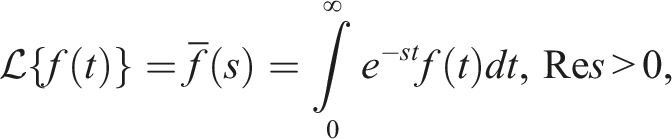
Laplace Transformation:
The Laplace transform of a function
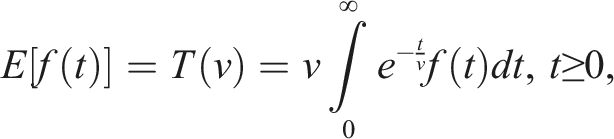
Elzaki Transformation:
The ELzaki transform of a given function is defined as
Sumdu Transformation:
The Sumudu transform of a given function is defined as

Formable Transform:
Consider a function

It can be written as



IFR of the function

By using Fourier transform definition
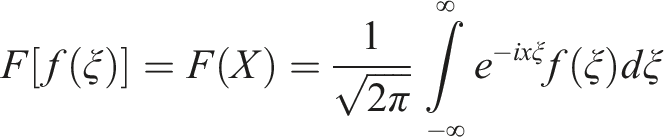

Therefore



Multiplying both sides of equation (2) by

Substituting

Defining f(


Thus, we have

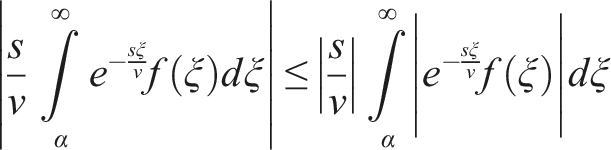
For the existence of the Formable transform`s sufficient condition. If piecewise continuous function
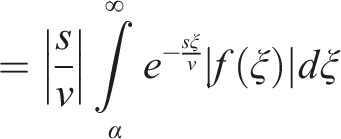
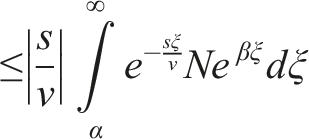
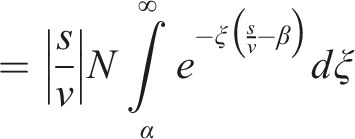
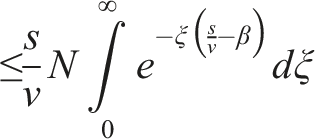
Suppose Since the function

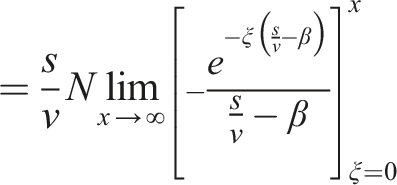
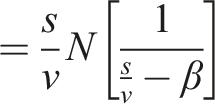
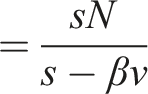
Duality relation with other transforms
We showed a relationship between Formable transform and other well-known transforms. This shows its easy applicability to the problem during computation; these relations also certify that our solution is accurate. • Formable-Laplace relation: let • Formable-Elzaki relation: let • Formable-Sumudu relation: let

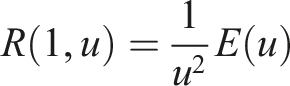

Problem statement
When we consider the system of a nonlinear oscillator in this system, we need a time-frequency relationship62,63 of nonlinear oscillators system. We took the problem of coordinate-dependent mass oscillator system as

Subject to initial constraints


The abovementioned equation (6), which is, a nonlinear oscillator equation, is very tough to solve because a linear term with a −ive sign arises. Wu and He 63 used the homotopy perturbation method (HPM) to solve a nonlinear oscillator along with coordinate which depends on mass with the help of suitable parameters. Anjum and He64,65 developed an algorithm from the variational iteration method involving Laplace transform for evaluating the approximate solution of a nonlinear oscillator. The authors implemented Elzaki transform to the nonlinear oscillators and compute the results using the variational iteration method by finding a suitable Lagrange multiplier with the help of the above transform.
In this paper, Formable transform is used to overcome the −ive sign of a linear term of a nonlinear oscillator model. For the implementation of this transform, first, we identify the Lagrange multiplier with this transform and then use this Lagrange multiplier in our method to compute numerical results. In higher nonlinear systems, by the use of this approach, we easily tackle the problems numerically and graphically. The results showed compatibility with the system’s nonlinearity ratio.
Main results
In this section, we propose a new iterative scheme to solve the nonlinear oscillator problem by implementing the Formable transform to estimate the variational iteration method`s correction functional.
Let us consider a nonlinear oscillator as


Rewrite equation (7) as

Consider the correctional functional of the variation iteration method for equation (9) as


Now apply Formable transform on both sides of equation (10); the correction functional will be transformed as

We use convolution theorem of Formable transform because the integration sign in equation (11) is convolution. Thus


For getting the optimal value of


After the application of variation and simplification of equation (12)

Implementing extremum condition, we have the stationary condition as


By applying inverse Formable transform on equation (14), we get the optimal value of the Lagrange multiplier

Equation (15) shows the optimal value of the Lagrange multiplier, which is the same as obtained in Anjum et al. 36
After getting the optimal value of

Convergence analysis
Here we discuss the convergence analysis of algorithm. Now we prove the sufficient condition for convergence with help of theorem.
assume that R and T are Banach spaces and By utilizing the Banach fixed point theorem, R has a unique fixed point And also



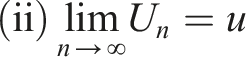
(i) By using principle of mathematical induction, for n = 1, we have Considering Now using the definition of Implies that Then, Hence, the claim is proved.




Numerical example
For numerical example, we consider a nonlinear oscillator as defined in equation (4) to apply the variational iteration method with Formable transform as

Now we use an iterative formula developed in equation (16)



Let



After applying the Formable transform, take the inverse Formable transform of equation (19)




After removing all secular terms of


The result in equation (22) is only valid when

The above equations (22) and (23) certify frequency amplitude is the same as obtained in Wu et al.;63–65 this shows the correctness of the solution.
Figures
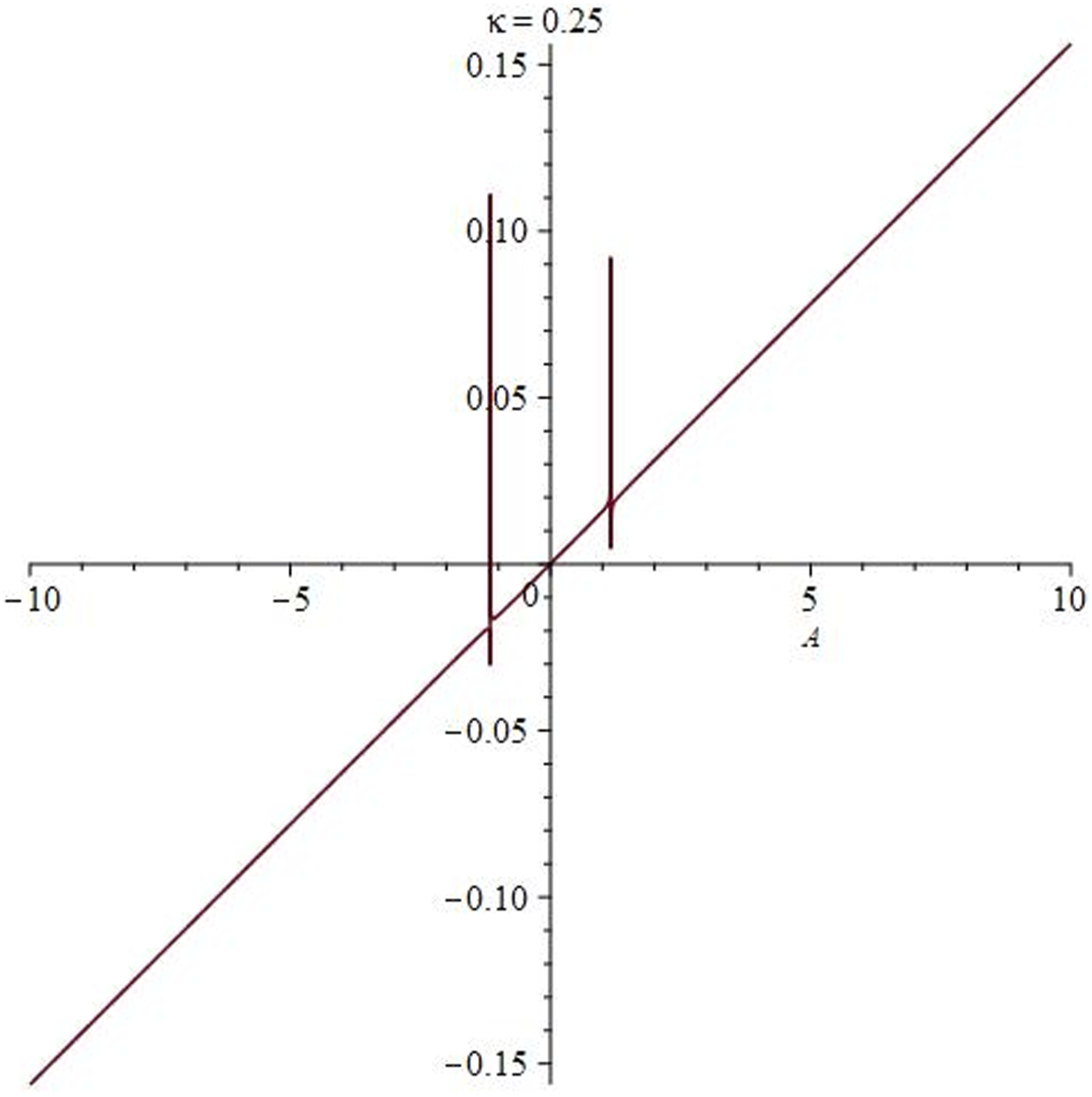
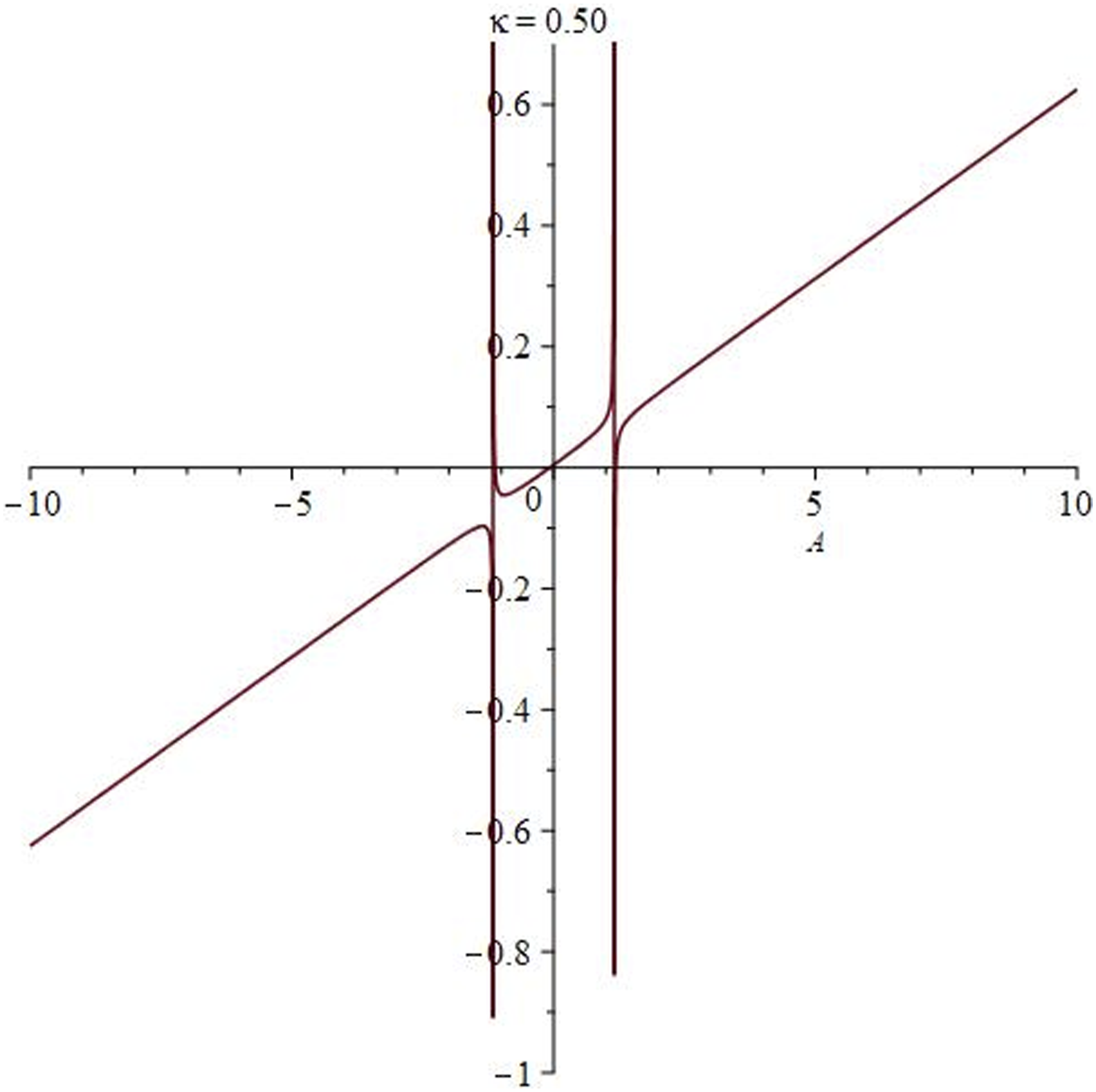
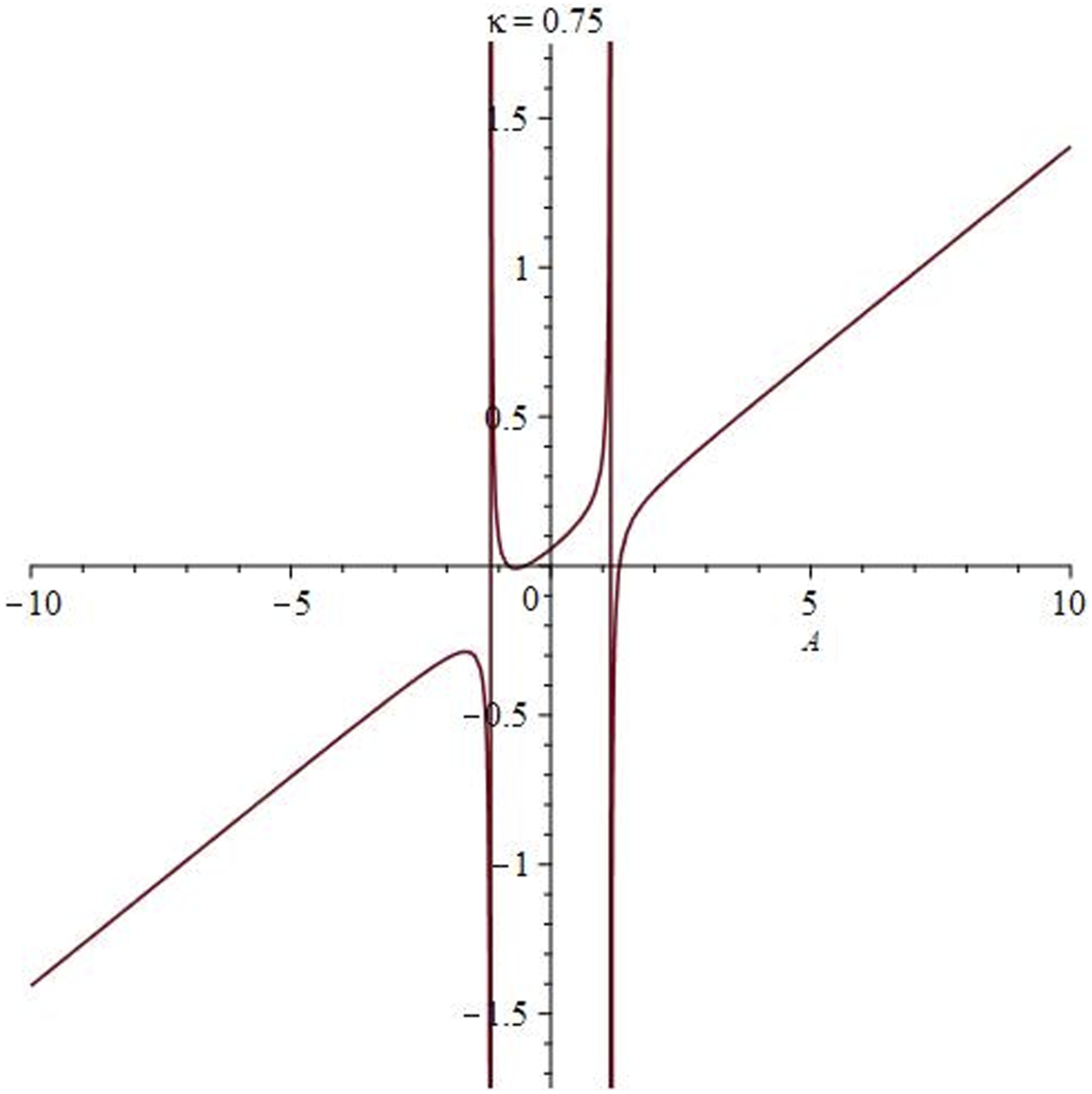
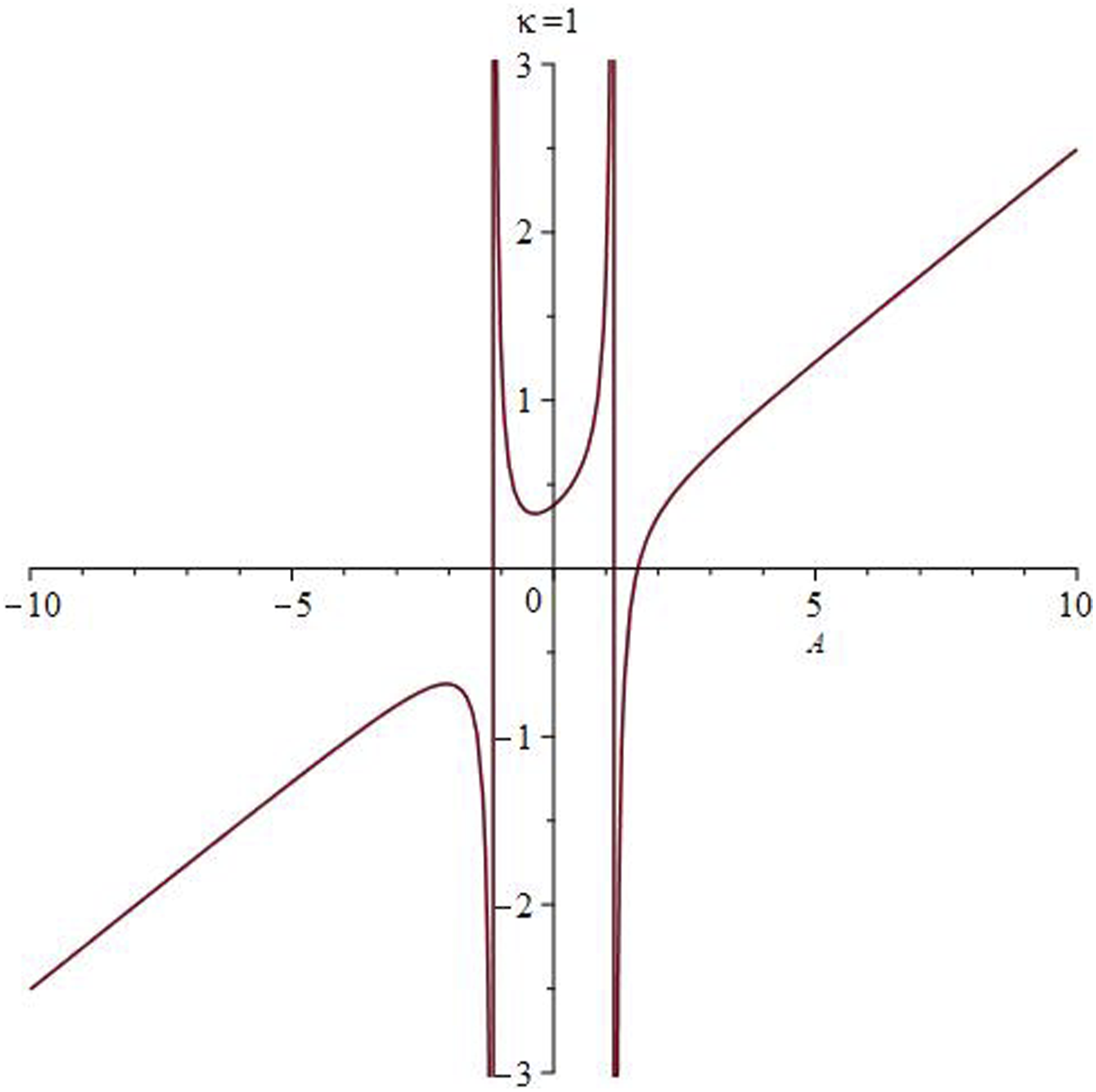
In the graphical representation, the behavior of nonlinear oscillator at different values of
Clearly seen from Figures 1–5, by varying the value of K, respective oscillations are received. At K = 0, not a complete oscillation occurred and at K = 0.25 quarter oscillation, and then by increasing the value of K, we lead to get complete oscillation. Period of the oscillation completes revolution at shows oscillations at K = 0. shows oscillations at K = 0.25. shows oscillations at K = 0.50. shows oscillations at K = 0.75. shows oscillations at K = 1.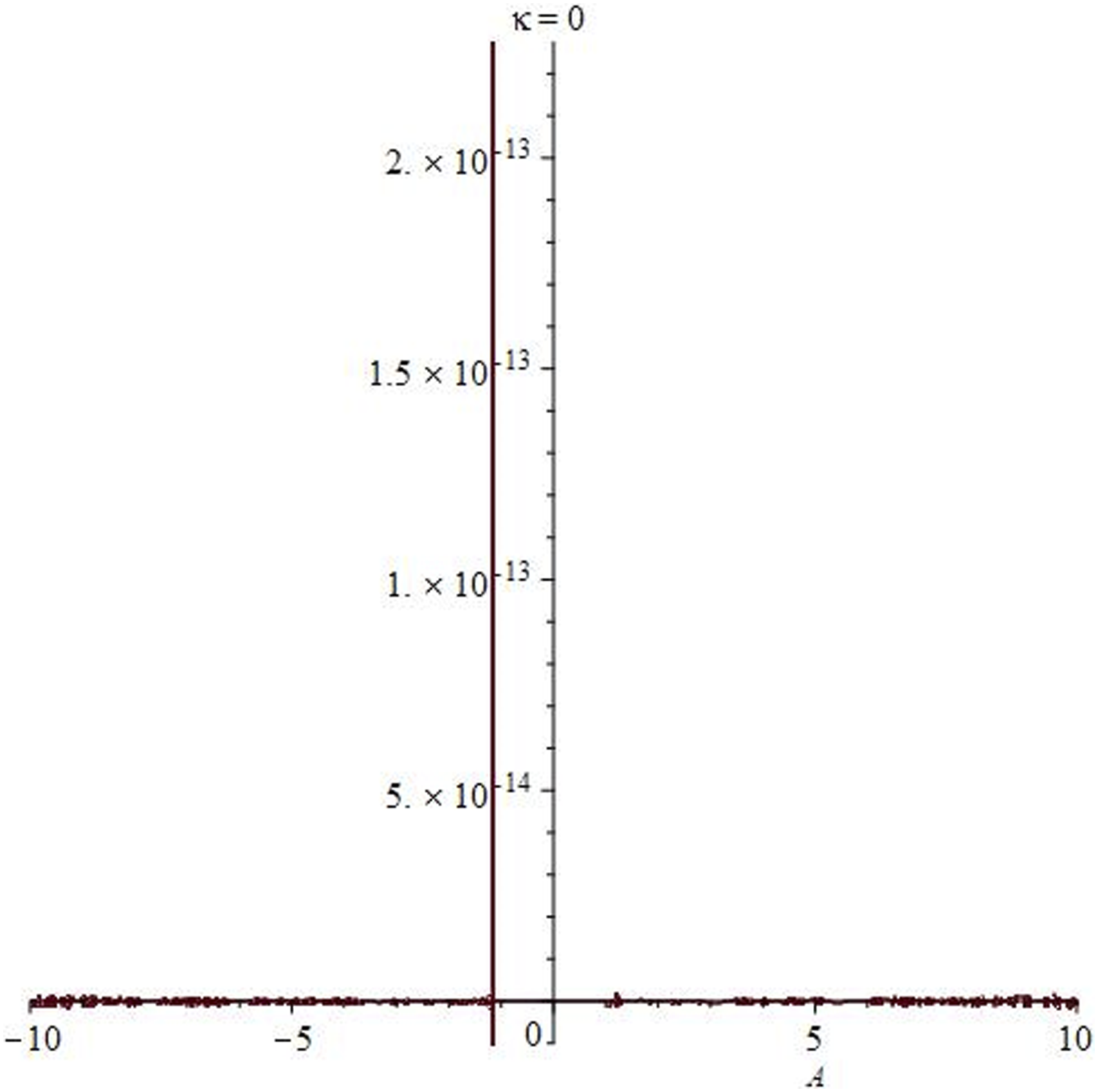
Conclusion
In the current work, an algorithm is developed using the variational iteration method (VIM) involving the Formable transform to evaluate the problem of nonlinear oscillator. For the evaluation of the nonlinear oscillator, variational iteration method (VIM) along with Formable transform is utilized. This approach contains correctional functional, after developing correctional functional formable transform is utilized to solve the problem. In the resultant term, Lagrange multiplier occurs and its optimal value is obtained by the variational theory, and the final algorithm is our required result. A numerical example is solved on these lines by using the resultant algorithm and a very fine result is obtained. In the graphical depiction, the sanctity of our obtained results is visualized. In the future, researchers may utilize this one-step iteration to tackle this type of nonlinear problem easily and may also implement a novel approach to get more refined results.
Footnotes
Author contributions
The work was conceived by MAB, MT, NAS, SMT, and MI. All authors contributed equally and approved submitted version.
Declaration of conflicting interests
The author(s) declared no potential conflicts of interest with respect to the research, authorship, and/or publication of this article.
Funding
The author(s) received no financial support for the research, authorship, and/or publication of this article.
