




Abstract
Iteration methods are widely used in numerical simulation. This paper suggests the Elzaki transform in the variational iteration method for simple identification of the Lagrange multiplier. The Elzaki transform is a modification of the Laplace transform, and it is extremely useful for treating with nonlinear oscillators as illustrated in this paper, a single iteration leads to a high accuracy of the solution.
Keywords
Introduction
Iteration methods are widely used to deal with nonlinear problems, the most used one is the well-known Newton’s iteration method for weak nonlinear problems, while for strong nonlinear problems the variational iteration method1,2 has been widely applied, which has been proved to be accurate and efficient3–8 and it is also efficient for fractal differential equations.9–16 In this paper, we will introduce the Elzaki transform17–20 to simplify the identification of the Lagrange multiplier involved in the variational iteration algorithm. The Elzaki transform18,19 which was introduced by Tarig Elzaki in 2011 is a modification of the Laplace transform. 21 This transformation can be used to solve ordinary, partial, and integral equations in the time domain.22,23 Many authors combined this transformation with the homotopy perturbation method, 24 the Adomian decomposition method, 25 and the variational iteration method 26 to solve nonlinear problems in a convenient way.
In this manuscript, there are two basic objectives of coupling of the variational iteration method with the Elzaki transform. Initially is to identify the Lagrange multiplier27,28 and then to find amplitude–frequency relationship29–31 of a nonlinear oscillatory system. To achieve these objectives, we will use an oscillator with coordinate-dependent mass32,33 in the form

with initial conditions

Equation (1) can define phase transition in physics and takes significant part in field theory to describe the new phase formation, cosmos logical model, quark confinement, and spinodal decomposition. 32
Equation (1) can be expressed as

This nonlinear oscillator is difficult to solve as it involves a linear term with negative coefficient. Wu and He 32 applied the homotopy perturbation method with an expanding parameter to overcome the difficulty. Anjum and He 33 hybridized the variational iteration method and Laplace transform to propose a fairly accurate solution of equation (1). This paper shows the Elzaki transform works for the negative coefficient of the linear term for a nonlinear oscillator.
Identification of variation iteration method’s Lagrange multiplier by the Elzaki transform
Consider a general nonlinear oscillator in the form


We can rewrite equation (4) as

According to the variation iteration method, the correction functional for equation (6) is given as

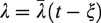
The integration in equation (7) is basically the convolution; hence, we can use convolution theorem of Elzaki transform easily. Applying Elzaki transform on both sides of equation (7) the correction functional will be transformed in the following manner

Thus



The optimal value of


By applying the extremum condition, we have the stationary condition as


By applying the Elzaki inverse on the last equation yields the optimal Lagrange multiplier

Using equation (8), the iterative formula has the form

Example
To apply the variational iteration method with Elzaki transform on equation (1), we can write it in the form

Using equation (13), the iterative formula is developed as



Assuming


After applying Elzaki and inverse Elzaki transform in equation (16), we have
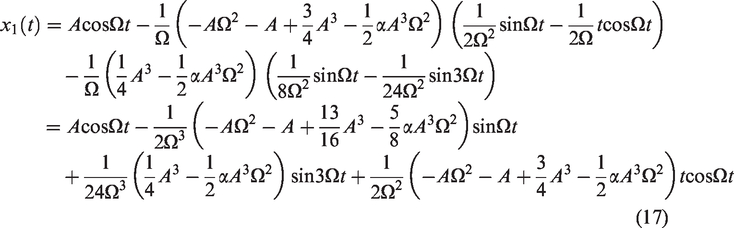
No secular-term in


Equation (19) is valid when

Equations (19) and (20) are the same as obtained in Wu and He 32 and Anjum and He, 33 showing the correctness of the solution.
Conclusion
This paper, for the first time ever, applies the Elzaki transform to the variational iteration algorithm with great success, the identification of Lagrange multiplier, which was identified by the variational theory, becomes simplier.34,35 An optimal variational iteration algorithm is obtained by the Elzaki transform, and the iteration algorithm converges fast and only one iteration results in a high accurate solution.
Footnotes
Declaration of conflicting interests
The author(s) declared no potential conflicts of interest with respect to the research, authorship, and/or publication of this article.
Funding
The author(s) received no financial support for the research, authorship, and/or publication of this article.