




Abstract
The frequency is an intrinsic mathematical index for a nonlinear oscillator. The variational iteration method and He’s frequency formulation are used to handle the special oscillator
Introduction
Nonlinear oscillators have an imperative role in practical applications and theoretical analysis. He and Kong 1 found that the oscillation property of a moving jet during the electro-spinning process2–4 plays an important role in fiber’s morphology and properties. Li and He 5 established an attachment oscillator on nano-scale by the geometric potential theory,6–8 showing the nano-scale oscillation is the key factor of the creature’s smart adhesion. Zhao et al. 9 studied needle’s vibration in electro-spinning, revealing that the vibration can control the nano-fiber’s morphology. Nonlinear vibration theory sheds a bright light on the nanotechnology and nonlinear science as well.
Recently, much concern was referred to an oscillator in the form10–13

This oscillator can be solved by various methods,10–13 among which the variational iteration method accompanied by Laplace transform 14 and the modified He’s amplitude–frequency formulation 15 have been caught much attention due to their simple solution process and high accurate solutions.
Variational iteration method with Laplace transform
The variational iteration method was proposed in the 1990s,16–18 the main difficulty is to effectively identify He–Lagrange multiplier involved in the iteration algorithm; however, the condition was changed, a simple and effective identification process by Laplace transform was suggested by Anjum and He. 14
Rewrite the problem (1) as

with
According to the variational iteration method with Laplace transform,
14
we have the iteration algorithm

Assume the initial approximation be

Then we have

Imposing the inverse Laplace transform

No secular term in equation (6) requires that


Equation (8) is the same as that in Zhao et al. 9 and Xu. 10
He’s frequency formulation
He’s frequency formulation 19 was widely applied to nonlinear oscillators due to its simplicity and effectiveness.20–22
According to He’s frequency–amplitude formulation,
19
we take a trial function

Submitting equation (9) into equation (1) results in the residual

Let

Submitting equation (10) into equation (11), we have

Let

Using He’s frequency formulation,
19
we have
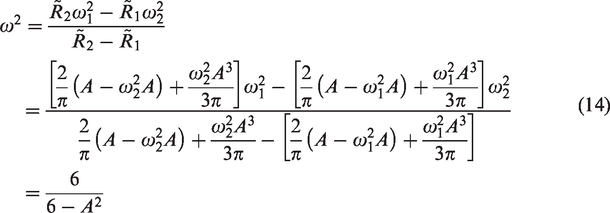
Equations (8) and (14) give an almost same result when A≪1. Equation (14) is a new angular frequency expression for the oscillator.
Conclusions
This paper shows the last development of the variational iteration method and He’s frequency formulation for nonlinear oscillators with a damping; the simple solution process and high accurate results make both methods famous for practical applications for fast and effective estimation about the frequency–amplitude relationship of a nonlinear oscillator. The Laplace transform makes free of the identification of the He–Lagrange multiplier in the variational iteration method. Ren–Hu’s average residual makes the calculation process much simpler. Both methods result in acceptable accuracy of the solutions with simple solution process, and we conclude both methods can be widely applied to nonlinear vibration systems.
The couple of the Laplace transform with either the variational iteration method16–18 or the homotopy perturbation method23–25 now is called as He–Laplace method26–29 and it has obvious advantages in the simple solution process. Both methods discussed in this paper are also powerful tools for fractal calculus and fractional calculus.30–33
Footnotes
Declaration of conflicting interests
The author(s) declared no potential conflicts of interest with respect to the research, authorship, and/or publication of this article.
Funding
The author(s) received no financial support for the research, authorship, and/or publication of this article.