




Abstract
In this article, a very simple modified form of the harmonic balance method is used to solve a strongly nonlinear oscillator with cubic nonlinearity and harmonic restoring force. Taylor series expansion up to third term is considered for the harmonic restoring force. The first approximate solutions of the present method pleasantly agree with the numerical solution obtained by Runge–Kutta fourth order method. Accuracy and simplicity of the present method solution is established when compared with the other method solutions. The present method can be utilized to other nonlinear oscillators.
Introduction
Nonlinear oscillators are formed from different aspects of engineering problems. Nonlinear oscillators can be modeled by ordinary and partial differential equations. Solution of the nonlinear ordinary and partial differential equations are not easy like linear differential equations. Moreover, exact solutions of the nonlinear oscillators are extremely complex and most of the times unreachable. Therefore, many researchers have contributed to obtain the approximate solution of various nonlinear oscillators. Initially the perturbation methods1–3 were used by expanding a small parameter to solve nonlinear oscillatory systems. But such expansion was not easy and suitable. Latter homotopy perturbation method 4 was first proposed by Ji-Huan He. Many approximate methods such as the harmonic balance method, 5 the energy balance method, 6 He’s frequency formulation method, 7 the variational iteration method, 8 the iteration perturbation method, 9 the homotopy analysis method, 10 max-min approach, 11 VIM-Pade technique 12 etc. were proposed by many researchers to solve strongly nonlinear oscillators.
Homotopy perturbation method was applied by others13,14 appropriately. Also, many researchers were applied the harmonic balance method, 15 the energy balance method, 16 He’s frequency formulation method,17,18 the variational iteration method,19–22 the homotopy analysis method,23,24 VIM-Pade technique25,26 etc. successfully to solve strongly nonlinear problems.
Many types of modification like the global residue harmonic balance method,27–31 the modified energy balance method,32,33 the modified harmonic balance method,34–36 the modified homotopy perturbation method,37–40 the modified Lindested–Poincare method,41,42 the modified Laplace based variational iteration method 43 etc. were also used by many researchers to solve strong nonlinear problems. Coupling techniques between the homotopy perturbation method and the variational method 44 and between the Lindested–Poincare method and the homotopy perturbation method 45 were also used for solving the nonlinear oscillators. Harmonic balance method and different modified forms of the harmonic balance method have been widely used for solving nonlinear oscillators from last few decades. In harmonic balance method the response of the system is assumed in terms of a Fourier series and using this expression in the governing nonlinear differential equation and separating the coefficients of the harmonic terms one can obtain the unknown coefficients and frequency amplitude relation of the nonlinear system. When the HBM is applied to the nonlinear equations for higher-order approximation, then a set of difficult nonlinear complex equations appear and it is very difficult to analytically solve these complex equations. In the present modified form of harmonic balance method, we applied a simple factor on the strongly nonlinear oscillator. To find the higher-order approximate solution and the corresponding frequencies, Fourier series expansion is used and the set of algebraic equations arises is solved easily.
In the present article, we have used the simple modified form of the harmonic balance method
36
to solve a strongly nonlinear oscillator with cubic nonlinearity and harmonic restoring force modeled by
30

The nonlinear equation represented by equation (1) has application in mechanical engineering (see
46
for details) and transmission system consisting of porous media. This strongly nonlinear oscillator can be modeled for the vibration of the system consisting a mass resting on a spring with cubic nonlinearity and the driving force as illustrated by Figure 1. Here we consider the system response, mass and the linear spring stiffness coefficient by Graphical configuration of the problem.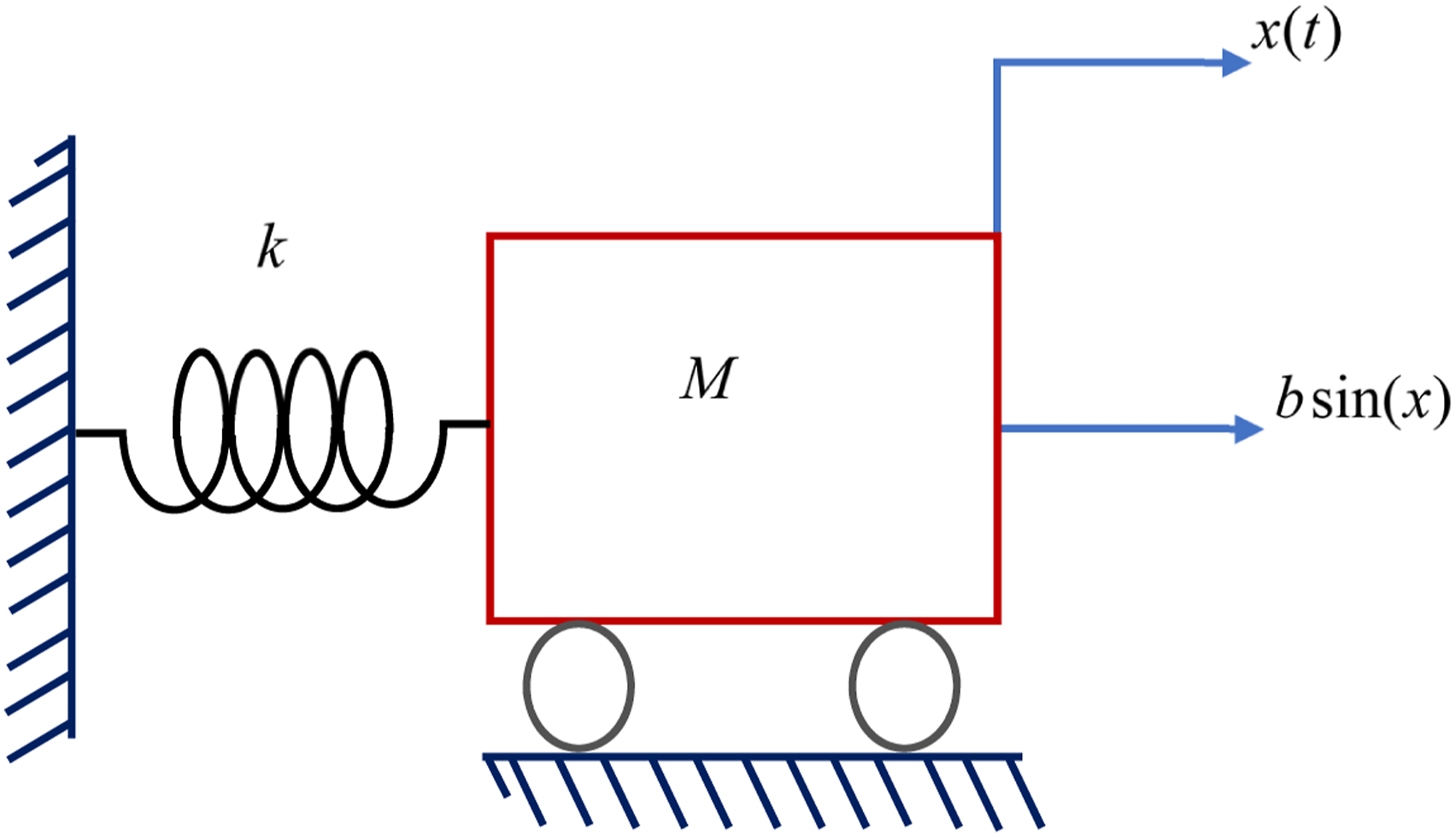
Marinca and Herisanu 47 applied an iteration method to solve the oscillator represented by equation (1). Also, many analytical techniques have been used to solve the strongly nonlinear oscillator with cubic nonlinearity and harmonic restoring force like Lu and Ma 26 used the VIM-pade technique, Alal et al. 32 proposed the modified energy balance method, Ismail and Alal 29 applied the global residue harmonic balance method, Alal and Chowdhury 15 used the harmonic balance method and Junfeng Lu 30 used the global residue harmonic balance method since the last decade.
The solution process for the equation (1) using the harmonic balance method and the energy balance method is laborious and complex. Also, the solution deteriorates for larger amplitudes and time. Solution obtained by the global residue harmonic balance method needed second or larger approximations to improve the result. Therefore, a simple and efficient harmonic balance method 36 presented in this article to overcome the above-mentioned problems. Only the first approximate solution of the present method provides better results than the other existing methods.
Modified harmonic balance method
Let us consider a strongly nonlinear oscillator

The nth order approximate solution of equation (2) is considered as
31

The zeroth order approximate solution of the equation (2) is considered choosing

Using equation (4) in equation (2) and using the condition of no secular term,
According to the present modified form of harmonic balance method, we rewrite the equation (2) to obtain the higher order solutions as

The initial conditions are replace by
Then equation (5) is expanded in Fourier series


From Equations (5) and (6), we get

For the first approximate solution, we consider


From Equations (5) and (10) we have



Neglecting higher order terms of

The solution
We consider the nonlinear oscillator


Equation (16) can be written as


Hence from Equations (17) and (18), we get




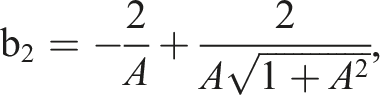







Now equating the coefficient of




Hence the first approximation solution of equation (15) is

where
He’s frequency formulation method solution
Considering two trial solutions
7


We have found the values of


He’s frequency formulation method provides

Hence frequency of the Oscillator equation (15) according to He’s frequency formulation method is

Solution of equation (15) is

Results and discussion

Comparison between the present method and other existing methods solution for
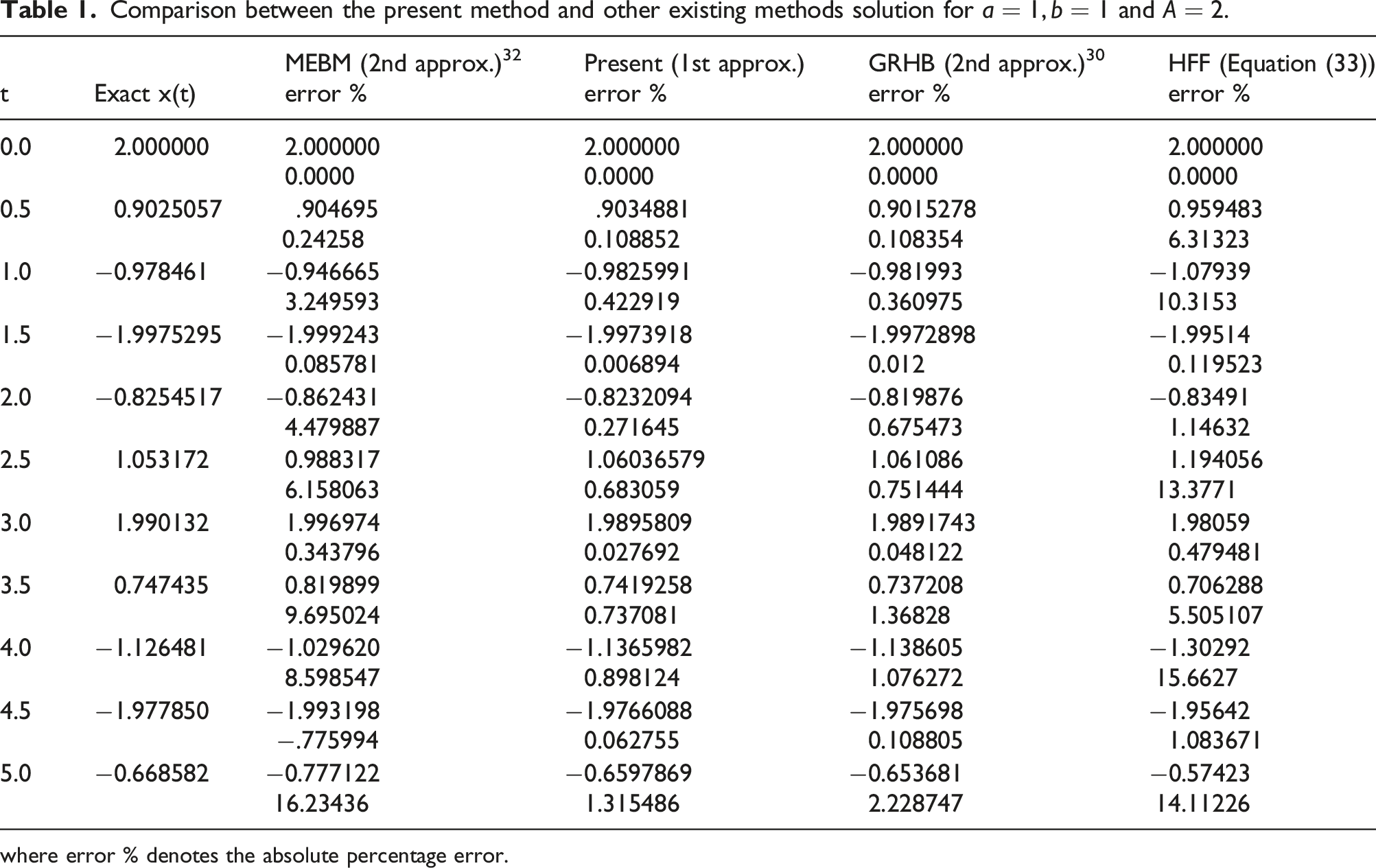
where error % denotes the absolute percentage error.
Comparison between the present method and other existing methods solution for
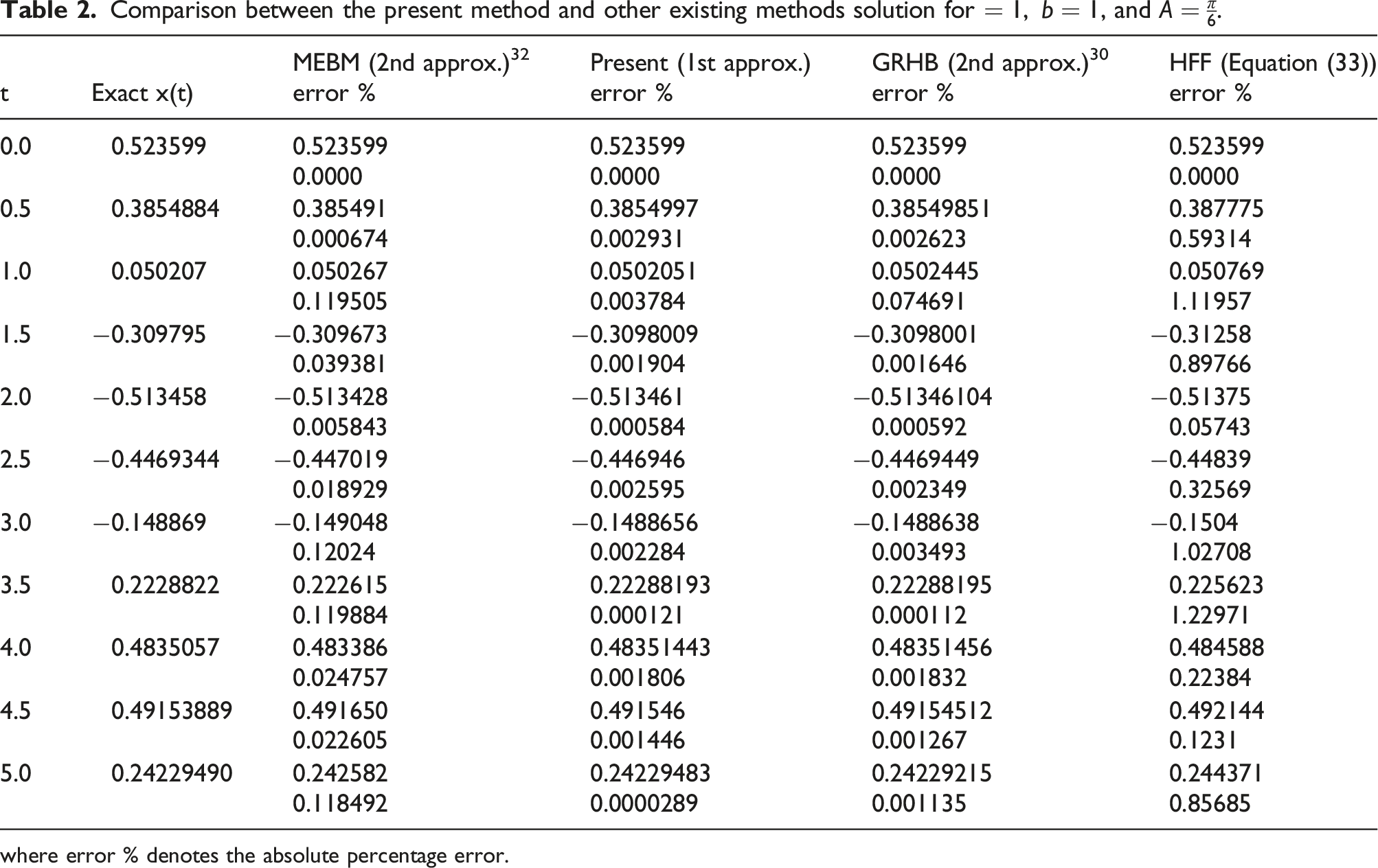
where error % denotes the absolute percentage error.
Comparison between the present method and other existing methods solution for
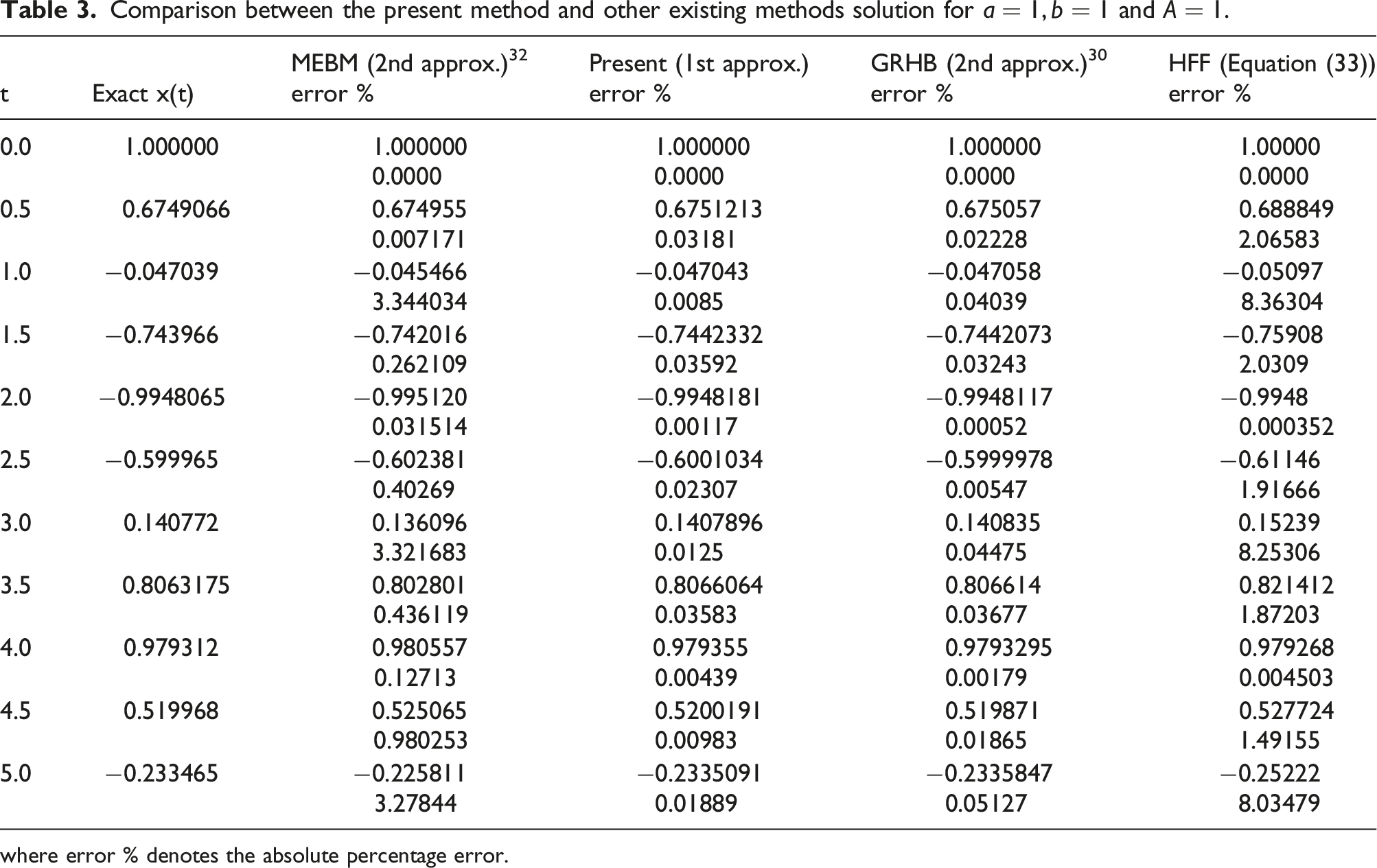
where error % denotes the absolute percentage error.
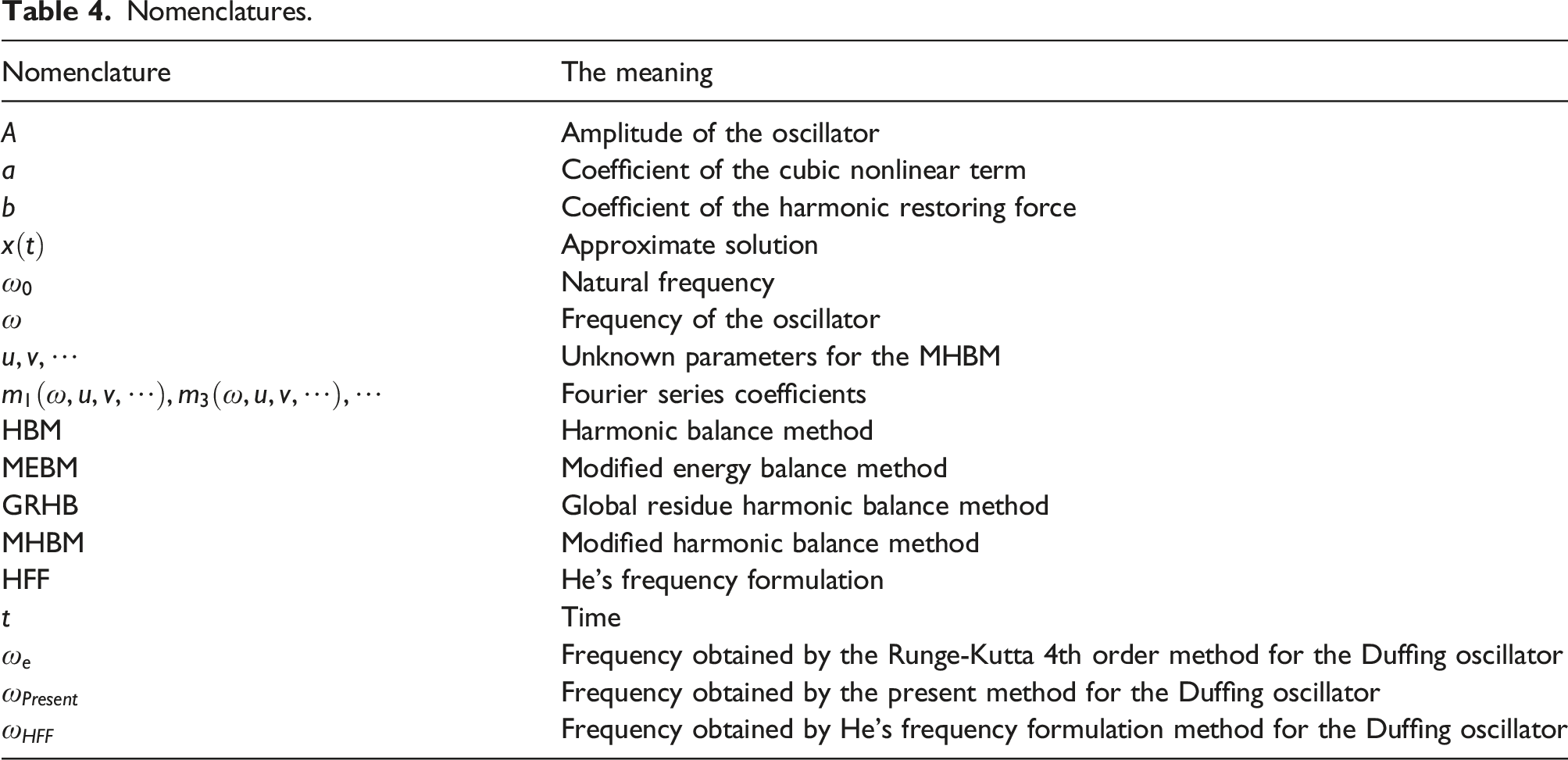
Nomenclatures.
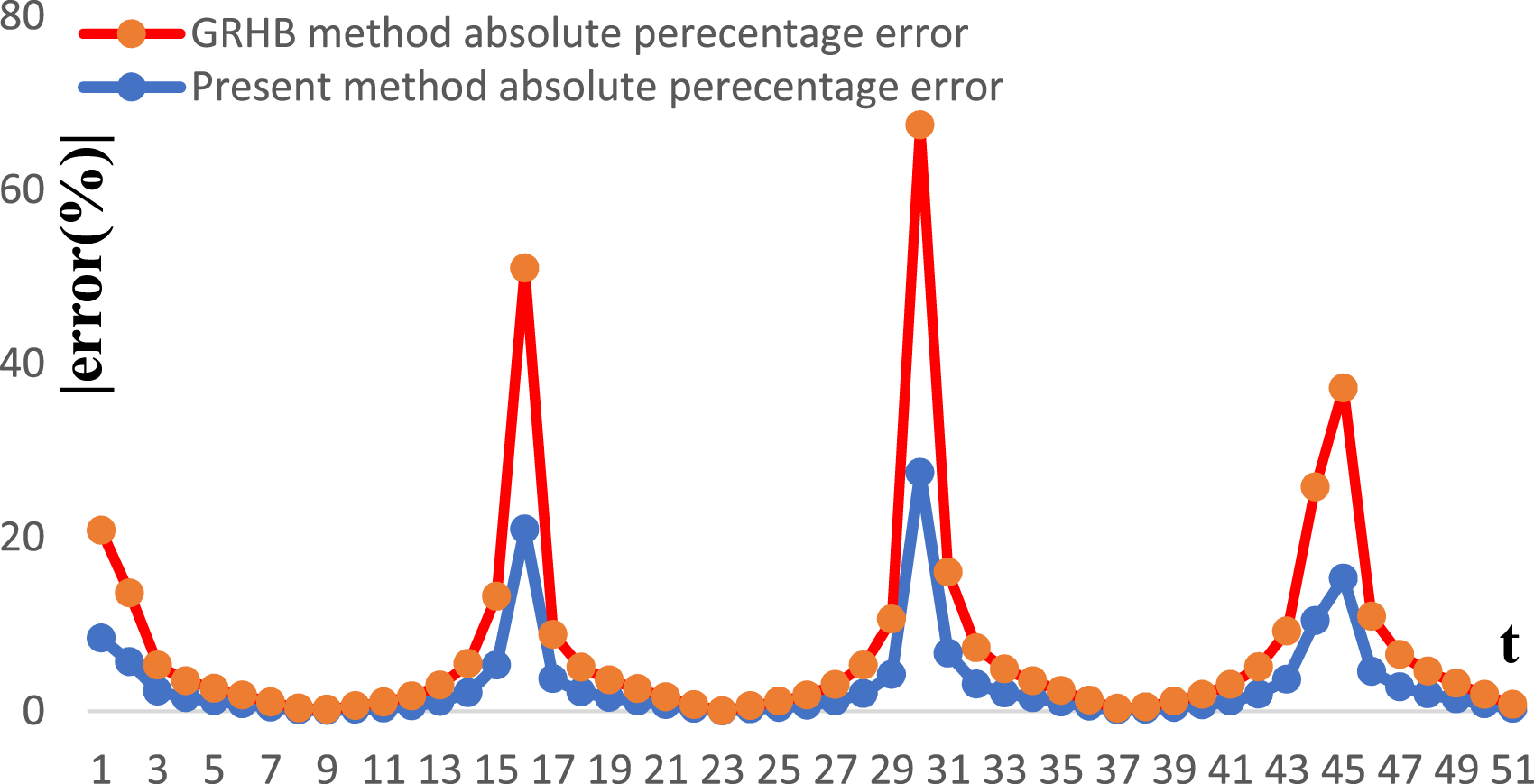
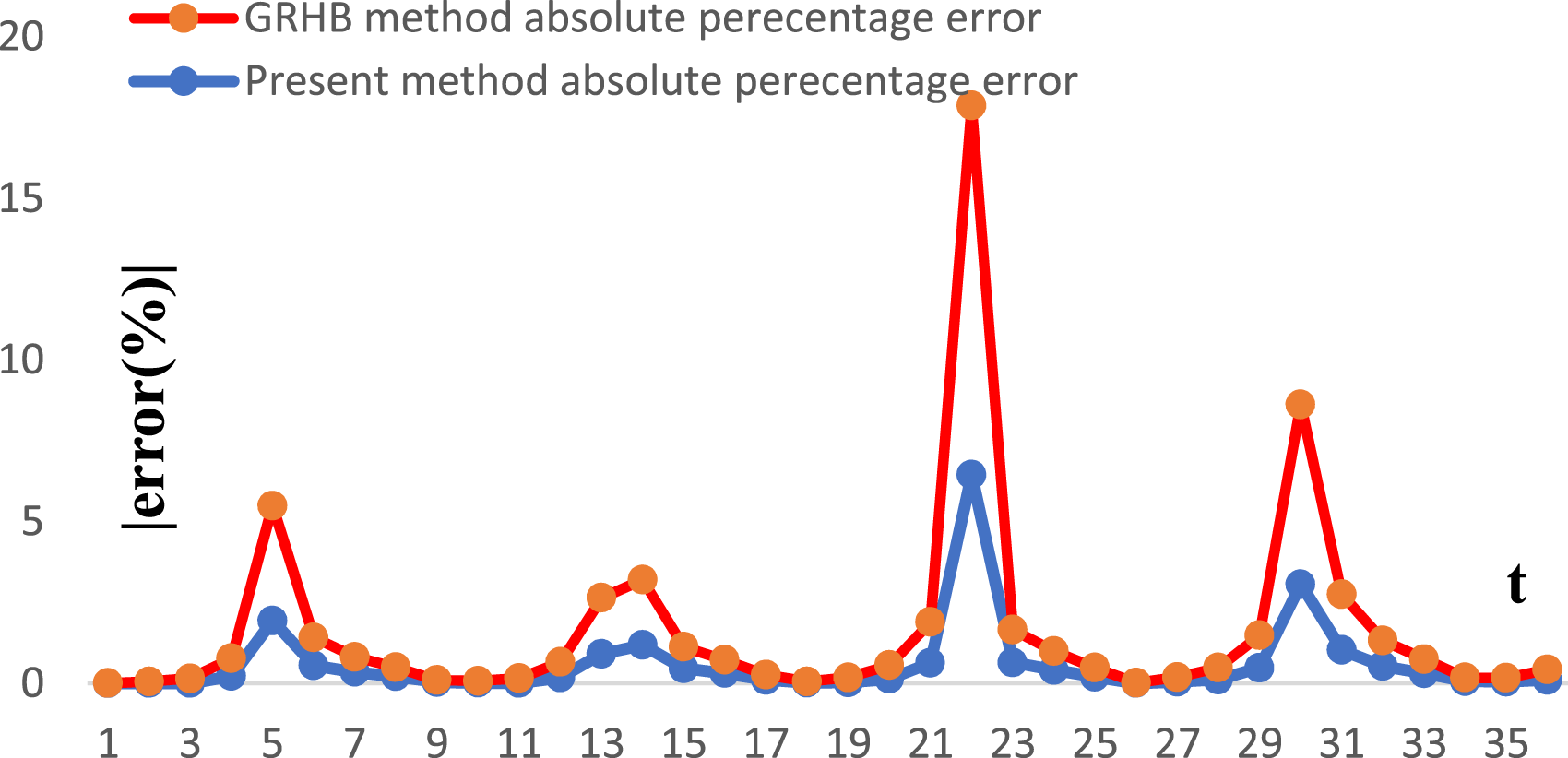
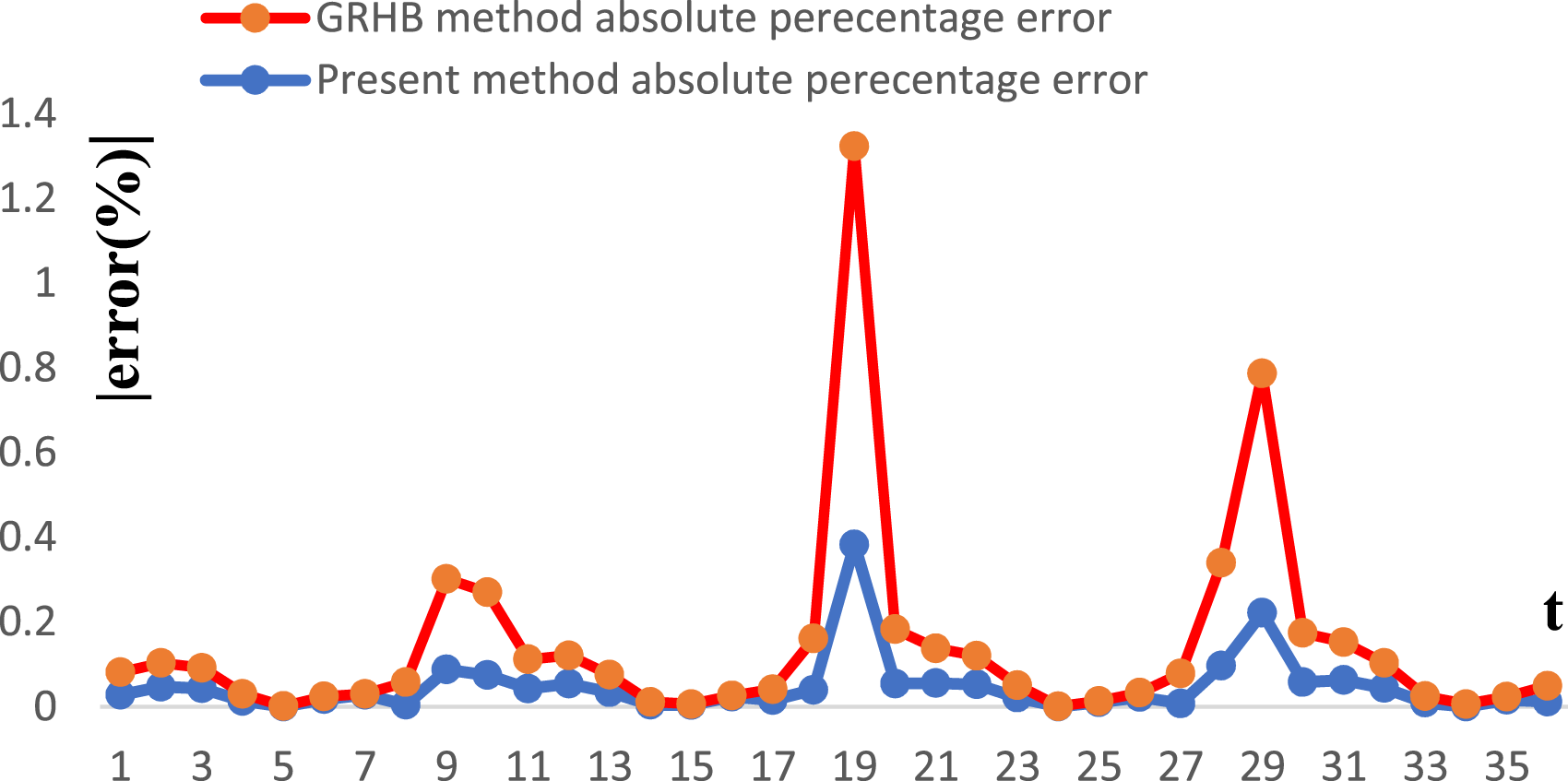
Absolute percentage error of the present method solution and the GRHB
30
method solution are plotted in Figures 2–5 for Comparison between the absolute percentage error obtained by the present method and the GRHB
30
method solution for Comparison between the absolute percentage error obtained by the present method and the GRHB
30
method solution for Comparison between the absolute percentage error obtained by the present method and the GRHB
30
method for Comparison between the absolute percentage error obtained by the present method and the GRHB
30
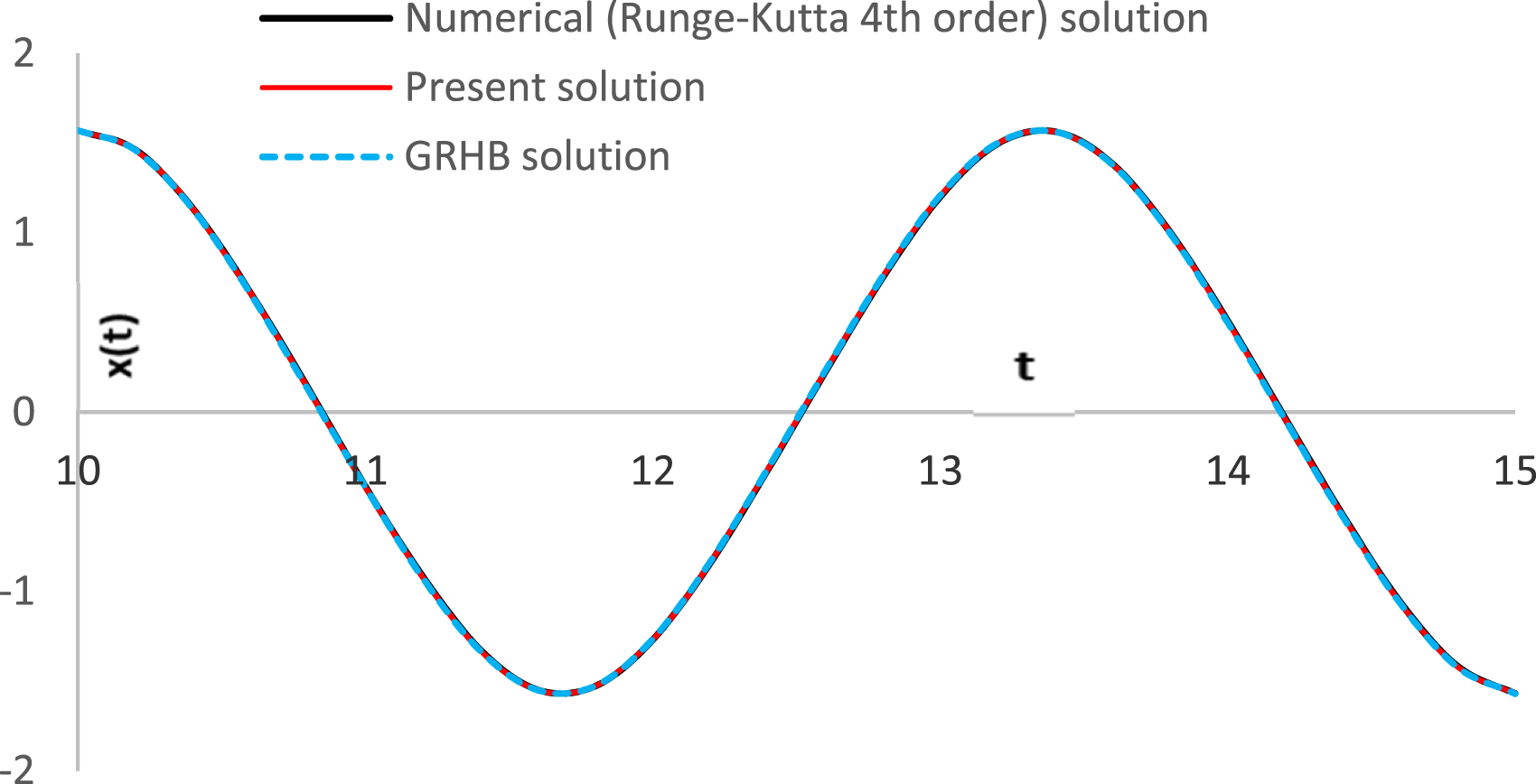
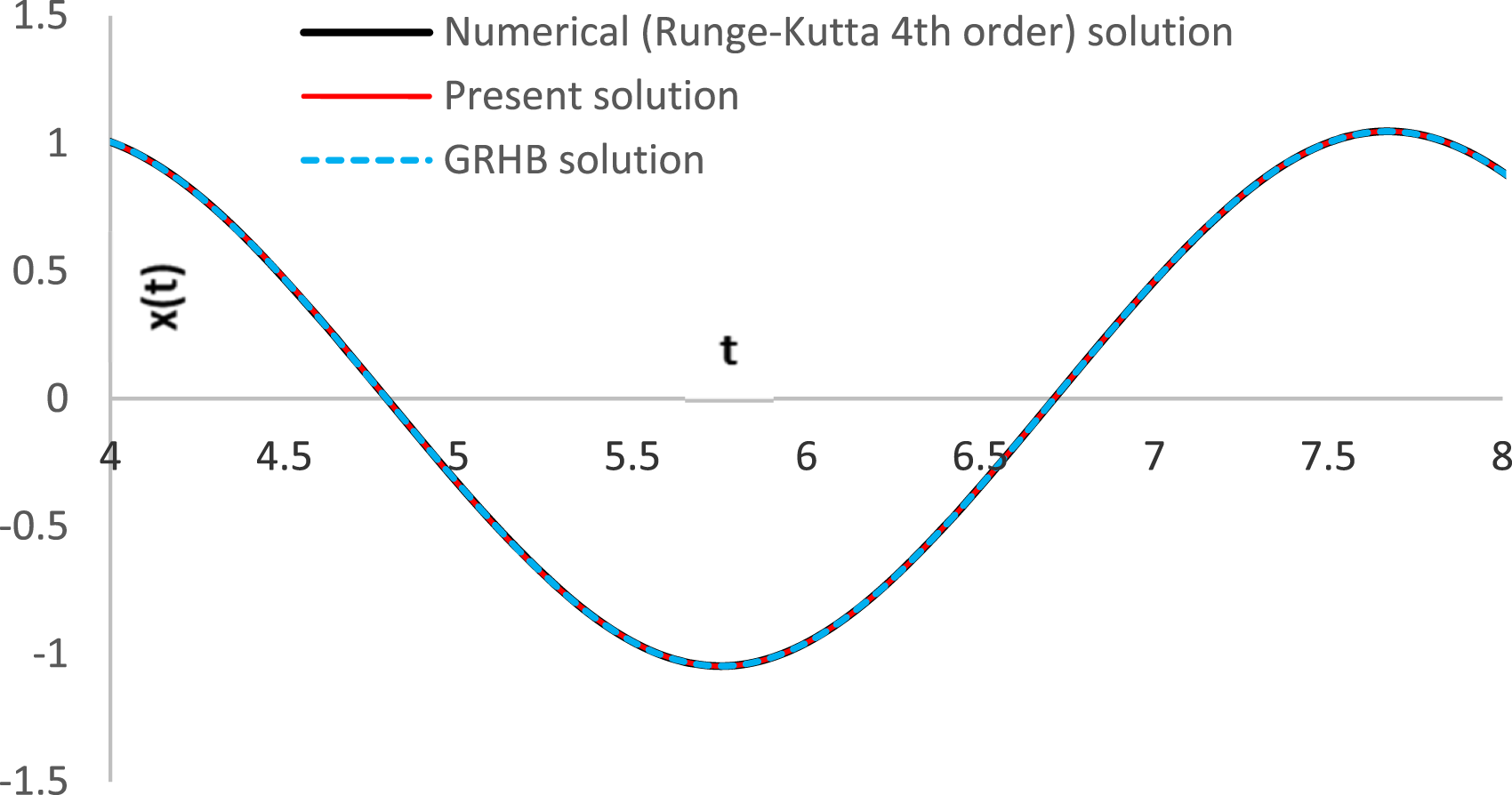
method for Comparison among the solutions obtained by the present method, numerical method and the GRHB
30
method, when Comparison among the solutions obtained by the present method, numerical method and the GRHB
30
method when 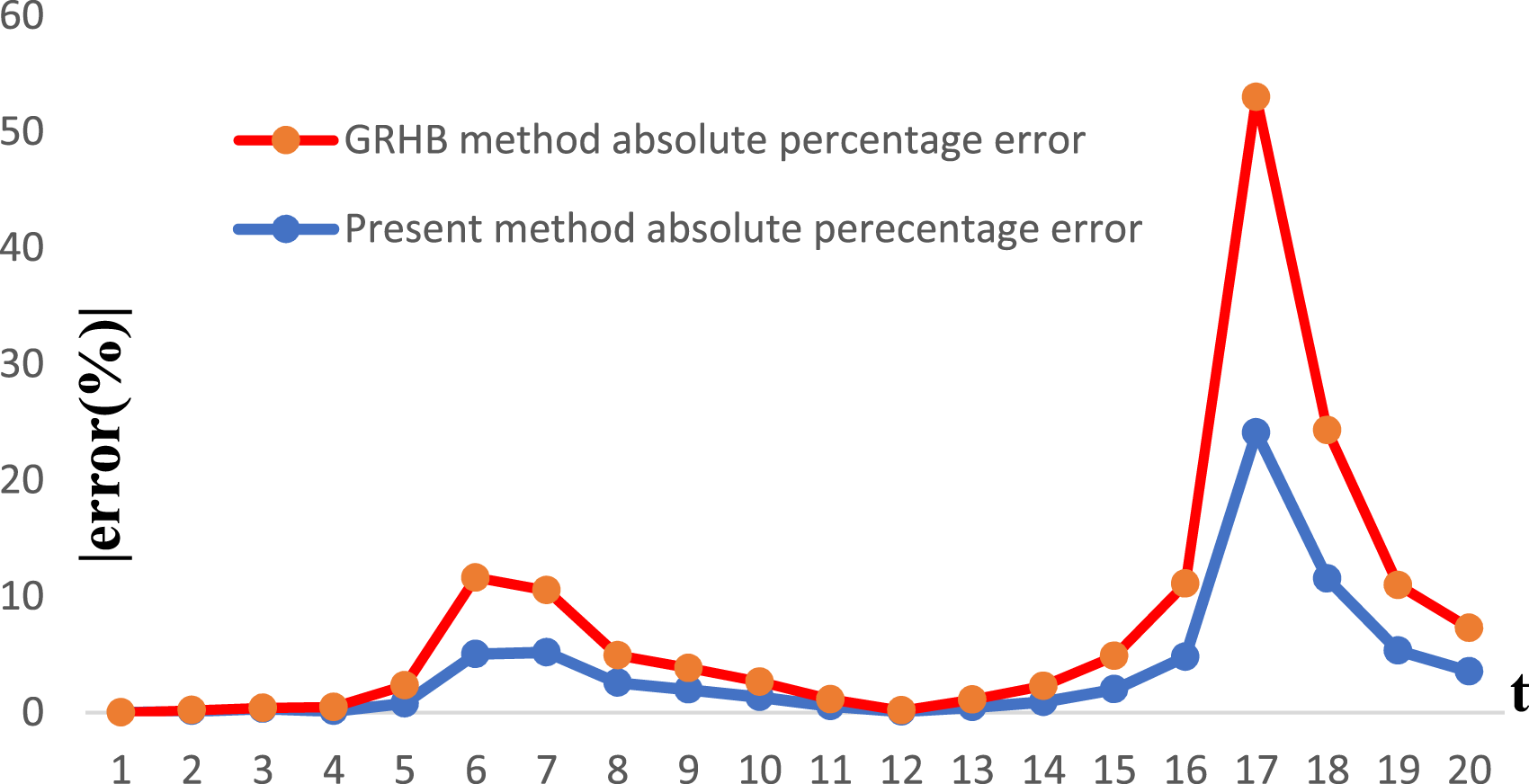
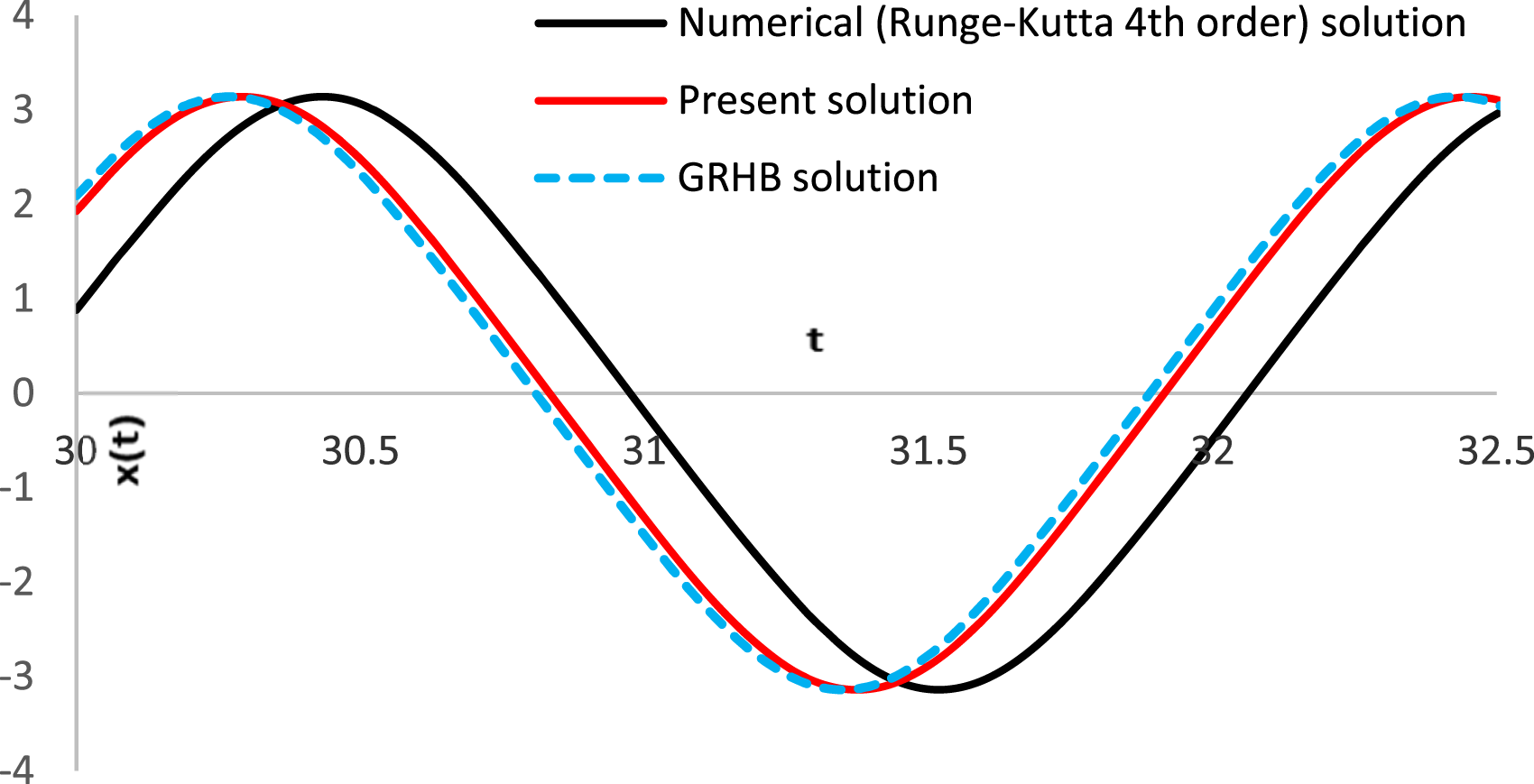
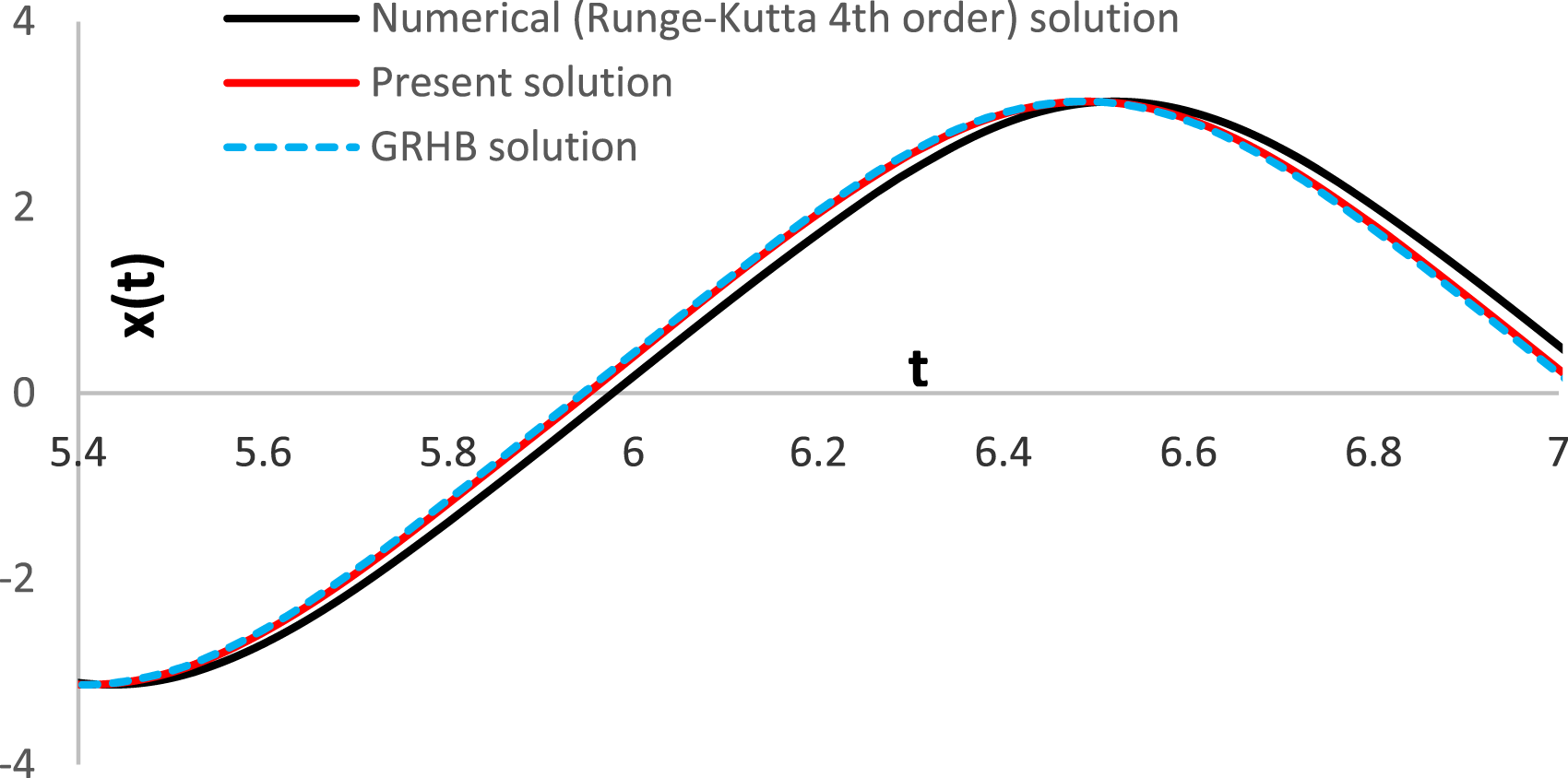
Also, solution of the present method, numerical solution obtained by Runge–Kutta fourth order method and the GRHB
30
method solution for Comparison among the solutions obtained by the present method, numerical method and the GRHB
30
method, when Comparison between solution obtained by the present method, numerical method and the GRHB
30
method, when Comparison among the solutions obtained by the present method, numerical method and the GRHB
30
method when, 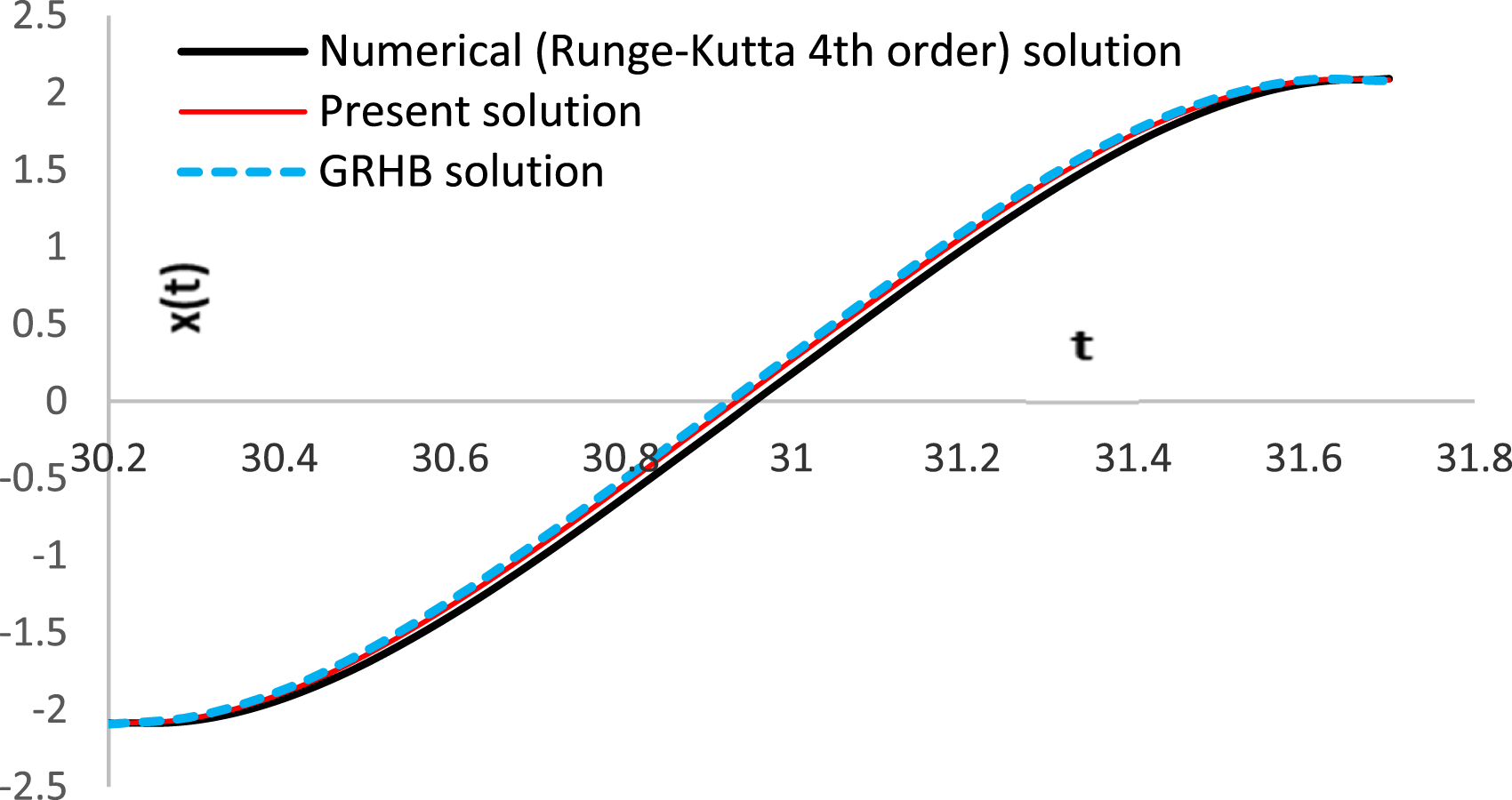
In particular, when we put 
The first approximation solution of equation (27) is
where
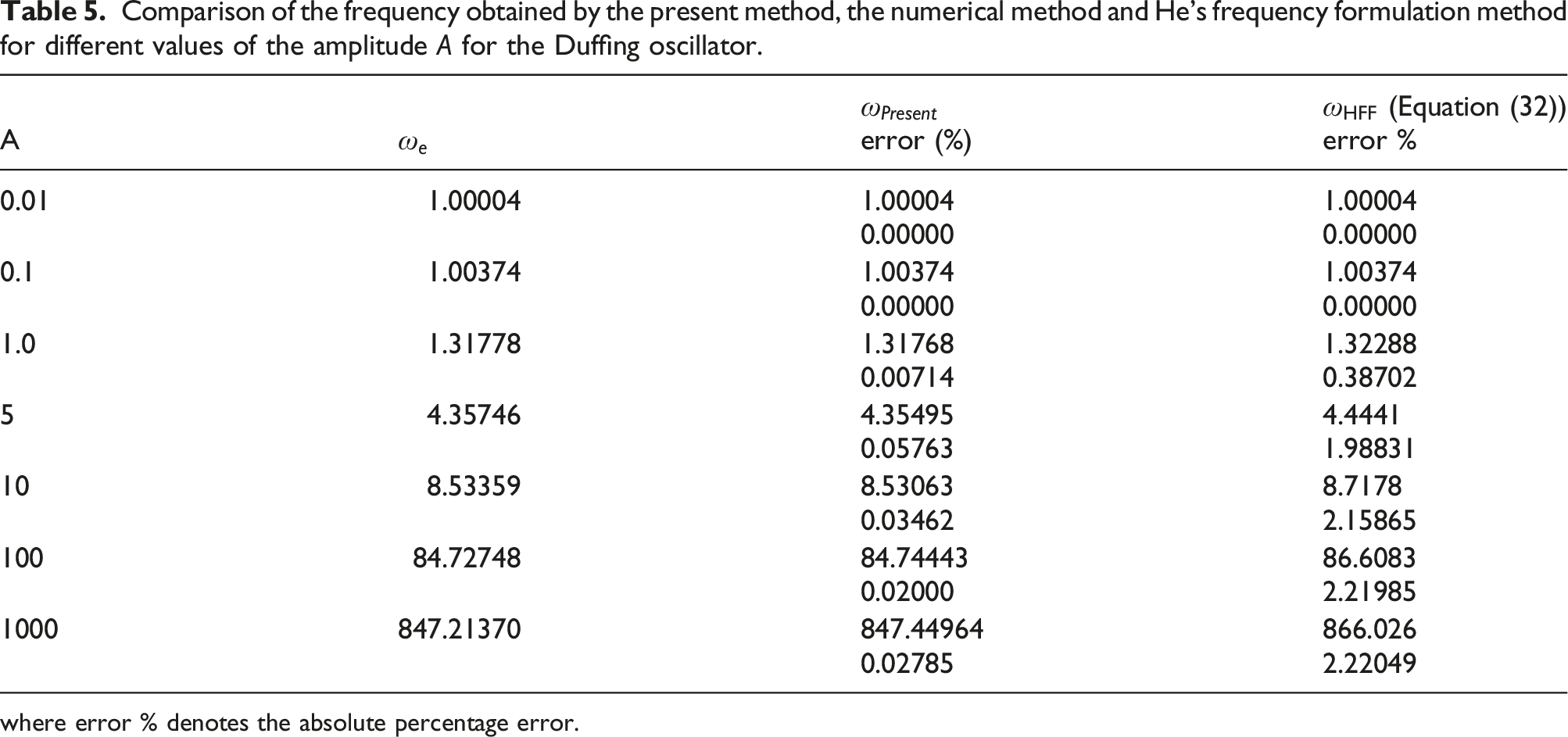
Figure 11 and Table 5 shows that the present method provides satisfactorily results for the Duffing oscillator for higher values of the amplitude when compared with the numerical results obtained by Runge–Kutta fourth order method and He’s frequency formulation method. Comparison among the solution obtained by the present method, He’s frequency formulation method and numerical method for Duffing oscillator, when Comparison of the frequency obtained by the present method, the numerical method and He’s frequency formulation method for different values of the amplitude where error % denotes the absolute percentage error.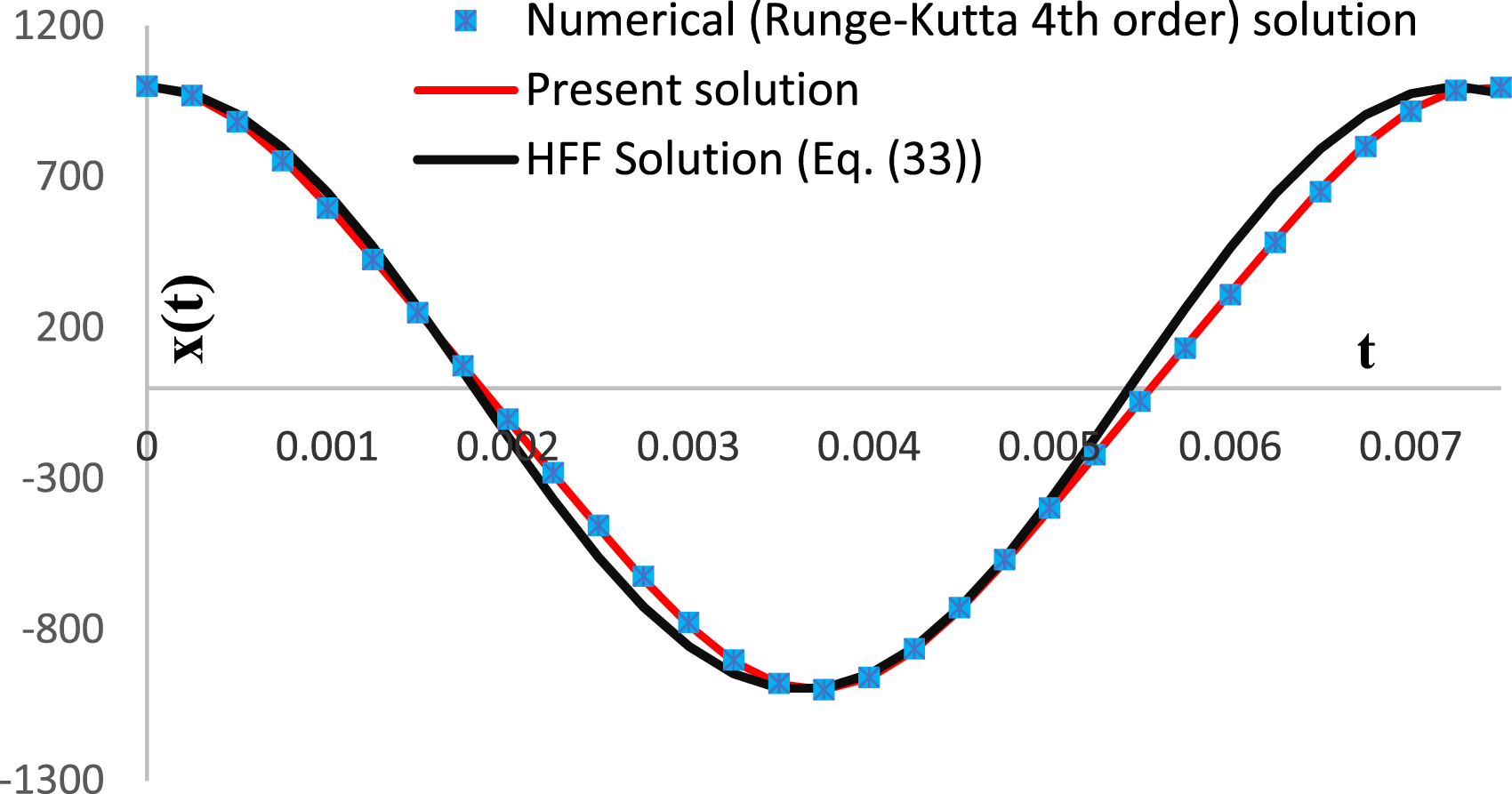
Conclusion
A strongly nonlinear oscillator with cubic nonlinearity and with harmonic restoring force is solved by using a simple modified form of the harmonic balance method. The determination process of the present solution scheme is simple and straightforward compared to the modified energy balance method (MEBM), 32 the harmonic balance method, 15 and the GRHB 30 method. Error analysis of the present method, the MEBM, 32 and the GRHB 30 method was investigated and found decent results for the present method. For the present problem, only the first approximate solution shows a remarkable agreement when compared with the exact solution. Also, we have compared the present solution scheme with He’s frequency formulation solution and found superiority of the present method. Based on above determinations, the present method can be used to solve other strongly nonlinear oscillators effectively. The simple computational form and accuracy of the present method is obvious but the present method cannot solve the Van der Pol equation, the Mulholland equation etc.
Footnotes
Acknowledgments
The authors are grateful to the honorable reviewers for their significant comments and suggestions in improving the manuscript.
Declaration of conflicting interests
The author(s) declared no potential conflicts of interest with respect to the research, authorship, and/or publication of this article.
Funding
The author(s) received no financial support for the research, authorship, and/or publication of this article.
