




Abstract
This paper aims to solve the nonlinear differential equation of the circular sector oscillator analytically via the modified harmonic balance method (MHBM). To assess the reliability and the precision of the present method, we have compared the obtained results with the global residue harmonic balance method, Akbari–Ganji’s method, and numerical Runge–Kutta method which reveals that the MHBM is more reliable than others methods.
Keywords
Introduction
Most oscillation systems used in engineering, biochemical, physical, and mechanical problems are generally revealed mathematically by nonlinear differential equations. Nonlinear differential equations are very important modern mathematics and are the basis for solving complex problems in many branches of sciences. In general, studying nonlinear oscillation differential equations that obtain exact solutions faces many difficulties. A few nonlinear systems of differential equations can be solved explicitly, and numerical methods, especially the Runge–Kutta method of the fourth order, are frequently used to calculate approximate solutions. Perturbation methods1–4 were the first analytical and approximate methods to achieve approximate analytical solutions for nonlinear differential equations (NDEs). Recently, several methods have been introduced and developed to obtain approximate solutions for (NDEs) due to their complexity and the difficulty of solving them through traditional perturbation techniques. For example, variational iteration method, 5 homotopy perturbation method, 6 max-min approach,7–9 global residue harmonic balance method (GRHBM) for obtaining higher-order approximate solutions,10–12 modified homotopy perturbation method,13–15 energy balance method,16,17 Hamiltonian approach,18–20 iteration perturbation technique, 21 coupled homotopy-variational approach,22–24 frequency-amplitude formulation,25,26 multiple scales technique, 27 parameter expansion method, 28 averaging method, 29 iteration method, 30 and Laplace variational iteration method. 31
The harmonic balance method (HBM) is one of the main techniques for obtaining approximate analytical solutions to NDEs describing oscillatory systems.4,6,32–34 In recent decades, some researchers have studied the behavior of the circular sector oscillator generally modeled using NDEs. For example, Shaban et al., 13 investigated the numerical behavior of the nonlinear system using the modified homotopy perturbation method (HBM). To obtain the approximated solution with high accuracy, Hadi et al., 35 considered Akbari–Ganji’s method (AGM) for solving this nonlinear oscillator. Moreover, Lu et al., 11 used the GRHBM to obtain higher-order approximate solutions and compared it with the MHPM, AGM, and Runge–Kutta method while Pakar et al., 36 used variational approach (VA).
This paper extended the modified HBM up to second order to obtain the approximate analytical solutions for strongly nonlinear conservative systems. Comparing the approximate frequencies obtained with its numerical frequencies reveals that this method is effective and convenient for solving these analytical problems. Finally, an illustrative example demonstrates the validity and applicability of the method, which is further discussed in detail. The MHBM is suggested as a useful approach that can be easily extended to other strongly nonlinear oscillators.
Basic concept of the proposed method
We consider the governing differential equation in the following form

with the initial conditions

We also consider the approximate analytical solution to equation (1), which is in the following form

Inserting equation (3) into equation (1) and using the Fourier series to expand the function

Comparing the coefficients of equation (4), we can obtain the following equations


By substituting

Finally, we can obtain the value of
Application of the modified harmonic balance method
In current work, we will consider the following nonlinear differential equation of the circular sector oscillator,
13
which are widely used in many physical and engineering applications such as car spaces, the base of structures, and many other swing systems.

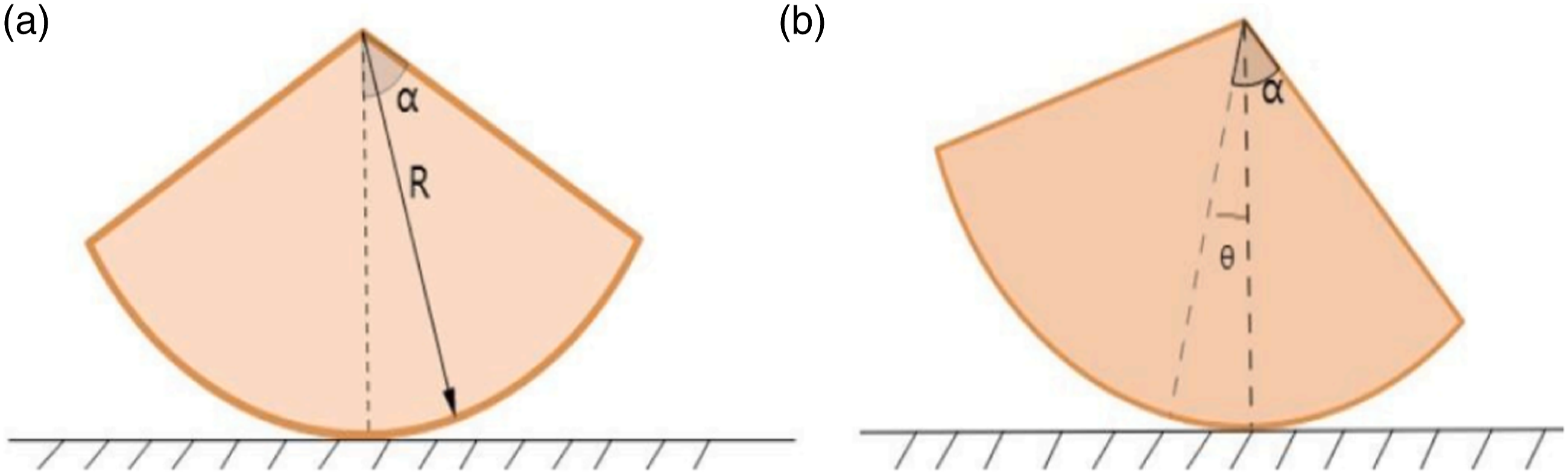
Replacing the relatively accurate approximations: Geometric parameters of the homogeneous solid circular sector oscillator.
13

We substitute

First-order modified harmonic balance method approximation
From equation (4), the first-order analytical approximate solution can be expressed as follows


Finally, from equation (12), the first-order approximate angular frequency is

Consequently, the first-order approximation for the approximate solution of equation (9) is given by equation (11) where
Second-order modified harmonic balance method approximation
The second-order approximation solution is assumed in the following form to improve the accuracy of the solution

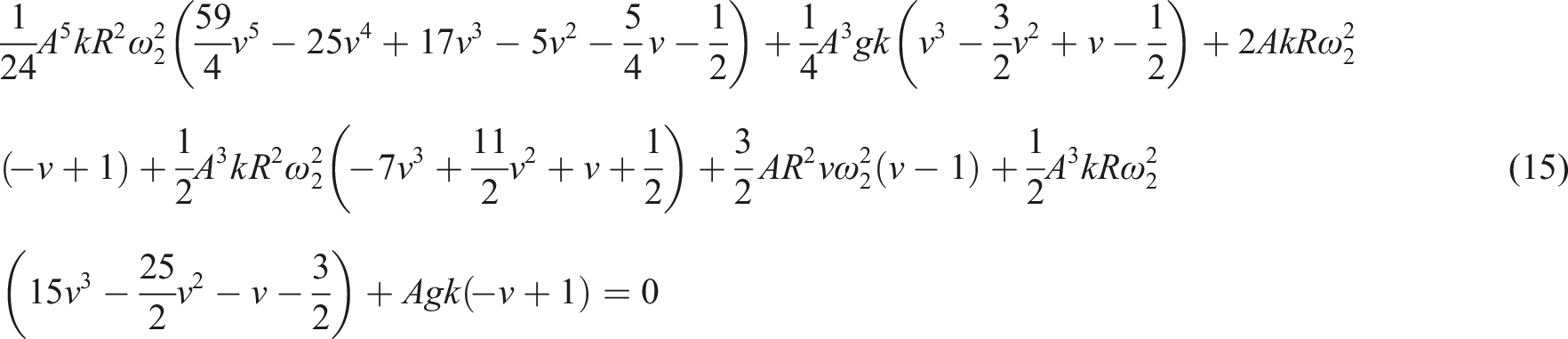

After simplification, equation (15) can be appeared into another form as




By eliminating
Finally, the second-order analytical approximate solution of equation (8) is
Results and discussion
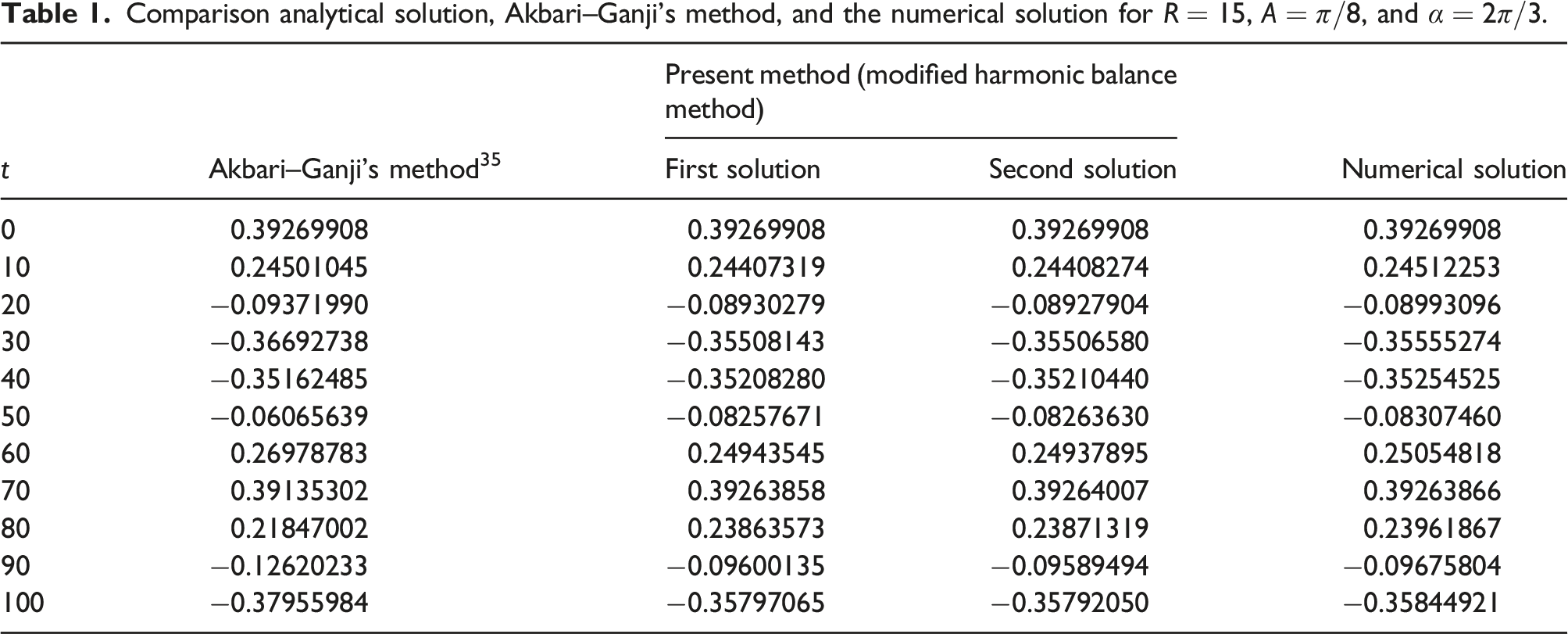
Comparison analytical solution, Akbari–Ganji’s method, and the numerical solution for
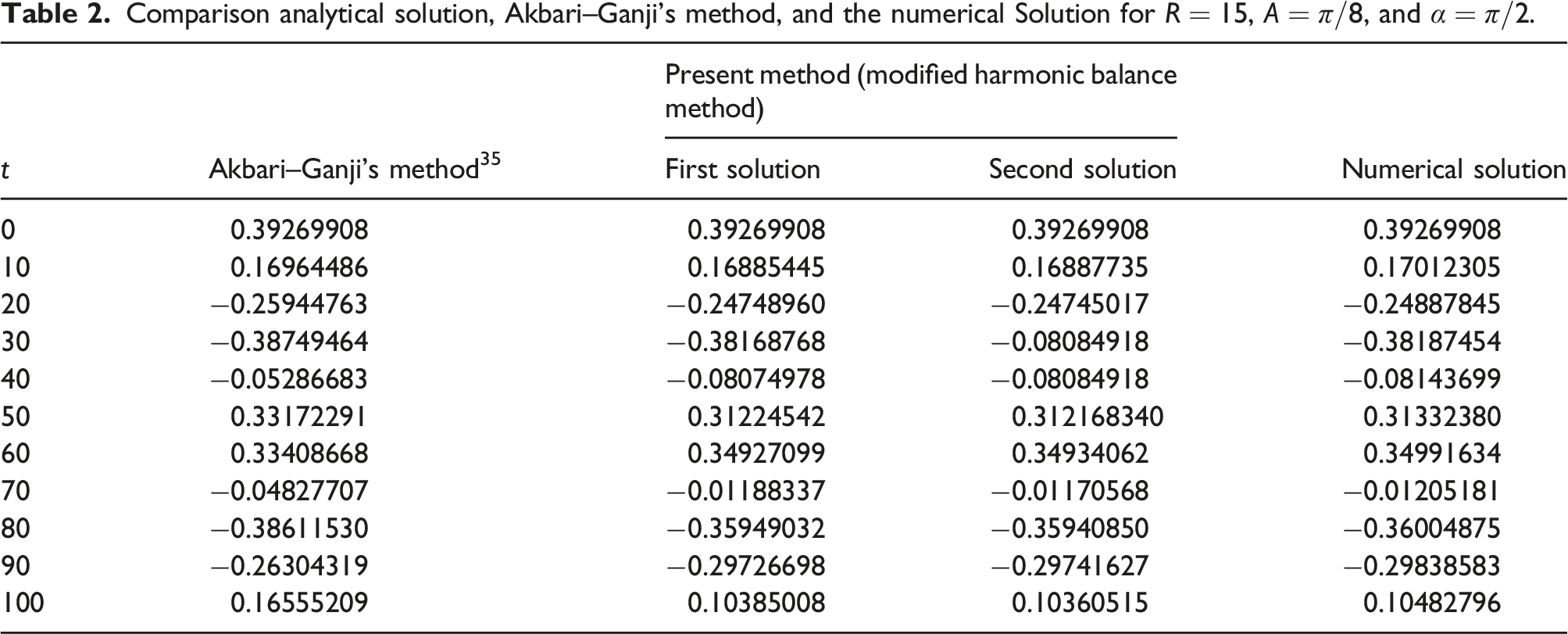
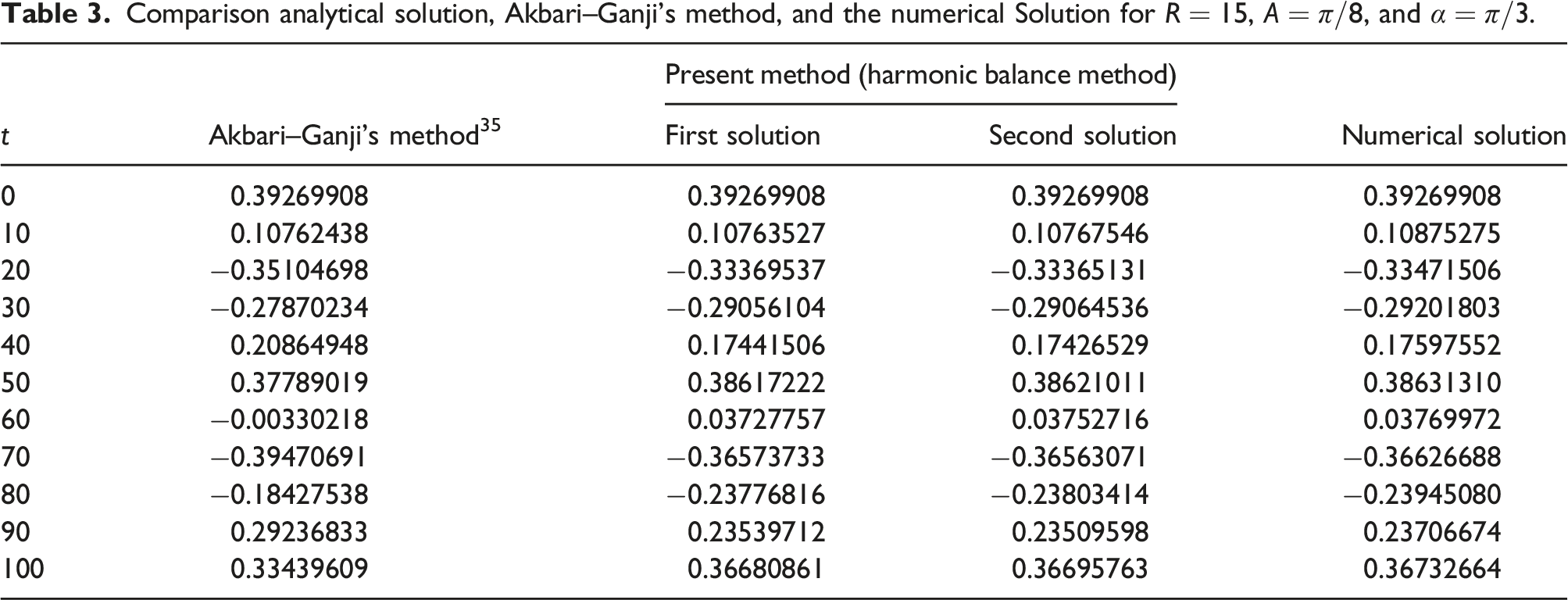
Comparison analytical solution, Akbari–Ganji’s method, and the numerical Solution for
Comparison analytical solution, Akbari–Ganji’s method, and the numerical Solution for
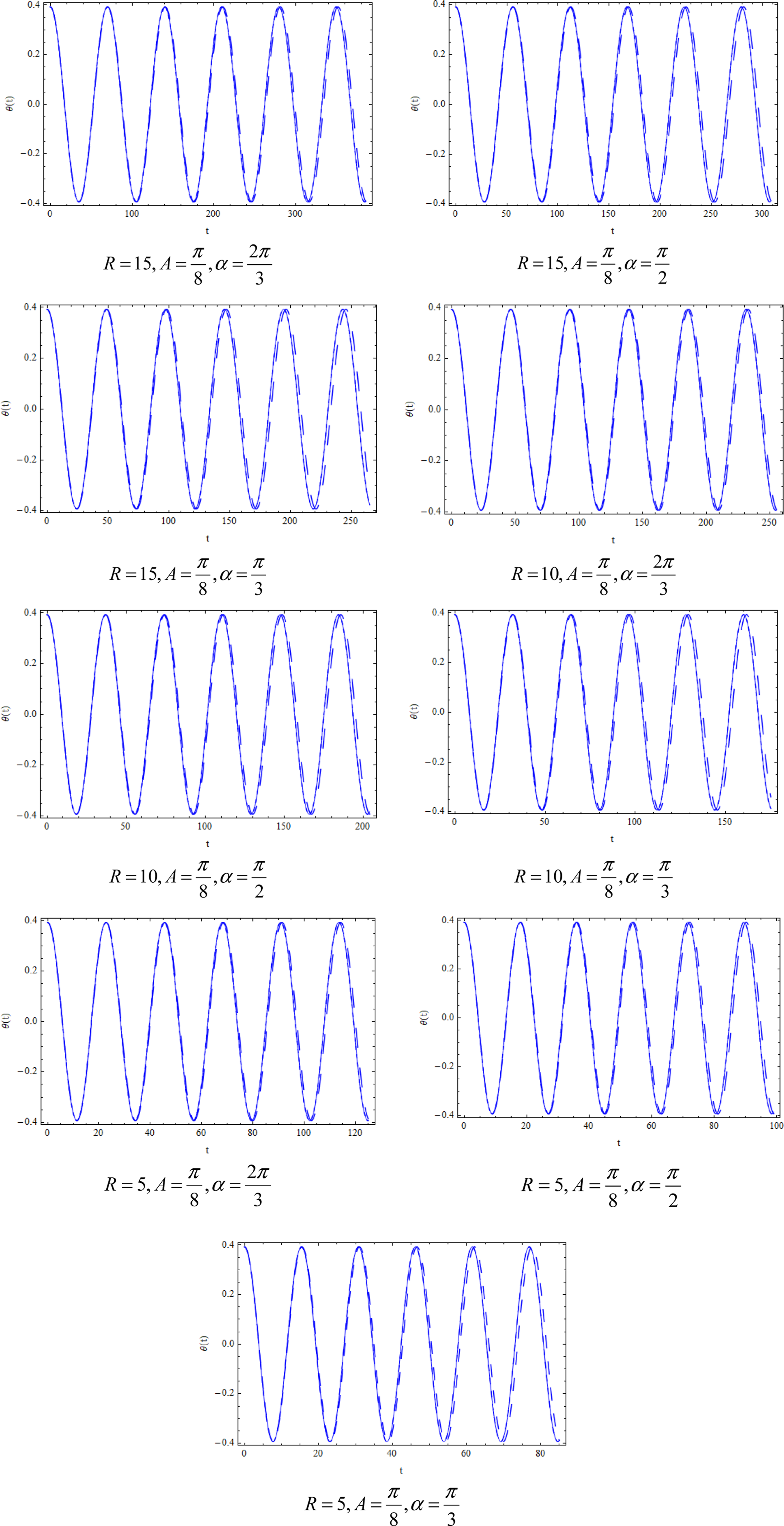
Comparison of the second-order analytical solution of equation (8) (——), second-order global residue harmonic balance method (— —) with the numerical solution (….).
Conclusion
The modified harmonic balance method was presented for determining higher-order approximate solution to the nonlinear differential equation of the circular sector oscillator. The accuracy of the approximate analytical solution was verified by comparing the present results with the exact numerical solution and other analytical methods. It is obvious that the exact numerical results agree very well with the approximate periodic solutions. Tables 1–3 and Figure 2 indicate that the modified HBM has acceptable accuracy in comparison with the Runge–Kutta numerical solution than other methods. We can say that the MHBM is very strong analytical method to solve nonlinear differential equations.
Footnotes
Acknowledgements
M. Zayed and G. M. Ismail extend their appreciation to the Deanship of Scientific Research at King Khalid University, Saudi Arabia, for funding this work through research groups program under grant R.G.P.2/207/43.
Declaration of conflicting interests
The author(s) declared no potential conflicts of interest with respect to the research, authorship, and/or publication of this article.
Funding
The author(s) disclosed receipt of the following financial support for the research, authorship, and/or publication of this article: This research is funded by King Khalid University, grant number R.G.P.2/207/43.
