




Abstract
This paper elucidates a wrong trend in solving nonlinear oscillators. The homotopy perturbation method leads to a period solution to a nonlinear oscillator with high nonlinearity, while the Parker–Sochacki method results in a chaotic one and it is invalid for solving nonlinear oscillators.
Introduction
Nonlinear vibrations arise everywhere in engineering, and it is of great importance to accurately predict its frequency. There are many analytical methods for this purpose, for example, the Parker–Sochacki method,1,2 the homotopy perturbation method,3–7 the variational iteration method,8–13 the variational principle14–17 and the fixed point theory,18–21 just to name a few, among which the homotopy perturbation method is the most powerful tool to nonlinear oscillators, while the Parker–Sochacki method always ends in a wrong result. In this paper, we will study a nonlinear oscillator with high nonlinearity and point out some misunderstandings in the analytical approach to nonlinear oscillators.
Multiple frequencies and their lowest common multiple
In order to approximately find the frequency or period of a nonlinear oscillator, we will use multiple frequencies to approach to the exact solution. To elucidate this, we consider a general oscillator in the form

The general approach to approximate identification of its frequency is to choose the following trial solution

In order to improve the accuracy, a multiple frequency assumption should be considered, that is we assume the solution can be expressed in the form

Recently there was a wrong trend to replace equation (3) by the following one
2
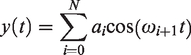
The assumption given in equation (3) should be avoided completely in solving approximately nonlinear oscillators.
We consider the following equations


The period of equation (4) is
Approximate period of a nonlinear oscillator by the homotopy perturbation method
Consider a nonlinear oscillator with fifth-order nonlinearity

By the homotopy perturbation method, we construct a homotopy equation in the form3–7

We assume the solution can be expressed in a power series of p

By the parameter expansion technology,22,23 we expand the coefficient 1 of the linear term in the form

Submitting equations (8) and (9) into equation (7), we have

Proceeding as what is required by the homotopy perturbation method,3–7 we have


The other components of

In view of equation (13), we obtain

Using the following identity

Equation (14) becomes

The periodic solution should be avoided any terms of

If we search for a first-order approximate solution, by setting p = 1 and

From equations (17) and (18), we have the following approximate frequency

In order to compare with the result in Abdelrazik et al.,
2
we choose

Its exact solution is illustrated in Figure 1, with the exact period of T = 6.0907.
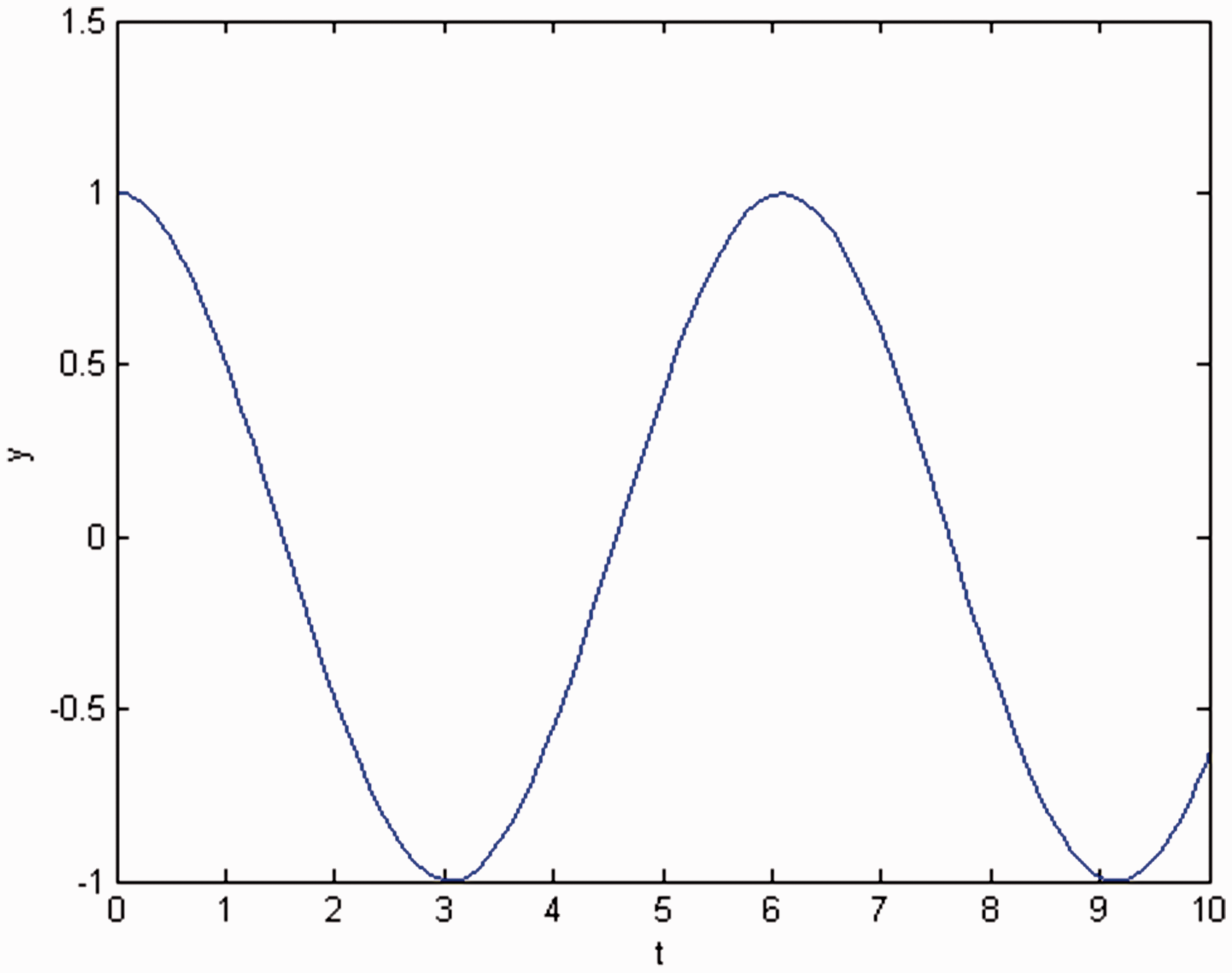
Exact solution of equation (1) with period of T = 6.0907.
Periodic solution versus chaotic solution
This section discusses the Parker–Sochacki method for nonlinear oscillators, which was originally proposed to solve a nonlinear differential equation in a power series. 1 This method was extended to nonlinear oscillators, 2 but in vain. For a nonlinear oscillator, it is of great importance to find an accurate frequency.
Abdelrazik et al.
2
obtained the following solution by the Parker–Sochacki method

There are four primary frequencies (1.03096, 3.19861, 5.4452 and 9.40308), and their corresponding periods are




The period of equation (21) is the least common multiple of

It can predict that
If the solution process continues by the Parker–Sochacki method, more frequencies appear in the approximate solution, and it will become chaotic, not periodic. Most frequencies become unneeded noise.
Abdelrazik et al.
2
gave a wrong direction to a nonlinear oscillator to have an approximate solution, or to track its trajectory. For a nonlinear oscillator, the most important property is the period–amplitude relationship or the frequency–amplitude relationship. The approximate solution can be generally expressed as


Equation (28) is a chaotic solution, not a periodic one unless
Conclusions
For a nonlinear oscillator, the frequency–amplitude relationship is of utmost importance, and there is much literature on this study, such as the He's frequency formulation,24–29 García’s frequency formulation, 30 and Suárez-Antola frequency formulation. 31 For conservative nonlinear oscillators, there are some even simpler methods,27,32 while the Akbari-Ganji method is a universal method for various nonlinear vibrations. 33 We conclude that the homotopy perturbation method is the most powerful tool to nonlinear oscillators, while the Parker-Sochacki method1,2 is totally invalid for nonlinear vibration and should be completely avoided.
Footnotes
Acknowledgment
The author feels greatly grateful for the helpful comments by the reviewers and the editor, without their help, this paper cannot reach such a present level.
Declaration of conflicting interests
The author(s) declared no potential conflicts of interest with respect to the research, authorship, and/or publication of this article.
Funding
The author(s) received no financial support for the research, authorship, and/or publication of this article.