



Abstract
A nonlinear oscillator with zero initial conditions is considered, which makes some effective methods, for example, the variational iteration method and the homotopy perturbation method, invalid. To solve the bottleneck, this paper suggests a simple transform to convert the problem into a traditional case so that He’s frequency formulation can be effectively used to solve its approximate solution. An microelectromechanical system (MEMS) oscillator is used as example to show the solution process, and a good result is obtained.
Introduction
He’s frequency formulation1–4 is the simplest method for nonlinear oscillators in the form

He’s frequency formulation predicts its square of the frequency as

or

He’s frequency formulation was first proposed in 2006, 5 and it has been broadly applied in literature and it has now matured into the simplest theory for nonlinear oscillators. For a relatively comprehensive survey on the formulation and its various modifications, the readership is referred to some articles published.6–11 He’s frequency formulation revealed, for the first time ever, the hidden mechanism of an ancient technology for water collection from air, where the low frequency property of the Fangzhu oscillator plays an important role to collect water molecules from air and to transport the water molecules to the collector. Using He’s frequency formulation, Li et al. revealed the attachment oscillation arising in nanotechnology, 12 much simpler than that in Ref. 13; He and Jin found the capillary oscillation which plays an important in life and engineering. 14 Now, the formulation has been extended to fractal oscillators with great success.15–19 In this paper, we will consider a nonlinear oscillator with zero conditions.18–26
Zero initial condition oscillator
Instead of equation (1), we consider the following nonlinear oscillator with zero initial conditions

For a linear oscillator, for example

The zero initial conditions,
For a nonlinear case as given in equation (4), some famous analytical methods, for example, the homotopy perturbation method,27–37 become invalid. The homotopy equation can be constructed as

By the traditional homotopy perturbation method, only a zero solution can be obtained, that is,
In order to convert the zero initial conditions to the traditional case, we give the following transform

Equation (4) becomes

Expanding

We can convert equation (8) into the following form

Equation (10) can be effectively solved by He’s frequency formulation.
Microelectromechanical system oscillator
Consider the following microelectromechanical system (MEMS) oscillator

with zero initial conditions

By the transform given in equation (7), equation (11) becomes


Here

It requires that

This results in

In view of equation (15), we can write equation (14) in the form

By He’s frequency formulation of equation (2), we obtain

The approximate solution is


The comparison of the approximate solution of equation (20) with the exact one is given in Figure 1; it shows a good accuracy when Comparison of the approximate solution of equation (20) with the exact one. The red line is the approximate solution, while the blue one is the exact one. (a) 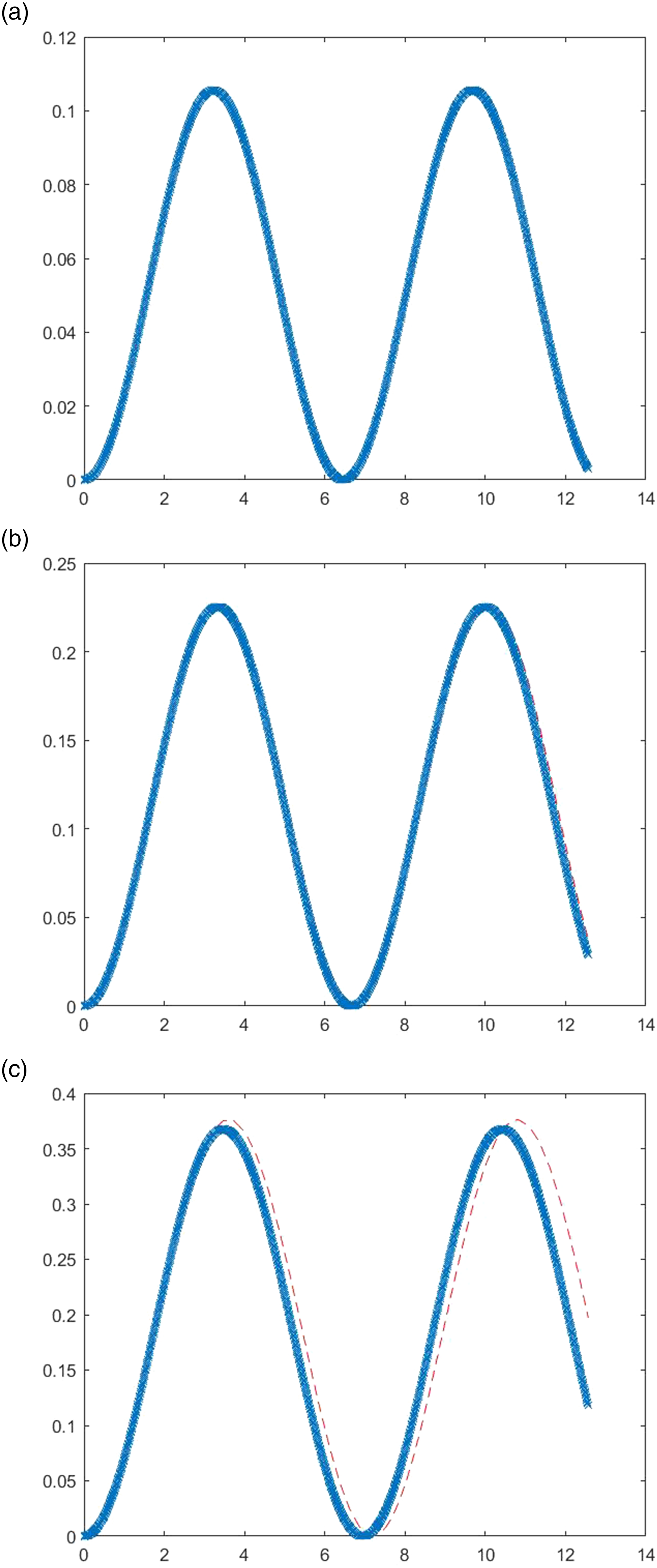
We can also write equation (17) in a power series

By He’s frequency formulation, we have

This leads to a more accurate result as shown in Figure 2. Comparison of the approximate solution of equation (20) with the exact one. The red line is the approximate solution, while the blue one is the exact one. (a) 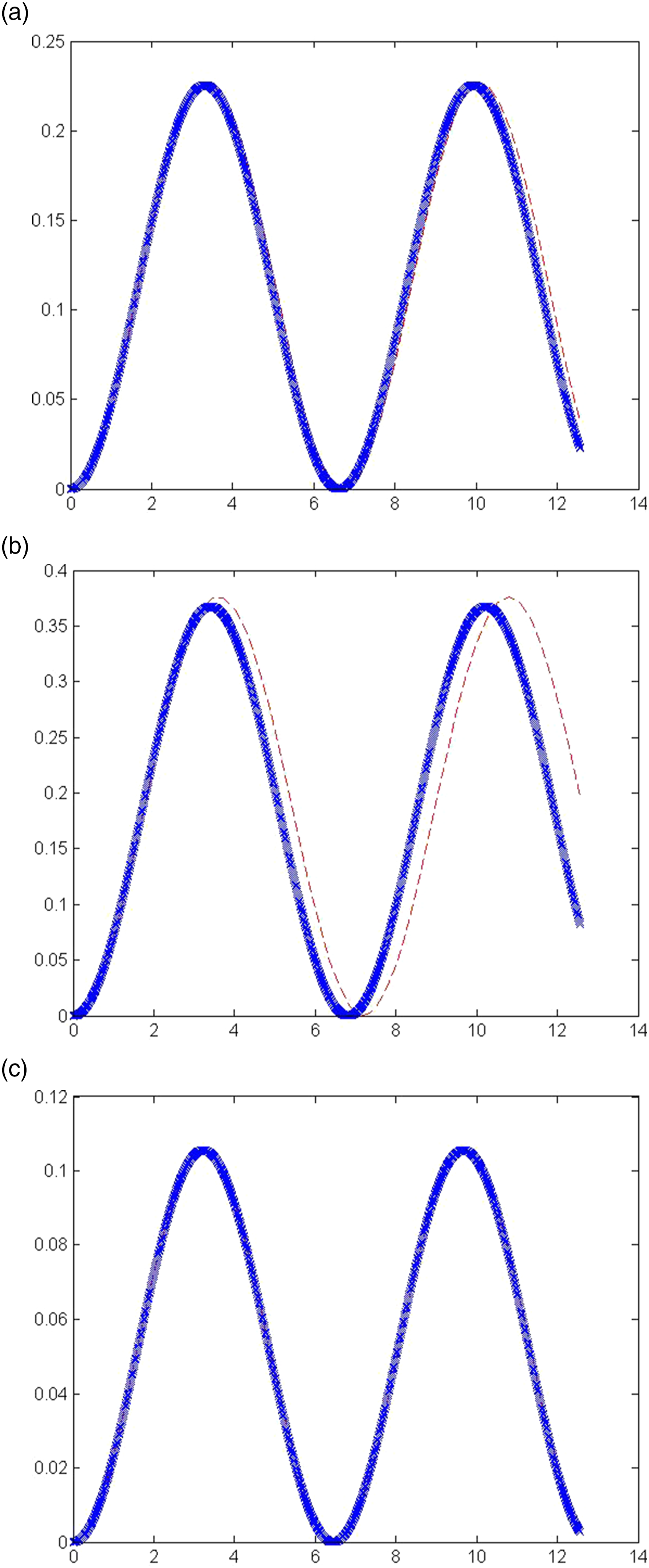
Conclusions
We use a very simple approach to a nonlinear oscillator arising in an MEMS system, which is difficult to be solved analytically by some analytical methods, such as the variational iteration method and the homotopy perturbation method. An extremely simple transform makes the problem extremely simple by He’s frequency formulation. This method can be extended to more complex oscillators arising in N/MEMS systems.
Footnotes
Author contributions
Conceptualization: Y-N Z, JP, and TD; methodology: Y-N Z and JP; formal analysis: Y-N Z and JP; writing—original draft preparation: Y-N Z; and writing—review and editing: Y-N Z, JP, and TD. All authors have read and agreed to the published version of the manuscript.
Declaration of conflicting interests
The author(s) declared no potential conflicts of interest with respect to the research, authorship, and/or publication of this article.
Funding
The author(s) disclosed receipt of the following financial support for the research, authorship, and/or publication of this article: This research was funded by National Natural Science Foundation of China, grant number: 11561051.
