



Abstract
In this paper, we investigate the nonlinear Chiral Schrödinger equation (CNLSE) in two dimensions where noise term affected randomly with time. This equation characterized some edges states of fractional-Hall Effect features in quantum. The CNLSE with multiplicative noise effects is studied as dynamical system to specify the acceptable solution types and then solved by unified solver method. The presented solutions are periodic envelopes, explosive, dissipative, symmetric solitons, and blow up waves. It was confirmed that the noise factor is dominant on all the wave conversion, growing and damping of envelopes and shocks. The presented technique in this study can be easily utilized for other nonlinear equations in applied science.
Keywords
Introduction
Mathematical simulation of some vital real life problems typically leads to differential equations and other problems; essential functions of mathematical physics, as well as their extensions and generalizations, are included.1–8 Recently, the nonlinear stochastic partial differential equations (NSPDEs) have been extensively studied by many scientists due to the fact that these equations are successfully utilized for modeling various physical phenomena such as superfluid, HIV internal virus dynamics, telecommunications, astrophysical dynamics, and growth of biological populations.9–14 These equations often rely on a noise source such as a white noise and certain probability laws.15–18 The investigation of optical solitons for the NSPDEs is an important topic as explained in.19–22
The investigation of chiral solitons is so important in the developments of quantum mechanics, especially in the field of quantum hall effect where chiral excitations are known to become visible. 23 The governing equations, that are going to be investigated through this study, are (2 + 1)-dimensional CNLSE. Namely, we consider this model in the presence of noise term, which produce various complex phenomena in quantum mechanics, superfluid, molecular biology, statistical mechanics, magneto hydrodynamics, deep water, and many others.24–28 More and more attention has been paid recently to the effect of a noise on the propagation of the soliton solutions.
In recent years, the generation of fractal solitary structures from many nonlinear equations via fractal variational principles in different media becomes an effective way to describe some new phenomena in our universe.29–32 The solitary peaks have been examined by unsmooth boundaries effects via fractal KdV equation by using various fractal dimensions of the boundaries. 32 Also, the solitary forms of Boussinesq equation has been examined in fractal space. 29 On the other hand, the nonlinear Chen-Lee-Liu equation in fractal form has been introduced to investigate the optical nonlinear pulses features in optics applications. 33
We consider the (2 + 1)-dimensional CNLSE as follows34,35 (a) Ξ(t), t ≥ 0 are continuous functions of t, where t refers to the time and Ξ(t) ∼ N(0, t). (b) For s < t < u < k, (c) Ξ(t) − Ξ(s) follows a normal distribution with zero mean and variance t − s, that is,

We note that the probability density function of the normal distribution is displayed as


The stochastic integral
We aim to produce some new stochastic solutions for the (2 + 1)-dimensional CNLSE forced by multiplicative noise in Itô sense, using the unified solver approach. The proposed solver reveals various advantages, such as it averts intricate and tedious computations, and provides us with exact solutions in an explicit form via free physical parameters. This solver is simple, sturdily built and vigorous. One can easily use this solver as a box solver. The presented solver can be applied for the huge classes of NSPDEs. Indeed, this solver can be easily extended for solving stochastic fractional NPDEs. One of the more interesting points is to clarify the influence of the noise term on the acquired solutions. We also illustrate the nonlinear dynamical behavior of some selected stochastic solutions.
The rest of the framework of this paper is structured as follows: Section 2 considers the (2 + 1)-dimensional stochastic CNLSE via Itô sense. Namely, CNLSE with multiplicative noise effects is studied as dynamical system to specify the acceptable solution types and then solved by the unified solver method. Section 3 provides the physical interpretation for the phenomena arising through the solutions of considered model. Conclusions appear in Section 4.
The stochastic ODE for equation (1a) and its solutions
Using the traveling wave transformation,
34
we obtain

Putting equations (2a) into (1a) yields



Expectation on both side for equation (2c) gives


Chiral NLSE dynamical mode
The investigated Chiral nonlinear mode in two dimensions can be reduced to the formal classical energy integral of particles in potential well. The particle kinetic energy and quasi-potential represented in the energy equation reads

Equation (2f) is a dynamical system of a particle in the potential given by

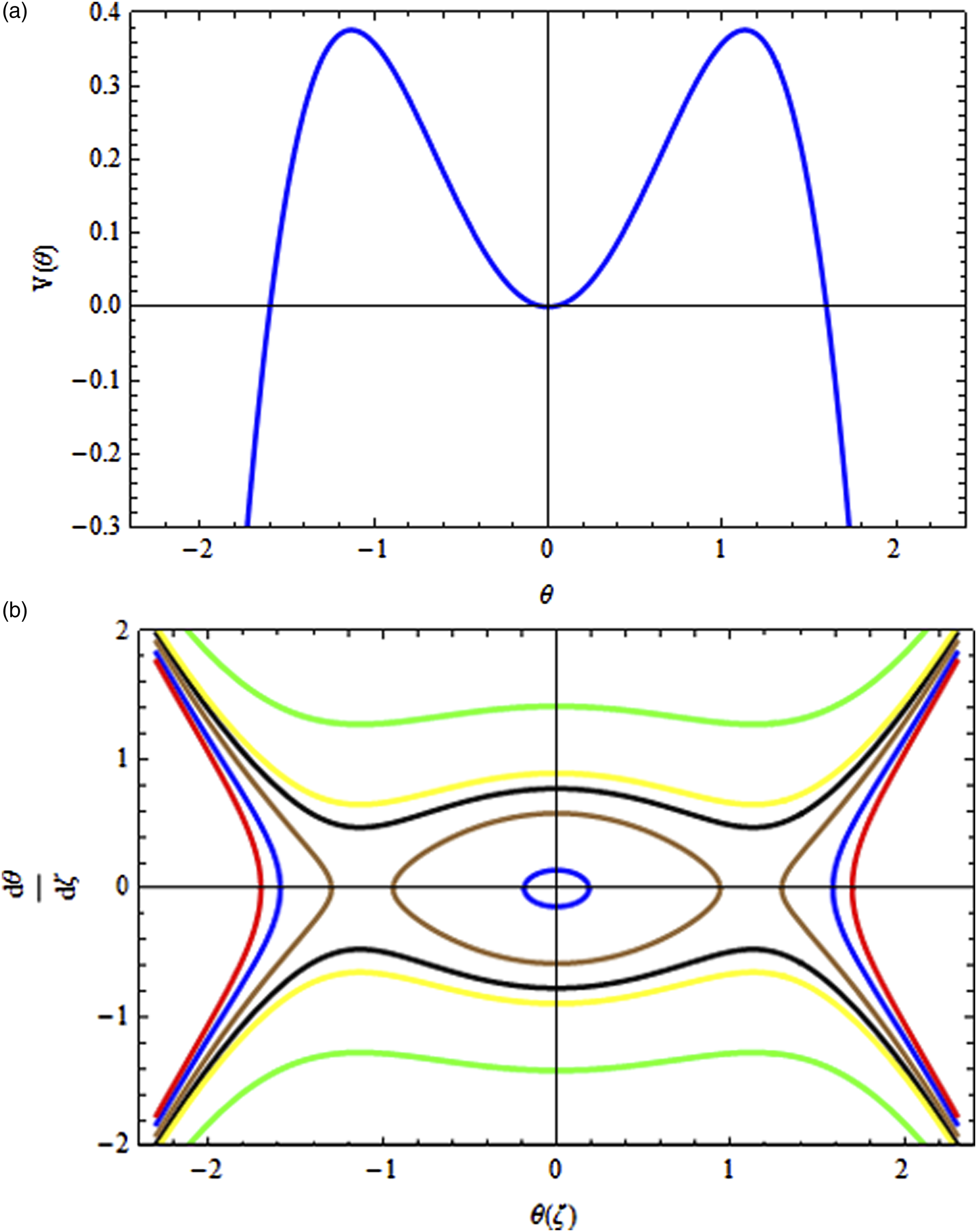
The graphical dynamical behaviors of V(θ) and the phase portrait are numerically simulated in Figures 1 and 2. Change of V and Change of V and 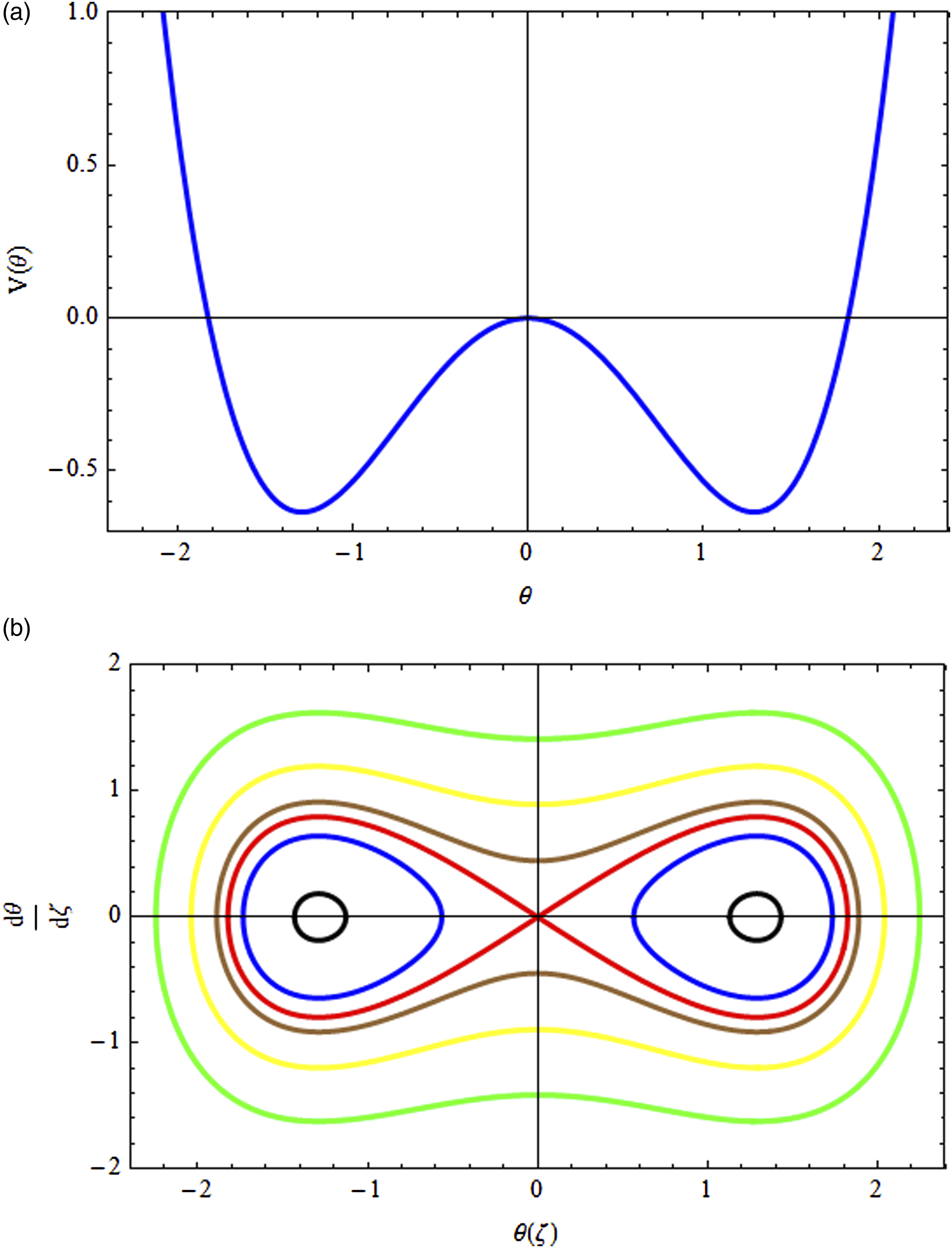
Stochastic solutions
Exact and unified solver technique solutions
The exact solution of equation (2f) is

Consequently, the solutions of equation (1a) is given by
In view of the unified solver technique,
41
the stochastic solutions for equation (2c) are:
The first stochastic solutions of equation (2c) are written as

Thus, based on equation (2k), the stochastic solutions of the equation (1a) are

The second stochastic solutions of equation (2c) are presented as

So, using equation (2m), the stochastic solutions of the equation (1a) are displayed as

The third stochastic solutions of equation (2c) are demonstrated as

Therefore, based on equation (2o), the stochastic solutions of the equation (1a) are

Physical interpretation
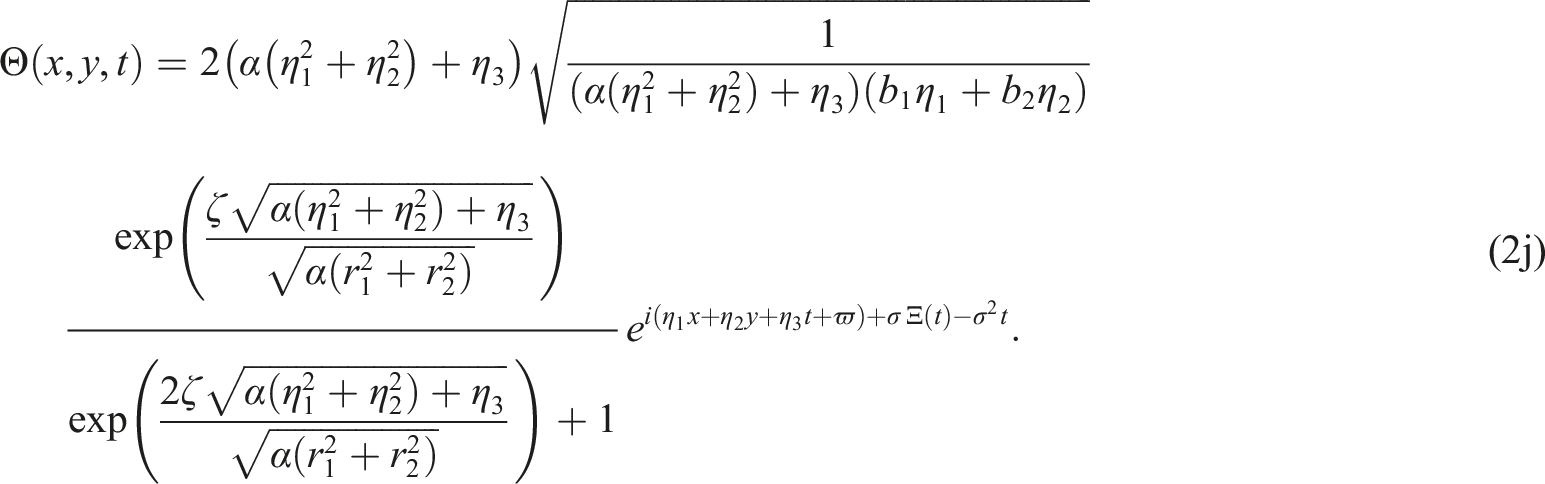
The (2+1)-dimension stochastic solutions of CNLSE have been released by exact and unified solver techniques. The CNLSE is of interest of many researchers to describe physical phenomena in the Quantum field of Fractional-Hall Effect edges state.24,27,28 The studied CNLSE in two dimensions can be treated as a particle motion with classical energy equation (2g), which has potential in equation (2h). The potential-phase portrait were numerically deliberated in Figures 1 and 2. It was represented that, there are three points corresponds to a center saddle point and two equilibriums in the phase portrait as in Figure 1. On the other hand, three points correspond to a center equilibrium point and two saddles in the phase portrait as in Figure 2. One can expect all solutions information from the heteroclinic orbits, saddle connections, and periodic orbit obtained in the studied phase portrait. Under noise term and time-dependent Brownian-function Ξ(t), the expectation equation with
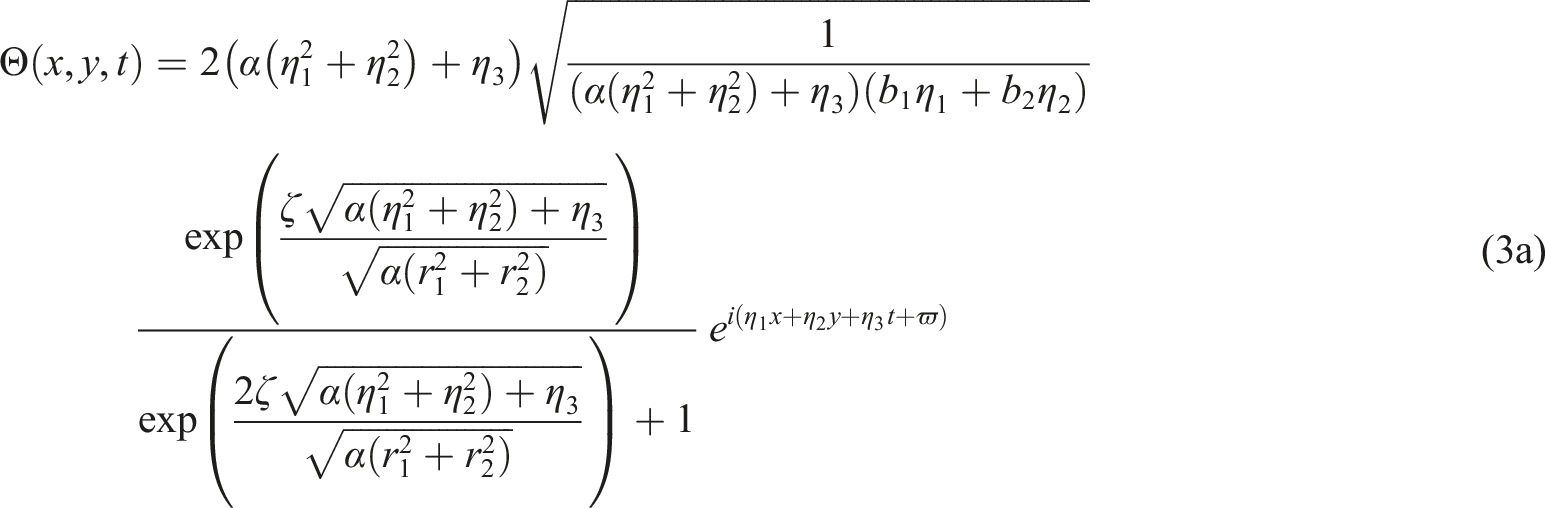



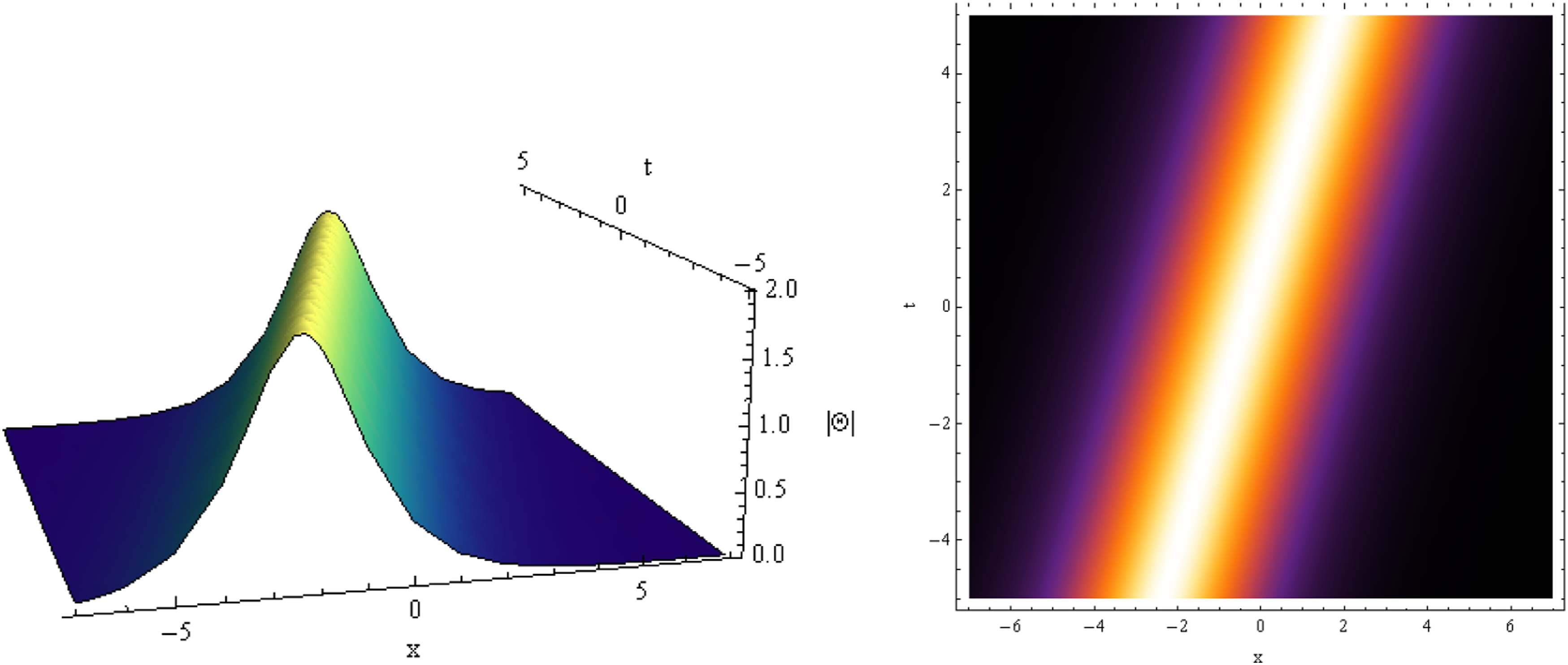
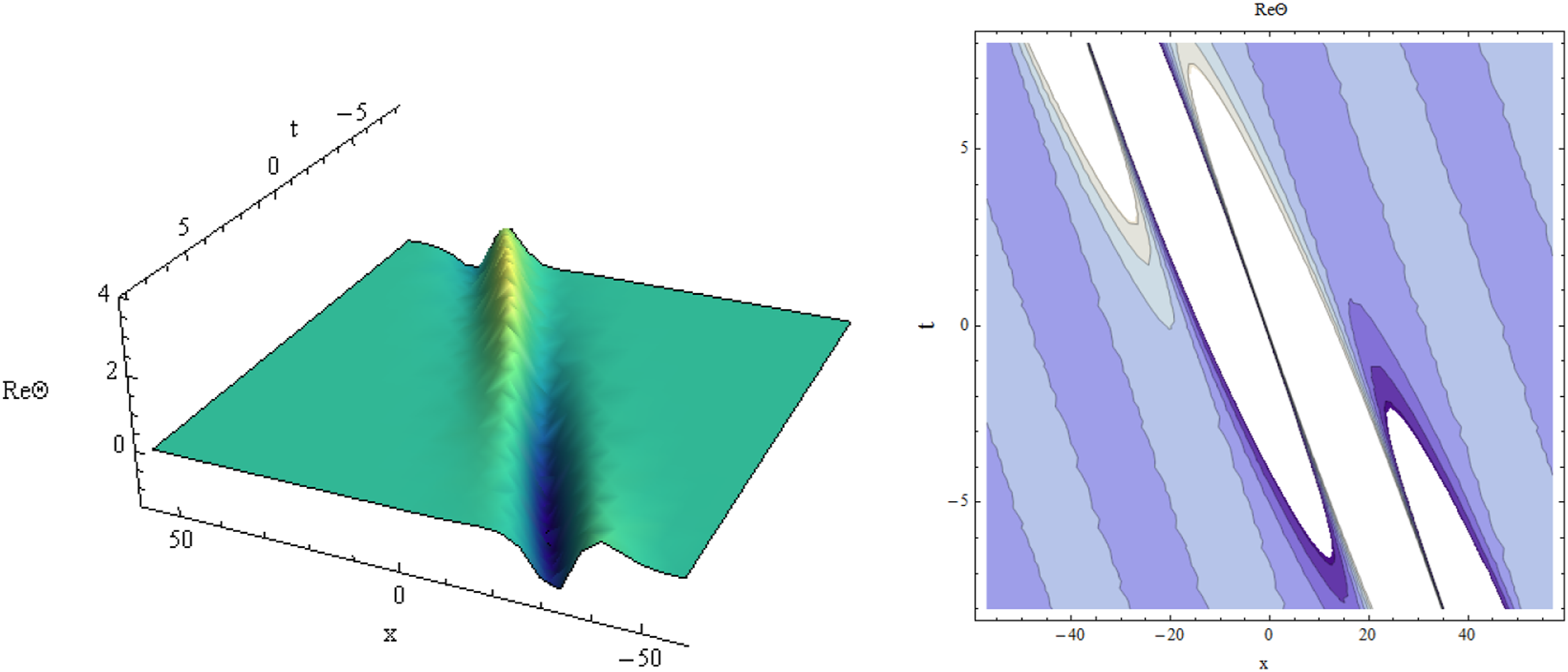
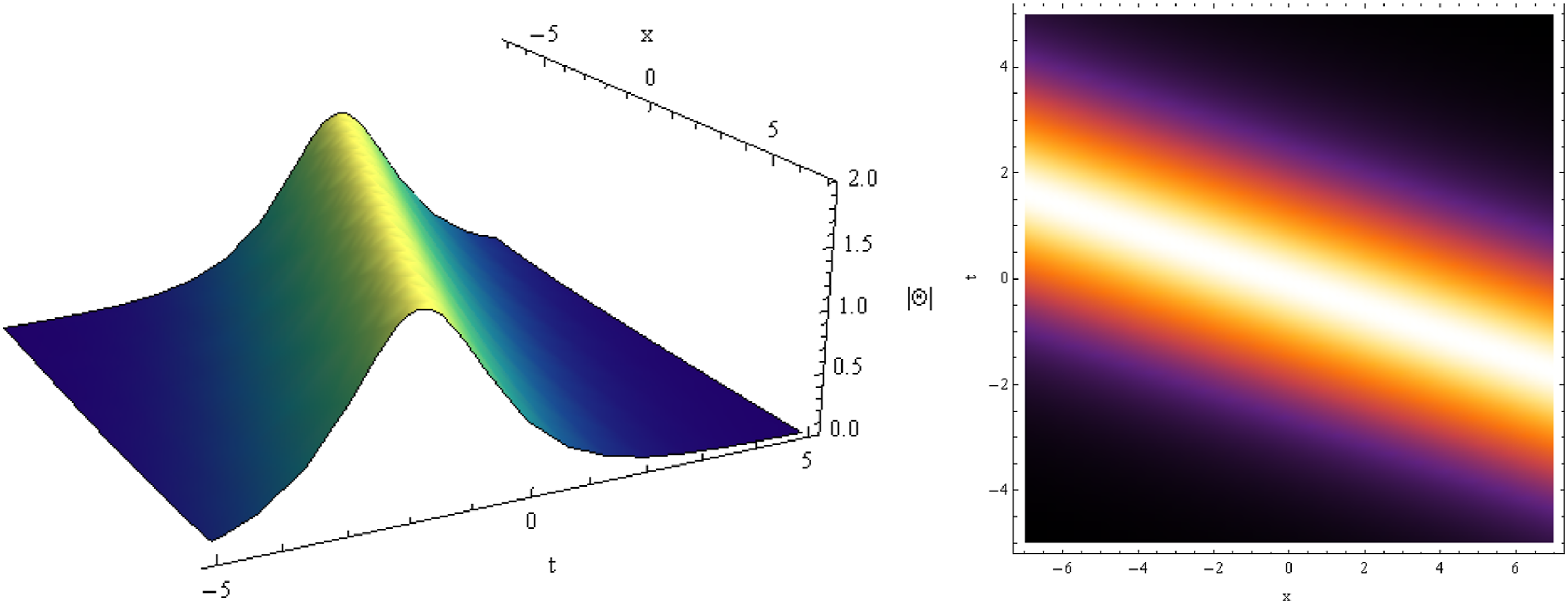
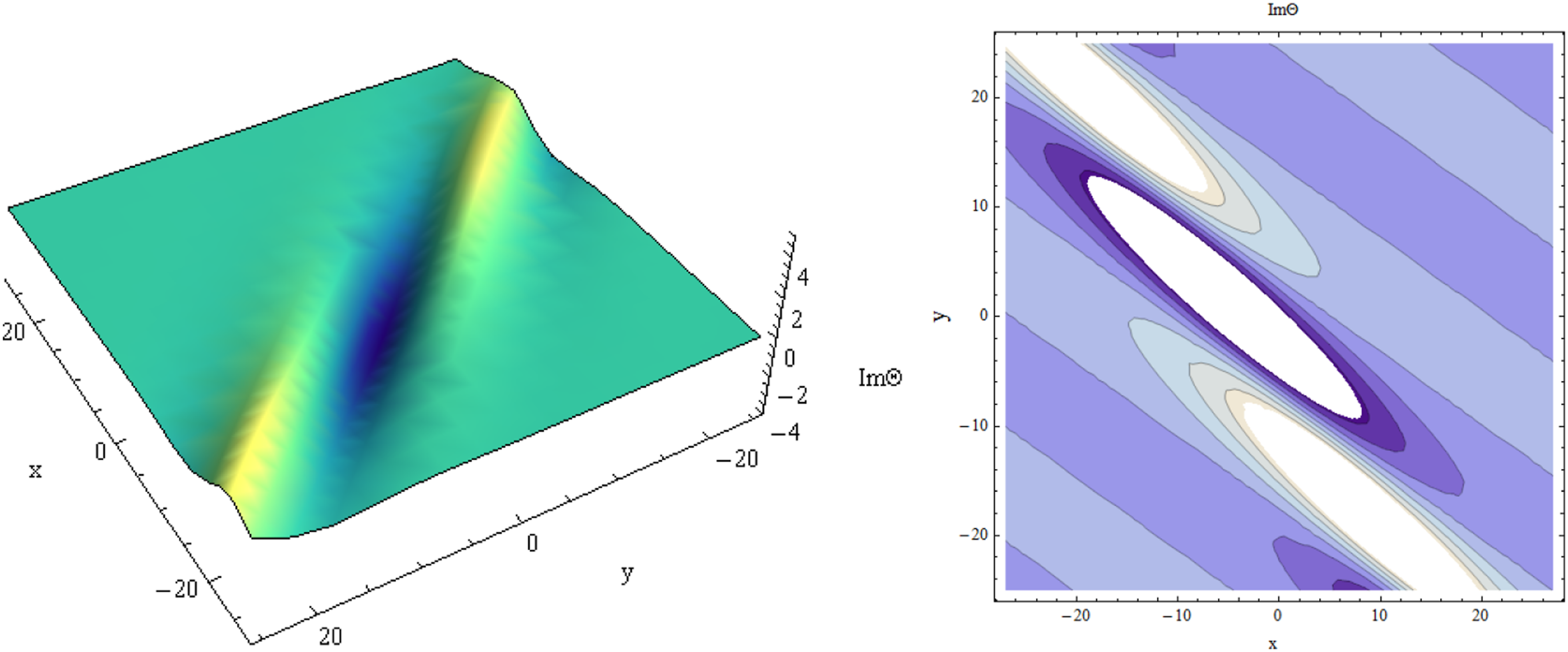
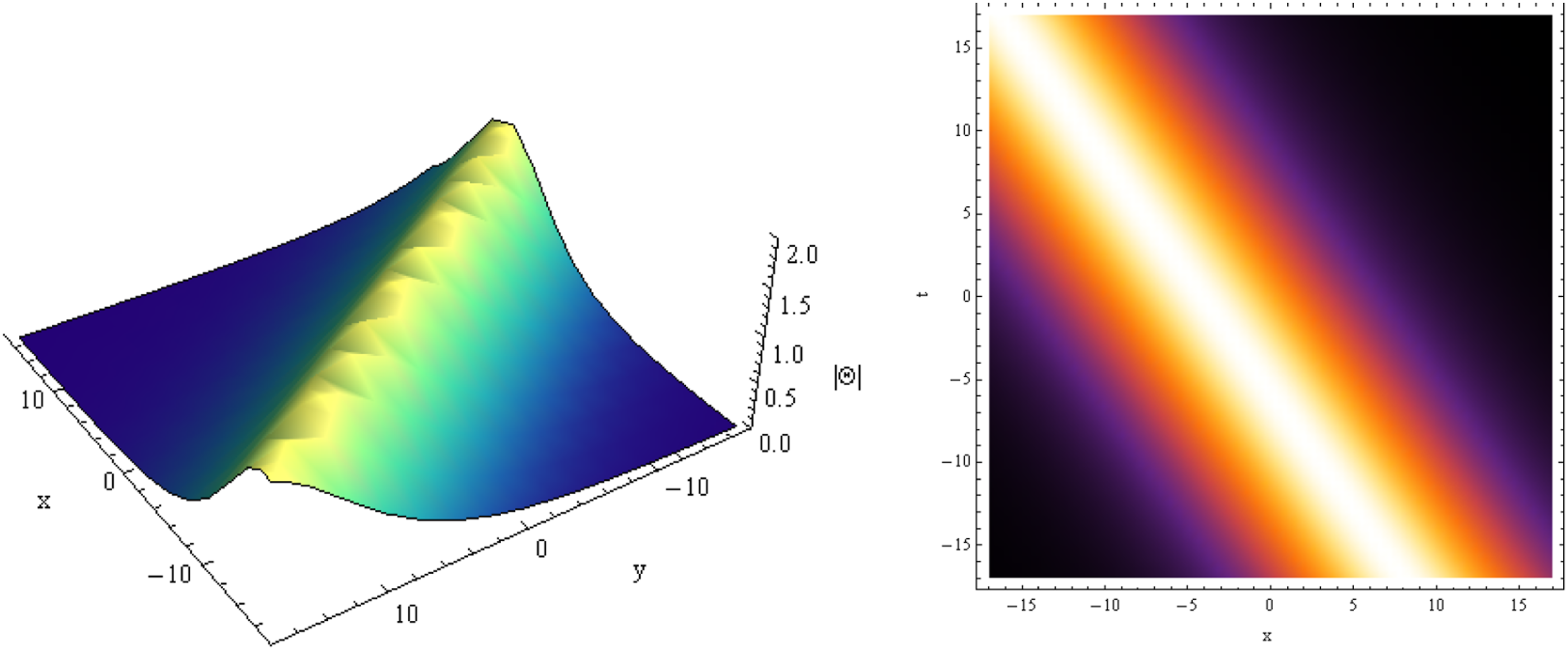
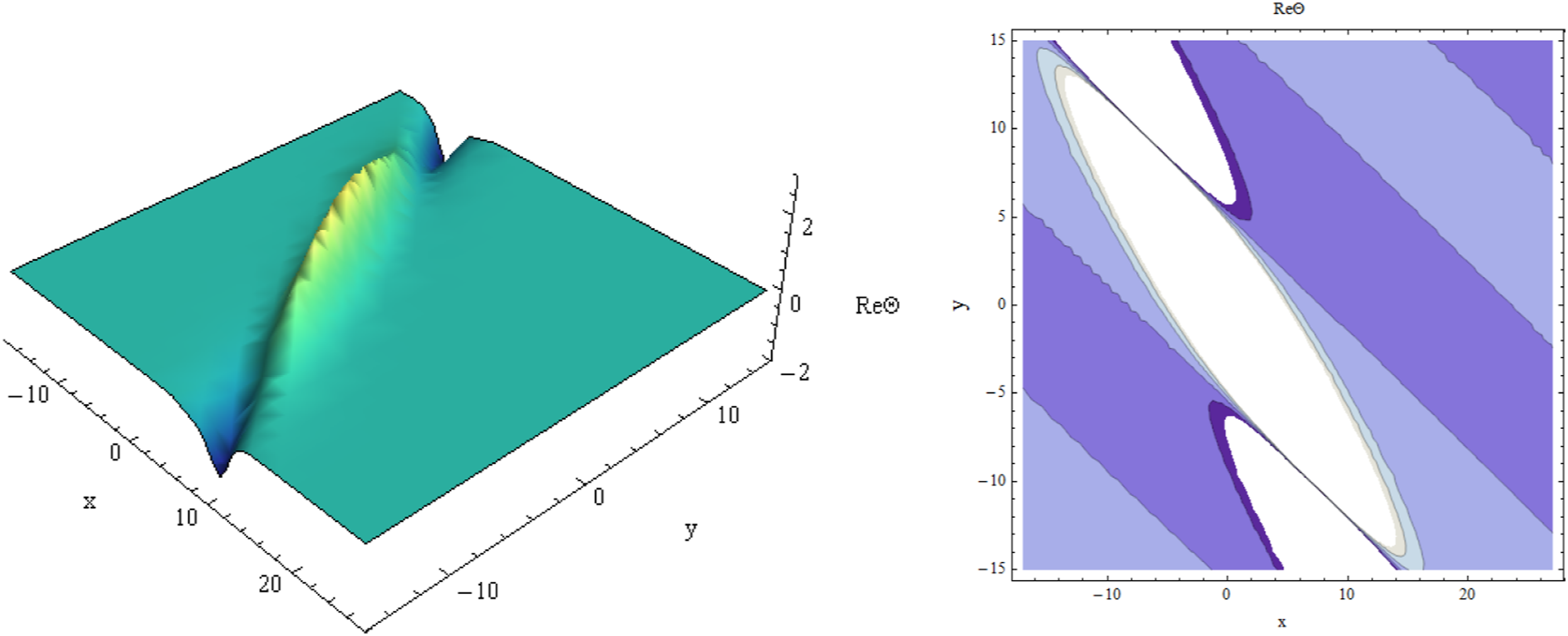
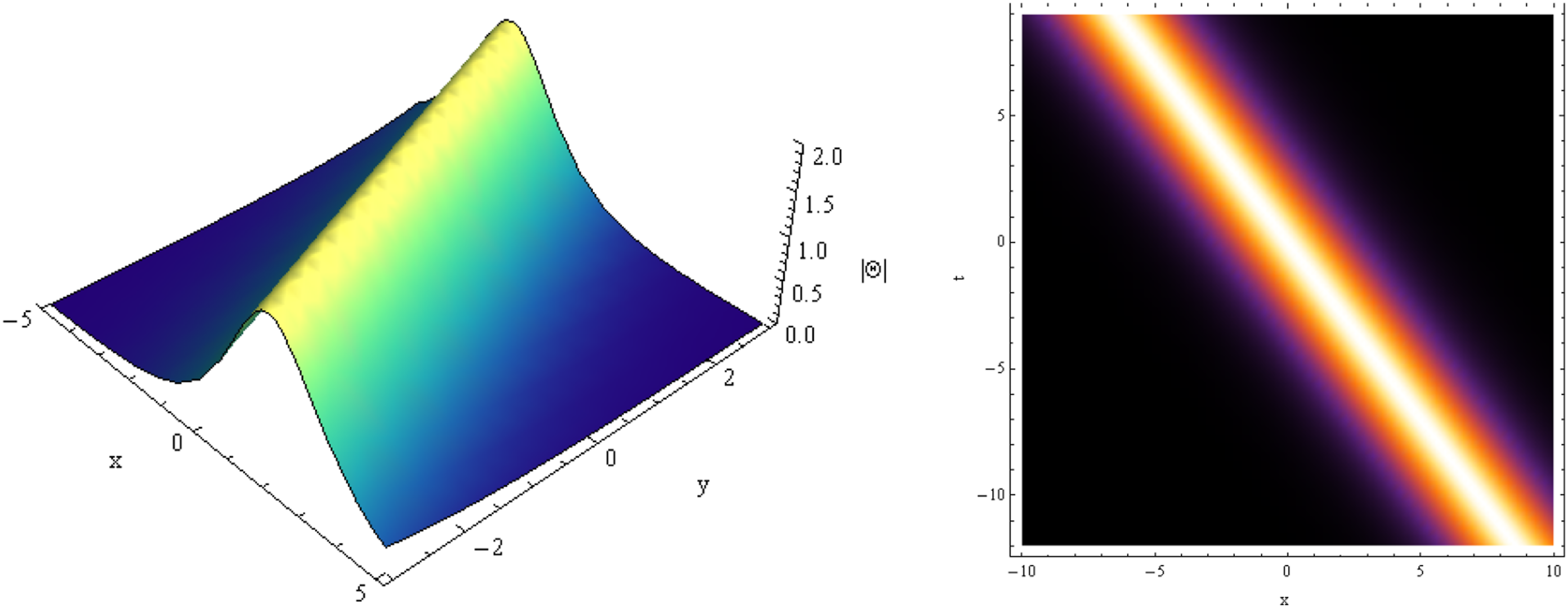
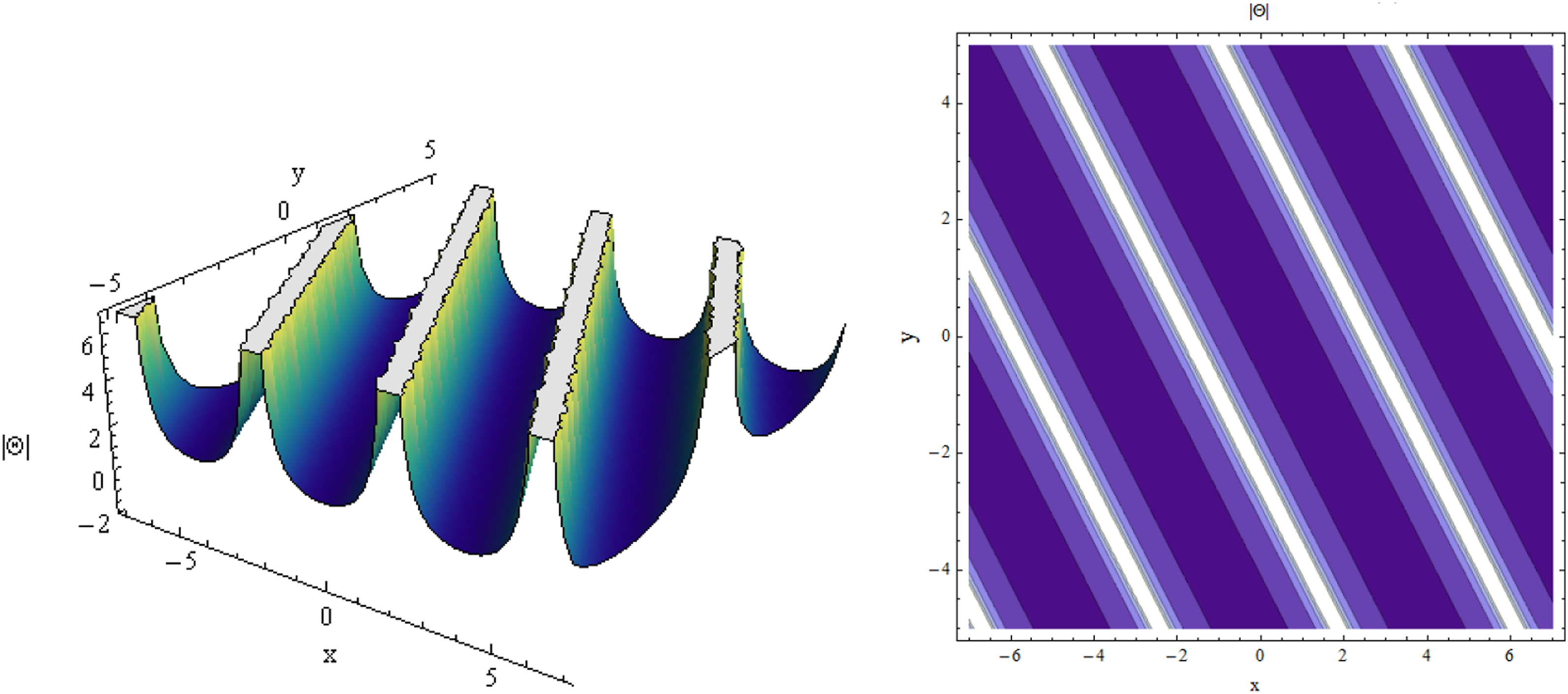
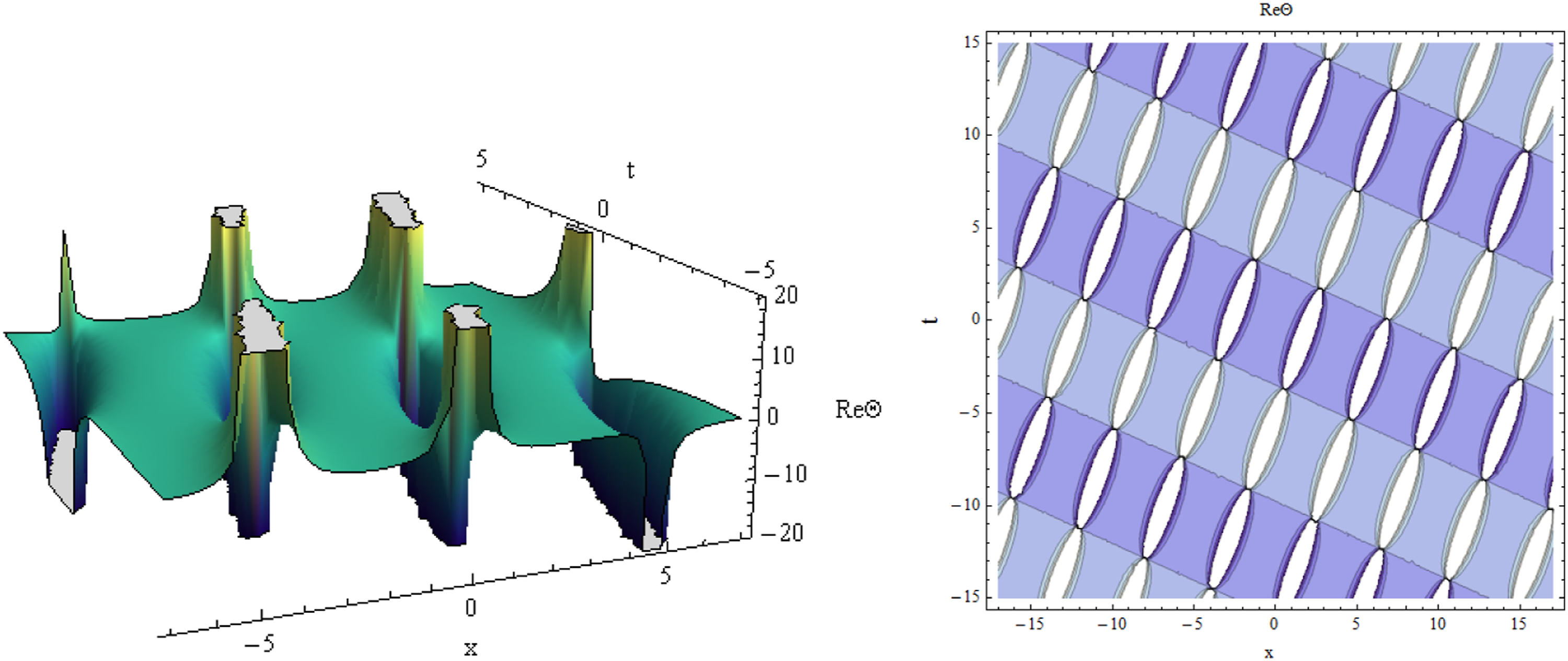
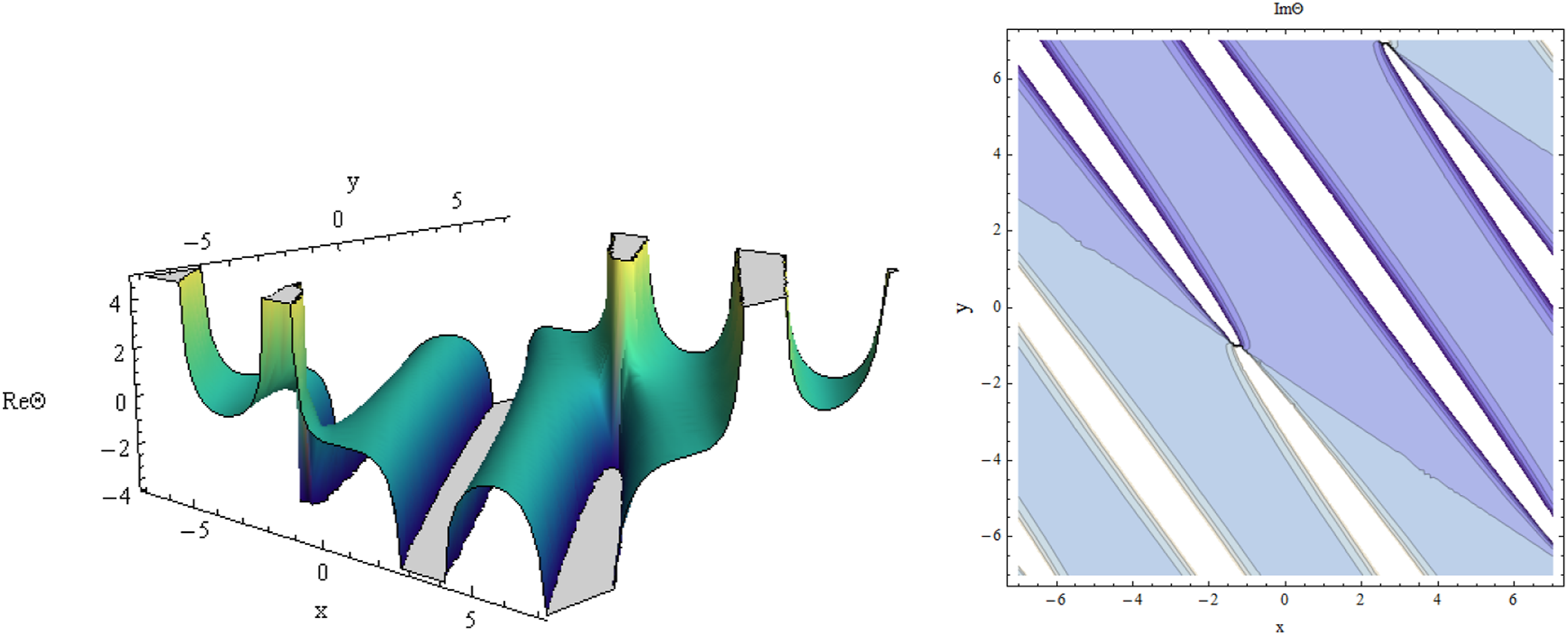
Here, 3D CNLSE solution profiles have been inspected with x, y and t for σ = 0 in Figures 3–13. Figures 3 and 4 described periodic envelopes and solitonic solutions for equation (3a). It was noted that solitonic form is directed to negative x axis is given in Figure 4. In Figures 5–8 some plots for equation (3b) solutions are introduced to show pairs of symmetric solitons as in Figures 5 and 7 and positive soliton directed to negative t axis as in Figure 6 and xy plan as in Figure 8. Equation for solutions (3c) represents three types of solutions as in Figures 9–11, two of them are bright solutions, namely, envelope bright soliton and stationary soliton as sketched in Figures 9 and 10 and the third one is a blow up solution as seen in Figure 11. Furthermore, solution (3d) denotes a dissipative behaviors with blow up and symmetric explosive forma as in Figures 12 and 13. Change of real part of equation (3a) with x, t, α = 0.5. Change of |Θ| of equation (3a) with x, t, α = 0.5. Change of real part of equation (3b) with x, t, α = 0.5. Change of |Θ| of equation (3b) with x, t, α = 0.5. Change of imaginary part of equation (3b) with x, y, α = 0.5. Change of |Θ| of equation (3b) with x, y, α = 0.5. Change of real part of equation (3c) with x, y, α = 0.5. Change of |Θ| of equation (3c) with x, y, α = 0.5. Change of |Θ| of equation (3c) with x, y, α = −1.5. Change of |Θ| of equation (3d) with x, t, α = 0.5. Change of |Θ| of equation (3d) with x, y, α = 0.5.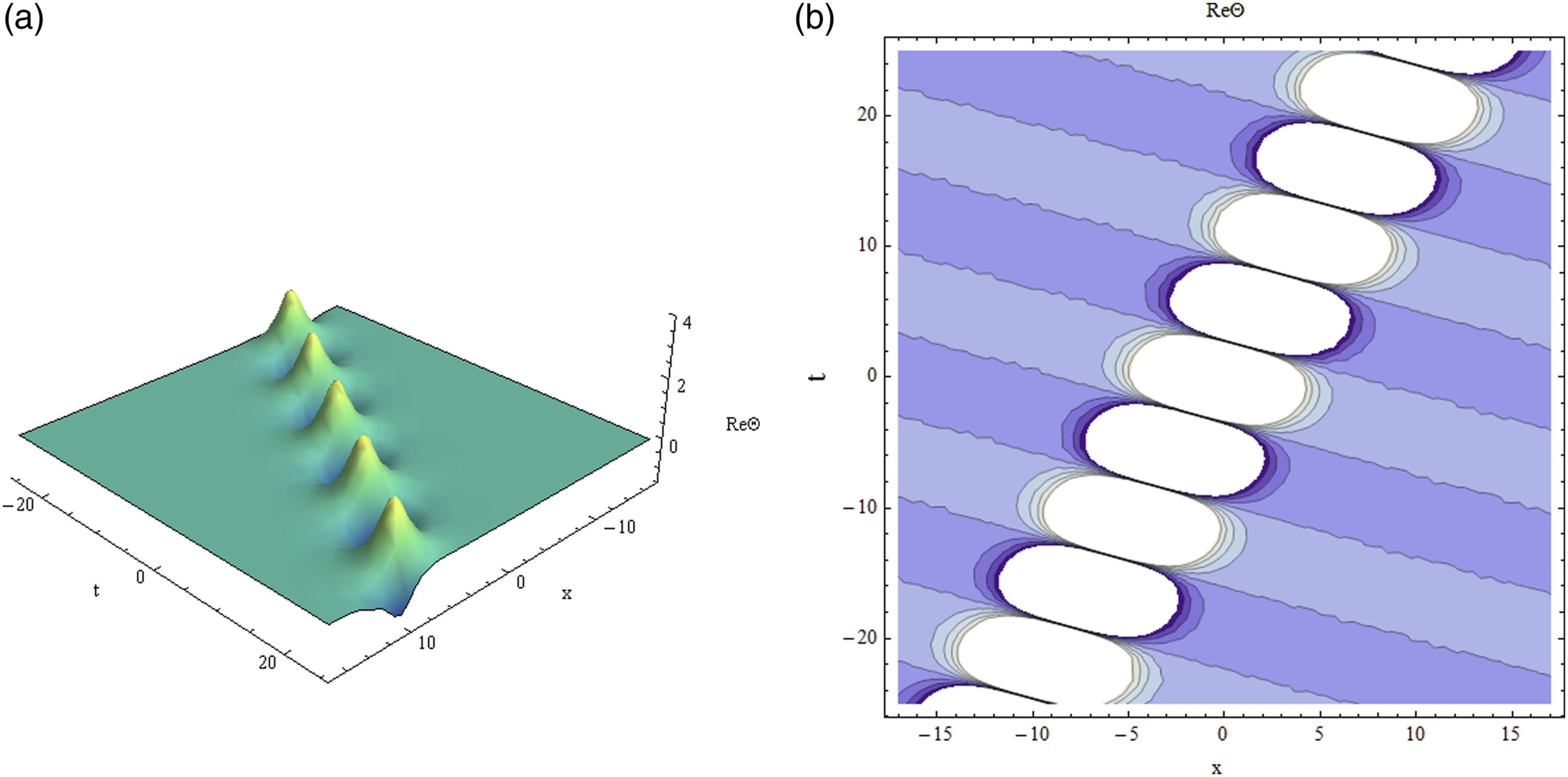
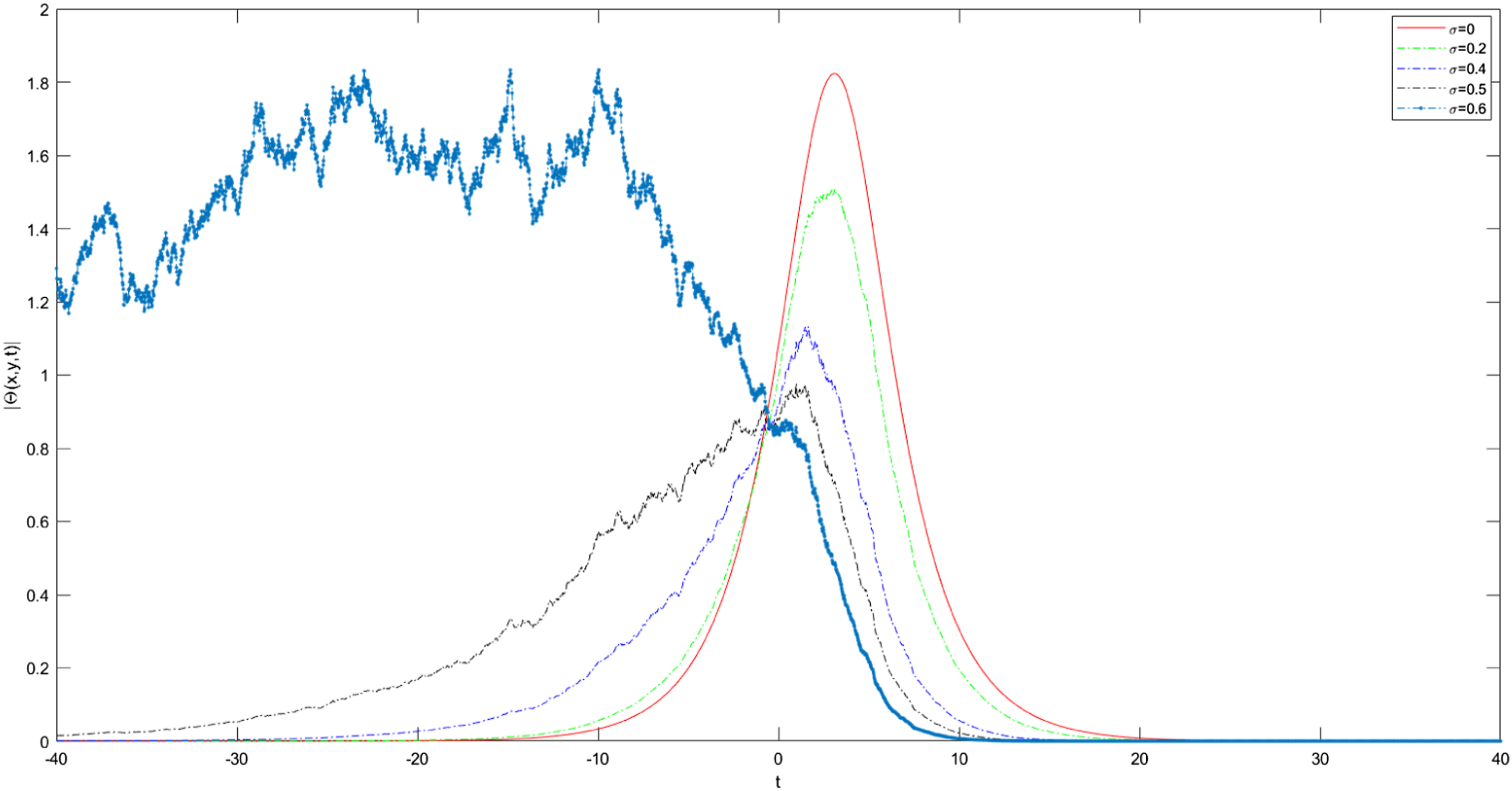
On the other hand, we examine the noise strength effects on the solitonic solutions properties, which may grow or damp with time. Solution (2l) is varying with time t and noise parameter σ as depicted in Figure 14. It was performed that by raising σ, the amplitudes of envelope profile contracting with t up to σ = 0.6 and then it began converting to shock oscillatory wave with deformed beaks. Finally, the variation of solution (2n) with time t and σ is given in Figure 15. By increasing σ, the stationary soliton amplitude damped with small movement of left tail up to σ = 0.6, and then it began converting to shock wave with stochastic amplitude. The stochastic properties of (2+1)-dimension CNLSE solutions were modulated by noise in Itô sense by varying solitary properties and fluctuated under stochastic σ parameter. Stochastic process for real part of equation (2l). Stochastic process for |Θ| of equation (2l).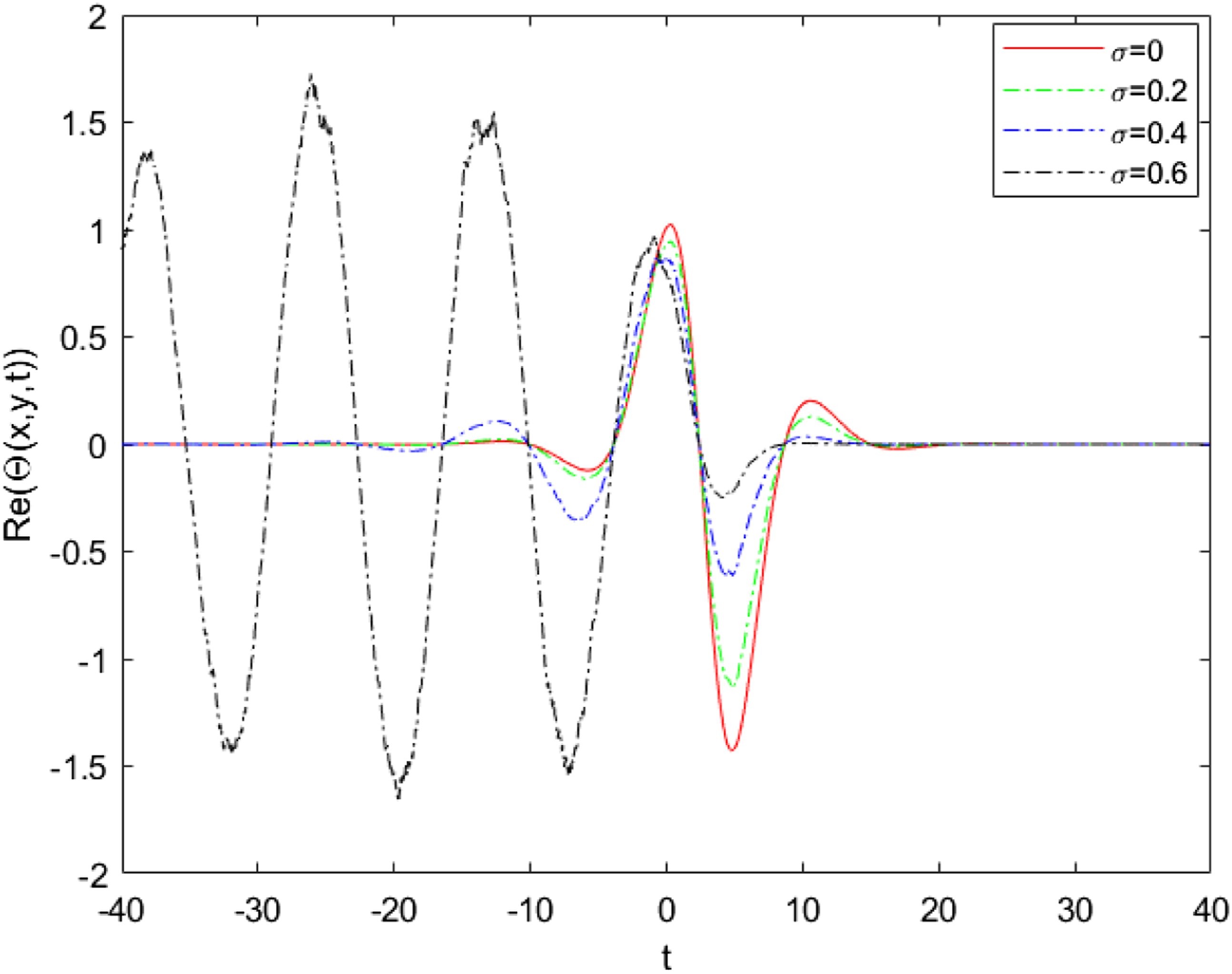
Our stochastic solutions may be valid with the modern investigations in extraordinary materials as topological insulators and strong correlated systems in quantum chromo dynamical studies, turbulences, and superconductor.
Conclusions
The Brownian stochastic two dimensional CNLSE have been investigated by dynamical system plots and then solved to obtain efficient and dynamic solitary structures. These specific solitary structures may be useful and important in new and modern quantum Hall Effect studies in topological materials. The Brownian noises influences on the structural properties have been examined. The parameter σ modulated the obtained structures, which may be useful and important in quantum Hall Effect studies. The Brownian noises strength influences on the features of solitonic forms which may growing or damping by time. The parameter σ modulated the envelope to behave as shock oscillatory with deformed beaks and stationary soliton to shock wave with stochastic amplitude. On the other ward, the envelope amplitudes may contract or converting to oscillatory shocks with distorted beaks. This study may be leading in quantum physics applications.
Footnotes
Declaration of conflicting interests
The author(s) declared no potential conflicts of interest with respect to the research, authorship, and/or publication of this article.
Funding
The author(s) received no financial support for the research, authorship, and/or publication of this article.
