




Abstract
The nonlinearly stochastic Schrödinger equation (NLSSE) predicts the nonlinear process that produces the waves decay in many physics applications. The unified method has been used in obtaining different new stochastic forms for NLSSE damped by noises in Itô sense. The derived structures appear in the form of rational, solitons, soliton-like shocks, and explosive propagations. The new stochastic solutions investigated the change of frequencies by noise term in NLSSE in nonlinear process that may be produced in many nonlinear wave applications. Finally, wave picture properties may controlled by noise term in Itô sense effect, which gives new information’s for NLSSE in physics applications which is believed to be affected by the influence of Brownian motion that change the shape and structures of the generated decaying and damping waves.
Introduction
Applied mathematics is the backbone for many real life problems, such as nonlinear partial differential equations (NPDEs),1,2 fuzzy systems,3,4 nonlinear stochastic process,5,6 and so on. Nonlinear stochastic behavior can be represented in various applications such as astrophysics, accelerators, disorder phase-transitions in liquids, material of porous medium, psychology, biology, social field, and economics. 5 From a mathematical view, the nonlinear stochastic processes in physical systems may be considered with the mean-field theory (see, e.g.,6–8 Dawson et al. 9 suggested strongly nonlinearity stochastic processes from the view of measured-valued process, while Stroock 10 used geometrical method to investigate the strongly nonlinear Markovian processes. Also, nonlinear form of Fokker–Planck equation has considerably been reported in the form of semilinearly and nonlinearly parabolic NPDEs.
Many phenomena in nature were described by different forms of differential equations (DEs), NPDEs, and nonlinear fractional partial differential equations (NFPDEs).11–14 These phenomena admit various applications in different fields of natural sciences, like nonlinear optics, superfluid, applications in high-energy physics, solid state physics, biology, nuclear physics, engineering, and so on.15–20 The critical behavior in plasma wave propagation has been investigated for different fluid parameters. 17 Many authors studied physical problems that described by deterministic and stochastic nonlinear equations.21–25 Alharbi et al. investigated the spatiotemporal dispersion effects using resonant SNEs using statistical beta distribution. 22 Many phenomena’s in nature were described by different forms of differential equations (DEs) and NPDEs. The solutions of NPDEs give an indication for the parameters which controlled the solutions affected these physical phenomena.26–32 The nonlinearly Schrödinger equation (NLSE) in many forms is the major and effective in describing the dynamical behaviors in dispersive environments such as optical fibers, magneto hydrodynamics, deep water, physics of plasmas, super conductors, quantum optics, magneto spin waves, and photonics.33–36 Recently, many analytical and numerical techniques have done for solitary waves of NPDEs and their applications such as37–40 and references therein.
On the other hand, it was elucidated that the stochastic wave characteristics introduces the field statistics of the essential wave frequency and predicts that some nonlinear low-frequency process may be produced in nonlinear wave decay. Furthermore, the turbulences and the developments of fluctuations in the nonlinearly progress due to wave decay occurring in localized regions. 41 Lebowitz et al. 42 explored the dynamics of complex fields that predestined by NLSE in the view of statistical mechanics. In recent years, NLSE has developed its scientific importance in many applications via various solutions types by a lot of mathematical novel methods as auxiliary equation; sine-cosine; sine-Gordon expansions; RB sub-ODE; and direct algebraic approaches.43–46 The impact of decay cussed by stochastic term in NPDEs is very serious to illustrate the damping phenomena in numerous nature issues in fluid mechanics, chemical engineering, biological systems, fluids, and physics of solid state.21–23,47 In this work, the NLSSE has been solved by unified solver to obtain stochastic rational, trigonometric, and hyperbolic solutions when noise in Itô sense is present. This solver produces these families of solutions via free physical parameters. It avoids complex and tiresome computation. The unified solver technique is well structured, straightforward, powerful, and efficient. For more details about this solver, we refer to Ref. 48. 48
The presence of new formal solitons, periodic, and shock waves in our model reveals new applicable solutions that introduce newly available dynamics for our model in the presence of noise term in Itô sense. In this paper, we restrict ourselves to the case of spatially constant noise. It is convenient to give a definition of Ψ(t) at this point. The standard Wiener process is a stochastic process {Ψ(t)}t≥0 with the following properties: (i) Ψ(t), t ≥ 0 are continuous functions of t, (ii) For s < t, Ψ(s) − Ψ(t) is independent of increments, and (iii) Ψ(t) − Ψ(s) has a normal distribution with mean 0 and variance t − s.
Underlying theory on Brownian motion and stochastic calculus is introduced in depth in.
49
It is known that the standard normal distribution is a special case of normal distribution with mean 0 and variance 1. Its probability distribution function is

This article is organized as follows. NLSE Forced by Multiplicative Noise in Itô Sense Section presents new stochastic solutions for the NLSE forced by multiplicative noise in Itô sense. Results and Discussion Section gives the explanation for the acquired solutions for the stochastic NLSEs. Finally, conclusion is provided in Conclusions Section.
NLSE forced by multiplicative noise in Itô sense
The proposed closed-form of solutions is tested through a range of applications. Namely, we applied this solver to different forms of the NLSE in presence of noise term in Itô sense. Namely, we consider the following equation

Using wave transformation
50


Taking expectation on both sides, we have


We also have

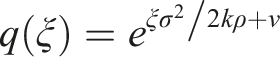

In light of the robust solver, 48 the solutions for equation (1) are
Stochastic rational solutions
The solutions of equation (4) are

Consequently, the solutions of equation (1) given by

Stochastic trigonometric solutions
The solutions for equation (4) are


Consequently, the solutions of equation (1) given by


Hyperbolic function solutions
The solutions for equation (4) are


Consequently, the solutions of equation (1) given by


Results and discussion
The model of the NLSE under investigation 43 in presence of noise term in Itô sense is converted to ordinary nonlinear form 41 with time dependent Brownian function Ψ(t).
The expectation of equation with

The dynamical system has an exact solution in the form


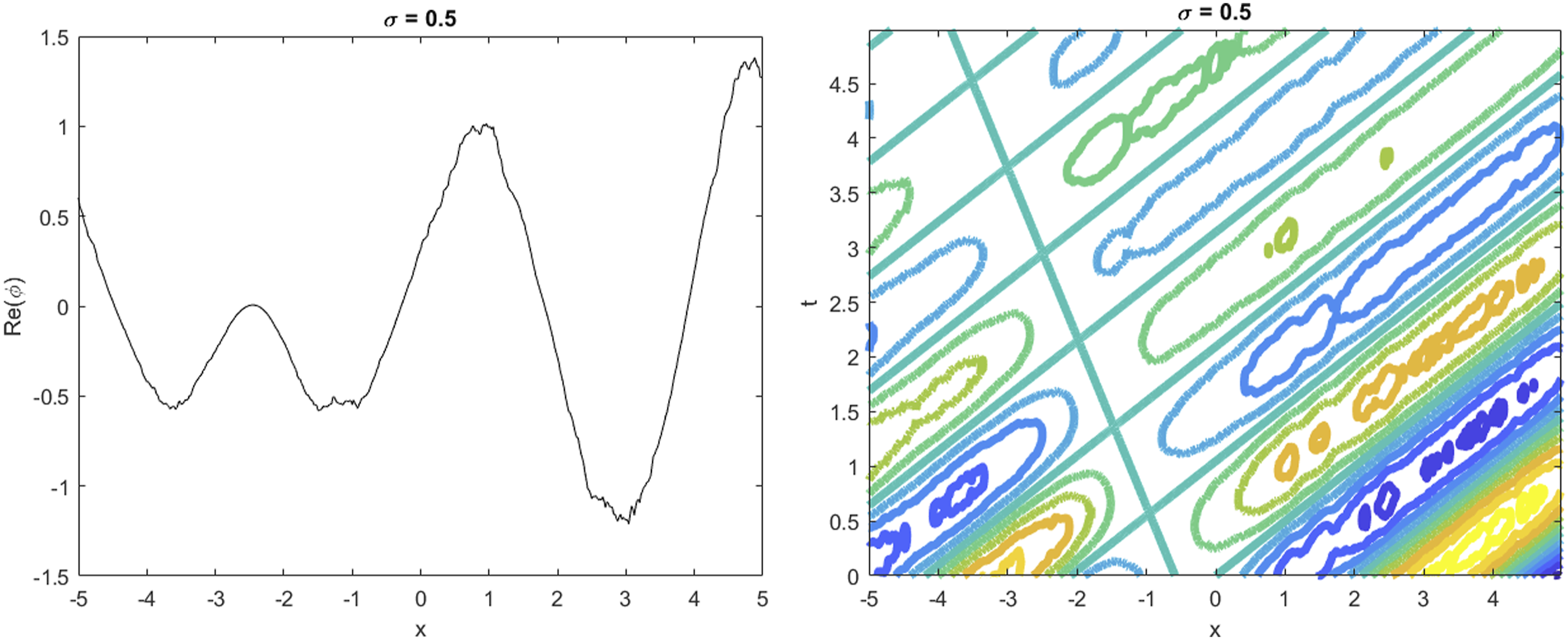
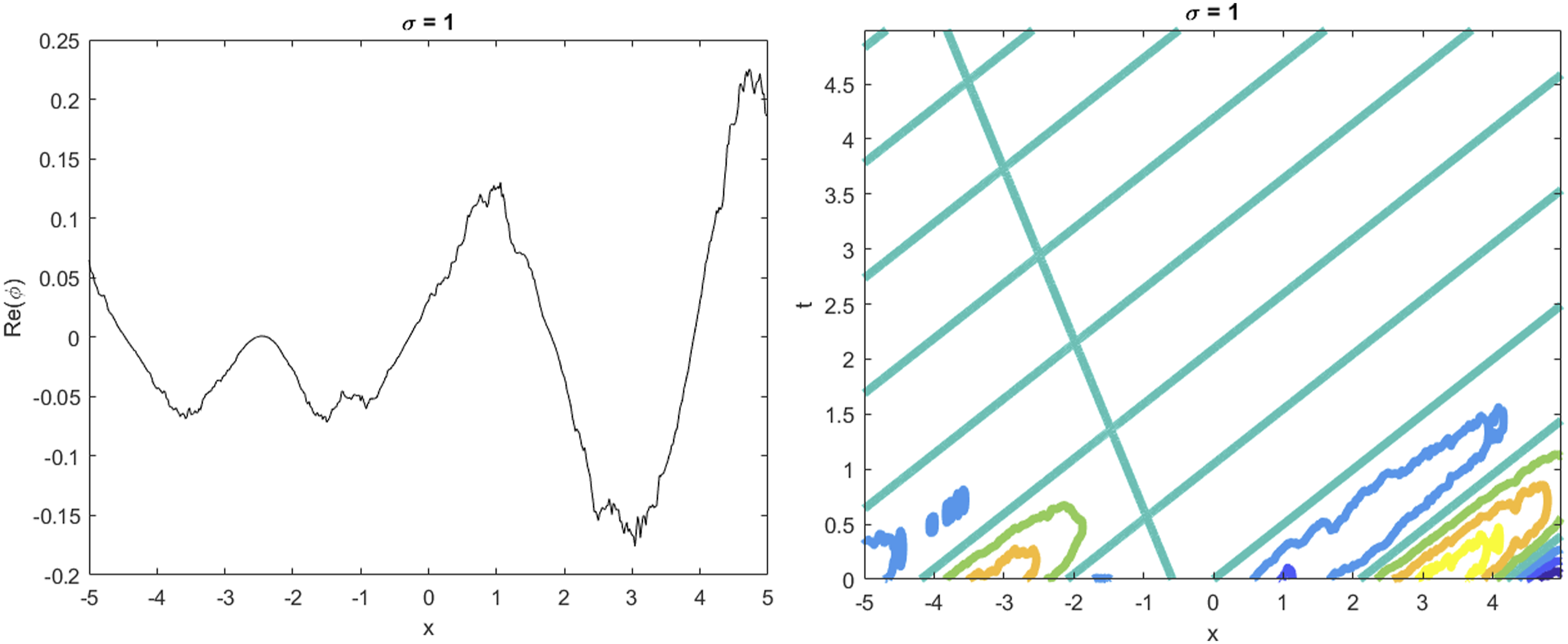
The new stochastic solutions for the NLSE forced by multiplicative noise in Itô sense were obtained using novel mathematical method to produces stochastic rational, trigonometric, and hyperbolic solutions. In the absence of noise effect, the method essences solutions in the form of periodic, soliton, and shock-like solitary forms depending on the dispersion nonlinearity interactions, that is, the conversion between the periodic and blow up waves. In Figures 1 and 2, the solution (14) behaves as periodic or semi-periodic propagation. On the other hand, the effective noise parameter σ plays essential factor in varying solution trajectories. These trajectories do not behave as deterministic expected case. The stochastic representation of solution (14) is depicted in Figures 3–5. It was reported that the increase of σ decreases the amplitude of the wave and varying the wave frequency. In summary, the properties of stochastic solutions for the NLSE forced by multiplicative noise in Itô sense have been investigated by mathematical solver to ameliorate the wave properties under stochastic effects. Graph of ϕ7 in (14) for σ = 0. Graph of ϕ7 in (14) for σ = 0.5. Graph of ϕ7 in (14) for σ = 1. Graph of ϕ7 in (14) for σ = 4. Graph of ϕ7 in (14) for σ = 5.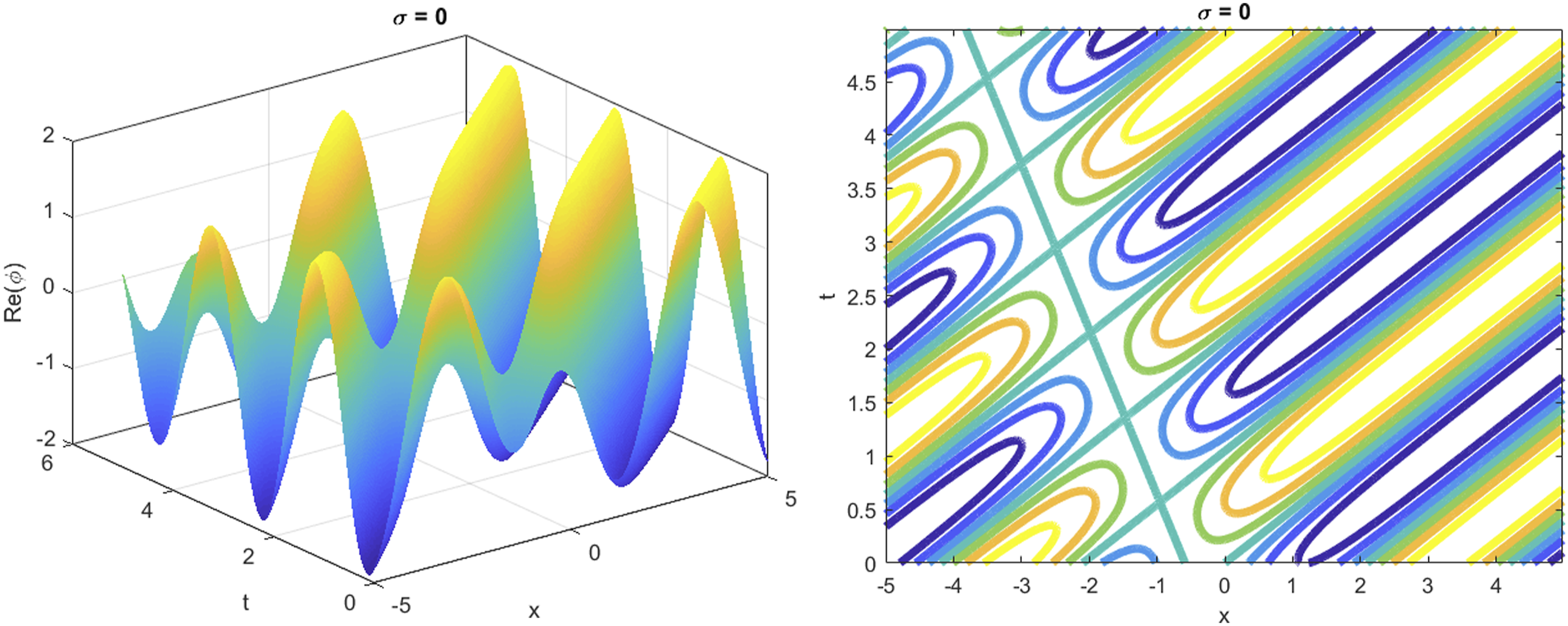
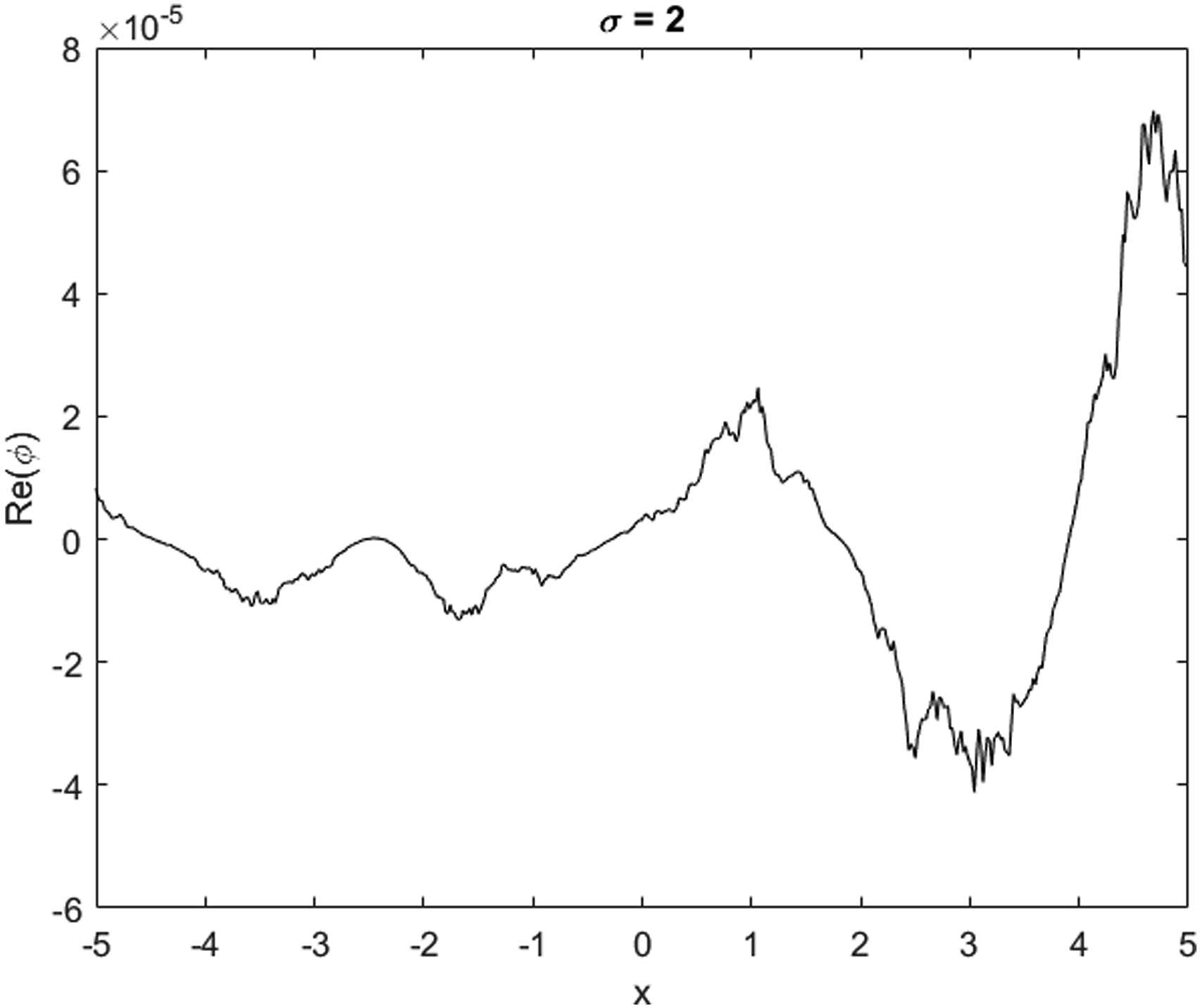
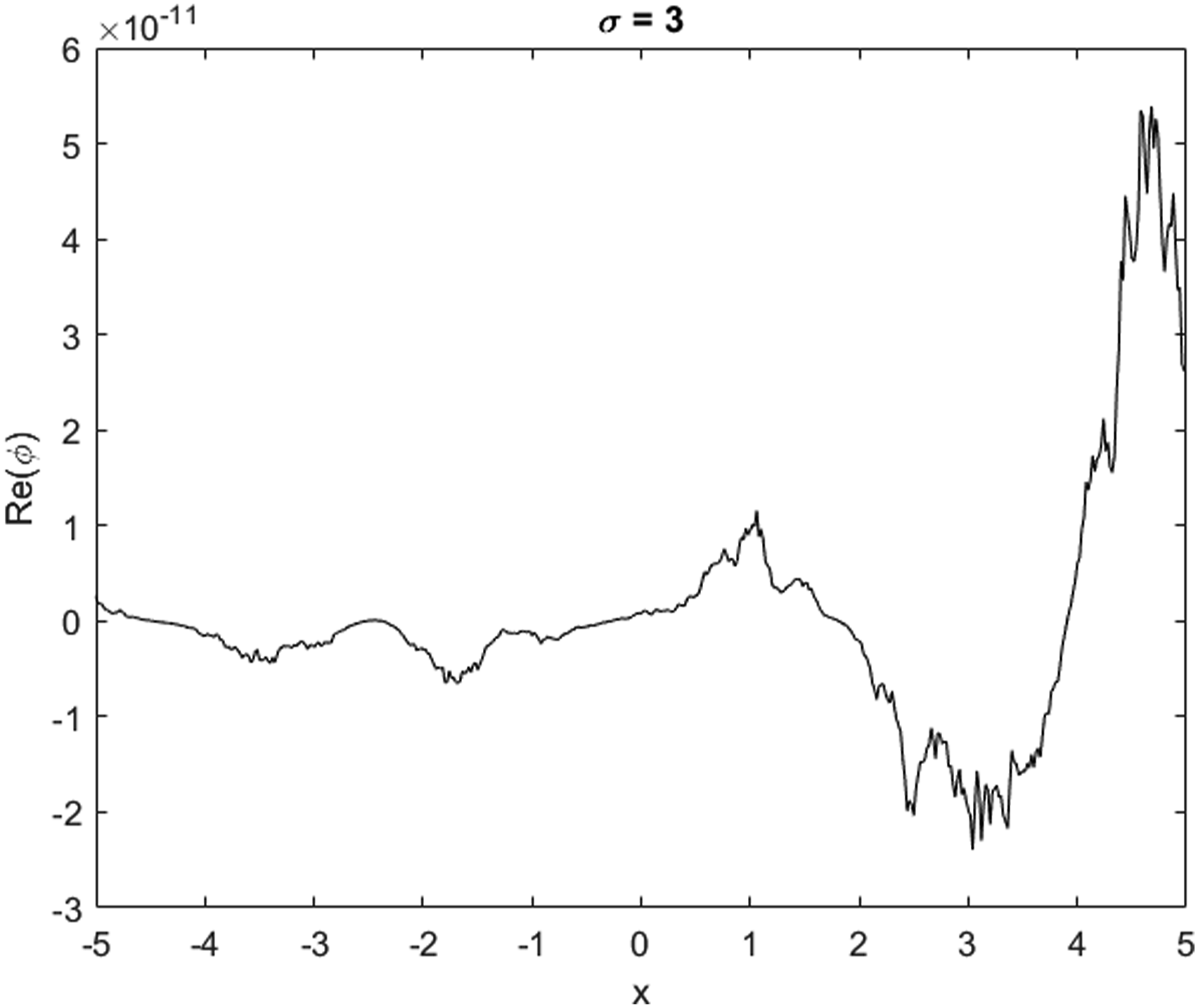
Remark 3.1. Due to the important of the fractal solitary theory and its applications,51–53 we aim to extend the proposed technique in this study to extract fractal solitary solutions for fractional NPDEs.
Conclusions
In this investigation, new solver has been applied to solve the stochastic NLSE equation which obliged by multiplicative noise. Many wave solutions have been obtained in the form of periodic, soliton, shocks-like solitary, and blow-up waves. These obtained forms are the leading in characterizing the dynamical behavior for some physical aspects as criticality, collapsing and squandering in dispersive modes as fiber optical soliton, hydrodynamics, electrostatic fields in space, super propagations, quantum physics, and photonics. The stochastic noise effects forcing the wave to behave differently from deterministic cases prognosticated. The stochastic depiction in NLSE plays a powerful role in modifying wave features. It was accounted that the excess of stochastic parameter of noise reducing the wave amplitude and mutating the wave frequency.
Footnotes
Acknowledgments
The authors extend their appreciation to the Deputyship for Research & amp; Innovation, Ministry of Education in Saudi Arabia for funding this research work through the project number (IF-PSAU-2021/01/17754).
Declaration of conflicting interests
The author(s) declared no potential conflicts of interest with respect to the research, authorship, and/or publication of this article.
Funding
The author(s) disclosed receipt of the following financial support for the research, authorship, and/or publication of this article: This work was supported by the Innovation, Ministry of Education in Saudi Arabia. The project number (IF-PSAU-2021/01/17754).
