In this article, we present a new form of solutions to the Chiral/perturbed Chiral nonlinear Schrödinger equation, using the unified solver method. This solver introduces the closed formula in an explicit way. In each problem, different families of elliptic functions solutions are found under suitable conditions. Moreover, some cases of hyperbolic solutions are obtained. The acquired solutions may be applicable for explaining various complex phenomena in the quantum Hall effect. The presented study displays that the proposed solver is simple, powerful and sturdy. For more details about the physical dynamical representation of the presented solutions, we introduce some graphs of some selected solutions using Matlab software. Finally, the presented solver can be used to solve many other models in real life problems.
Investigation of optical solutions has distinctly acquired momentum in the field of the solitary waves.1–5 In dielectric fibers, the dynamic balance between the optical Kerr effect and dispersion generates an optical solution. Indeed, solutions have acquired much attention because of their robust nature and powerful applications in all long-distance and optical communications.6–12 Due to the nonlinear Schrödinger equation’s (NLSE’s) rich physical features, optical solutions, namely, complex and hyperbolic solitons, are now the most interesting fields of nonlinear wave propagation in plasma of fluids, electromagnetic wave propagation, deep water, quantum mechanics, superconductivity, electromagnetic wave propagation, nuclear physics, and magneto-static spin waves optical fibers communications.13–21 Various physicists and mathematicians proposed and developed some standing wave stabilities for NLSEs and related equations such as perturbed, Hartree, Choquard, and its fractional form equations.22–27
The concept of chiral solitons represents a crucial role in the developments of quantum mechanics, specifically, in the field of quantum Hall effect (QHE) and biological sciences in the context of neurosciences, where the appearance of chiral solitons is known to appear. In 1980, Klaus von Klitzing investigated the relation between the QHE and fundamental physical constants for which he received a Nobel Prize in 1985. The chiral NLSE (CNLSE) was investigated earlier where both bright and dark soliton solutions were given.28 The (1+1)-dimensional CNLSE is28
where is a nonlinear coupling constant, is a complex function of and , and the indicates it’s complex conjugate. The first term on the left-hand side denotes the evolution term and the second term denotes the dispersion. Subsequently, in 2004, Bohm potential was presented and various studies were done with new perturbed NLSE (where Bohm potential was taken as the perturbation term, x),29,30 given by
where denotes the coefficient of dispersion and denotes a nonlinear coupling constant. On the right-hand side, which is called the perturbation term, the coefficient is known as Bohm potential. The perturbed CNLSE (PCNLSE) has remarkable applications in the development of quantum mechanics, which give us the main basics of a hidden variable theory. Thus, it is important to find exact solutions of PCNLSE for the development of quantum mechanics. There are various approaches have been applied to extract solutions of the PCNLSE, such as the extended fan sub-equation method,31 extended modified auxiliary equation mapping method,32 and many other techniques, for example, see.33–37
Our work is devoted to extracting new solutions for the CNLSE and PCNLSE, using the unified solver method.38 The main advantage of utilizing this technique is to get different family solutions via free physical parameters. The unified solver method is well-structured, simple, adequate, and efficient It is avoiding challenging and time-consuming computations and offering accurate solutions. Indeed, physicists, engineers, and mathematicians can employ the suggested solver as a box solver. The suggested fundamental technique has a number of benefits, including avoiding challenging and time-consuming computations and offering accurate solutions. The presented solutions will be extremely beneficial in many fields of applied sciences, such as nuclear physics, quantum mechanics, fluid mechanics, plasma physics, nonlinear optics, and nanotechnology. Indeed, the proposed solutions are used to study the adiabatic parameter dynamics. To our knowledge, the proposed solver for resolving the CNLSE and PCNLSE has not been used in any prior research.
This article is arranged as follows. The “Unified solver method” section discusses the presented solver technique. The “Applications” section presents the solutions for the CNLSE and PCNLSE, using the unified solver method. The “Results and discussion” section gives some physical interpretation for the gained results. Finally, some conclusions are reported in the “Conclusions” section.
Unified solver method
Consider the following nonlinear partial differential equation:
Utilizing the suitable wave transformation:
where is the traveling wave transformation and is the velocity speed of the traveling wave, equation (3) will be converted to the following ODE:
Various models in natural sciences presented in form of equation (3) can be converted to the following ODE:
where , and are certain constants depend on the constants of the main problem and the velocity speed of the wave transformations.
In view of the unified solver technique introduced by Abdelrahman and AlKhidhr,38 the solution of equation (6) was assumed to be given in the form of:
Substituting equations (7) and (9) into equation (6) and comparing the coefficients of , , , , , , in both sides of the new equation, gives some algebraic equations. Solving these equations for , and , yields two main cases:
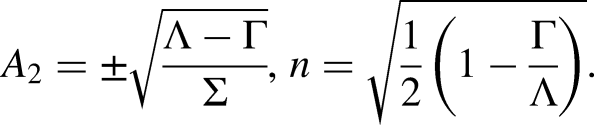
For and (or ), there exist a constant solution takes the form:
For and , we obtain four families of solutions depending on the values of , and , where :
Family I
The family of solutions takes the form:
where
Family II
The form of the solutions is given by:
where
Family III
The family of solutions takes the form:
where
Family IV
The fourth family of solutions is
where
From the above conditions, we find that there exist:
only one family of solutions under the condition ,
two families of solutions and under the condition ,
three families of solutions under the condition .
Hyperbolic functions solutions
From the previous families of elliptic functions solutions, we get the hyperbolic functions solutions, which can appear for certain values of corresponding to in the following sense:
We implement the presented solver method, to provide new solutions for CNLSE and PCNLSE.
Solutions of CNLSE
CNLSE was given by the form in equation (1). We first use the following complex wave transformation28:
where , , , , and are real constants. Substituting equation (23) into equation (1) and by taking the real and imaginary parts of the reduced equation we get:
and
respectively. Thus from equations (23) and (25), we get:
The second-order differential equation (24) has the form of equation (6), where
Thus the solutions of equation (24) take a similar forms of solutions (10), (11), (13), (15), and (17). The solution of equation (1) corresponding to the constant solution of equation (24) takes the form:
For , the four families of solutions of equation (1) can be written in the form:
Family I
The first family of solutions takes the form:
where
Family II
The second family of solutions is given in the form:
where
Family III
The third family of solutions can be given as:
where
Family IV
For the same value of given in equation (33) and under the same condition (34), we get the fourth family of solutions written as follows:
From the conditions (30), (32), and (34), we find that:
For , there exist only one family of solutions .
For , there exist two families of solutions and .
For , there exist three families of solutions .
Hyperbolic functions solutions
The hyperbolic functions solutions can appear for specific values of as follows:
The equation of the new PCNLSE is given in equation (2). For this equation the complex wave transformation takes the form:
where is the soliton wavenumber, is the frequency of the solitons, is the phase constant, and is the wave speed.
Substituting from equation (40) into equation (2) and considering the real and imaginary parts separately, gives
where .
The solutions of equation (42) can be obtained by applying the solver demonstrated in the “Unified solver method” section. The form of the solutions is similar to those given above.
For the solutions of equation (2), there are two main cases to discuss:
For & (or ), there exist a solution given in the form:
For & , and by applying the solver demonstrated in the “Unified solver method” section to equation (42), there are four families of solutions presented as follows:
Family I
The formula of the first family of solutions is given by:
where
Family II
The second family of solutions takes the form:
under the condition
Family III
The third family of solutions is given by
under the condition
Family IV
Under the same previous condition given by (50) and for the same value of given by (49) the fourth family of solutions takes the form:
Hyperbolic functions solutions
Hyperbolic functions solutions of equation (42) can be found under certain values for the amount and are given as follows:
From the conditions (30), (32), and (34) we find that:
For , there exist only one family of solutions .
For , there exist two families of solutions and .
For , there exist three families of solutions .
Results and discussion
Here, we discuss the presented results to the CNLSE and PCNLSE. It has been reported that some new solutions to these two equations were achieved in the explicit way with free physical parameters via certain constraints. The behavior of the given solutions being solitons, blow up, rough, periodic, explosive, dissipative, etc., depends on the values of the physical parameters in the coefficients of the CNLSE and PCNLSE. For example, the attitude of profile picture of the wave varies from compressive to rarefactive at critical points and stability regions varies in unstable regions at certain critical values (wavenumber).39,22
The topic of chiral solitons solutions is so important in the developments of QHE, where chiral excitations are known to appear.40,41 The entire computer industry is built on quantum mechanics. The laser operation is largely based on the quantum mechanics. Moreover, the presented solutions will be quite beneficial in the areas of biological molecules, superfluid, fiber communications, and nuclear physics. For example, the hyperbolic tangent emerges in the calculation of magnetic moment and rapidity of special relativity, and the hyperbolic secant emerges in the profile of a laminar jet.42
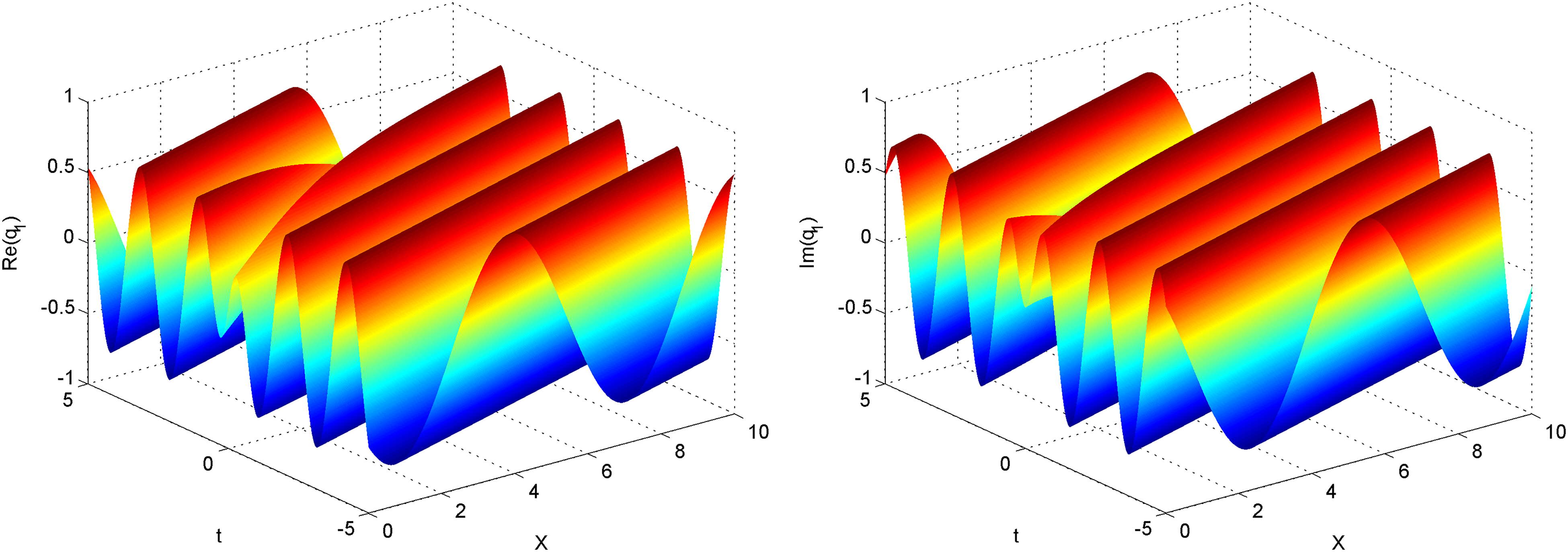
We present some graphs for some selected solutions in order to show the dynamical behavior of these solutions. Figures 1 to 8 depicted these behaviors for certain values of physical parameters. Namely, Figures 1 and 2 depicted the periodic wave of solutions (28) and (36). Figure 3 depicts the envelopes waves for solution (37). Figures 4 to 6 depicted the periodic wave of solutions (38), (43), and (52). Figure 7 depicts the envelopes waves for solution (53). Figure 8 depicts the periodic wave of solution (54). Figures 9 and 10 demonstrate the influence of the parameters on structure, amplitude, phase shift, and bandwidth.
The surface plot for real and imaginary parts of in (28) with the variables , and , , , .
The surface plot for real and imaginary parts of in (36) with , and , , , .
The solution in (37) at , when with , , ,, and with , , , .
Trajectory of solutions , , , and with , , , , , , .
Conclusions
In this study, a unified solver method is used in solving the CNLSEs/PCNLSEs. In both equations, four families of traveling wave solutions are found via free physical parameters under certain constraints. These solutions may be applicable in many interesting applications such as fiber communications, biological molecules, computer industry, magnetic materials, and laser operation. Some 2D and 3D graphs were plotted for different values of parameters to illustrate the behavior of some selected solutions. We observed that the used solver technique is a straightforward and robust tool, which gives vital results when applied to other composite nonlinear models. In future work, we will use other analytical methods to get other forms of solutions. Also, we can analyze the bifurcation and chaotic patterns for of perturbed model with full nonlinearity.
Footnotes
CRediT authorship contribution statement
Dana Al-Saleh: Data curation, Investigation, Software, Writing—original draft.
SZ Hassan: Data curation, Methodology, Software, Writing—original draft.
RA Alomair: Data curation, Investigation, Software, Writing—original draft.
The author(s) declared no potential conflicts of interest with respect to the research, authorship, and/or publication of this article.
Funding
The author(s) received no financial support for the research, authorship and/or publication of this article.
ORCID iD
Mahmoud AE Abdelrahman
References
1.
SarwarSIqbalS. Stability analysis, dynamical behavior and analytical solutions of nonlinear fractional differential system arising in chemical reaction. Chin J Phys2018; 56: 374–384.
2.
AbdelrahmanMAEAlmatrafiMBAlharbiAR. Fundamental solutions for the coupled KdV system and its stability. Symmetry2020; 12: 429.
3.
AbdelrahmanMAERefaeyHAAlharthiMA. Investigation of new waves in chemical engineering. Phys Scr2021; 96: 075218.
4.
AlmatrafiMBAlharbiATunçC. Constructions of the soliton solutions to the good Boussinesq equation. Adv Differ Equ2020; 2020: 629.
5.
IncMAliyuAIYusufAet al. Optical solitons to the (n+1)-dimensional nonlinear Schrödinger’s equation with Kerr law and power law nonlinearities using two integration schemes. Mod Phys Lett B2019; 33: 1950223.
6.
ZubairARazaNMirzazadehMet al. Analytic study on optical solitons in parity-time-symmetric mixed linear and nonlinear modulation lattices with non-Kerr nonlinearities. Optik2018; 173: 249–262.
7.
RazaNZubairA. Optical dark and singular solitons of generalized nonlinear Schrödinger’s equation with anti-cubic law of nonlinearity. Mod Phys Lett B2019; 65: 1950158.
8.
RazaNJavidA. Generalization of optical solitons with dual dispersion in the presence of Kerr and quadratic-cubic law nonlinearities. Mod Phys Lett B2019; 33: 1850427.
9.
DalfovoFGiorginiSPitaevskiiLPet al. Theory of Bose–Einstein condensation in trapped gases. Rev Mod Phys1999; 71: 463.
10.
NakkeeranK. Bright and dark optical solitons in fiber media with higher-order effects. Chaos Solitons Fract2002; 13: 673–679.
11.
RafiqMHJhangeerARazaN. The analysis of solitonic, supernonlinear, periodic, quasiperiodic, bifurcation and chaotic patterns of perturbed Gerdjikov–Ivanov model with full nonlinearity. Commun Nonlinear Sci Numer Simul2023; 116: 106–818.
12.
RazaNSeadawyARArshedSet al. A variety of soliton solutions for the Mikhailov-Novikov-Wang dynamical equation via three analytical methods. J Geom Phys2022; 176: 104–515.
13.
TrikiHBensalemCBiswasAet al. Self-similar optical solitons with continuous-wave background in a quadratic-cubic non-centrosymmetric waveguide. Opt Commun2019; 437: 392–398.
14.
AlharbiYFSohalyMAAbdelrahmanMAE. Fundamental solutions to the stochastic perturbed nonlinear Schrödinger’s equation via gamma distribution. Results Phys2021; 25: 104249.
15.
SohalyMAAbdelrahmanMAE. A novel motivation for the (2+1)-dimensional chiral NLSE via two random sources. Indian J Phys2023; 97: 1965–1971.
16.
AlharbiYFAbdelrahmanMAESohalyMAet al. Stochastic treatment of the solutions for the resonant nonlinear Schrödinger equation with spatio-temporal dispersions and inter-modal using beta distribution. Eur Phys J Plus2020; 135: 368.
17.
AbdelrahmanMAEHassanSZIncM. The coupled nonlinear Schrödinger-type equations. Mod Phys Lett B2020; 34: 2050078.
18.
AbdelrahmanMAEAbdoNF. On the nonlinear new wave solutions in unstable dispersive environments. Phys Scr2020; 95: 045220.
19.
WazwazAMTrikiH. Soliton solutions of the cubic-quintic nonlinear Schrödinger equation with variable coefficients. Romanian J Phys2016; 61: 360–366.
20.
AlharbiYFAbdelrahmanMAESohalyMAet al. Disturbance solutions for the long–short-wave interaction system using bi-random Riccati-Bernoulli sub-ODE method. J Taibah Univ Sci2020; 14: 500–506.
21.
WazwazAM. Bright and dark optical solitons for (2+1)-dimensional Schrödinger (NLS) equations in the anomalous dispersion regimes and the normal dispersive regimes. Optik2019; 192: 162948.
CazenaveTLionsPL. Orbital stability of standing waves for some nonlinear Schrödinger equations. Comm Math Phys1982; 85: 549–561.
24.
FengBZhangH. Stability of standing waves for the fractional Schrödinger-Choquard equation. Comput Math Appl2018; 75: 2499–2507.
25.
RazaNRafiqMH. Abundant fractional solitons to the coupled nonlinear Schrödinger equations arising in shallow water waves. Int J Mod Phys B2020; 34: 162–205.
26.
AbdelrahmanMAESohalyMAAlharbiYF. Fundamental stochastic solutions for the conformable fractional NLSE with spatiotemporal dispersion via exponential distribution. Phys Scr2021; 96: 125223.
27.
CazenaveT. Semilinear Schrödinger equations, Courant Lecture Notes in Mathematics vol. 10, New York University, Courant Institute of Mathematical Sciences, New York; American Mathematical Society, Providence, RI, 2003.
BiswasA. Perturbation of chiral solitons. Nucl Phys B2009; 806: 457–461.
30.
EbadiGYildirimABiswasA. Chiral solitons with Bohm potential using method and exp-function method. Rom Rep Phys2012; 64: 357–366.
31.
YounisMCheemaaNMahmoodSAet al. On optical solitons: The chiral nonlinear Schrödinger equation with perturbation and Bohm potential. Opt Quant Electron2016; 48: 542.
32.
CheemaaNChenSSeadawyAR. Chiral soliton solutions of perturbed chiral nonlinear Schrödinger equation with its applications in mathematical physics. Int J Mod Phys BVol2020; 34: 2050301.
33.
Torres-SilvaHZamoranoM. Chiral effects on optical solitons. Math Comput Simul2003; 62: 149–161.
34.
NandyS. Inverse scattering approach to coupled higher-order nonlinear Schrödinger equation and N-soliton solutions. Nucl Phys B2004; 679: 647–659.
35.
BiswasAMirzazadehMEslamiM. Soliton solution of generalized chiral nonlinear Schrödingers equation with time-dependent coefficients. Acta Phys Pplonica B2014; 45: 849–866.
36.
IsmailMSAl-BasyouniKSAydinA. Conservative finite difference schemes for the chiral nonlinear Schrödinger equation. Bound Value Probl2015; 2015: 89.
37.
RazaNJavidA. Optical dark and dark-singular soliton solutions of (1+2)-dimensional chiral nonlinear Schrodinger’s equation. Waves Random Complex Media2019; 29: 496–508.
38.
AbdelrahmanMAEAlKhidhrH. Closed-form solutions to the conformable space-time fractional simplified MCH equation and time fractional Phi-4 equation. Results Phys2020; 18: 103294.