




Abstract
The Duffing oscillator equation is one of important equations that model several nonlinear phenomena in science and engineering. The differential transform method (DTM) is applied to obtain the solutions of homogeneous and non-homogeneous Duffing oscillator equations under the influence of different initial conditions. In fact, the DTM can only find the solutions of the Duffing oscillator equation in a small domain, therefore the method has been improved using Padé approximation. We obtain the solutions by the Padé-DTM (PDTM) in long domain. This article proves the validity, simplicity and applicability of the PDTM method. In addition, the accuracy of the PDTM and the instability of the solution are discussed.
Introduction
Over the recent decades, many scientific phenomena and applications have been described by nonlinear ordinary differential equations (ODEs) and Partial differential equations (PDEs).1–6 One of these significant equations is called the Duffing oscillator equation which is utilized in many sciences such as physics and engineering.7,8 It was discovered in 1918 by electrical engineer Ger man Duffing.
9
The general form of Duffing equation
10
is given by the following form



The Duffing equation has been solved in the literature by several methods such as Variation iteration method,13–15 Homotopy perturbation transform method,16,17 an effective approach, 18 a new approach method, 19 Homotopy analysis method9,20 and modified differential transform method.2,21 The mathematician continuously have improved the computational methods to obtain fast and high accurate results. In this paper, we will turn the light on the differential transformation method (DTM).
The DTM was first introduced by Pukhov to compute linear and nonlinear initial value problems in electric circuit analyses. 22 Chen and Ho invented the DTM for solving PDE and discovered closed-form series solutions for various linear and nonlinear initial value problems. 23 Hassan showed that the DTM is usable on a large selection of PDEs and is able to effortlessly get closed-form solutions.24–26 The results by the DTM is more accurate than some other numerical and semi-analytical methods for solving ODEs. 27 So the advantages of the two-dimensional DTM are ability to find accurate solutions and unaffected by tiny or big numbers unlike perturbation approaches. In addition, the DTM can be used regardless of whether the governing equations and boundary/initial conditions of a given nonlinear problem have modest or big numbers and the DTM solves equations without the use of starting estimations or an auxiliary linear operator. On the other hand, one of the DTM disadvantages is solving the solution in small domain for some problems in physics.28–30 Therefore, the DTM needs to be improved. Recently, the Padé approximation has been used to improve some iterative methods. The Padé approximation was introduced by Her-Moths and Padé. It has been utilized in physics for over 40 years and there are numerous notable examples in the field. Therefore, we aim to use the Padé approximation technique in order to improve the DTM to solve the Duffing oscillator equation. 31 However, the DTM does not require a small parameter such as the traditional perturbation methods or a small embedded parameter such as the Homotopy perturbation method (HPM). In addition, the HPM fails to solve the damping nonlinear oscillator. 32 In fact, the DTM does not required integration such as Adomian decomposition method (ADM) or Laplacian Adomian decomposition method (LADM). The ADM and LADM fail to solve non-integrable equation because their numerical scheme includes integration operators.
The novelty of this article is presenting the semi-analytical solution of the non-homogeneous Duffing oscillator equation by the Padé differential transformation method (PDTM) and finding the relation between the number of iteration and the order of the Padé approximation.
This article is organized as follows: Padé-Differential Transform Method presents steps of the algorithm of PDTM. Stability introduces some applications for forced Duffing oscillator equation and shows the solutions by using PDTM. Applications is the study of the PDTM accuracy and last section is the conclusion of the work.
Padé-Differential transform method
This section explains the steps of a logarithm of the PDTM. In general, the idea starts by finding a solution as a power series by the DTM. However the radius of convergence of this power series may not be big enough to hold the two limits. Therefore, the Padé approximation is used to modify the produced series as rational functions since the Padé approximation delivers the best estimate by converting a function’s approximate polynomial into rational functions of polynomials of a specific order.33–35
Assume the power series



The numerator and denominator coefficients are P + 1 and N + 1, respectively, in equation (5) as can be seen. We can multiply the numerator and denominator by a constant while keeping [P/N] intact and also apply the normalization constraint O
N
(0) = 1. Because of the P + 1 independent numerator and N independent denominator coefficients, there are a total of P + N + 1 unknown coefficients. This value suggests that the power series should generally fit [P/N] equation (4) in the orders 1, y, y2, y3, ….., y1+N. As a result, we have a formal power series


We get the following sets of equations by combining the coefficients of 1, y, y2, y3, …, y
P
and the coefficients of yP+1, yP+2, …, yP+N


If m < 0 is true, then b m = 0 is true for consistency, and o i = 0 is true for accuracy, i > N.
By solving equations (6) and (7), we obtain
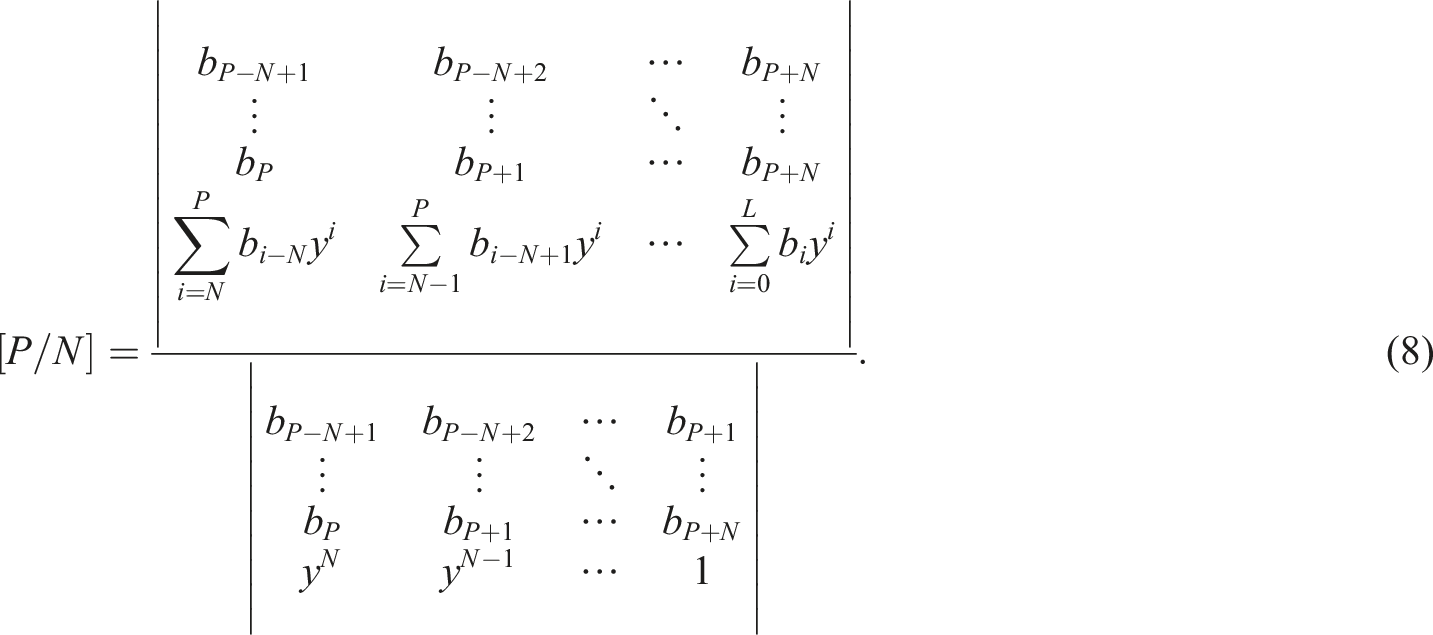
The Padé equations are equations (6) and (7), which generally determine the Padé numerator and denominator. Equation (8) is used to construct the [P/N] Padé approximant. 36
Definition (1): Differential transformation in one-dimension If q(t) is analytic function in the domain T that is continuously differentiated with respect to time t, then


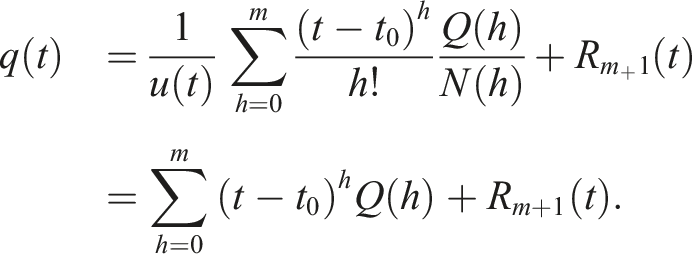
Definition (2): Differential inverse transformation in one-dimension Assume the following is a Taylor series for a function q(t) The inverse transformation of Q(h) is known as equation (11), and Q(h) is defined using definition (1) A differential equation in the domain of interest can be translated into an algebraic equation in the H domain using the differential transform, and q(t) can be derived as a finite-term Taylor series plus a remainder




Stability
In this section, we study the stability of the Duffing equation



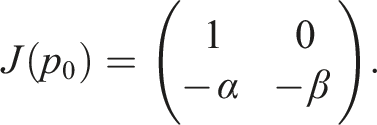
The equilibrium points for the system are found by setting q′ = 0 and
Applications
Example 1






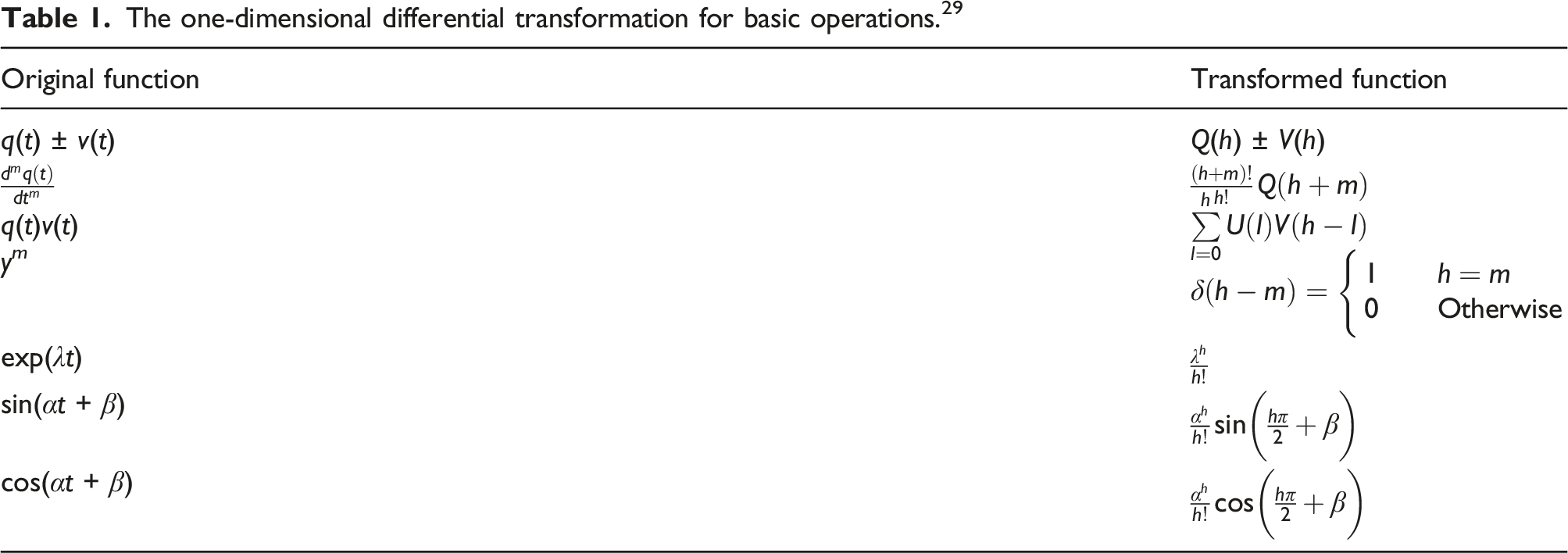
The one-dimensional differential transformation for basic operations. 29
To improve the result, we use the Laplace transform (L) on the series solution equation (20) as follows
Replacing s by 



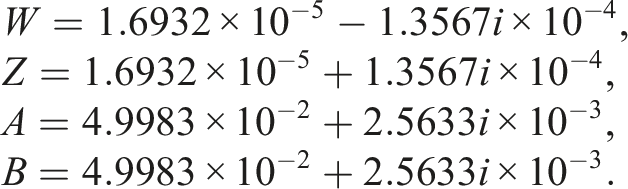
The Padé approximation of 
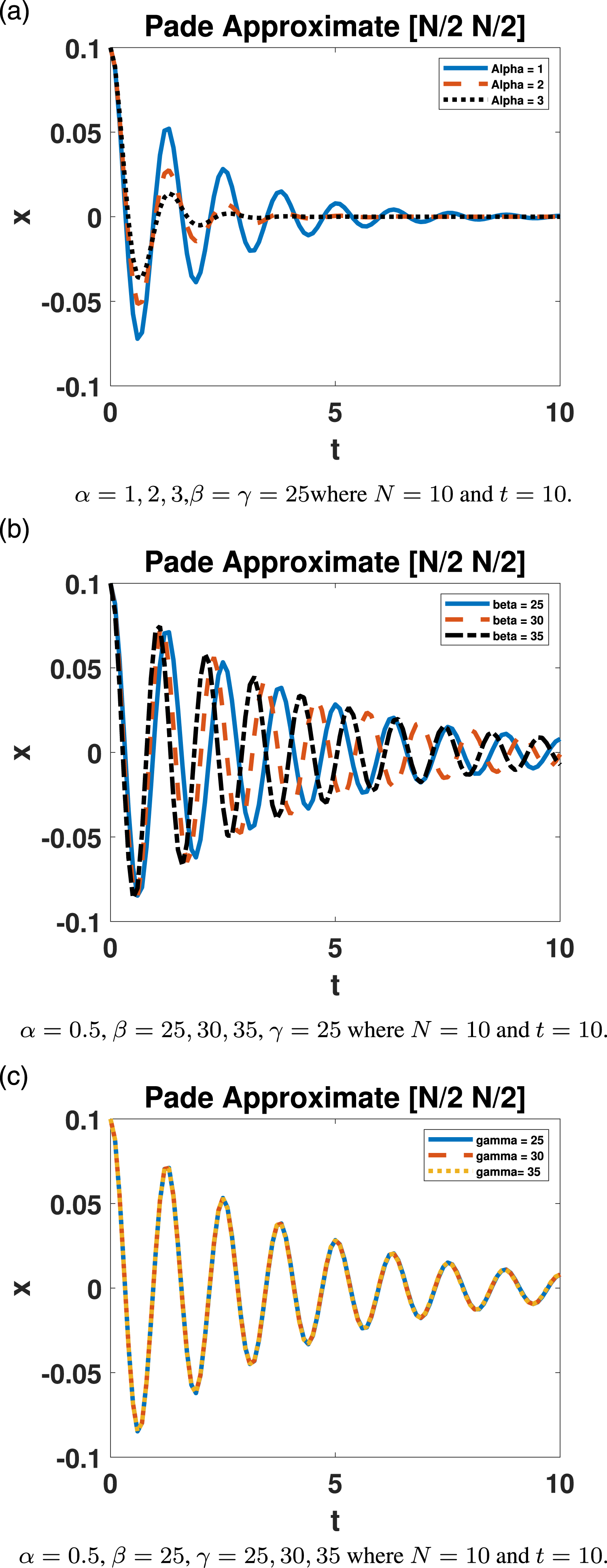
Figure 1 presents the solution by PDTM for third and fourth order. The best result was found by applying PDTM of fourth order. Figure 2 shows the effect of the parameters α, β and γ in the solution. We realized that the frequency is changed by different α and β but does not change by γ. The comparisons of the results of The effect parameters in Duffing equation.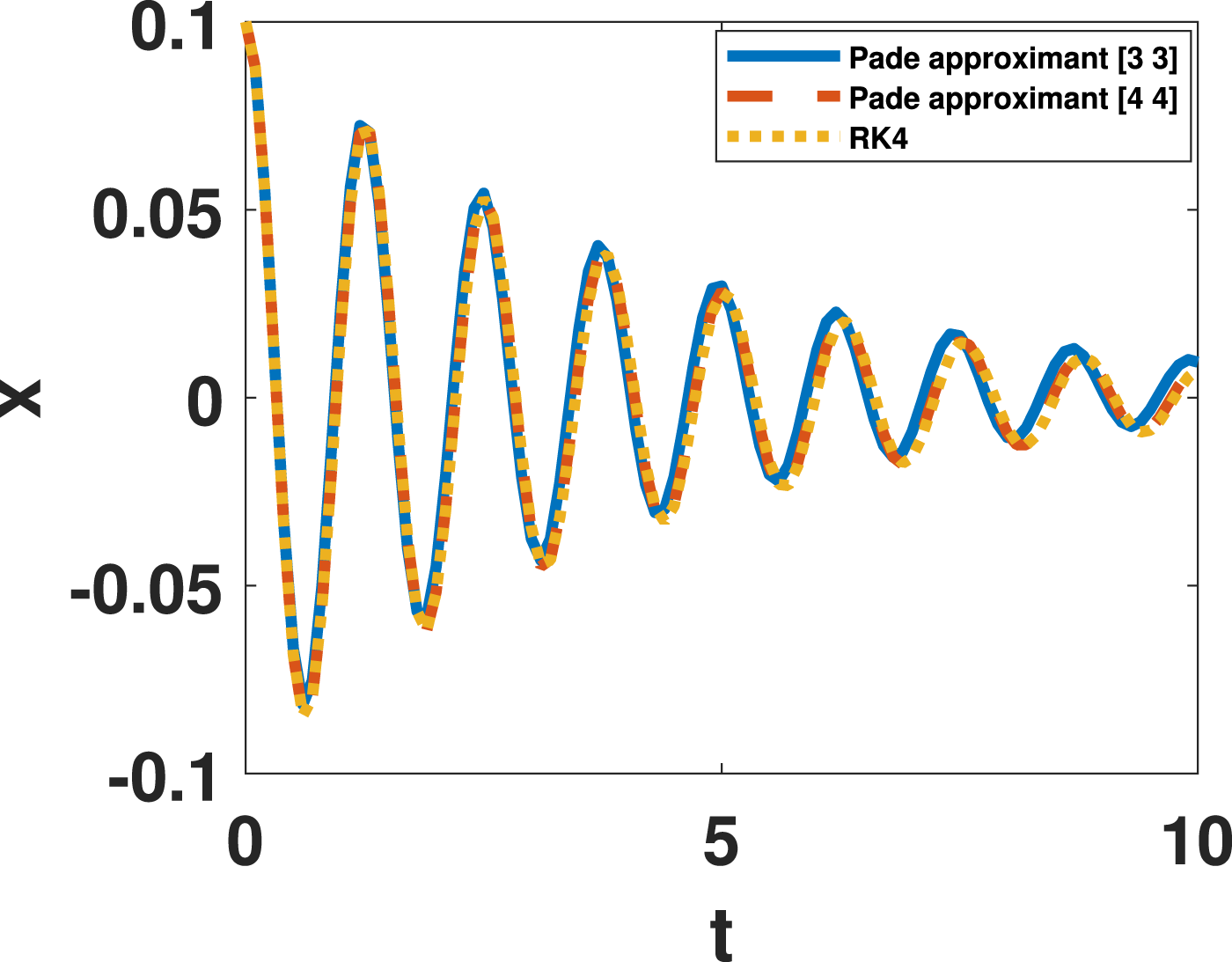
Example 2
Consider the Duffing oscillator equation in the following type
10



By applying the DTM and using Tables 1, we have the following scheme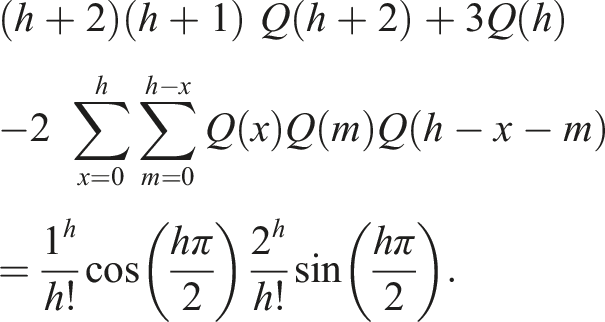
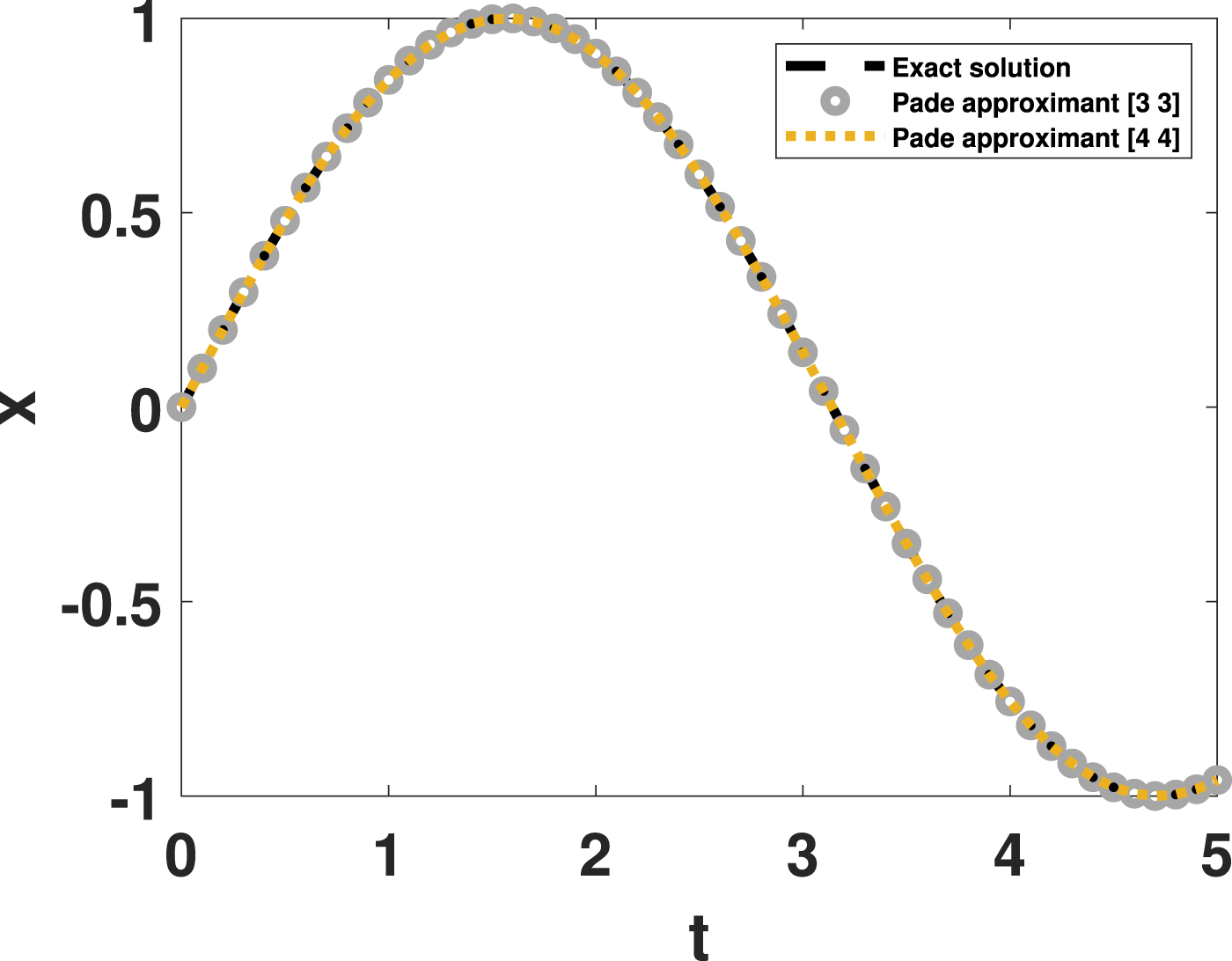
Then, we apply the Padé approximation of order [3/3], [4/4] and N = 8 to obtain the solution as we see in Figure 3. The best solution is obtained by P[4/4].
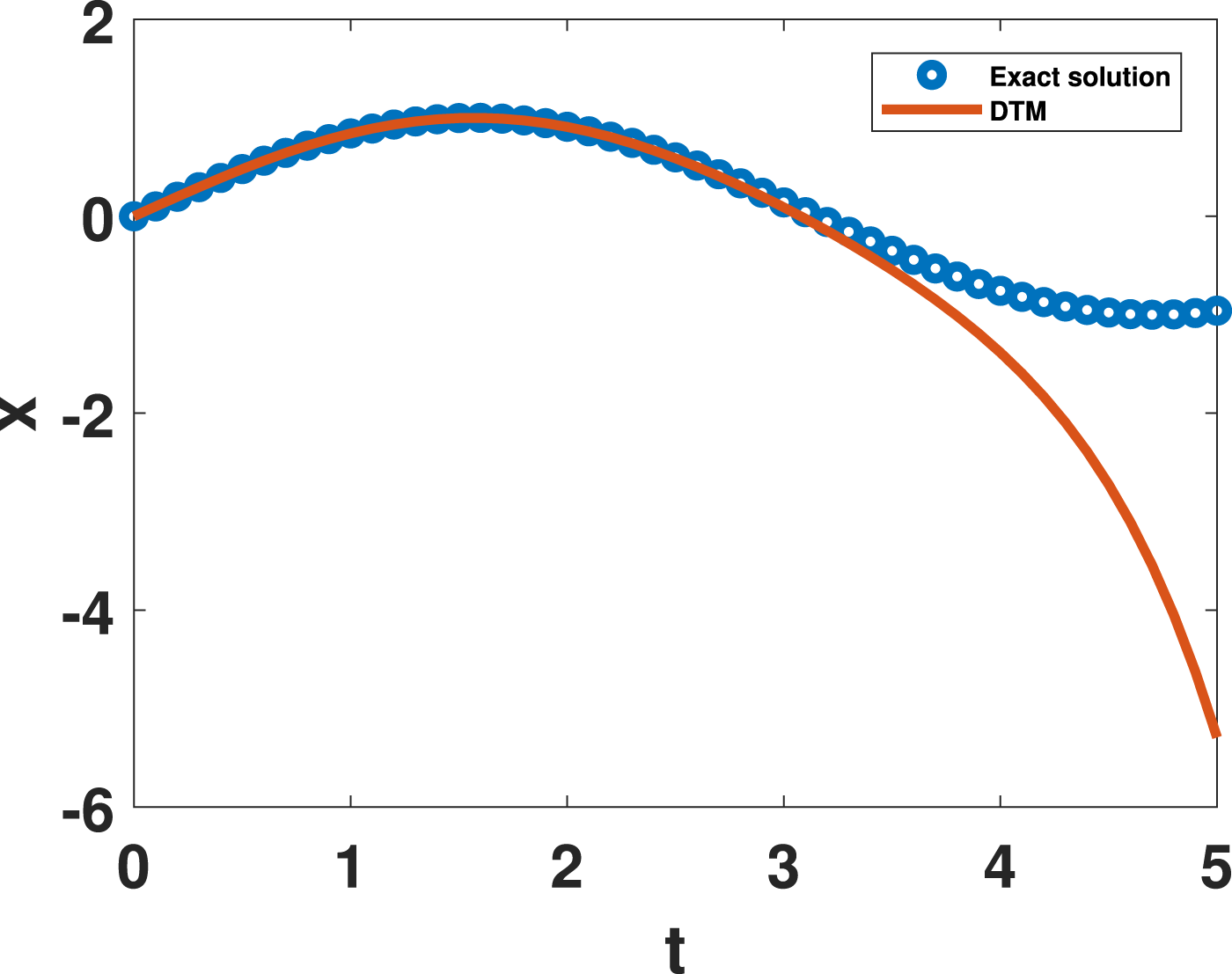
By plotting the solution of example (2) by DTM and by PDTM in Figures 4 and 5, respectively, we proved that the solution by PDTM converges to the exact solution in long domain, but the solution by DTM diverges after t = 3. The comparisons of the results of the The comparisons of the solution by differential transform method with exact solution at t = 5, N = 8. The comparisons of the results of the 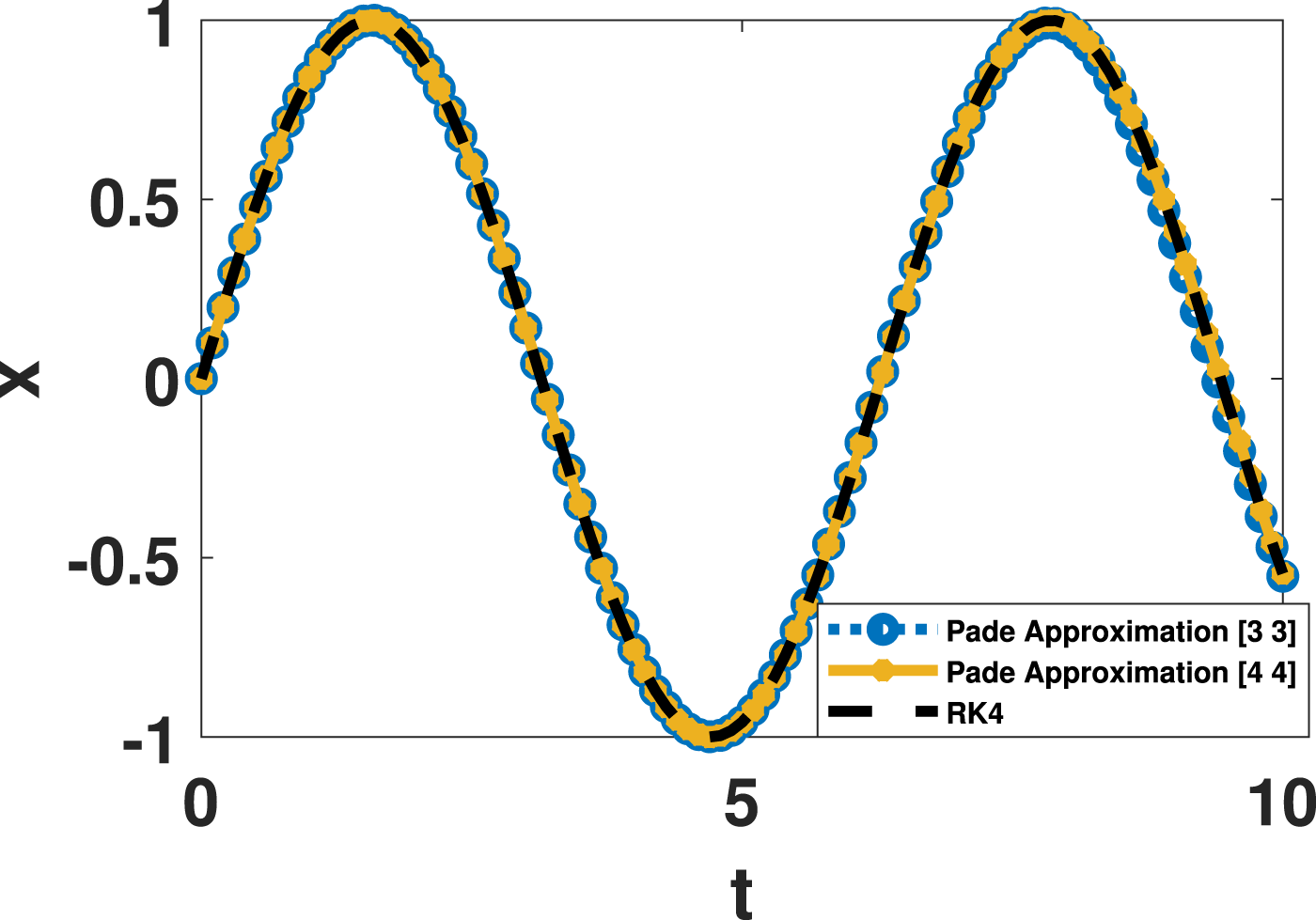
Example 3
Let the non-dimensional Duffing oscillator equation10,39

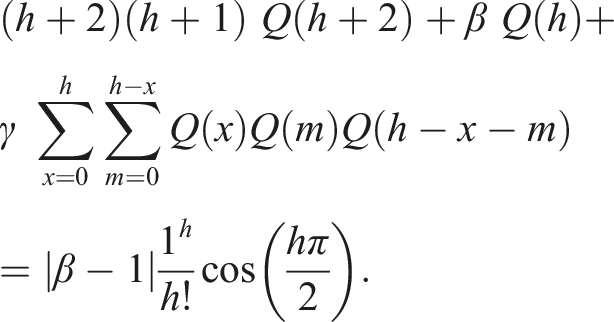
Then, we apply P[3/3] as well as as P[4/4] and the results are presented in Figure 6. We note that 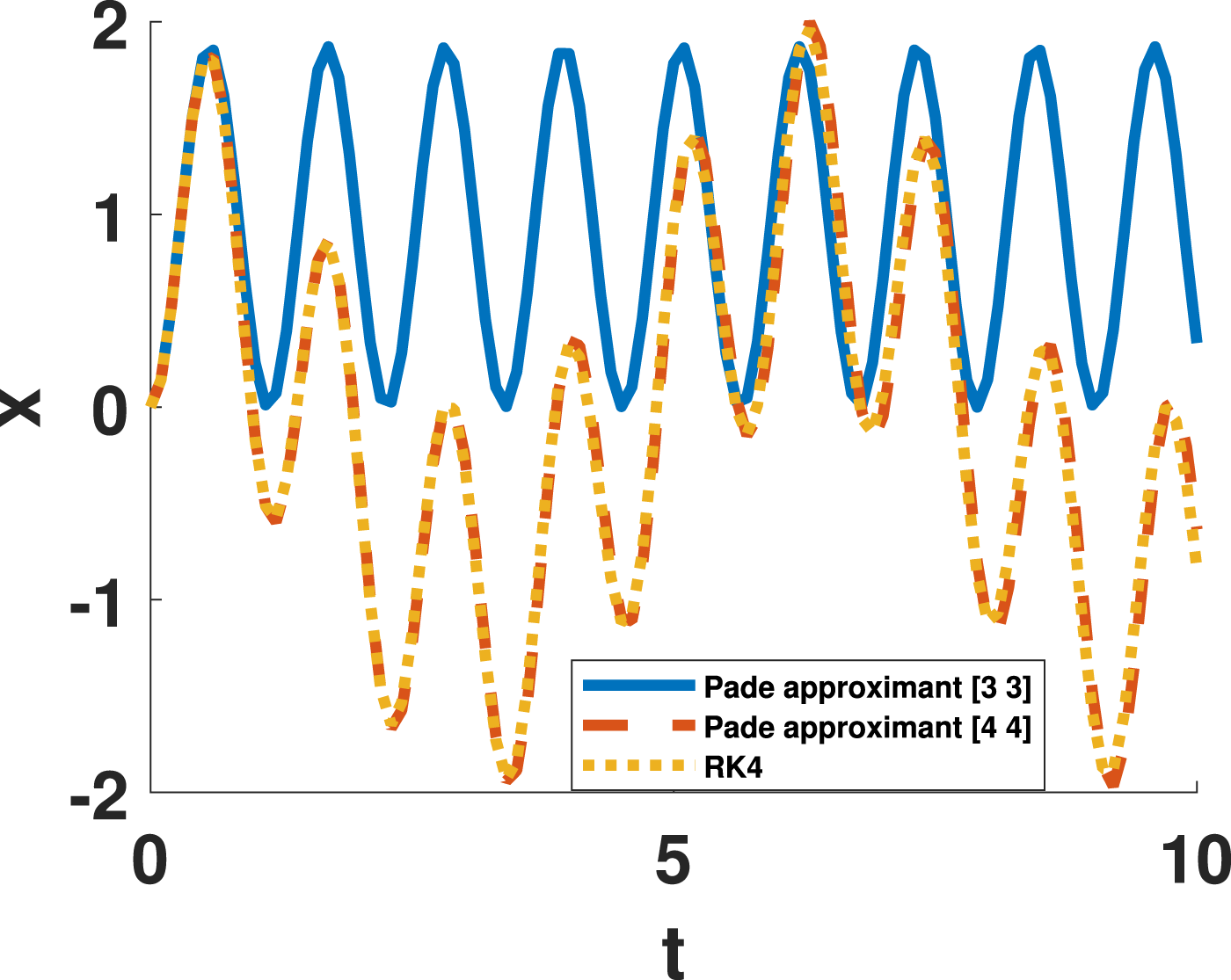
However, we noticed that when the number of iteration is N = 8, then the best results are obtained when the order of the Padé approximation is [4/4]. The example 2 and 3 are non-damped, thus they have a periodic property. The following formula is the relationship between the frequency and the amplitude40,41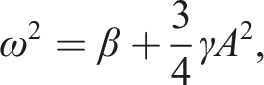



Accuracy of the PDTM
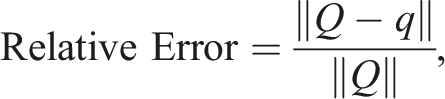
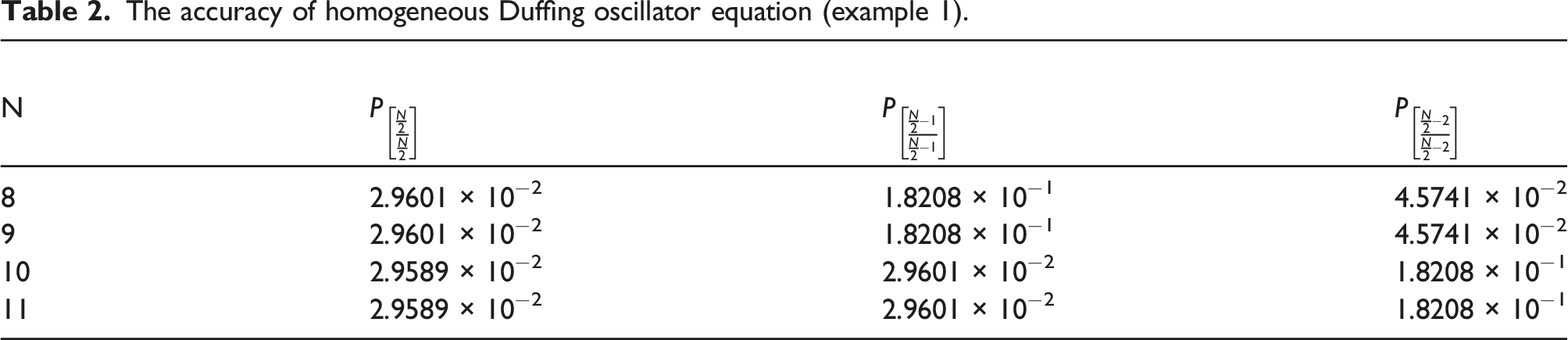
The accuracy of homogeneous Duffing oscillator equation (example 1).
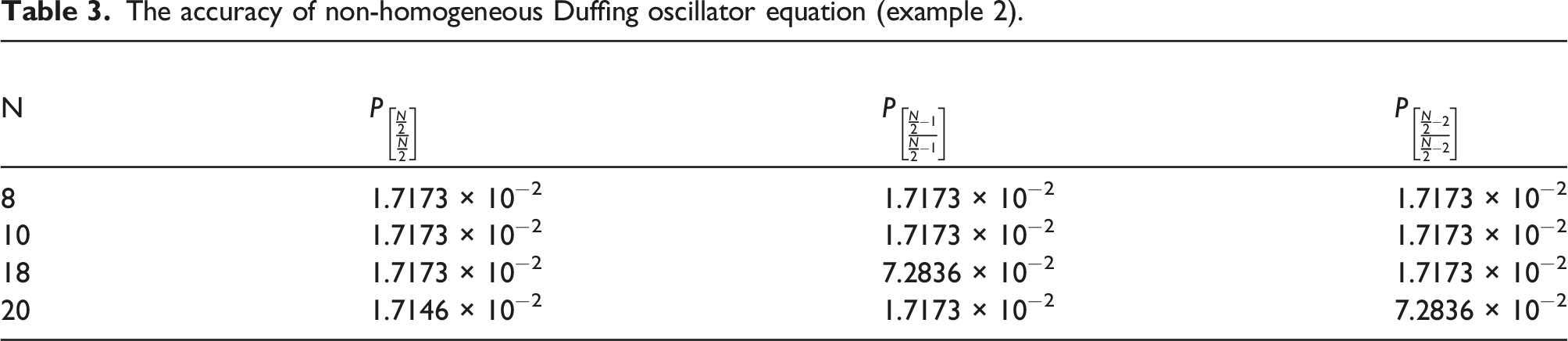
The accuracy of non-homogeneous Duffing oscillator equation (example 2).
Conclusion
The article introduced the Padé differential transform approach to find a numerical solution for a non-homogeneous Duffing oscillator equation. The scheme of PDTM does need normalization or discretization and is simple and powerful method to find the numerical solution for the non-homogeneous class of ODEs. The accurate results are obtained when the order of the Padé approximation takes about half of the number of iteration. A comparison of the results with 4th-Runge–Kutta’s results reveals that the solution is extremely accurate. In future, the PDTM can be applied for variety of classes of ODEs.
Footnotes
Acknowledgements
The Deanship of Scientific Research (DSR), King Abdulaziz University, Jeddah, Saudi Arabia has founded this preoject, under grant No. (KEP-MSc: 36-665-1443). The authors, therefore, acknowledge with thanks DSR technical and financial support.
Declaration of conflicting interests
The author(s) declared no potential conflicts of interest with respect to the research, authorship, and/or publication of this article.
Funding
The author(s) disclosed receipt of the following financial support for the research, authorship, and/or publication of this article: This work was supported by the The Deanship of Scientific Research (DSR), King Abdulaziz University, Jeddah, Saudi Arabia has founded this project, under grant No.(KEP-MSc: 35-665-1443)
