




Abstract
In this paper, we propose an analytical approach (VIM-Padé) based on the variational iteration method (VIM), Laplace transformation and the Padé approximation. We apply this technique to solve the strongly nonlinear oscillators with cubic and harmonic restoring force. The approximated solutions to the initial value problems are provided and compared with the original variational iteration method solutions and the numerical solutions obtained by Runge-Kutta method. Numerical experiments show that the VIM-Padé technique is efficient for solving the strongly nonlinear oscillators.
Introduction
Nonlinear oscillations have been paid many attentions due to the wide applications in physical science, mechanical structures and other engineering problems. Specially, the strongly nonlinear oscillators with cubic and harmonic restoring force play an important role in mathematical physics and engineering fields, which can be modeled as nonlinear differential equations (NDEs). In the past decades, several methods were proposed for solving these nonlinear problems. Such methods include homotopy analysis method, 1 variational iteration method (VIM),2,3 homotopy perturbation method,4,5 modified homotopy perturbation method, 6 asymptotic method,7,8 differential transformation method, 9 He’s energy balance method, 10 harmonic balance method,11,12 modified harmonic balance method, 13 parameter expansion method14,15 and other methods.
In this paper, we consider a strongly nonlinear oscillator with cubic and harmonic restoring force
13


The VIM, for solving linear and nonlinear differential equations, was first proposed by He,2,3 and has been widely discussed, including its modifications and extensions.16–19 This method can give the analytical and numerical solutions without unrealistic nonlinear assumptions, linearization, perturbation, discretization or calculation of the complicated Adomian polynomials. However, for strongly nonlinear oscillators, the VIM solution corresponds to a truncated series solution. The accuracy of this approximated solution may deteriorate when the time increases largely. Furthermore, the obtained solution does not provide the periodic behavior characteristic of nonlinear oscillator systems. In order to improve these two drawbacks of VIM, we introduce an analytical approach combined with Padé approximation and Laplace transformation, which is named as VIM-Padé technique. Motivated by the modified homotopy perturbation method for solving strongly nonlinear oscillators, 6 we construct the procedure of VIM-Padé technique for nonlinear oscillator (1) as follows: Laplace transformation is first used to improve the series solution obtained by VIM; then, we apply Padé approximation to the above transformed solution; finally, inverse Laplace transformation is applied to the rational solution, which results in a periodic solution of high accuracy. Two numerical examples are presented to show the efficiency of the VIM-Padé technique.
This paper is organized as follows: we first illustrate the main idea of the VIM-Padé technique, which is based on the VIM, Padé approximation and Laplace transformation. Then, this method is applied to two numerical examples to demonstrate its efficiency. Finally, some conclusions are given.
The VIM-Padé technique
We briefly illustrate the idea of VIM and Padé approximation. Consider the following nonlinear differential equation


The Padé approximation20,21 is used to improve the accuracy of the VIM solution by a rational function. Given a series solution



This approximation is named as [L, M] Padé approximation to f(x).20,21 By using the normalization condition
Numerical example
In this section, we consider two initial value problems of the nonlinear oscillator (1) with different a and b. It is an open problem to give the exact periodic solution of the nonlinear oscillator (1). We focus on considering the numerical behavior of the approximated solutions obtained by VIM-Padé method. All the numerical computations are performed by Matlab 7.8.0 on PC with an Intel Core 2 Duo CPU, 1.5 GHz and 4 GB RAM.
We first consider the following nonlinear oscillator


Based on the Taylor approximation of sin(u), i.e.
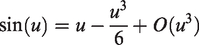

By applying the VIM16,17 to equation (8) with initial conditions (equation 7), we have the following iteration formula

By means of the VIM iteration (equation 9), we obtain the following approximations
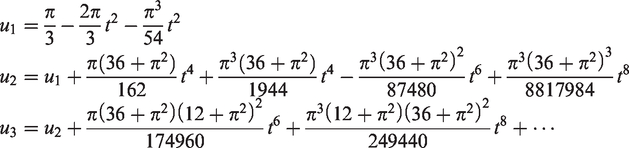
Obviously, the above VIM solutions are expressed in series form. Comparisons of the third-order VIM solutions u3 and the fourth order Runge-Kutta solutions (uRK) are shown in Figure 1. We see that the series solutions have two shortcomings, one is that the error of the VIM solutions may enlarge with the increasement of time t and the other is that the obtained solutions do not exhibit the periodic behavior of the solution of the nonlinear oscillator. To overcome these two issues, we consider Laplace transform and Padé approximation, the detailed procedure is given below.
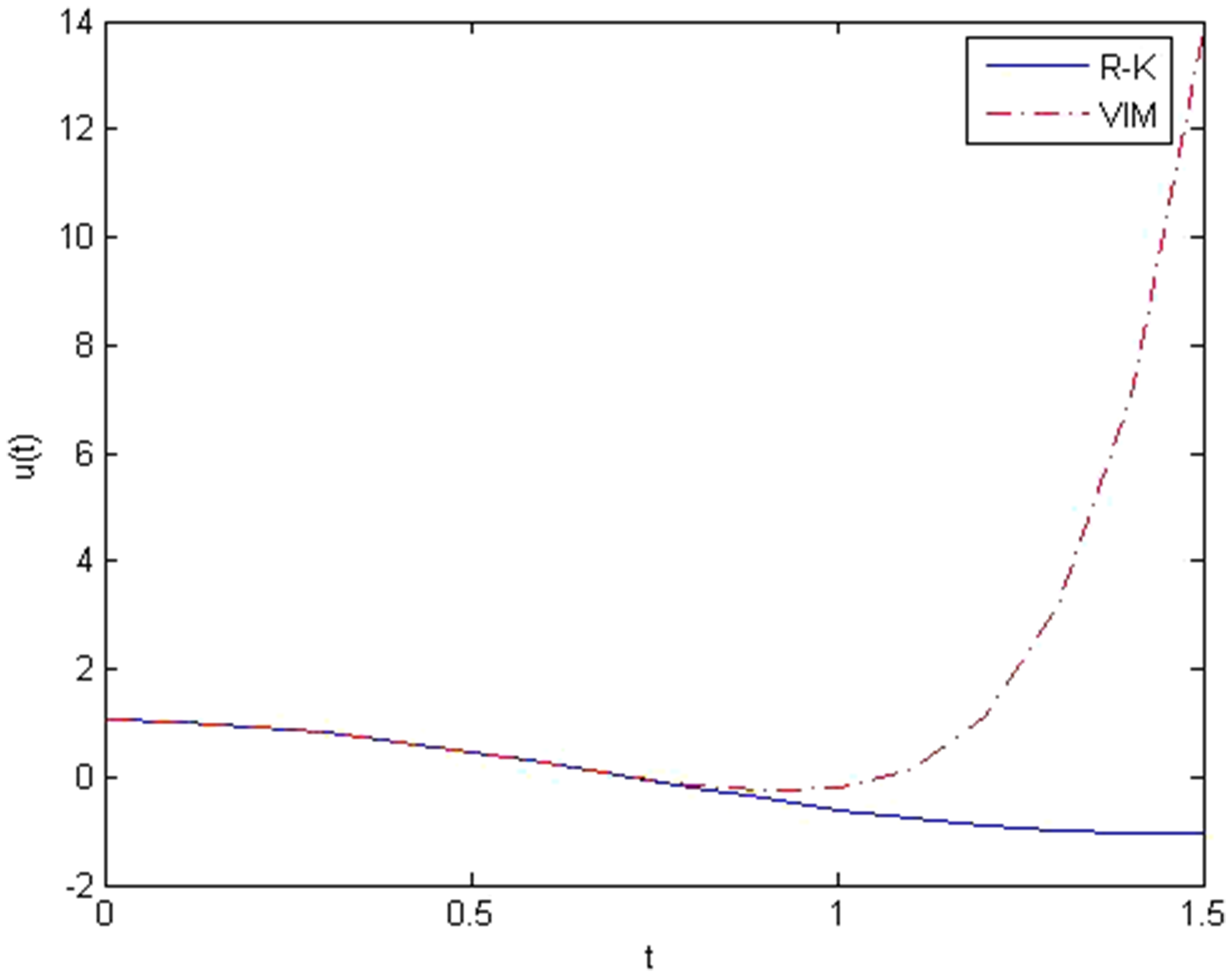
Comparisons of VIM solutions u3(t) and numerical solutions by Runge-Kutta method. VIM: variational iteration method.
We apply the Laplace transformation to the third-order approximation u3, which results in

Letting

The [4/4] Padé approximation to

Recalling

By using the inverse Laplace transformation to the [4/4] Padé approximation, we obtain the following VIM-Pade solution

For comparison, we test the VIM-Padé method and Runge-Kutta method for nonlinear system (6). The periodic curves of the VIM-Padé solutions and the fourth-order numerical solutions by Runge-Kutta method are plotted in Figure 2. We also show the numerical results of the VIM- Padé solutions and the Runge-Kutta solutions in Table 1. By Figure 2 and Table 1, the VIM- Padé solutions are in good agreement with the solutions obtained by Runge-Kutta method. We remark that the relative errors of the VIM-Padé solutions in Table 1 can be improved by considering more iteration steps of VIM-Padé method.
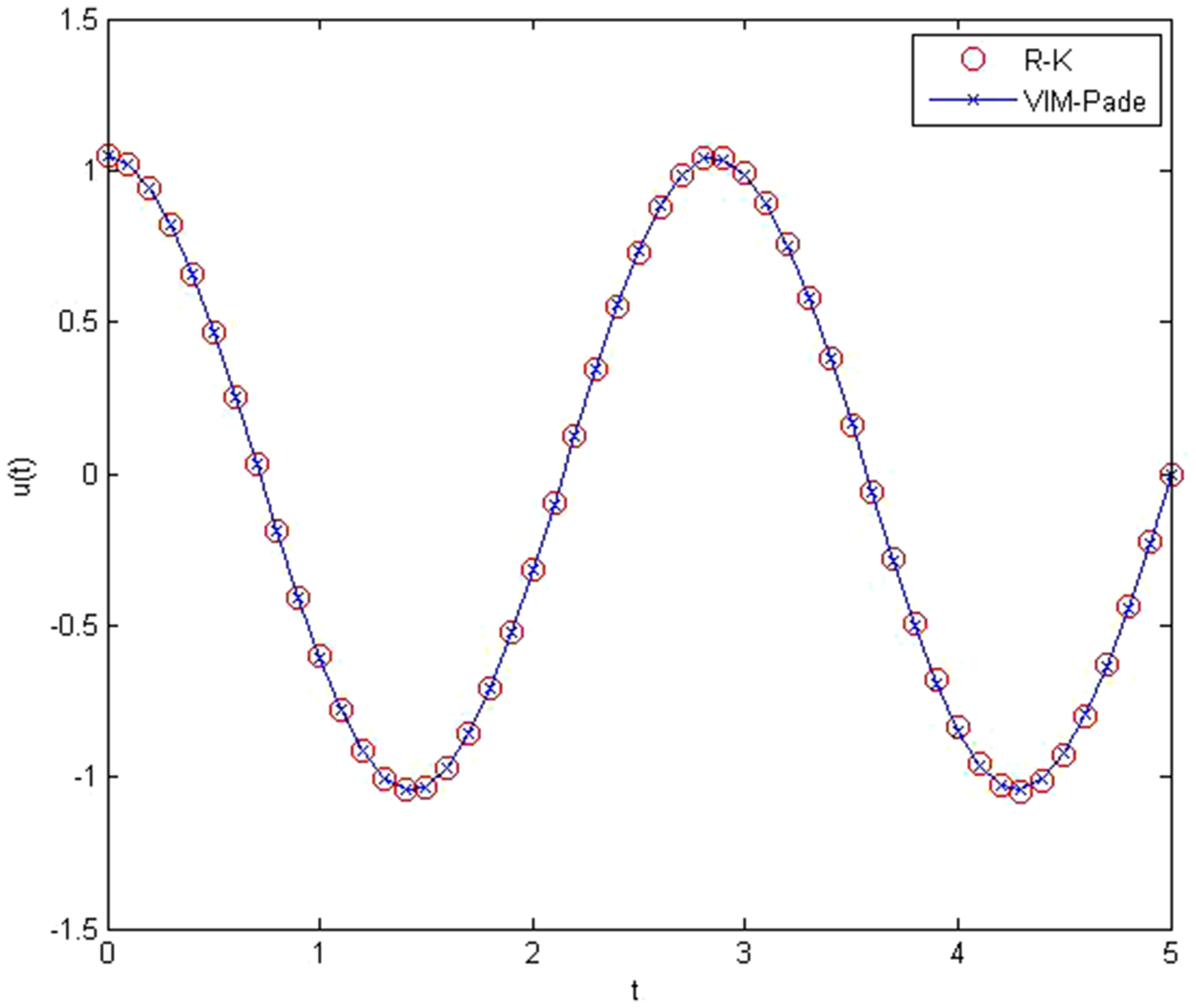
Comparisons of VIM-Padé solutions and numerical solutions by Runge-Kutta method. VIM: variational iteration method.
Numerical results of the VIM-Padé solutions and Runge-Kutta solutions.
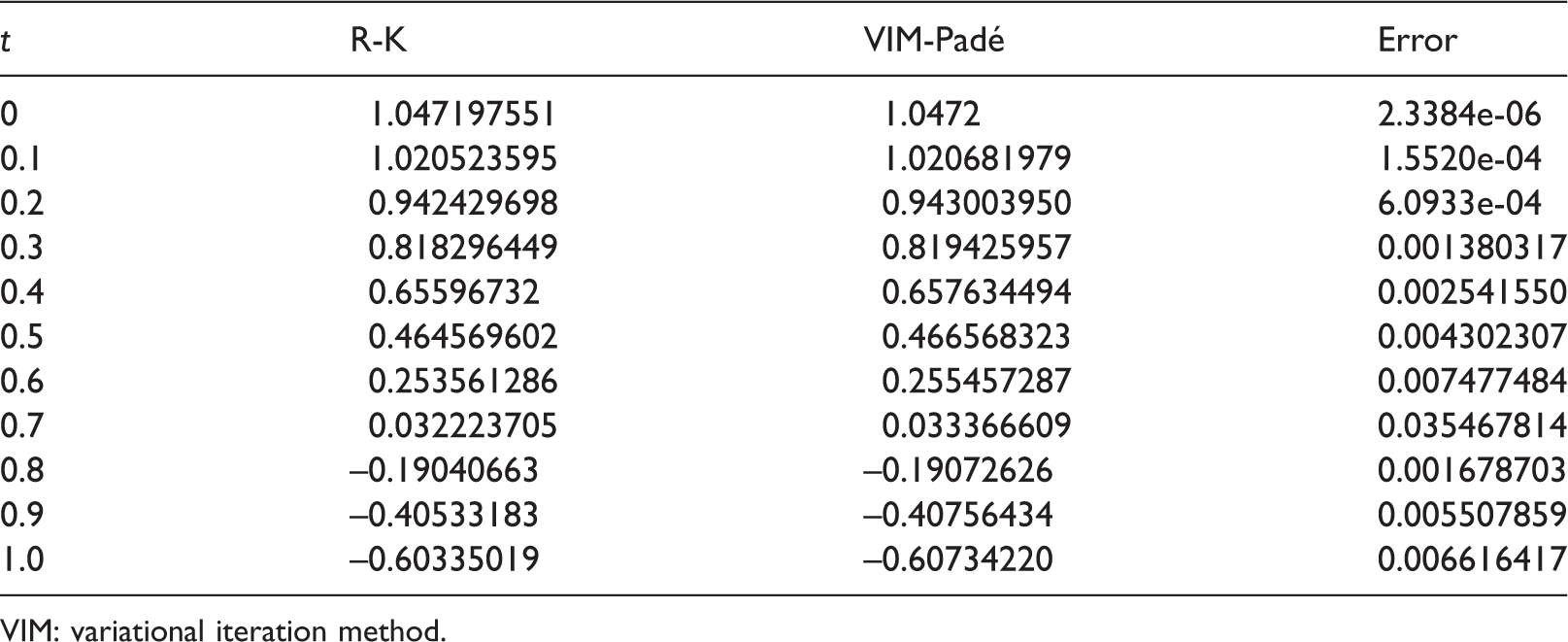
VIM: variational iteration method.
We then consider another nonlinear oscillator


Similar to the previous procedure, we can obtain the approximated oscillator 
By (equation 12), we have the following third-order approximation

By using the Laplace transformation to u3 together with 
The [4/4] Padé approximation gives

Letting 
By applying the inverse Laplace transformation to the [4/4] Padé approximation, we obtain the approximated solution

The VIM-Padé method also works well for this nonlinear oscillator. Figure 3 shows the comparisons of the VIM-Padé solutions and the fourth-order Runge-Kutta solutions.
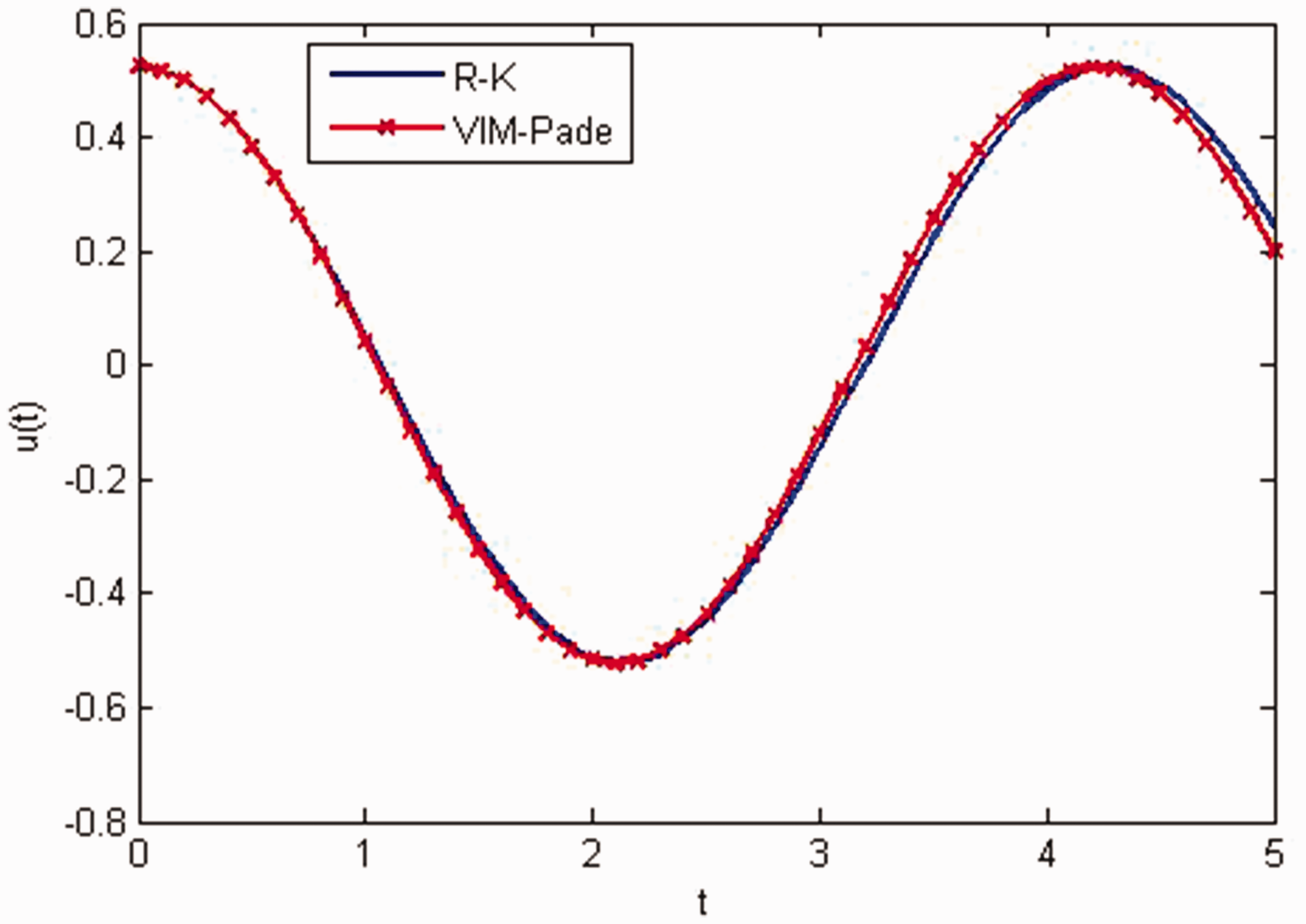
Curves of approximated solutions (VIM-Padé) and numerical solutions (R-K). VIM: variational iteration method.
Conclusions
This paper focused on the numerical investigation of the strongly nonlinear oscillators with cubic and harmonic restoring force. Two initial value problems of the strongly nonlinear oscillators were solved by using an efficient approach which is a combination of the VIM, Padé approximation and Laplace transformation. Compared results of the VIM-Padé technique and Runge-Kutta method were given to show the efficiency of this method. The approximated solutions agreed well with the numerical solutions by Runge-Kutta method, which suggests that VIM-Padé technique is efficient for solving this nonlinear oscillator. It will be interesting to further consider its exact or approximated frequency. Future work will focus on investigating this topic and extending this analytical approach to other nonlinear oscillators.
Footnotes
Declaration of conflicting interests
The author(s) declared no potential conflicts of interest with respect to the research, authorship, and/or publication of this article.
Funding
The author(s) disclosed receipt of the following financial support for the research, authorship, and/or publication of this article: The work was supported by the National Natural Science Foundation of China (11201422), the Natural Science Foundation of Zhejiang Province (LY17A010001), and the project Y201636537 of Education Department of Zhejiang Province.