




Abstract
This paper gives analytical solutions to a nonlinear oscillator with coordinate-dependent mass and Euler–Lagrange equation using the parameterized homotopy perturbation method. The results demonstrate the simplicity and convenience of the method to nonlinear differential equations.
Keywords
Introduction
Nonlinear differential equations are fundamental aspect of mathematics that finds great interest in science and engineering. Most physical phenomena are modeled using nonlinear differential equations. Of such equations are the nonlinear oscillator with coordinate-dependent mass 1 and the Euler–Lagrange equation.
These equations in almost all cases require valid, robust, and effective solutions. Over the years, different solution techniques have been established. These include the homotopy perturbation method (HPM),1–6 energy balance method,7–10 amplitude–frequency formulation,11,12 variational iteration method,13–18 and parameter expanding method.19,20
The HPM given by He et al.1–5 is applied to provide solutions to differential and integral equations—linear and nonlinear. The method is known to pair the traditional perturbation technique with the homotopy in topology. The method since introduction has seen many modifications to meet with the demand of more accurate and fast convergent results. Among the recent modification is the parameterized HPM. 3
This work utilizes the idea of the parameterized HPM to provide analytical solutions to a nonlinear oscillator with coordinate-dependent mass and Euler–Lagrange equation.
Review of parameterized homotopy perturbation method
Parameterized HPM is a powerful method developed by Adamu and his student, Ogenyi in 2017. The technique modified the classical idea of the HPM to make improvement.
For the review of the method, we consider a general nonlinear oscillator:

With initial conditions

The division of

The following homotopy is constructed for the nonlinear differential equation

Obviously


Equation (4) changes from linear to nonlinear equation as p changes from 0 to
Using p as an expanding parameter and the premise that the solution of equation (4) can be composed in the form

The approximate solution of equation (3) becomes

Applications/Results
Example 1
Consider a Lev–Tymehyshgn–Zagorodny nonlinear oscillator with coordinate-dependent mass
1

With initial condition

Rewriting equation (9) we have

Using the constructed homotopy
3

Equation (12) transits from linear to nonlinear oscillator as p changes from p to
Expanding the linear term (-1),
1
we have

Studies by various authors1–5 give

Substituting equation (13) and equation (14) into equation (12), and solving the resulting equation leads to


Equation (15) gives the following solution

Substituting equation (17) into equation (16) results

Further evaluation of equation (18) provides

The absence of secular term in equation (19) implies

First approximation of equation (13) gives
1

The following solution results after substituting equation (21) into equation (20)

Taking
3

Equation (22) becomes


Equation (25) is the approximate solution of equation (9) provided in He and Yue. 1
Equating equations (24) and (25)

The choice of equation (25) in the identification of the optimal alpha is based on the fact that there is no known exact solution for equation (9).
Solving for the


Since for periodic solution,

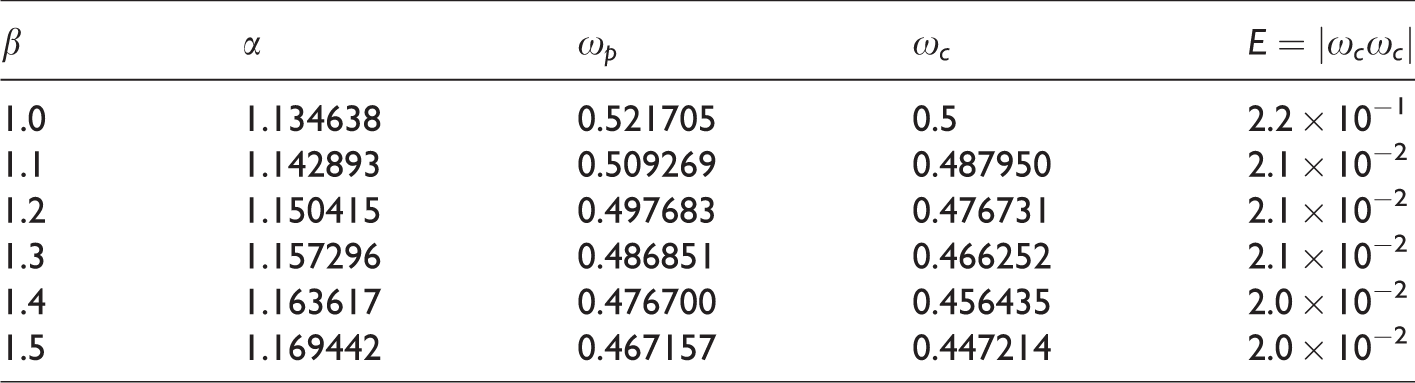
Table 1 gives the numerical values of
Numerical results of equation (9).
Example 2
Consider an Euler–Lagrange equations

With the initial condition

Rewriting equation (30)

Homotopy is constructed for equation (32)

With reference to various studies1–5 we can write

This follows that


Equations (34), (35), and (36) are substituted into equation (33) and simplified to give


Consequently

Combining equations (39) and (38)

Further simplification leads to

The absence of secular term in 
This implies

Taking 

Considering an approximate solution of equation (30) given by the classic HPM

Equating equations (44) and (45)


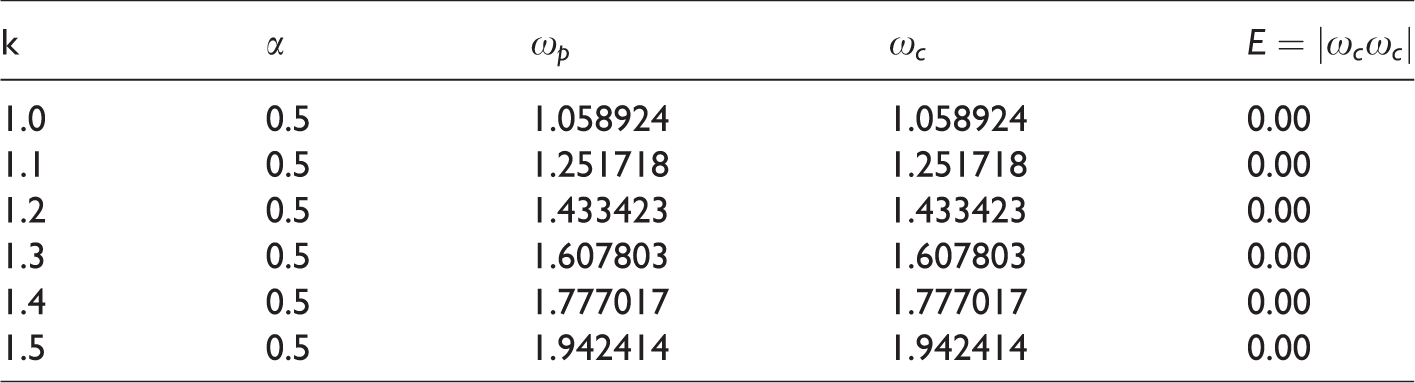
The numerical solution of equation (30) is given in Table 2.
Numerical results of equation (30).
Conclusion
The parameterized HPM is successfully used to obtain analytical solutions to a nonlinear oscillator with coordinate-dependent mass and Euler–Lagrange equations. The method is simple, convenient, and able to handle wide varieties of nonlinear differential equations with ease.
Footnotes
Acknowledgement
We like to express our profound gratitude to Professor Ji-Huan He who has been an encouragement and source of inspiration for us. We hope he will continue to support us in becoming better and renowned researchers.
Declaration of conflicting interests
The author(s) declared no potential conflicts of interest with respect to the research, authorship, and/or publication of this article.
Funding
The author(s) disclosed receipt of the following financial support for the research, authorship, and/or publication of this article: This study was funded by TET Fund research grant.