




Abstract
The pull-in voltage is crucial in designing an optimal nano/micro-electromechanical system (N/MEMS). It is vital to have a simple formulation to calculate the pull-in voltage with relatively high accuracy. Two simple and effective methods are suggested for this purpose; one is an ancient Chinese algorithm and the other is an extension of He’s frequency formulation.
Keywords
Introduction
The pull-in instability1–6 is an inherent property of a nano/micro-electromechanical system (N/MEMS) when the applied voltage reaches a threshold (see Figure 1), and it plays a significant role in electrostatically actuated sensors for their effective and reliable operation. The MEMS system opens a broad road for microfluidics,
7
energy harvester,
8
drug delivery device,
9
timing and frequency control,
10
and portable devices.
11
The pull-in voltage can be easily obtained for the linear case; however, it is highly intricate and challenging for the nonlinear case. The MEMS system.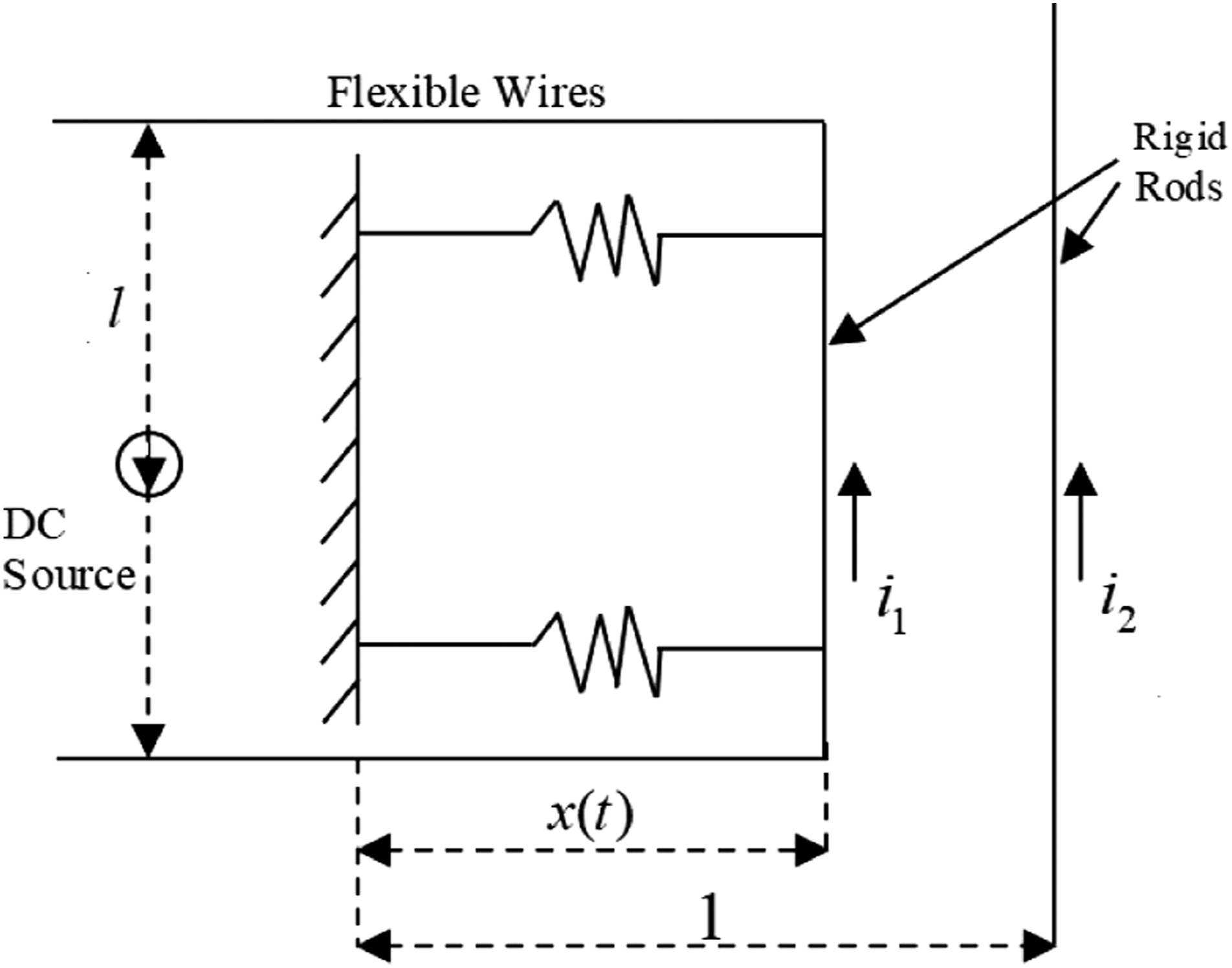
Since the problem of static pull-in (as a consequence of a saddle-node bifurcation)12–16 and dynamic pull-in (as a consequence of a homoclinic bifurcation)17–20 in the MEMS structure is a highly decisive factor, fast estimation of the pull-in voltage is much needed in practical applications.
We consider the following dynamical pull-in problem
21

The pull-in behavior occurs when

This implicit function cannot clearly see the effect of the system’s parameters on the pull-in voltage. An analytical closed-form solution is much needed for MEMS applications. 16 There are many experimental, numerical, and analytical methods for this purpose; for example, the finite-difference method, 22 the finite element method, 23 the modal expansion method, 24 the generalized differential quadrature method, 25 the Ritz method,26,27 and the variational iteration method.28,29
To solve
Ancient Chinese Algorithm
We begin with the well-known Newton iteration method. If we choose the initial guess as
Consider a simple example

The Newton iteration process.

The Newton iteration process.

To solve the transcendental equation given in equation (2), we introduce the ancient Chinese method.30,31 Consider an algebraic equation in the form
The ancient Chinese algorithm begins with two trials,
30

The iteration process of the ancient Chinese algorithm is illustrated in Figure 2. For the above example, the two residuals are
according to equation (5), we estimate that The iteration process of the ancient Chinese algorithm.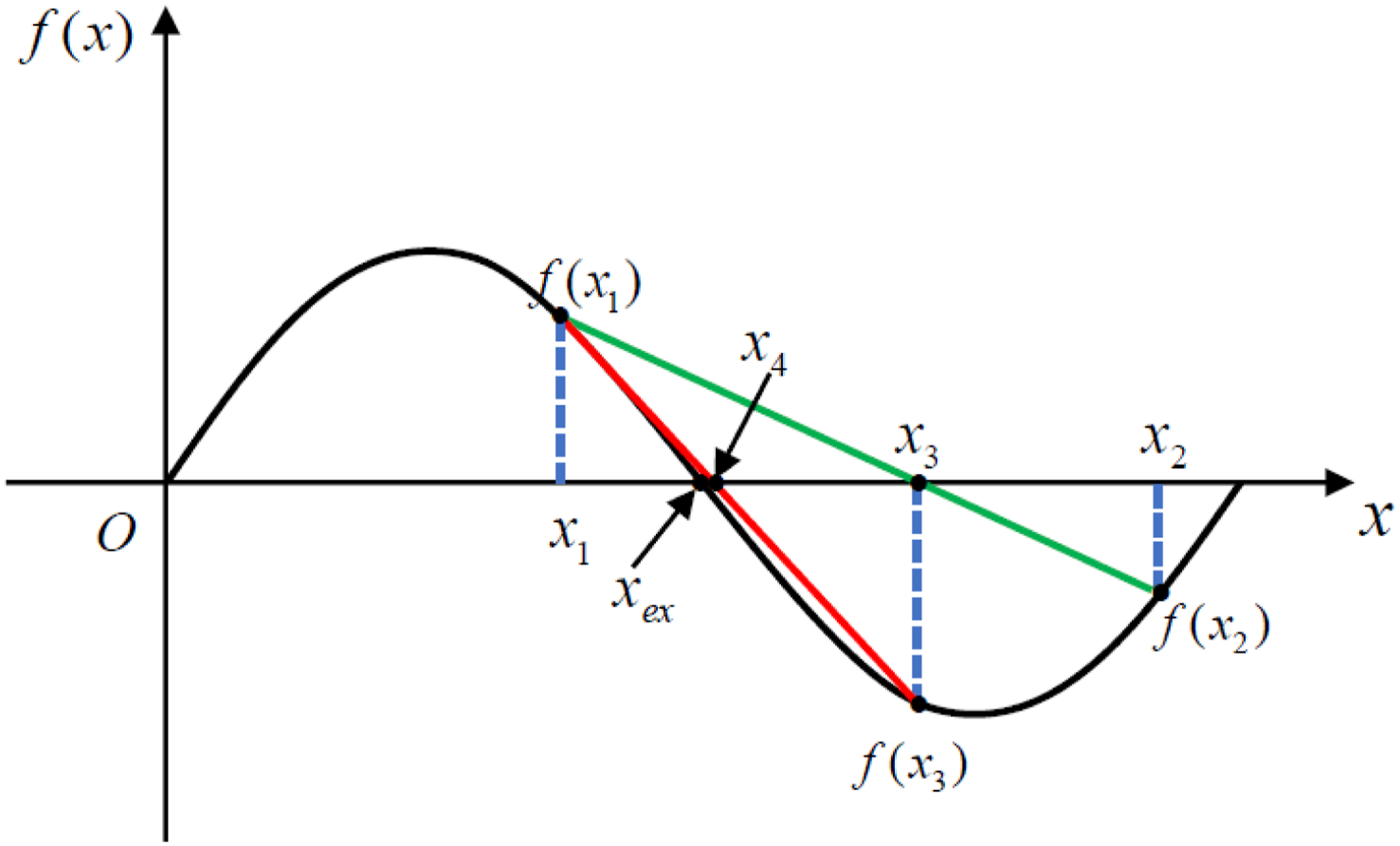
To solve equation (2), we introduce a residual function
We choose two trials 
This has a relative error of 2.82%. The accuracy can be improved using the other two trials
He's frequency formulation
He’s frequency formulation32,33 is to calculate the frequency of a nonlinear oscillator in the form

For equation (1), we have
The pull-in threshold is to change the periodic solution (

We have a maximum 
Now, the relative error reduces to 0.62%.
Discussion and Conclusion
Newton’s iteration method is sensitive to the initial guess. A good guess always leads to a good result, while a not-good guess results in a non-convergent solution, or the convergent solution is a wrong one. To overcome the shortcoming of the Newton’s iteration method, we suggest two simple but effective methods in this paper to determine the pull-in voltage. A simple method with relatively high accuracy is welcome in many practical applications.
Footnotes
Acknowledgments
The authors thank Taif University Researcher for Supporting project number (TURSP-2020/16), Taif University, Taif, Saudi Arabia.
Declaration of conflicting interests
The author(s) declared no potential conflicts of interest with respect to the research, authorship, and/or publication of this article.
Funding
The author(s) received no financial support for the research, authorship, and/or publication of this article.
