




Abstract
A fast insight into the frequency–amplitude relationship of a rehabilitation training device and other nonlinear vibrations as well is of great importance. This paper applies Ren’s frequency–amplitude formulation to obtain approximate frequencies of nonlinear oscillators with little calculation while keeping high relative accuracy. The golden mean location is used in the example procedures.
Introduction
Nonlinear vibration arises everywhere in engineering, such as electronics, biomechanics, physiology, textile engineering, and nanotechnology, though there are many analytical methods to approximately solve various nonlinear oscillators with remarkable accuracy, for examples, the variational iteration method,1–3 the homotopy perturbation method,4–6 the variational approach,7,8 the Hamiltonian approach, 9 a complete reviews on analytical approaches to nonlinear oscillators are available in He. 10 Although much achievement in analytical methods has been made, it is of great importance to have a fast insight into the frequency and amplitude relation with simple calculation. For example, a fast estimation of the frequency of a rehabilitation training device is important for rehabilitation training. To this end, many frequency–amplitude formulae were applied, for examples, He’s max–min approach, 11 He’s frequency–amplitude formulation and various modifications,12–14 García’s amplitude-frequency formula, 15 Suárez-Antola’s amplitude–frequency formula. 16 Tian and Liu gave a systematic review on various amplitude–frequency formula. 17
He’s frequency–amplitude formulation was derived through ancient Chinese mathematics.
18
China is one of the most famous countries with brilliant ancient culture in the world. The ancient Chinese mathematics had made great contributions to the world human civilization, which is increasingly attracting worldwide attention and studies. According to an ancient Chinese mathematical method, the algebraic equation (equation (1)) can be solved as below

Let x1 and x2 be its two approximate solutions, which lead to two remainders

The modern application of this algorithm has led to He’s frequency–amplitude formulation.18–20 Recently, Zi-Yin Ren proposed another formulation 21 for nonlinear oscillators.
Ren’s frequency–amplitude formulation
Consider a generalized nonlinear oscillator with initial conditions in the below form

We use two trial functions




According to He’s frequency–amplitude formula, the approximate frequency of equation (3) can be written as

Equation (8) is He’s frequency–amplitude formulation for nonlinear oscillators,18–20 which was often used in literatures.22–26
Zi-Yin Ren proposed another formulation
21
for nonlinear oscillators as shown in equation (9)

This equation is called as Ren’s frequency–amplitude formulation, which is much effective to nonlinear oscillators.
Examples
Example 1
Now consider the below nonlinear oscillator

We substitute two trial functions


According to equation (9), we have the approximate frequency
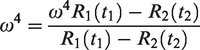

Choosing the location point


The approximate period of equation (10) can be expressed as

The exact period of equation (10) is
10

The relative error of the approximate period of equation (16)

Example 2
Now we consider another nonlinear oscillator below

This equation can be rewritten as

Substituting the two trial functions,


By Ren’s frequency–amplitude formulation, the approximate frequency can be expressed as
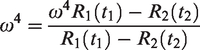

Still choosing the location point

Simplifying equation (24) results in

We, therefore, get

We obtain the approximate period

The exact period of equation (19) can be expressed as
10

The relative error ERelat of the approximate period can be calculated by

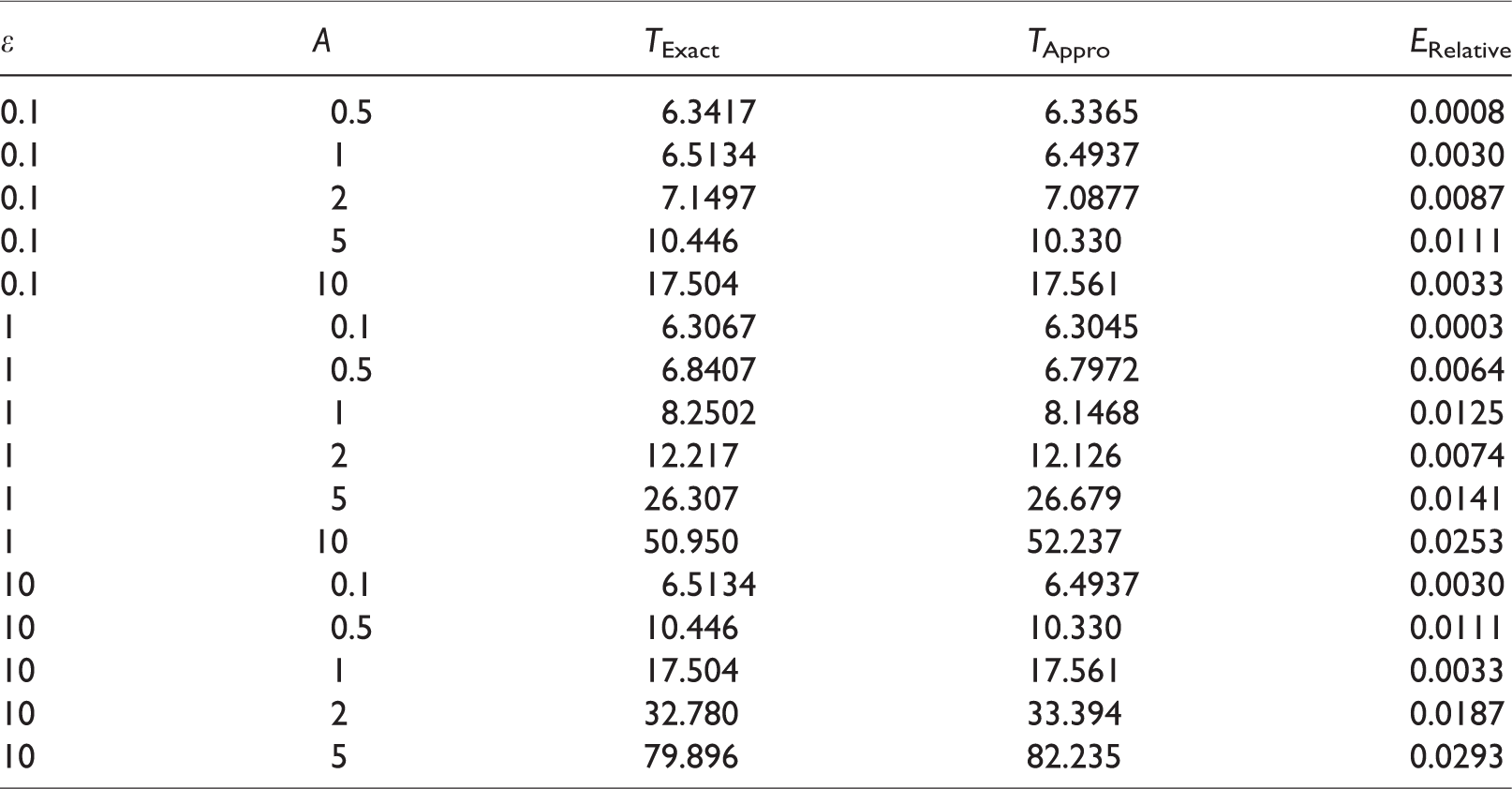
The comparison between the approximate periods TAppro and the exact periods TExact is listed in Table 1 for different values of ε and A, a good agreement is obtained.
Relative errors of approximate period.
Conclusion
In this work, Ren’s frequency–amplitude formulation is demonstrated through examples, the solution process is very simple, and the results are fairly effective. Ren’s frequency–amplitude formulation provides an efficient alternative method for the analysis of nonlinear vibrations. Although He’s frequency–amplitude formulation is simple enough for practical applications, and Prof. Ji-Huan He has developed some even simpler amplitude-period formulae in his recent studies.27,28
Footnotes
Declaration of conflicting interests
The author(s) declared no potential conflicts of interest with respect to the research, authorship, and/or publication of this article.
Funding
The author(s) disclosed receipt of the following financial support for the research, authorship, and/or publication of this article: The work is supported by the Natural Science Foundation of Shandong Province under Grant No. ZR2009AL005.