



Abstract
Noise cancellation is one of the most successful applications of the wavelet transform. Its basic idea is to compare wavelet decomposition coefficients with the given thresholds and only keep those bigger ones and set those smaller ones to zero and then do wavelet reconstruction with those new coefficients. It is most likely for this method to treat some useful weak components as noise and eliminate them. Based on the cyclostationary property of vibration signals of rotating machines, a novel wavelet noise cancellation method is proposed. A numerical signal and an experimental signal of rubbing fault are used to test and compare the performances of the new method and the conventional wavelet based denoising method provided by MATLAB. The results show that the new noise cancellation method can efficaciously suppress the noise component at all frequency bands and has better denoising performance than the conventional one.
Introduction
Denoising is the key to improve the reliability and accuracy of data analysis. The core of denoising is to improve the signal-to-noise ratio of the signal, so as to eliminate the false and retain the true, eliminate the coarse and extract the fine. 1 This is because there are many kinds of interference in the measured signal, such as the interference from the external environment and the interference from the test instrument itself, which are generally reflected in various forms of noise in the signal. In fault diagnosis, the effect of noise elimination often directly affects the subsequent fault analysis and diagnosis. 2 Noise is a kind of uncertain random process, which can be roughly divided into white noise and colored noise according to its power spectrum characteristics. In order to eliminate the noise in the signal, many methods have been proposed. The traditional methods include optimal filtering or estimation methods and adaptive filtering methods. When using these methods, some prior knowledge and assumptions are often needed, such as the types of noise and useful signals. 3 In contrast, when using the wavelet based method to eliminate noise, it is enough to know which type the signal belongs to roughly, and then apply some standard noise elimination methods, as Donoho 4 said: “you can do as well as those who make the right assumptions, but better than those who make the wrong assumptions.”
The compactness of wavelet basis function is the main basis for wavelet transform to be used as noise elimination processing. It can make the signal energy concentrate on a few large wavelet coefficients, and the wavelet coefficients after noise decomposition are generally very small, which makes people can filter the signal according to certain strategies. Because of the advantages of wavelet transform, it is widely used in signal denoising5–8 once it is proposed. When wavelet transform is applied to denoise, the key is to set appropriate threshold.9–11 According to different threshold setting strategies, it can be roughly divided into soft threshold method and hard threshold method. MATLAB provides corresponding implementation functions for both wavelet denoising methods. But in practical application, the signal may contain some useful components of small energy, and the wavelet coefficients after decomposition will be smaller. When these wavelet coefficients are smaller than the threshold value, these small energy components will be treated as noise elimination.12,13 This situation also exists in other denoising methods.14,15
According to the cyclostationarity of the vibration signal of rotating equipment, a new method of signal denoising based on wavelet transform is proposed, and the simulation data and test data are denoised by using it. The results show that the new method has good denoising performance.
Characteristic analysis of vibration signal of rotating equipment
When the rotating equipment operates stably, if it is only excited by some stable forces, such as unbalanced force, and is not disturbed by any other disturbances, its vibration signal is stable, and its frequency does not change with time. When the equipment is interfered by the external environment, these interferences will bring non-stationary components to the vibration signal, and this kind of interference is often random. Therefore, the non-stationary components introduced are often random. In addition, when the equipment fails, the fault interference will also bring non-stationary components to the vibration signal. Different from the non-stationary components caused by random interference, the non-stationary components generally appear periodically. Therefore, if they are analyzed in a time scale smaller than the rotation period, they can be considered as non-stationary, and when they are analyzed in a whole period time scale, they can be considered as stationary, which is often called a cyclostationary component.16–18
Note that the stationary component of vibration signal

When the signal
In engineering practice, in order to analyze the vibration signal accurately, it is often required to sample the whole period. Based on the Keyphasor signal, the whole period sampling can be realized by interpolating the original sampling signal. Set the rotating equipment to operate stably under a certain working condition, sample its vibration signal in a whole period, and take


There is no doubt that compared with
According to the cyclostationarity of the vibration signal, a method of using multiple data packets to design a filter based on wavelet transform to denoise the signal is proposed.
Design of wavelet transform filter
After more than 10 years of development, wavelet analysis technology has been widely used in many disciplines and has made important achievements of scientific significance and application value.19–23 Now, wavelet transform is also well known. Therefore, before introducing the design method of wavelet transform filter, we only introduce the discrete wavelet transform.
The frequency of non-stationary signal changes with time, which can be divided into two parts: slow change and fast change. The slow changing part corresponds to the low-frequency part of the signal, representing the main contour of the signal; the fast changing part corresponds to the high-frequency part of the signal, representing the details of the signal. In DWT, Mallat algorithm plays a very important role. Its idea is that if the original signal
According to the decomposition idea of Mallat algorithm, the rough image


In the formula,

After

Wavelet basis function has tight support, so after decomposition, the energy of the signal will be concentrated on a few large wavelet coefficients, and the wavelet coefficients after noise decomposition are generally very small, which is the root cause of the successful application of wavelet transform in noise elimination.
It is assumed that there are 1. The signals of group m are normalized to get {
Standard normal treatment is adopted, which can be expressed as 2. By selecting the same wavelet function and performing discrete wavelet transform on each group of normalized signals, we can get m group of wavelet transform coefficients {CJ 3. The definition of wavelet transform filter is as follows


Ideally, the filter coefficients of the wavelet transform corresponding to the stationary component and the cyclostationary component in the signal should be 1, while the filter coefficients corresponding to the noise component would be close to 0. In practical application, the filter can be properly modified to set the coefficients larger than 1 to 1, and those very small coefficients to 0.
When the wavelet transform filter is applied to denoise, the original signal

The denoised signal can be obtained by inverse wavelet transform of
Simulation
The improved denoising method is used to filter the simulation signal and the vibration signal of the rotor test-bed, so as to verify its effectiveness. In the process of wavelet packet decomposition, “db9” is chosen as wavelet basis function. In order to further compare the signal quality before and after denoising, a quantitative performance evaluation index SNR is introduced to evaluate the denoising effect, which is defined as follows
24

In order to test the performance of the new method, a simulation signal with strong noise component is denoised, and the result is compared with the wavelet denoising method provided by MATLAB. According to the vibration characteristics of the imbalance fault of the rotating machinery, the periodic vibration of the rotor with the rotation frequency

In the application of the above denoising method, the signal is divided into 10 segments, each segment of data has 500 points. Using the “db9” wavelet function provided by MATLAB, the decomposition series is 8.
When the wavelet denoising function provided by MATLAB is used to denoise the signal, the signal is not divided equally. The “db9” wavelet function is also used, the decomposition series is also 8, and the soft threshold method is used.
The time-domain waveform of the real vibration signal of the rotor in the imbalance fault state is shown in Figure 1, and the signal state with Gaussian noise and white noise is shown in Figure 2. The wavelet denoising method provided by MATLAB and the method in this paper are respectively applied to denoise the noisy signal. The waveform of the denoised signal is shown in Figures 3 and 4. Table 1 lists the signal-to-noise ratio of the original signal and the noise reduced signal. The vibration signal of rotor imbalance. The complex signal with heavy noise. Wavelet filtering method provided by MATLAB. The signal processed by the improved method. The SNRs of simulation signal before and after denoising (dB).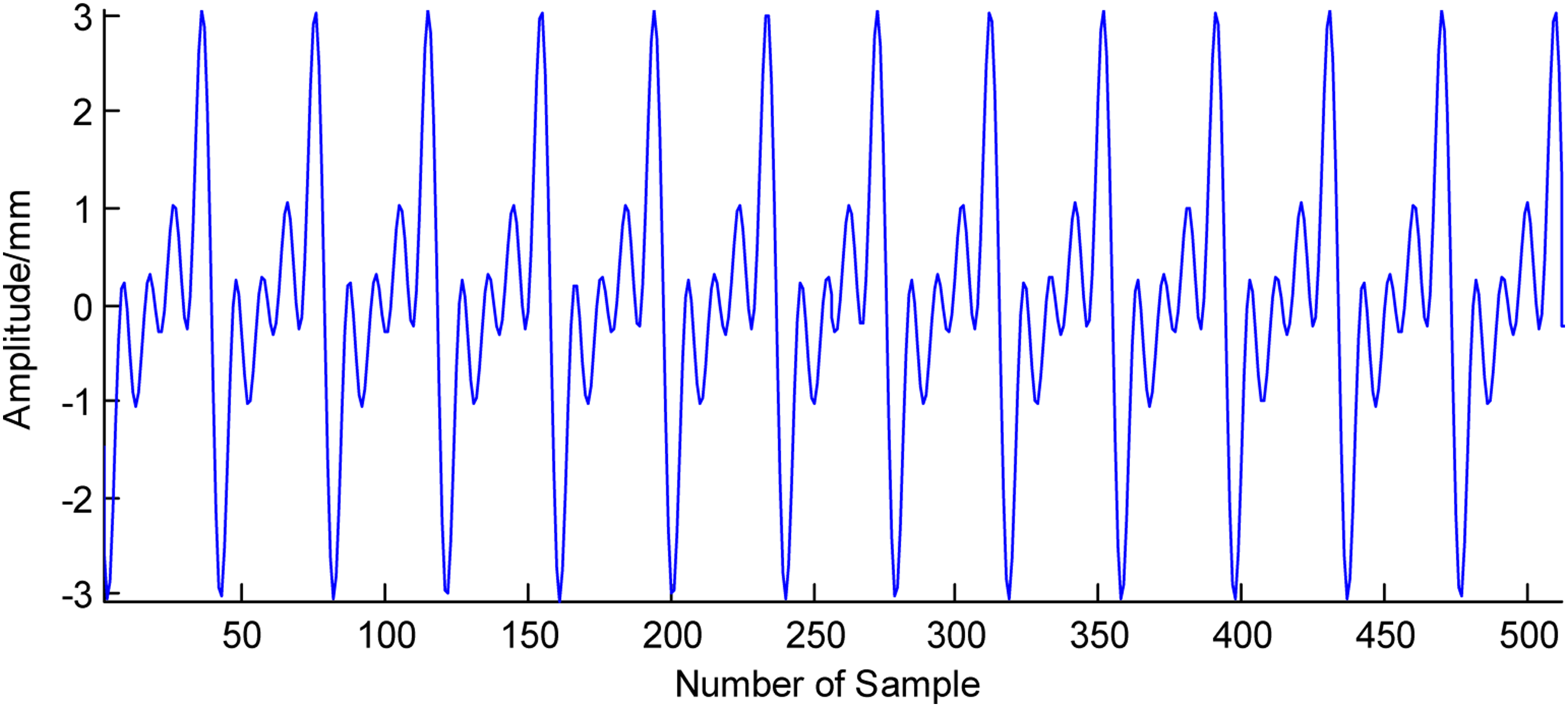
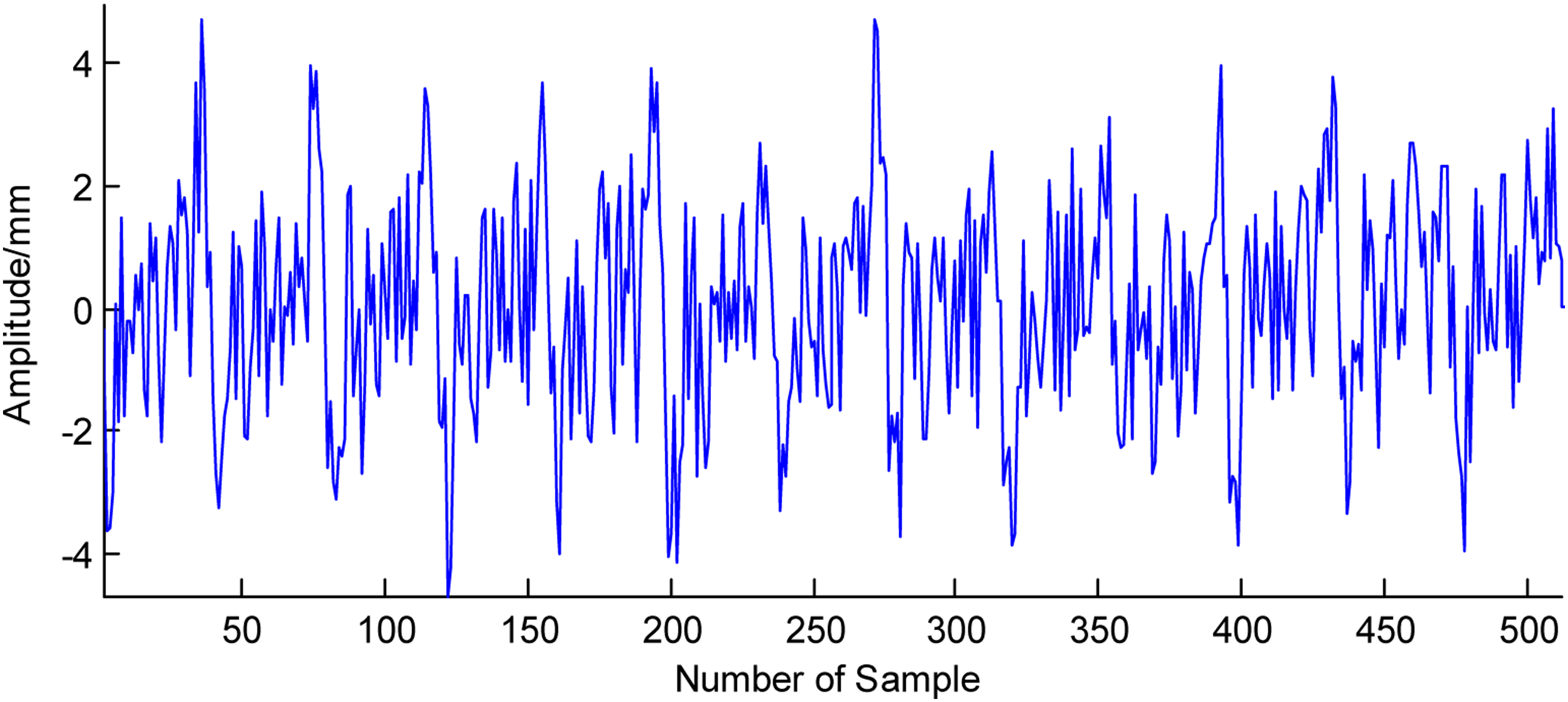
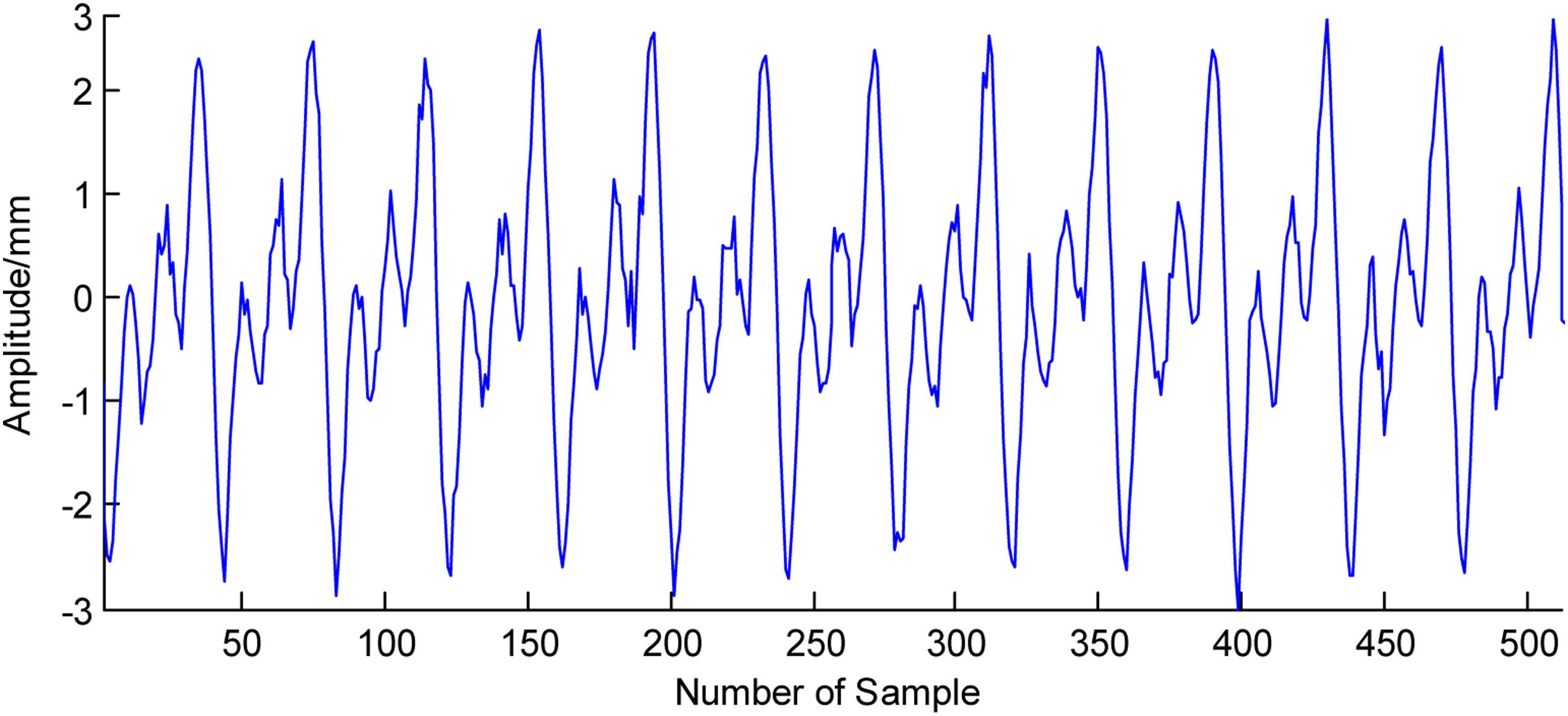
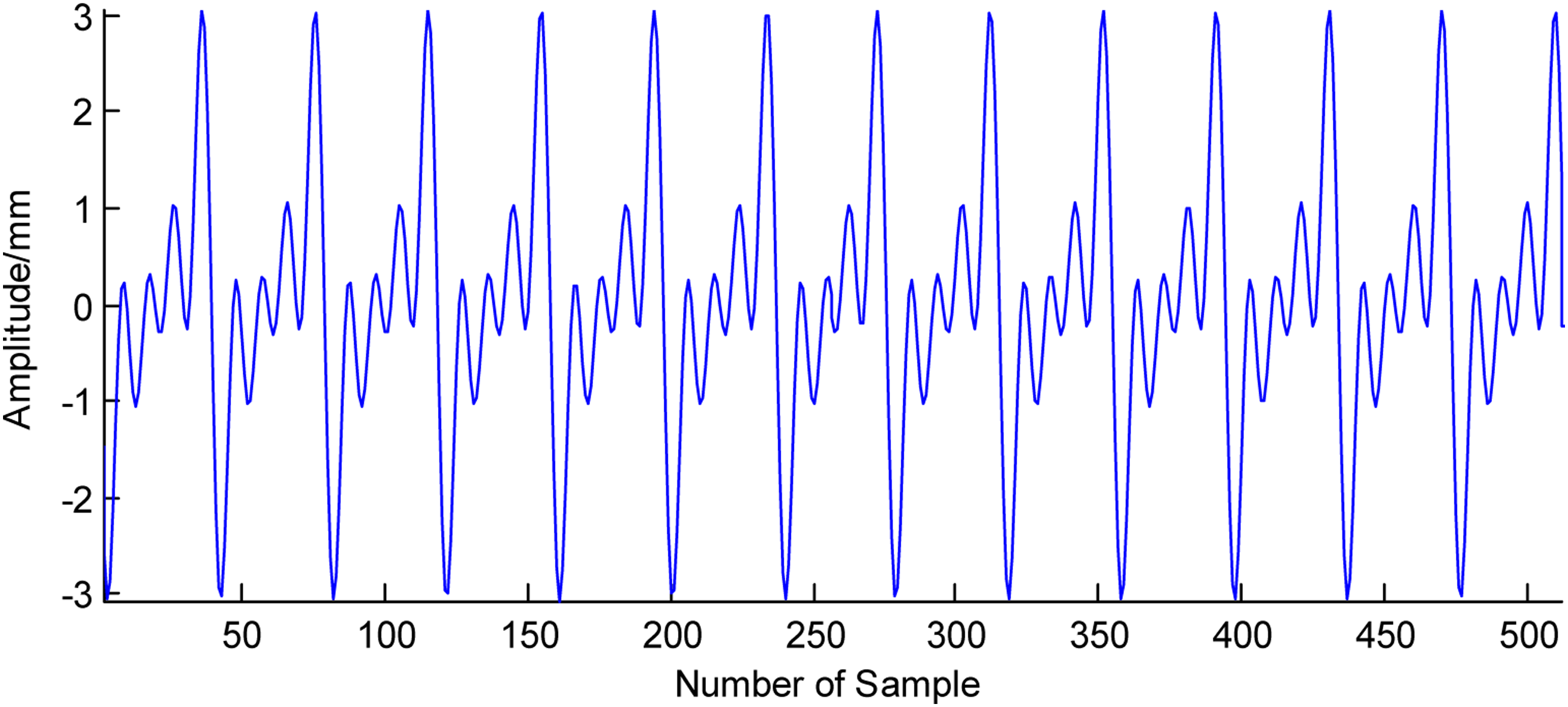

It can be seen from Figure 3 that the wavelet denoising method provided by MATLAB brings serious distortion to the signal, and some components are not recovered well, which is the reason of too strong noise. It can be seen from Figure 4 that the denoising method proposed in this paper recovers five sinusoidal components from strong noise, and the waveform distortion is very small. The magnitude of the signal-to-noise ratio of the two noise reduction methods in Table 1 also fully proves this.
Experimental
Rub impact is a common fault of rotating equipment. The research shows that its vibration signal has cyclostationarity.24,25 In this paper, a group of rub impact test signals are processed by the new method and the wavelet denoising method provided by MATLAB. The data is collected from a double span rotor test-bed, and the test device is shown in Figure 5. The rotor speed The rotor test-bed.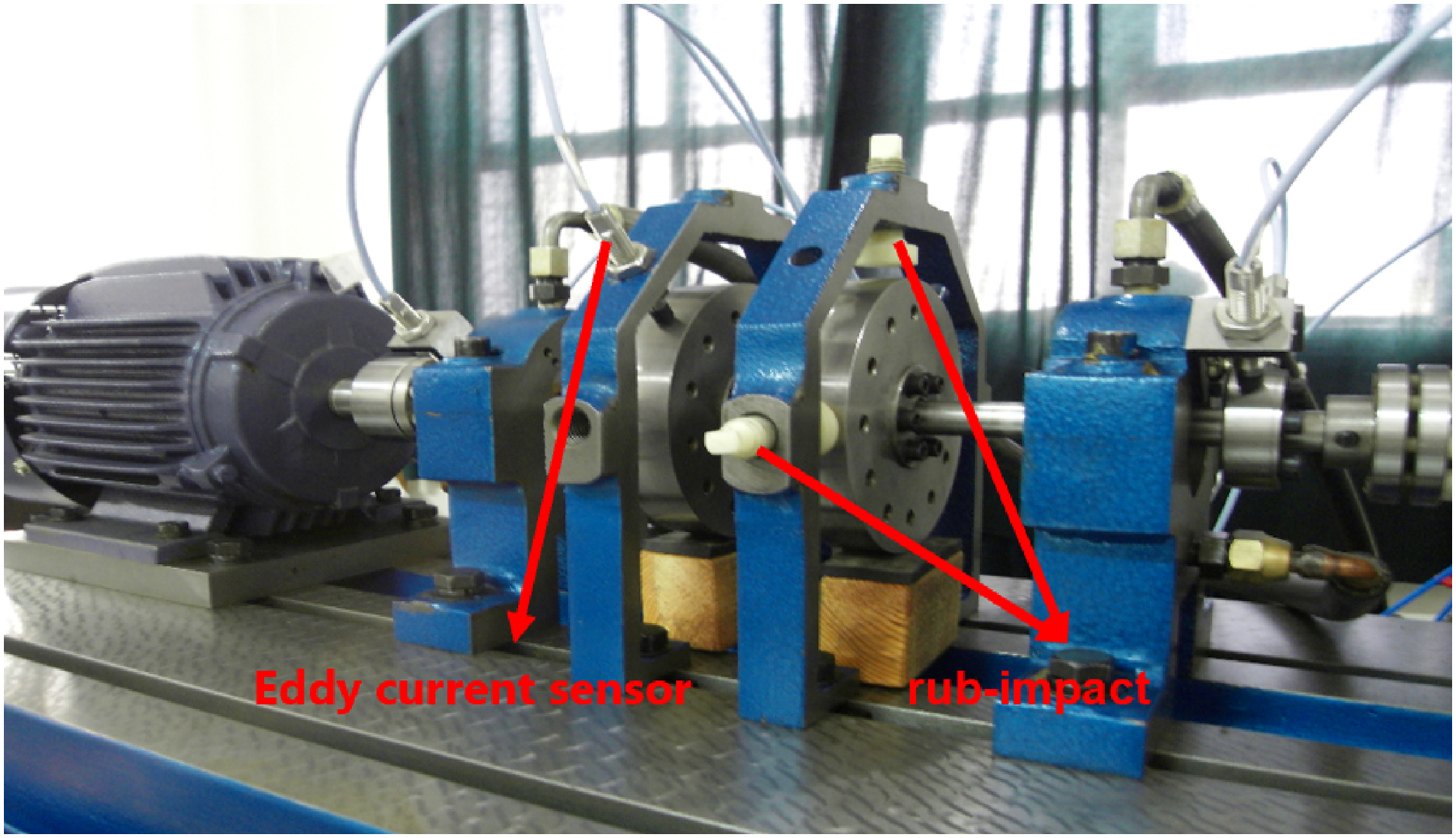
In the application of the proposed denoising method, the data are divided into 10 segments, that is, each segment contains 37 cycles of data. When the wavelet denoising function provided by MATLAB is used to denoise the signal, the signal is not divided equally. The “db9” wavelet function is also used, the decomposition series is also 8, and the soft threshold method is used. In order to better display the performance of the denoising method, a section of data is artificially added with white noise, and the maximum amplitude of the noise is 1/10 of the maximum amplitude of the original signal.
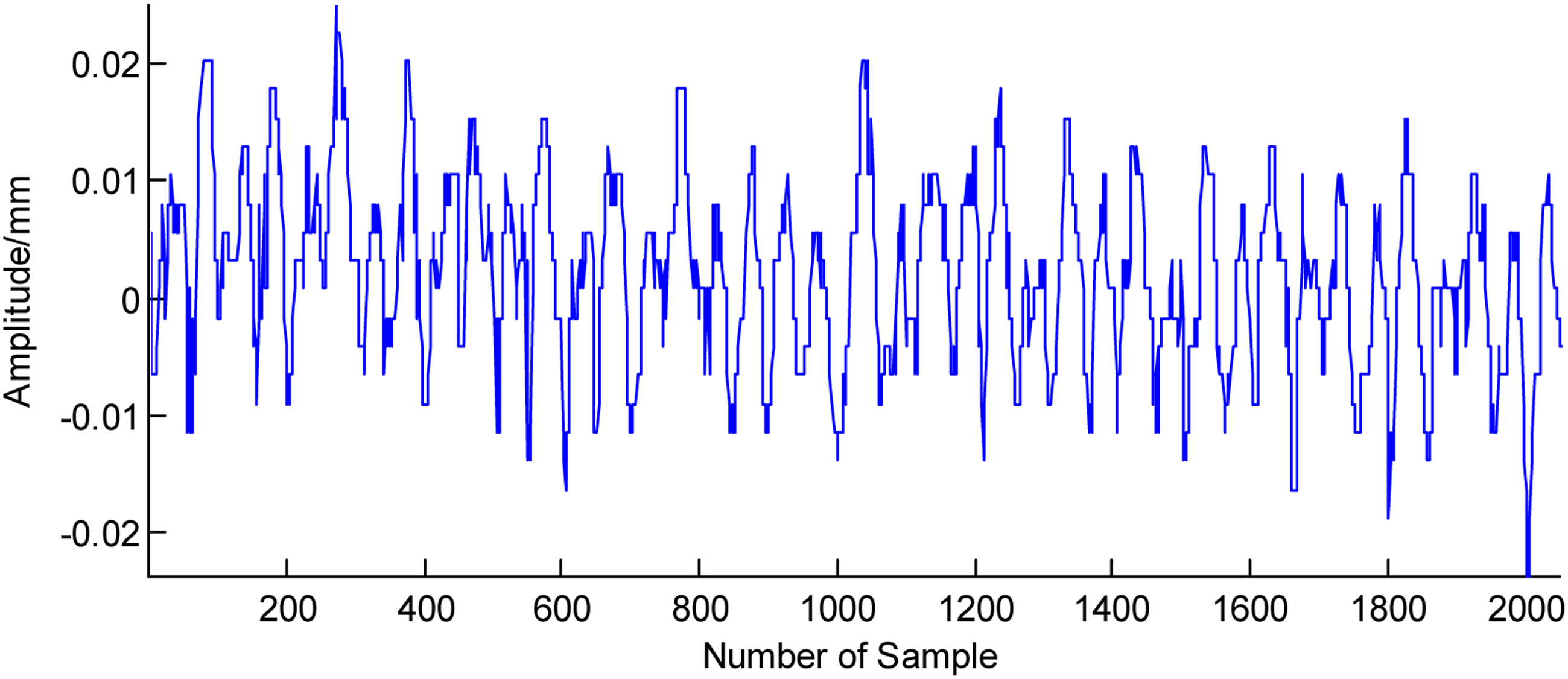
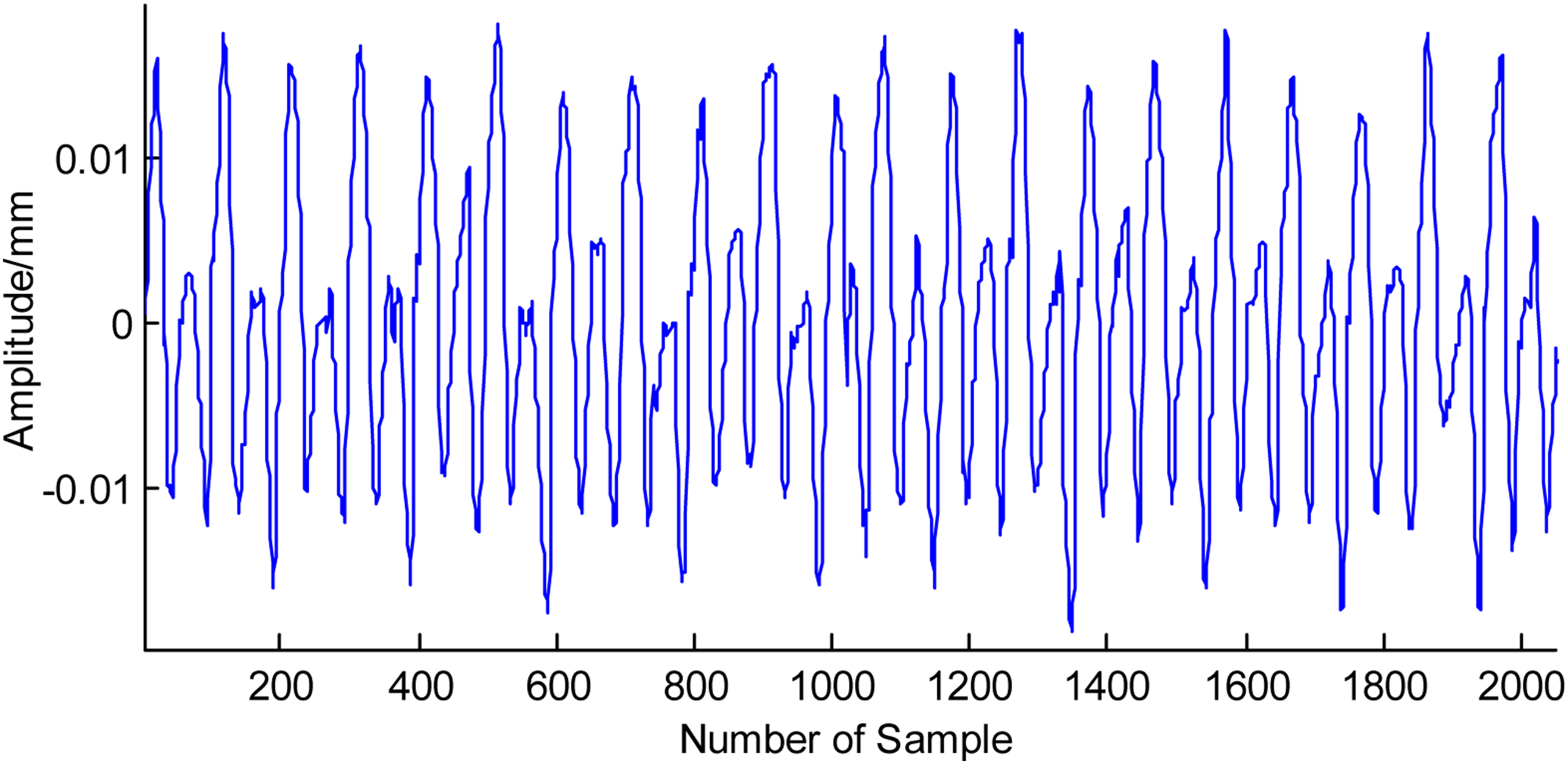
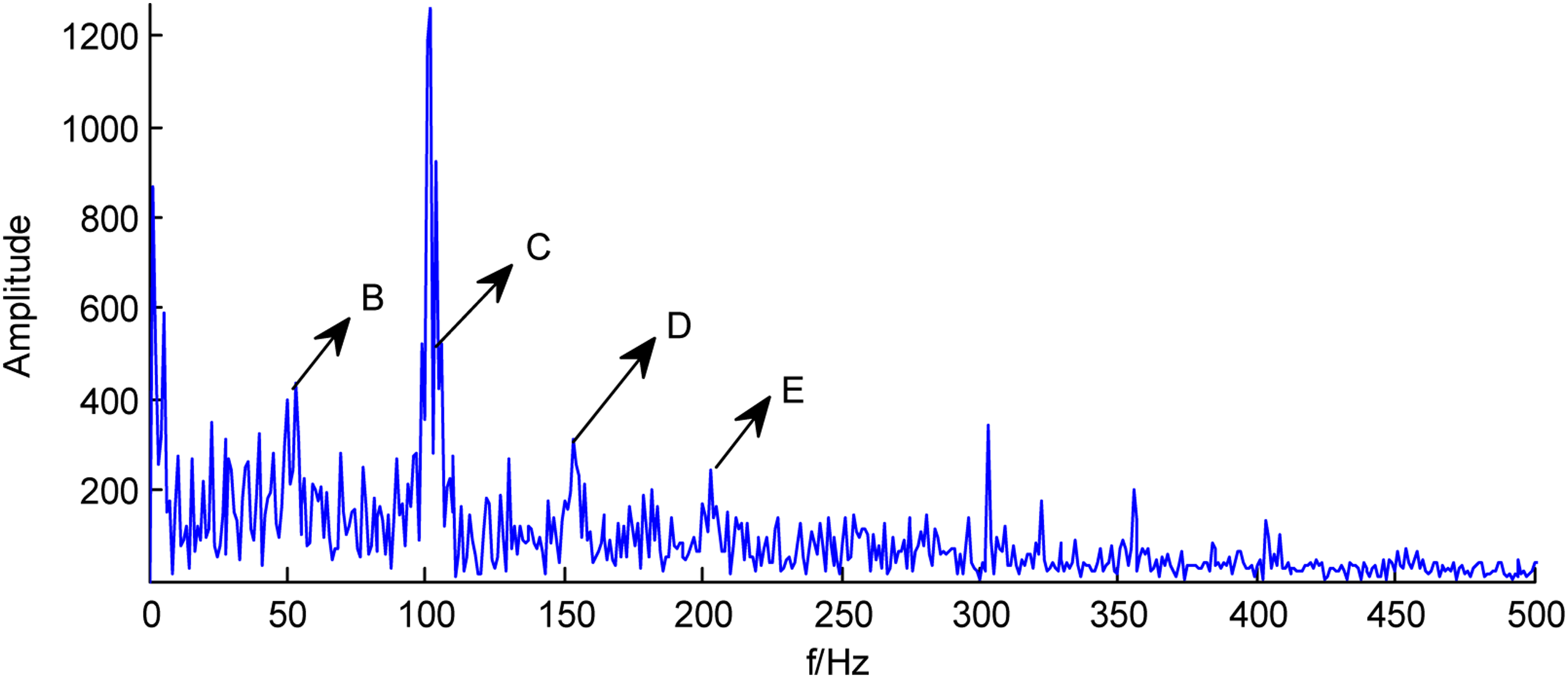
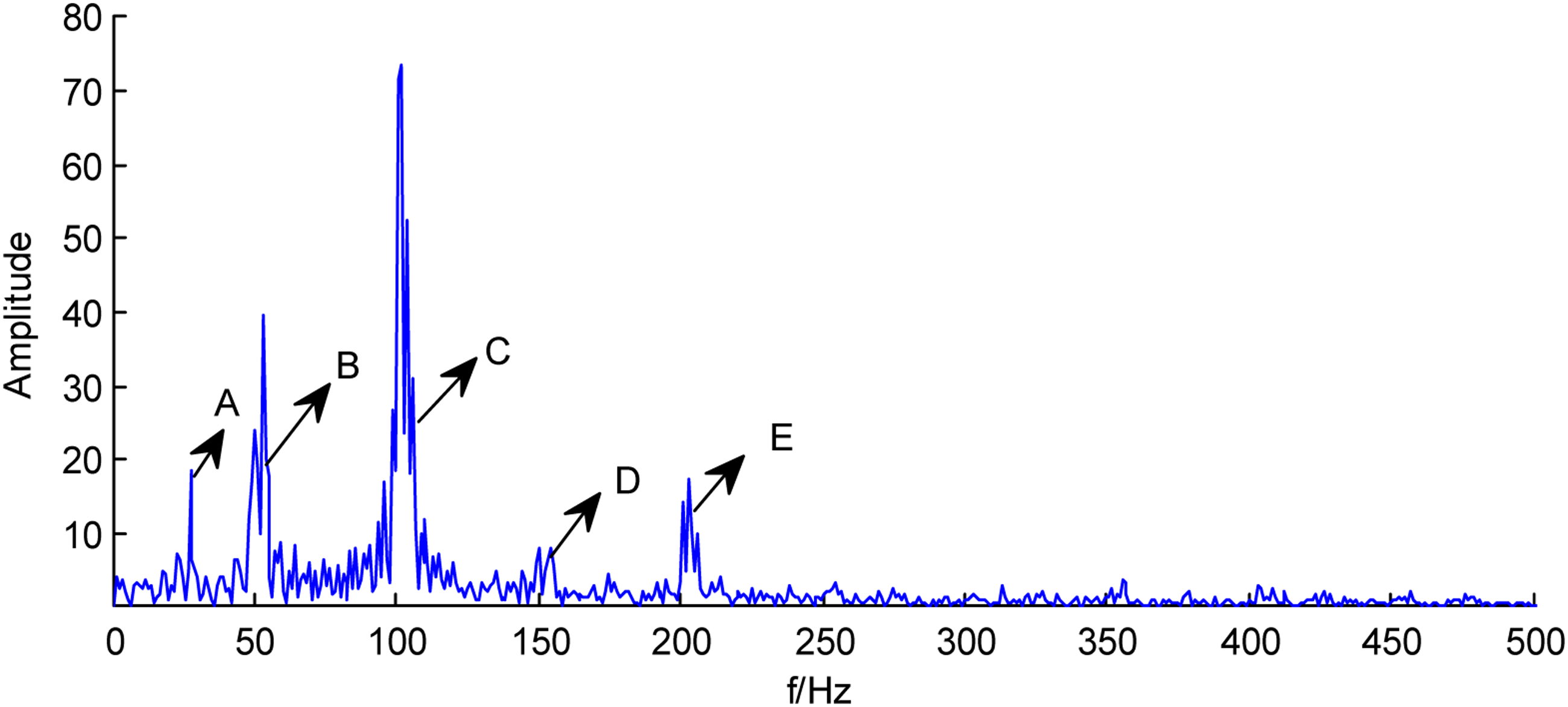
Figure 6 shows the rubbing signal with noise. Figure 7 shows the waveform processed by the wavelet denoising method provided by MATLAB data package. Figure 8 shows the waveform processed by the new denoising method. It can be seen that the two denoising methods can eliminate the noise on the rub impact signal, but the improved wavelet denoising method is better than the wavelet processing denoising method of MATLAB data package. In order to compare the complex vibration of the rotor before and after filtering more intuitively, it is necessary to analyze the spectrum of each data signal before and after filtering, and observe the different characteristics of the signal before and after filtering from the frequency domain. Time-domain waveform of the sampled rotor vibration signal. Time-domain waveform of the signal after denoising by MATLAB. Time-domain waveform of the signal after denoising by the proposed method.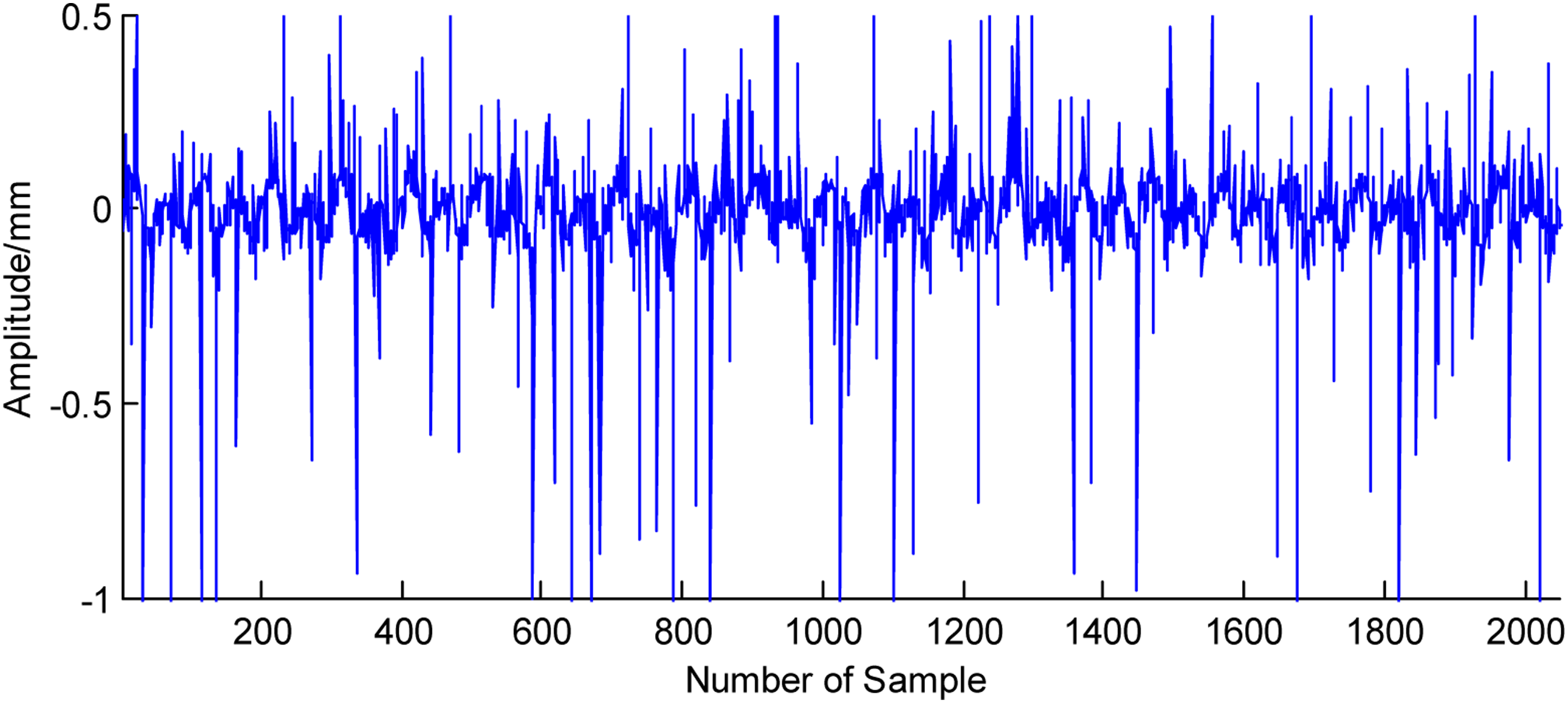
It can be clearly seen from Figures 9 to 11 that the proposed denoising method and the denoising method provided by MATLAB play a good role in suppressing the noise component in the rub impact signal. As in the previous simulation signal denoising, the proposed wavelet denoising method can well suppress the noise components, and several main frequency components are well preserved, basically without energy loss, including two small energy frequency components marked with D and E. In the same way, the wavelet denoising method provided by MATLAB has better denoising effect in the high-frequency area than the proposed method, but its denoising effect in the low-frequency area is not very ideal, and the frequency component of A is eliminated as noise due to its small energy. This component corresponds to the 1/2 fundamental frequency components of the signal. These components are more important rub impact characteristics. Their elimination will bring adverse effects on the diagnosis. Frequency domain waveform of the sampled rotor vibration signal. Frequency domain waveform of the signals after denoising by MATLAB. Frequency domain waveform of the signal after denoising by the proposed method.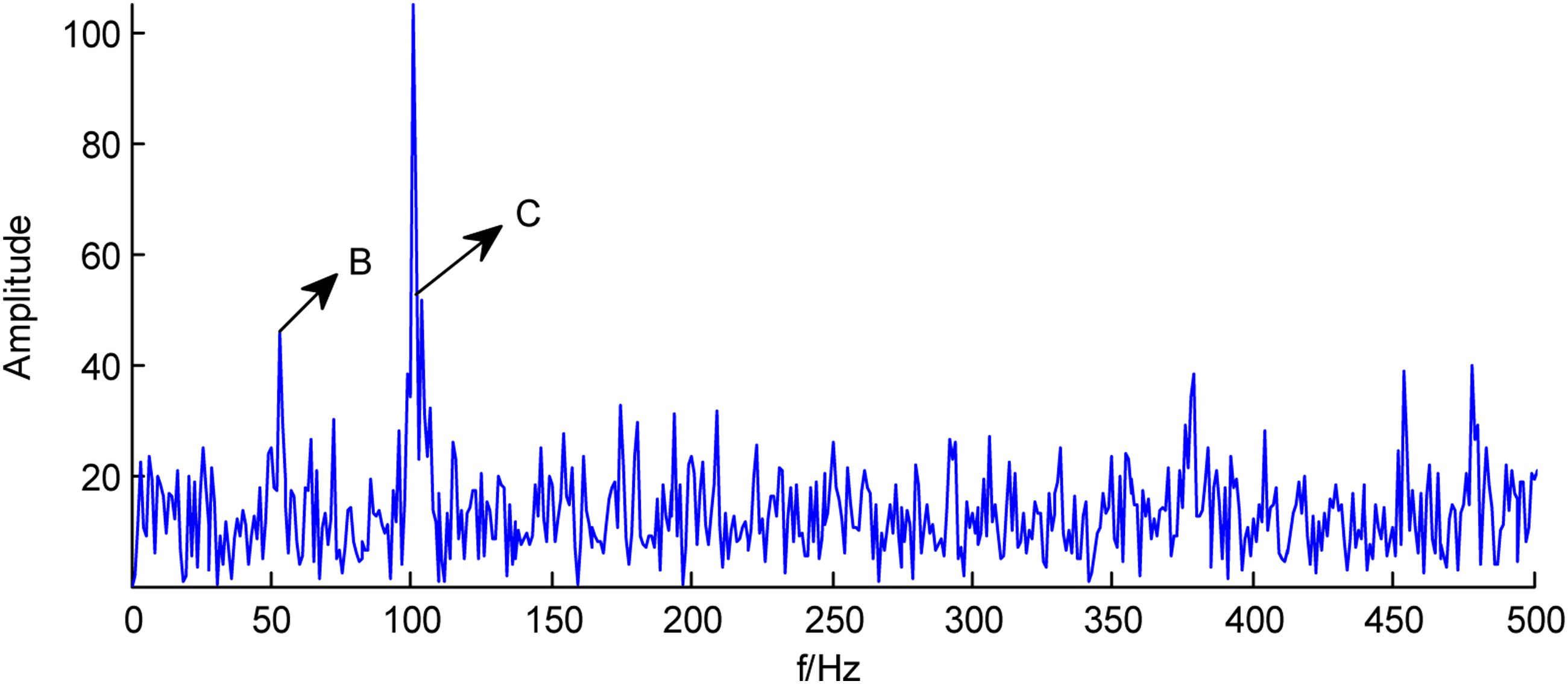
Conclusions
According to the cyclostationarity of the vibration signal of rotating machinery, a new denoising method based on wavelet transform is proposed. The new method and the wavelet denoising method provided by MATLAB are used to denoise the digital test signal and the test vibration signal respectively. The results show that the new method has good denoising performance, can well suppress the noise components in each frequency band of the signal, and can avoid some small energy stationary or cyclostationary components as noise elimination. The proposed denoising method based on wavelet transform can be used to extract the time-frequency characteristics of fault signals in the early stage of fault development, which provides reliable technical support for early fault diagnosis.
Footnotes
Declaration of conflicting interests
The author(s) declared no potential conflicts of interest with respect to the research, authorship, and/or publication of this article.
Funding
The author(s) disclosed receipt of the following financial support for the research, authorship, and/or publication of this article: The authors are grateful to the Foundation of Henan Educational Committee (16A470021) and key scientific and technological project of Henan Province (172102210097) for the financial support of the current work.
Data availability statement
The data used to support the findings of this study are included within the article.
