




Abstract
The microelectromechanical devices have triggered rocketing interest in various advanced technologies, that is, sensors, material science, and energy harvesting, and now the devices tend to a nanoscale size, making the technology much more attractive in both academic and industrial communities. This paper takes a graphene nano/microelectromechanical system as an example to study its dynamical property, which is the foundation for the optimal design and reliable operation. As the system is inextricably complex with singularity and zero conditions in a fractal space, the iteration perturbation method is used to obtain the periodic solution of the system. The results show clearly the low-frequency property of the system and pull-in instability; furthermore, the fractal dimension affects greatly the system’s dynamical property.
Keywords
Introduction
Recently, the nano/microelectromechanical system (N/MEMS) has attracted extensive attention due to its attractive characteristics such as the extremely small size, the remarkably high reliability, the easy batch manufacturing, and the low power consumption. Its numerous applications to the highly sensitive sensors, the excellently reliable actuators, bridges, and switches have been extensively studied.1–4 During the operation of MEMS, the pull-in instability will occur,5–9 which should be avoided in practical applications. There are various methods in the literature to deal with the pull-in instability: Anjum et al. 10 gave a systematical review on various analytical methods for MEMS systems, Anjum et al. 11 showed that the variational iteration method is an efficient tool to the analysis of the periodicity of an N/MEMS, Ji-Huan He et al. established a variational theory for MEMS systems, 12 Anjum et al. applied Li-He’s modification of the homotopy perturbation method with great success, 13 Rehman et al. suggested a modified variational iteration method coupled with Laplace transform, 14 and Ji-Huan He et al. discovered the pull-in plateau. 15
Carbon-based nanomaterials, including one-dimensional carbon nanotubes (CNTs) and two-dimensional graphene,16,17 are more attractive in various N/MEMS applications (such as electronic components, mass/gas sensors, and supercapacitors) due to their unique mechanical, electrical, optical, and chemical properties and have become the first choice for sensing applications in MEMS (microelectromechanical systems) and NEMS (nanoelectromechanical systems) devices.18–22 Graphene is widely used in mass and gas sensing applications because of its low mass and high surface to volume ratio and its good mechanical and electronic properties.
In 2021, Tian et al. 23 suggested a totally new concept of the fractal MEMS system, that is a microelectromechanical system working in a porous medium like plasma. In this paper, we will extend the fractal MEMS system to a graphene N/MEMS.24,25 Considering the environmental pollution, these electronic devices must work in a fractal space filled with particles. Under such conditions, the operation of electronic devices will inevitably be affected, which will also affect the pull-in instability. In this paper, the two-scale fractal theory26–28 is adopted to establish a fractal-fractional differential model for the graphene N/MEMS. The two-scale fractal is now widely used for fractal vibration systems,29–33 the fractal diffusion,34,35 porous concretes,36–38 and dynamic economics. 39
Nonlinear problems are relatively complex, and it is difficult for us to obtain an exact solution of a nonlinear equation. Therefore, analytical approximation methods are mostly used in the study of nonlinear systems. In particular, for the N/MEMS model, many of these analytical methods are also applicable. For example, the variational iteration method,40,41 the homotopy perturbation method, 42 the energy balance method,43,44 He’s frequency formula,45,46 the parameter expansion method,47–49 the residual power progression method, 50 and Hamiltonian method.51,52 Recently, a powerful method, namely, the iteration perturbation method (IPM), has been proved to be an extremely simple, effective, and convenient method which is adequate for both weak and strong nonlinear oscillators proposed by Ji-Huan He. 53 The IPM is exceedingly simple in principle, easy to apply, and has good accuracy. 53 A comprehensive overview of various analysis methods for nonlinear oscillators has been provided by He.54,55
In this paper, firstly, the fractal derivatives in the fractal space are used to describe the dynamic behavior of graphene N/MEMS, and the generalized fractal MEMS equation is constructed. The model is characterized by second-order nonlinear ordinary differential equations with zero initial conditions. Secondly, the fractal model is transformed into differential forms by using the two-scale transformation. Finally, considering the complex nonlinear problem in fractal space, the periodic solution of graphene N/MEMS model is obtained by using the He’s IPM. This simple and effective method gives the approximate nonlinear frequency and approximate analytical solution. We compare the results of IPM with those of the fourth-order Runge–Kutta method (RK4) to verify the solution procedure.
Fractal mathematical modeling
We consider a model of a dual parallel plate driven by electrostatic power. A graphene strip of cross-sectional area Graphene N/MEMS model.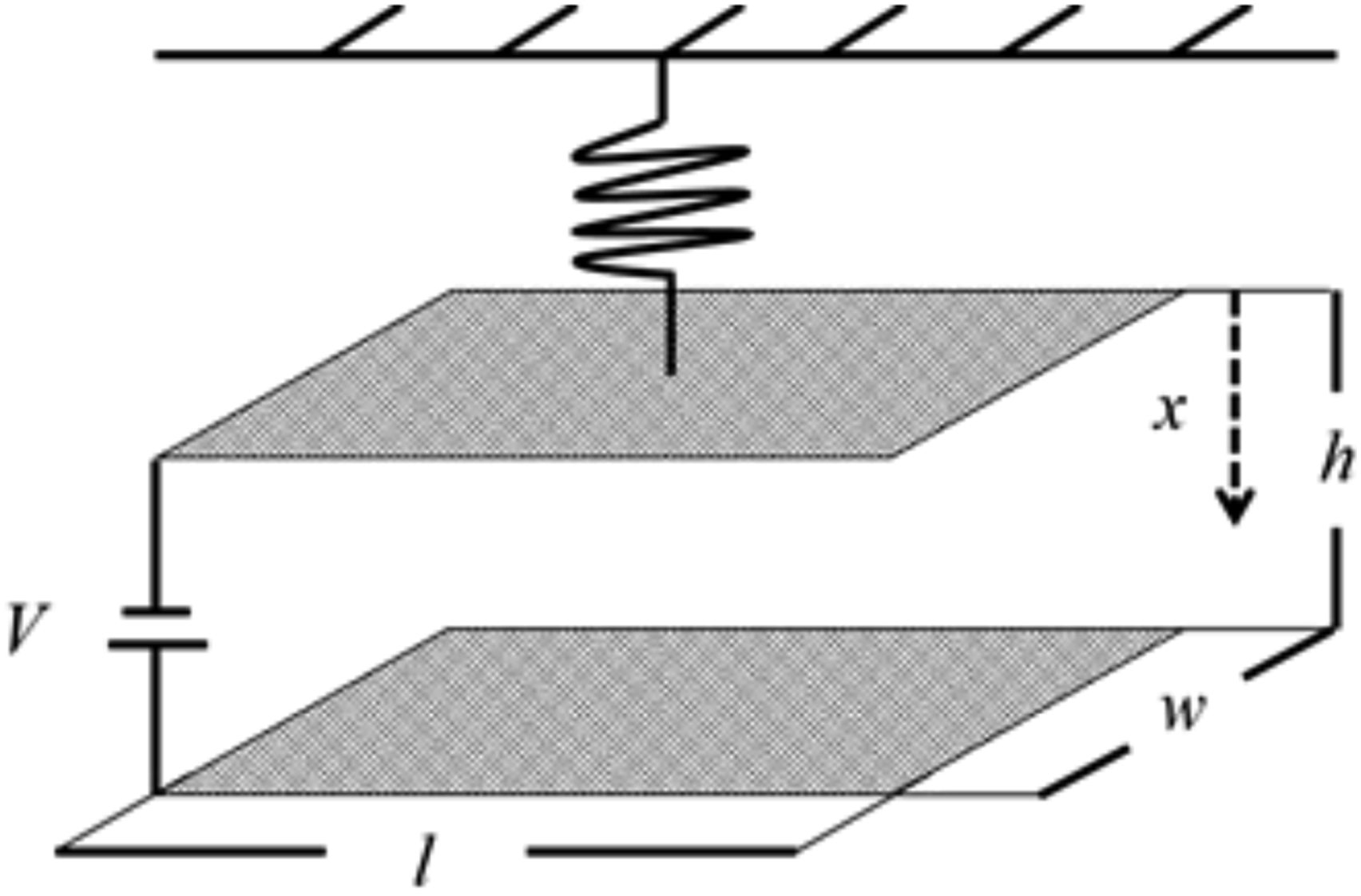




In order to simplify equation (4), we introduce the following dimensionless variables


We suppose that the following zero initial conditions:

If the microelectromechanical system in Figure 1 is carried out in the porous medium, then the model needs to consider in the fractal space. Therefore, the generalized fractal microelectromechanical system is given as follows


The fractal derivative can be used to model various discontinuous problems, for example, shallow water waves along an unsmooth boundary, 57 the fractal modification of Chen–Lee–Liu equation, 58 the fractal boundary layer theory, 59 fractal Duffing equation, 60 heat prevention through porous materials,61,62 and a cement mortar’s fluidity. 63
Equation (8) is a microelectromechanical system in the fractal space investigated by Tian et al.7,23 The air can be viewed as a porous medium, and the fractal dimension
The two-scale transform is a powerful tool to convert a discontinuous space into its continuous one. It can approximately transform the fractional calculus into the traditional calculus,
64
which is easy to solve. For example, consider a fractal differential equation:



Therefore, equation (10) can be rewritten as follows:


In the case of zero initial values, the use of existing asymptotic approaches can make the approximation process really complicated. In order to overcome the influence of the calculation difficulty caused by the zero initial conditions, we consider the following transformation


The nonlinear term can be expanded as follows:

Therefore, equation (16) can be written in the following form:

Equation (18) can also be rearranged as follows:

We re-write equation (19) in the form


Basic ideas of the IPM
The IPM was developed by He
53
which is based on the combination of the perturbation technique and the iterative method. It can be used for weak nonlinear problems and strong nonlinear differential equations. Sedighi et al.
65
had obtained high accurate approximate solution to transversely vibrating quintic nonlinear beams in order to demonstrate the efficiency of IPM. In this section, it offers a concise introduction about IPM to solve nonlinear differential equations. Consider the following nonlinear oscillation:

The above nonlinear equation is rewritten as follows:

The iteration formula of the above equation can be constructed as follows:




Application of IPM in a fractal space
Consider the nonlinear equation, equation (20), for the purpose of gaining the iteratively perturbed solution of the governing equation. An artificial parameter

Equation (28) can be approximated by
53


Equation (30) can be converted in the following form:



This expansion method is proposed by He
66
in the homotopy perturbation method with two expansion parameters. This method is very suitable for nonlinear equations with two nonlinear terms, and there may be diverse influence on the solution. By substituting equations (32) and (33) into equation (31) and equalizing the coefficients with the same power, we can obtain differential equation for

Assuming that there exists the term

No secular term in the second equation for


Solving


Numerical experiments
This subsection considers the effects of different values of the parameters When A = 0.03, k = 0.045, the horizontal axis is dimensionless time, and the vertical axis is the dimensionless displacement. (a)–(c): compared the results of first-order approximation with second-order approximation at fractal dimension When A = 0.065, k = 0.08, the horizontal axis is dimensionless time, and the vertical axis is the dimensionless displacement. (a)–(c): compared the results of first-order approximation with second-order approximation at fractal dimension 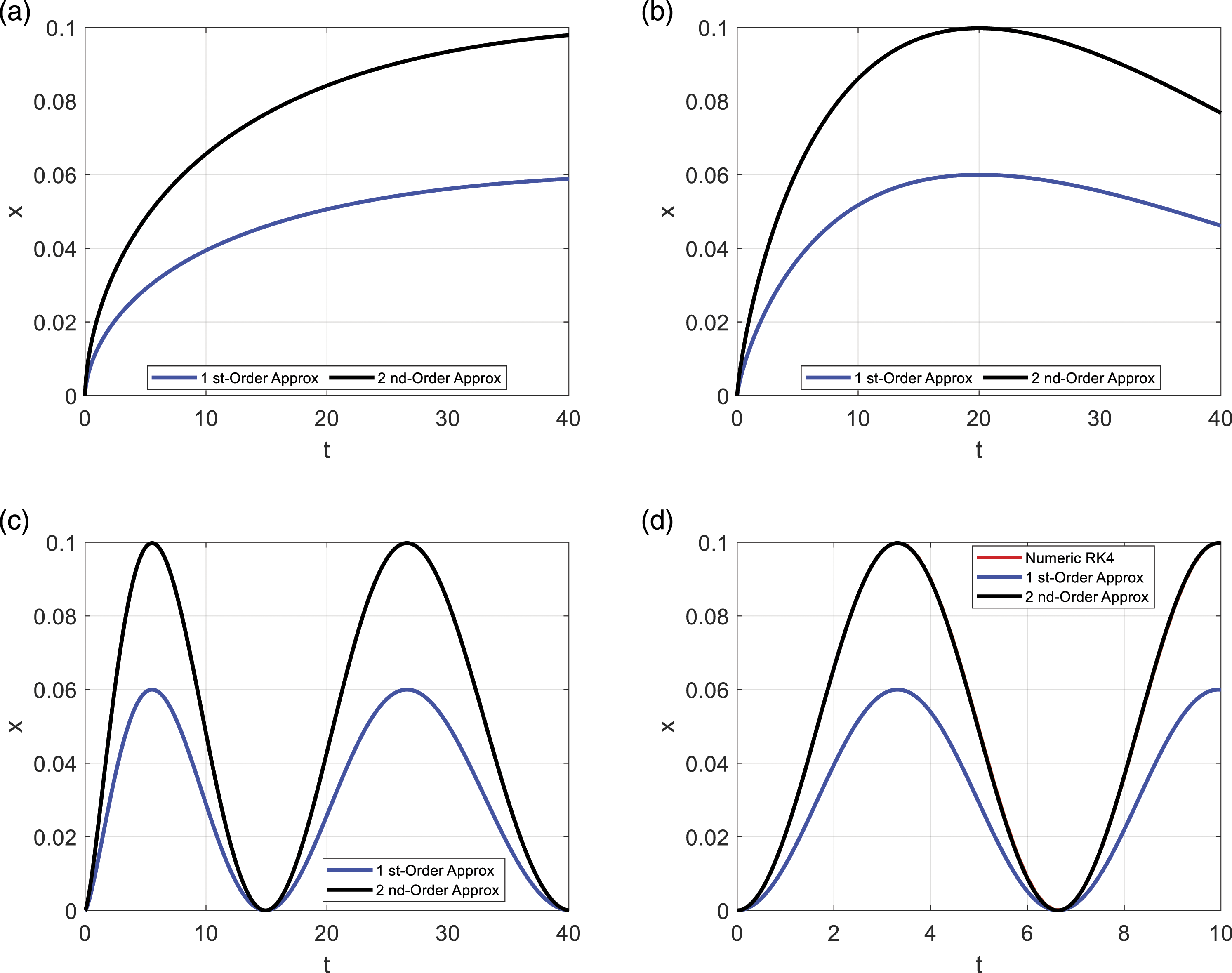
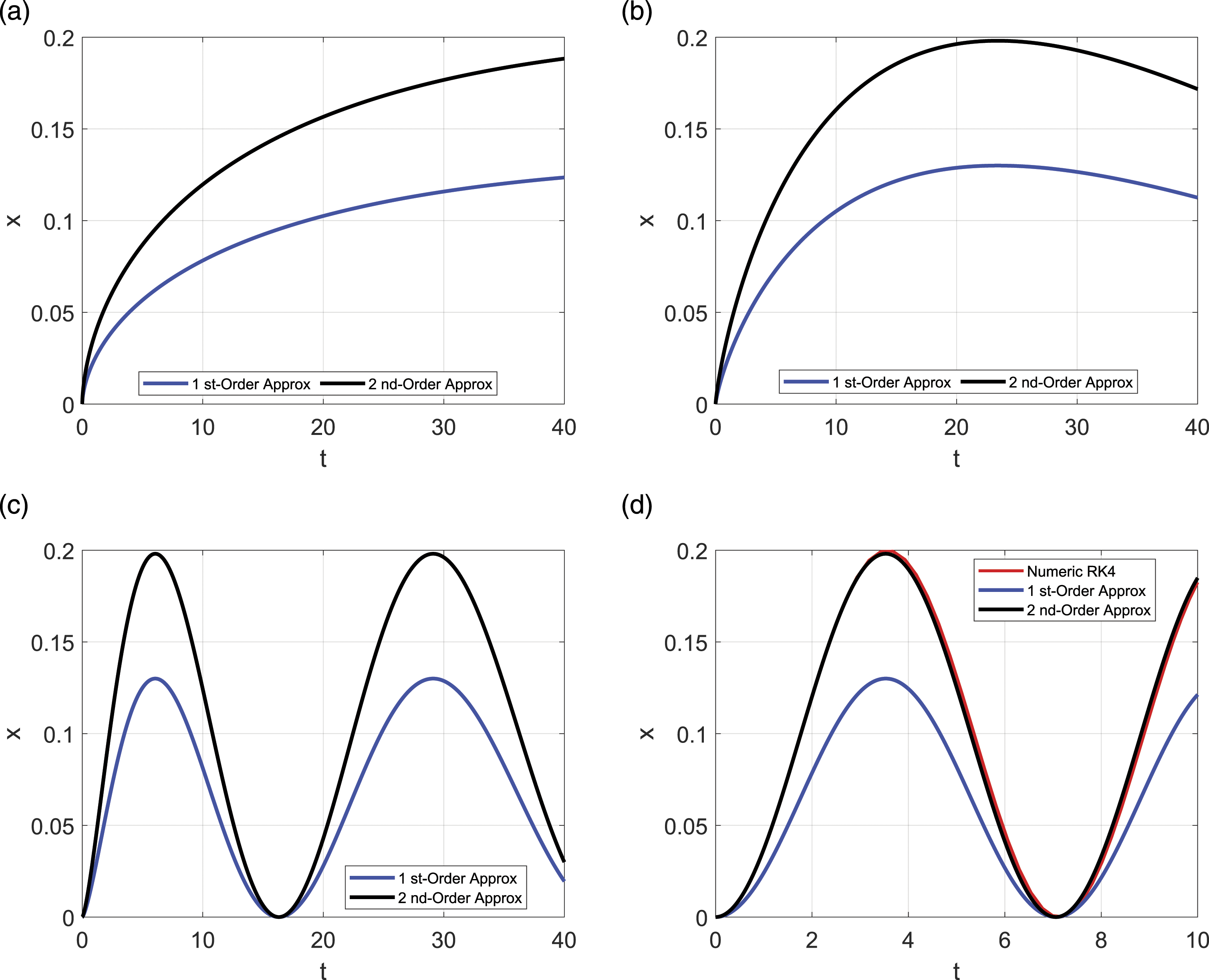
In order to show the completeness of the solution proposed by IPM, the asymptotic solution and the corresponding numerical results are plotted. As shown in Figures 2 and 3, the second-order approximation of
Equation (39) shows the low-frequency property at the initial stage, equation (39) can be written in the following form

For
When

The pull-in instability will occur. So
Concluding remarks
In this paper, the dynamic behavior of the graphene N/MEMS in the fractal space is studied, and a fractal mathematical model considering constitutive stress–strain law and electrostatic force interaction is constructed for the system. In the case of zero initial conditions and magnetostatic excitation, the IPM is used to solve the model. The frequency–amplitude relationship of the graphene N/MEMS is effectively provided. The IPM has much advantages over the variational iteration method 67 and the variational method, 68 and the obtained result can be used for optimization of the N/MEMS system like that in Ref. 69, and the fractal MEMS also shows advantages over fractional differential models.70,71
The influence of vibration amplitude on natural frequency is obtained. Numerical results verify the accuracy of the analytical solutions obtained. Finally, two terms in the series expansion are sufficient to produce an acceptable approximate solution. The amplitude–frequency relationship is very important for a better understanding of the oscillatory behavior of the system. Compared with other methods, the method applied in this paper is very simple and effective and can be extended to other fractal-fractional nonlinear problems.72,73
Footnotes
Declaration of conflicting interests
The author(s) declared no potential conflicts of interest with respect to the research, authorship, and/or publication of this article.
Funding
The author(s) disclosed receipt of the following financial support for the research, authorship, and/or publication of this article: This work is supported by the Natural Science Foundation of Shaanxi Province (No. 2023-JC-QN-0016) and and the Natural Science Foundation of Shaanxi Provincial Department of Education in 2022 (22JK0437).
