




Abstract
This study presents the nonlinear vibration and chaotic response of a beam subjected to harmonic excitation. The multi-level residue harmonic balance method is applied to solve the geometrically cubic nonlinear vibration of the simply supported beam. The obtained results agree well with those of the numerical integration method. The amplitude frequency response curves are presented to illustrate the nonlinear dynamic system response both for a damping and without damping model. Also, the chaotic response is examined for a simply supported beam with a nonlinear dynamic system.
Introduction
Dynamic responses such as vibration behavior are an important part of structural analysis. In recent years, extensive research has been carried out, for example, on geometrically nonlinear beams, 1 nonlinear vibration of a curved beam with quadratic and cubic nonlinearities, 2 large deflection of a simply supported beam due to pure bending moment, 3 nonlinear dynamics of an axially moving viscoelastic beam, 4 nonlinear dynamics of a buckled beam subjected to primary resonance, 5 theoretical study of and experiments on a buckle beam, 6 and nonlinear vibrations and stability of an axially moving Timoshenko beam. 7 Nonlinear vibration and stability of duffing oscillators have been enormously investigated.8–10 Lin et al. 11 studied the nonlinear dynamic of a cantilever beam excited by periodic force. In their study, they considered the combined impacts and nonlinear terms in relation to beam deflection and employed numerical simulations in order to investigate chaotic motions. In the literature, as mentioned above, the nonlinear vibrations of beams are formulated by nonlinear partial differential equation in space and time with the different boundary conditions. The partial differential equations are discretized into ordinary differential equations as a mathematical model containing cubic or quadratic and cubic nonlinearity. Analytical solutions of such kind of nonlinear forced vibrations are highly complicated. Owing to the presence of nonlinearity in the mathematical models formulated from the governing equation, explicit solutions are rarely obtained.
A general computational formulation for geometrically nonlinear structures excited by harmonic forces and executing periodic motion in a steady state was developed by Lewandowski 12 in part 1 and provided the resulting matrix amplitude equation and corresponding tangential matrix in an explicit form. Then, the numerical strategy for solving a resulting set of nonlinear algebraic equations and an example application of general theory for beam vibrations were presented by Lewandowski 13 in part 2. Although the efficiency and accuracy of the predicted method were demonstrated, the multi-level residue and higher-order analytical approximations were not considered in that analysis.
In the past, an extensive study with an approximate analytical method was carried out for solving nonlinear vibration problems, for example, harmonic balance14–16 and incremental harmonic balance method (IHB). 17 The incremental harmonic balance method eliminates all nonlinear terms during the variational process. On the other hand, the total HB method keeps all the nonlinear terms to produce the possible multiple solutions in a set of nonlinear algebraic equations. In this method, the solution of nonlinear differential equation is assumed by Fourier series expansion to produce a set of nonlinear algebraic equations in terms of the Fourier coefficients. Since a set of nonlinear algebraic equations is produced, it is very difficult to use HB and IHB to construct higher-order analytical approximation. 18 They introduced an iterative homotopy HB method by constructing homotopy parameter P, which is considered a small parameter in the HB method. The analytical solutions of algebraic equations are also complicated. Traditional numerical methods are unable to provide all branches of solution of such nonlinear algebraic equation since the solution process is defined as the starting point as an initial guess.
In recent years, He and El-Dib 19 developed a new approach called the homotopy perturbation method (HPM) with the reducing rank method introduced to analyze a nonlinear Klein–Gordon equation with a strong damping parameter. They derived the oscillating solutions individually and finally obtained a frequency–amplitude formulation. In the same year, He and El-Dib 20 developed an accurate frequency–amplitude relationship for describing the properties of the oldest device Fangzhu. He and Sedighi 21 applied the simplest frequency–amplitude formulation to study the Fangzhu device. They showed the effectiveness of HPM for solving a singular Duffing-like oscillator. In order to obtain frequency–amplitude formulation, an extensive study was carried out by Anjum et al. 22 They employed hybridization of the enhanced perturbation method and parameter expansion technology called the Li-He approach. This method is able to provide highly accurate results for nonlinear oscillators. For accurate analysis of nonlinear vibration behavior, Leung et al. 23 developed the multi-parameter homotropy HB method for steady-state multiple solutions. The total and tangential stiffness matrix with respect to Fourier components of polynomial nonlinearity has been provided explicitly. The present study was carried out by adopting the multi-level residue HB method.
The main objective of this study was to perform an analytical solution for determination of the vibration behavior of a harmonically excited simply supported beam. The cubic nonlinear response of a beam to a primary-resonance excitation of its first vibration mode is reported. The multi-level residue HB method of solution process was used to solve the nonlinear dynamic response of a simply supported beam. The obtained results from this method were compared with those of nonlinear dynamic analysis using the direct numerical integration (NI) method; second, a frequency and amplitude relationship was investigated to illustrate the nonlinear dynamic system response both for a damping and without damping model, and finally, chaotic response was also examined.
Description of the problem
The governing equation of motion of nonlinear vibration of the Euler–Bernoulli theory including the effect of mid-plane stretching
24
is as follows

Considering a straight beam on an elastic foundation with length L, the cross-sectional area of the beam A = B × h, the beam width B, the beam thickness h, the properties of the beam including the Young’s modulus of the beam E, the material density ρ = 2700 kgm−3, the damping coefficient of the beam ξ, and foundation modulus K, there will be no axial force acting on the beam; therefore, p = 0, F is the excitation amplitude (F = ρA κg),

The governing equation is discretized by applying the Galerkin procedure assuming that the transverse displacement is expressed in terms of simply supported beam mode shapes

Hence, the residual can be defined by substituting equation (3) into equation (1) as follows


For the single mode approach, equation (5) can be written as

Residue harmonic balance method
Governing equation (6) can be written as



The approximate harmonic balance solution of equation (8) is

Substituting equation (10) into equation (9) and applying the Galerkin procedure, we have the following harmonic balance equations


Carrying out the integration yields the nonlinear algebraic equation




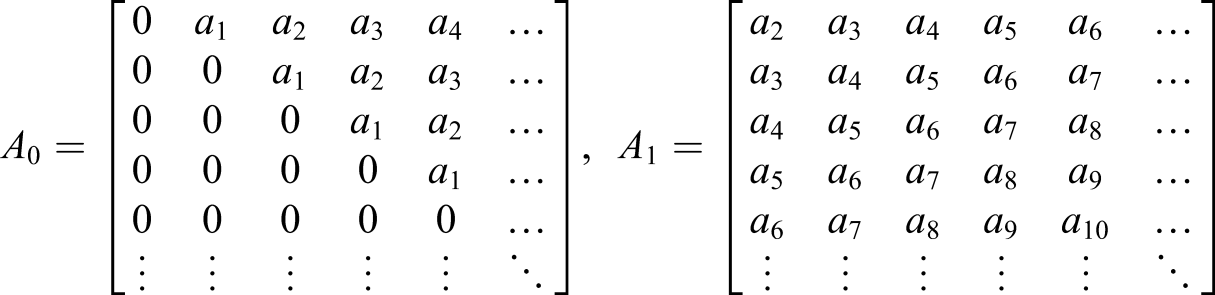
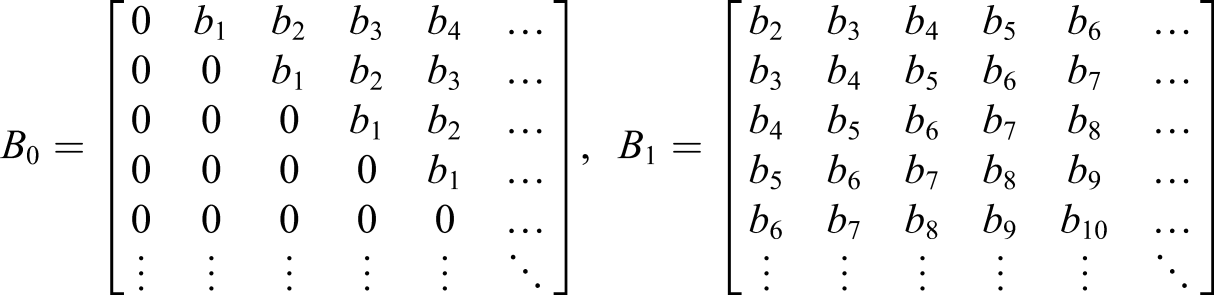
The unknown

Then

Finally, the Jacobian associated with

The tangential stiffness is
Hamiltonian-based frequency–amplitude formulation
We consider a nonlinear oscillator in the form

The variational principle of equation (13) can be written as
26

The total energy remains unchanged during the oscillation


We use the following trial function to determine the angular frequency

Substituting (17) into (16), we obtain the following residual equation

Similarly, we define two average residuals


A modification of the frequency–amplitude formulation is given as follows

Homotopy continuation method
The analytical solutions of the nonlinear algebraic equations are rather difficult to obtain accurate and all kinds of possible solutions. The initial starting values for iteration in the numerical method cannot be defined properly; therefore, this method is unable to provide all solutions. The homotopy continuation method is a global numerical method which is capable of solving nonlinear equations with all solutions and useful for a wide variety of problems. Hence, this method is applied to peak up all solutions of equation (12). We defined a target equation for solution in a linear-product homotopy and homogenization. Homogenization is recommended because path endpoints approaching infinity are very common and the available projective transformation after homogenization keeps both the magnitudes of the coordinates and the arc-lengths of the homotopy paths finite.
27
For the nonlinear algebraic equation (12)


Residue
Substituting the obtained harmonic solutions (8) into governing equation (7), the residue vector



Note that the residue vector
Assume that the accurate harmonic solutions of equation (9) are in the form

Zero level solution
Substituting equation (25) into equation (9) and equating the coefficients of

Then, after separating the summation into two parts

The zero solution
First-level solution
Substituting equations (25) and (26) into equation (9) and equating the coefficients of

Then, after separating the summation into two parts

Based on harmonic balance, we eliminate the terms


There are

Note that the zero-level
Second-level solution
Substituting equations (25) and (27) into equation (9) and equating the coefficients of the

Then, after separating the summation into two parts

Based on the harmonic balance procedure, we eliminate the terms


There are

Modified homotopy perturbation method
Homotopy perturbation method is an impotent method for solving nonlinear vibration problems. Several authors modified this method to improve the accuracy of the method. Li and He proposed a modified homotopy perturbation technique called Li-He method combining homotopy perturbation and enhanced perturbation methods. In this section, a modified homotopy perturbation method (Li-He method) to solve the nonlinear forced vibration problem is presented as follows 20 .
Consider the equation

Operating on equation (30) by

Equation (34) can be written as follows

Substituting

The solution of equation (36) is chosen as

Substituting equation (37) into equation (36) and equating the identical power of ………………………………………………………………………………………………….


The solution of equation (38) is as follows

Substituting equation (40) into equation (39) and eliminating secular terms, we obtain


Solving equations (41) and (42), the values of
Results and discussion
The comparison of displacement amplitude between zero- and second-level solutions both for damping and without damping of the cubic nonlinear beam is shown in Figure 1. This figure shows that zero-level and second-level solutions are much closer to each other. A little difference of displacement amplitude corresponding to normalized frequency of 1.5 is about 0.55% and the maximum difference is about 1.2% corresponding to normalized frequency of 2.053. Comparison of displacement amplitude between zero- and second-level (a) without damping (b) with damping of the nonlinear cubic beam.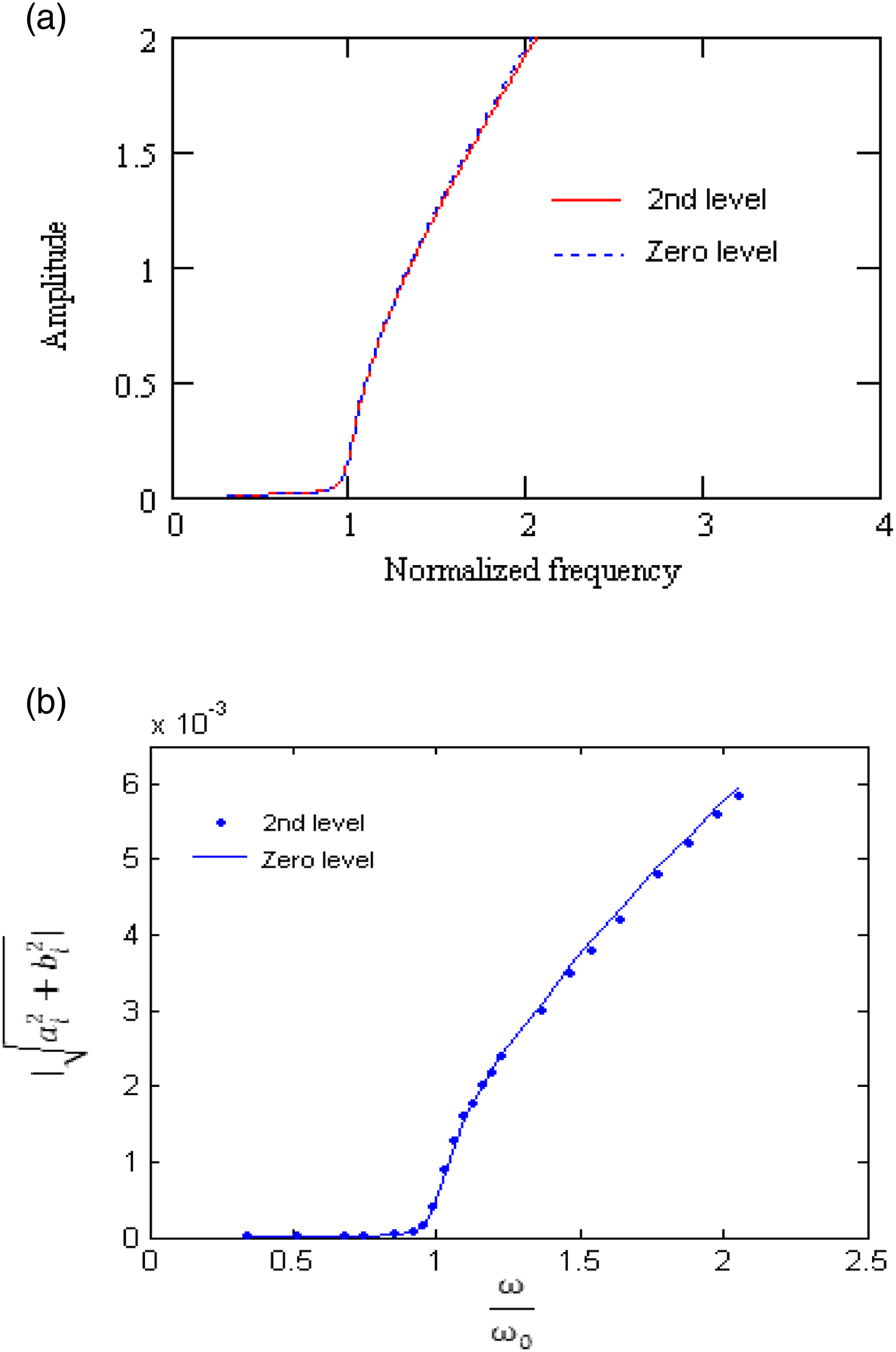
On the other hand, Figure 2(b) represents a difference of displacement amplitude occurring at normalized frequency (a) Comparison of time history and (b) deformation shape plot of the existing stable responses when the normalized frequency = 0.684. Zero- and second-level solutions when 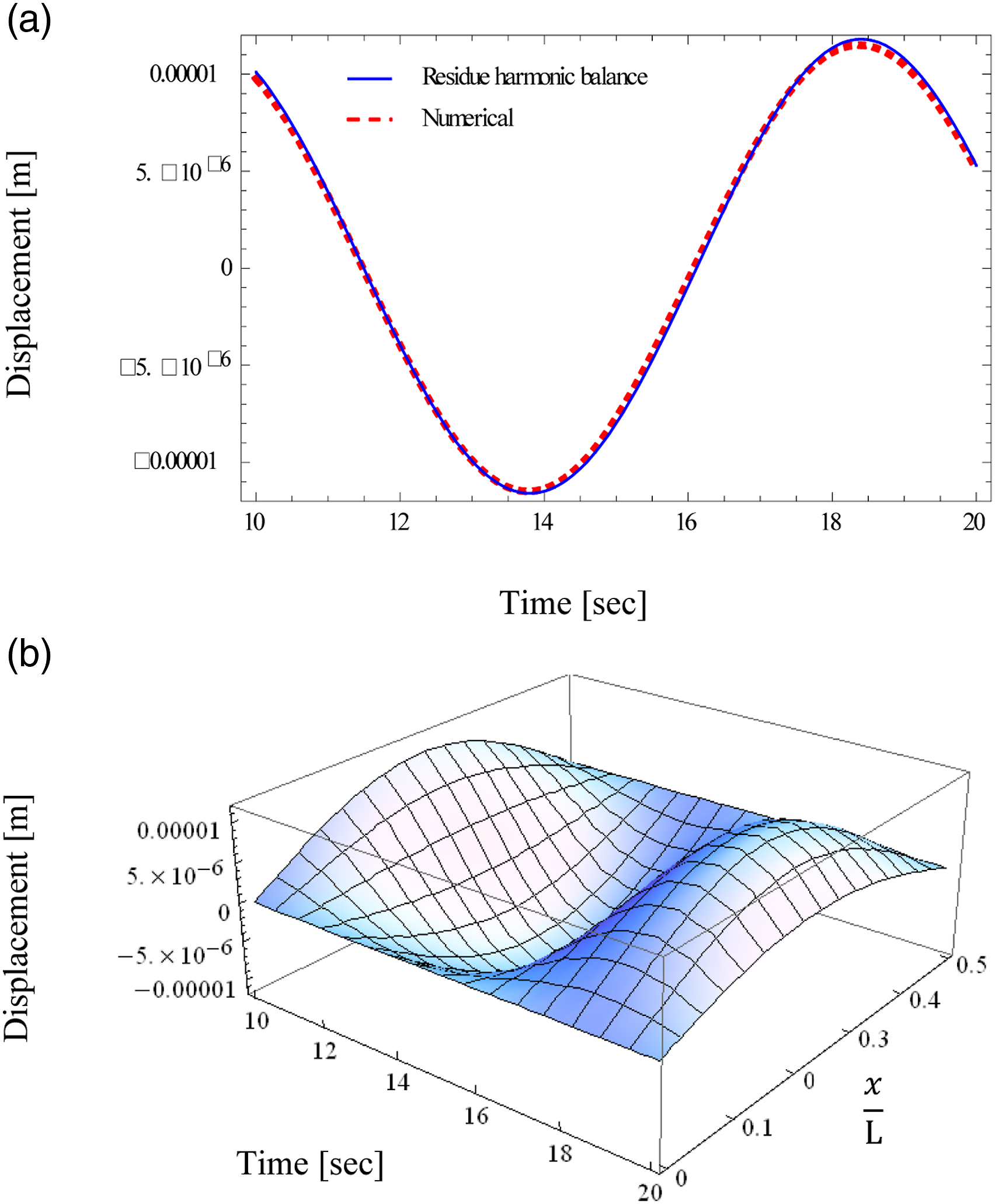
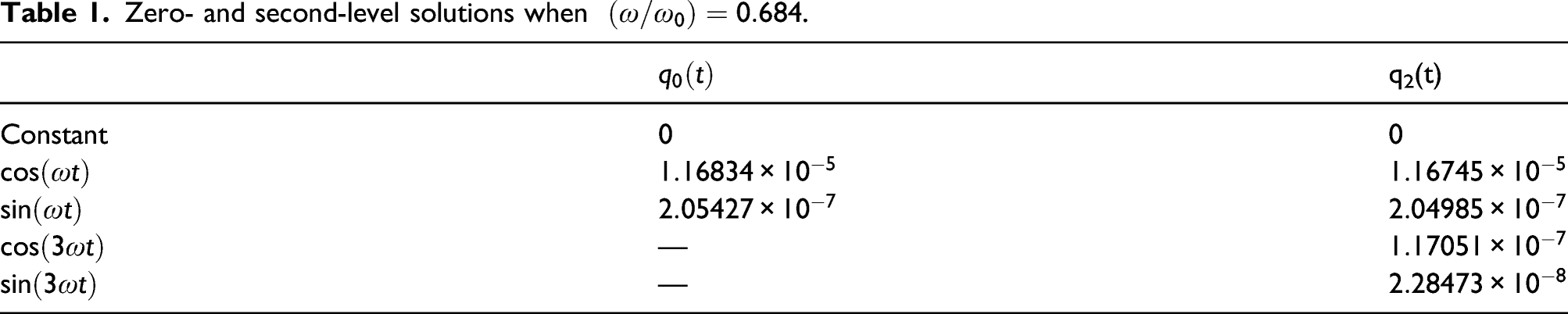
Comparison of results
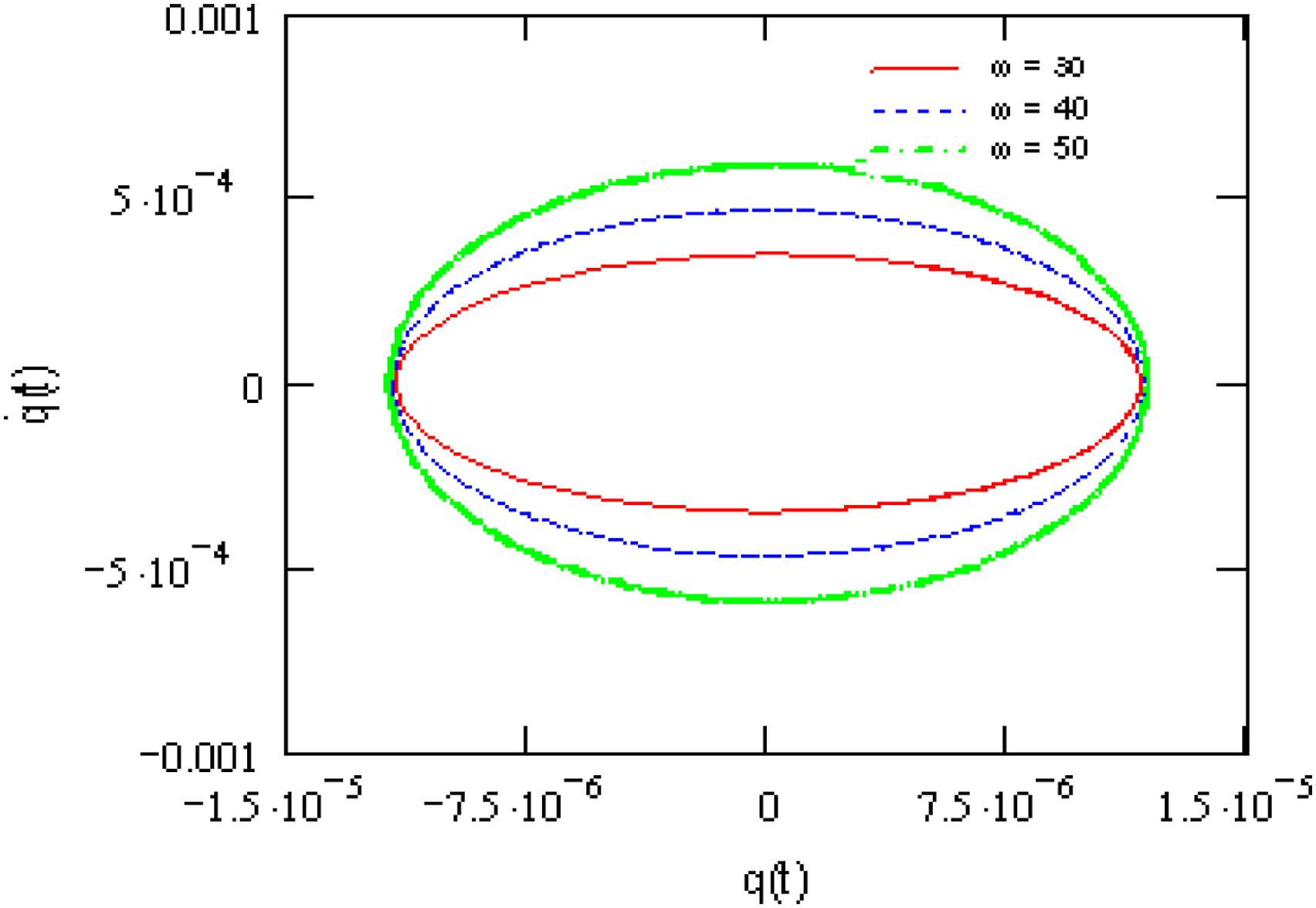
The results obtained from the RHB method are (a) Poincare map of the existing stable responses when ω = 0.684 and (b) comparison of phase trajectories. Phase trajectories varying with different frequencies.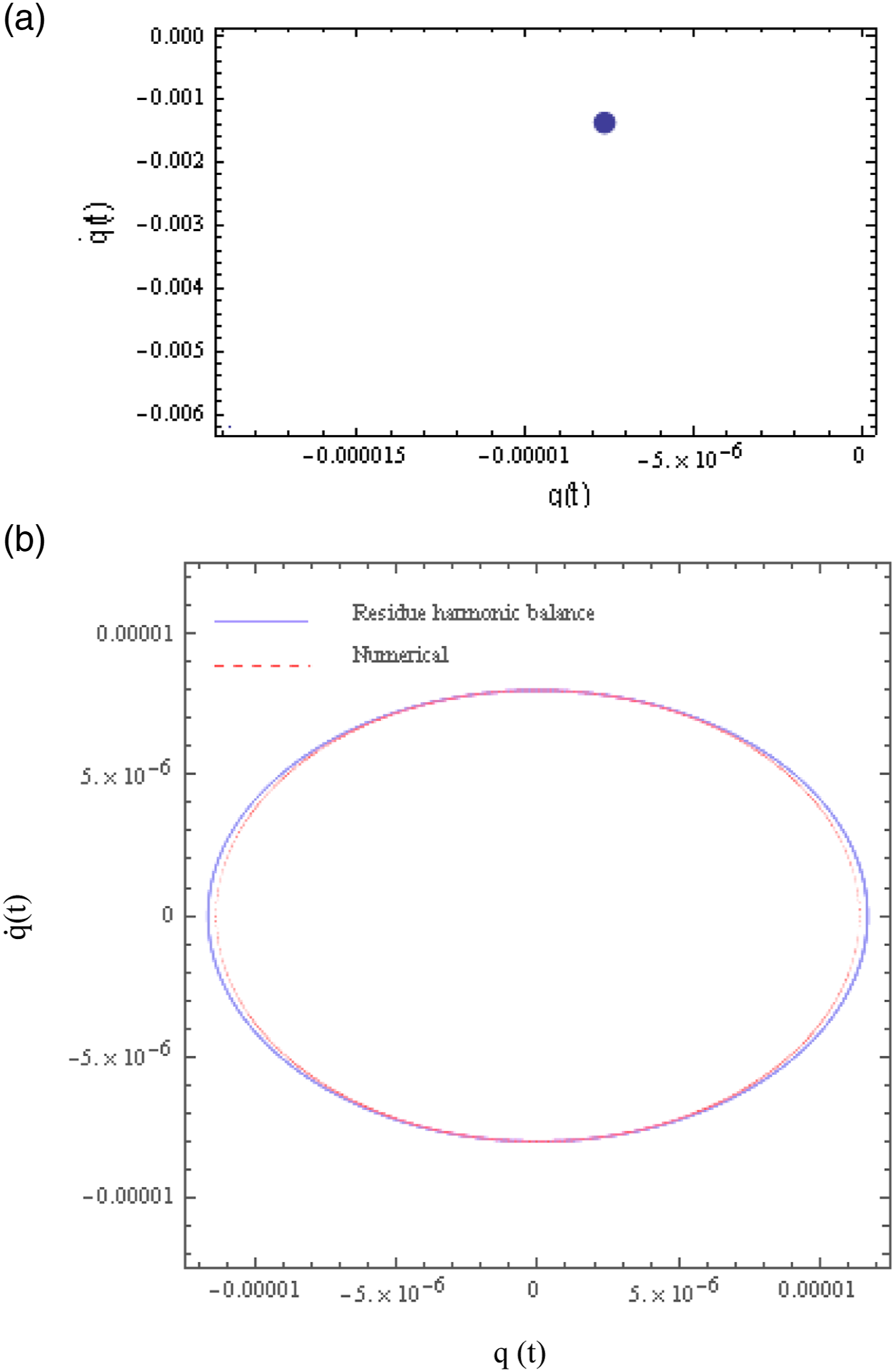
Backbone curves
In Figure 5, a representative amplitude response curve is shown to illustrate the jump phenomenon. The backbone curve is plotted considering no damping. There is exactly one solution branch for Backbone curve of the beam equation (12) without damping.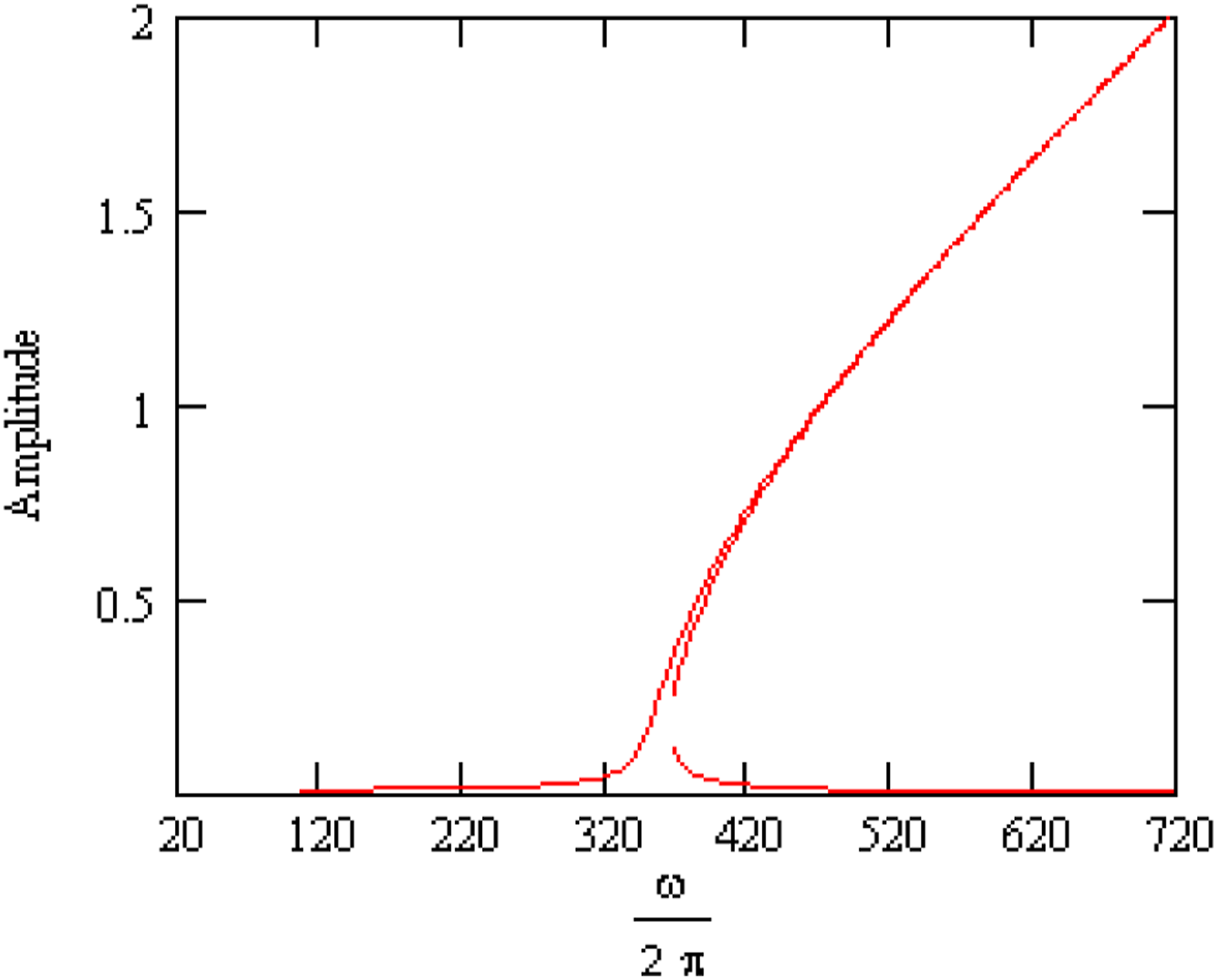
In Figure 6, a comparison between amplitude–frequency response curves is shown to illustrate considering the damping model when the base excitation Comparison between the amplitude versus frequency response curve obtained by the proposed method, harmonic balance method, and He’s homotopy perturbation method.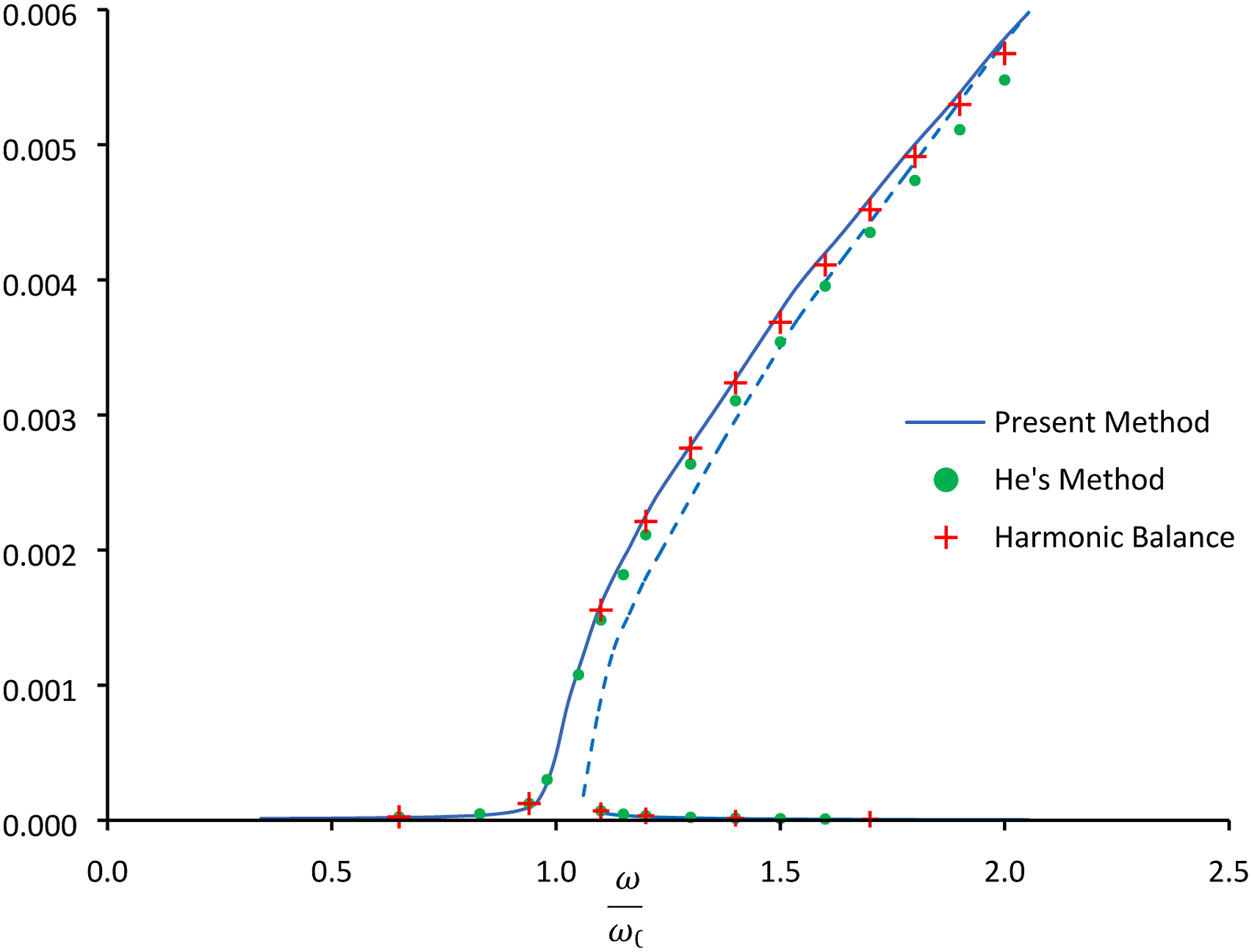
If the driving frequency is slowly decreased from the normalized frequency of 2.053, the displacement amplitude of the steady-state forced response increases. At
Chaotic response
It was found that the transition occurs when the normalized frequencies are 1.095 and 2.053. The chaotic responses are summarized in Figure 7, through the time histories, phase trajectories, and the Poincare map. (a) Time history, (b) phase trajectories, and (c) Poincare map of irregular attractor of equation (12) when the normalized frequency = 2.053.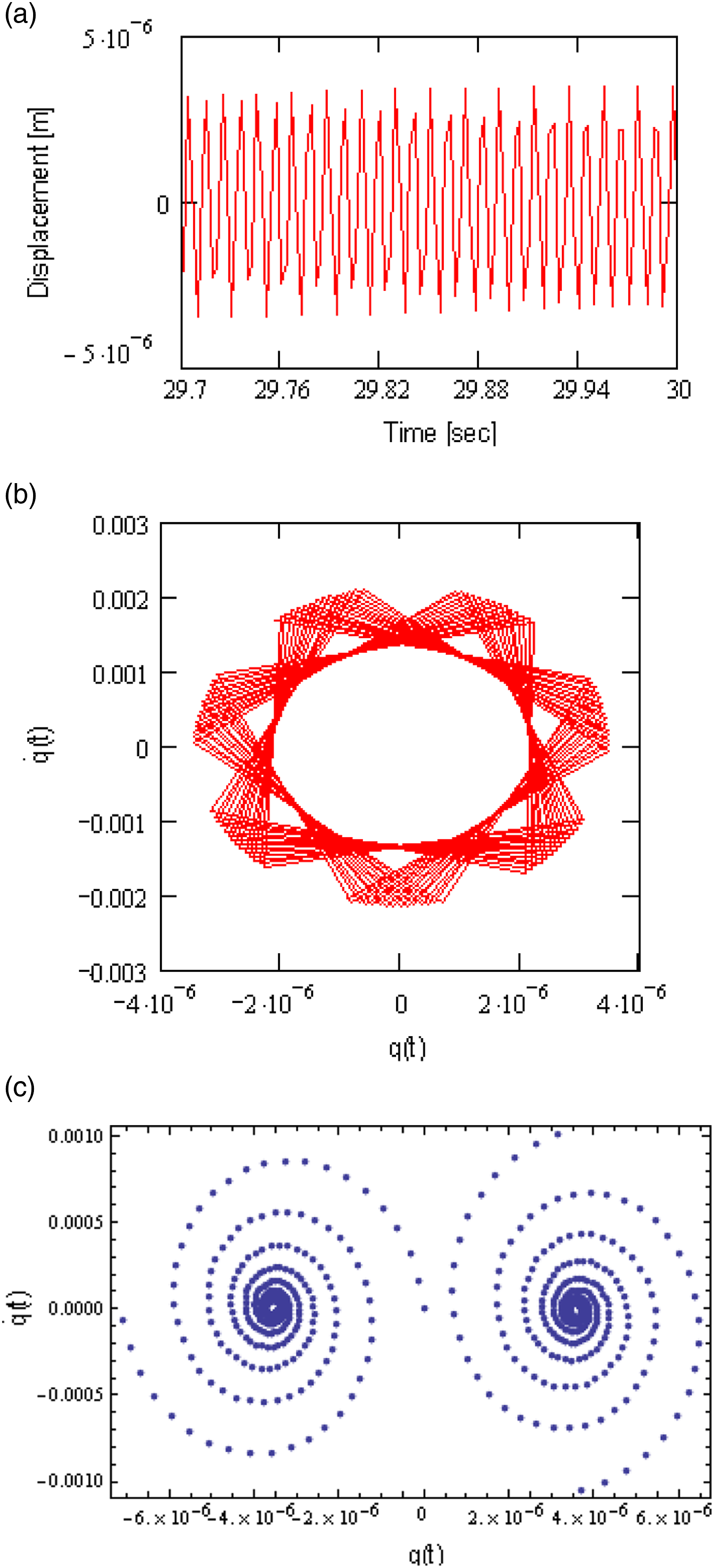
Conclusion
In this study, the RHB method was applied to examine nonlinear vibration of a straight Euler–Bernoulli’s beam with cubic nonlinearities subjected to harmonic excitation. The Galerkin method was employed to discretize the governing partial differential equation to a single-mode nonlinear ordinary differential equation with mid-plane stretching effect. This method can be employed for the analysis of multi-modes vibration of beam and plate. Also, this method has enabled to solve nonlinear couple equations, and hence it can be used for sub-harmonic analysis of beam and plate. From this study it can be concluded that: (i) no period doubling was observed, (ii) the comparison shows good agreement between the present results and the numerical results along with the time histories, phase trajectories, and backbone curves, (iii) the quasi-periodic response was observed in the present study, and the small magnitude of external harmonic excitation is the main reason for a quasi-periodic response, and (iv) chaotic responses through time histories, phase trajectories, and Poincare sections were investigated numerically. The backbone curves prove that the chaotic region started after the primary resonance at the normalized frequency of 1.095.
Footnotes
Declaration of conflicting interests
The author(s) declared no potential conflicts of interest with respect to the research, authorship, and/or publication of this article.
Funding
The author(s) received no financial support for the research, authorship, and/or publication of this article.
