




Abstract
A fast estimation of periodic properties of a nonlinear oscillator is much needed as pointed out by Tian and Liu in their review article (Tian D and Liu Z, Journal of Low Frequency Noise, Vibration & Active Control, https://doi.org/10.1177/1461348418756013). Although a relatively high accuracy can be achieved, there is no way to continue the solution process to obtain any accuracy of a solution. This paper suggests an effective modification so that any accurate frequency can be obtained.
Introduction
Recently Tian and Liu gave a complete review on frequency–amplitude formulae for nonlinear oscillators,
1
which give a very fast estimation of the periodic property with relative accuracy; this review article gave an immediate response in academic community. Ren gave an extension by replacing
He’s frequency–amplitude formulation
Consider a general nonlinear oscillator


He’s frequency–amplitude formulation
17
is to choose two arbitrary solutions in the forms




There are other modifications of He’s frequency–amplitude formulation as summarized by Tian and Liu,
1
and the last modification was given by Ren,
2
which is

This modification did not improve the accuracy, and the calculation becomes complex.
A modification
The shortcoming of He’s frequency–amplitude formulation is that the solution process cannot be continued if a higher accurate solution is needed. To overcome this shortcoming, we can choose the following two trial solutions like that in the homotopy perturbation method
10


We use the Duffing equation as an example

The residuals for two trial solutions are, respectively, as



For simplicity we set t = 0 in equations (11) and (12)


By He’s frequency–amplitude formulation, we have
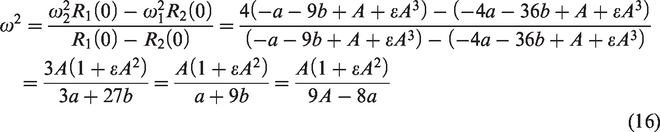
In case when b = 0, we have the same result as that by equation (5). In equation (16) we have a free parameter to improve the accuracy of the frequency.
The approximate solution is

In order to obtain a closed solution, we need an additional equation to determine a, b and

We set



Solving equations (13), (16) and (21) simultaneously, a closed solution can be obtained. It is obvious that
Discussion and conclusions
Hereby we show that the modification of He’s frequency–amplitude formulation can lead to any accuracy of the frequency of a nonlinear oscillator, and the present modification is also valid for other modifications of He’s frequency–amplitude formulation summarized in Tian and Liu.
1
A general trial solution can be written as

According to the initial conditions, we have

We need additional M-2 equations to have a closed solution, we set

Solving equations (16), (23) and (24) simultaneously, we can obtain a closed solution.
He’s frequency–amplitude formulation was widely used to a fast insight into the periodic property of a nonlinear oscillator, so it has been attracting much attention in engineering. Now this simple formulation is modified to solve a nonlinear oscillator for any accuracy, making it much attractive for both mathematics and engineering applications.
Footnotes
Declaration of conflicting interests
The author(s) declared no potential conflicts of interest with respect to the research, authorship, and/or publication of this article.
Funding
The author(s) received no financial support for the research, authorship, and/or publication of this article.