




Abstract
Many nonlinear vibrations arising in the engineering of architecture include noise and uncertain properties, and this paper suggests a fractional model to elucidate the properties. The fractional sine-Gordon equation with the Riemann–Liouville fractional derivative is used as an example to solve its periodic solution by the homotopy perturbation method. The frequency–amplitude relationship is obtained, and the effect of the fractional derivative order on the vibration property is discussed. Additionally, the harmonic resonance is also discussed. This preliminary research can be further extended to real applications.
Keywords
Introduction
The sine-Gordon equation is a traditional wave equation with a sine function term. This equation and its modifications are widely applied in physics and engineering. It used to describe the spread of crystal defects, the propagation of waves, the extension of biological membranes, relativistic field theory,1–3 it can reduce to the Klein–Gordon equation4,5 in some special cases. Many researchers focused on the solitary wave solutions of the sine-Gordon equation; here for the first time, we will point out its periodic solution. An effective mathematical approach to noise and uncertain properties of nonlinear vibrations arising in the engineering of architecture can be modeled by the fractional calculus.
In this paper, we consider the following time-fractional sine-Gordon equation

The fractional term in equation (1) can describe the noise and uncertain properties of many practical problems and can model a nonlinear beam vibration, a bridge vibration, and other vibration systems arising in architectural engineering. Ji et al. 9 found many attractive properties for nonlinear transverse vibration of a nanofiber reinforced concrete pillar, which cannot be revealed by any traditional differential models. He 10 demonstrated that a nonlinear wave equation might have some periodic properties and a nonlinear vibration equation might have solitary properties.
Fractional calculus performs a popularization of standard differentiation and integration in arbitrary order. It has been proved already that discontinuous problems can be effectively modeled by fractional calculus and fractal calculus.9–25 Ahmadinia and Safari 26 applied the local discontinuous Galerkin method to study the time–space fractional sine-Gordon equation; however, analytical approaches to equation (1) are rare and this paper will apply the homotopy perturbation method27–37 to solve equation (1). Anjum and Ain 38 applied the He’s fractional derivative for the time-fractional Camassa–Holm equation by employing the fractional complex transform to convert the time-fractional Camassa–Holm differential equation into its partial differential equation and then use HPM to find a fairly accurate solution.
The fractional derivative
It requires indicating the definition of the fractional derivative that is used here. There are diverse definitions of a fractional derivative of an order
One of the greatest frequently utilized tools in the fractional calculus is prepared by the Riemann–Liouville operators.6–8 In this work, we use the Riemann–Liouville fractional derivative to solve any periodic function that could strongly pose the physical interpretation of the initial conditions wanted for the initial value problems involving fractional differential equations. Moreover, this operator has the advantages of quick convergence, better stability, and best accuracy.
The Riemann–Liouville time-fractional derivative of the function f of order

The Riemann–Liouville operators for

Consequently, by applying the above definition, the following fractional derivatives of trigonometric functions are6–8




An analytical approach of the fractional sine-Gordon equation
To obtain an analytical periodic solution of equation (1), we integrate equation (1) by applying the fractional integration operator

By the bits of help of equation (1) and its spatial derivative, we can remove the functions

We convert equation (9) to be an equation without any harmonic functions; the frequency

This is an alternative form of the fractional sine-Gordon equation and its solution is available by the homotopy perturbation method through the Riemann–Liouville definition. To construct the corresponding modified homotopy equation, we introduce two expanding parameters
39

At this end, the perturbation technique is required to obtain an approximate solution. Therefore, we expand the solution

To solve the homotopy equation (11) by the technology of the parameter expansion,
40
we let



Substituting equation (10) into equation (15), applying the rules of the fractional derivatives of the trigonometric functions as defined in equations (4) to (7), we find after some simplification
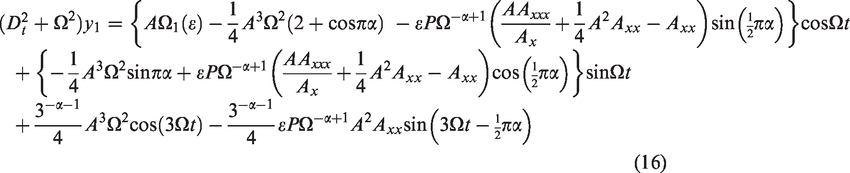
The solution


Bearing in mind the above conditions, we obtain the following uniform solution
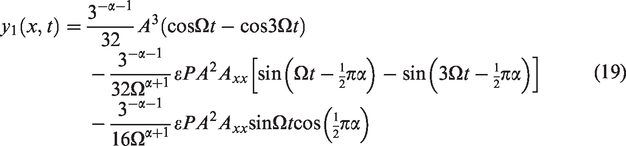
If the one iteration operation is required, one can substitute equations (14) and (19) into the expansion (12) making
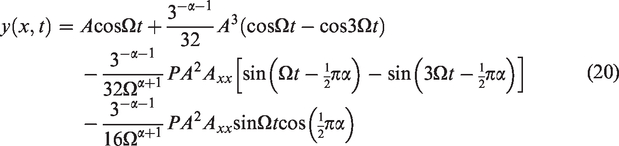
The frequency–amplitude equation can be constructed from the bits of help of the above two solvability conditions (17) and (18). It is achieved by the combined these solvability conditions, in one equation, through the dividing operation for equation (17) by equation (18), yields

In one iteration process, one inserts equation (21) into the expansion (13) and setting

This is the frequency–amplitude equation having the fractional power. To obtain an approximate solution for it, one can expand the parameter

Inserting the expansion (23) into the frequency equation (22), equating like the power of


Employing equations (24) and (25) into equation (23) and letting

It is seen that the bounded solution is obtained only when
In the limiting case as

Also, the frequency is given by

Harmonic force of the fractional sine-Gordon equation
Consider the following time-forced sine-Gordon equation with the fractional order


To carry on finding the solution to this equation, two cases will occupy the analysis, the non-resonance case and the harmonic resonance case.
The non-resonance case of the forced frequency
is away from the natural frequency
To inspect this case, we proceed using the technology of the expanded frequency as mentioned in the above section. Consequently, we employ the two expansions (12) and (13) into equation (30). Equating the identical powers of

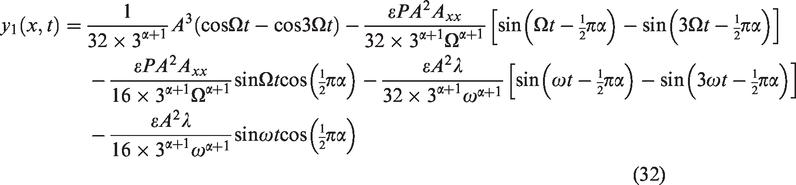
The final first-order solution can be formulated as

The solution at the harmonic resonance case where
is approached
In this case, we assume that the nearness of

Employing equation (34) in the homotopy equation (30), the outcome is

Consequently, we insert the expansion (12) into equation (35). Equating the identical powers of


Replacing

Avoiding the secular terms in equation (38) requires the following conditions


Pick in mind the above conditions, equation (38) has the following solution

By the dividing operation, the above solvability conditions (39) and (40) can be combined in one condition having the configuration

Employing equation (42) in the definition (34), we obtain the frequency–amplitude equation in the form
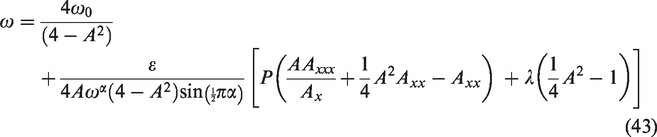
This is a complicated equation having a fraction power in the frequency parameter

Including equation (44) in equation (43) and equating the identical powers of


In one iteration operation, we insert equations (45) and (46) in equation (44) picking in mind

It is noted that the frequency at the harmonic resonance case of the ordinary forced sine-Gordon equation can be found as

Discussion and conclusion
This paper shows that equation (1) admits a periodic solution when the amplitude meets the condition
Because the sine-Gordon equation has been used to model several phenomena in mathematical physics and due to the wide applications of fractional derivatives in applied sciences, we succeed in finding approximate periodic solutions for equation (1) for the first time. The harmonic resonance also discussed as given in equation (47), the resonance is the generalized form of traditional forced nonlinear vibration problems.
This paper is a preliminary study and the results are extremely helpful for architectural design. As the frequency–amplitude relationship is different from traditional nonlinear vibration problems, 42 this paper sheds new light on fractional vibration systems. The current work suggests an effective modification of the well-known homotopy perturbation method for solving fractional differential equations, and some new findings were obtained. It can be concluded that this article gives an absolute new avenue of research in various fields such as mathematics, vibration theory, and architectural engineering. This paper will open up a flood of opportunities for further research.
Footnotes
Declaration of conflicting interests
The author(s) declared no potential conflicts of interest with respect to the research, authorship, and/or publication of this article.
Funding
The author(s) received no financial support for the research, authorship, and/or publication of this article.
