



Abstract
Recently Zhong-Fu Ren and Gui-Fang Hu suggested a modification of He’s frequency–amplitude formulation for nonlinear oscillators. This paper shows that this modification results in a lower accuracy than that by the original one. The temperature oscillation in a polar bear hair is used as an example to illustrate the effectiveness of He’s frequency–amplitude formulation.
Introduction
Recently He’s frequency–amplitude formulation1–7 has been caught much attention due its extremely simple calculation with high accuracy for the whole solution domain for nonlinear oscillators, it is the simplest method among all analytical methods for nonlinear oscillators, for example, the homotopy perturbation method8,9 and the variational iteration.10–12 It is also very effective for oscillators with fractal derivatives13–18 which arise in oscillations in discontinuous media, e.g. a nanofiber membrane.19–21 Tian and Liu gave a complete review on various period/frequency estimation of a nonlinear oscillator, showing that He’s frequency–amplitude formulation is the simplest method. 22 Ren and Hu 23 suggested a modification of He’s frequency–amplitude formulation; however, their modification cannot lead to a higher accuracy than that by the original one.
He’s frequency–amplitude formulation and Ren–Hu modification
Consider a nonlinear oscillator in the form
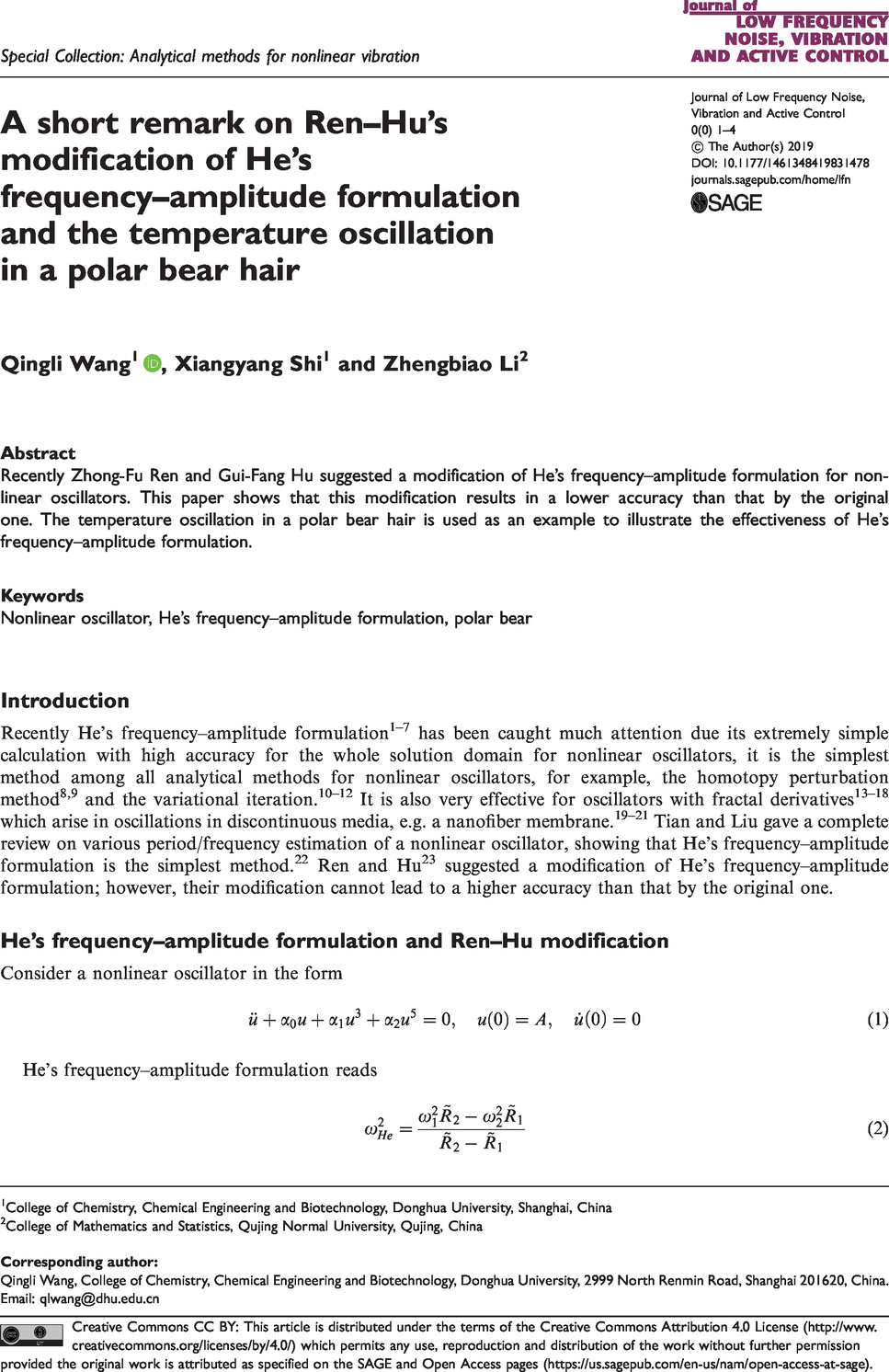
He’s frequency–amplitude formulation reads


While the Ren-Hu’s modification results in
23

Ren and Hu showed that equation (4) gives a good accuracy when
Case 1:
The numerical method by the variational iteration method gives the following result
24

While He’s formulation and Ren–Hu’s modification give, respectively


Case 2
The numerical method by the variational iteration method gives the following result
24

While He’s formulation and Ren–Hu’s modification give, respectively


Both cases show that He’s formula give a higher accuracy than that by Ren–Hu’s modification.
Case 3
The exact frequency is

He’s formulation and Ren-Hu’s modification predict, respectively


The relative errors are, respectively, 2.18% and 3.60%, showing He’s formulation gives a higher accuracy.
Temperature oscillation in a hollow hair of polar bear
Temperature along a polar bear changes periodically.
15
The heat conduction equation can be written in the form



Equation (16) becomes

By He’s frequency formulation, we have

Conclusion
This paper shows that He’s frequency–amplitude formulation gives much better estimation of the frequency–amplitude relationship for a nonlinear oscillator than Ren–Hu’s modification.
Footnotes
Declaration of conflicting interests
The author(s) declared no potential conflicts of interest with respect to the research, authorship, and/or publication of this article.
Funding
The author(s) disclosed receipt of the following financial support for the research, authorship, and/or publication of this article: This work is supported by National Natural Science Foundation of China under grant no. 51463021.