In this work, the Duffing’s type analytical frequency–amplitude relationship for nonlinear oscillators is derived by using Hés formulation and Jacobi elliptic functions. Comparison of the numerical results obtained from the derived analytical expression using Jacobi elliptic functions with respect to the exact ones is performed by considering weak and strong Duffing’s nonlinear oscillators.
Many dynamic systems that arise in physics and engineering applications are known to be modeled by a homogeneous nonlinear differential equation whose closed-form solution is unknown, Then, numerical or approximate methods have to be used to predict its dynamic response behavior and determine the frequency–amplitude relationship needed to understand its qualitative and quantitative dynamic response.1–18 However, in a few cases, the closed-form solution of some nonlinear oscillators is known. In fact, the cubic, the quadratic–cubic, and the cubic–quintic Duffing-type oscillators are those whose analytical closed form solutions are described exactly in terms of Jacobi elliptic functions.19–22 It is also known that when the rational or irrational functions describe the restoring forces of nonlinear oscillators, the original nonlinear differential equations can be written in an equivalent form using methods that transform the original equations into Duffing-type oscillators and thus, the approximate frequency–amplitude relationship can be determined by the analytical closed-form solutions of the corresponding Duffing-type oscillator.
However, to find a simple and accurate frequency–amplitude expression, Professor He has used an ancient Chinese mathematical algorithm in which the frequency–amplitude of various nonlinear oscillators was found.23–25
Therefore, the article aims to enhance the accuracy of He’s formulation using trial residuals based on Jacobi elliptic functions, which are a more general class of periodic functions that include the trigonometric functions as a particular case. To demonstrate the accuracy achieved by using Jacobi functions to find the approximate frequency–amplitude expression by He’s algorithm, two cases are examined. The first case focuses on determining the approximate frequency of the Fangzhu singular equation of motion, while the second case focuses on obtaining the frequency–amplitude equation for Duffing-type oscillators considering even and odd nonlinearities.
Preliminaries: He’s frequency–amplitude approach
In this section, we provide a brief summary of He’s formulation to derive frequency–amplitude expressions of nonlinear oscillators of the form
where ω and ω are location points, are arbitrary chosen frequencies with , and are trial residual functions defined as , where
and , . are assumed to be time-dependent and therefore, their average values can be computed from the following expression
where is the motion period, and is a weighted function that can take any simple form.
We shall next modify He’s approach by introducing Jacobi elliptic functions instead of trigonometric ones.
Frequency–amplitude formulation based on elliptic functions
It is well known that most of the nonlinear oscillators can be expressed in the form
where is the initial amplitude of oscillation and are the conservative system restoring forces. If the following transformation is introduced, then equation (6) can be written as
Based on the ancient Chinese method, two trial functions are needed to find the approximate solution of equation (7) that are assumed to be , and that satisfy the following Duffing differential equations
where , , and are trial amplitudes, frequencies, and modulus of the Jacobi elliptic functions and that need to be found. Thus, the residuals to find the approximate solution of equation (7) are
Since the restoring forces of nonlinear oscillators can be expressed in equivalent form as polynomial expressions of the form
where the identities and have been used.26 Here represents the Jacobi amplitude given by the expression
where is a Jacobi elliptic function.
From He’s formulation, the residual equations (12) and (13) are found using the following relations
that yield after integration the expressions of
Recalling that and are periodic Jacobi elliptic functions with period , where are the complete elliptic integral of the first kind with modulus then equation (16) reduces to
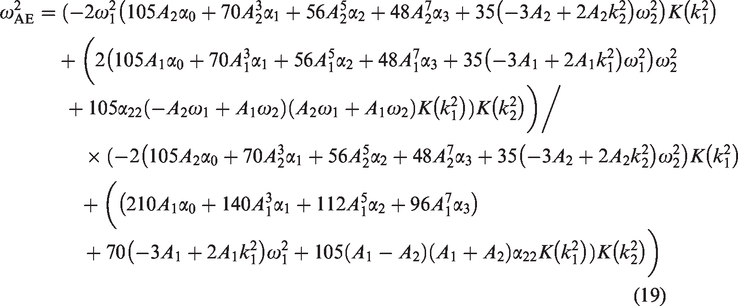
Thus from equation (2), the approximate frequency–amplitude relationship of nonlinear oscillators modeled by an equation of the form
is given as
In the next section, we shall next evaluate the accuracy of using Jacobi elliptic functions by examining the approximate frequency–amplitude solution of the Fangzhu singular oscillator, and the accuracy of equation (19) in providing the frequency–amplitude value of nonlinear Duffing-type oscillators considering weak and strong nonlinearities.
Results
The accuracy of the proposed approach is evaluated by examining two cases.
Case (a): The Fangzhu singular oscillator
First, the frequency–amplitude of the Fangzhu singular oscillator is determined. This singular oscillator arises during the mathematical modeling of the Fangzhu water harvester device considering the influence of its nanoscale surface morphology.27 Its equation of motion is given as
where is the distance of the attracted molecule from its equilibrium position, is a positive fractional or integer number, is a driving force, and represents a positive number related to the water harvester device surface morphology.27–29 Introducing the transformation equation (20) becomes
Since we are interested in determining the frequency–amplitude relation of equation (21), it is assumed that . Thus, equation (21) becomes
Notice that equation (22) does not have critical points. Furthermore, equation (22) has exact solution when and and a pseudo-period of the weak periodic solution given by .30,31 However, the closed-form solution of equation (22) is unknown. Therefore, in order to determine the approximate frequency–amplitude expression of the weak periodic solution of the Fangzhu equation, it is assumed that , . Thus, from equation (22) the following trial residuals are obtained
If the Jacobi elliptic identities and are applied then, equation (24) becomes
The trial residual functions are computed using equation (15). This yields, after considering the limits of integration and , and the fact that the period of the Jacobi elliptic functions and is , the expression
Using equation (2) gives the approximate frequency–amplitude relation
where .23–25Equation (27) illustrates that the frequency varies inversely with the oscillatory amplitude. This qualitative behavior of as a function of the oscillation amplitude agrees with the results obtained by He et al.29 Furthermore, when and , equation (27) provides the frequency value of 1.2533 if , , , and , where . This result agrees with the frequency value obtained from the exact solution derived by Gadella and Lara, García and Gasull.30,31 If now and with , using equation (27) gives while the exact numerical frequency value of equation (22) is . This implies a relative error value of 0.188%. For values of and with , the relative error does not exceed the value of 5.8%, which corroborates the accuracy of our proposed approach.
On the other hand, it is important to point out that our solution procedure can be extended to study the fractal form of equation (22) given as
where is a fractal parameter. Using the two-scale transform method , equation (28) becomes13
The second case focuses on determining the frequency–amplitude relationship for Duffing-type cubic, cubic–quintic, cubic–quintic–heptic oscillators, and for the quadratic Duffing–Helmhotz oscillator, since these arise in many physical and engineering systems and their closed-form solutions are known.1,2 Furthermore, these Duffing-type oscillators can be used to transform nonlinear oscillators that have rational or irrational restoring forces into polynomial ones.32–40
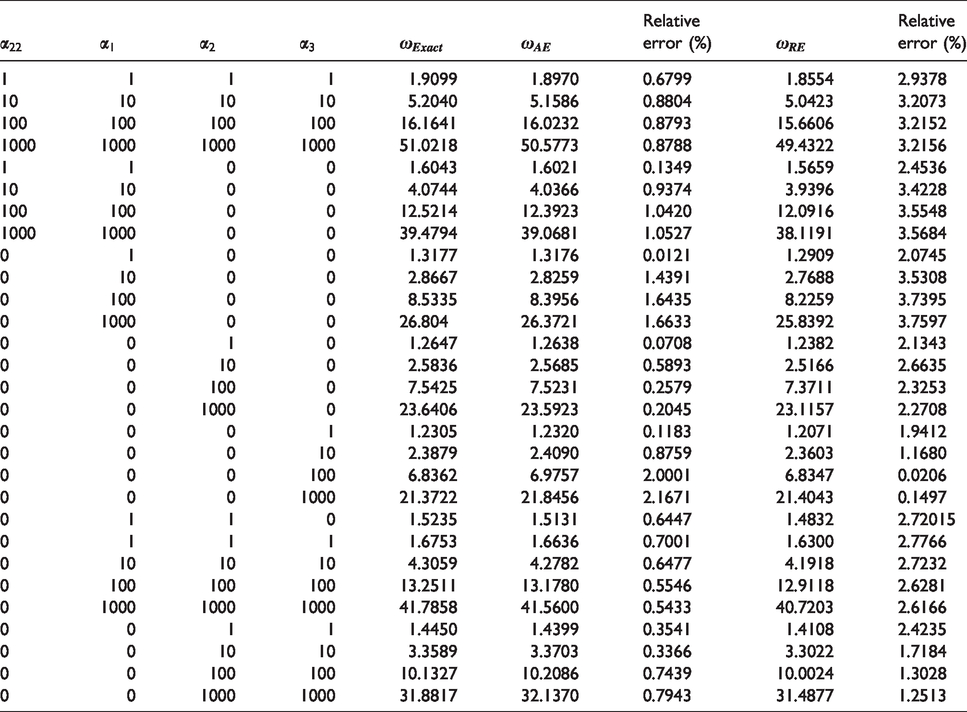
Table 1 illustrates the errors attained by considering different values of the nonlinear terms , , , and in equation (18). For comparison purposes, Table 1 lists the frequency values obtained by using the approach introduced by Ren and Hu to derive the frequency–amplitude equation41
where the term related to the quadratic nonlinearity of equation (18) has been considered. In all cases examined here, the values of , , with and were selected to minimized the error. Notice from Table 1 that in general, the error attained from equation (19) is smaller than that of . This reduced error is expected since the Duffing-type equations’ exact solution is based on Jacobi elliptic functions. Table 1 shows the values of and are similar and compare well with respect to the exact frequency, , whose value can be obtained by numerical integration of equation (18). It is also seen from Table 1 that for increasing values of the nonlinear parameters , the errors attained tend to decrease.
Exact and estimated frequency values for Duffing-like nonlinear oscillators.
Relative error (%)
Relative error (%)
1
1
1
1
1.9099
1.8970
0.6799
1.8554
2.9378
10
10
10
10
5.2040
5.1586
0.8804
5.0423
3.2073
100
100
100
100
16.1641
16.0232
0.8793
15.6606
3.2152
1000
1000
1000
1000
51.0218
50.5773
0.8788
49.4322
3.2156
1
1
0
0
1.6043
1.6021
0.1349
1.5659
2.4536
10
10
0
0
4.0744
4.0366
0.9374
3.9396
3.4228
100
100
0
0
12.5214
12.3923
1.0420
12.0916
3.5548
1000
1000
0
0
39.4794
39.0681
1.0527
38.1191
3.5684
0
1
0
0
1.3177
1.3176
0.0121
1.2909
2.0745
0
10
0
0
2.8667
2.8259
1.4391
2.7688
3.5308
0
100
0
0
8.5335
8.3956
1.6435
8.2259
3.7395
0
1000
0
0
26.804
26.3721
1.6633
25.8392
3.7597
0
0
1
0
1.2647
1.2638
0.0708
1.2382
2.1343
0
0
10
0
2.5836
2.5685
0.5893
2.5166
2.6635
0
0
100
0
7.5425
7.5231
0.2579
7.3711
2.3253
0
0
1000
0
23.6406
23.5923
0.2045
23.1157
2.2708
0
0
0
1
1.2305
1.2320
0.1183
1.2071
1.9412
0
0
0
10
2.3879
2.4090
0.8759
2.3603
1.1680
0
0
0
100
6.8362
6.9757
2.0001
6.8347
0.0206
0
0
0
1000
21.3722
21.8456
2.1671
21.4043
0.1497
0
1
1
0
1.5235
1.5131
0.6447
1.4832
2.72015
0
1
1
1
1.6753
1.6636
0.7001
1.6300
2.7766
0
10
10
10
4.3059
4.2782
0.6477
4.1918
2.7232
0
100
100
100
13.2511
13.1780
0.5546
12.9118
2.6281
0
1000
1000
1000
41.7858
41.5600
0.5433
40.7203
2.6166
0
0
1
1
1.4450
1.4399
0.3541
1.4108
2.4235
0
0
10
10
3.3589
3.3703
0.3366
3.3022
1.7184
0
0
100
100
10.1327
10.2086
0.7439
10.0024
1.3028
0
0
1000
1000
31.8817
32.1370
0.7943
31.4877
1.2513
Conclusion
He's formulation for getting the frequency–amplitude relationship for nonlinear oscillators provides accurate results when the two trial residuals are based on Jacobi elliptic functions. The simplicity of Professor He’s formulation can now be expanded to obtain analytical expressions for the frequency of nonlinear oscillators, since most of these can be written as a Duffing-type equation using transformation techniques. Furthermore, using the two-scale transform, our results can be applied to obtain approximate frequency–amplitude expressions for the fractal Fangzhu singular oscillator and for the fractal Duffing-type equations. Therefore, this paper provides evidence of the applicability of He’s formulation for all homogeneous single-degree-of-freedom nonlinear oscillators found in physics, aerospace, and engineering applications.
The author(s) declared no potential conflicts of interest with respect to the research, authorship, and/or publication of this article.
Funding
The author(s) disclosed receipt of the following financial support for the research, authorship, and/or publication of this article: Tecnológico de Monterrey funded this research through the Research Group of Nanotechnology for Devices Design, and by the Consejo Nacional de Ciencia y Tecnología de México (Conacyt), Project Numbers 242269, 255837, 296176, and National Lab in Additive Manufacturing, 3D Digitizing and Computed Tomography (MADiT) LN299129.
ORCID iDs
Alex Elías-Zúñiga
Luis Manuel Palacios-Pineda
Daniel Olvera Trejo
References
1.
HayashiC.Nonlinear oscillation in physical systems.
Princeton:
Princeton University Press, 1964.
2.
NayfehAHMook DT.Non-linear oscillations.
New York:
John Wiley, 1973.
3.
SandersJAVerhulstF.Averaging methods in nonlinear dynamical systems.
New York:
Springer-Verlag, 1985.
HeJH.The homotopy perturbation method for nonlinear oscillators with discontinuities. Appl Math Comput2004;
151: 287–292.
6.
HeJH.Some asymptotic methods for strongly nonlinear equations. Int J Mod Phys B2006;
20: 1141–1199.
7.
HeJH.New interpretation of homotopy perturbation method. Int J Mod Phys B2006;
20: 2561–2568.
8.
HeJH.Homotopy perturbation method with an auxiliary term. Abstract Appl Anal2012;
2012: 857612.
9.
HeJH.Asymptotic methods for solitary solutions and compactons. Abstract Appl Anal2012;
2012: 916793.
10.
HeJH.Homotopy perturbation method with two expanding parameters. Indian J Phys2014;
88: 193–196.
11.
OlveraDElías-ZúñigaALópez de LacalleLN, et al.
Approximate solutions of delay differential equations with constant and variable coefficients by the enhanced multistage homotopy perturbation method. Abstract Appl Anal2015;
2015: 382475.
12.
CompeánFIOlveraDCampaFJ, et al.
Characterization and stability analysis of a multivariable milling tool by the enhanced multistage homotopy perturbation method. Int J Mach Tools Manuf2012;
57: 27–33.
13.
HeJH.A tutorial review on fractal spacetime and fractional calculus. Int J Theor Phys2014;
53: 3698–3718.
14.
HeJHWuXH.Variational iteration method: new development and applications. Comp Math Appl2007;
54: 881–894.
15.
ZhouYPangSChongG, et al.
A variational iteration method integral transform technique for handling heat transfer problems. Therm Sci2017;
21: S55–S61.
16.
MengZJZhouYMWangHQ.Local fractional variational iteration algorithm III for the diffusion model associated with non-differentiable heat transfer. Therm Sci2016;
20: S781–S784.
17.
HeJH.Max-min approach to nonlinear oscillators. Int J Nonlinear Sci Numer Simul2008;
9: 207–210.
18.
HeJH.Variational approach for nonlinear oscillators. Chaos Solitons Fractals2007;
34: 1430–1439.
19.
BeattyMF.Stability of a body supported by a simple vehicular shear suspension system. Int J Non-Linear Mech1989;
24: 65–77.
20.
BeattyMF.Finite amplitude vibrations of a body supported by simple shear springs. J Appl Mech1984;
51: 361–366.
21.
Elías-ZúñigaA.Exact solution of the quadratic mixed-parity Helmholtz Duffing oscillator. Appl Math Comput2012;
218: 7590–7594.
22.
Elías-ZúñigaA.Exact solution of the cubic-quintic Duffing oscillator. Appl Math Model2013;
37: 2574–2579.
23.
HeJH.Ancient Chinese algorithm: the Ying Buzu Shu (method of surplus and deficiency) vs. Newton iteration method. Appl Math Mech (English Ed)2002;
23: 1407–1412.
24.
HeJH.An improved amplitude-frequency formulation for nonlinear oscillators. Int J Nonlinear Sci Numer Simul2008;
9: 211–212.
25.
HeJH.Amplitude-frequency relationship for conservative nonlinear oscillators with odd nonlinearities. Int J Appl Comput Math2017;
3: 1557–1560.
26.
ByrdPFFriedmanMD.Handbook of elliptic integrals for engineers and physicists. New York: Springer-Verlag, 1953.
27.
HeCHHeJHSedighiHM.Fangzhu: an ancient Chinese nanotechnology for water collection from air: history, mathematical insight, promises and challenges. Math Methods Appl Sci2020; https://doi.org/10.1002/mma.6384
28.
WangKL.Effect of Fangzhu’s nanoscale surface morphology on water collection. Math Meth Appl Sci. Epub ahead of print 26 June 2020. DOI: 10.1002/mma.6569.
29.
HeJHEl-DibYO.Homotopy perturbation method for Fangzhu oscillator. J Math Chem. Epub ahead of print 16 September 2020. DOI: 10.1007/s10910-020-01167-6.
30.
GadellaMLaraLP.On the solutions of a nonlinear ‘pseudo’-oscillator equation. Phys Scr2014;
89: 105205.
31.
GarcíaJDGasullA.Weak periodic solutions of ξξ¨ + 1 = 0 and the Harmonic Balance Method. Phys Conf Ser2017;
811: 012003.
32.
Elías-ZúñigaAMartínez-RomeroO.Energy method to obtain approximate solutions of strongly nonlinear oscillators. Math Probl Eng2013;
2013: 620591.
33.
Elías-ZúñigaAMartínez-RomeroOCórdoba-DíazRK.Approximate solution for the Duffing-harmonic oscillator by the enhanced cubication method. Math Probl Eng2012;
2012: 618750.
34.
Elías-ZúñigaAMartínez-RomeroO.Accurate solutions of conservative nonlinear oscillators by the enhanced cubication method. Math Probl Eng2013;
2013: 842423.
35.
Elías-ZúñigaAMartínez-RomeroO.Investigation of the equivalent representation form of damped strongly nonlinear oscillators by a nonlinear transformation approach. J Appl Math2013;
2013: 245092.
36.
Elías-ZúñigaA. “
Quintication” method to obtain approximate analytical solutions of non-linear oscillators. Appl Math Comput2014;
243: 849–855.
37.
Elías-ZúñigaAPalacios-PinedaLMOlvera-TrejoD, et al.
Lyapunov equivalent representation form of forced, damped, nonlinear, two degree-of-freedom systems. Appl Sci2018;
8: 649.
38.
Elías-ZúñigaAPalacios-PinedaLMMartínez-RomeroO, et al.
Equivalent representation form in the sense of Lyapunov, of nonlinear forced, damped second order differential equations. Nonlinear Dyn2018;
92: 2143–2158.
39.
Elías-ZúñigaAPalacios-PinedaLMJiménez-CedeñoIH, et al.
Equivalent power-form transformation for fractal Bratu’s equation. Fractals2020; https://doi.org/10.1142/S0218348X21500195.
40.
Elías-ZúñigaAPalacios-PinedaLMJiménez-CedeñoIH, et al.
Equivalent power-form representation of the fractal Toda oscillator. Fractals2020; https://doi.org/10.1142/S0218348X21500341.
41.
AnjumNHeJH.Laplace transform: making the variational iteration method easier. Appl Math Lett2019;
92:134–138.