




Abstract
An analytical technique has been developed based on the harmonic balance method to obtain approximate angular frequencies. This technique also offers the periodic solutions to the nonlinear free vibration of a conservative, couple-mass-spring system having linear and nonlinear stiffnesses with cubic nonlinearity. Two real-world cases of these systems are analysed and introduced. After applying the harmonic balance method, a set of complicated higher-order nonlinear algebraic equations are obtained. Analytical investigation of the complicated higher-order nonlinear algebraic equations is cumbersome, especially in the case when the vibration amplitude of the oscillation is large. The proposed technique overcomes this limitation to utilize the iterative method based on the homotopy perturbation method. This produces desired results for small as well as large values of vibration amplitude of the oscillation. In addition, a suitable truncation principle has been used in which the solution achieves better results than existing solutions. Comparing with published results and the exact ones, the approximated angular frequencies and corresponding periodic solutions show excellent agreement. This proposed technique provides results of high accuracy and a simple solution procedure. It could be widely applicable to other nonlinear oscillatory problems arising in science and engineering.
Keywords
Introduction
In past century, the motion of an oscillating system with a multidegree of freedom was widely considered by researchers. An approximate method was proposed by Moochhala and Raynor 1 for the motions of unequal masses connected by (n + 1) nonlinear springs and anchored to rigid end walls. Huang 2 studied the harmonic oscillations of nonlinear two-degree-of-freedom (TDOF) systems. The free oscillations of conservative quasilinear systems with TDOF have been analysed by Gilchrist. 3 Efstathiades 4 investigated the existence and characteristic behaviour of combination tones in nonlinear systems with TDOF. Alexander and Richard 5 considered the resonant dynamics of a TDOF system which was composed of a linear oscillator which was weakly coupled to a strongly nonlinear one, with an essential (nonlinearizable) cubic stiffness nonlinearity. A generalized Galerkin’s method has been used by Chen 6 on the nonlinear oscillations of TDOF systems. Ladygina and Manevich 7 applied the multiscale method for the free oscillations of a conservative system with TDOF having cubic nonlinearities (of symmetric nature) and close natural frequencies. A combination of a Jacobi elliptic function and a trigonometric function has been used by Cveticanin8,9 to obtain an analytical solution for the motion of a two-mass system with TDOF in which the masses were connected with three springs.
Currently, TDOF systems are very important in physical and engineering disciplines. Many practical engineering vibration systems such as elastic beams supported by two springs and the vibration of a milling machine 10 can be studied by considering them as TDOF systems. The TDOF oscillation systems consist of two second-order differential equations with cubic nonlinearities. The equations of motion for a mechanical system with associated linear and nonlinear springs were solved by the transformation into a set of differential algebraic equations using intermediate variables. The equations of motion for a TDOF system were transformed into the Duffing equation 11 as a result.
In general, finding an exact approximation for nonlinear equations is extremely difficult. This perception of difficulty has led to intensive research over many decades. Many analytical and numerical approaches are currently being investigated. Traditional perturbation methods are the most widely used analytical methods for approximating nonlinear equations. They are not effective for strongly nonlinear equations, however, and there have limitations. In the recent past, many new analytical techniques have been investigated to overcome these limitations. These include the Newton harmonic balance method (HBM), 12 He’s variational approach, 13 the energy balance method, 14 the max-min approach 15 and He’s improved amplitude–frequency formulation method.16–18 All have been used to derive approximate angular frequencies and corresponding periodic solutions to the TDOF system. In fact, to the best of our knowledge, of most of these methods, only the first-order approximation has ever been considered. This does not result in sufficient accuracy.
The HBM19–22 provides a general technique for determining approximate periodic solutions to strongly nonlinear systems. Usually, a set of complicated higher-order nonlinear algebraic equations appear when the HBM is formulated. It is tremendously difficult to solve these equations analytically, especially in the case of large values of vibration amplitude of the oscillation. In this paper, a analytical technique has been developed to eradicate this limitation. In the proposed technique, an iterative method based on the homotopy perturbation method23,24 has been used to solve the set of complicated high-order nonlinear algebraic equations that give desired results for small as well as large values of vibration amplitude of the oscillation. In addition, a suitable truncation principle has also been used to these nonlinear higher-order algebraic equations which make the solutions better than the existing ones saving many calculations. The higher-order approximations (mainly third-order approximations) have been applied to the nonlinear free vibration of a conservative, couple-mass-spring system having linear and nonlinear stiffnesses with cubic nonlinearity. Comparison of obtained results with those published and the corresponding exact solutions show that the obtained results are highly accurate. The advantage of the proposed method is that the solution procedure is very easy, direct, concise, and simple to implement compared to other existing methods.
This paper is organized as follows: In the next section, we provide the outline of the solution approach based on the HBM. In the subsequent section, we offer a detailed description of a two-mass system connected with linear and nonlinear stiffnesses and a two-mass system also connected with linear and nonlinear stiffnesses but fixed to a rigid body both geometrically and mathematically. Then, we apply the solution approach to the nonlinear free vibration of a conservative, couple-mass-spring system having linear and nonlinear stiffnesses with cubic nonlinearity. In the penultimate section, results are discussed in detail. Finally, concluding remarks are given in the last section.
The solution approach based on the HBM
Consider a second-order nonlinear differential equation as follows

An N-th order periodic solution of equation (1) can be assumed to be

Substituting equation (2) into equation (1), the algebraic identity is obtained as

Comparing the coefficients of equal harmonic terms of equation (3), we obtain the following nonlinear algebraic equations

With the help of the first equation,

Now applying the iterative method based on the homotopy perturbation method (see Appendix 1 for details), the values of


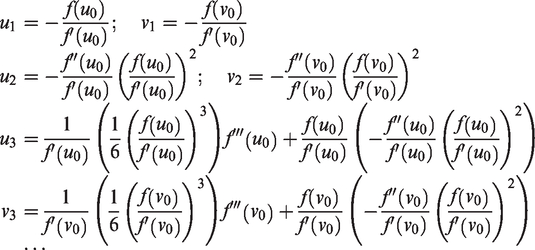
Finally, substituting the values of
Formulation and mathematical modelling of the problems
A two-mass system connected with linear and nonlinear stiffnesses
The model of a two-mass system connected with linear and nonlinear stiffnesses is considered as shown in Figure 1 9 .
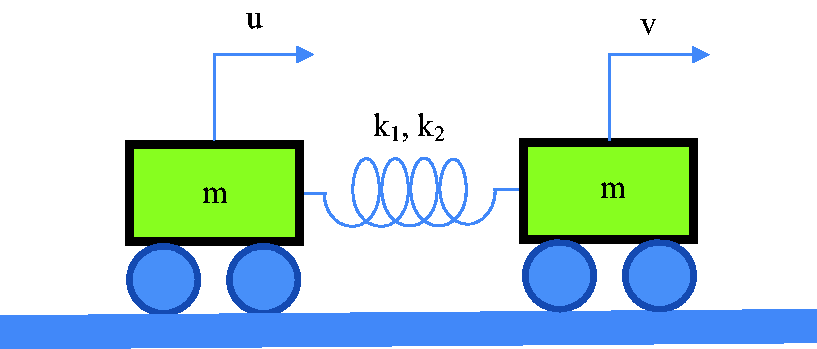
The two-mass system connected by linear and nonlinear stiffnesses.
The equations of motion are defined as in Cveticanin
9






Introducing the intermediate variables





Substituting equation (13) into equation (12b), it becomes


Equation (14) is obviously similar to the well-known Duffing equation
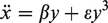

A two-mass system connected with linear and nonlinear stiffnesses fixed to the body
Consider a two-mass system connected with linear and nonlinear springs and fixed to a rigid body at two ends as shown in Figure 2. 8
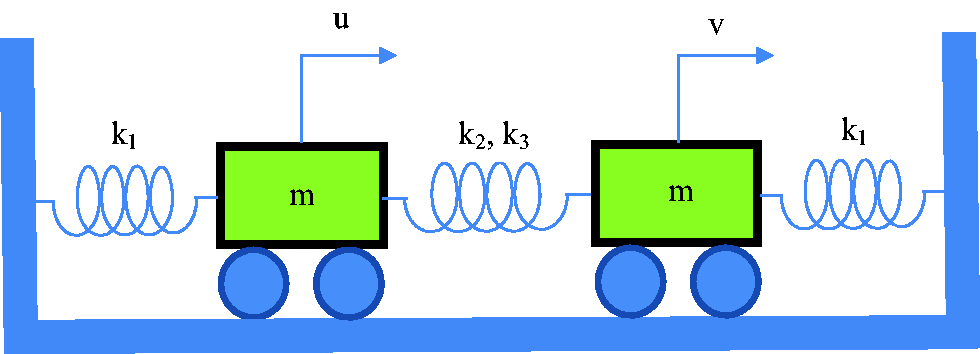
Two-mass system connected with the fixed bodies.
The equations of motion are defined as






Similar to problem 1, transforming the above equations using the intermediate variables in equations (11a) and (11b), they become



Substituting equation (20) into equation (19b), it becomes


Equation (21) is obviously similar to the well-known Duffing equation


Equation (23) is a linear non-homogeneous second-order ordinary differential equation and it can be solved readily using a standard method such as the Laplace transformation.
Applications
A two-mass system connected with linear and nonlinear stiffnesses
A second-order approximation for equation (14) can be assumed to be

Substituting equation (25) along with


Considerable calculation is saved and obtains improved results, if we use the truncation principle in equations (26) and (27). The higher-order terms of


Equation (28) can be easily written as

Substituting

Now applying the iterative method based on the homotopy perturbation method (see Appendix 1 for details) in equation (31), the value of

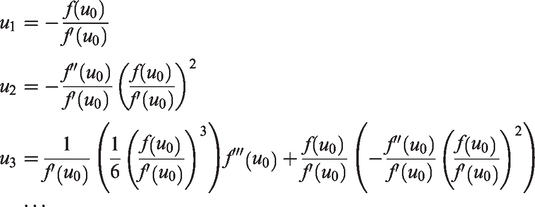
By substituting the value of

Thus, the second-order approximate solution of equation (14) is
In the similar way, the higher-order approximations have been obtained by using the proposed method. In this study, a third-order approximate solution can be considered to be

Substituting equation (34) along with



Considerable calculation is saved and improved results are obtained, if we use the truncation principle in equations (35) to (37). After implementing it in equations (35) to (37), the following equations are obtained



Equation (38) can be easily written as

Substituting

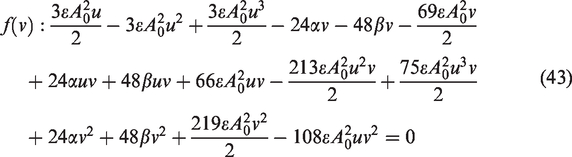
Now applying the iterative method based on the homotopy perturbation method (see Appendix 1 for details) in equations (42) and (43), the values of


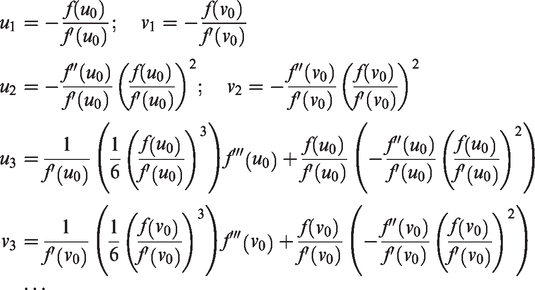
Now substituting the values of

Thus, the third-order approximate periodic solution of equation (14) is
Two-mass system connected with linear and nonlinear stiffnesses fixed to the body
A second-order approximation for equation (21) can be assumed to be

Substituting equation (47) along with


Considerable calculation is saved and improved results are obtained, if we use the truncation principle in equations (48) and (49). The higher-order terms of


Equation (50) can be easily written as

Substituting

Now applying the iterative method based on the homotopy perturbation method (see Appendix 1 for details) in equation (53), the value of

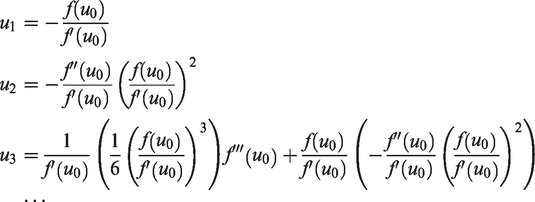
Substituting the value of

Thus, the second-order approximate solution of equation (21) is
In the similar way, the higher-order approximations have been obtained by using the proposed method. In this study, a third-order approximate solution can be considered to be

Substituting equation (56) along with



Considerable calculation is saved and improved results are obtained, if we use the truncation principle in equations (57) to (59). After implementing this in equations (57) to (59), the following equations are obtained



Equation (60) can be easily written as

Substituting
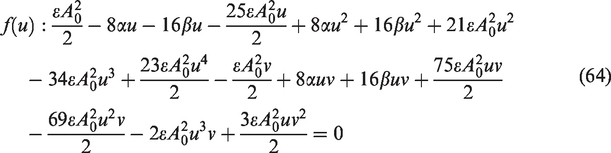
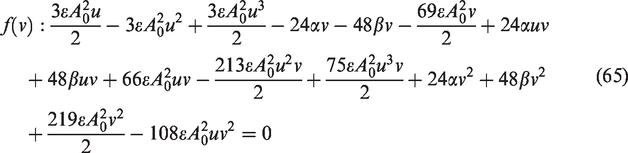
Now by applying the iterative method based on the homotopy perturbation method (see Appendix 1 for details) in equations (64) and (65), the values of


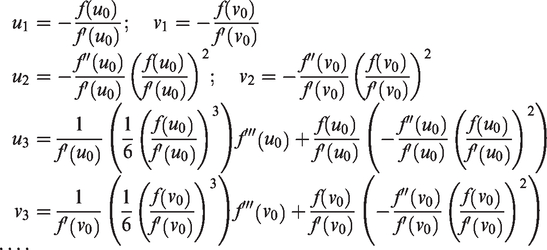
Now substituting the values of

Thus, the third-order approximate periodic solution of equation (21) is
Results and discussions
To demonstrate and verify the accuracy of the proposed method, we present a comparison with already published results and the exact solutions. The second- and third-order approximate solutions are highly accurate, with a significantly improved percentage error for different values of parameters and initial amplitudes. Tables 1 to 4 give the comparison of the approximate results with those previously published13–16 and also the exact solutions for different values of parameters
Comparison of the approximate angular frequencies with already published results and exact frequencies for various parameters of the system.
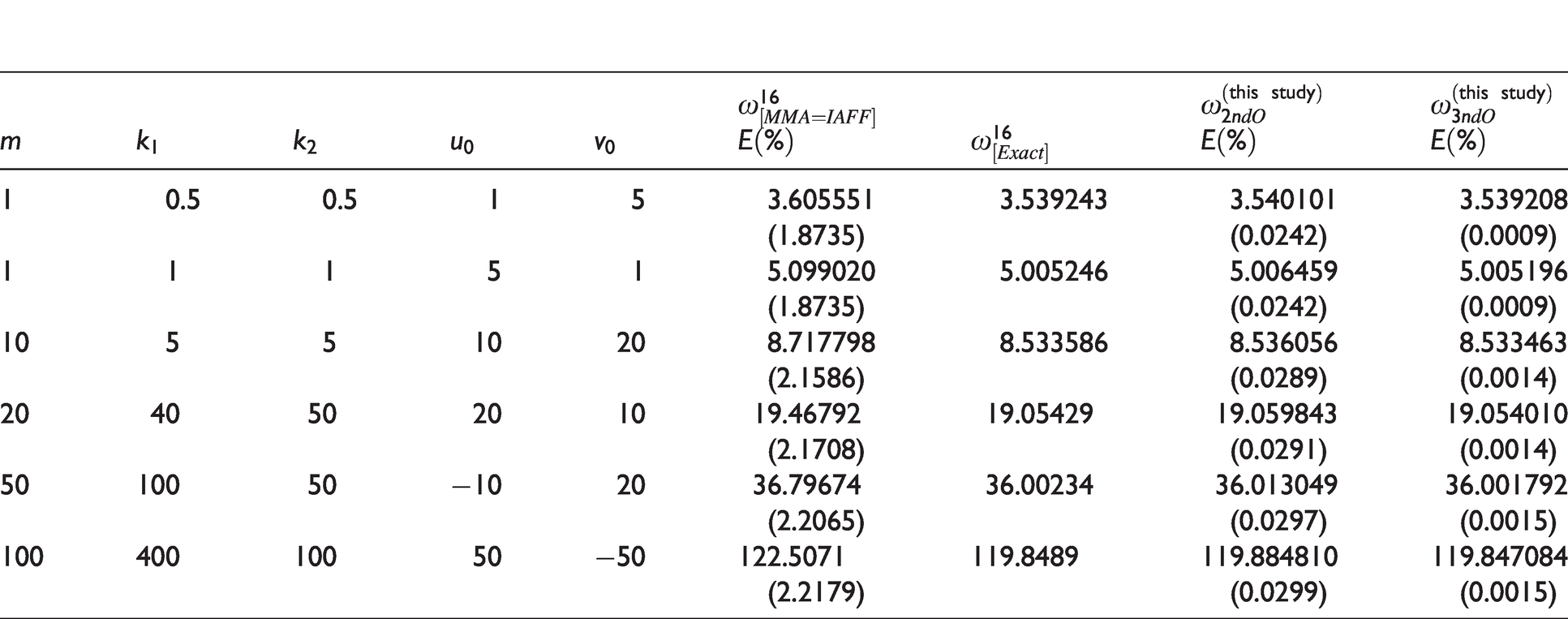
Comparison of the approximate angular frequencies with already published results and exact frequencies for various parameters of the system.
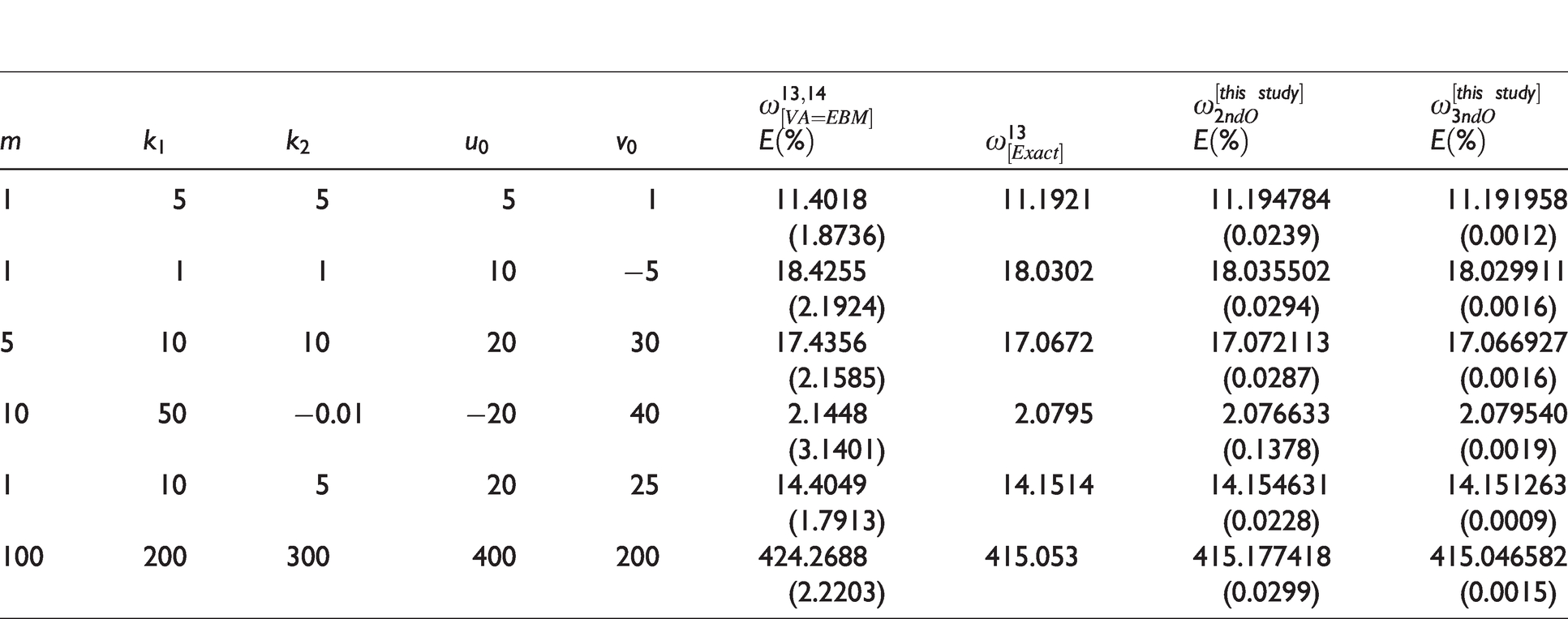
Comparison of the approximate angular frequencies with already published results and exact frequencies for various parameters of the system.
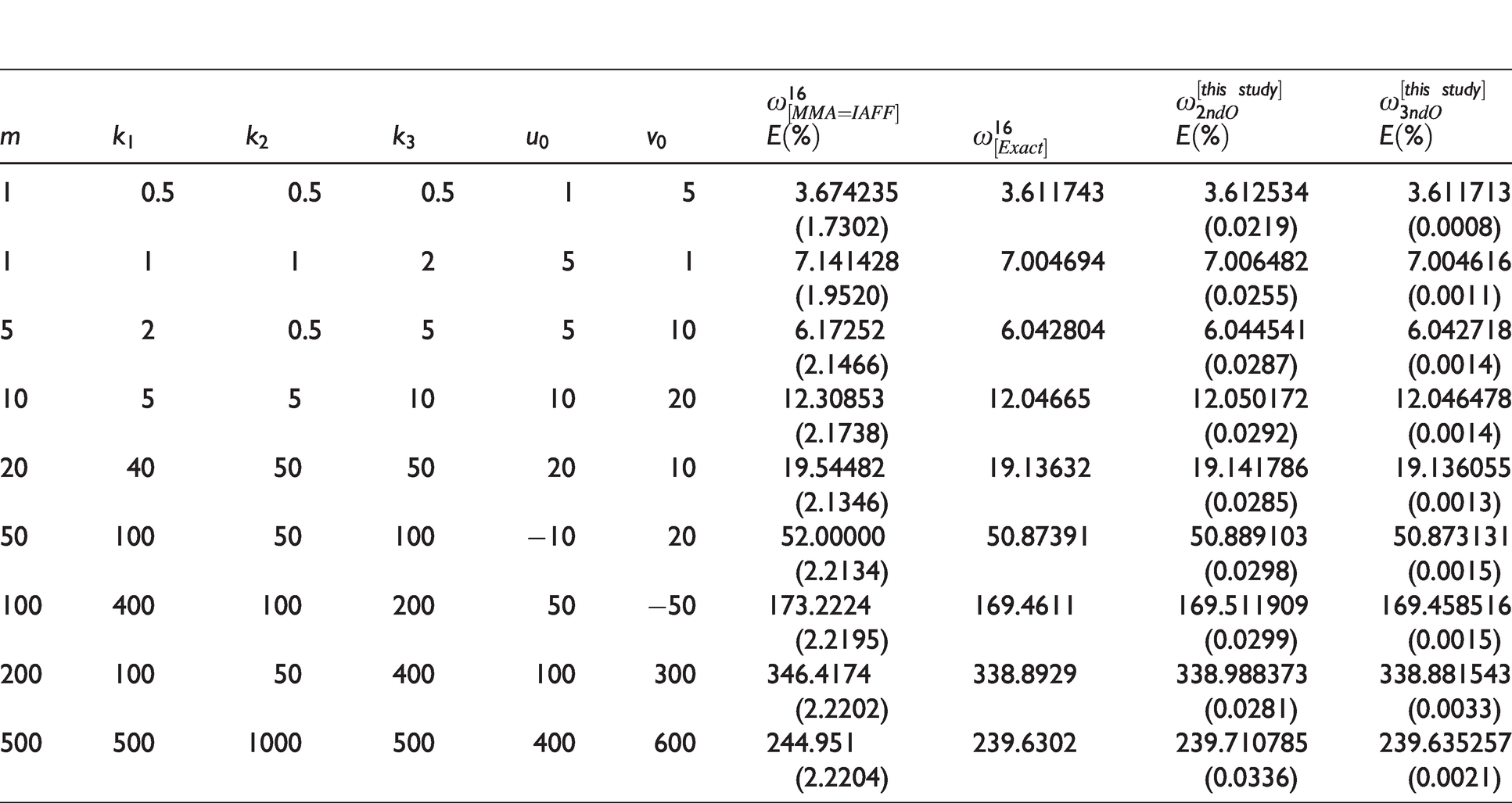
Comparison of the approximate angular frequencies with already published results and exact frequencies for various parameters of the system.
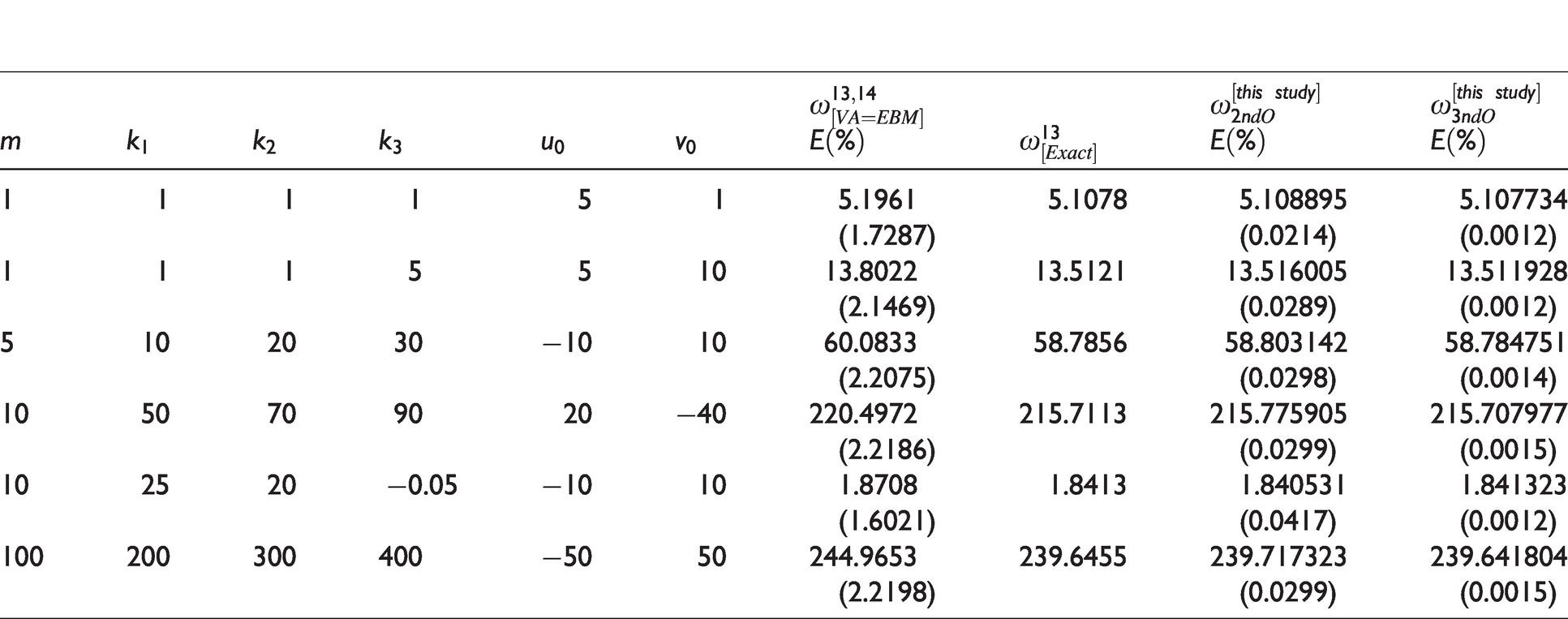
In Tables 1 to 4,
In order further to illustrate and verify the exactness of the approximate analytical solution, a comparison of the time history oscillatory displacement response for the two masses for different values of initial conditions and stiffnesses with fourth-order Runge–Kutta (considered to be exact) solutions are plotted in Figures 3 to 5 for Problem 1 and Figures 6 to 8 for Problem 2. The proposed method is simple, quite easy, and highly efficient and is valid for a wide range of vibration amplitudes of the oscillation. As can be seen in Figures 3 to 8, it is found that the proposed method has excellent agreement with the numerical solution. The proposed method is rapidly convergent and can also be easily generalized to two-degree-of-freedom oscillation systems by combining the transformation technique.
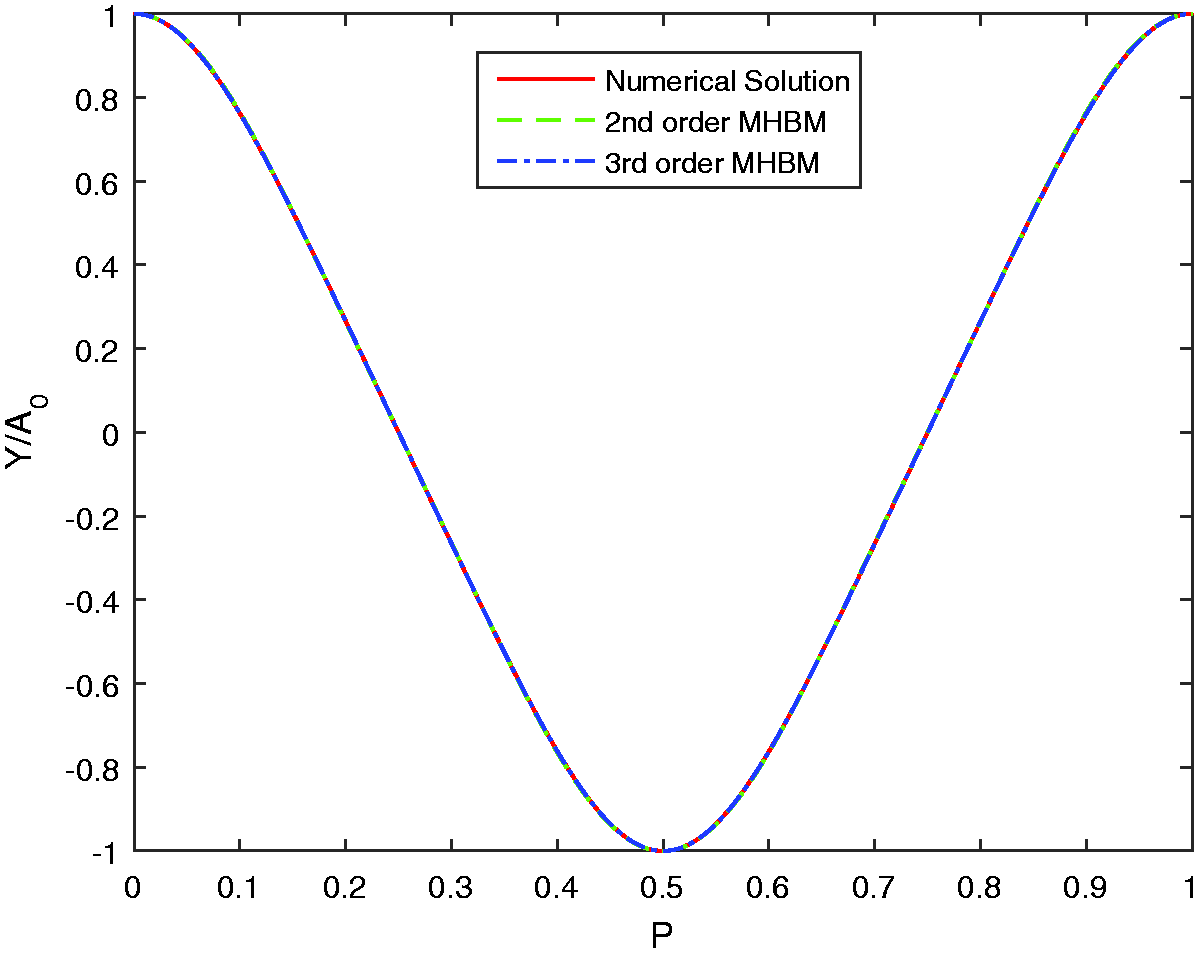
Comparison of the approximate solution in equation (14) with the corresponding numerical one for various parameters
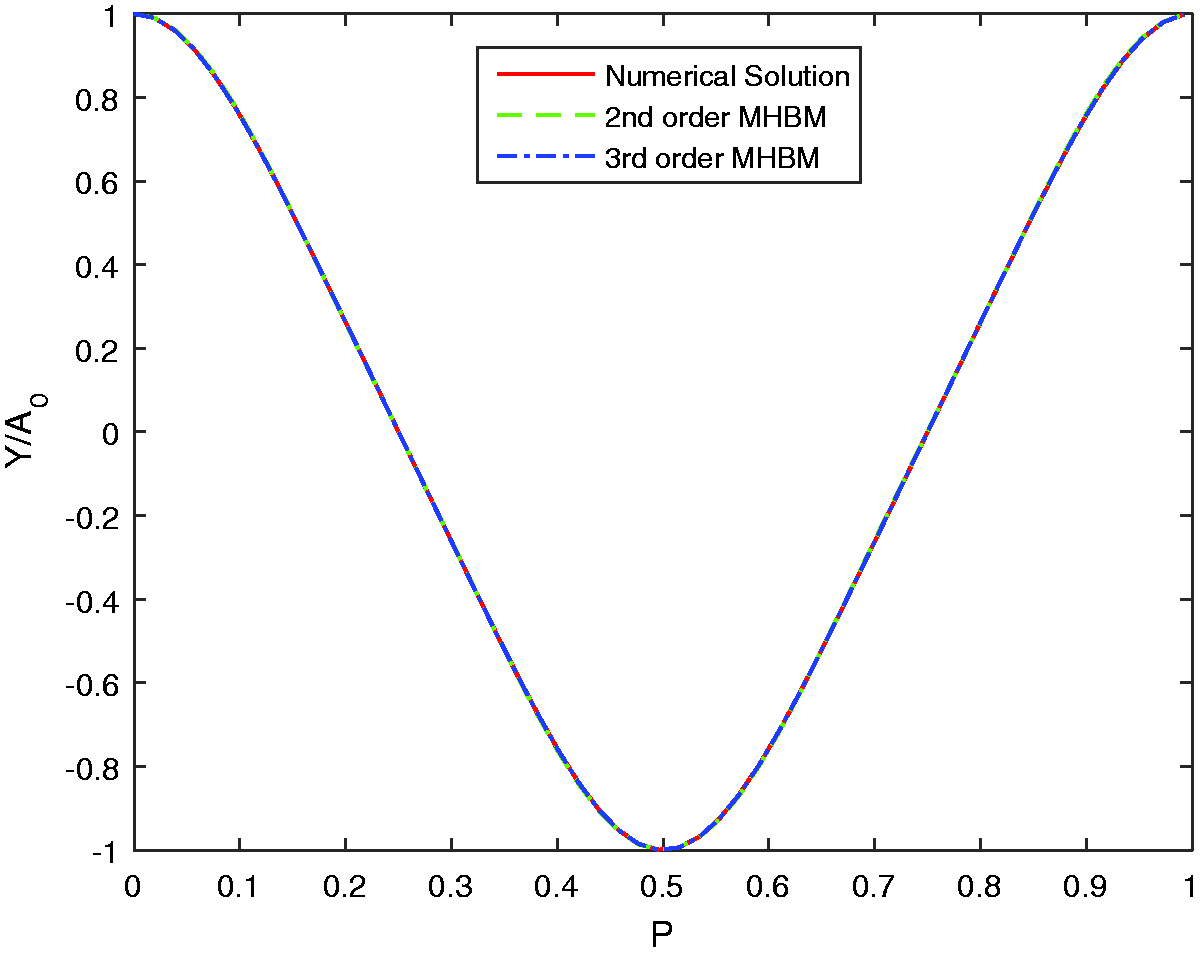
Comparison of the approximate solution in equation (14) with the corresponding numerical one for various parameters
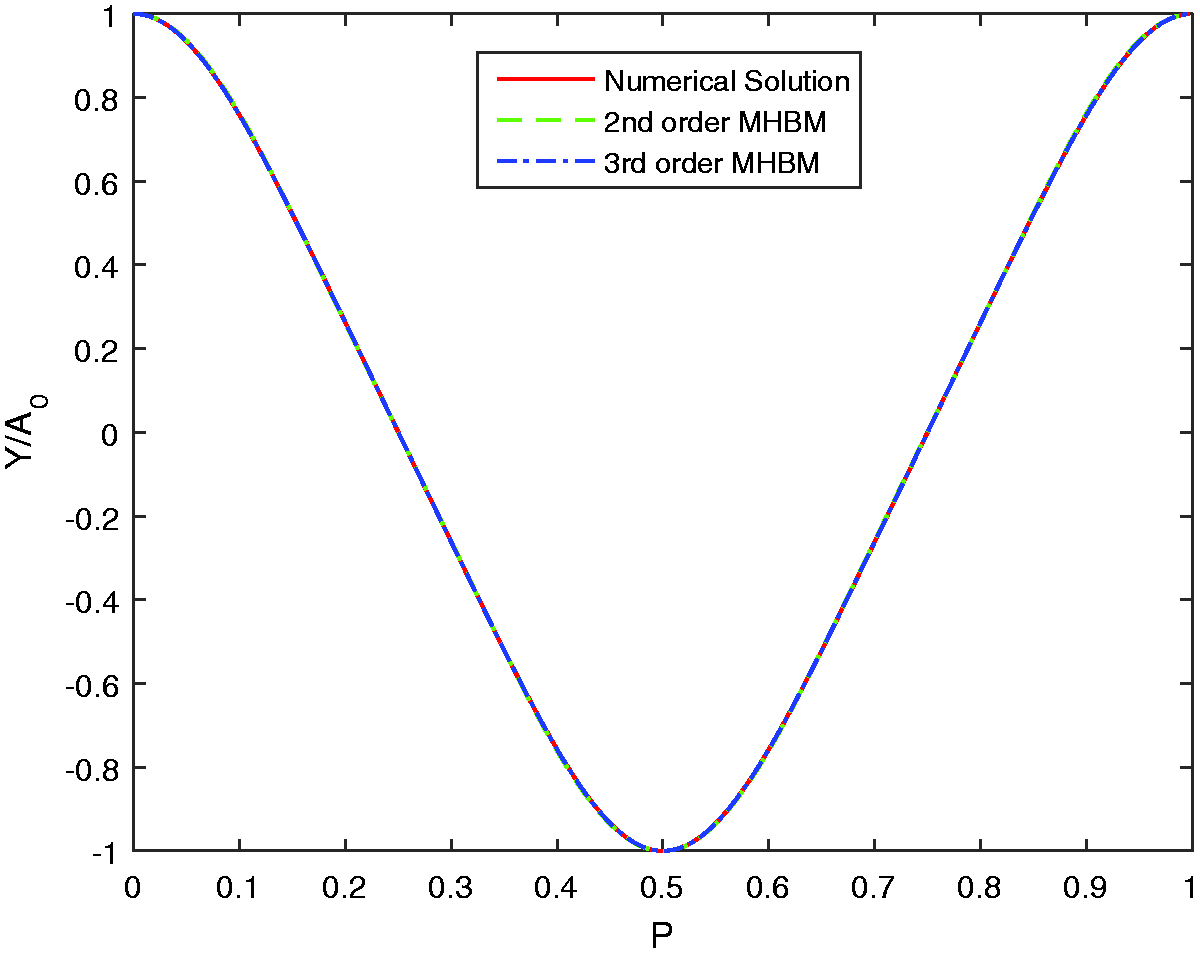
Comparison of the approximate solution in equation (14) with the corresponding numerical one for various parameters
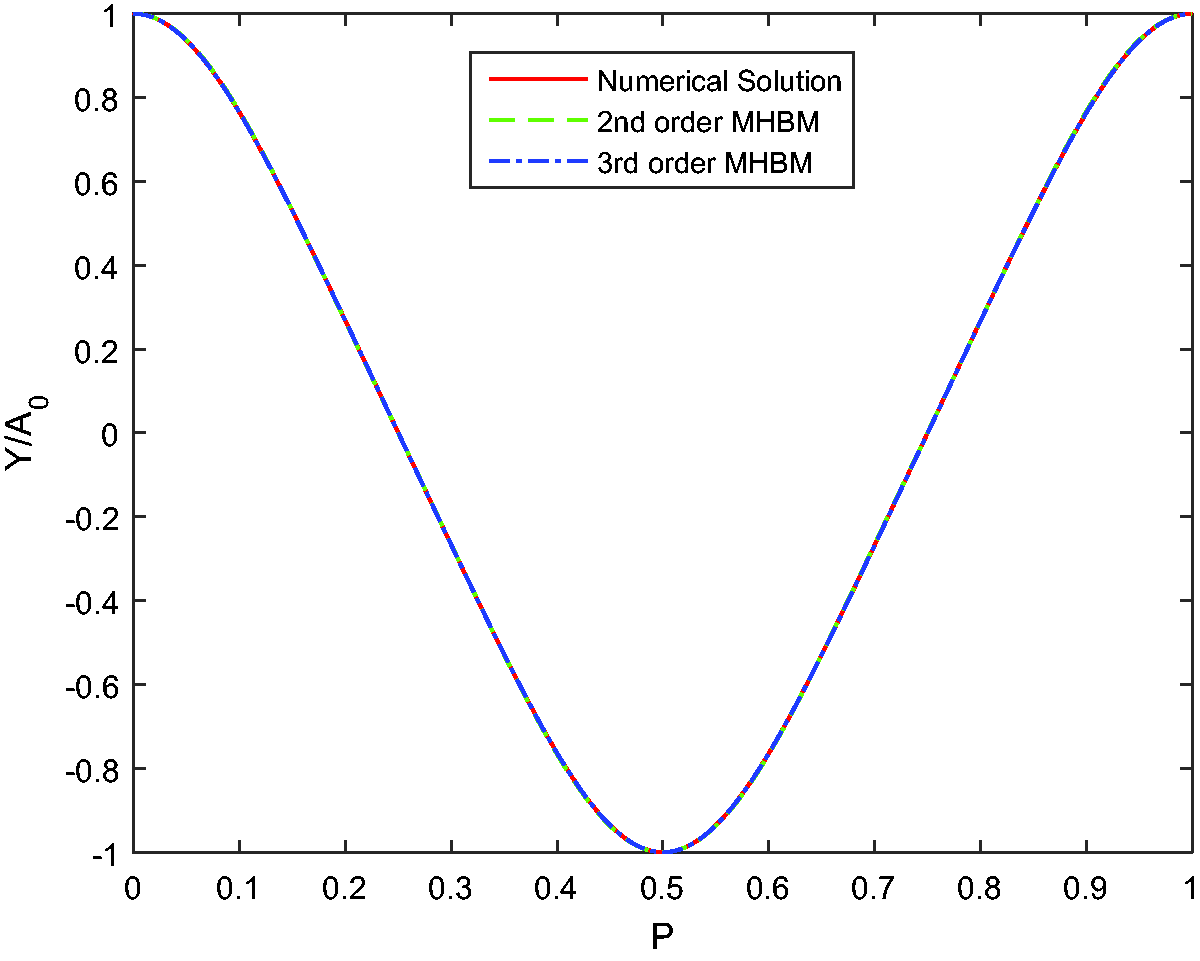
Comparison of the approximate solution in equation (21) with the corresponding numerical one for various parameters
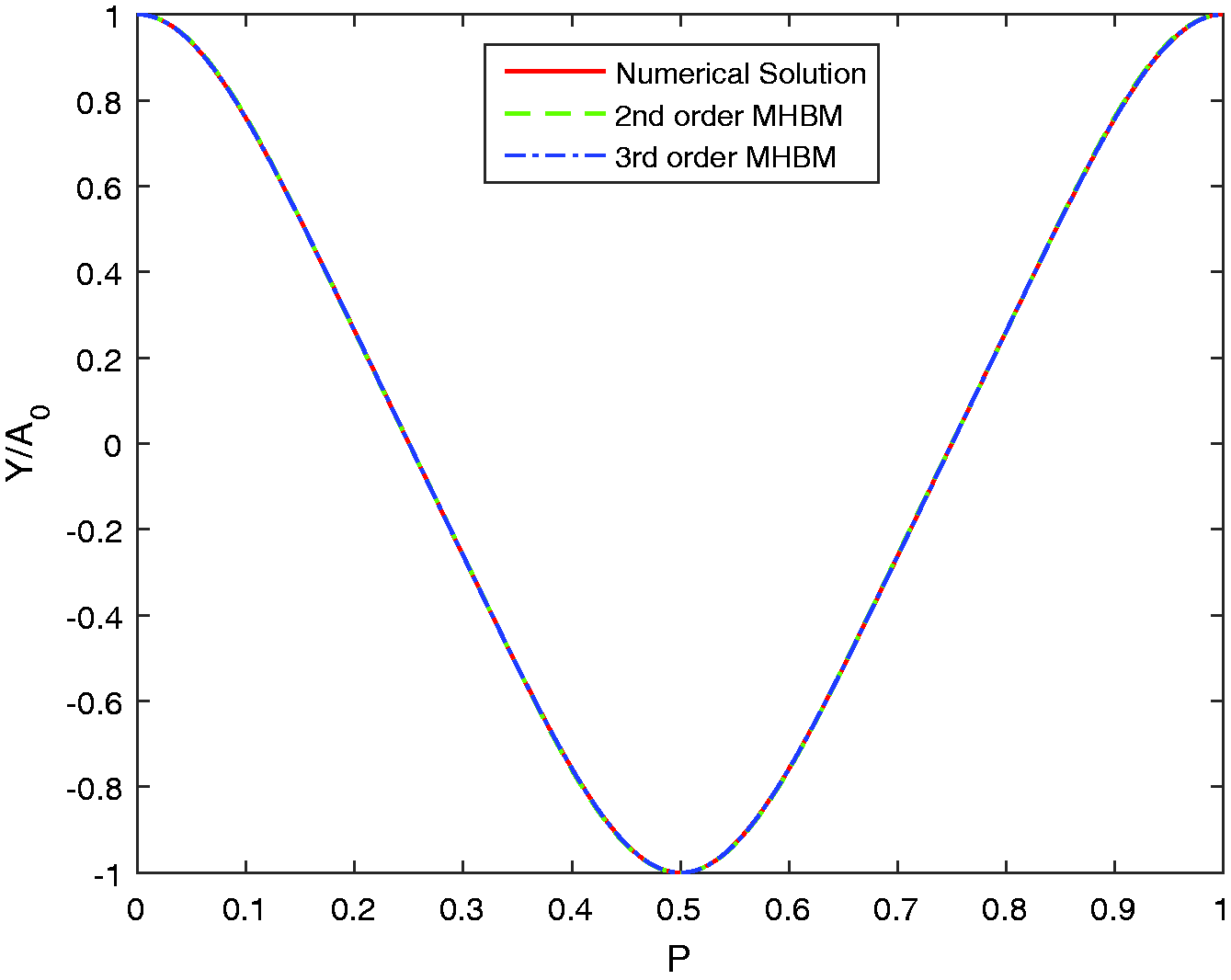
Comparison of the approximate solution in equation (21) with the corresponding numerical one for various parameters
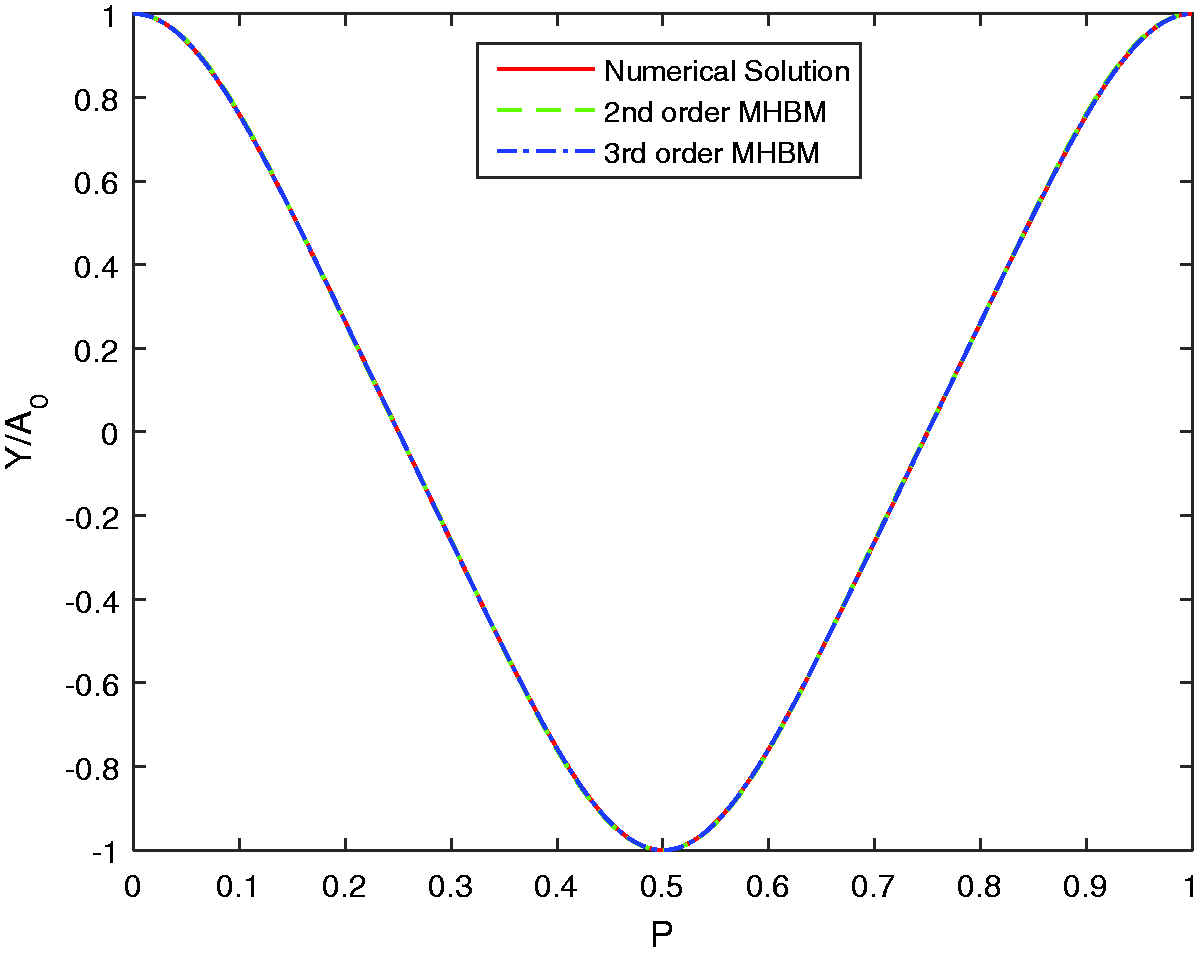
Comparison of the approximate solution in equation (21) with the corresponding numerical one for various parameters
Conclusion
We have developed an analytical technique based on the HBM to a set of second-order coupled differential equations with cubic nonlinearity. These govern the nonlinear free vibration of a conservative, couple-mass-spring system having linear and nonlinear stiffnesses. We obtained the approximate angular frequencies as well as the corresponding periodic solutions using this proposed method. As compared with published results and exact solutions, we have found excellent agreement. The exactness of the results shows that the proposed method can be easily and efficiently used for the analysis of strongly nonlinear vibration problems with high accuracy. Hence, we conclude that the proposed method has great potential and provides an efficient alternative to the previously existing methods for solving strongly nonlinear oscillatory systems.
Footnotes
Acknowledgement
The authors are grateful for the financial support from the Research Management Centre (RMC), International Islamic University Malaysia.
Declaration of conflicting interests
The author(s) declared no potential conflicts of interest with respect to the research, authorship, and/or publication of this article.
Funding
The author(s) disclosed receipt of the following financial support for the research, authorship, and/or publication of this article: The authors received financial support from the Research Management Centre (RMC), International Islamic University Malaysia, for publication of this article.
