Local fractional nonlinear oscillators are studied by a modification of the homotopy perturbation method coupled with the variational iteration method. In the solution process, the fractional variational iteration method is adopted to transform the nonlinear oscillator equation into an integral equation, which is then decomposed into a series of equations, which are solved by the homotopy perturbation method. Two examples are given to show that the proposed method is simpler and more flexible than the classical homotopy perturbation method. It is also shown that the key to use this method is to select the appropriate decomposition of the initial value series.
Most fractional equations are generated by solving specific problems of science and engineering, for example the gas permeability of a nanofiber membrane,1–6 moisture permeability through a cocoon,7,8 nanoscale multiphase flow,9 solvent evaporation in the bubble electrospinning,10–12 oscillators arising in microphysics and tsunami motion,13,14 and sound transmission in hierarchic porous medium that can be exactly modeled by fractional calculus.15–17 There are many fractional derivatives in literature, which are incompatible with each other, among which He’s fractional derivative,15 the local fractional derivative,18–20 the Riemann–Liouville fractional derivative, the Caputo fractional derivative, the Hadamard fractional derivative, and the Atangana–Baleanu fractional derivative21 are widely used.
There are many computational methods for handling these fractional differential equations, such as the reduced differential transform method,22 the transform methods,23 the Yang Laplace transform-DJ iteration method,24 the local fractional Fourier method,25,26 and others.15–17
Fractional oscillation equations arise in various areas of engineering and applied sciences, which are used as a powerful tool to vibration isolation and reduction of unnecessary vibration by porous media.
The variational iteration method27 and the homotopy perturbation method (HPM)28 were first proposed by Chinese mathematician, Prof. Ji-Huan He, and have been widely used to deal with nonlinear problems.29–39 In this paper, we attempt to solve nonlinear fractional oscillation equations by coupling the variational iteration method with the HPM, which is simpler than using only the HPM or the variational iteration method.
The organization of the manuscript is as follows. In the next section, the local fractional operators are introduced. In “A modification of the HPM” section, the improved HPM for solving the local fractional oscillation equation is investigated. In “Illustrative examples” section, several examples are considered. In the final section, conclusions are presented.
Local fractional operators
In this section, we introduce the mathematical preliminaries of fractional calculus theory which shall be used in this paper.18–20
Definition 1. If the function is local fractional continuous on the interval , the local fractional derivative of of order at is given by
where .
Definition 2. In the interval the local fractional integral of of order is defined as
where , and , j=0,…,N−1, , is a partition of the interval [a,b].
Definition 3. The Yang–Sumudu transform of of order α(0 < α ≤ 1) is defined as
Theorem 1. Assuming and , then we have
where the convolution .
A modification of the HPM
In this section, we shall illustrate the solution procedure of the improved HPM to derive particular solution of some local fractional nonlinear oscillation equations. In order to present this method, we give the following local fractional oscillation equation
associated with the initial conditions represents the linear part and represents the nonlinear terms, and are generalized displacements and time variables, respectively, and are the well-known initial conditions, and is the inhomogeneous part, often this inhomogeneous part contains excited parameters.
Moreover, α is the value of fractal dimensions of the porous medium. For , the proposed models turn out to be those of the classical oscillation equation without holes.
By means of the initial conditions and according to the rule of fractional variational iteration method, we construct the following initial value for equation (5)
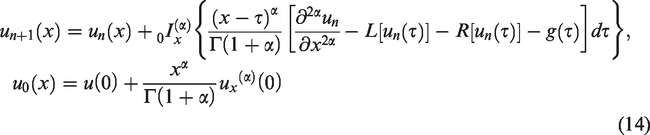
According to the fractional variational iteration method,32 we construct a correction functional for equation (5) as follows
where is a fractal Lagrange multipliers and and are considered as restricted local fractional variation, i.e. and
Applying the Yang–Sumudu transform18–20 on both sides of equation (7) results in
Wu and Lee29 gave the proof of the convergences of equation (14).
Via calculating, we know that equation (14) is equivalent to the following iteration relationship
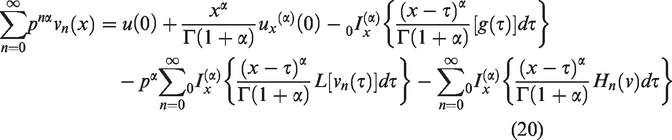
The following integral equation can be induced from equation (15)
Note that both equations (15) and (16) have the same times approximate solution , which tends to their exact solution of equation (5). Then, solving equation (5) can be reduced to solving equation (16), which actually provides an equivalent equation for equation (5). On the other hand, since there are many choices of the Lagrange multipliers, the equivalent integral equations can be derived by many other forms.
In order to demonstrate the validity of the improved HPM in “A modification of the HPM” section, we give the following local fractional differential equations.
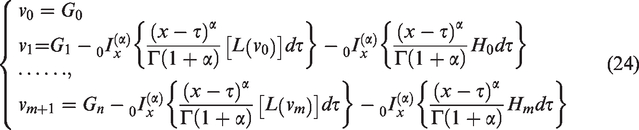
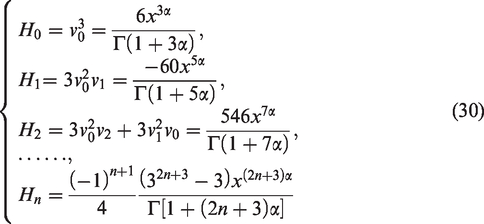
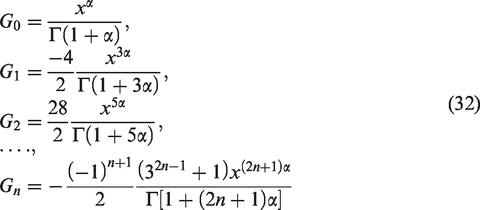
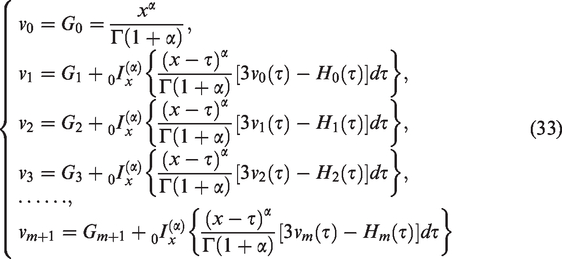
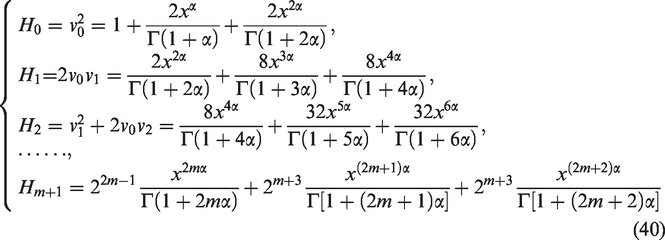
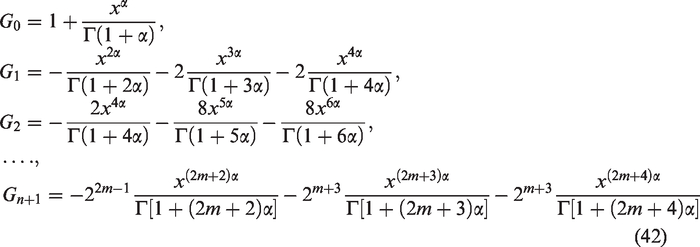
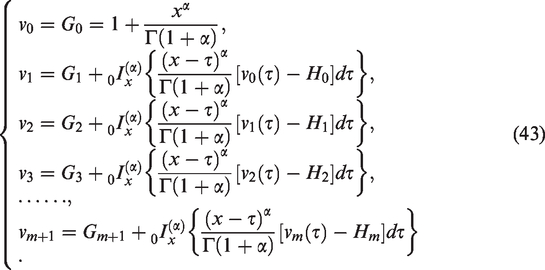
Substituting equation (30) into equation (33), we can get
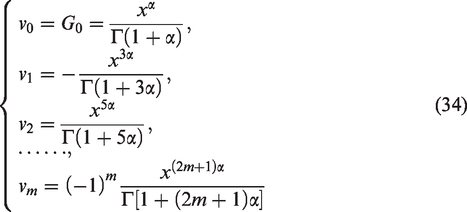
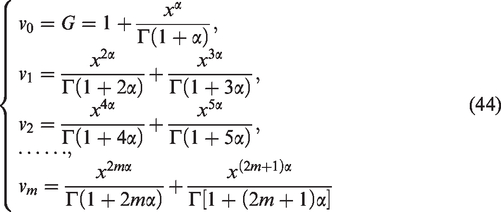
Proceeding in this manner, the rest of the components can also be completely determined and then, making using of equation (25), we can yield the following exact solution of equation (26)
This periodic solution is nondifferentiable and it is stair shaped, which can be seen in the works of Chinese mathematician, Prof. Xiao-jun Yang.18–20 Since α is the value of fractal dimensions of the fractal medium, with the help of the geometric meaning of the Cantor fractal space, we can quantitatively analyze the intensity of sound wave propagation in porous medium.18–20
Example 2. Consider the following fractional differential equation
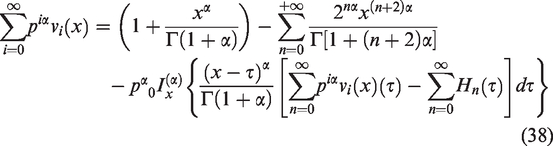
Proceeding in this manner, the rest of the components of can also be completely determined and then, making using of equation (25), we can yield the following exact solution of equation (36)
Conclusions
In this work we proposed the improved HPM. The test examples showed that the suggested new technique can be regarded as an efficient tool for solving the local fractional differential equations, which avoids cumbersome computational works.
Footnotes
Acknowledgements
The authors are grateful to Professor Ji-Huan He and other anonymous reviewers for their valuable comments and useful suggestions.
Declaration of conflicting interests
The author(s) declared no potential conflicts of interest with respect to the research, authorship, and/or publication of this article.
Funding
The author(s) disclosed receipt of the following financial support for the research, authorship, and/ or publication of this article: This work is supported by the foundation of the Nanyang Normal University (2018STP005).
References
1.
LiuYQFengJWZhangCC, et al.
Air permeability of nanofiber membrane with hierarchical structure. Therm Sci2018;
22: 1637–1643.
2.
WangFYHeJHSunQL, et al.
Improvement of air permeability of Bubbfil nanofiber membrane. Therm Sci2018;
22: 17–21.
3.
HeJHKongHYYangRR, et al.
Review on fiber morphology obtained by the bubble electrospinning and Blown bubble spinning. Therm Sci2012;
16: 1263–1279.
4.
LiuPHeJH.Geometrical potential: an explanation on of nanofibers wettability. Therm Sci2018;
22: 33–38.
5.
TianDLiXXHeJH.Self-assembly of macromolecules in a long and narrow tube. Therm Sci2018;
22: 1659–1664.
6.
YuDNTianDHeJH.Snail-based nanofibers. Mater Lett2018;
220: 5–7.
7.
LiuFJ, et al.
A delayed fractional model for cocoon heat-proof property. Therm Sci2017;
21: 1867–1871.
8.
FanJ, et al.
Model of moisture diffusion in fractal media. Therm Sci2015;
19: 1161–1166.
9.
LiuYQZhaoLHeJH.Nanoscale multi-phase flow and its application to control nanofiber diameter. Therm Sci2018;
22: 43–46.
10.
ZhaoLLiuPHeJH.Sudden solvent evaporation in bubble electrospinning for fabrication of unsmooth nanofibers. Therm Sci2017;
21: 1827–1832.
11.
LiuLGHeJH.Solvent evaporation in a binary solvent system for controllable fabrication of porous fibers by electrospinning. Therm Sci2017;
21: 1821–1825.
12.
PengNBLiuYQXuL, et al.
A Rachford-Rice like equation for solvent evaporation in the bubble electrospinning. Therm Sci2018;
22: 1679–1683.
13.
WangYDengQG. Fractal derivative model for tsunami travelling. Fractals. Epub ahead of print 20 September 2018. DOI: 10.1142/S0218348X19500178.
14.
Wang Y and An YJ. Amplitude–frequency relationship to a fractional Duffing oscillator arising in microphysics and tsunami motion. J Low Freq Noise Vib Active Control. Epub ahead of print 28 August 2018. DOI: 10.1177/1461348418795813.
15.
HeJH.A tutorial review on fractal spacetime and fractional calculus. Int J Theor Phys2014;
53: 3698–3718.
16.
HeJH.Fractal calculus and its geometrical explanation. Results Phys2018;
10: 272–276.
17.
HuYHeJH.On fractal space-time and fractional calculus. Therm Sci2016;
20: 773–777.
18.
YangXJ.Local fractional functional analysis and its applications.
Hong Kong:
Asian Academic Publisher Limited, 2011.
19.
YangXJBaleanuandDSrivastavaHM.Local fractional integral transforms and their applications.
New York:
Academic Press, 2015.
20.
YangXJ.Advanced local fractional calculus and its applications.
New York:
World Science Publisher, 2012.
21.
AtanganaAKocaI.Chaos in a simple nonlinear system with Atangana-Baleanu derivatives with fractional order. ChaosSoliton Fract2016;
89: 447–454.
22.
WangKLWangKJ.A modification of the reduced differential transform method for fractional calculus. Therm Sci2018;
22: 1871–1875.
23.
WangKLiuS.Analytical study of time-fractional Navier-Stokes equation by using transform methods. Adv Differ Equ2016;
2016: 61.
24.
YangYJYangCJinXF.The Yang Laplace transform-DJ iteration method for solving the local fractional differential equation. J Nonlinear Sci Appl2017;
10: 3023–3029.
25.
YangJYChangYNWangSQ.Local fractional Fourier method for solving modified diffusion equations with local fractional derivative. J Nonlinear Sci Appl2016;
9: 6153–6160.
26.
YangYJWangSQ.Local fractional Fourier series method for solving nonlinear equations with local fractional operators.Math Probl Eng2015;
2015: 1–9.
27.
HeJH.Approximate analytical solution for seepage flow with fractional derivatives in porous media. Comput Meth Appl Mech Eng1998;
167: 57–68.
WuGCLeeEMM.Fractional variational iteration method and its application. Phys Lett A2010;
374: 2506–2509.
30.
YangXJBaleanuD.Fractal heat conduction problem solved by local fractional variation iteration method. Therm Sci2013;
17: 625–628.
31.
WuGCBaleanuD.Variational iteration method for the Burgers’ flow with fractional derivatives – new Lagrange multipliers. Appl Math Model2013;
37: 6183–6190.
32.
HeJH.A short remark on fractional variational iteration method. Phys Lett A2011;
375: 3362–3364.
33.
HeJH.Some asymptotic methods for strongly nonlinear equations. Int J Mod Phys B2006;
20: 1141–1199.
34.
HeJH.Homotopy perturbation method with an auxiliary term. Abstr Appl Anal2012;
2012: 1–7.
35.
HeJH.Homotopy perturbation method with two expanding parameters. Indian J Phys2014;
88: 193–196.
36.
WuYHeJH.Homotopy perturbation method for nonlinear oscillators with coordinate dependent mass. Results Phys2018;
10: 270–271.
37.
LiuZJAdamu MYSuleimanE, et al.
Hybridization of homotopy perturbation method and Laplace transformation for the partial differential equations. Therm Sci2017;
21: 1843–1846.
38.
AdamuMYOgenyiP.Parameterized homotopy perturbation method. Nonlinear Sci Lett A2017;
8: 240–243.
39.
YoED.Multiple scales homotopy perturbation method for nonlinear oscillators. Nonlinear Sci Lett A2017;
8: 352–364.