




Abstract
In this study, the theoretical and experimental investigations of the dynamics of complex passive low-frequency vibration systems are described. It is shown that a complex system consisting of a vibrating platform, an optical table and a vibration isolation system of quasi-zero stiffness loaded by a certain mass may isolate low-frequency vibrations in a narrow frequency range only. In another case, the system does not isolate vibrations; it even operates as an amplifier. The frequencies that ensure the top efficiency of the vibration damping system of quasi-zero stiffness were established.
Introduction
For damping low-frequency vibrations (up to 50 Hz), two types of passive systems are applied: systems for isolation of the foundation and systems for isolation of the means usable. One of the most widely used and applied seismic protection systems is an isolation of the foundation. Seismic isolation of foundation1,2 is a technology that reduces the impact of an earthquake by isolating the building and its contents from potentially dangerous ground, especially when the range of affecting frequencies impacts the building considerably. The investigation of the efficiency of foundation isolation upon seismic excitation of various types encouraged to carry out a theoretical and experimental analysis of foundation isolation and to explore it.3–8 Foundation isolation supplemented by active or smart devices ensures much better results. 9
However, using isolation of the foundation for high-precision measuring and research is too expensive and not applicable. Therefore, systems based on passive vibration and noise control are most frequently used. Such systems reduce vibrations and noise by dissipating energy as heat. 10 Such a system consists of a spring (an elastic element) and an energy damper. Elastomers, liquids or elements of negative (quasi-zero) stiffness may be used as well. The springs resist to shifts of vibrations by generating the resistance forces proportional to the shift. The damper consists of a piston moving in a viscous liquid or a conductor moving in a magnetic field. The damper dissipates kinetic energy as heat. Nevertheless, the spring has the natural resonance frequency that depends on its stiffness, and if the frequency of vibrations approaches to the natural resonance frequency of the system, the spring turns into an amplifier. This simple system is not effective for vibrations under 10 Hz. 11 The damping level of vibration less than 10 Hz is poor enough. However, these systems are cheap and simple, so they are widely used. 10 A passive system has properties that cannot be corrected until the system operates. 12 Some studies13–16 propose using complex systems for isolation of vibrations. For verification of such recommendations, the investigation of complex systems is carried out.
Dynamic tests
Dynamic models of a complex vibration isolation system are provided in Figure 1(a) and (b).
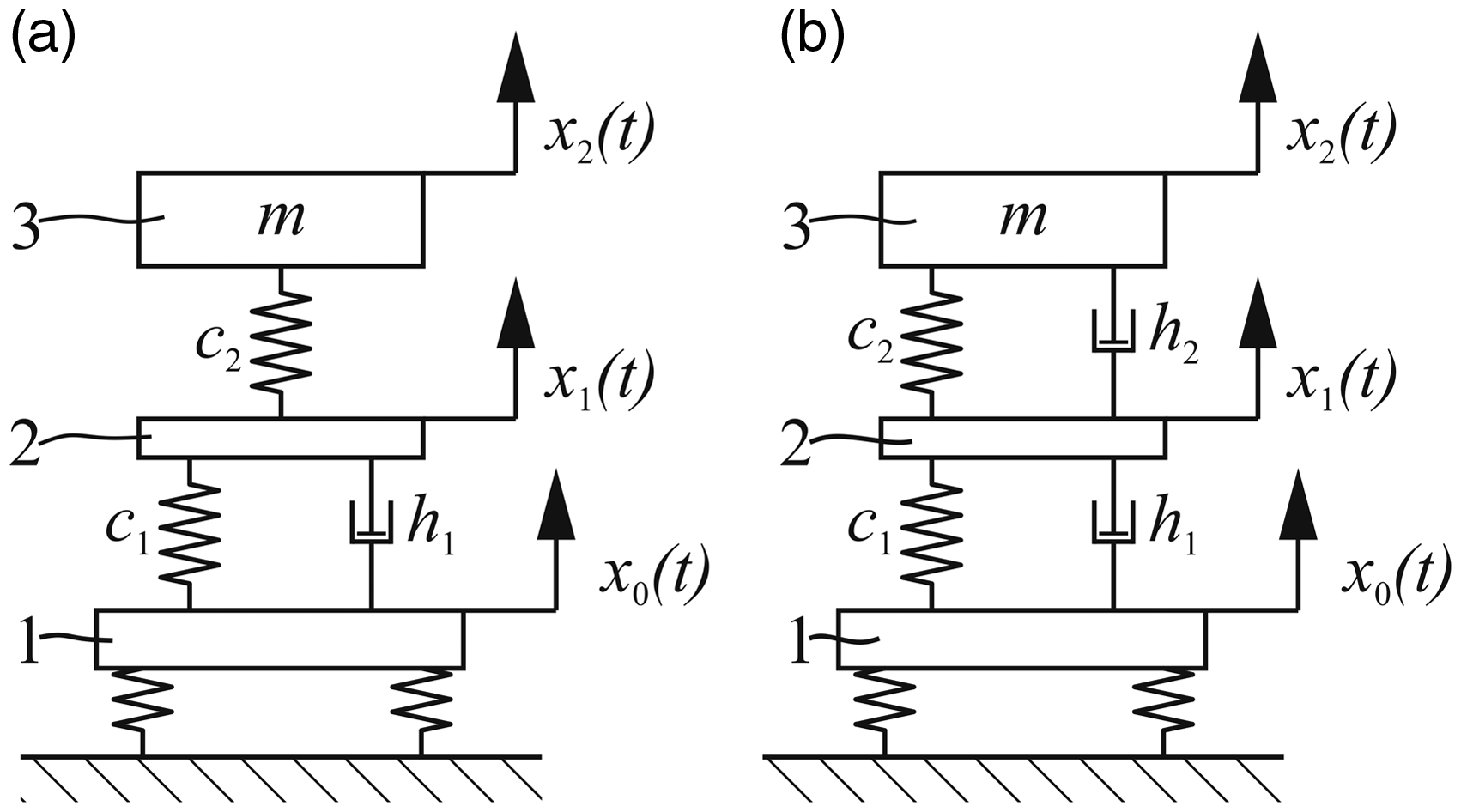
Dynamic models of a complex vibration isolation system: (a) when only elastic damping (c2) exists and (b) when the system of quasi-zero stiffness ensures viscose-elastic damping (c2 + h2).
The complex system consists of a vibrating platform (1), an optical table (2) with pneumatic vibration isolators and a vibration isolating system of quasi-zero stiffness (3) 17 with mass m. For simplifying the theoretical expression, the mass of the optical table plate (2) is ignored.
The differential equation of movement of the complex system (Figure 1(a) and (b)) shall be written as follows

The system is analysed for two cases: when the quasi-zero mechanism ensures only elastic damping (Figure 1(a)) and when it ensures viscose-elastic damping (Figure1(b)).
When the quasi-zero mechanism of the complex vibration isolation systems ensures only elastic damping (Figure 1(a), elasticity c2), and the platform is affected by kinematic harmonious excitation


The transmissibility of the amplitude of the relative acceleration of the system is expressed as follows

F confirms to expression (2).
The results of calculation of transmissibilities are provided in Figure 2(a) and (b).
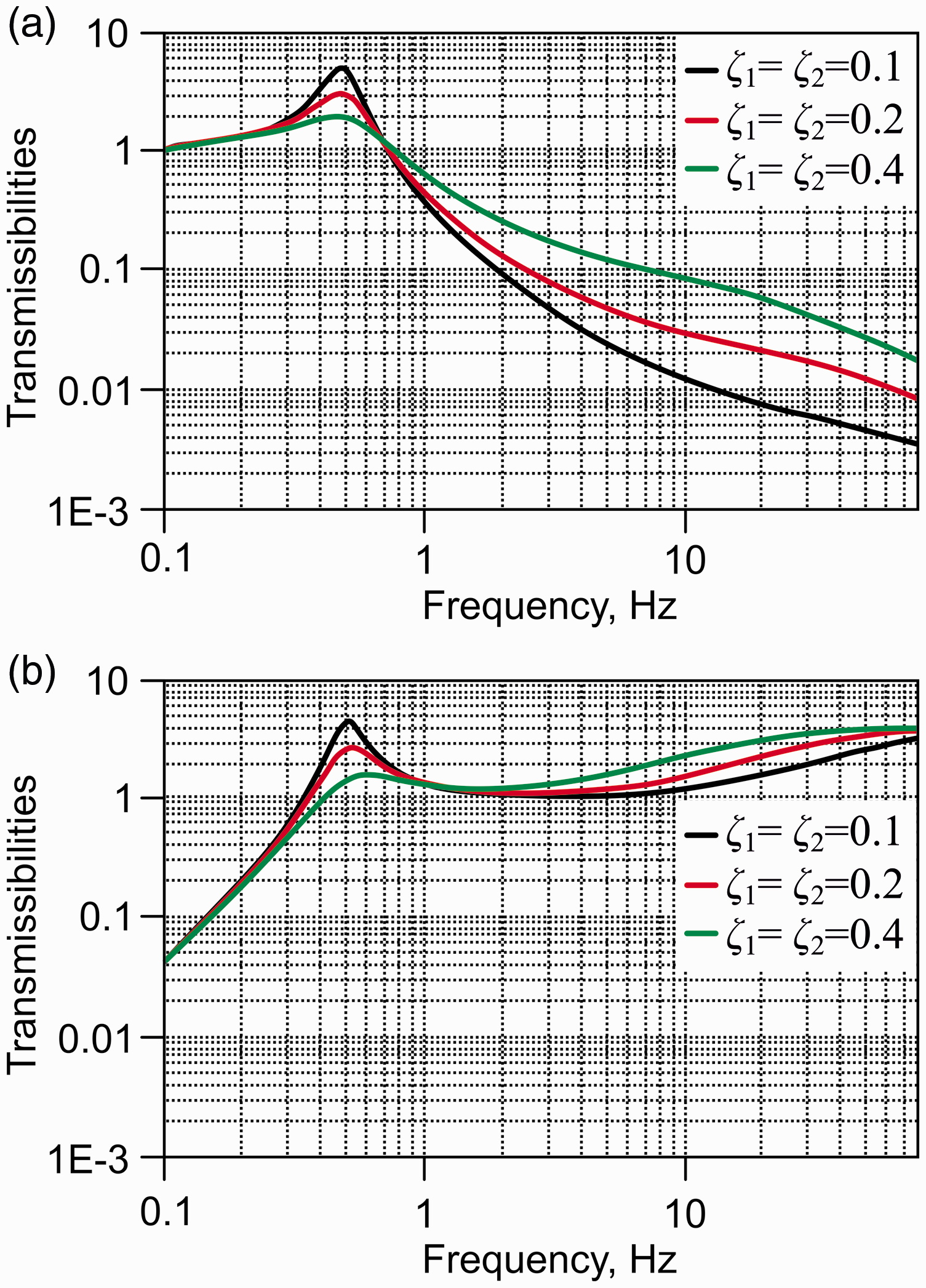
Transmissibilities of a system (Figure 1(a)): (a) the transmissibility of the amplitude of the absolute acceleration (formula (2)) and (b) the transmissibility of the amplitude of the relative acceleration (formula (3)).
In the second case (Figure 1(b)), the transmissibilities of amplitudes of the acceleration of the system vibrations are found from the solution of equation (1).18–20 When the platform is affected by kinematic harmonious excitation

And the transmissibility of amplitudes of the relative acceleration of the system vibrations is given by
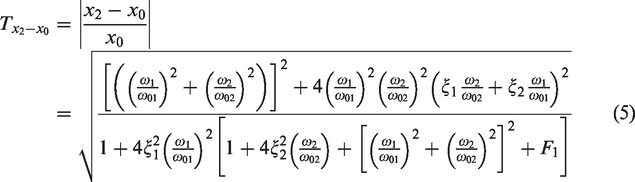
The value of F1 conforms to expression (4).
The results of calculation of transmissibilities are provided in Figure 3(a) and (b).
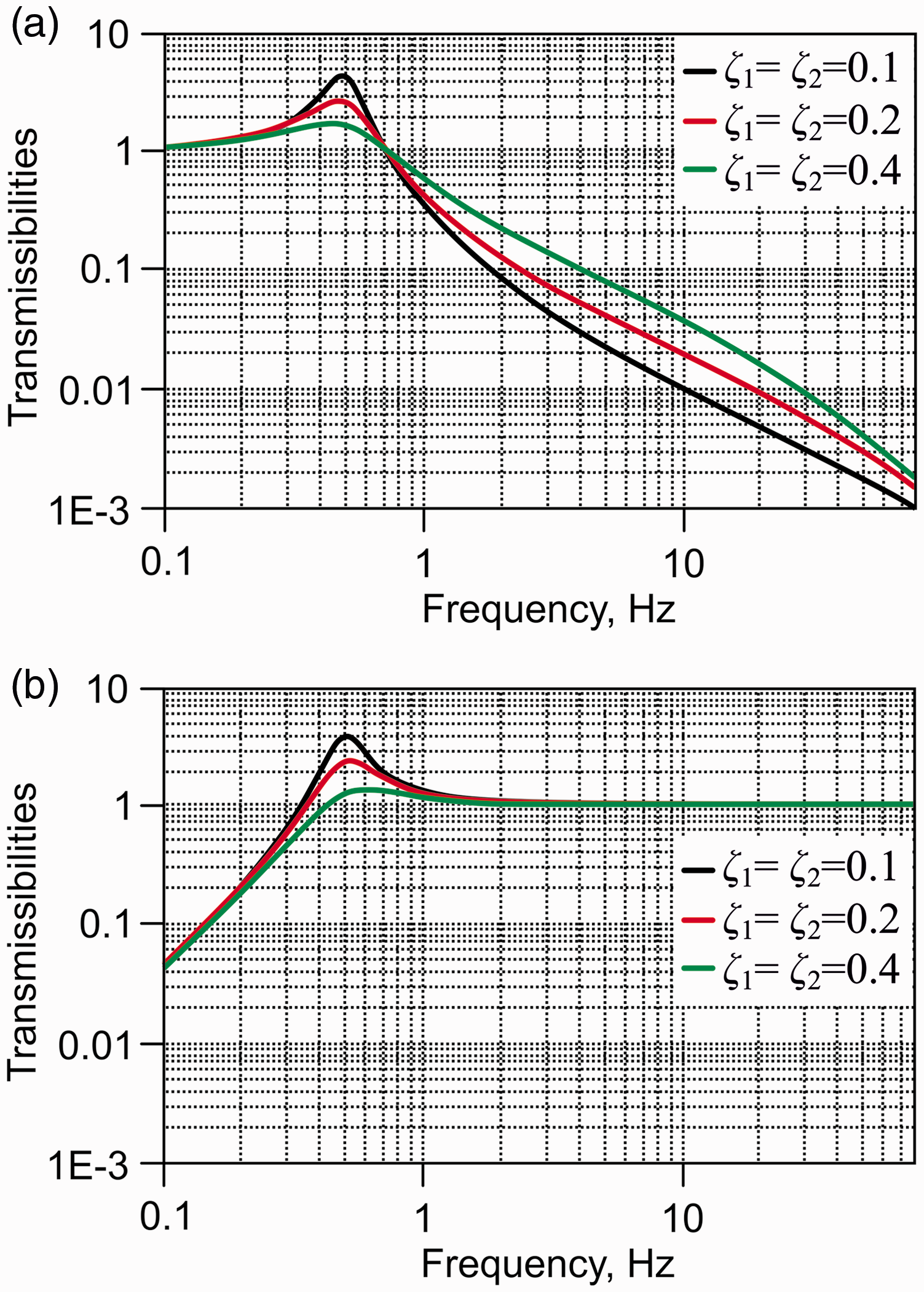
Transmissibilities of a complex system (Figure 1(b)): (a) the transmissibility of the amplitude of the absolute acceleration (formula (4)) and (b) the transmissibility of the amplitude of the relative acceleration (formula (5)).
It is seen from Figure 2(a) that if
Experimental tests
For the experimental tests, a special vibration isolation system has been designed and tested. The system consists of a vibrating platform, an optical table with pneumatic vibration isolators and a system of quasi-zero (negative) stiffness loaded with an allowable load of 330 kg.
The vibrator generated harmonious, impulse and random (white noise) vibrations in the range 0.1–50 Hz in the vertical direction.
The measurement signals will be processed by a computer by applying a set of programs “Origin 7.5.” The block scheme of the control and registration system is provided in Figure 4(a) to (c).
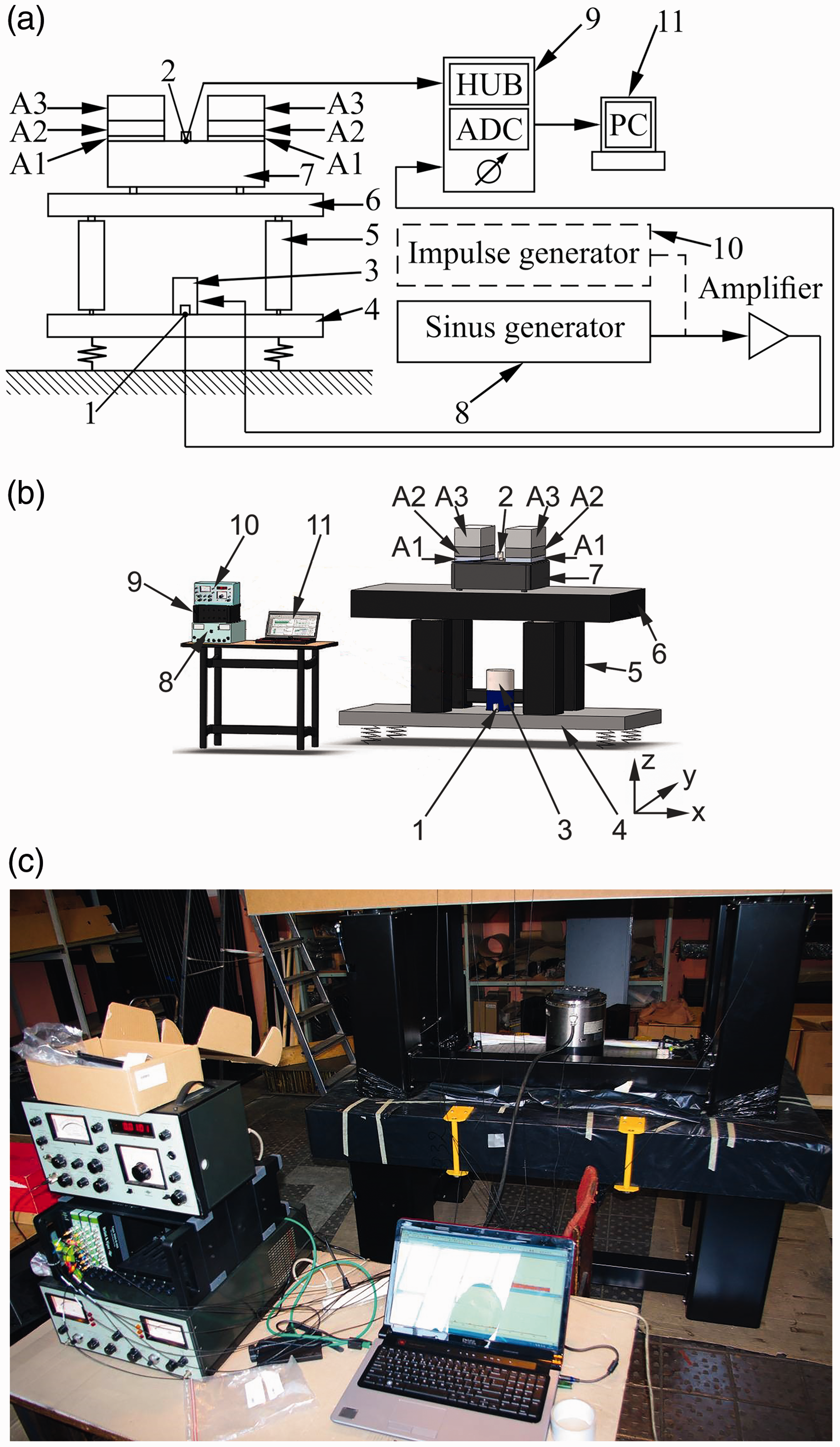
Scheme of the research stand (a), general view (b), photo (c). 1 and 2: accelerometers; 3: vibrator; 4: vibrating platform; 5: pneumatic isolators of vibration; 6: optical plate; 7: vibration isolation system of a quasi-zero stiffness; A1-A3 load 330 kg; 8: sinusoidal vibration generator; 9: amplifier with vibration analyser; 10: impulse vibration generator; 11: equipment of handling of measurement results “Machine Diagnostics Toolbox Type 9727” with computer DELL.
The time-response characteristics of low-frequency vibrations are provided in Figure 5(a) to (d) and in Figure 6(a) to (f).
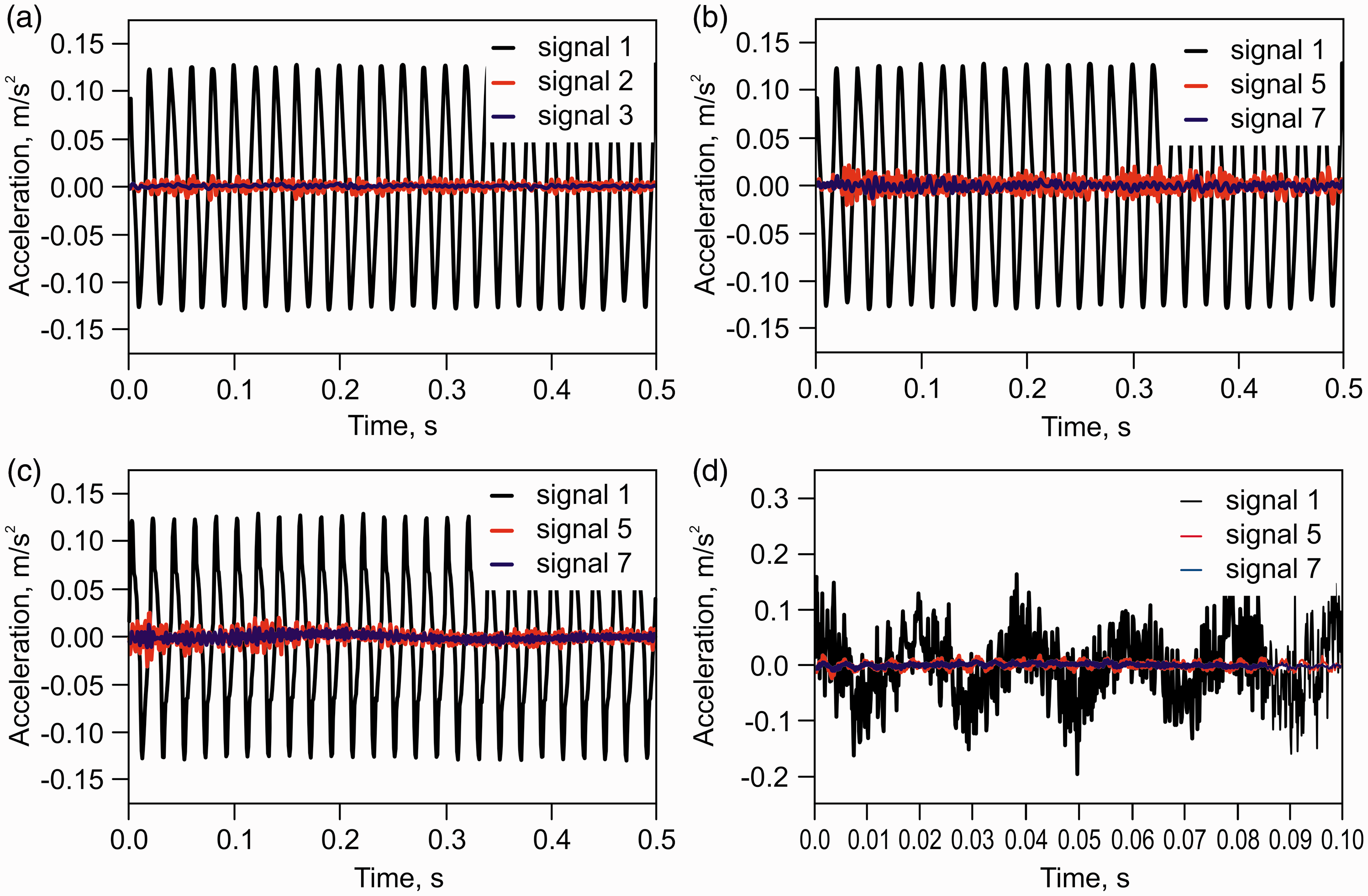
Isolation of low-frequency vibrations of a complex system: (a) harmonic excitation of 0.8 Hz; (b) harmonic excitation of 1.0 Hz; (c) harmonic excitation of 2.0 Hz; and (d) random excitation (white noise). The black, red and blue signals conform to the vibrations of the platform, the optical table and the system of quasi-zero stiffness, respectively.
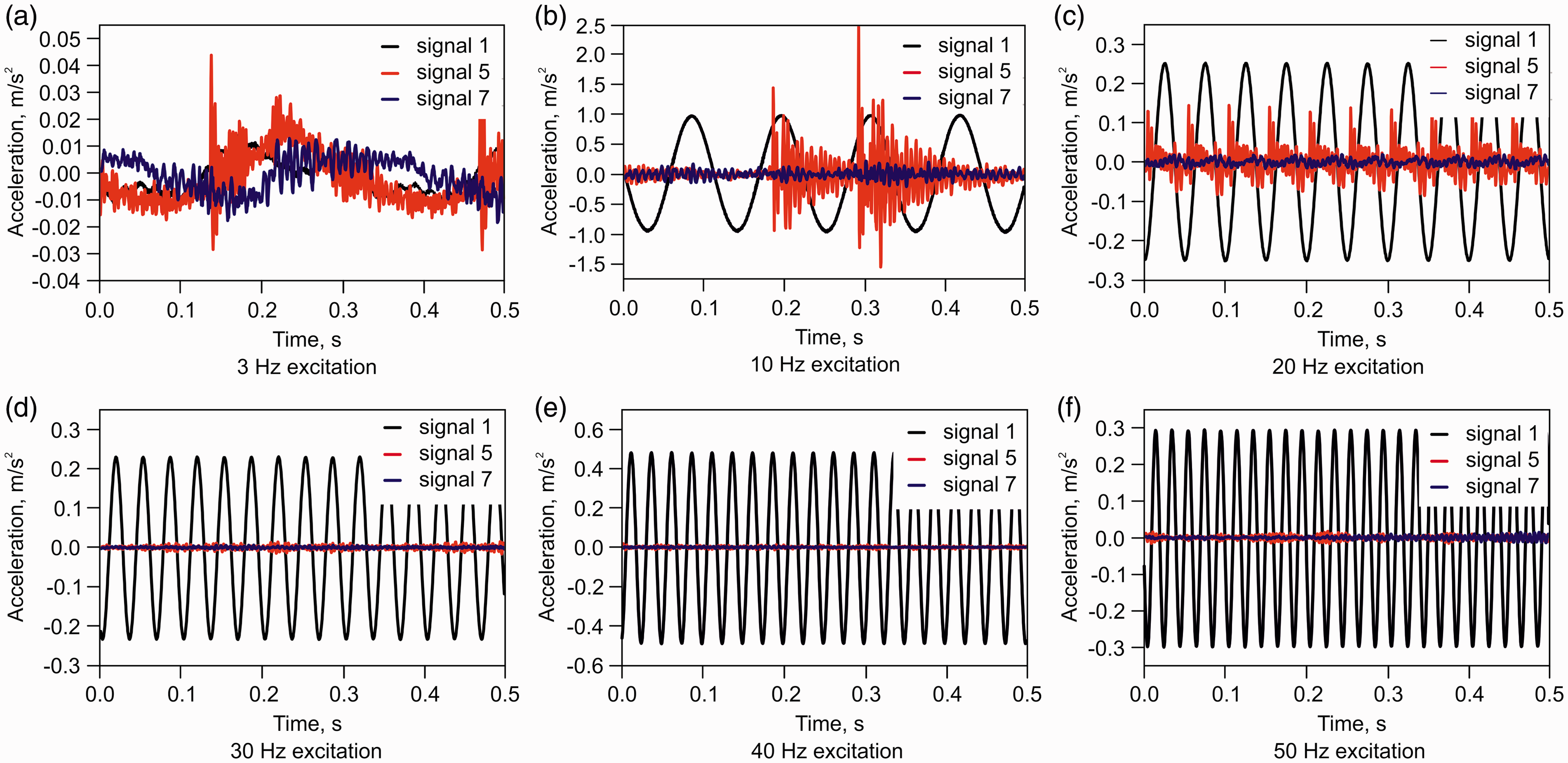
Results of isolation of harmonic vibrations of a complex system: (a) excitation of 3.0 Hz; (b) excitation of 10.0 Hz; (c) excitation of 20.0 Hz; (d) excitation of 30.0 Hz; (e) excitation of 40.0 Hz; and (f) excitation of 50.0 Hz. The black, red and blue signals conform to the vibrations of the platform, the optical table and the system of quasi-zero stiffness, respectively.
The obtained results show that the isolation of low-frequency vibration is effective in the range 0.8–2.0 Hz and not effective in the range 3.0–10.0 Hz; in the range from 10.0 Hz to 50.0 Hz, the vibrations are well isolated. Such complex systems are fit in a narrow range of low-excitation frequencies (0.8–2.0 Hz) only, and at higher excitation frequencies (over 10.0 Hz), vibrations are well isolated by a system of quasi-zero stiffness and the optical table with pneumatic vibration isolators.
Conclusion
In the course of an analytic research of the dynamic parameters of the complex of vibration isolation system, it is found that such systems damp well low-frequency vibrations from 0.8 Hz, when the mass of the plate of the optical table neglected, i.e. a single mass system examined. In course of the experimental research of the dynamic characteristics of the complex systems, it is found that a complex of vibration isolation system is fit for isolation of frequencies in the frequency range from 0.8 Hz to 2.0 Hz and in the frequency range from 10.0 Hz to 50.0 Hz. However, in the frequency range from 3.0 Hz to 10.0 Hz, a complex of vibration isolation system does not isolate vibrations and operates as an amplifier. The results may be applicable in designing low-frequency isolation equipment, in particular high-precision and sensitivity measuring systems.
Footnotes
Authors' note
A Kilikevicius is now affiliated to Institute of Mechanical Science, Vilnius Gediminas Technical University, Vilnius, Lithuania.
Declaration of conflicting interests
The author(s) declared no potential conflicts of interest with respect to the research, authorship, and/or publication of this article.
Funding
The author(s) received no financial support for the research, authorship, and/or publication of this article.