This study is based on an analytical approach for nonlinear vibration of nonlinear evaluation equations which arises in shallow water waves. This approach is, coupled with variational iteration method and Laplace transformation, known as He–Laplace method. In order to show the capability of the proposed method, He’s polynomials are employed to handle nonlinear terms in illustrated problems due to specific limit of Laplace transformation. Significant results and their graphical representations demonstrated that He–Laplace method is most suitable for nonlinear problems, and it is enormously active for nonlinear vibrations and nonlinear waves.
Mathematical modeling of many physical system leads to nonlinear ordinary or partial differential equations (PDEs) in numerous fields of physics and engineering.1–4 It is well known that the investigation of the exact solutions of nonlinear PDEs plays an important role in the study of nonlinear physical phenomena. The Boussinesq equation appears in studying the transverse motion and nonlinearity in acoustic waves on elastic rods with circular cross section. This equation also arises in other physical applications such as nonlinear lattice waves,5 iron sound waves in plasma,6 and vibrations in a nonlinear string.7 Kaya8 investigated the explicit solution of generalized Boussinesq equation using Adomian decomposition scheme. Yu et al.9 estimated multiple soliton solutions of the Boussinesq equation in the light of some suitable transformations. Wazwaz10–13 investigated different approaches for the solution of Boussinesq equation and showed reliable results to nonlinear evolution equation. Jawad14 obtained exact solution for cubic Boussinesq and modified Boussinesq using tanh method, sech method, and sine-cosine method equations. Mousa and Kaltayev15 constructed approximate and exact solutions for Boussinesq equations using homotopy perturbation Padé technique.
The idea of variational iteration method was developed by He16–18 and was introduced as a powerful tool in various kinds of nonlinear problems.19,20 Another efficient iterative technique was introduced to solve nonlinear differential equations, known as homotopy perturbation method.21–24 Recently, Khuri and Sayfy25 developed a technique for the solution of differential equations applying Laplace variational iteration strategy and many researchers26–29 demonstrated the efficiency of this method with various kinds of ordinary and PDEs but all these techniques have some limitations.
In this paper, we are interested in applying He–Laplace method to obtain approximate, analytical, and exact solutions of the cubic Boussinesq and modified Boussinesq equations. The significant results show that He–Laplace method is suitable for nonlinear vibration in shallow water waves.
Basic idea of homotopy perturbation method
To illustrate the basic concept of homotopy perturbation method, consider the following nonlinear functional equation
with boundary conditions
where A is a general functional operator, B is a boundary operator, f(r) is a known analytic function, and Γ is the boundary of the domain Ω. The operator A can be generally divided into two operators, L and N, where L is a linear, while N is a nonlinear operator. Therefore, equation (1) can be written as follows
Using the homotopy technique, we construct a homotopy which satisfies
or
where is called homotopy parameter, and u0 is an initial approximation for the solution of equation (1), which satisfies the boundary conditions. According to HPM, we can use p as a small parameter, and assume that the solution of equation (5) can be written as a power series in p
Considering p = 1, the approximate solution of equation (1) will be obtained as follows
Construction of He–Laplace method
In order to construct He–Laplace method, we may take the Laplace transform of equation (3) and obtain
Multiplying the above equation with Lagrange multiplier, say , we get
operating with Laplace transform
therefore, the recurrence relation becomes
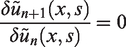
This recurrence relation is known as the Laplace variational method, taking the variation of equation (9)
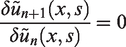
To identify the value of Lagrange multiplier with the help of Laplace transform, we reveal that is a restricted variable, i.e. and
Now, taking the inverse Laplace transform of equation (9) as follows
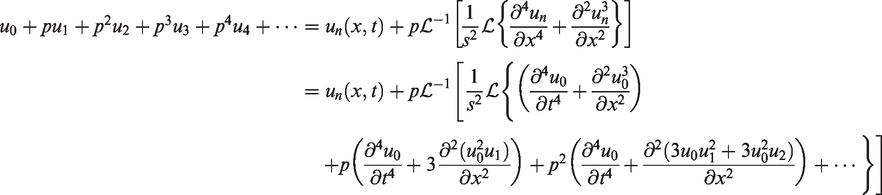
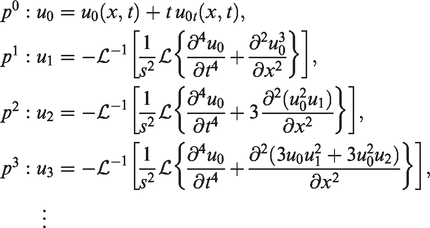
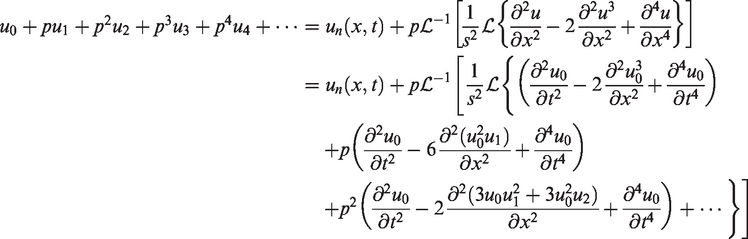
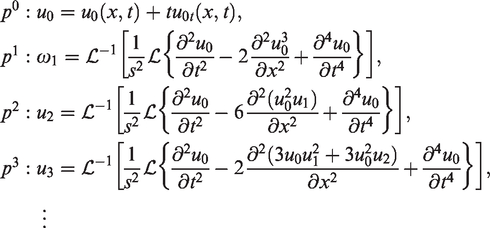
Finally, the homotopy perturbation method is implemented to investigate the approximate solution, obtained by substituting the calculated coefficients from equation (7).
Analysis of the method
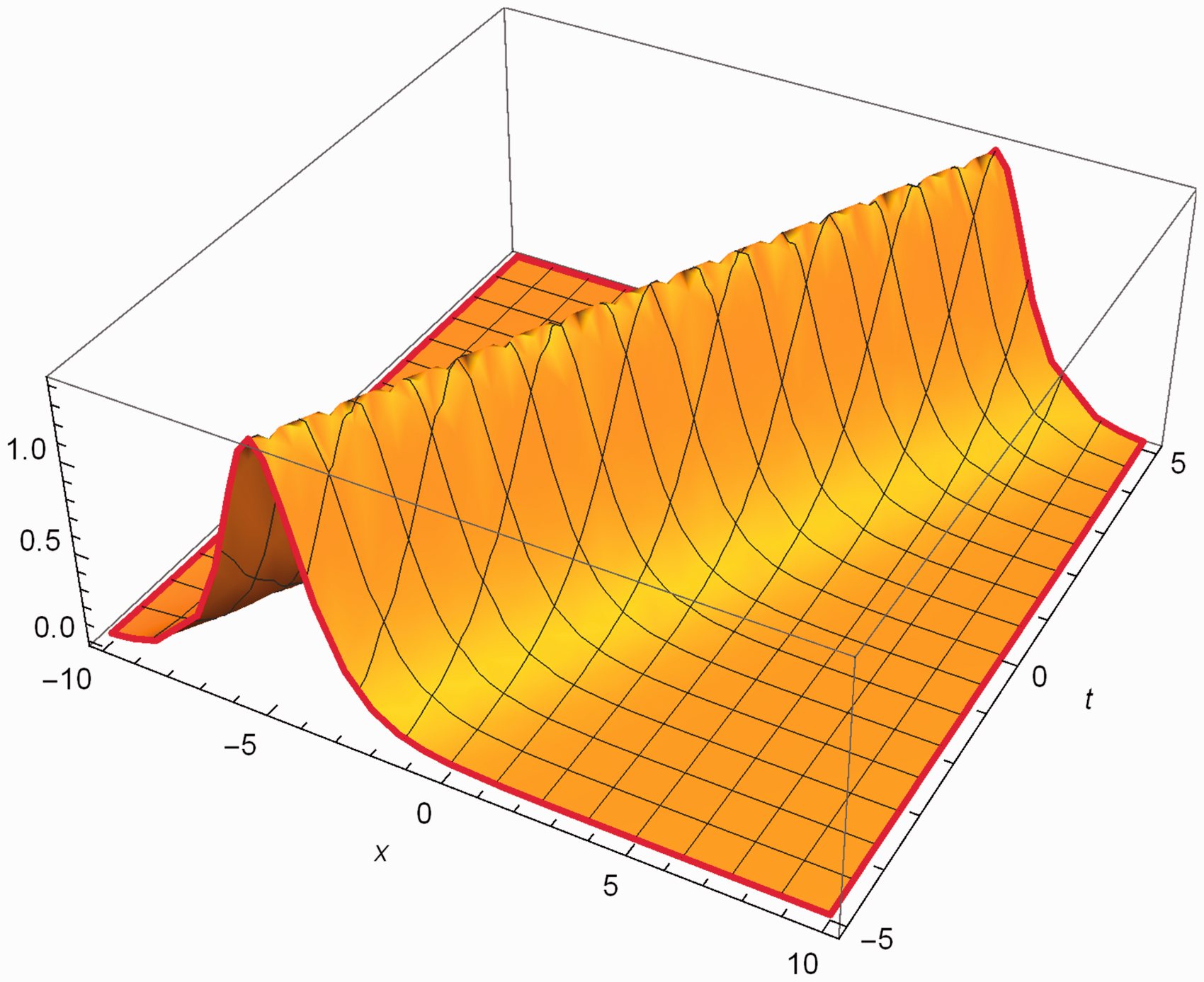
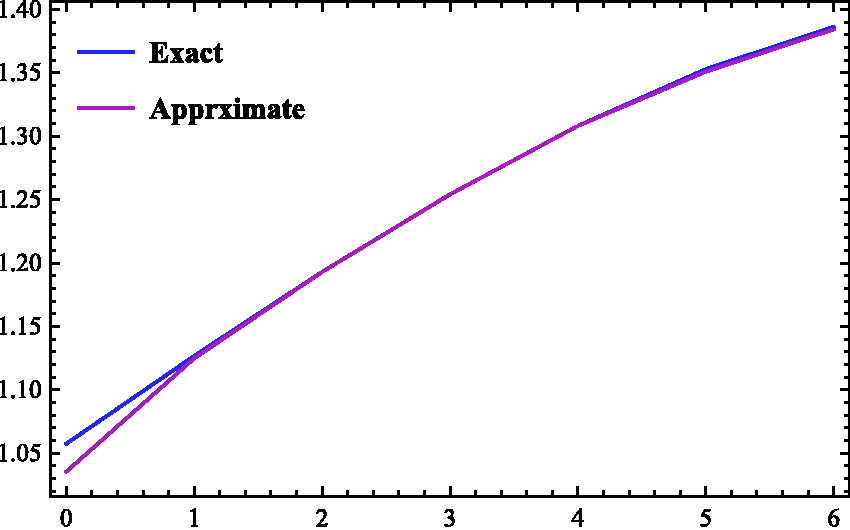
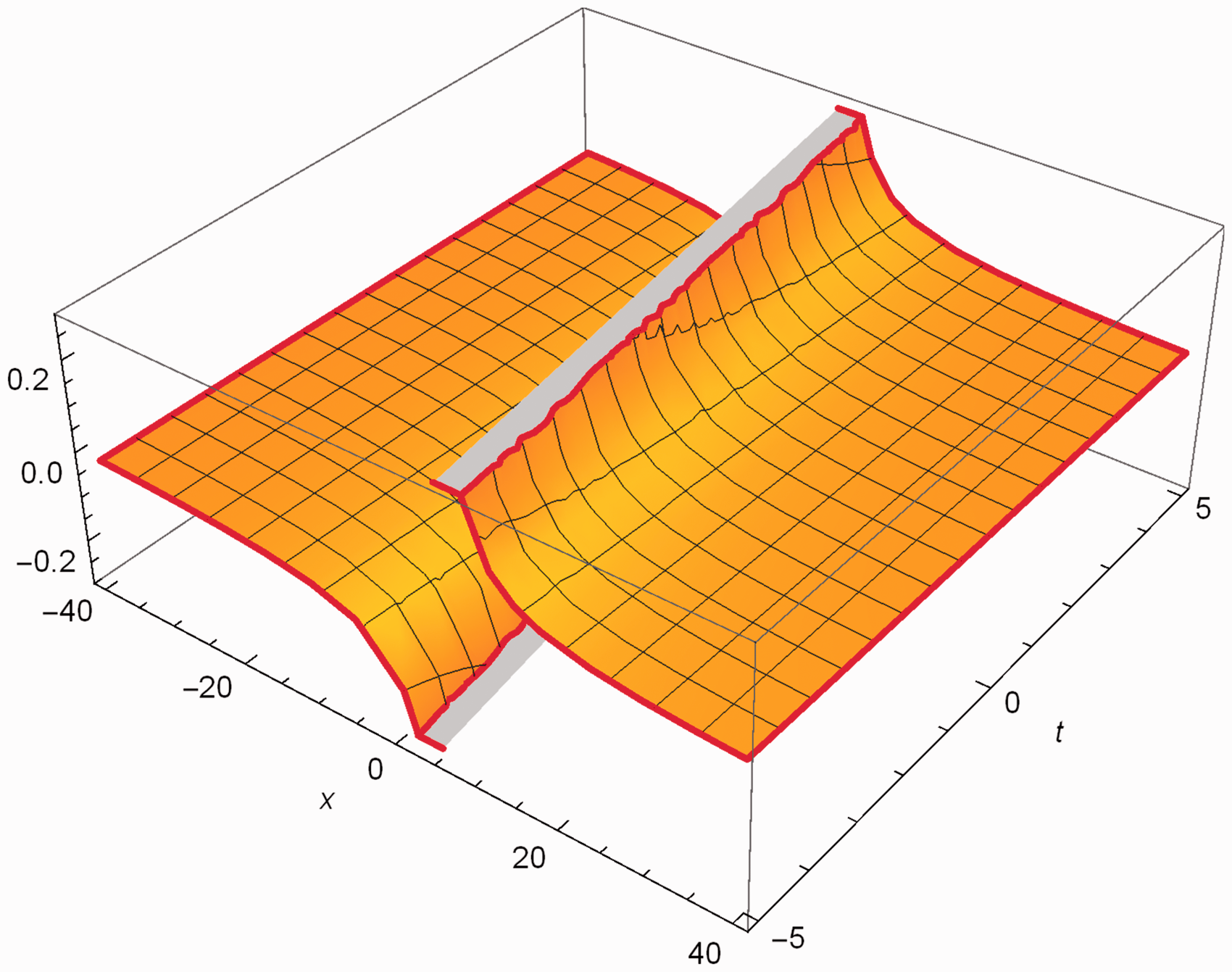
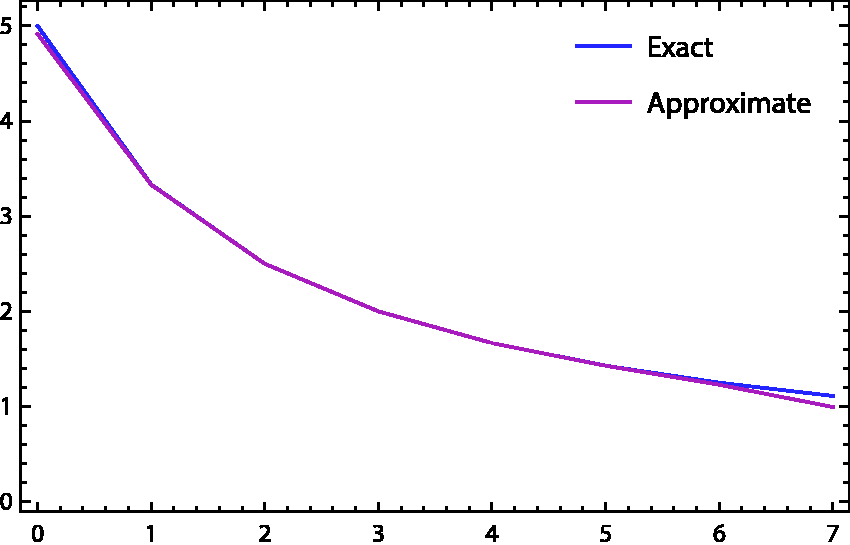
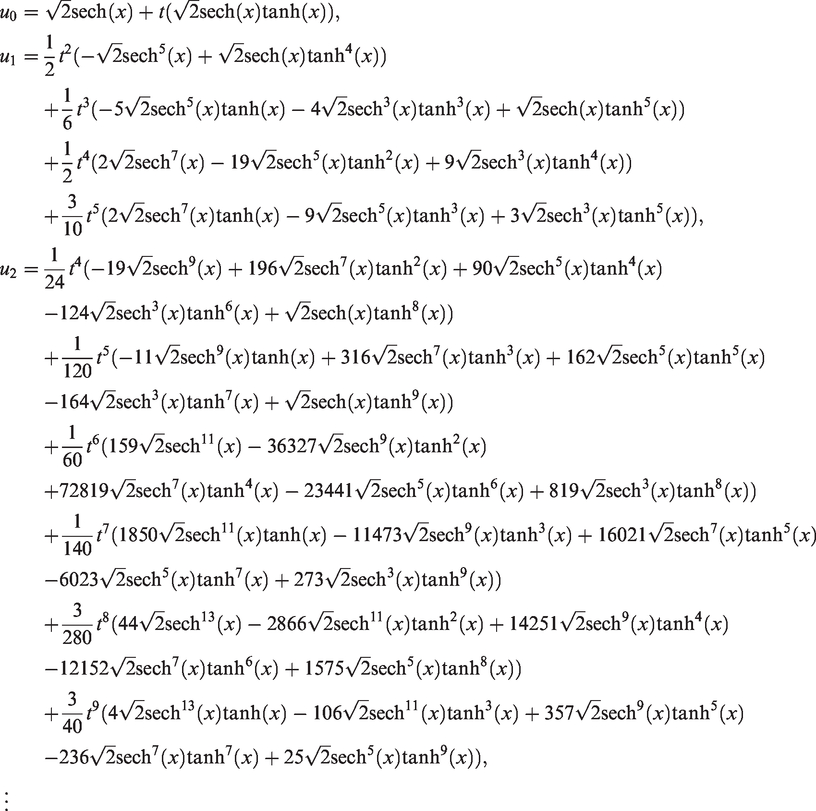
In this section, He–Laplace method is applied for solving modified Boussinesq equation and cubic Boussinesq equation. The results show that He–Laplace method is very effective and valid for nonlinear evolution equations. Figures 1 and 3 show the behavior of illustrated problems, while Figures 2 and 4 show the error between exact solution and approximate solution.
Behavior of u(x, t) with and .
Error between exact solution and approximate solution.
Behavior of u(x, t) with and .
Error between exact solution and approximate solution.
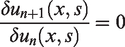
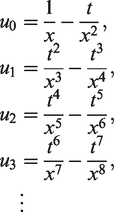
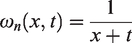
Using Taylor’s series, the exact solution converges to
Conclusions and future work
In this article, He–Laplace method is provided for strongly nonlinear vibration of nonlinear evolution equations. The following conclusions are made:
This method is applied in a direct way without using linearization, transformation, discretization, or restrictive assumptions.
The suggested He–Laplace method is a key solution for nonlinear issues in the field of nonlinear vibration and nonlinear waves.
The recommended scheme is quick and influential for analytical solution of nonlinear problems.
It is an open problem for readers that He–Laplace method can be employed for fractional heat- and wave-like equations.
Footnotes
Declaration of conflicting interests
The author(s) declared no potential conflicts of interest with respect to the research, authorship, and/or publication of this article.
Funding
The author(s) disclosed receipt of the following financial support for the research, authorship, and/or publication of this article: This work is supported by National Natural Science Foundation of China (Grant No. 11571057).
References
1.
WangKJSunHCLiCL, et al.
Thermal management of the hotspots in 3-d integrated circuits. Therm Sci2018;
22: 1685–1690.
2.
WangKJSunHCPanZL.An analytical thermal model for three-dimensional integrated circuits with integrated micro-channel cooling. Therm Sci2017;
21: 1601–1606.
3.
WangKJPanZL.An analytical model for steady-state and transient temperature fields in 3-D integrated circuits. IEEE Trans Compon Packag Manufact Technol2016;
6: 1026–1039.
4.
WangKLWangKJ.A modification of the reduced differential transform method for fractional calculus. Therm Sci2018;
22: 1871–1875.
5.
DaripaPHuaW.A numerical study of an ill-posed Boussinesq equation arising in water waves and nonlinear lattices: filtering and regularization techniques. Appl Math Comput1999;
101: 159–207.
6.
NagasawaTNishidaY.Mechanism of resonant interaction of plane ion-acoustic solitons. Phys Rev A1992;
46: 3471.
7.
ZakharovV.On stochastization of one-dimensional chains of nonlinear oscillators. Zh Eksp Teor Fiz1973;
65: 7.
YuJSunQZhangW.Multiple soliton solutions of the Boussinesq equation. Phys Scr2005;
71: 129.
10.
WazwazAM.Compactons and solitary wave solutions for the Boussinesq wave equation and its generalized form. Appl Math Comput2006;
182: 529–535.
11.
WazwazA.Construction of soliton solutions and periodic solutions of the Boussinesq equation by the modified decomposition method. Chaos Soliton Fract2001;
12: 1549–1556.
12.
WazwazAM.Multiple-soliton solutions for the Boussinesq equation. Appl Math Comput2007;
192: 479–486.
13.
WazwazAM.A sine-cosine method for handling nonlinear wave equations. Math Comput Modell2004;
40: 499–508.
14.
JawadAJM.Soliton solutions for the Boussinesq equations. J Math Comput Sci2013;
3: 254–265.
15.
MousaMMKaltayevA.Constructing approximate and exact solutions for Boussinesq equations using homotopy perturbation Pade technique. World Acad Sci Eng Technol2009;
38: 3730–3740.
16.
HeJH.Variational iteration method – a kind of non-linear analytical technique: some examples. Int J Non-Linear Mech1999;
34: 699–708.
17.
HeJH.Variational iteration method for autonomous ordinary differential systems. Appl Math Comput2000;
114: 115–123.
18.
HeJHWuXH.Variational iteration method: new development and applications. Comput Math Appl2007;
54: 881–894.
19.
WazwazAM.The variational iteration method for rational solutions for KdV, K (2, 2), burgers, and cubic Boussinesq equations. J Comput Appl Math2007;
207: 18–23.
20.
YusufogluEBekirA.Numerical simulations of the Boussinesq equation by He’s variational iteration method. Int J Comput Math2009;
86: 676–683.
HeJH.Homotopy perturbation method: a new nonlinear analytical technique. Appl Math Comput2003;
135: 73–79.
23.
HeJH.Application of homotopy perturbation method to nonlinear wave equations. Chaos Soliton Fract2005;
26: 695–700.
24.
WuYHeJH. Homotopy perturbation method for nonlinear oscillators with coordinate-dependent mass. Results Phys2018; 10: 270–271. DOI: 10.1016/j.rinp.2018.06.015
25.
KhuriSASayfyA.A Laplace variational iteration strategy for the solution of differential equations. Appl Math Lett2012;
25: 2298–2305.
26.
Kumar MishraHNagarAK. He-Laplace method for linear and nonlinear partial differential equations. J Appl Math2012; 16.
27.
GuptaSKumarDSinghJ.Analytical solutions of convection–diffusion problems by combining Laplace transform method and homotopy perturbation method. Alexandria Eng J2015;
54: 645–651.
28.
LiuZJAdamuMYSuleimanE, et al.
Hybridization of homotopy perturbation method and Laplace transformation for the partial differential equations. Therm Sci2017;
21: 1843–1846.
29.
Filobello-NinoUVazquez-LealHSarmiento-ReyesA, et al.
Laplace transform–homotopy perturbation method with arbitrary initial approximation and residual error cancelation. Appl Math Modell2017;
41: 180–194.