




Abstract
This study suggests a new approach for solving telegraph equation, commonly called damped wave equation, arising in electromagnetic waves and propagation of electrical signals. In this paper, He–Laplace method, formulated by He’s variational iteration method and Laplace transformation, is used to find the exact solution or a closed approximate solution of differential equations. The most distinct aspect of this method is that there is no need to calculate integration for next iterations in recurrence relations and convolution theorem is kept away to calculate the Lagrange multipliers in Laplace transformation. Moreover, He’s polynomials via homotopy perturbation method is introduced to bring down the computational work in nonlinear terms as Laplace transform has some limitation to nonlinear terms. The results obtained by proposed method indicate that this approach is easy to implement and converges rapidly to exact solution. Several problems are illustrated to demonstrate the accuracy and stability of this method.
Introduction
Nonlinear vibration systems generally are characterized by instable response, chaos, bifurcation phenomena, and other relatively complex behaviors of vibration. In most cases, these vibration phenomena arise from a large number of factors such as electric field force, nonlinear damping, and large elastic deformation.
1
Thus, a better understanding of the nonlinear vibration systems is essential for the study of vibration phenomena. Let the following variables: i is the current, u is the potential, L is the inductance, C is the capacitance, R is the resistance, and G is the leakage conductance. As a physical law that describes the change of the current and potential in a cable, it will end up with the system of first order partial differential equations, i.e.


Diff. equation (1) w.r.t. t and equation (2) w.r.t. x and solving them, we get


During past years, much attention has been attracted for the numerical solution of second-order hyperbolic equation. Azab and Gamel 2 developed a numerical algorithm for telegraph equation, which was based on Rothe’s approximation in time discretization and on the Wavelet-Galerkin in the spatial discretization. Pandit et al. 3 formulated a scheme coupled with Crank–Nicolson finite difference and Haar wavelets to analyze the hyperbolic telegraph equation with variable coefficients. Evans and Bulut 4 developed an alternating group explicit (AGE) method to investigate the solution of telegraph equation. Ding et al. 5 studied the finite difference scheme in time direction for solving telegraph equation.
Recently, many numerical schemes have been introduced for two dimensional hyperbolic telegraph equations such as: three-level explicit difference scheme, 6 radial basis functions, 7 cubic B-spline collocation method, 8 polynomial scaling function, 9 and modified B-spline differential quadrature method. 10
The basic idea of variational iteration method (VIM) was first suggested by Inokuti, 11 where the identification of Lagrange multiplier was a difficult step. Later, VIM was proposed by a Chinese mathematician He12–14 and has been demonstrated by many researchers in various kinds of nonlinear problems.15–18 VIM explored the series solution which converges rapidly in terms of easily computable components. Biazar et al. 19 employed VIM for solving linear telegraph equation. Another efficient iterative technique was introduced to solve nonlinear differential equations, known as homotopy perturbation method.20–25 Many researchers26,27 developed a scheme coupled with Laplace transform and homotopy perturbation method to analyze the value of Lagrange multiplier. It is observed that, the value of the Lagrange multiplier is much difficult in some cases and all these methods have some limitations. To avoid these limitations, we introduce an easy approach to find the analytical solution of telegraph equations, called He–Laplace method.
Decomposition of nonlinear equations
In order to apply the homotopy perturbation method,20–25 consider the nonlinear equation

One usually rewrites the nonlinear equation (4) in the following form




In this method, one usually assumes that the solution


where

By equating the powers of p, one has
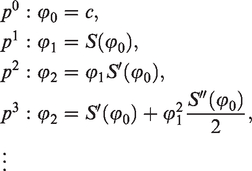
hence, equation (8) gives

He–Laplace method
Recently, the authors28,29 developed a scheme for solving some partial differential equations to identify the Lagrange multiplier in a new manner. In present paper, we used the Laplace transformation for the differential equation and then multiply it with the Lagrange multiplier to obtain the recurrence relation, which is restricted to identify the Lagrange multiplier. The importance of this way is that, recurrence relation neither involves the integral evaluations nor the convolution. Due to some limitations of Laplace transform on nonlinear terms, the homotopy perturbation method20–25 is employed to reduce the computational work. Finally, the approximate solution has been acquired by comparing the higher powers of p. In order to implement He–Laplace method, one may take the Laplace transform of equation (5)


One can find the recurrence relation given below

To identify the Lagrange multiplier
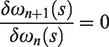
Now, taking the inverse Laplace transform of equation (10) as follows

Finally, the homotopy perturbation method has considered to investigate the series of approximate solution by equating the higher powers of p.
Numerical examples
In this section, He–Laplace method has been employed for the analytical treatment of telegraph equations. Results obtained from novel method are very encouraging and significant. Illustrated examples show the efficiency and validity of proposed scheme.
Example 1
Consider the following telegraph equation



Now taking the Laplace transform of equation (12)

Multiplying the above equation with

The recurrence relation takes the form

Now, taking the variation of equation (15)

This in turn gives
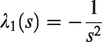
Notice that
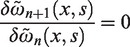
Using the value of

Taking inverse Laplace of above equation

By applying He’s polynomial formula, we acquire

It may also be written as
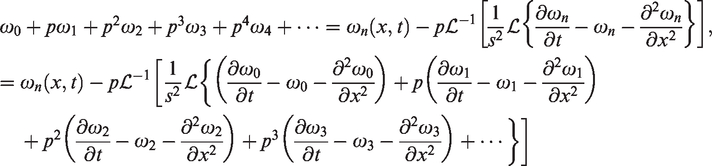
By equating highest powers of p
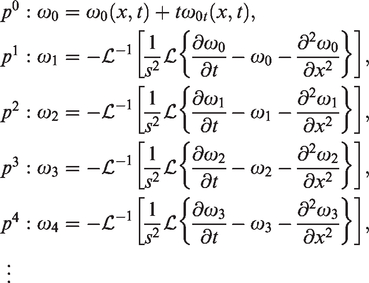
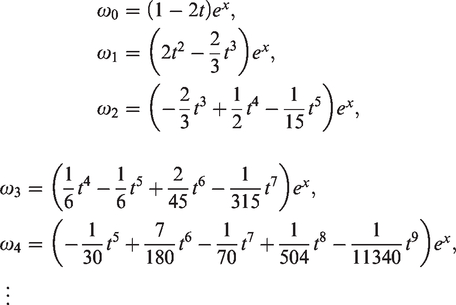

Using Talyor’s series, the exact solution converges to

Example 2
Consider the following telegraph equation



Now taking the Laplace transform of (16)

Multiplying the above equation with

The recurrence relation takes the form

Now, taking the variation of equation (19)

This in turn gives
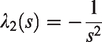
Notice that
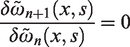
Using the value of

Taking inverse Laplace of above equation

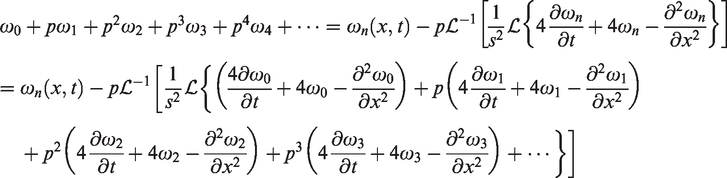
By applying He’s polynomial formula, we acquire

It may also be written as
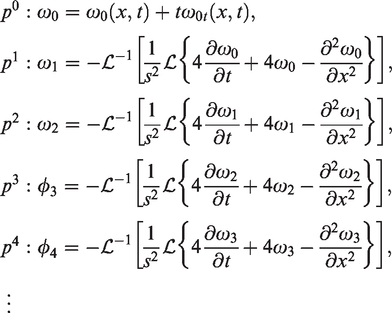
By equating highest powers of p
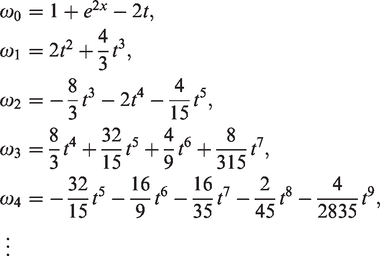

Using Talyor’s series, the exact solution converges to

Example 3
Consider the following telegraph equation



Now taking the Laplace transform of (20)

Multiplying the above equation with

The recurrence relation takes the form

Now, taking the variation of equation (23)

This in turn gives
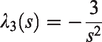
Notice that
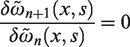
Using the value of

Taking inverse Laplace of above equation

By applying He’s polynomial formula, we acquire

It may also be written as
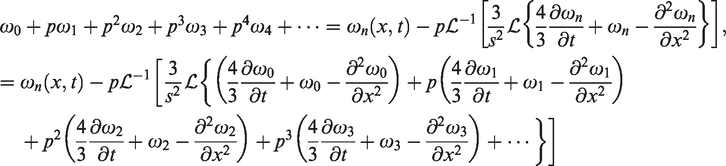
By equating highest powers of p
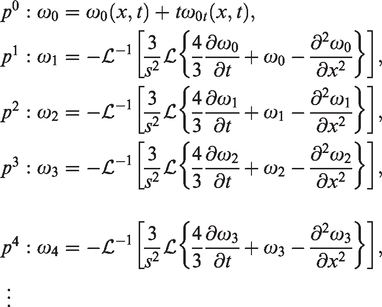
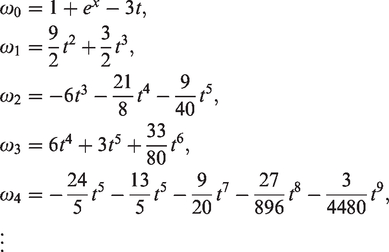

Using Talyor’s series, the exact solution converges to

Example 4
Consider the following telegraph equation



Now taking the Laplace transform of (24)

Multiplying the above equation with

The recurrence relation takes the form

Now, taking the variation of equation (27)

This in turn gives
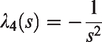
Notice that
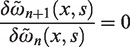
Using the value of

Taking inverse Laplace of above equation

By applying He’s polynomial formula, we acquire

It may also be written as
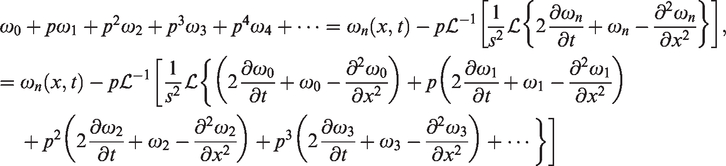
By equating highest powers of p
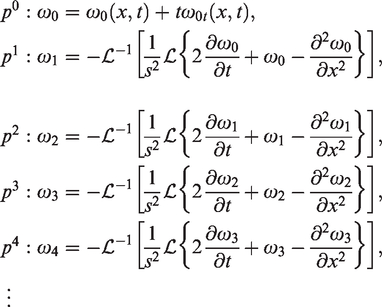
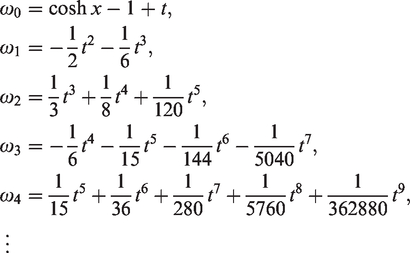

Using Talyor’s series, the exact solution converges to

Example 5
Consider the following nonlinear telegraph equation



Now taking the Laplace transform of (28)

Multiplying the above equation with

The recurrence relation takes the form

Now, taking the variation of equation (30)

This in turn gives
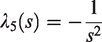
Notice that
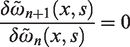
Using the value of

Taking inverse Laplace of above equation

Applying He’s polynomial formula, we acquire

It may also be written as
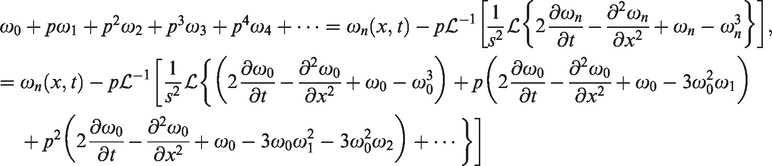
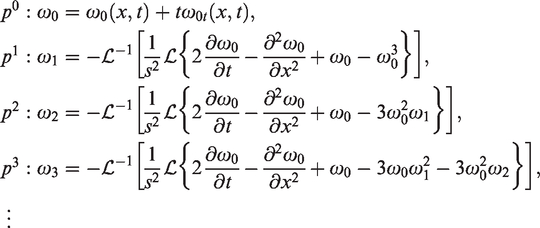
By equating highest powers of p

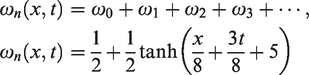
Using Talyor’s series, the exact solution converges to
Conclusions
In this article, He–Laplace method has been studied for solving linear and nonlinear telegraph equations which describe the voltage and current on an electrical transmission line with distance and time. It can be seen that, Laplace transform identified the Lagrange multiplier much easier than other existing methods, like VIM or Adomian decomposition method. No discretization, linearization, and small parameter assumptions are required, which in actual ruins the physical nature of the problems. Hence, it can be concluded that He–Laplace method is more appropriate and reliable for solving boundary value problems in science and engineering. On the basis of the above work, following conclusions are drawn:
He–Laplace method obtained significant results which showed the accuracy of telegraph equations. This approach avoids rounding off errors, discretization of the variables and any kind of assumptions. The proposed scheme is suitable for linear and nonlinear partial differential equations which yield exact solutions after few iterations. This method has direct approach for finding the Lagrange multiplier in both linear and nonlinear problems. It is obviously concluded that He–Laplace method is valid for not only nonlinear vibration equations, but also other nonlinear problems. All calculations are made by Mathematica Software 11.0.1.
Footnotes
Declaration of conflicting interests
The author(s) declared no potential conflicts of interest with respect to the research, authorship, and/or publication of this article.
Funding
The author(s) disclosed receipt of the following financial support for the research, authorship, and/or publication of this article: This work is supported by National Natural Science Foundation of China (grant no. 11571057).