




Abstract
This article is devoted to finding solutions of problems of vibration isolators with quasi-zero stiffness from a manufacturing point of view. The following study is appeared after experimental study and manufacturing of preproduction serial of universal isolators of a dome type. An analytical description of some types of vibration isolators with quasi-zero stiffness is briefly observed. The sensitivity of vibration isolators of a dome type is studied. It is proved that vibration isolators with quasi-zero stiffness require high precision at manufacturing. Dynamics of a group of vibration isolators is also analyzed. It appears that an average behavior of an isolator in a group may not coincide with the behavior of a single isolator. Due to the normal distribution of parameter, the total properties of the vibration isolator can be slightly changed.
Introduction
Many types of industrial equipment use high power. Such equipment may produce more vibration and noise even at normal functioning. Defects like rotor unbalance increase vibration very sharply. These factors have a negative influence on other equipment and staff. High vibration accelerates wear of machines, bearings and foundations. Noise during operation of equipment is uncomfortable for staff and in some cases may cause chronic diseases.1–3 Precision equipment also has a problem with regard to vibration. Therefore, isolation from external forces is required for the smooth process. Another example of harmful influence of vibration is heavy-duty vehicles: the driver suffers from high vibration and shocks, and hence it is required to use a seat suspension system with high vibration isolating properties.4,5 Also vibration can be caused by household appliances, for example by a washing machine. 6
For noise and vibration protection, different methods can be applied: adding weight to the equipment, application of vibration isolator, installation of dynamic damper, etc. In practice, the most convenient and effective way is to use vibration isolators. Traditional vibration isolators like spring or rubber ones work quite good at common conditions. But their application causes several problems in special cases. The disadvantage of traditional vibration isolators is the difficulty of obtaining a high degree of vibration isolation while maintaining the small dimensions.
For good vibration isolation, low natural frequency is required. But traditional vibration isolators usually introduce linear mechanical systems, so they require big dimensions for low natural frequency. This problem can be solved with the help of vibration isolators with quasi-zero stiffness.
Vibration isolator with quasi-zero stiffness effect (or just vibration isolator with quasi-zero stiffness) is introduced by a mechanical elastic system with flat area on its force characteristic. And this force characteristic has a point with stiffness close to zero. Such a system or isolator is also called as “systems with low stiffness” or “systems with high-static-low-dynamic-stiffness.”7,8 Sometimes these systems may be mentioned as a system with negative stiffness structure or a system with stiffness compensator. The principle sketch of force characteristic of system with quasi-zero stiffness is presented in Figure 1.
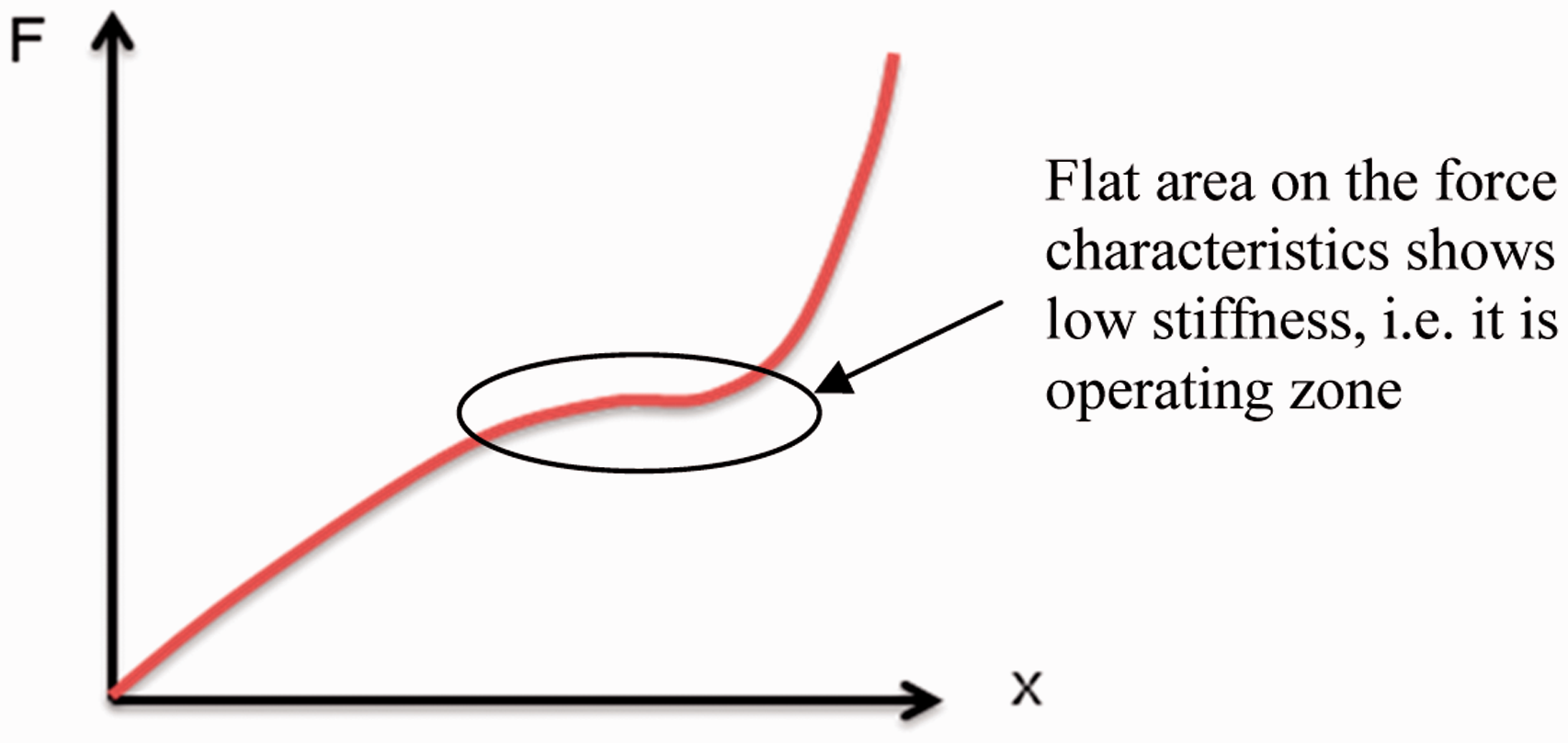
Force characteristic of mechanical system with quasi-zero stiffness.
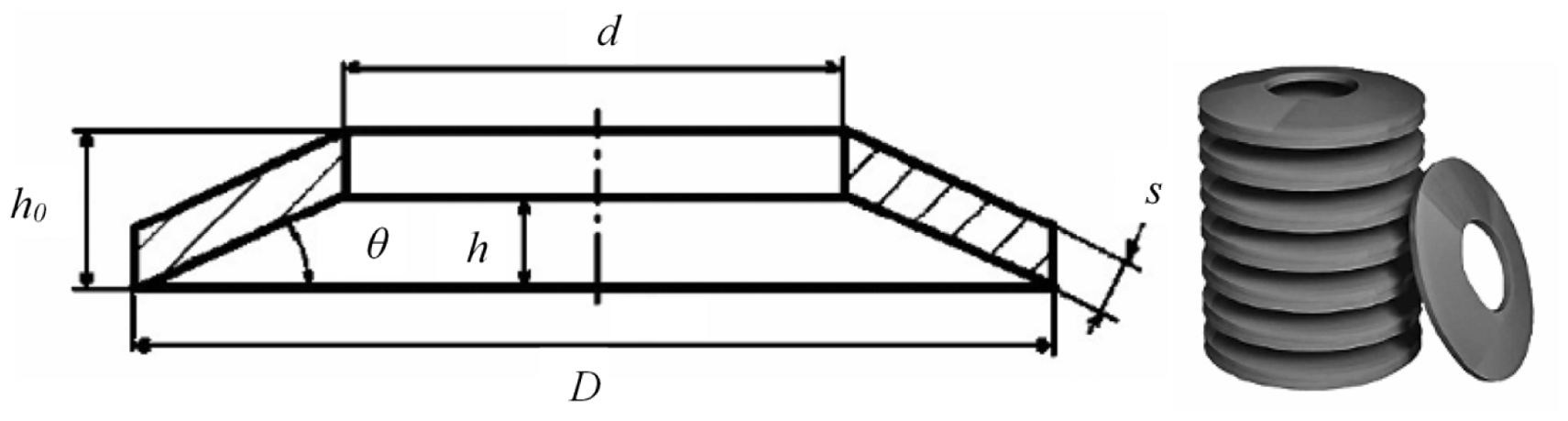
Disk spring: h – full height of the inner cone; s – thickness of spring cone; h0 – overall height of spring; D, d – outer and inner diameters.
Vibration isolators with quasi-zero stiffness present a very promising trend in mechanical engineering. The systems are very prospective in the vibration isolations in various fields, for example, industrial machines and equipment, vibration control of heavy-duty vehicles, workstation, hand-held machines, ship engines, precision equipment, aerospace equipment, etc. The systems provide simultaneously high static load and low dynamic stiffness. Low stiffness of the system with a significant static load reduces natural frequency up to less 1 Hz and allows isolating a wide range of vibration with high efficiency.
Study of vibration isolators with quasi-zero stiffness is presented by Alabuzhev et al. 7 who analyzed different types of passive systems with quasi-zero stiffness. Carrella 8 is also known due to the analysis of quasi-zero stiffness obtained by two inclined springs or two stable states (bistable plate).9–11 “Scissor-like” system with spring for obtaining quasi-zero stiffness is observed by Sun et al. 12 The systems can be also achieved by pneumatic active elements as reported in Le and Ahn. 13 Pneumatics are also used by Holtz and Van Niekerk 14 for a seat suspension. Application of quasi-zero stiffness effect for special hummock isolators is studied by Ponomarev.15,16 Another type of special hummock is studied by Tapia-Gonzales et al. 17 Also systems with quasi-zero stiffness of a passive type are proposed by Le and Ahn 18 and Maciejewski. 19
There is also a new prototype of vibration isolator with quasi-zero stiffness inspired by origami-based foldable cylinders with torsional buckling patterns. 20 Experimental study shows suppression of the transmission of vibrations with frequencies of over 6 Hz. It is also known that it is possible to obtain quasi-zero stiffness with cam–roller–spring mechanisms. 21
Systems with quasi-zero stiffness can be also obtained by active or semi-active methods. Seat suspensions with semi-active devices are proposed by Choi et al.22,23 Electromagnetic linear actuators are used by Gan et al. 24 and electric servomotor with a ball screw mechanism as the active seat suspension actuator is used by Kawana and Shimogo. 25 Electromagnetic systems are presented by Robertson et al. 26 Unfortunately, active systems with quasi-zero stiffness are usually rather expensive. Systems with quasi-zero stiffness controlled by rotor drive are presented by Donghong Ning et al. Also a vibration isolator with high-static–low-dynamic stiffness is made by Zheng et al. 27 It is implemented by connecting a negative stiffness magnetic spring in parallel with membrane springs to cancel its positive stiffness. The isolator consists of two coaxial ring magnets that are axially magnetized and their magnetization directions are the same. Quasi-zero stiffness can be also obtained with the help of off-road seat suspension system using intelligent active force control. 28
Often systems with quasi-zero stiffness are characterized by design complexity. The experiment of the author and other scientists shows that practical implementation of systems with quasi-zero stiffness is rather difficult. Any significant inclination of any parameter may spoil vibration isolator. It also may occur that since a serial of identical vibration isolator is made and the isolators are installed under a machine, their behavior may slightly differ from predicted one.
As it follows from the authors’ experience and experience of other scientists, vibration isolators with quasi-zero stiffness generally are rather sensitive. These need careful tuning. Application of such a vibration isolator in practice requires the study of potential inclination of parameters and analysis of its influence on efficiency of vibration isolation. Moreover, usually new prototypes of vibration isolators with quasi-zero stiffness are studied singly. But it is evident that a machine or an equipment requires a group of isolators (at least four). It is useful to know a difference of behavior between single isolators and a group of isolators.
Therefore, the goal of this study is to analyze the sensitivity of the vibration isolator with quasi-zero stiffness at designing and also to analyze the behavior of a group of vibration isolators with slightly different parameters.
Analytical base for designing of vibration isolators with quasi-zero stiffness
At this time there are several ways of analytical description of vibration isolators with quasi-zero stiffness. In general, systems with quasi-zero stiffness can be described by polynomial of the third order. In this case, the restoring force equals

The initial conditions should be added. First of all, restoring force at zero compression equals zero

Consider that operating load F0, i.e. load when stiffness is minimum, corresponds to compression x0

For obtaining quasi-zero stiffness, the bend on the graph of force characteristic should be defined, so a point of inflection should be at the operating load

At the operating load, stiffness of the systems should be equal to zero or a small value c0


Equation (1) leads to

Equation (2) leads to

For further analysis, consider the exact type of vibration isolator with quasi-zero stiffness. It is known that disk springs (also called Belleville springs) after some addition and rework may have a quasi-zero effect (Figure 2).29,30
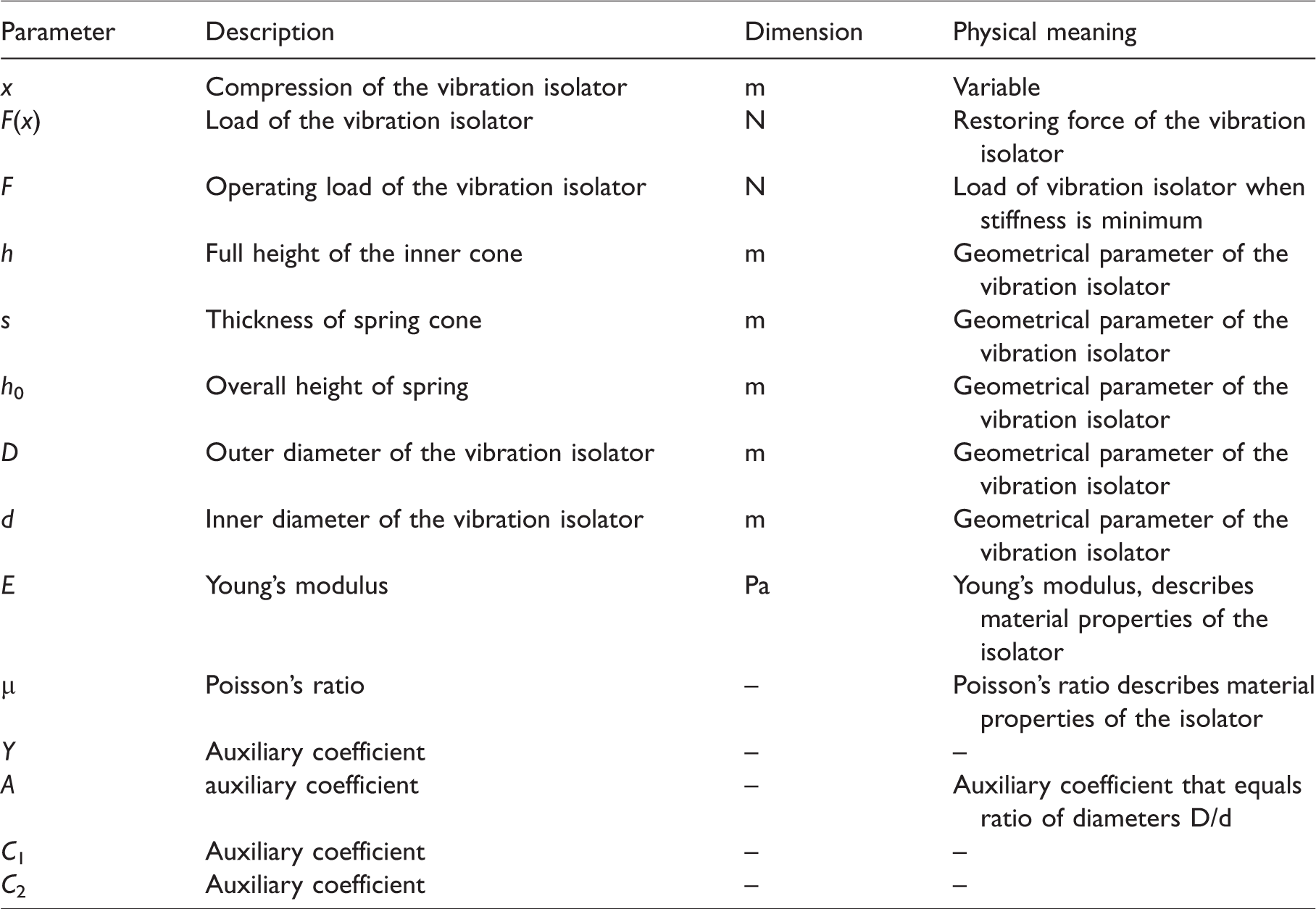
For description of vibration isolator with quasi-zero stiffness of a disk type, the following parameters are used (Table 1).
Description of parameters of isolator with quasi-zero stiffness of a disk type.
Dependence between the load F operating on the disk spring and its compression x is determined by the formula
28

Coefficient Y equals

Coefficient A equals

The effect of quasi-zero stiffness should be the following

After conversion, h = √2 s. In this case, quasi-zero stiffness effect is observed at x = h. Hence, the operating load value equals

The highest stress equals



Consider the relationship between the restoring force F and the highest tensile stress σ

As the coefficients C1, C2 depend only on A, this expression can be simplified. Linearization F/[σ] with confidence level R2 = 0.999 may be used

Mass of the disk spring equals to

Substituting D2 leads to

Assume that all values except A are constant and characterized by the properties of the spring material and determine the minimum of the function m(A). Minimum of this function corresponds to the A ≈ 1.65. Then, substitute the obtained value for the coefficients C1 and C2


After calculation, Y = 0.591. Then

Expressing wall thickness gives

Then values of D1 and D2 are obtained



With these formulas, vibration isolator with quasi-zero stiffness on the base of disk springs can be designed.
Note that disk spring without any changes in design is hard for application, because the disk spring has quasi-zero stiffness when it is flat (height of the cone h equals zero), i.e. it totally lay of foundation. On other hand, the disk spring must have a space for deformation; hence, something like a support should be used. Such a design of isolator is presented in Figure 3. To differentiate these two designs, the isolator in Figure 3 is named as “of a dome type.”
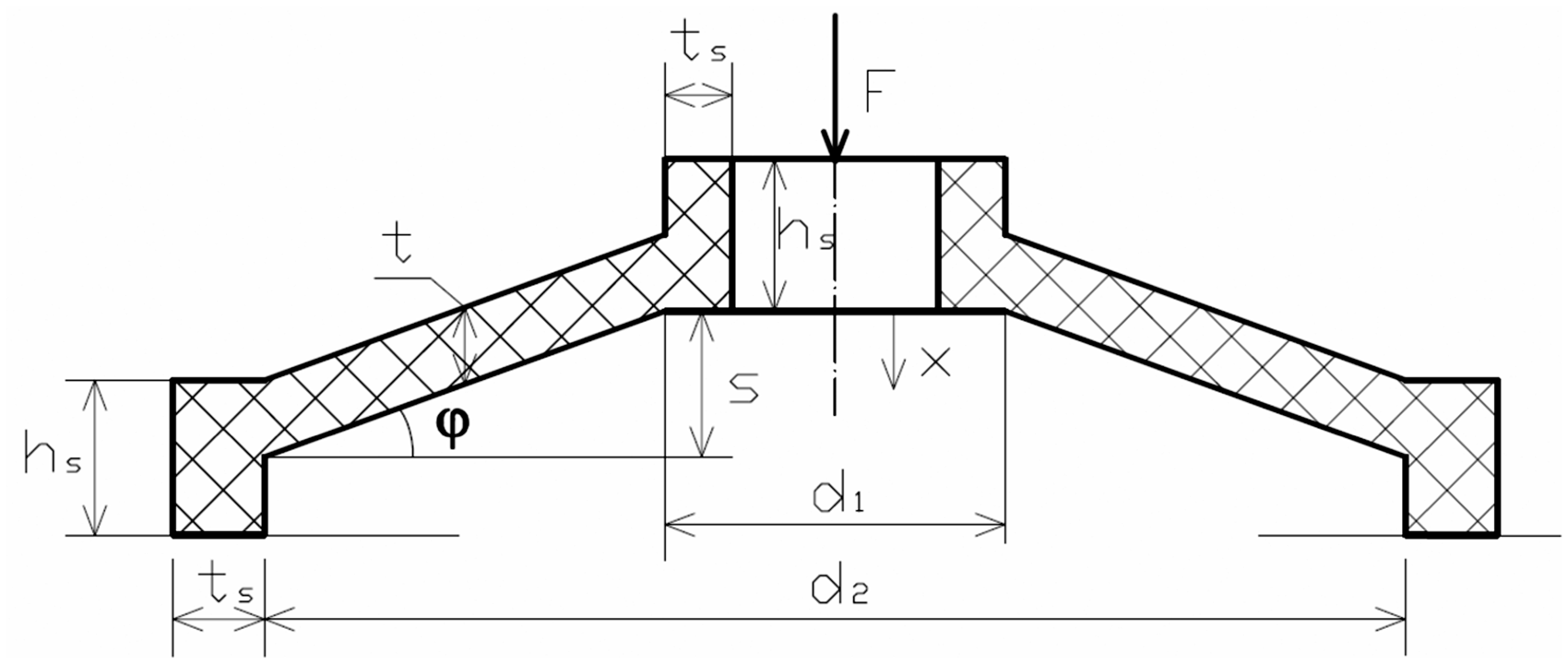
Vibration isolator with quasi-zero stiffness of a dome type.
For further description of vibration isolator with quasi-zero stiffness of a dome type, the following parameters are used (Table 2). A detailed derivation of the formulas in this article is omitted.
Description of parameters of isolator with quasi-zero stiffness a dome type.
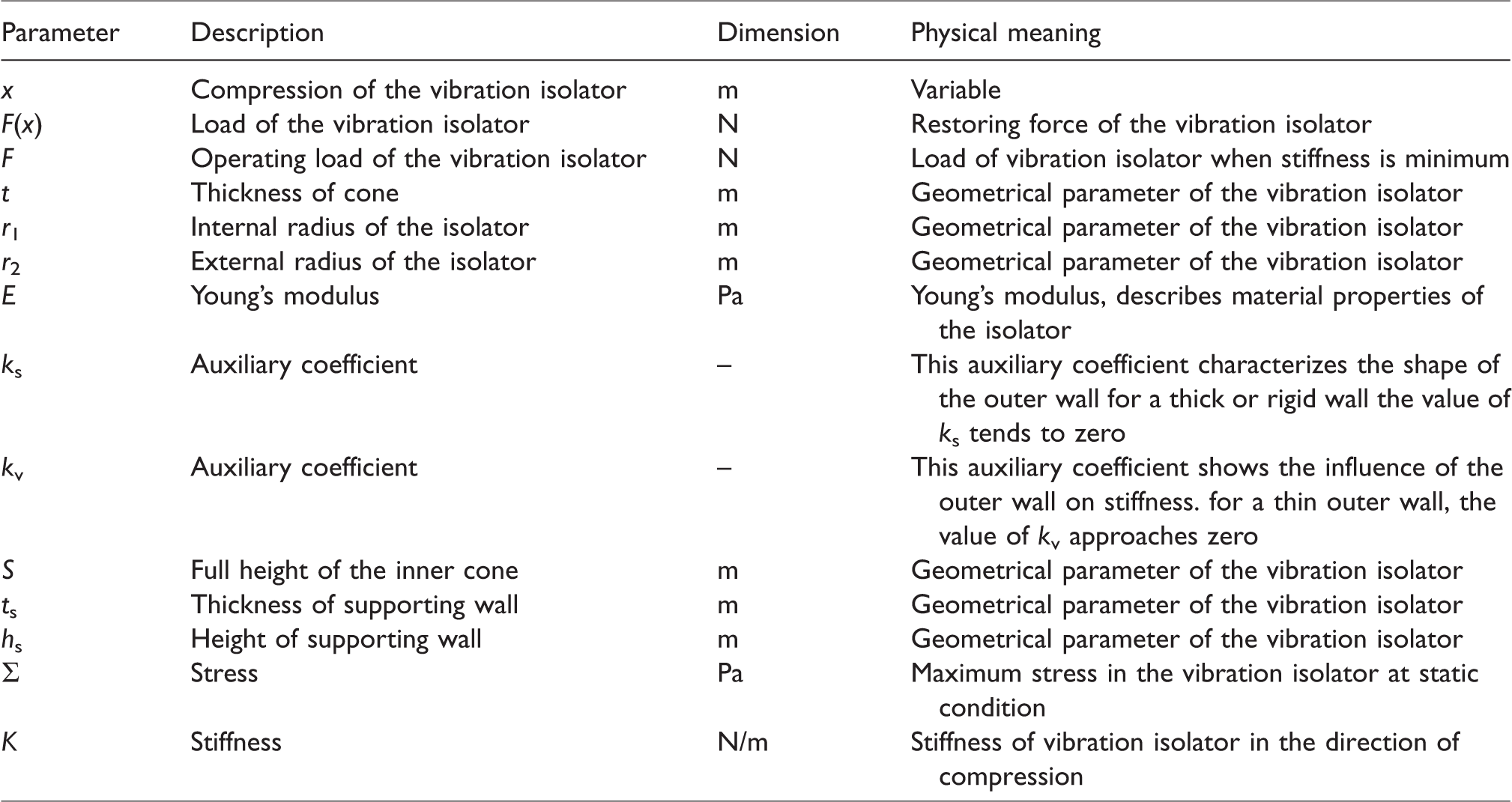
Dependence between the load F operating on this vibration isolator and its compression x is determined by the formula

The auxiliary coefficients are described as


The height of the wall cone equals

The operating load equals to

The highest stress equals

For further analysis, stiffness of the vibration isolator should be considered

After transformations

At an optimum point, the stiffness of the vibration isolator equals

Therefore, some main basics should be followed in the designing of vibration isolators of a disk spring type and isolators of a dome type.
Sensitivity vibration isolators with quasi-zero stiffness of the dome type
Designing a vibration isolator with isolators of a dome type and studying dynamics of a group of the isolators requires information about sensitivity of the isolators relative to the inclination of parameters.
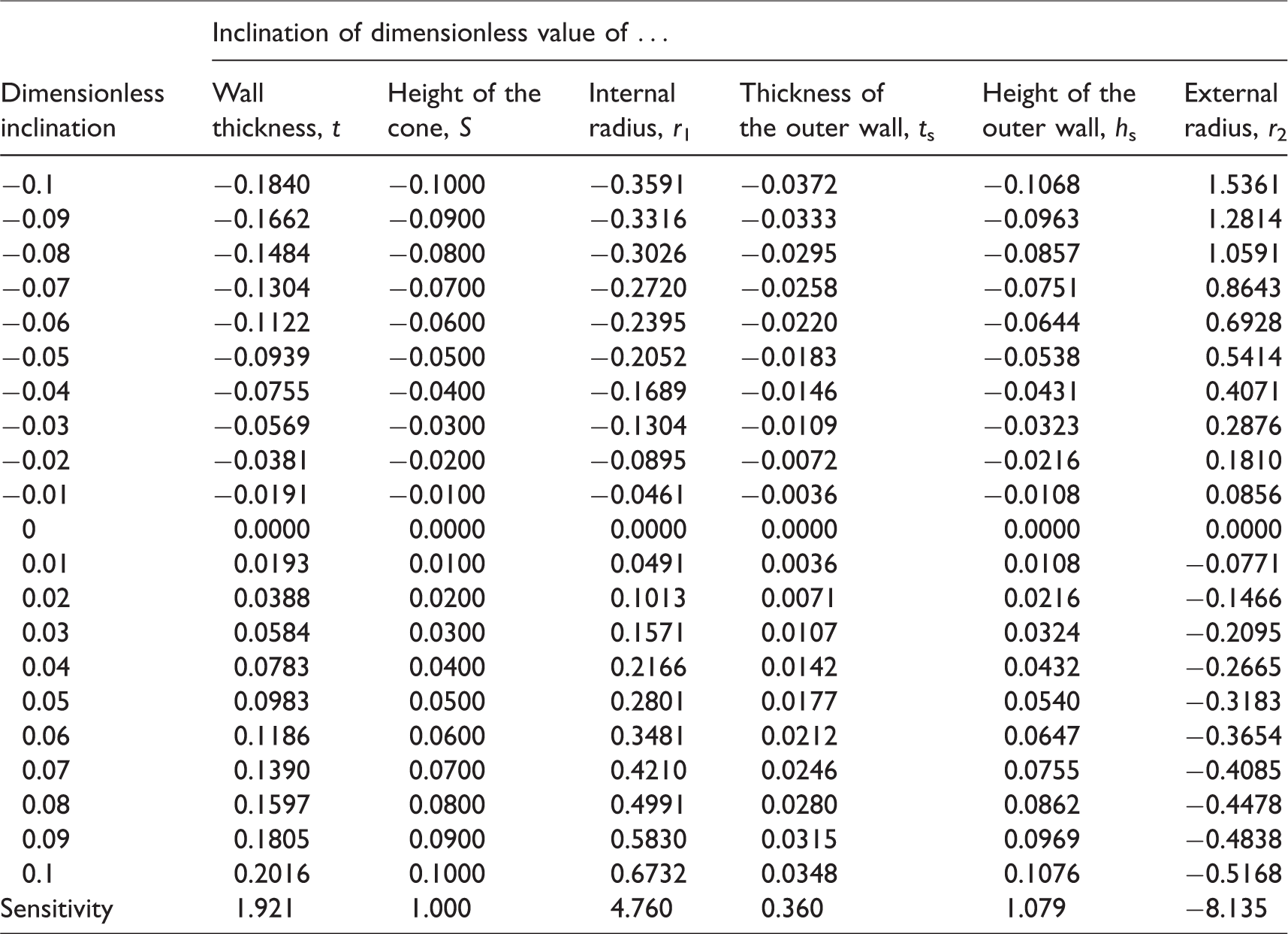
First, consider that one of the parameters of the isolator suddenly differs from its operating value. Then, the sensitivity of operating load and also stiffness of the system relative to inclinations should be calculated. The analysis of the formulas for dome-type isolator is done. In Table 1, the inclination of operating load relative to the inclination parameters is shown. The taken parameters are: wall thickness, height of the cone, internal radius of the isolator, external radius of the isolator, thickness of the outer wall of the vibration isolator and height of the outer wall of the vibration isolator. The calculations are made in a dimensionless form. Dimensionless parameters are taken as
– dimensionless operating load – dimensionless wall thickness – dimensionless internal radius – dimensionless cone's height – dimensionless thickness of the outer wall – dimensionless height of the outer wall – dimensionless stiffness
Note that the dimensionless stiffness is defined relative to static stiffness.
In Table 3, the sensitivity of operating load is presented. And also sensitivity of stiffness at the operating point (i.e. minimum stiffness of the system) is presented in Table 4. Sensitivity of stiffness is calculated relative to static stiffness, i.e. the value of operating load divided by the operating compression of vibration isolator (i.e. F/S).
Sensitivity of operating load.
Sensitivity of stiffness at the operating point.
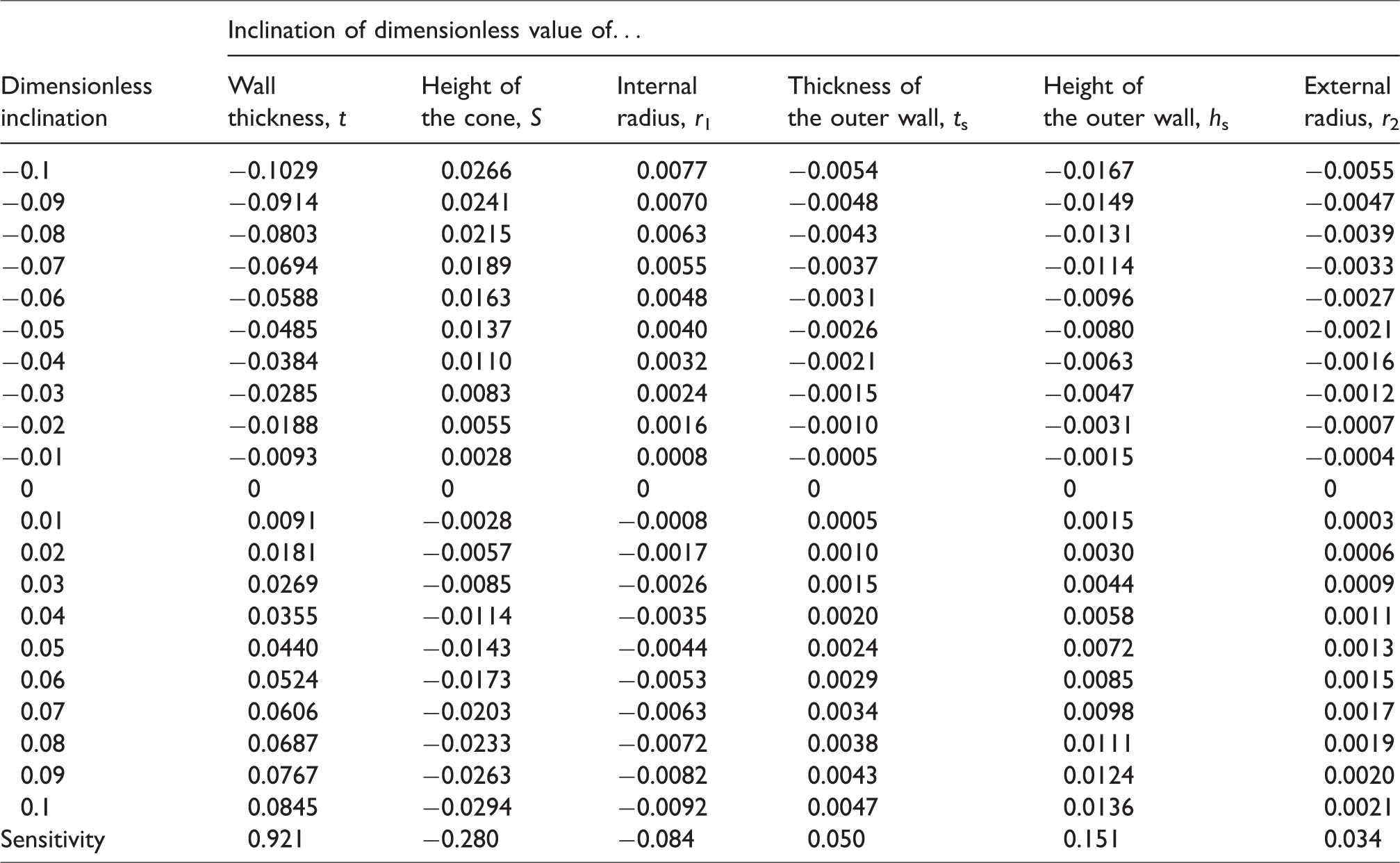
The sensitivity of the operating load and stiffness at the operating point are illustrated in Figures 4 and 5.
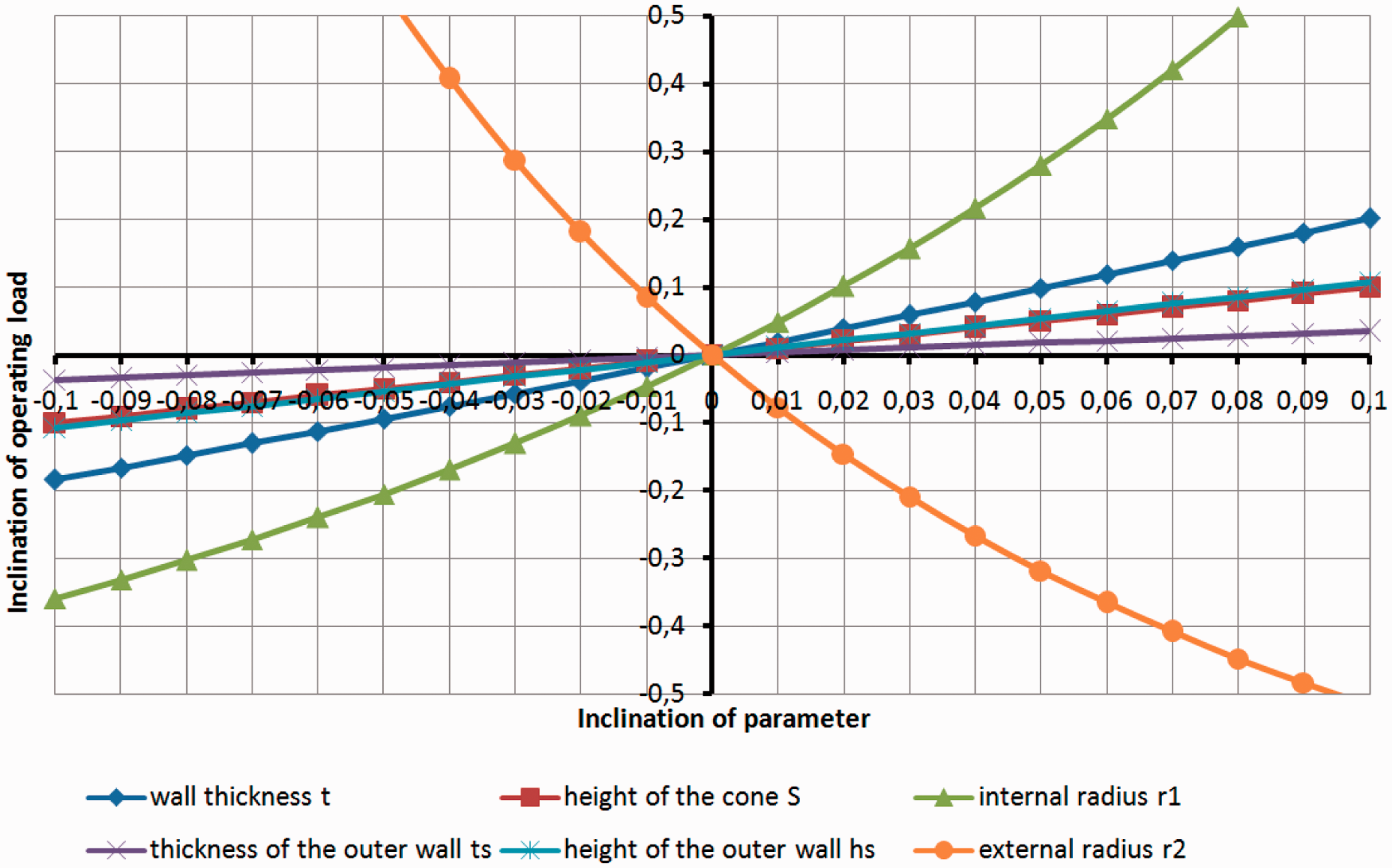
Sensitivity of operating load.
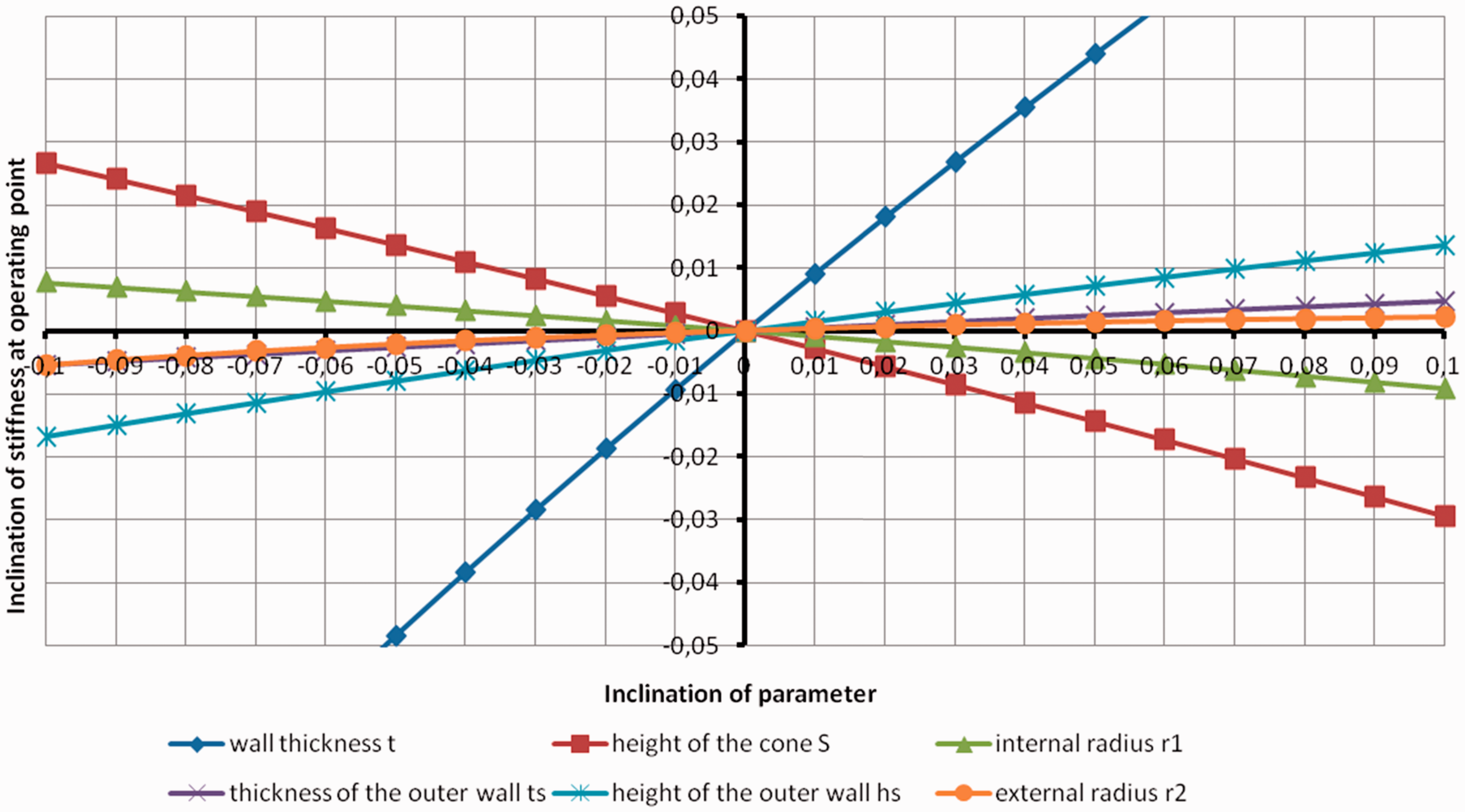
Sensitivity of stiffness at the operating point.
As we can see from Table 3 and Figure 4, the value of operating load is very sensitive to the internal and external radii of the vibration isolator. It is also sensitive to wall thickness and cone's height. Therefore, a lot of attention at manufacturing should be paid for these parameters.
According to Table 4 and Figure 5, it is evident that stiffness at the operating point depends on wall thickness. Note that if wall thickness is less than calculated one, then the stiffness is negative at operating point. It means that buckling will occur – it is unacceptable. Therefore, wall thickness should be under careful control.
Dynamic of a group if vibration isolators with quasi-zero stiffness
It follows from Figure 4 that sensitivity of vibration isolators with quasi-zero stiffness is not symmetrically relative to nominal values. Indeed, every vibration isolator has some deviation of parameters from the nominal ones. It is necessary to check the behavior of group of vibration isolators with quasi-zero stiffness if it is like for a single one or not.
For this purpose, the following calculations were made. It is taken that the parameters of the vibration isolator (wall thickness, height of the cone, internal radius of the isolator, thickness of the outer wall of the vibration isolator, height of the outer wall of the vibration isolator) can slightly deviate. The deviation is taken according to normal distribution (Gaussian distribution) with standard deviation σ.
A series of numerical experiments were done. During one experiment, 10,000 isolators with standard deviation σ were calculated. The results are presented in Table 5.
Deviations for a group of vibration isolators.
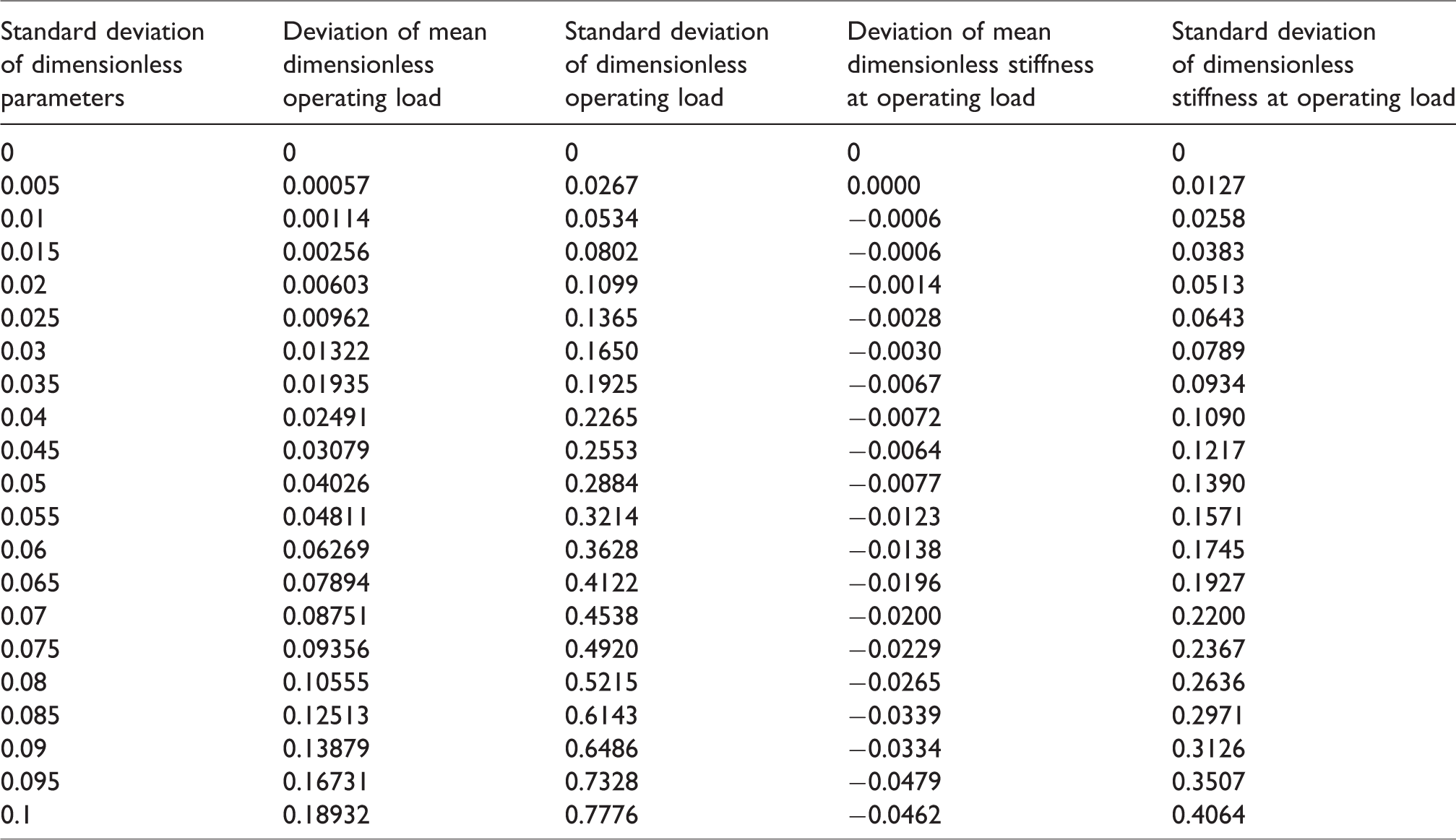
The results in Table 5 are graphically illustrated in Figure 6.
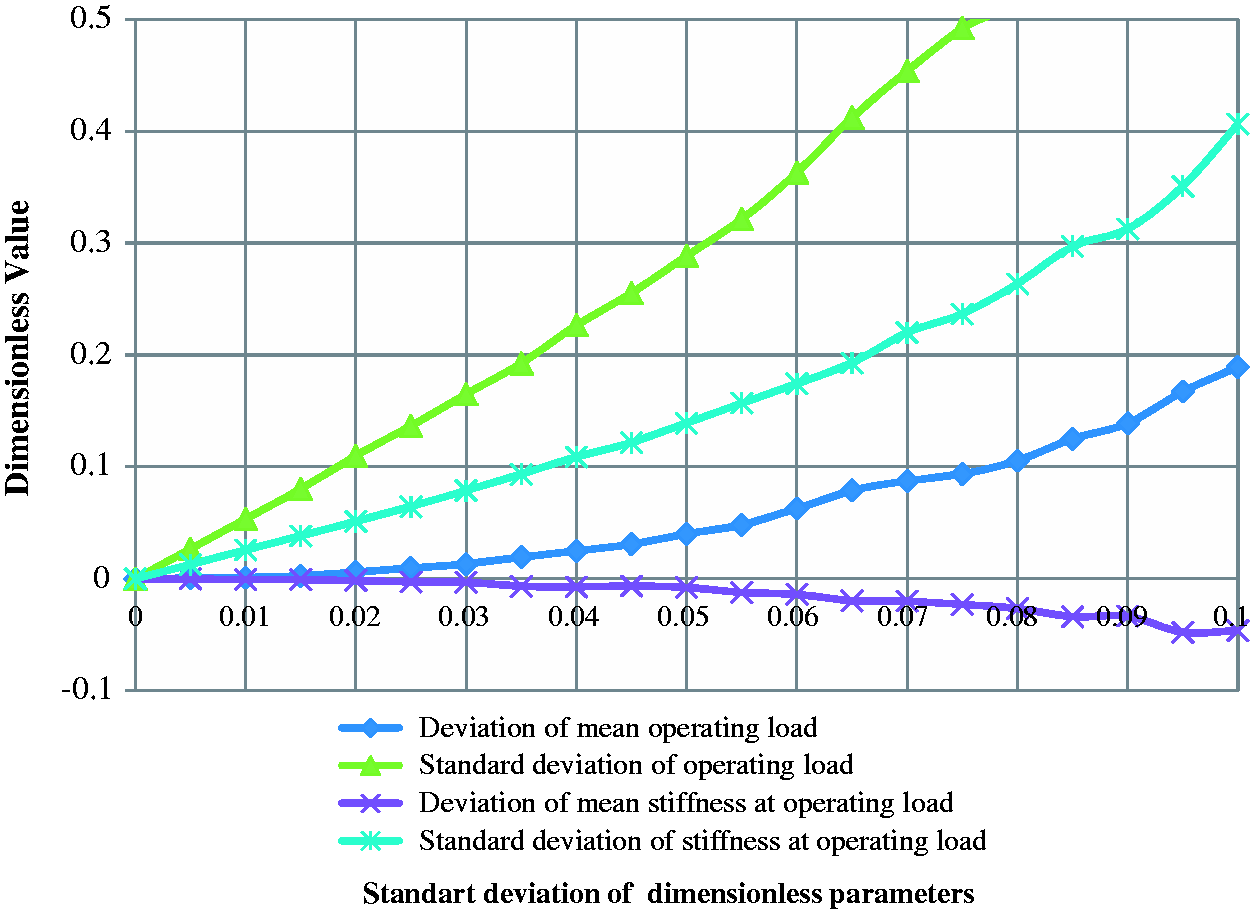
Sensitivity of stiffness at the operating point.
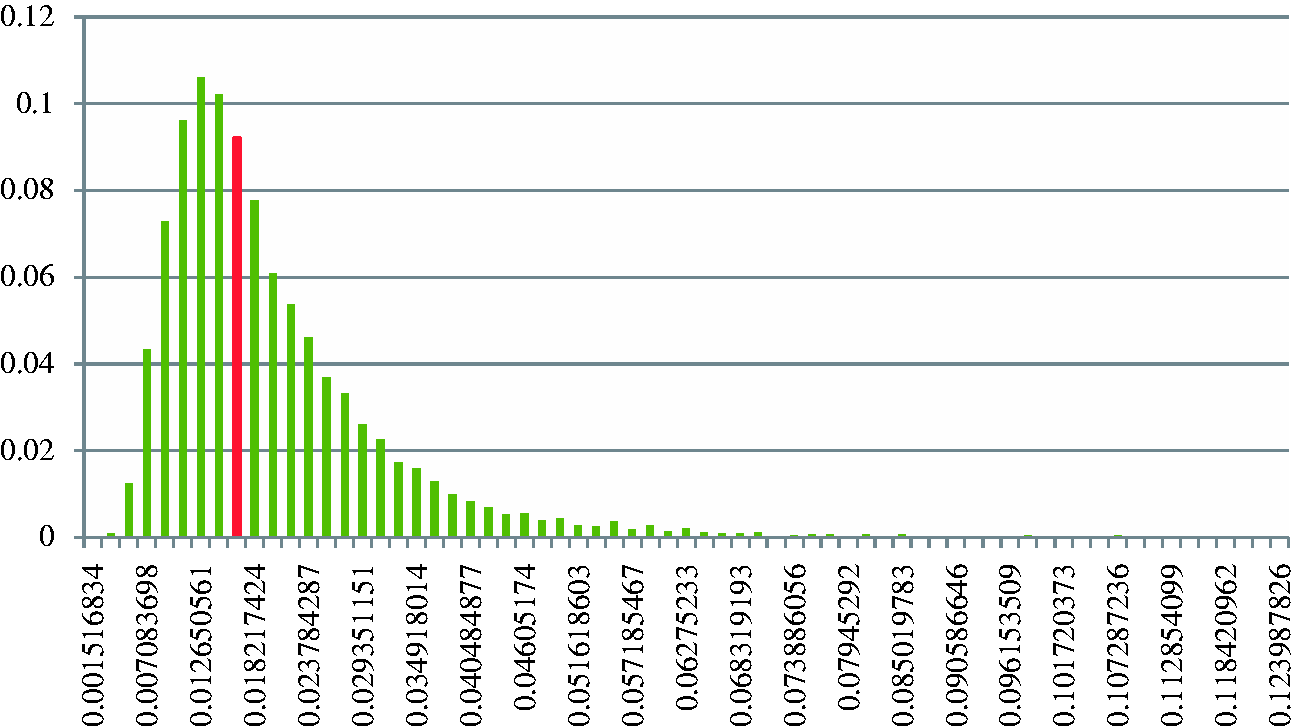
Density distribution of operating load (the mean value is mark by red color).
Analysis of Figure 6 shows that the mean operating load (or total operating load of a group of isolators) increases as the standard deviation of parameters increases (Figure 7). Hence, it is necessary to design isolators for a slightly lesser operating load.
As for stiffness, its value decreases. Stiffness less than zero is very negative for isolators because bucking can be observed. Buckling leads to inadmissible behavior of the systems – the vibration would increase in this case. Also the durability of the isolator would decrease sharply.
For avoiding buckling of the whole systems, the stiffness of all vibration isolators should be slightly increased. For example, standard deviation of dimensionless parameters σ = 0.1 leads to be decreased by 4.6%, i.e. for avoiding of height of the cone should be decreased by 2.6% (according to interpolation of Table 4).
Conclusions
The analytical analysis proves the fact that vibration isolators with quasi-zero stiffness are very sensitive facilities. Main properties, such as operating load and stiffness at operating load, sharply depend on key parameters. For the isolators of the dome-type, sharp dependence of operating load on external and internal radii, height of the cone and wall thickness are observed. The stiffness depends mainly on wall thickness, but this relation is also rather sharp. It proves that vibration isolators with quasi-zero stiffness require very careful attention and precision at manufacturing.
Next, the dynamics of a group of vibration isolators was analyzed. Due to deviation of different parameters and nonlinearity of force characteristics, the behavior of the group does not coincide with the average behavior of a single isolator. For a group of isolators, a small increase of operating load is observed. But another problem is more important. Deviations of parameters lead to stiffness decrease. As it may cause bucking and instability, it should be avoided. For this purpose, compensation of stiffness decrease should be done due to height of the cone decrease.
Therefore, the efficiency of vibration isolators with quasi-zero stiffness may be increased by careful analysis and designing.
Such sensitivity also proves that designing of systems with quasi-zero stiffness with many elements is very difficult. Various elements lead to design complexity, increase in size, and high friction. And due to the deviation of parameters, the behavior of such a system can be unpredictable. Therefore, there is an opinion that future vibration isolators with quasi-zero stiffness should be either made of fine elements, be of an active type, or have a very good setting ability.
It does not directly relate to this paper, but the following should be noted. As vibration isolators with quasi-zero stiffness of a passive type are very sensitive to deviation of parameters, new ways of designing and manufacturing are required. The idea is to use these isolators as metamaterial, i.e. to create a material with special periodic structure that provides quasi-zero stiffness. Such materials are now gaining popularity in areas like optics, acoustics, and electromagnetism because they can provide unique features that are not available for homogeneous materials. Modern methods of 3D prototyping offer a tremendous opportunity to create specially designed material structures. Thus, it is possible to create a material with an internal structure with cells with effect of quasi-zero stiffness. Having different layers set with different properties may provide protection in a wide range of vibration and noise.
Footnotes
Declaration of conflicting interests
The author(s) declared no potential conflicts of interest with respect to the research, authorship, and/or publication of this article.
Funding
The author(s) disclosed receipt of the following financial support for the research, authorship, and/or publication of this article: The reported study was funded by RFBR according to the research project No. 16–38-00825 mol_a.