




Abstract
Background
Smart home technologies and assistive robots play a role in enhancing the well-being of older adults. This study aims to evaluate the factors and acceptance level of these technologies among seniors and to explore the factors affecting their acceptance.
Methods
Three databases were systematically searched using keywords to identify relevant articles. The retrieved studies were screened based on eligibility criteria. Key features of the studies and the acceptance status of the aforementioned technologies among seniors were documented in a data extraction form.
Results
Twenty-seven studies met the eligibility criteria. Robots (74.1%), sensors (18.5%), wireless technologies (3.7%), and smart home voice assistants (3.7%) were utilized by seniors. Remote patient monitoring (33.3%) was the most prevalent application of these technologies. Approximately 89% of the studies reported positive attitudes toward these technologies. “Technology convenience” (22.2%) emerged as the most significant reason for smart technology acceptance. Conversely, “concerns about privacy and security” (14.8%) and “lack of need for technology” (14.8%) were the most frequently cited reasons for non-acceptance.
Conclusions
To enhance the adoption of reviewed technologies, it is crucial to implement strategies that raise awareness, ensure data security, and address the actual needs of this demographic in both the design and implementation phases.
1. Introduction
In the 21st century, we are witnessing significant implications for healthcare systems worldwide, driven by unprecedented changes in global demographics. 1 The aging population is central to these changes, resulting from increased life expectancy and declining fertility rates. 2 According to the United Nations Population Division, the proportion of older individuals aged 65 and over, as well as those aged 60 and over, was 5% and 8%, respectively; in 1950, these figures are projected to reach 10% and 14% by 2021. 3 The World Health Organization (WHO) predicts that the global population aged 60 and above will double by 2050, reaching approximately 2 billion, 4 with a substantial number coming from developing countries.5,6
The aging global population necessitates improvements in services to enhance the health and quality of life for the elderly, particularly within the constraints of limited financial resources at both individual and governmental levels. Furthermore, as functional capabilities decline due to physiological changes associated with aging, we can expect a rise in chronic diseases, leading to increased demand for support, services, and healthcare.7,8 Therefore, the rapid growth of the older population will create a significant gap between those requiring services and the healthcare personnel available to provide care.9,10 These challenges have led to an increasing recognition of the potential of technology and communication to enhance services and foster information sharing and social participation.11–13
The integration of technology, including telemedicine and telemonitoring, enhances healthcare access for the elderly, particularly in remote or underserved areas.14–16 Digital health technologies also assist in managing chronic conditions and improving overall health outcomes.4,17 Consequently, older adults benefit from assistive technologies that promote independence and enhance safety and well-being.18,19
To support the elderly effectively, it is crucial to provide a physical environment conducive to active aging and healthy aging (as defined by the WHO, the functional ability to maintain well-being in older age), utilizing innovative technologies such as smart homes and assistive robots.20–22 Robots can serve as a technological solution to bridge the gap between the demand for and supply of healthcare services. A robot is essentially a sophisticated computer with complex software housed in a mobile body, capable of logical actions based on its perception of the surrounding environment.7,23 On the other hand, many older individuals prefer to live in their own homes due to various factors, including health status, the desire to avoid disturbing others, and feelings of loneliness. 8 As the older adult population increases, the demand for private space with health monitoring solutions tailored to their needs also rises.24,25 Smart homes can be particularly beneficial for those wishing to maintain their independence. A smart home is designed to assist residents in daily activities and promote an independent lifestyle, incorporating features such as voice commands, motion sensors, hand gestures, touch panels, and other interactive options.26–28 This group of technologies encompasses various networking and communication devices, including displays, sensors, applications, and robotics, which can help healthy older adults continue living independently as they age. 29 Overall, smart homes represent a comprehensive technological solution that supports older individuals by monitoring and assisting them in their daily activities. 30
Along with the importance of technology, identifying effective ways for older adults to continuously and effectively use technology over time is crucial for them to reap the benefits of an increasingly digital society. 31 While robots can aid the elderly in maintaining independence and well-being by assisting with daily tasks, it remains uncertain whether they are ready to embrace such technologies in their homes. 32 Technology acceptance is influenced by an individual’s mindset regarding the intention to use a specific technology. 33
The ongoing adoption of technology by users is significant as it evolves beyond the design phase and initial implementation, undergoing continual changes influenced by information systems, design, work environments, and user needs, which may also vary due to social or cultural factors.34,35 Understanding the facilitators and barriers to the adoption of robots and smart home technologies by the elderly will enable researchers and professionals to design more acceptable technological solutions for this demographic.32,36
Given the increasing population of older adults and the major challenges they face, such as physical decline, cognitive deterioration, health management, and psychosocial issues, smart technologies—especially smart homes and robots—can serve as effective solutions to meet the needs of the elderly by preserving their independence and improving their quality of life.37–39 Therefore, addressing these two technologies among older adults is of particular importance. Additionally, similar studies have primarily focused on examining the role and types of smart technologies and comparing the acceptance models of these technologies among older adults.40–42 This study, alongside investigating the acceptance of smart home technologies and robots, simultaneously examines the factors influencing acceptance and non-acceptance as a key factor in overcoming barriers to older adults’ interactions with technologies and their application in daily life. It aims to create a consensus framework for enhancing the acceptance and implementation of smart technologies by older individuals. Thus, we aim to examine the acceptance level of smart home technologies and robots and the factors influencing their adoption among elderly populations.
2. Method & materials
This study was conducted in accordance with the Preferred Reporting Items for Systematic Reviews and Meta-Analyses (PRISMA) guidelines 43 and was not registered on any registration website, e.g. PROSPERO.
2.1. Eligibility criteria
Inclusion and exclusion criteria.

2.2. Information sources and search strategy
Three electronic databases, including Web of Science, PubMed, and Scopus, were systematically searched on April 20, 2025, without any time limitation to select the relevant articles. Three main keywords were used in the search strategy, namely “Elderly People,” “Acceptance,” and “Smart Home,” and their synonyms, which were designed by two authors. The results were limited to journal articles in English [Appendix 1].
2.2.1. Questions of study
1. How frequently are the technologies of smart homes and robots individually applied in the care of older adults? 2. What is the level of acceptance of smart home technologies and robots among older individuals? 3. Which influential factors affect the acceptance or rejection of smart home technologies and robots by older adults? 4. How do older individuals perceive the use of smart home technologies and robots?
2.3. Study selection
EndNote reference management software was used to manage the retrieved articles. After detecting and removing duplicates, the title and abstract of the remaining articles were examined according to the eligibility criteria. Then, the accessibility of the full texts of eligible papers was assessed in detail. The selection process was performed by two researchers independently, and in case of disagreement, this issue was referred to another researcher.
2.3.1. Quality assessment
The quality of eligible studies was assessed using the JBI critical appraisal checklist for analytical cross-sectional studies. 44 This tool consists of eight items, with four answers (Yes, No, Unclear, and Not applicable). Two researchers independently evaluated the quality of studies using this tool. The results of the quality assessment are presented in [Appendix 2].
2.4. Data extraction
All selected studies were independently reviewed after removing duplicates and irrelevant, and unavailable papers. Firstly, a data extraction form was created, and using this tool, the characteristics of the included studies were captured. The data extraction form consisted of the following variables: study aim, research location, number of samples, sex distribution, the average age of samples, accommodation of older adults, health conditions of older people, type of technology, application of technology, name of the technology, evaluation tool, older adults’ perspectives, factors affecting the acceptance of the technology, factors influencing non-acceptance of the technology, acceptance models, and acceptance rates. Two researchers extracted data and any uncertainty during this process was discussed between these researchers and the third reviewer.
3. Results
3.1. Search results
After reviewing the 240 retrieved articles, according to the inclusion and exclusion criteria, 27 papers were included in the study and selected for further investigation. Figure 1 represents the selection process of eligible articles conducted based on PRISMA. PRISMA flow diagram.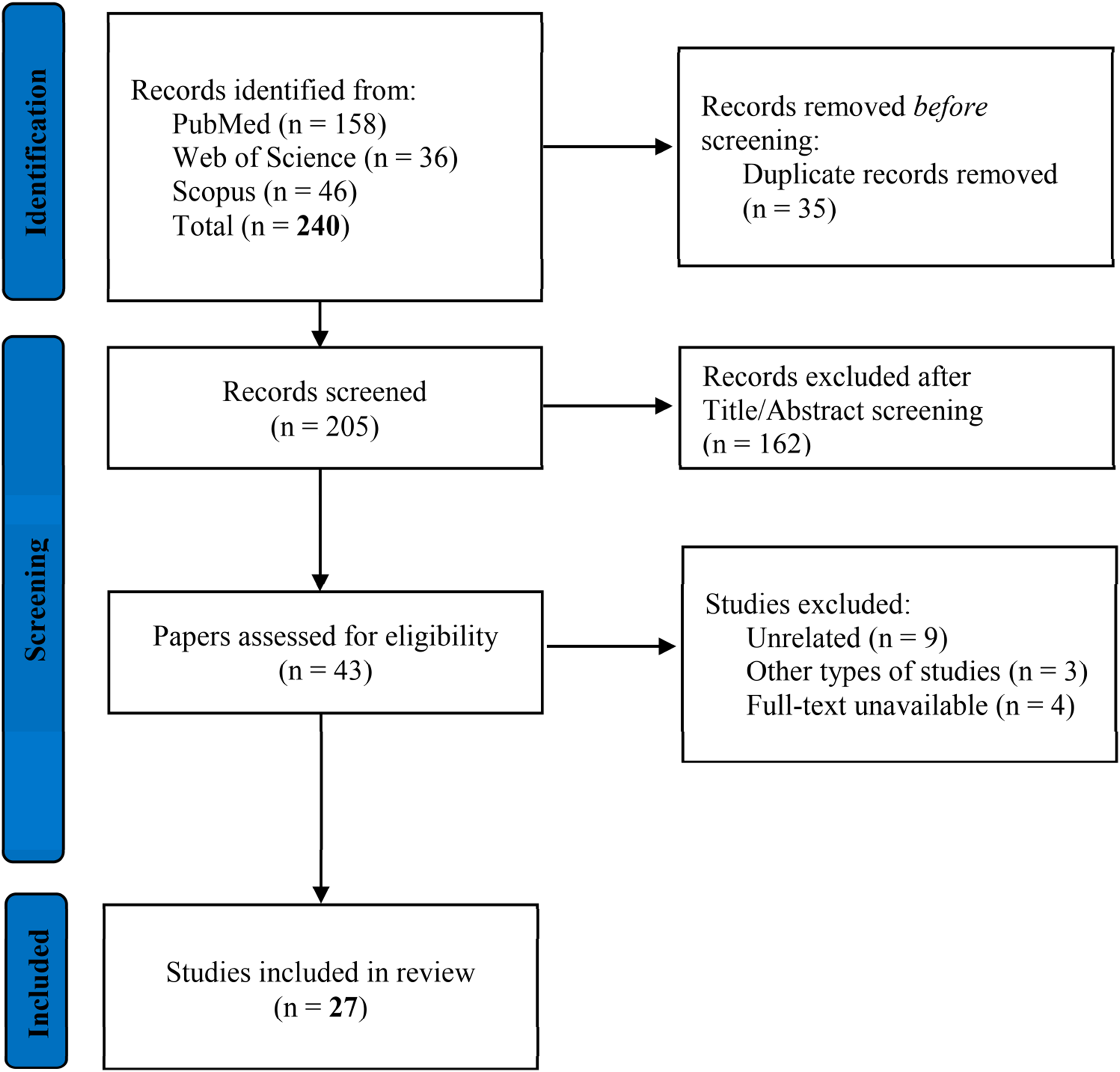
3.2. Quality assessment
The results of the quality assessment of the reviewed studies were analysed according to the JBI critical appraisal checklist and are presented in Figure 2. Therefore, the assessed studies had appropriate quality for further investigation. Most included studies demonstrated moderate to high methodological quality according to the JBI checklist, with the majority receiving positive responses across the appraisal items. Quality assessment of the reviewed studies according the JBI critical appriasal items.
3.3. Characteristics of the included studies
Investigation of the characteristics of reviewed articles showed that studies were published between 2009 and 2023, and most studies (14.81%) were conducted in 2022 (Figure 3). Number of published works based on year.
Furthermore, more than 22% of articles were affiliated with Germany, and other countries were represented by one, two, or three studies. More details are presented in Figure 4. Number of publications based on country.
Different numbers of older adults, in terms of sample size, were included in the selected articles. The average number was 69.11, and the maximum and minimum numbers were 257 and 8 older adults, respectively. Moreover, the average age of samples in these studies was 72.78 years.
3.4. Conditions of older adults
We also reviewed the characteristics of older adults in the included studies. Analysis of this data revealed that the participating seniors were accommodated in different places. About 41% were community-dwelling older adults, and others lived in their homes, nursing homes, or other institutions. Figure 5 illustrates this statistic. Accommodations of older adults.
Additionally, review of the health status of seniors showed that most of them (62.1%) were healthy. However, there were some older people with dementia, ischemic stroke, cardiovascular disease, mobility-impairing fractures, etc., among the investigated samples (Figure 6). Health status of older adults.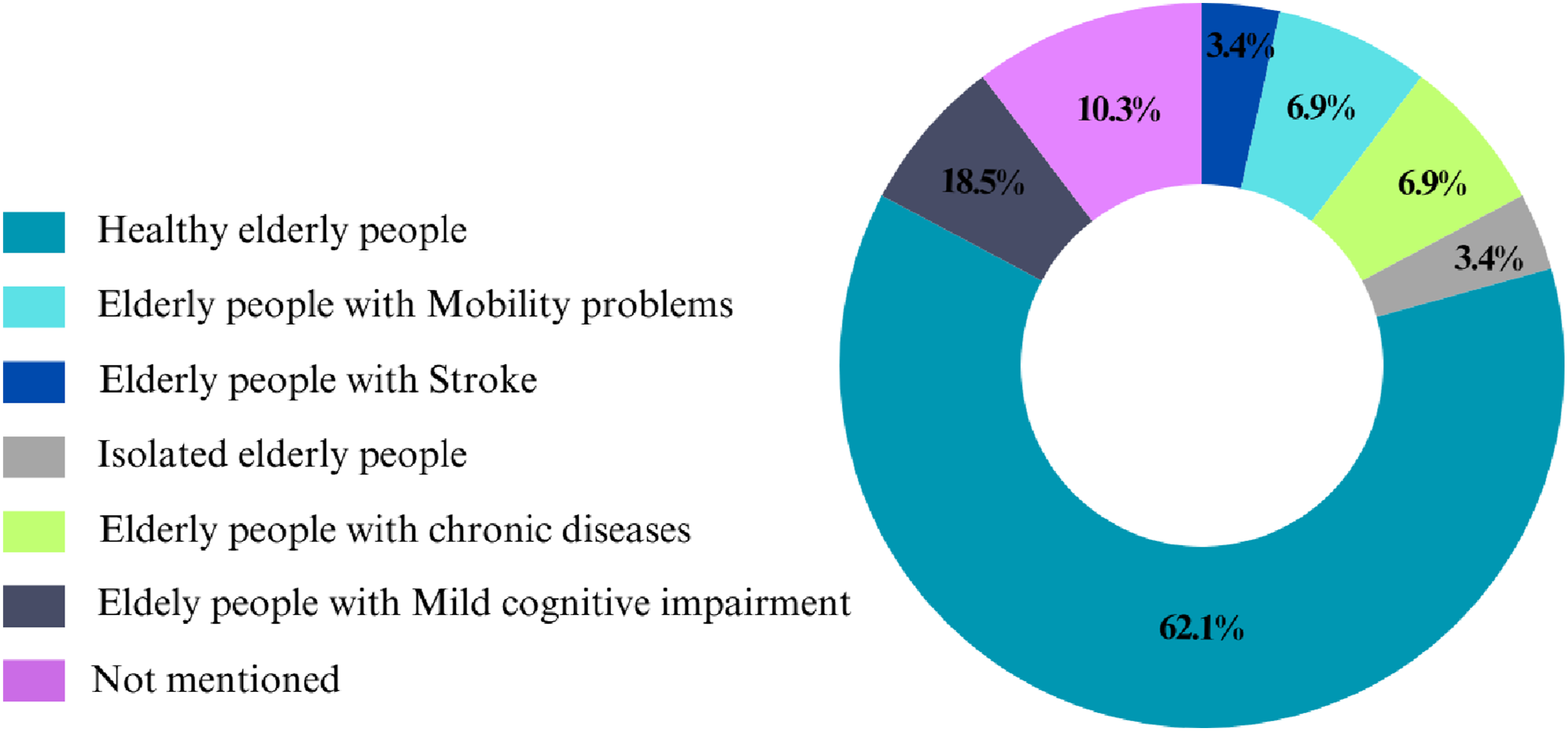
3.5. Types and applications of technologies analyzed in studies
Different smart home technologies were surveyed in the selected articles. Investigation of this information showed that Robots and Sensors were the most reviewed technologies (74.1% and 18.5% respectively). Figure 7 represents this finding. Types of applied technologies.
The reviewed technologies had a wide range of applications. For instance, Giraff and Paro robots are used for psychosocial support, monitoring of medication intake, household support, safety support, and interaction with the medical team, as documented in Ref. 45. Moreover, sensors in Ref. 46 are utilized for fall detection and status monitoring in nursing homes. Remote patient monitoring (33.3%), daily living support (25.92%), and psychosocial support (25.92%) were the most prevalent applications of the reviewed technologies. Figure 8 provides more comprehensive data. Types of technology applications to support elderlies.
3.6. Older adults’ perspectives
Older adults had different perspectives towards technologies. They stated their main perspectives and mentioned positive and negative expressions. We categorized the expressions into two groups: positive keywords and negative keywords, and represented them in the extraction form [Appendix 3].
In general, about 89% of studies (24 papers) reported positive perspectives of seniors and 11% (3 papers) revealed the negative points of view of them towards the analyzed technologies.
3.7. Acceptance levels and models declared in studies
Only 17 studies clearly mentioned the acceptance levels of seniors towards reviewed technologies. A few studies reported the acceptance levels of technologies quantitatively and qualitatively, but most of them mentioned only qualitative results. Due to the heterogeneity in reporting formats, acceptance levels were quantitatively summarized only where explicitly reported. Qualitative findings were synthesized descriptively to provide an overall overview and should not be interpreted as definitive or comparable acceptance measures. The summarized results are illustrated in Figure 9. Acceptance levels of older adults towards technologies.
It is also noteworthy that different acceptance models were used in 12 studies. The popular models in these papers were TAM (Technology Acceptance Model) (58.3%), UTAUT (Unified Theory of Acceptance and Use of Technology) (33.3%), and Almere technology acceptance model (16.6%). More detail is presented in [Appendix 3].
3.8. Factors affecting the acceptance and non-acceptance of technologies
We extracted some important factors from the reviewed studies that influenced the acceptance and non-acceptance of robots and smart home technologies. These factors and the frequency of reporting them in different studies are pictured in Figures 10 and 11. Among the factors mentioned in studies, “comfort of technology” (22.2%) was the most reported factor in acceptance, and “concerns about privacy and security” (14.8%) and “not perceiving the need for technology” (14.8%) were the most reported factors in the non-acceptance of analyzed technologies. Effective factors in acceptance of robots and smart home technologies. Effective factors in non-acceptance of robots and smart home technologies.

4. Discussion
This systematic review investigated the acceptance level of smart home technologies and robots among older people. Reviewing the included studies showed that most elders had a high level of acceptance and expressed positive attitudes toward the examined technologies. In this section, the main findings are discussed and compared with similar studies.
Among the different technologies that were used in the included studies, robots were the most prevalent. Therefore, more than 70% of the articles analyzed this type of technology. This finding highlights the considerable role of robotics in providing tasks and managing elders’ lives since it helps seniors with daily tasks and provides reminders or emergency support. Many older adults felt these features helped them stay safe and independent. Researchers47,48 also pointed to these benefits of robots and emphasized the effects of robots on older people’s independence.
According to the results, the eligible articles mentioned different applications for reviewed technologies. Hence, remote patient monitoring (33.3%), daily living support (25.92%), and psychosocial support (25.92%) were the most prevalent ones. These applications show the basic needs of older adults. Since some of them suffer from chronic diseases and need to be monitored and aided in their daily activities, most robots and smart home technologies are designed to fulfill these needs. Researchers 49 highlighted the significant role of smart home technologies in the management of seniors’ chronic conditions. In Ref. 50, this importance was also emphasized, and Socially Assistive Robots (SARs) were mentioned as the best tools to empower older people in their daily lives.
A review of older adults’ perspectives indicated that most of them had positive attitudes towards technology (89%). We realized this based on the positive keywords that were mentioned in the reviewed studies based on seniors’ expressions. In other studies,51,52 elders’ attitudes towards robots were examined. Findings of 52 revealed that older adults are not as welcoming to robots as younger adults. In Ref. 51, positive, negative, and conflicting attitudes were reported, and the previous experience of seniors in using robots was considered as a potential factor in the high acceptance of these technologies by elders.
Furthermore, the acceptance level of robots and smart home technologies was examined in the included studies, and only 17 studies mentioned this issue transparently. According to the results, 14 of 17 studies reported high acceptance of the reviewed technologies among elders. A similar finding was reported in Ref. 53, which analyzed the acceptance level of new technologies in people older than 64. In our opinion, the main reasons for accepting these technologies were the various applications of these technologies in seniors’ daily lives that make life easier for them and help with their health needs, like medication reminders or fall detection. Furthermore, various factors in the reviewed studies had pivotal roles in this issue, and the comfort of technology was the most reported one.
We extracted a wide range of acceptance factors from the articles included, which have been reported in other studies as well. For instance, researchers in Ref. 54 pointed to 27 factors influencing the acceptance of technology among older adults and categorized them into six themes. Among these factors, perceived benefits of technology, need for technology, and characteristics of older adults (e.g., familiarity with technology) were the effective factors in acceptance of technologies. Moreover, in Ref. 55, which explored the factors influencing older adults’ acceptance of voice assistants, perceived usefulness, perceived enjoyment, technological self-efficacy, and dispositional resistance to change were reported as the most significant factors. These findings were compatible with ours.
Besides factors effective in the acceptance of technologies, we extracted other factors that have negative impacts on the acceptance of reviewed technologies among seniors. Concern about privacy and security and difficulty of use were the most important factors influencing the non-acceptance of technologies. These barriers are also reported in other studies.53,54,56
All in all, reviewing eligible studies showed that acceptance is often linked to how well the technology meets the practical needs of older individuals, like safety, ease of use, and independence. Furthermore, older people are more likely to accept a technology that respects their personal space, keeps things simple, and doesn’t require them to learn complicated new skills. Other studies39,57,58 also verified this importance and mentioned that smart technologies, like smart homes, should focus not only on the basic needs of the elderly, such as comfortable living conditions and home safety, but also on maintaining privacy and simple design for ease of use by elderly users.
Additionally, addressing the barriers to acceptance of the reviewed technologies must be taken into account. We believe that adding privacy features or explaining how data is protected are appropriate strategies to tackle privacy challenges. Moreover, defining the benefits of technologies and making them clear for seniors is a good approach to dealing with the perceived lack of need challenge. In accordance with these solutions, other studies, like,47,56,59 mentioned similar barriers and suggested solutions, like robust security measures and clear consent procedures to manage privacy challenges, as well as education and awareness programs to demonstrate the benefits of technologies. We suggest that system developers involve older users in the design process of technologies to ensure that the technology is both useful and easy to use. Moreover, policymakers have to support education around these technologies to help older people understand their benefits and build trust.
This study had some limitations as we searched only three databases, focused on two health-related technologies (smart homes and robots), and considered only a specific age group of older individuals. It is highly recommended that more similar studies be conducted on elders with different cultural backgrounds or health conditions to analyze their potential impacts on the acceptance level of this age group. Furthermore, there is a need for research into long-term use to understand whether older people find the technology valuable over time, not just when they first start using it. Short-term experimental studies often capture initial enthusiasm rather than sustained engagement, which may be influenced by usability issues, changing needs, or declining motivation over time. Longitudinal studies are therefore essential to identify factors that support continued use and to distinguish temporary adoption from meaningful, sustained integration into daily life. 60
Moreover, future research is encouraged to separately examine acceptance and attitude using standardized and validated instruments, enabling clearer differentiation between these constructs and facilitating effect-size–based synthesis in systematic reviews.
5. Conclusion
In conclusion, novel and emerging health technologies, such as smart homes and robots, offer significant potential to enhance independence, safety, and quality of life for older individuals, addressing key challenges in elder care. This study found that while most older participants were receptive to using these technologies for practical support—particularly for health and safety—barriers like privacy concerns and a perceived lack of need for the technology affected their acceptance. To increase adoption, it is essential for developers to prioritize ease of use, data privacy, and targeted health applications that meet older users’ specific needs. Additionally, policymakers and technology providers should consider initiatives that raise awareness and provide user-friendly training to improve comfort and understanding. Future research is needed to examine acceptance across diverse cultural and health backgrounds and to assess the long-term impact of smart technologies on the well-being of older populations.
Supplemental material
Supplemental material - Influencing factors and acceptance levels of robotic and smart home health technologies among elderly people: A systematic review
Supplemental material for Influencing factors and acceptance levels of robotic and smart home health technologies among elderly people: A systematic review by Reyhaneh Jaberi, Sharareh Rostam Niakan Kalhori, Fateme Bahador, Saeedeh Heydarian, Zohreh Javanmard in Health Informatics Journal
Supplemental material
Supplemental material - Influencing factors and acceptance levels of robotic and smart home health technologies among elderly people: A systematic review
Supplemental material for Influencing factors and acceptance levels of robotic and smart home health technologies among elderly people: A systematic review by Reyhaneh Jaberi, Sharareh Rostam Niakan Kalhori, Fateme Bahador, Saeedeh Heydarian, Zohreh Javanmard in Health Informatics Journal
Supplemental material
Supplemental material - Influencing factors and acceptance levels of robotic and smart home health technologies among elderly people: A systematic review
Supplemental material for Influencing factors and acceptance levels of robotic and smart home health technologies among elderly people: A systematic review by Reyhaneh Jaberi, Sharareh Rostam Niakan Kalhori, Fateme Bahador, Saeedeh Heydarian, Zohreh Javanmard in Health Informatics Journal
Footnotes

Authors’ contributions
S.R.N.K., R.J., and Z.J. initiated the process by selecting the title, designing a comprehensive search strategy, and identifying key terms and criteria to define the study’s scope. R.J. and S.H. meticulously conducted the initial review of titles and abstracts, ensuring alignment with the study’s inclusion and exclusion criteria. Any disagreements were resolved through deliberation, guided by S.R.N.K. Data extraction was undertaken by S.H. and F.B. The duo collaborated closely to collect detailed information from full-text articles, addressing uncertainties with the expert guidance of S.R.N.K. Concurrently, S.R.N.K., R.J., and Z.J. worked together to create and organize the Excel sheet for structuring and analyzing study features effectively. The analytical phase was spearheaded by R.J. and Z.J., who evaluated the quality of the included studies and performed statistical analyses. Z.J. further led the preparation of figures and the writing of the methods and results sections, ensuring a clear and impactful presentation of the findings. The discussion section was collaboratively developed by R.J. and Z.J., with invaluable oversight and input from S.R.N.K., whose perspective enriched the narrative. Finally, the manuscript was read and approved by all authors.
Funding
The authors received no financial support for the research, authorship, and/or publication of this article.
Declaration of conflicting interests
The authors declared no potential conflicts of interest with respect to the research, authorship, and/or publication of this article.
Supplemental material
Supplemental material for this article is available online.
Appendix
References
Supplementary Material
Please find the following supplemental material available below.
For Open Access articles published under a Creative Commons License, all supplemental material carries the same license as the article it is associated with.
For non-Open Access articles published, all supplemental material carries a non-exclusive license, and permission requests for re-use of supplemental material or any part of supplemental material shall be sent directly to the copyright owner as specified in the copyright notice associated with the article.
