



Abstract
Introduction
Entering the era known as Industry 4.0 has manifested itself in the development of technology that is getting faster and that makes human life easier. Changes have occurred in various industrial sectors. One of these is the health sector which is experiencing changes in terms of the development of its services which are provided both offline (in person) and now online as well. These online services have given rise to facilities known as telemedicine. Telemedicine makes it easier for consumers to meet their health needs. This development accelerated during the COVID-19 pandemic when the paramount demand was for safe, fast, precise, and convenient health services. Telemedicine services existed before the pandemic, but they tended to be more complementary. Then, during the pandemic, telemedicine services became the primary way to reach many patients as quickly as possible. The Indonesian Ministry of Communication and Information Technology (Kominfo) noted that before the pandemic, there were four million users of various telemedicine applications, while, as of June 2020, there were 15 million users of such applications. 1 Telemedicine is the use of technology to provide and support health services remotely. 2 Generally, telemedicine is carried out online using communication and information technology-based devices. In Indonesia, telemedicine services are regulated in the Regulation of the Minister of Health No. 20 of 2019 concerning the Implementation of Telemedicine Services Between Health Service Facilities. Article 1 paragraph 1 states that the definition of telemedicine is a remote health service provided by health professionals using information and communication technology, including the exchange of diagnostic information, treatment, prevention of disease and injury, research and evaluation, and continuing the education of health service providers for the benefit of improving individual and community health. 3 Telemedicine services in Indonesia are also called remote health services. 4 In addition to digital health services, there has also been the development of digital pharmacy by paying attention to patient care. 5
Research by Miner et al. 6 shows that consumers are satisfied with the quality of service from the application providers when using telemedicine. The application providers pay attention to perceived ease of use which is the basis for influencing perceived usefulness and behavioral intention so that consumers are willing to use telemedicine and feel satisfaction when doing so. 7 If the perceived usefulness felt by consumers is positive, it will create continuance intention according to Hadji and Degoulet. 8 This is different from the research of Lu et al. 9 where perceived usefulness does not affect continuance intention in using mobile health applications. According to Zobair et al., 10 consumers adopt telemedicine if they feel self-efficacy, telemedicine experience, enjoyment, and prior satisfaction. Meanwhile, research on telemedicine by Schmitz et al. 11 shows that performance expectancy has an influence on intention to use while effort expectancy, social influences, and facilitating conditions are not significant.
Factors that influence people to want to use telemedicine from a health perspective are perceived ease of use, self-efficacy, subjective norm, facilitating conditions, compatibility, attitude, perceived usefulness, perceived behavioral control, health culture, government policies, security, and reduced cost. 12 The results of research by Alexandra et al. 13 show that facilitating conditions and social influences have no effect on behavioral intention to use telemedicine. This is different from the results of research by Cobelli et al. 14 which show that facilitating conditions, performance expectancy, and effort expectancy have an influence on the intention to adopt telemedicine. Indria et al. 15 show that patients are satisfied with telemedicine but service providers are still paying attention to improving infrastructure and performance.
Previous research results show how important it is to change consumer attitudes so as to create confidence in adopting telemedicine. This suits the circumstances found in an archipelago like Indonesia as it makes it easier to provide health services to the community. Based on the background above, this study uses a different approach from previous studies. The focus of this study is to test the effect of the unified theory of acceptance and use of technology (UTAUT) on the technology acceptance model (TAM) through consumer trust. The UTAUT variables used are performance expectancy, effort expectancy, social influences, and facilitating conditions. As for the TAM variables, they are perceived usefulness (equivalent to performance expectancy) and perceived ease of use (equivalent to effort expectancy). 16 The TAM and UTAUT theories emphasize intention to use without including beliefs. In research with health objects, the belief factor is important for patients. The belief factor needs to be developed by means of a relationship based on communication between the doctor and the patient. If the relationship is formed, it will lead to belief. This is the basis for individual belief to mediate between UTAUT and TAM theories.
Literature review
Telemedicine
Telemedicine is defined by the World Health Organization (WHO) as follows: “The provision of health care services, where distance is a significant consideration, by all health care professionals utilizing information and communication technologies for the exchange of accurate information pertaining to diagnosis, treatment, and disease and injury prevention, research and evaluation, as well as the ongoing education of health care providers, all aimed at enhancing the health of individuals and their communities.” (World Health Organization 2010). The WHO delineates several fundamental elements that telemedicine must encompass: providing clinical support, overcoming geographical barriers, employing information and communications technology, and finally enhancing patient outcomes (World Health Organization 2010).17
Telemedicine, a branch of information and communication technology (ICT), has emerged as a viable approach for delivering healthcare remotely. It surmounts geographical barriers, enhances medical outcomes, increases patient engagement, and reduces costs.18–20 It can be employed to provide diverse clinical services, including consultations, diagnosis, treatment, monitoring, therapeutic processes, and the exchange of medical information via electronic communication tools such as video conferencing, telephone calls, or secure messaging. 21
Numerous systematic literature evaluations have been performed regarding the application of telemedicine and e-consultation in healthcare. Most of this research focuses on the effectiveness, efficiency, and potential of telemedicine to improve healthcare services. 22 One of the important things about telemedicine is that it demonstrates that geography is not an obstacle, which means it is suited to the archipelago of Indonesia; this means it is very helpful for the inhabitants of the islands in maintaining their health 23 because health services can reach the outermost areas of the country effectively and efficiently.
Unified theory of acceptance and use of technology (UTAUT)
UTAUT was first developed in 2003 by Venkatesh et al. 24 The theory’s variables consist of performance expectancy, effort expectancy, social influence, and facilitating conditions which form behavioral intention, thus causing use behavior. Research by Schmitz et al. 11 has modified UTAUT; the results of their study show that performance expectancy has an influence on the intention to use virtual doctor appointments. Meanwhile, effort expectancy, social influence, and facilitating conditions do not affect the intention to use. 11 The results of the study by Schmitz et al. 11 differ from the results of the study by Akinnuwesi et al. 25 who show that performance expectancy, social influence, and facilitating conditions have an influence on the intention to use digital protective tools for COVID-19, while effort expectancy does not affect the intention to use.
When UTAUT was used to test mobile payment services (MPSs), it demonstrated that effort expectancy had no effect on the intention to use mobile payment services, whereas performance expectancy and social influence did have an effect on the intention to use them. 26 The results of a study by Patil et al. 27 show that performance expectancy and effort expectancy influence attitude, while social influence and facilitating conditions influence behavioral intention. Meanwhile, research by Abu-Taieh et al. 28 shows that performance expectancy, effort expectancy, and social influence in addition to facilitating conditions influence behavioral intention. The results of previous studies have resulted in inconsistent results with regard to UTAUT variables; therefore, this study uses performance expectancy, effort expectancy, social influence, and facilitating conditions as variables. These are in accordance with the four core variables of UTAUT, namely performance expectancy, effort expectancy, social influence, and facilitating conditions. 29
Individual belief
Attitude to the use of telemedicine is influenced by positive and negative factors; if the positive influence is greater then there will be an intention to use telemedicine 30 ; in this way, individual beliefs regarding the use of telemedicine will be formed. Telemedicine has been shown to be beneficial, cost-effective, and satisfying for both patients and service providers in the treatment of various types of diseases, except when it is important that there is a physical examination. 31 Overall, a good experience strengthens the ability of telemedicine to complement traditional health services 31 making it easier for consumers to use those services. Consumers are comfortable consulting by telephone and are satisfied with the services received from health workers. 32
Consumer trust in telemedicine is influenced by performance expectancy and effort expectancy where the antecedent variables are information quality, system quality, and service quality. 33 Positive self-efficacy in adopting telemedicine services increasingly forms individual belief. 10 Research by Velsen et al. 34 shows that trust in telemedicine services is formed by trust in care organizations, trust in treatment, trust in care professionals, and trust in technology which can ultimately form individual belief.
Technology acceptance model (TAM)
The development of technology changes human lives. TAM was initiated by Davis in 1986 and thereafter developed by many other studies. According to Davis, 35 there are two dimensions that form TAM, namely perceived usefulness and perceived ease of use. TAM has also been used in telemedicine research such as the studies on perceived ease of use and perceived usefulness by Kissi et al., 7 Lee et al., 36 and Garavand et al. 12 using TAM. Perceived usefulness affects attitudes and intentions while perceived ease of use does not affect attitudes and perceived usefulness 37 on the object of Internet banking research. Meanwhile, telemedicine research shows that perceived usefulness has an effect while perceived ease of use does not affect the intention to use. 38
Perceived ease of use affects the intention to use through perceived usefulness in telemedicine. 30 In addition, perceived ease of use and perceived usefulness form behavioral intention. 7
Intention to use
If the consumer’s experience in using the telemedicine application creates belief, then the intention to use will occur. This belief can be formed from effort expectancy, performance expectancy, social influence, and facilitating conditions. Individual belief will create behavioral intention toward the telemedicine application where behavioral intention is influenced by perceived usefulness and perceived ease of use in the telemedicine application. The usefulness of the application felt by consumers will form the intention to use. 8 In addition, behavioral intention also has an influence on the actual use of consumers. 13
In addition, the variables effort expectancy, performance expectancy, and facilitating conditions can have a direct effect on the intention to adopt telemedicine. 14 Meanwhile, there is a basic theory developed by Venkatesh et al. 24 on behavioral intention toward use behavior, subsequently developed by many other studies. This study develops TAM and UTAUT as well as the variable individual belief in forming consumer intention to use telemedicine in Indonesia.
Based on the theoretical study above, the following research model was created (Figure 1). Research model.
Effort expectancy, performance expectancy, social influence, facilitating conditions, and individual belief
When using the application online, very practical facilities are also needed so that it can make it easy for consumers to use it; this means that facilitating conditions can form perceived usefulness. 8 Meanwhile, when the telemedicine application is used it creates an experience that forms consumer expectations. 10 The social influence that occurs can influence consumer beliefs, thus creating behavioral intentions, especially in perceived usefulness. 8
Effort expectancy, social influence, and facilitating conditions apparently do not affect intention to use in telemedicine applications, while performance expectancy can only form intention to use. 11 Based on their research, the following hypotheses will be tested.
Effort expectancy has an influence on individual belief
Performance expectancy has an influence on individual belief
Social influence has an influence on individual belief
Facilitating conditions have an influence on individual belief
Individual belief and behavioral intention
Health information technology (HIT), seen through a combination of TAM and UTAUT, can influence individual beliefs and consumer attitudes. 39 Consumer attitudes are also formed by effort expectancy, performance expectancy, personal innovativeness, anxiety, and trust while behavioral intention is influenced by social influence and facilitating conditions which ultimately form use behavior. 27 Patil et al.’s research in 2020 used UTAUT which was developed from TAM.
Their research explored the effect of technological changes on consumer beliefs. Technology makes it easier for consumers to adopt products or services. Therefore, they developed TAM into UTAUT. Although the emphasis of their research is different, this study emphasizes the influence of individual belief on behavioral intention, where individual belief is influenced by effort expectancy, performance expectancy, social influence, and facilitating conditions. If individual belief has been formed in the consumer, it will cause behavioral intention. Individual belief places more emphasis on consumer trust in using telemedicine applications, while attitude places more emphasis on the emotional influence of consumers in using them. Therefore, attitudes can also be formed from effort expectancy, performance expectancy, social influence, and facilitating conditions. 40 This study places more emphasis on individual belief. Based on this, the following hypothesis will be tested.
Individual belief has an influence on behavioral intention.
Behavioral intention and intention to use
Behavioral intention will occur if what is offered by the company providing the application is attractive to consumers. Attraction can be realized by creating consumer trust or individual belief. There are things that must be considered in forming consumer behavioral intention. Therefore, telemedicine applications need to offer usefulness and ease of use. This accords with the TAM theory which posits that perceived usefulness/performance expectancy and perceived ease of use/effort expectancy influence behavioral intention 16 which will ultimately lead to the intention to use.
Intention to use is also formed by effort expectancy, performance expectancy, and facilitating conditions. 41 However, according to the TAM theory, behavioral intention forms the intention to use or actual use. 13 For this reason, this study emphasizes the influence of behavioral intention on the intention to use telemedicine services in Indonesia. This is the basis for testing hypothesis 6.
Behavioral intention has an influence on intention to use.
Methodology
Data analysis
This research uses a quantitative approach, so hypothesis testing is carried out to answer the problem under study. The hypothesis testing used structural equation modeling (SEM) with smart-partial least square (Smart-PLS 4). This analysis tool was used in accordance with the research model consisting of exogenous, mediating, and endogenous variables. In this study, there are four exogenous variables, two mediating variables, and one endogenous variable.
Variables
The indicators of the research variables.

Sample and data collection
Characteristics of respondents.

Table 2 shows that the respondents in the sample were mostly women and mostly in the age range of 17–25 years. This shows that most application users are young people. The predominant level of education was S1 (undergraduate) and most work as students or are self-employed.
Statistical analysis
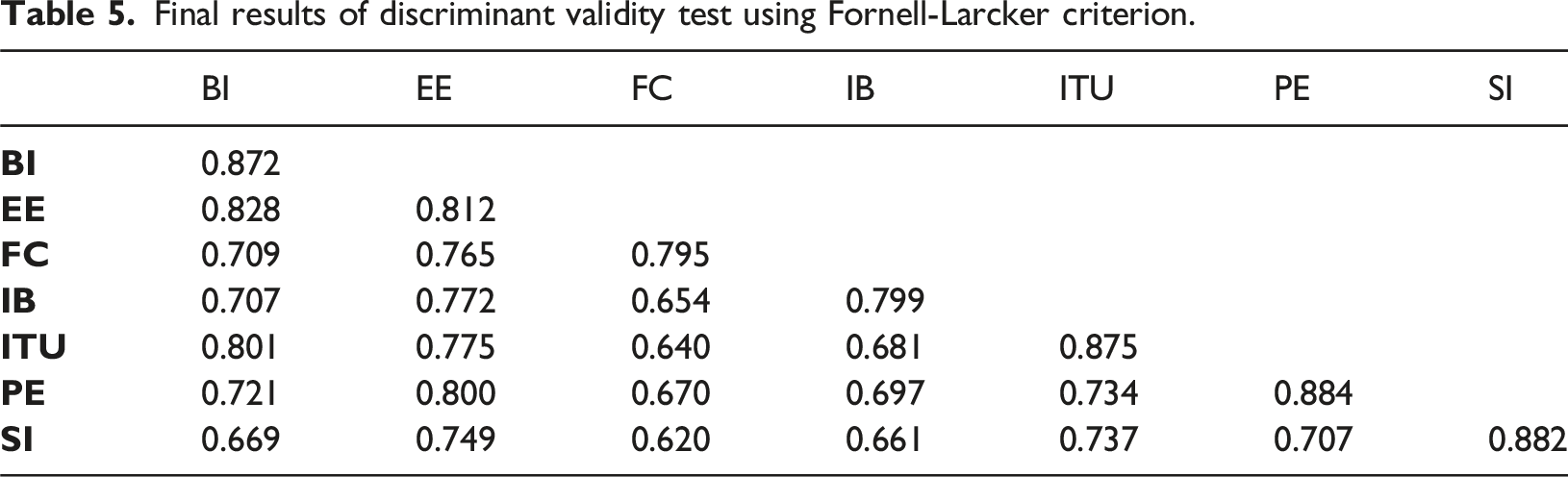
The instruments in this research were used first tested to establish their validity and reliability. After the instruments were deemed valid and reliable, the model construct test was carried out.
The instruments used in this study were tested for validity and reliability.
Loadings, CA, CR and AVE.

Discriminant validity Fornell-Larcker criterion.
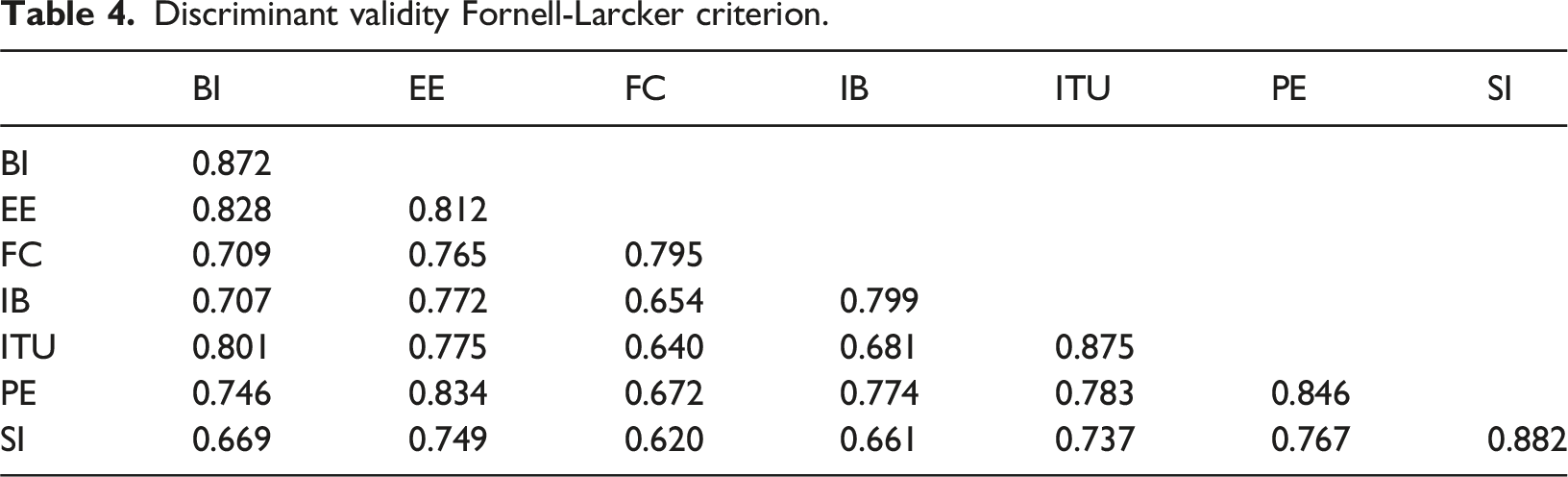
Final results of discriminant validity test using Fornell-Larcker criterion.
Discriminant validity cross loadings.

Table 6 shows that the result of the discriminant validity test gives a value above 0.7, meaning that the variable construct used in the structure of the model is valid. 48 Overall, the results of the validity, reliability, and construct tests, the variables met the requirements meaning that the variables and instruments can be used in this study.
Ethical considerations
This was how we obtained written informed consent from all the subjects prior to our study’s initiation, the requirement for which was supervised and approved by the institutional review board/ethics committee to which we were responsible. There was no need for legally authorized representatives to be involved because our subjects were all at least 17 years old, and in Indonesia, 17-year-olds have already obtained an ID card, so they can decide for themselves whether or not to participate in research. “Consumer Trust in Telemedicine in Indonesia” has adhered to ethical protocols by securing an approval certificate, confirming that this research does not violate any ethical standards.
The questionnaire’s cover page featured an opportunity for responders to give their informed written consent. The questionnaire explicitly delineated the study’s objectives, methodologies, potential risks and benefits, anonymity, confidentiality, and the voluntary nature of participation for each respondent. If the respondent consented, he or she would then proceed to complete the questionnaire. By proceeding, participants in the study indicated their consent. Consent was also expressed in the questionnaire with the following statement: “I have read and comprehended the consent form above. I affirm that I am 17 years of age or older. By selecting the ‘Next’ button to commence the survey, I am expressing my voluntary consent to participate in this research.”
Result
Hypothesis test results.

Table 7 shows that the greatest influence on consumers’ use of telemedicine is when the attitude that forms behavioral intention has emerged. Attitudes are formed from the beliefs of individual consumers. Effort expectancy, social influence, and performance expectancy influence individuals’ beliefs. This study demonstrates that facilitating condition has no influence on consumers using telemedicine.
Table 7 shows that, although social influence have an effect on individual beliefs, their influence is very small at 0.137. Social influence shows little influence on patients because the use of telemedicine emphasizes the performance of service providers rather than social influence. This is in accordance with the results of hypothesis testing where effort expectancy is shown to have the greatest influence. The variable that most forms belief is effort expectancy with a value of 0.451; this shows that consumers will indeed have belief if the effort of telemedicine is good and in accordance with their expectations.
Table 8 shows the indirect and direct effects. As for facilitating conditions, in direct and indirect tests they also showed no significance. This means that facilities in telemedicine applications are not the main thing for people to adopt telemedicine applications. The main factors behind consumers adopting telemedicine applications are effort expectancy and performance expectancy with research objects in Indonesia. The results of this study are different from the results of previous studies, especially the research of Siripipatthanakul et al. 41
The above results of the testing of the hypotheses show that the greatest influence on the intention to use is where there is behavioral intention in consumers. Based on this, companies that provide telemedicine need to pay attention to consumer behavior in using their applications. The largest shaper of behavioral intention is perceived ease of use, meaning that companies need to pay attention to the ease and comfort that consumers experience while they are using telemedicine applications.
Discussion
Consumer behavior in the use of digitization shows differences in the services that are adopted. In telemedicine, where the services adopted are directly related to consumer health, consumers are cautious in the adoption process. They want telemedicine effort expectancy that can provide solutions for their health. Consumer trust is more formed from effort expectancy, performance expectancy, and social influence on telemedicine. Consumers’ behavioral intention is influenced by perceived usefulness, individual beliefs, and perceived ease of use of telemedicine services in Indonesia.
For telemedicine service providers, they can pay attention to the same service performance as offline services. All service factors are a focus for service providers. Factors such as the performance of doctors, nurses, administration, and pharmacy are of concern to patients. Therefore, their performance needs to be improved so that consumers are willing to adopt telemedicine. The advantages of telemedicine can reach the territory of Indonesia without experiencing problems if a good internet network is available for all regions across the archipelago of Indonesian.
Conclusion
In people’s everyday lives, technology is making everything easier to do. One example of this is in the health sector where technology has given rise to health applications. Telemedicine applications are one alternative means of conducting health consultations. Overall, consumers are willing to use telemedicine applications if they feel confident in the services offered by the providers. The manifestation of this belief can be seen in effort expectancy, performance expectancy, and social influence which have a positive influence on individual belief. The emergence of individual belief in consumers further strengthens trust in telemedicine applications which causes changes in consumer behavior. In addition, behavioral intention is also formed from perceived usefulness and perceived ease of use. The results of this study show consumer trust in telemedicine in Indonesia.
For telemedicine companies, they can improve the performance of those involved in providing the services. Improved performance would be in terms of doctors, nurses, delivery of medicines, and the system. The ease and convenience of patients in using telemedicine is a priority for telemedicine companies. Ease and comfort are a form of performance and effort expectancy.
The limitation of this study is that it did not differentiate between the generations that exist. Therefore, the results of this study are based on the perception of consumers broadly regarding the adoption of telemedicine applications without distinguishing between them based on age. Future research could be developed to examine the moderating role of generations in the use of telemedicine applications.
Footnotes
Acknowledgments
We would like to thank the respondents of survey.

Ethical statement
Author contributions
The contributions of each author are as follows: Yasintha Soelasih, first and corresponding author (email:
Funding
The authors disclosed receipt of the following financial support for the research, authorship, and/or publication of this article: The research was supported by a grant from DRTPM Kemendikbudristek in Indonesia. Mandatory research grant Number: 0375.19/III/LPPM-PM.10.03.01/06/2024.
Declaration of conflicting interests
The authors declared no potential conflicts of interest with respect to the research, authorship, and/or publication of this article.
Data Availability Statement
Data available on request from the authors.