



Abstract
An increasing number of patients turn to YouTube for medical information, driving the growth of research on medical video content, including in dermatology. The objective was to analyze the content of YouTube videos discussing acne, psoriasis, or anti-aging skincare in Arabic. This infodemiological study analyzed the most viewed videos on these topics. A usefulness score was created to compare “useful” and “not useful” videos, along with assessments of global quality and reliability. Among the 98 most viewed videos, 75 were analyzed. Non-professionals produced 53.33%. Median scores for quality (2/5), reliability (1/5), and usefulness (4/19) were low. Most videos (78.67%) were “not useful,” while 21.33% were “useful,” with the latter showing significantly higher quality and reliability. In conclusion, most videos present shortcomings both in terms of quality and reliability. Videos from professional sources are far fewer in number and less popular.
Introduction
Social media are ubiquitous in the daily lives of people of all ages and professions. 1 They are a vast and constantly evolving field, reaching 4.2 billion users by 2021, i.e., half the world’s population.2,3 YouTube is one of the platforms that is accessible in 100 countries and 80 different languages. 4 It is also the second most consulted website in the world by patients, medical students, and healthcare professionals after Google. 5 It presents videos from various sources claiming to provide medical education or promote a specific treatment or advice. 6 This global popularity reaches dermatology too, with a share that rose from 19% to 35% between 2014 and 2018.6,7 However, using YouTube to disseminate information escapes scientific endorsement or content regulation. No authority is empowered to verify the accuracy or the relevance of posted videos. 8
A noteworthy part of medical YouTube deals with dermatology.3,6 The Arab world, like any other cultural community, broadcasts and views videos in its language. The number of publications reporting content analysis of medical videos is rapidly growing in many specialties including dermatology.9–12 Only six studies included the Arabic language in their analysis.13–18 None dealt with dermatology.
Arabic videos on dermatology are de facto intended for anyone who understands this language. However, they lack quality control or may contain misinformation.
Acne has a prevalence of 52% In the Middle East. 19 Psoriasis’ prevalence in Africa and the Middle East lies between 1% and 3% and is comparable to that observed in Caucasians. 20 The worldwide increasing interest in anti-aging skincare is highlighted by an annual global expenditure on cosmetic anti-aging products estimated at USD 60 billion. 21
For all the previous reasons, we aimed to analyze the content of Arabic videos discussing these 3 common conditions, acne, psoriasis, and anti-aging skincare.
Materials and methods
Type of study
It was a summative content analysis, 22 designed to systematically quantify and evaluate video content. Additionally, it was an infodemiological study aimed at assessing the distribution and public health impact of online information. Together, these methods are well-suited for analyzing large volumes of digital content and identifying trends or inaccuracies in health-related information.
Objectives
The primary objective was to evaluate the content, quality, and reliability of YouTube videos dealing with acne, psoriasis, or anti-aging skincare and using the Arabic language. The secondary objective was to compare the characteristics of the videos according to their usefulness and source (medical experts vs non-medical experts).
Population
We consulted the YouTube platform (youtube.com) between August 1 and September 30, 2023. We performed a search for videos dealing with acne, psoriasis, or anti-aging skincare. The search terms, separately used, were “Habb Al Chabab - حبّ الشّباب” for acne, “Al Sadafiya - الصدفيّة” for psoriasis, and “Tajaaid Al Bachara - تجاعيد البشرة” for age-related skin wrinkles. These were the most appropriate Arabic terms on YouTube since the literal translation of anti-aging skincare did not lead to any relevant video.
Inclusion criterion
The top 30 most-viewed Arabic-language videos were evaluated for each search term, given that over 90% of Internet users generally click on the first three pages of the search results (9). They were obtained using YouTube’s “view count” filtering, which displays videos from most to least viewed.
Exclusion criteria
(1) videos that were not in Arabic. (2) videos without audio. (3) duplicate videos. (4) off-topic videos such as music, games, or others. (5) animation videos or film extracts.
Videos’ collected parameters
Videos were saved and an “Excel” document containing video titles and characteristics was created.
The following parameters were collected: total number of views, video duration (in minutes), uploading date (day/month/year), duration on YouTube (in days), source (dermatologist, physician of another specialty, non-physician healthcare professional, non-healthcare professional) and content (epidemiology, risk factors, pathophysiology, clinical aspects, diagnosis, treatment, and prevention).
Six other parameters were used as measures of audience interaction: the number of views per day (obtained when dividing the total number of views by the number of days since upload); the number of likes and dislikes; the number of subscribers; the number of comments; and the video’s popularity, estimated as the ratio of likes multiplied by the ratio of views, then divided by 100, given that the ratio of likes = likes x 100 / likes + dislikes, and the ratio of views = number of views/number of days online.
Evaluation of the videos
Evaluators
Each video was assessed individually and separately by two evaluators (the first author and the second author) to ensure the reliability and comparability of the results. In case of discrepancy, the video was evaluated and scored by a third person (the third author).
The awarded scores were then averaged to obtain an overall score in the results and the statistical analyses.
Evaluation of global quality using the “global quality scale” (GQS)
The overall quality and fluidity of the educational content of online videos were assessed using the GQS. 23 It’s a subjective 5-point Likert scale where 1 point corresponds to poor quality, 3 points to average quality, and 5 points to the highest possible educational quality. 20
Evaluation of the medical content using the content score
The specific content of each video was evaluated using the content score, a linear numeric scale based on the presence of seven elements that must be included to adequately address any medical topic: risk factors, epidemiology, pathophysiology, clinical aspects, diagnosis, treatment, and prevention. 24 For each element, a scoring system was used as follows: 0 points (not mentioned), 1 point (briefly introduced), and 2 points (introduced in detail). The assigned content score can have zero as the minimum and 14 as the maximum.
Total usefulness
A total usefulness scoring scheme was created by adding the GQS score to the content score (24); videos were then categorized as “not useful” (1–9) or “useful” (10–19).25,26
Evaluation of the reliability using the modified DISCERN score, and the JAMA score
The modified DISCERN score is built around five questions: achievement of the objectives, reliability of the source, balance of the information, listing of additional references, and mention of uncertainty. The answer to each question was either yes (1 point) or no (zero points), generating a maximum score of 5. 10 The higher the score, the more reliable the video in terms of quality and credibility. 27
The JAMA score (JAMAS) assigns one point to each of these 4 items if present: authors’ affiliation, attribution of references, disclosure of ownership, and post’s currency. The score varies between zero and four.26,28 Videos adhering to these 4 criteria have the highest level of reliability.
Assessing the title-content consistency
The TCCI “Title-Content Consistency Index” uses a 5-point Likert scale to assess the consistency between a video’s title and content, ranging from 1, the poorest consistency, to 5, the highest consistency.10,29
Statistical analysis
Data were tested for conformity to a normal distribution using the Shapiro-Wilk test. Continuous variables were presented as medians, while categorical variables were expressed as percentages. Two statistical tests were selected to compare the “useful” and “not useful” groups. Fisher’s exact test was used for categorical variables, and the Mann-Whitney U test for continuous variables. A p-value strictly inferior to 0.05 was considered statistically significant. The “Python” programming language was used for all statistical analyses, particularly the “scipy.stats” library.
In addition, a reporting standardization tool,
IRB approval
This study received ethical approval from the institution’s IRB committee on 07 November 2023.
Results
The first three pages of each search term displayed a total of 30 videos, including eight photo links without audio. We excluded these non-video items and replaced them with an equivalent number of videos from the fourth page of each search. This resulted in a final count of 98 items, of which 90 were actual videos.
The cumulative length was 656 minutes. Their sum of views was more than 150 million. Of the 90 videos, 15 were excluded and 75 were included, comprising 25 on acne, 25 on psoriasis, and 25 on anti-aging skincare (Figure 1). YouTube video search flowchart.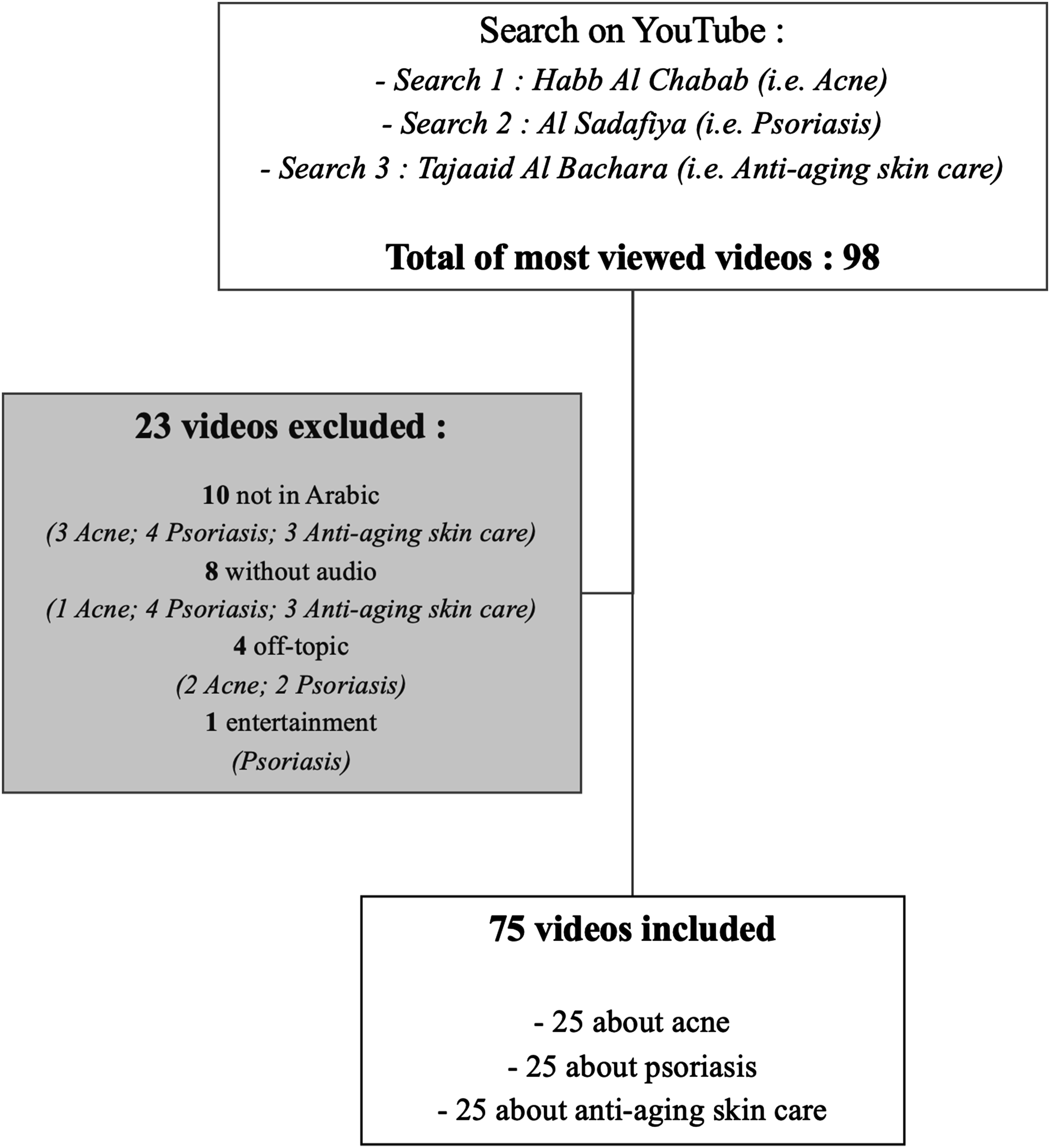
Characteristics of the included videos
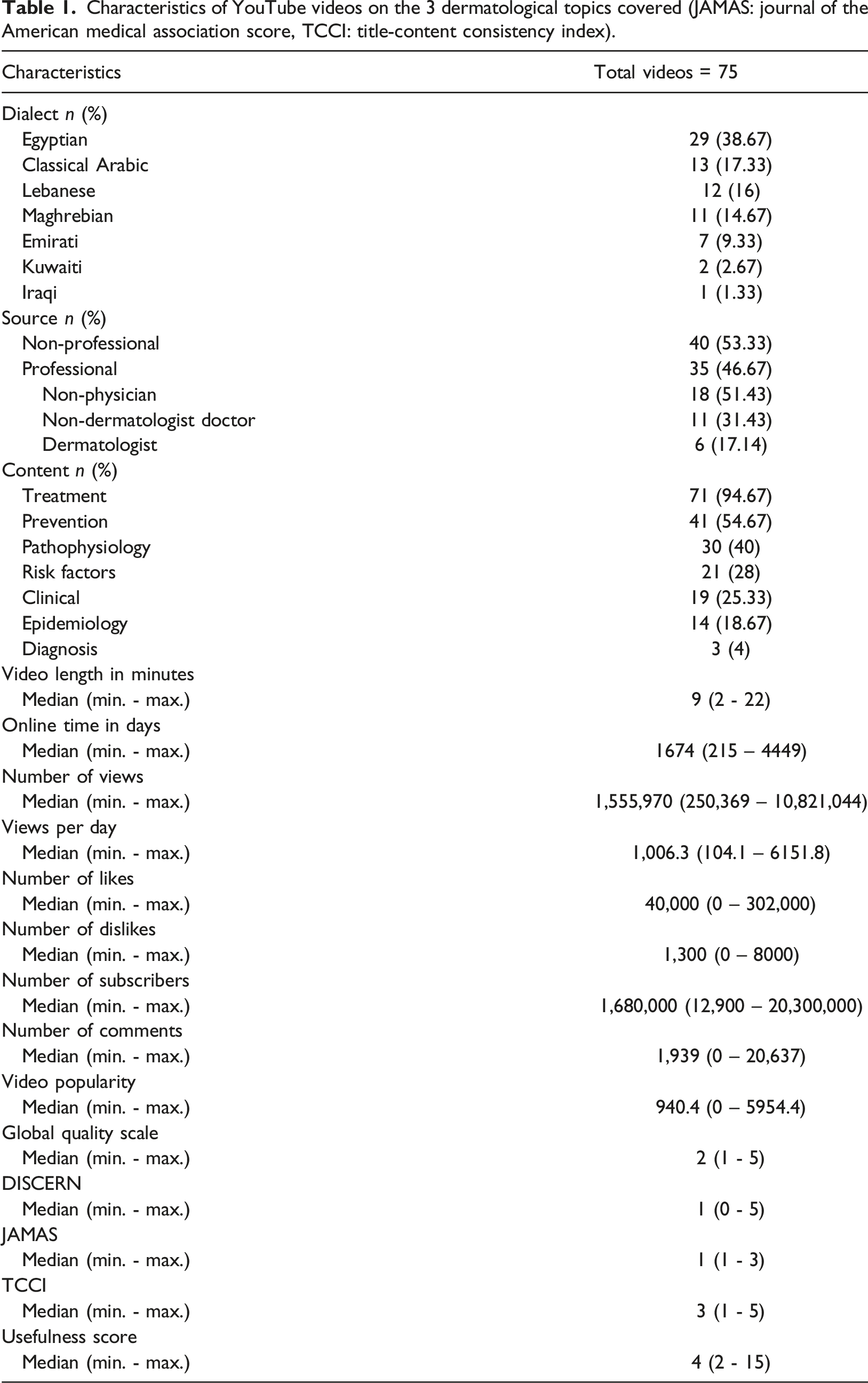
Characteristics of YouTube videos on the 3 dermatological topics covered (JAMAS: journal of the American medical association score, TCCI: title-content consistency index).
Comparison of the “useful” and “not useful” videos
Comparison of the videos according to their usefulness.
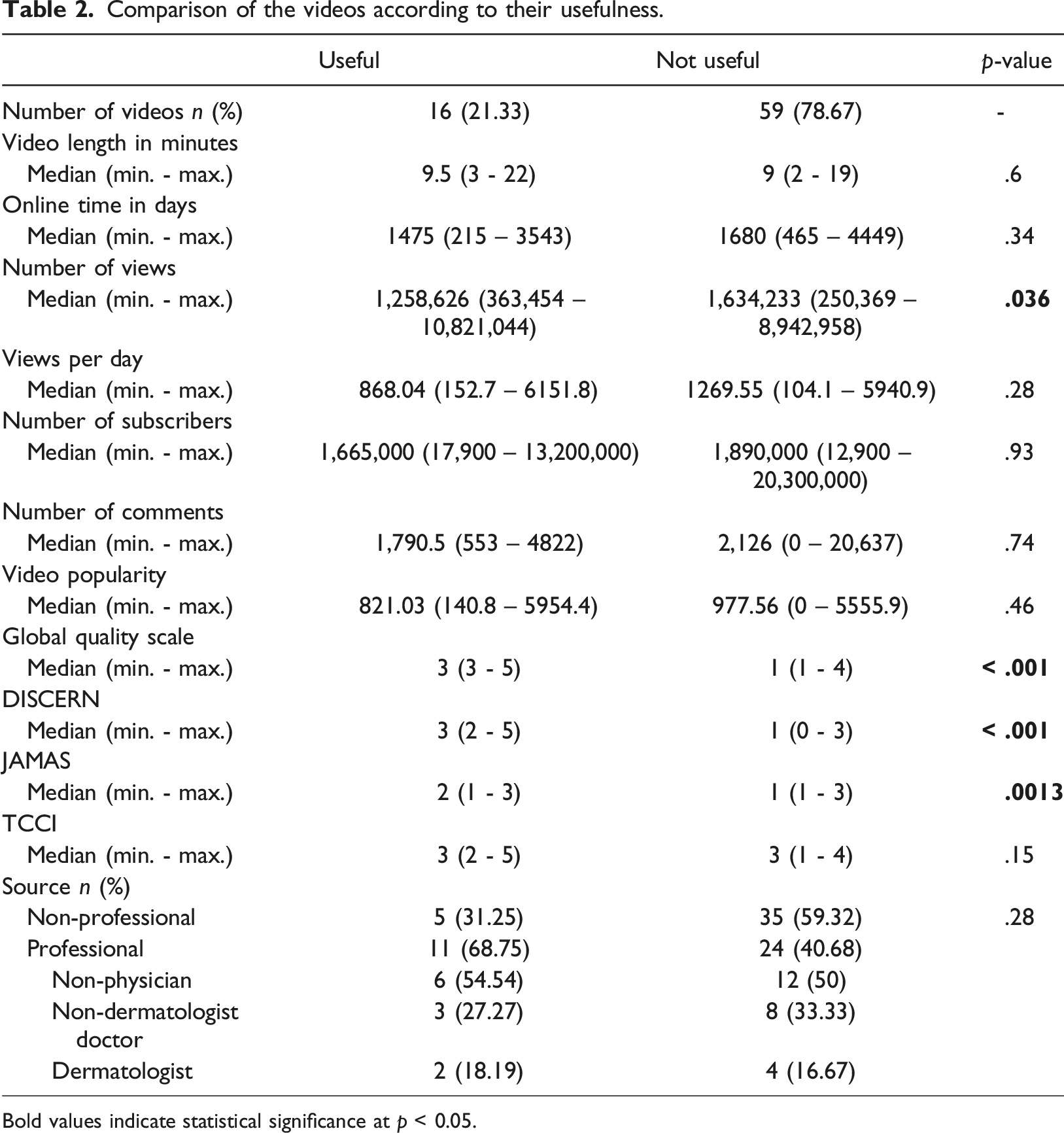
Bold values indicate statistical significance at p < 0.05.
Comparison of the “useful” and “not useful” acne videos
Comparing the usefulness of acne, psoriasis, and anti-aging videos.
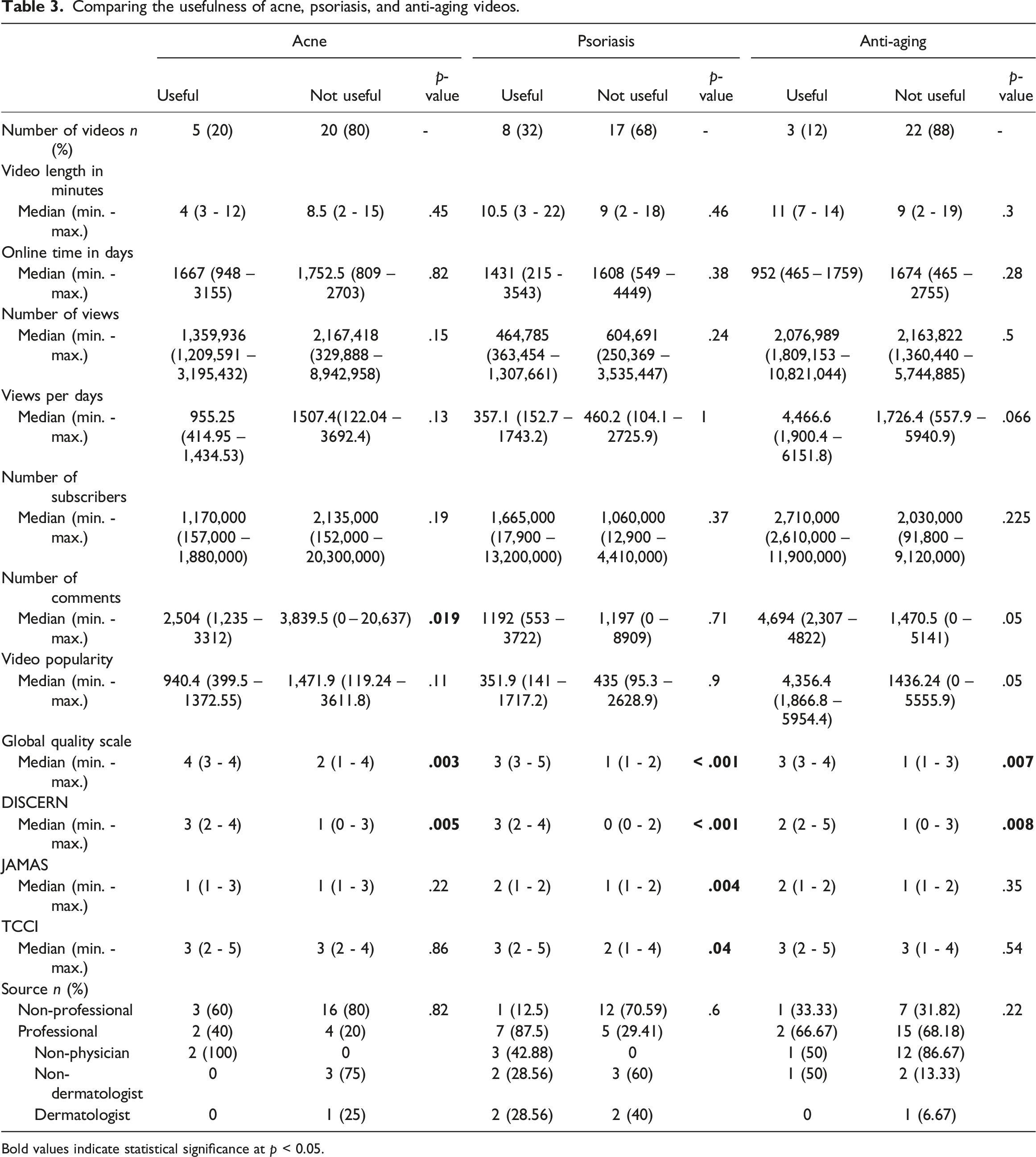
Bold values indicate statistical significance at p < 0.05.
Comparison of the “useful” and “not useful” psoriasis videos
The 25 psoriasis videos were divided into 8 (32%) “useful” and 17 (68%) “not useful” (Table 3). The “useful” videos had a significantly higher median in DISCERN, JAMAS, and TCCI scores, 3 versus 0 (p < 0.001), 2 versus 1 (p = 0.004), and 3 versus 2 (p = 0.04), respectively.
Comparison of the “useful” and “not useful” anti-aging skincare videos
Three videos (12%) were “useful” and 22 (88%) were “not useful” (Table 3). The “useful” videos had a significantly higher median in the DISCERN score (2 vs 1, p = 0.008).
Discussion
Evaluation of the most viewed Arabic YouTube videos on acne, psoriasis, and antiaging skincare showed, according to different scores, that most videos were “not useful” and lacked reliability and credibility. Their content was of little benefit to the patients. Non-healthcare professionals mainly uploaded videos of poor to low-quality scores.
Of the few studies that analyzed the content of YouTube Arabic medical videos, none have specifically focused on dermatology.16,18 This study measured the quality of information disseminated to all Arabic speakers, a community of 19 countries sharing the same official language but expressing themselves through different dialects. 30 Our results shall guide non-specialists who cannot filter out misleading information on a platform that is an easily accessible tool for patient education but whose video’s scientific quality is not regulated. Madathil et al. concluded in their systematic review of health information on YouTube that the platform content was misleading and primarily anecdotal. It also contradicted the reference standards. Moreover, a lay user had a high probability of finding such content, since the retrieval of relevant videos depends on the search term used. 8
Some limitations need to be considered when interpreting our results. First, the coding process is done manually, making the human factor a potential source of error when interpreting the evaluation tools. This is particularly relevant as none of the authors have prior experience with content analysis. Second, the method lacks the statistical measures of inter-rater agreement and the prior calculation and justification of the sample size. Third, rating the usefulness of videos’ content is exposed to subjectivity due to the lack of universally validated tools. Fourth, the results may change over time due to the rapid evolution of the platform and would consequently be relevant only at a given time; this dynamic is linked to the addition of new videos and the deletion of older content. 31 We suggest repeating the same analysis in 5 years or so. Finally, the criteria for this assessment are rooted in the current knowledge and concepts of medicine, which can change at the pace of scientific discoveries.
The fact that most of the analyzed videos were “not useful”, had poor quality content, and disseminated scientifically inaccurate dermatological information, risks to overwhelm YouTube users with misleading content. This echoes not only the findings of Guzman et al. where most English-language YouTube videos on the treatment of acne and psoriasis were of poor overall quality and contained incomplete information, 12 but also those of several Arabic-language YouTube studies that revealed, for instance, the inaccuracy and the poor quality of the disclosed medical information on the retinopathy of prematurity or the holmium laser enucleation of the prostate.16,18 However, at a time when some studies concluded that YouTube might not be an appropriate educational source for patients about colorectal or prostate cancer,32,33 another one has claimed that YouTube videos teaching subcutaneous injection of anti-TNF were educationally useful to patients. 9
The “useful” videos had significantly higher DISCERN and JAMA scores, thus higher credibility, and reliability, than the “not useful” ones. However, scores were relatively low, especially for JAMAS, indicating that the source has not properly presented its affiliations and qualifications, and the information disclosed was not properly referenced. The “useful” videos were mainly put online by professionals, corroborating the findings of Guzman et al. 12 and Ayoub et al. 15 where videos made by specialists were superior on several levels, although significantly fewer in numbers. The study by Gokcen et al. 34 evaluating YouTube videos on herniated discs has oppositely shown that the rate of videos uploaded by doctors was higher. We hypothesize that, due to their popularity and connection with traditional and sociocultural beliefs, dermatological topics are likely to encourage the incursive participation of non-specialists or even non-professionals.
Notwithstanding their lower quality, the “not useful” videos were more appreciated than the “useful” ones, with higher popularity, number of subscribers, and comments. This could be attributed not only to the complexity of the medical language of doctors but also to patients’ inability to discern useful information. Even though these differences were not statistically significant, those parameters cannot be used to set the usefulness of the videos. 35
Suggested strategies for effective optimization
Faced with the current boom in social networking and the growth in the use of online content as an educational resource, physicians, universities, and governments have a crucial role to play by: - actively participating on social media platforms with simplified language, thus making accurate information more understandable; - closely monitoring the quality, accuracy and credibility of Arabic-language content on social media to hinder the spread of misleading information; - directing patients to reliable and appropriate sources of health information; - educating patients on how to evaluate online resources and identify those that are balanced and free from commercial interests.
In addition, YouTube can play a crucial role in limiting the dissemination of misleading information. For instance, they could integrate into each video a dedicated section displaying evaluation scores on the usefulness of the video. Otherwise, they can put in place regulations to ensure the quality, reliability, and credibility of the information distributed on the platform.
Conclusion
In conclusion, YouTube seems to be an abundant source of information on acne, psoriasis, and anti-aging skincare in the Arab world. However, most videos present shortcomings in quality and reliability, running the risk of providing inaccurate information. Although videos from professional sources, notably dermatologists, are more accurate and relevant, they are far fewer in number and less popular. The drawn conclusion raises the need to bring order to the expanding domain of health informatics by setting regulations for video uploads or sending alerts against unverified material.
Supplemental Material
Supplemental Material - Analysis of the content of YouTube videos discussing acne, psoriasis, and anti-aging skincare in Arabic
Supplemental Material for Analysis of the content of YouTube videos discussing acne, psoriasis, and anti-aging skincare in Arabic by Karim Rizk, Maria Farhat and Boutros Soutou in Health Informatics Journal.
Footnotes
Author contributions
All authors were involved in drafting the article. All authors approved the final version to be published. They had full access to all the data in the study. They accept the responsibility for the data integrity and accuracy. Study conception and design: KR, BS. Acquisition of data: KR, MF, BS. Analysis and interpretation of data KR, MF, BS.
Declaration of conflicting interests
The author(s) declared no potential conflicts of interest with respect to the research, authorship, and/or publication of this article.
Funding
The author(s) received no financial support for the research, authorship, and/or publication of this article.
Ethical statement

Supplemental Material
Supplemental material for this article is available online.
References
Supplementary Material
Please find the following supplemental material available below.
For Open Access articles published under a Creative Commons License, all supplemental material carries the same license as the article it is associated with.
For non-Open Access articles published, all supplemental material carries a non-exclusive license, and permission requests for re-use of supplemental material or any part of supplemental material shall be sent directly to the copyright owner as specified in the copyright notice associated with the article.
