



Abstract
Background
The increasing global incidence of gout has heightened public interest in accessible health information. Video-sharing platforms such as Bilibili, Douyin, and YouTube have become major sources of gout-related content, yet the quality and reliability of these videos remain insufficiently evaluated.
Methods
On September 1, 2025, approximately 100 top gout-related videos were retrieved from each platform. Video features and interaction metrics were recorded. Quality and reliability were appraised using the Global Quality Score (GQS), modified DISCERN (mDISCERN), Patient Education Materials Assessment Tool (PEMAT), and Video Information and Quality Index (VIQI). Spearman correlation analyses explored relationships between video characteristics and quality scores.
Results
Overall quality was moderate (GQS: 3.00; mDISCERN: 2.00; PEMAT-T: 75.00; PEMAT-U: 83.33; PEMAT-A: 75.00; VIQI: 15.00; respectively). Douyin videos were significantly shorter with higher interaction metrics but limited depth, while YouTube and Bilibili videos were longer and covered broader topics. YouTube excelled in understandability but lagged in actionability, whereas Douyin performed best in VIQI. Healthcare professional-produced videos significantly surpassed non-professional counterparts across most quality metrics. Correlation analysis confirmed the consistency of these tools in reliability assessment. Meanwhile, positive correlations were observed between video length, view count, and quality scores.
Conclusion
This study reveals that gout-related videos on major platforms exhibit moderate quality and reliability. Professional uploads demonstrated superior thematic diversity and quality compared to non-professionals. Platform-specific differences were observed: Douyin prioritized interactivity over depth, whereas YouTube and Bilibili offered broader topic coverage. Positive correlations between duration, views, and quality imply that extended, evidence-based content fosters greater engagement.
Introduction
Gout is a disease associated with purine metabolism disorders and impaired uric acid excretion. Hyperuricemia is the most important biochemical basis for gout. 1 Persistent elevation of uric acid can lead to deposition of urate crystals in joints and surrounding tissues, leading to local inflammation and joint damage. 2 Over the past 15–20 years, a rising incidence of gout has been reported across multiple countries around the world.3,4 With the adjustment of dietary patterns, gout has become the second most prevalent chronic metabolic disease in China, after diabetes. 5 Although pharmacological treatment remains central to disease management, lifestyle modifications can play a significant role in preventing and reducing gout attacks.6,7 In today's society with widespread Internet access, many individuals obtain medical information and broaden their health knowledge through video platforms. The effective interaction between the public and medical practitioners on video platforms extends the breadth of disease education and chronic disease management. The dissemination of health information can change health behavior and contribute to the early diagnosis and prevention of diseases. 8 However, the spread of misinformation may also lead patients to make wrong decisions and miss the best opportunity to prevent the development of the disease. Therefore, it is necessary to assess the current ability of video platforms to provide health education related to gout.
This study aims to evaluate the quality and accuracy of gout-related videos on YouTube, Bilibili, and Douyin, analyze the current situation of the public getting guidance on gout from video platforms, and provide actionable recommendations for platform operators and content creators.
Materials and methods
Ethical considerations
The data analyzed in this study were obtained from video platforms Bilibili, Douyin, and YouTube. The study focused solely on publicly accessible content, including audiovisual materials, video metadata, and publicly visible comments. No attempts were made to access non-public information, contact content creators, or collect personally identifiable information. Data analysis and reporting were conducted at an aggregate level to uphold the principles of privacy and confidentiality. As such, the study did not require approval from a medical ethics committee.
Data collection
Data collection was conducted on a single day (September 1, 2025) in Hangzhou, Zhejiang, China, using a Windows computer (Windows 11) equipped with a newly installed Safari browser (Version 18.1.1). To minimize bias arising from personalized recommendations, all cookies, cache data, browsing history, and auto-fill information were systematically cleared prior to initiating the search. Searches were performed in English on YouTube using the keyword “Gout,” and in Chinese on Bilibili and Douyin using the term “痛风” (the standard Chinese term for gout), which corresponds to the medical condition known as gout. The search results were presented in the default order with no filtering criteria. However, videos posted within the past week were excluded because the interaction data of newly released videos was not stable, and could not reliably reflect actual viewer engagement. The top 100 videos on each platform were finally included in the study (Supplemental Additional File 1).
Video characteristics
The following information was systematically recorded for each video: web link, platform, duration, topics, shooting style, and viewer engagement metrics—including view counts, coin donations (which on Bilibili signify audience support), bullet comments, likes, comments, collections, and shares. To enhance the clarity and interpretability of the results, we categorized the video topics into the following areas: anatomy, epidemiology, etiology or prevention, examinations or diagnosis, pathology, symptoms, and treatment or prognosis. It should be noted that individual videos may address multiple topics simultaneously. In addition, the style of video shooting was classified as solo narration, question-and-answer (Q&A) format, PPT or class, animation or action, medical scenarios, and television program or documentary. Due to the characteristics of the platform itself, the following data could not be obtained: (1) view counts, coin donations, and bullet comments on Douyin; (2) coin donations, bullet comments, collections, and shares on YouTube. All data were stored in a spreadsheet to ensure consistency and accessibility.
At the same time, the researchers collected relevant information on the video uploaders, including ID, number of fans, categories, and certification status. Uploaders were classified into the following categories 9 : (1) doctors; (2) other medical workers or medical students; (3) non-profit organizations including hospitals, departments, and trade associations; (4) for-profit companies; (5) official media; and (6) self-media. Among the aforementioned categories, for-profit companies and self-media were classified as non-professionals, while others were categorized as professionals. The certification status of uploaders was determined as follows: (1) Bilibili: a yellow flash, blue flash or gray V is displayed below the uploaders' profile picture; (2) Douyin: a yellow V or Blue V appears to the right of the ID; and (3) YouTube: a blue label appears below the video, or a gray tick is displayed to the right of the ID.
Quality assessment
Two researchers (XY and HS) independently completed the quality assessment, and any discrepancies were reviewed and resolved by a third researcher (YZ). To ensure a more objective and comprehensive evaluation of video quality, this study used five scoring scales: Global Quality Score (GQS), modified DISCERN (mDISCERN), Patient Education Materials Assessment Tool (PEMAT), and Video Information and Quality Index (VIQI) to score the video quality respectively. The GQS is a widely used tool for evaluating the overall quality, usability, and viewer engagement of video information, rated on a 5-point scale from poor (1) to excellent (5), offering a holistic assessment of educational flow and utility. 10 The mDISCERN scale focuses on the reliability of health information, assessing aspects such as clarity of aims, referencing of sources, and balanced presentation of evidence; it uses a binary scoring system (0 or 1 per item, total 0–5), providing a quick measure of content trustworthiness. 11 The VIQI evaluates the accuracy, quality, precision, and flow of video materials on a 20-point scale (four subscales from 1 to 5), serving as a complementary tool to quantify informational depth and coherence. 12 PEMAT is a comprehensive instrument assessing understandability (PEMAT-U: how easily viewers comprehend the content) and actionability (PEMAT-A: how well it guides practical actions), along with a total score (PEMAT-T); scores are percentage-based (0–100%), with strong validity for patient education materials, enabling detailed evaluation of accessibility and applicability. 13 Previous studies on the evaluation of video quality on social media platforms have confirmed the reliability of the above tools.14–16 Supplemental Additional File 2 provides detailed descriptions of these tools and the researchers’ control over specific aspects during the scoring process.
Statistical analysis
The normality of continuous variables was first assessed using a normality test. Continuous variables with non-normal distribution were described by median and interquartile range (IQR), and those with normal distribution were presented as mean ± standard deviation (SD). A Kruskal–Wallis non-parametric test was employed for between-group comparisons. Categorical variables were analyzed using the chi-square test or Fisher's exact test to evaluate their significance. Spearman's correlation analysis was conducted to examine the relationship between frequency quality assessment indicators, reliability parameters, and basic characteristics. Data processing and analysis were performed using R (version 4.3.0), along with Zstats version 1.0 (www.zstats.net). Cohen's kappa 17 coefficient was calculated to assess the inter-rater agreement between the two researchers in the evaluation of video quality (κ > 0.8 indicates excellent agreement; 0.6 < κ ≤ 0.8 indicates substantial agreement, 0.4 < κ ≤ 0.6 indicates moderate agreement; and κ ≤ 0.4 indicates poor agreement). All data were analyzed using two-sided test, and a p-value less than 0.05 was considered statistically significant.
Results
Video characteristics
A total of 241 videos met the inclusion criteria were included in the final analysis, among which 72 from Bilibili, 70 from Douyin, and 99 from YouTube (Table 1). The screening procedure is detailed in Figure 1. Following the removal of duplicates, videos were excluded for irrelevance, including content featuring gout-related celebrity news or posts designed to solicit sympathy. The overall sample had a median length of 67.0 s (IQR, 44.0–273.0). The median number of likes and comments were 1510.0 (IQR, 423.0–9112.0) and 212.0 (IQR, 32.0–951.0), respectively. All of these metrics differed significantly across the three platforms (p < 0.001). Compared to YouTube (57.00 [40.00, 285.00] s) and Bilibili (215.00 [88.50, 467.75] s), Douyin videos (53.00 [35.25, 98.25] s) are notably shorter. However, the interaction metrics (5161 likes and 930 comments) are significantly higher than those of other platforms.

Search strategy for videos on gout.
Baseline characteristics of the videos.
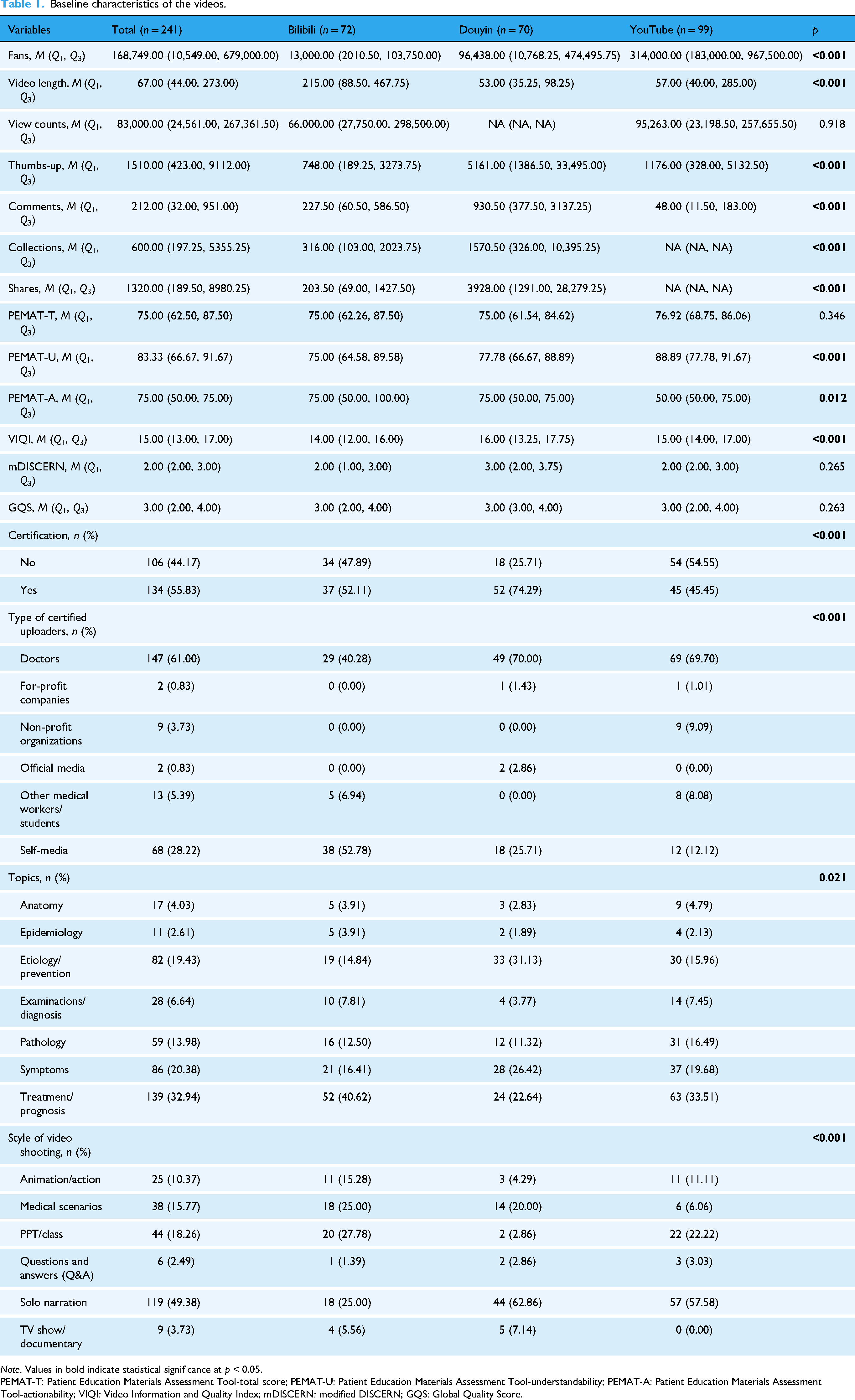
Note. Values in bold indicate statistical significance at p < 0.05.
PEMAT-T: Patient Education Materials Assessment Tool-total score; PEMAT-U: Patient Education Materials Assessment Tool-understandability; PEMAT-A: Patient Education Materials Assessment Tool-actionability; VIQI: Video Information and Quality Index; mDISCERN: modified DISCERN; GQS: Global Quality Score.
Regarding the number of followers of uploaders, YouTube creators have the largest following. In terms of the identity of uploaders, 55.83% of the videos were uploaded through verified accounts. Doctors were the most prevalent source of videos (61.0%), particularly on Douyin (70.0%) and YouTube (69.7%) (Figure 2). Self-media accounts constituted 28.2% of the total, with a higher proportion on Bilibili (52.8%). Non-profit organizations and official media were less common, appearing primarily on YouTube and Douyin, respectively. Analysis of video shooting styles revealed that solo narration was the most common format overall (49.4%), with a high prevalence on both Douyin (62.9%) and YouTube (57.6%). In contrast, Bilibili featured a more diverse range of styles. In addition to the PPT/lecture format (27.8%), some doctors shared surgical procedures or pre-operative interviews. Animation/action and TV show/documentary styles were comparatively uncommon across platforms.

Numbers of video uploaders about gout on Bilibili, Douyin, and YouTube: (a) all the authors and (b) the certified authors.
Topic distribution by uploader type
Across all platforms, professionals contributed to a broader and more balanced range of topics, with a total of 307 topic instances across 169 videos, compared to 115 topic instances in 72 non-professional videos (p = 0.015). The most prevalent topic overall remained “treatment/prognosis” (32.9% of all instances), but professionals emphasized it more frequently (103 instances, 33.6% of their total) than non-professionals (36 instances, 31.3%). Similarly, “symptoms” was covered in 57 professional instances (18.6%) versus 29 non-professional (25.2%), while “pathology” showed a stark contrast, with professionals addressing it 45 times (14.7%) compared to just 16 times (13.9%) by non-professionals. Platform-wise, on YouTube, professionals dominated in-depth topics like “etiology/prevention” (29 instances) and “pathology” (29 instances), whereas non-professionals focused more on accessible themes such as “treatment/prognosis” (10 instances) and “symptoms” (5 instances), although no significant difference was observed between the two groups (p = 0.108). On Douyin, professionals covered “etiology/prevention” extensively (25 instances), while non-professionals prioritized “symptoms” (12 instances). Bilibili exhibited similar patterns, with non-professionals favoring “treatment/prognosis” (24 instances) and professionals balancing across topics like “treatment/prognosis” (28 instances) and “examinations/diagnosis” (8 instances), with all these differences being statistically significant (all p < 0.05) (Supplemental Additional File 3).
Information quality and reliability
This study systematically assessed the quality and reliability of gout-related videos across multiple platforms using the PEMAT, VIQI, mDISCERN, and GQS instruments (Table 1, Figure 3). The inter-rater reliability was excellent for VIQI (κ = 0.823), high for PEMAT-T and PEMAT-U (κ = 0.742 and 0.701, respectively), and moderate for PEMAT-A, GQS, and mDISCERN (κ = 0.635, 0.658, and 0.576, respectively). Overall, the evaluated videos demonstrated moderate quality and reliability. The median scores were as follows: PEMAT-T, 75.00 (IQR: 62.50–87.50); PEMAT-U, 83.33 (IQR: 66.67–91.67); PEMAT-A, 75.00 (IQR: 50.00–75.00); VIQI, 15.00 (IQR: 13.00–17.00); mDISCERN, 2.00 (IQR: 2.00–3.00); and GQS, 3.00 (IQR: 2.00–4.00). While PEMAT-T scores were comparable across platforms, YouTube videos scored highest in PEMAT-U but lowest in PEMAT-A. Douyin performed notably well in terms of VIQI. As shown in Table 2, videos created by professionals scored significantly higher than those from non-professionals across nearly all quality dimensions (PEMAT-T, PEMAT-U, VIQI, mDISCERN, and GQS), underscoring the influence of professional background on the quality of health education content. In contrast, PEMAT-A scores did not significantly differ by platform or uploader type, suggesting that video “actionability” may be influenced by other factors, such as cultural context or platform-specific features.

The differences in video quality and reliability among specific video-sharing platforms: (a) PEMAT-T score; (b) PEMAT-U score; (c) PEMAT-A score; (d) VIQI score; (e) mDISCERN score; and (f) GQS score. PEMAT-T: Patient Education Materials Assessment Tool-total score; PEMAT-U: Patient Education Materials Assessment Tool-understandability; PEMAT-A: Patient Education Materials Assessment Tool-actionability; VIQI: Video Information and Quality Index; mDISCERN: modified DISCERN; GQS: Global Quality Score. *p < 0.05; **p < 0.01; ***p < 0.001.
Quality comparison between the videos uploaded by professionals and non-professionals.

Note. Values in bold indicate statistical significance at p < 0.05.
PEMAT-T: Patient Education Materials Assessment Tool-total score; PEMAT-U: Patient Education Materials Assessment Tool-understandability; PEMAT-A: Patient Education Materials Assessment Tool-actionability; VIQI: Video Information and Quality Index; mDISCERN: modified DISCERN; GQS: Global Quality Score.
Correlation analysis
A heatmap was employed to visualize the correlations among the four quality assessment tools (PEMAT, VIQI, mDISCERN, and GQS) and their associations with video characteristics (Figure 4). The results revealed moderate to strong positive correlations among all quality assessment scores (p < 0.05). Distinct correlation patterns were observed between each tool and video metrics: PEMAT-T was positively correlated with video length (r = 0.46, p < 0.001), view count (r = 0.21, p < 0.01), thumbs-up (r = 0.16, p < 0.05), and collections (r = 0.32, p < 0.001). PEMAT-U showed positive correlations with video length (r = 0.33, p < 0.001), view count (r = 0.18, p < 0.05), and collections (r = 0.25, p < 0.01), but a negative correlation with comments (r = −0.17, p < 0.01). PEMAT-A was positively correlated with all video characteristics except shares. Similarly, VIQI, mDISCERN, and GQS scores were positively associated with all video metrics (p < 0.05).

The Spearman correlation coefficients between video general information and quality and reliability of video content. *p < 0.05; **p < 0.01; ***p < 0.001.
Discussion
Gout is a prevalent metabolic disorder characterized by hyperuricemia and the deposition of monosodium urate crystals in joints, leading to inflammatory responses and tissue damage. 18 Epidemiological studies from Asia, Europe, and North America indicate that the adult incidence rate ranges from 0.6 to 2.9 per 1000 person-years, with prevalence rates between 0.68% and 3.90%.19–21 A higher occurrence is observed in men compared to women. The widespread use of the Internet has transformed how individuals access health-related information. Video-sharing platforms such as Bilibili, Douyin, and YouTube have emerged as key sources of medical knowledge.22,23 These platforms have facilitated direct interaction between the public and healthcare professionals, enhancing patient education and chronic disease management. 24 However, the unregulated nature of user-generated content poses challenges regarding the accuracy and reliability of health information, potentially influencing patient behaviors and clinical outcomes.25,26 This study aims to evaluate the quality and credibility of gout-related videos across three major platforms, offering evidence-based recommendations for content creators and health educators.
After analyzing 241 gout-related videos, we identified significant variations in content quality and audience engagement across platforms. Videos on Douyin were notably shorter but exhibited higher interaction metrics (e.g. likes and comments), likely due to the platform's algorithm favoring emotionally engaging or entertainment-oriented content that generates immediate user responses—potentially disadvantaging detailed, scientifically rigorous health information.27,28 In contrast, videos on YouTube and Bilibili were longer. The majority of videos were uploaded by certified physicians, especially on Douyin, whereas self-media accounts were more prevalent on Bilibili. This disparity may stem from Douyin's stricter certification requirements, which restrict the use of the “doctor” title to attending physicians, associate chief physicians, or chief physicians from Class A tertiary hospitals—the highest tier in China's hospital grading system. Although this policy enhances content credibility, it limits participation by other healthcare professionals and medical students, who may therefore prefer Bilibili, where verification is less restrictive. These findings align with prior research,9,29 underscoring how platform-specific policies and audience characteristics shape content creation and interaction patterns.
The observed disparities in topic distribution by uploader type further illuminate how source credibility influences the educational landscape of gout-related content on social media. Professionals, leveraging their clinical knowledge, tended to delve into foundational and diagnostic topics such as “pathology,” “etiology/prevention,” and “examinations/diagnosis,” which require evidence-based explanations and may deter non-professionals due to the risk of inaccuracy. This aligns with prior studies on health misinformation, where expert-sourced videos provide more comprehensive coverage of disease mechanisms and prevention strategies, potentially aiding in long-term patient empowerment.25,30 In contrast, non-professionals gravitated toward symptom-focused and treatment-oriented content, which is often more anecdotal or lifestyle-based, reflecting public demand for immediate, relatable advice but also raising concerns about oversimplification or unverified remedies. For instance, the underrepresentation of “epidemiology” and “anatomy” in non-professional videos may contribute to gaps in public understanding of gout's global burden and physiological basis, as seen in similar analyses of chronic disease education on platforms like TikTok. 31 These findings reinforce the need for platform algorithms to promote professional content, particularly on short-form sites like Douyin, where engagement-driven formats may amplify superficial topics from non-experts. Ultimately, encouraging collaborations between healthcare professionals and self-media creators could bridge these divides, enhancing the overall reliability and depth of gout education while addressing viewer preferences for practical guidance.
The overall quality of gout-related videos was assessed as moderate using established tools such as GQS, mDISCERN, PEMAT, and VIQI. Videos produced by professionals—such as physicians and medical institutions—achieved significantly higher scores than those created by non-professionals across nearly all quality dimensions, underscoring the critical role of professional expertise in ensuring scientific accuracy and educational value in health content. However, the mDISCERN scores on various platforms were generally low, indicating a common deficiency in both clarifying the sources of viewpoints and elucidating uncertain areas. These shortcomings may contribute to the dissemination of misinformation, particularly when videos oversimplify complex medical concepts or promote unproven treatments.
Correlation analysis revealed moderate to strong positive correlations among the quality assessment tools, supporting their consistency in reliability assessment. Weak to moderate positive associations were observed between video quality scores and engagement metrics such as view counts, likes, and collections. Notably, PEMAT-U scores correlated positively with video length and collections but negatively with comment count, suggesting that highly understandable content may reduce confusion and subsequent debate. These findings align with previous research indicating that well-structured, professional content tends to sustain viewer engagement over the long term, although this relationship may be modulated by platform-specific interaction cultures.32–34 The consistent association of VIQI, mDISCERN, and GQS scores with all measured engagement metrics supports the use of these instruments in evaluating the effectiveness of health videos.
Our study offers three distinct strengths. First, its multi-platform design, encompassing YouTube, Douyin, and Bilibili, captures content from varied cultural and regulatory settings, an approach seldom adopted in prior research. Second, the use of multiple validated tools (GQS, mDISCERN, PEMAT, VIQI) allows for a robust, multi-faceted evaluation of quality. Third, the systematic comparison between content from professional and non-professional uploaders underscores the critical impact of source credibility on information quality. Collectively, these findings provide actionable insights for platform operators to enhance content curation algorithms and for health professionals to optimize patient communication via digital media.
Limitations
The following limitations are acknowledged. First, the study offers a snapshot with a finite sample, restricting the generalizability across regions and time. Second, by focusing solely on Chinese and English content (as specified in the “Data collection” section), the results may not capture worldwide diversity. Third, subjective bias in quality ratings, though mitigated, cannot be fully excluded. Future studies could adopt longitudinal designs, incorporate a wider range of platforms and languages, and employ artificial intelligence-driven content analysis to enhance scalability and objectivity. Furthermore, cross-cultural investigations into health communication patterns are highly recommended.
Conclusion
This study reveals that gout-related videos on major platforms exhibit only moderate quality and reliability. Videos produced by professionals tend to feature more comprehensive coverage of topics, along with greater accuracy and higher educational value. Platform characteristics markedly influence presentation: Douyin prioritizes engagement over depth, while YouTube and Bilibili enable greater breadth. Longer, evidence-based videos attract stronger audience engagement. These findings emphasize the need for viewers to critically evaluate sources, for healthcare professionals to actively produce reliable content, and for platforms to promote credible videos to enhance public gout education.
Supplemental Material
sj-pdf-1-dhj-10.1177_20552076261426335 - Supplemental material for Assessing the content and quality of gout-related videos on video platforms: A cross-sectional study
Supplemental material, sj-pdf-1-dhj-10.1177_20552076261426335 for Assessing the content and quality of gout-related videos on video platforms: A cross-sectional study by Xiangsheng Ye, Hao Sun, Wenze Jiang and Yuqing Zhu in DIGITAL HEALTH
Supplemental Material
sj-docx-2-dhj-10.1177_20552076261426335 - Supplemental material for Assessing the content and quality of gout-related videos on video platforms: A cross-sectional study
Supplemental material, sj-docx-2-dhj-10.1177_20552076261426335 for Assessing the content and quality of gout-related videos on video platforms: A cross-sectional study by Xiangsheng Ye, Hao Sun, Wenze Jiang and Yuqing Zhu in DIGITAL HEALTH
Supplemental Material
sj-docx-3-dhj-10.1177_20552076261426335 - Supplemental material for Assessing the content and quality of gout-related videos on video platforms: A cross-sectional study
Supplemental material, sj-docx-3-dhj-10.1177_20552076261426335 for Assessing the content and quality of gout-related videos on video platforms: A cross-sectional study by Xiangsheng Ye, Hao Sun, Wenze Jiang and Yuqing Zhu in DIGITAL HEALTH
Footnotes
Acknowledgments
The authors would like to express their gratitude to the video uploaders for their contributions to public health.

Ethical considerations and consent to participate
All data were responsibly sourced from publicly available videos on Bilibili, Douyin, and YouTube in full compliance with each platform's terms of use and relevant ethical guidelines. The dataset does not contain any identifiable personal information, as we limit our collection to aggregated metadata, video features, and anonymized interaction metrics without accessing or recording any user-specific details that could compromise privacy. This study did not involve clinical data, human specimens, or human participants, and none of the data include personal information; therefore, neither informed consent from human participants nor ethics approval is required.
Author contributions
XY conceived and designed the study. XY collected the top 300 videos. YZ collected the characteristics of the videos and authors. XY, HS, and YZ were responsible for reviewing, classifying, and scoring the videos. XY analyzed the data. XY wrote the original draft. WJ reviewed and edited the manuscript. YZ critically revised the manuscript for intellectual content. All the authors contributed to manuscript writing and editing and approved the final draft for submission.
Funding
The authors received no financial support for the research, authorship, and/or publication of this article.
Declaration of conflicting interests
The authors declared no potential conflicts of interest with respect to the research, authorship, and/or publication of this article.
Supplemental material
Supplemental material for this article is available online.
References
Supplementary Material
Please find the following supplemental material available below.
For Open Access articles published under a Creative Commons License, all supplemental material carries the same license as the article it is associated with.
For non-Open Access articles published, all supplemental material carries a non-exclusive license, and permission requests for re-use of supplemental material or any part of supplemental material shall be sent directly to the copyright owner as specified in the copyright notice associated with the article.
