




Abstract
The aim was to evaluate the content of videos titled “How to administer subcutaneous immunoglobulin in immunodeficiency” on YouTube. The search term ‘How to administer subcutaneous immunoglobulin in immunodeficiency?’ was searched on YouTube™ (https://www.youtube.com) and the first 200 videos were reviewed on December 16, 2023. The majority of the 40 videos included in the study were uploaded by patients (62.5%). It was found that the understandable rate of patients’ uploads was significantly lower (4.0%) than other (46.7%) (p = .000). The number of likes and comments per 1000 views were higher in the patient group (p = .000, p = .006, respectively), but the GQS and mDISCERN scores were lower and statistically significant (p = .040, p = .000, respectively). Healthcare professionals and organizations have not shared enough videos on the use of subcutaneous immunoglobulin, and studies on this subject appear insufficient. In addition, a control mechanism is needed for video content on the internet related to health.
Keywords
Introduction
Primary immunodeficiencies (PIDs), now called inborn errors of immunity (IEI), are hereditary disorders affecting components of the innate and/or adaptive immune system. 1 Primary immunodeficiencies require lifelong immunoglobulin replacement therapy. Immunoglobulin replacement can be administered intravenously or subcutaneously. The subcutaneous route provides patients with ideal and protective immunoglobulin levels; it also increases the quality of life by reducing the occurrence of systemic adverse events, providing flexibility in planning, and comfort of treatment in the home environment, and may be attractive to many patients.2,3 It is known that the training location, particularly the hospital/doctor’s office, is associated with more efficient infusions and that it is potentially beneficial for patients to be well educated before moving to self-infusion at home. 4 Patients and their relatives use the Internet for medical information because it provides easy and instant access to information at any time, 24 h a day, 7 days a week. 5 YouTube™, an online video sharing social media platform, is one of the most visited websites and can be used as a source of information on medical issues for patients. 6 The lack of a regulatory mechanism to control the content of uploaded videos allows everyone to share information on any topic they want. However, this situation causes the spread of false information and problems in terms of the reliability and quality of the videos.7,8 Therefore, it was aimed to evaluate the reliability, quality, understandability and actionability of videos published on YouTube on how to administer subcutaneous immunoglobulin (SCIG) in immunodeficient patients.
Material and methods
Study design
This study is a cross-sectional analysis that systematically examines the content on the YouTube platform. Before searching, we cleared the search history and created a new YouTube™ account to prevent previous search results from influencing the search. The search term “How to administer subcutaneous immunoglobulin in immunodeficiency” was written on YouTube™ (https://www.youtube.com) on December 16, 2023. To minimize personalization, an incognito tab was used for all searches, with relevance selected from the ‘sort by’ section in the search filter, saving the top 200 videos for further evaluation. Four duplicate videos, four non-English videos, 149 irrelevant videos, and three videos shorter than 30 s were removed from the study. The video scanning process in the study is shown in Figure 1. The remaining 40 videos were evaluated by an allergist and immunologist (M.E.) and a public health expert (Y.S.), videos with disagreements between the researchers were re-evaluated by another allergist and immunologist (G.T.V.S.), and a final decision was made. The screening process for study.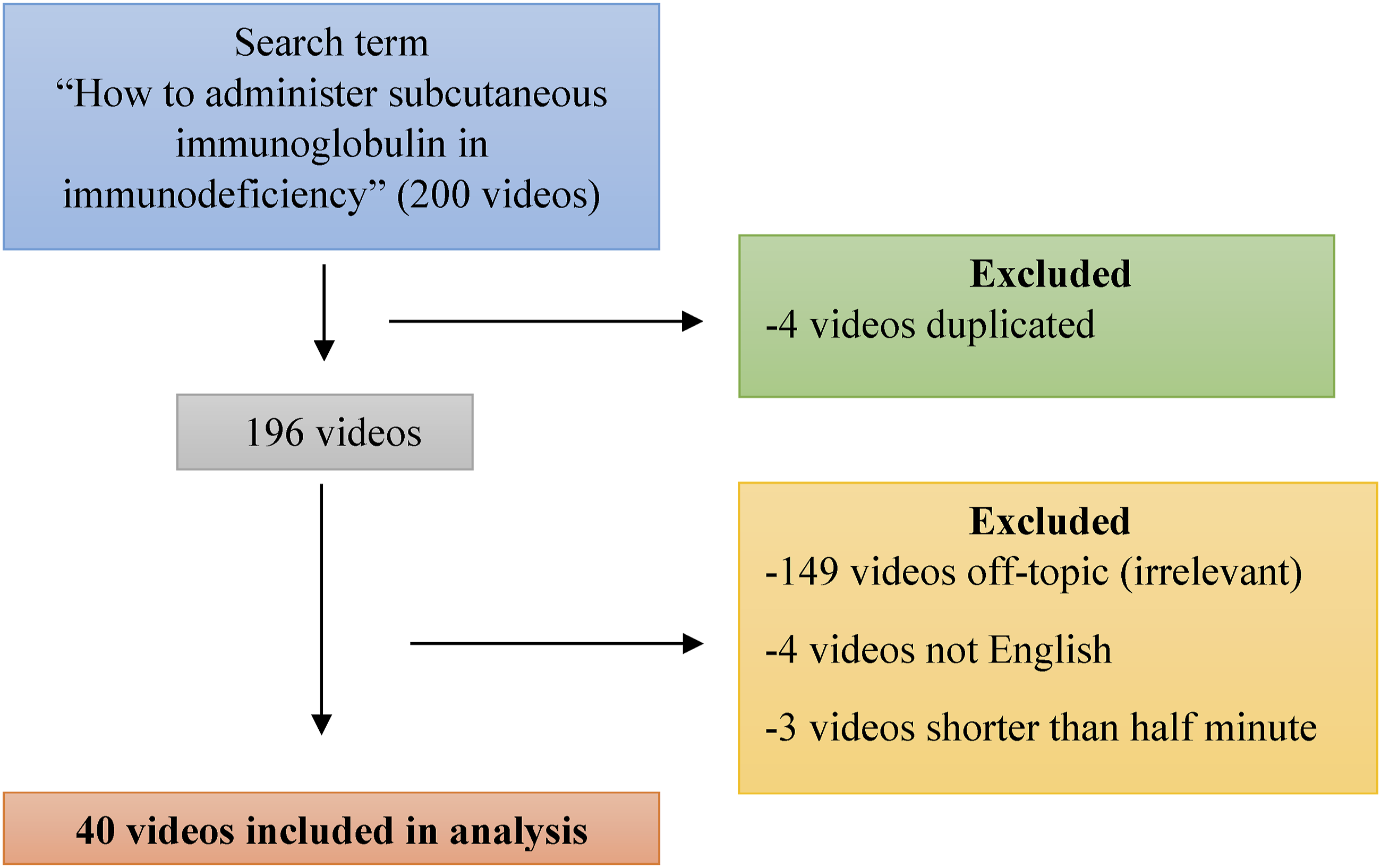
Video evaluation
Videos were evaluated in terms of the target audience (public education, academic education), video source (physician, non-physician healthcare professional, patient, organization, pharmaceutical company), video duration, number of video views, number of daily views, number of likes, and number of comments. The number of daily views of the videos was calculated according to the time elapsed since the video was uploaded, and the number of likes and comments per 1000 views was also calculated. After the authors read the video evaluation guidelines, the videos were evaluated with 3 different scales.
The first of these scales was the Global Quality Scale (GQS), developed by Bernard, which evaluates the quality of videos by rating them between 1 and 5 points, with the quality increasing as the score increases. According to the GQS score, videos were classified as poor, generally poor, moderate, good and excellent. 9
The second scale is modified DISCERN (mDISCERN), which evaluates the reliability of the videos. Videos are scored between 0 and 5 according to the answers given to the questions asked, and as the score increases, the reliability also increases. 10
The Patient Education Materials Assessment Tool for Audiovisual Materials PEMAT-A/V is the third scale, which evaluates the understandability and actionability of the videos. According to the PEMAT-A/V score, videos are classified as understandable or actionable if the average scores in each scale are greater than 70%. 11
Ethical considerations
This study analyzed publicly available content from YouTube, an open-access platform, and did not involve any interaction with human subjects. Additionally, no personally identifiable or sensitive information was collected or processed during the evaluation of the videos. Consistent with previously published studies that assesesed online medical content on platforms such as YouTube without requiring ethical approval,7,12 our study did not necessitate ethical permission.
Statistical analysis
Data were evaluated using IBM SPSS (Statistical Package for the Social Sciences) 25.0 package program. Data compliance with normal distribution was evaluated using Kolmogorov-Smirnov analysis. The mean ± standard deviation values were given for normally distributed data and median (minimum-maximum) values were given for non-normally distributed data. Categorical variables were evaluated using the Chi-Square test and Fisher’s Exact. Ordinal variables were evaluated using the Mann-Whitney-U test, and p < .05 was considered significant.
Results
Video features and information
Features of videos.

Subcutaneous Immunoglobulin: SCIG; United States of America: USA.
Video information and scale scores.

Min: Minimum; Max: Maximum; GQS: Global Quality Scale; mDISCERN: Modified DISCERN; PEMAT-A/V: Patient Education Materials Assessment Tool for Audiovisual Materials.
Evaluation of videos with scales
Ratios and scores of understandable and actionable videos.
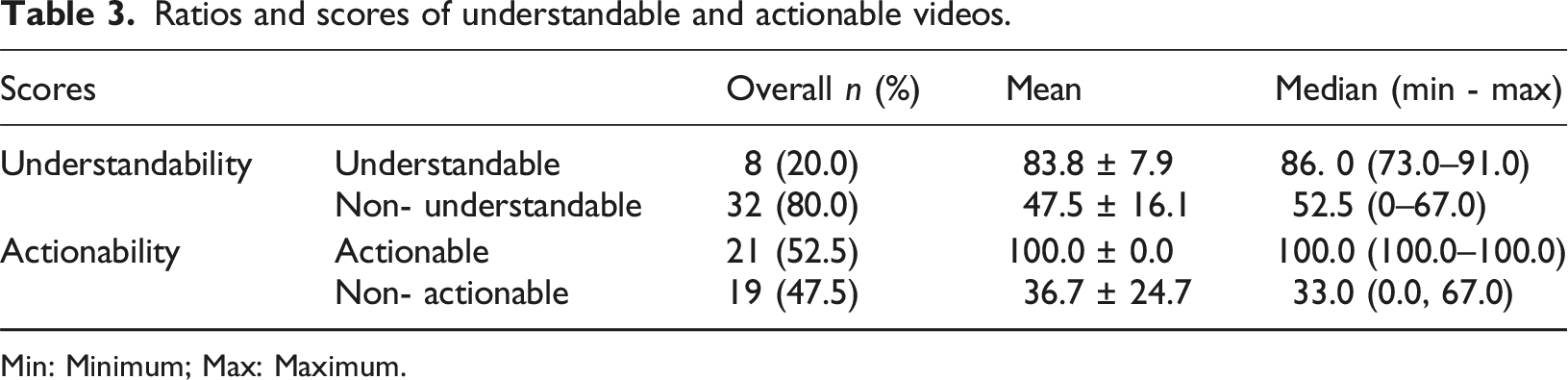
Min: Minimum; Max: Maximum.
Comparison of video features with scale values
The possible independent factors for understandability.

Subcutaneous Immunoglobulin: SCIG; Min: Minimum; Max: Maximum; GQS: Global Quality Scale; mDISCERN: Modified DISCERN. *P values in bold were considered significant at p < .05.
The possible independent factors for actionability.

Min: Minimum; Max: Maximum; GQS: Global Quality Scale; mDISCERN: Modified DISCERN. *P values in bold were considered significant at p < .05.
Comparison of understandability and actionability with GQS and mDISCERN
The mDISCERN scores of the videos were found to be higher in understandable videos than in non-understandable videos (p = .000). When mDISCERN scores were compared with actionable states, actionable was found to be higher (p = .000). The Global Quality Scale scores were found to be higher in understandable and actionable videos (p = .001, p = .000, respectively). Comparison of understandability and actionability with GQS and mDISCERN is given in Tables 4 and 5.
Comparison of the patient group with the other group
The comparison of the patient group with the other group in terms of independent factors.
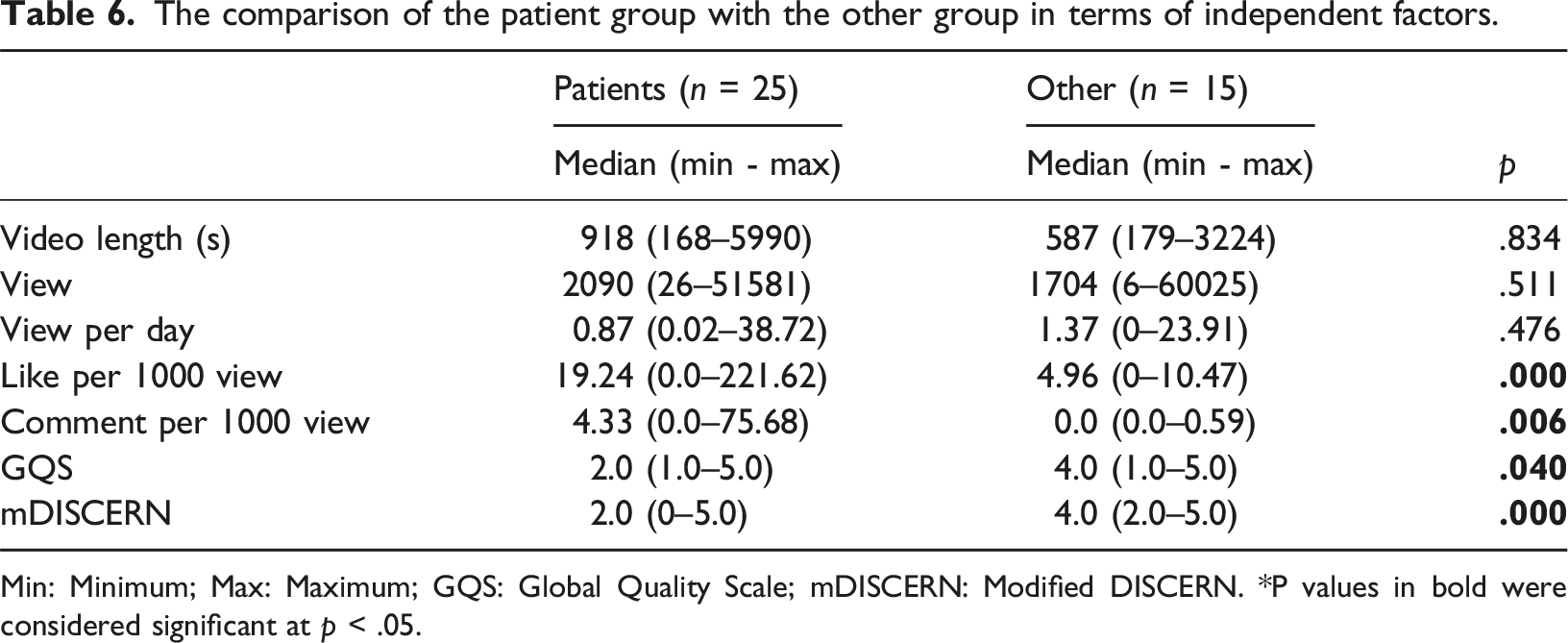
Min: Minimum; Max: Maximum; GQS: Global Quality Scale; mDISCERN: Modified DISCERN. *P values in bold were considered significant at p < .05.
Discussion
Our study is the first in this field, and we found that more than half of the videos on YouTube titled “How to administer subcutaneous immunoglobulin in immunodeficiency?” were uploaded by patients and the majority of the videos were uploaded to inform the public. These videos often demonstrated the practices on patients. Additionally, while nearly half of the videos were actionable, less than half were high quality and only about a fifth were understandable. In particular, videos uploaded by patients had higher views and comments per 1000 views, while GQS and mDISCERN scores were lower.
Many patients use the internet to seek education and answers to their questions about various health issues. YouTube has also become a “how-to” search engine in this regard. Additionally, immunologists, allergists, professional organizations, and patient support groups are known to use the Internet to improve patient care and provide comprehensive information about different health conditions. 13 When used by health professionals and organizations, social networks are beneficial for advising on healthy habits, medical information, and disease prevention. 14 It is also known that in order to maximize the effectiveness of drugs, techniques specific to that drug must be used and all recommended application steps of the drug must be followed. 15 However, in our study, videos on how to apply SCIG were uploaded more by patients than by healthcare professionals and organizations. Patients may have shared their experiences and knowledge via social media to help other patients like them, feeling that there is not enough content on YouTube. The practices in the videos are mostly shown on patients, and including practices on patients in the videos, while paying attention to ethical issues, may also provide a better understanding of the areas and forms of practice. In particular, videos uploaded by patients are more popular, and there were problems with the quality and reliability of these videos, and their understandability was also quite low. It is essential for healthcare professionals and organizations to increase the number of clear YouTube videos on SCIG, especially on how to apply SCIG, and to improve the educational impact of medical video content; it is recommended to use simplified but medically correct terminology when preparing these videos, to cite reliable and up-to-date scientific sources, to adjust the length of the videos according to the complexity of the topic, and to add visual aids such as animations where appropriate. These strategies are also very important to improve understanding and ensure effective dissemination of medical information.
An evaluation of 22,300 YouTube videos covering various health topics highlighted that YouTube is not a reliable source for medical and health-related information, and that popularity-based metrics such as views and likes should not be considered as quality indicators. 16 It is clearly stated that YouTube can provide useful information about immunology to medical students, but it cannot replace textbooks and academic lectures in terms of content. 17 In order to find a solution to the reliability problem of YouTube videos, it is recommended that relevant references be shown in the videos, conflicts of interest be disclosed, and other ethical notes be provided, as in academic articles. 18 On the other hand, regarding immunology content on YouTube, videos are known to be of low quality, explanations of the chosen topic are largely confusing, and the most popular videos are not necessarily of the highest quality. 19 Less than half of the videos in our study were of high quality and only one in five were understandable. However, when we look at understandable and actionable videos specifically, these videos are of higher quality and more reliable. It is increasingly important to increase the number of quality videos, especially those that address health issues, and if necessary, to collaborate with professional quality experts on this subject and share understandable and actionable videos that contain evidence-based information.
Many studies in the literature evaluating YouTube videos that contain content on how to use allergy-related treatments.20–24 Although there is a study evaluating YouTube videos in the field of immunology, it seems that the evaluation of YouTube videos on how to use treatments used in PID patients is insufficient. 17 The observation that the number of tweets about both intravenous and SCIG therapy has tended to increase over the years suggests that immunoglobulin therapy will become more prominent on the social agenda in the coming years. 25 We believe that health professionals and organizations should work to disseminate more accurate and reliable information on various internet platforms, including social media, on this issue, which is on the agenda at the societal level.
Potential advantages of video-based education include visual and auditory support, replayability, and learning independent of time and space. In addition, the patient’s level of knowledge may increase, which may improve increase treatment compliance. However, people have different learning styles, so there may be a lack of personalization in video-based education. In today’s world where technology is rapidly advancing, in addition to studies evaluating video content on social media, studies comparing video-based education with traditional clinical education and patient perception and perception of education should also be conducted. There are some limitations to our study. First, considering the dynamic evolution of YouTube, our study was conducted over a short time period. The results may vary depending on the videos uploaded and deleted on YouTube in different time periods. The second limitation is that although we deleted the search history and created a new YouTube account, we may have evaluated certain content due to country-specific internet providers. This may limit the universality of the findings. The third limitation is that other widely used social media platforms were not evaluated.
Conclusion
More than half of the videos demonstrating SCIG administration were created by individuals outside of professional healthcare settings, creating a risk of knowledge gaps and potential administration errors. Clearly, an audit center is needed to improve the quality and reliability of videos and to create understandable and actionable videos. Additionally, there are not enough studies evaluating YouTube videos on how to implement PIDs, and the number of studies needs to be increased to understand the areas that need improvement in this regard. When conducting new studies, including videos from languages other than English and different social media platforms will provide comprehensive results.
Footnotes
Authors note
This study was presented as a poster presentation at the EAACI Hybrid Congress 2024, held in Valencia, Spain, from 31 May to 03 June 2024.

Ethical approval
YouTube is a free platform accessible to everyone. Since no humans or participants were included in our study, ethics committee approval was not required.
Author contributions
Concept: ME, GTVS, YS; Design: ME, GTVS, YS; Data collection or processing: ME, GTVS, YS; Analysis or Interpretation: ME, GTVS, YS; Literature Search: ME, GTVS, YS; Writing: ME, GTVS, YS; Approval: ME, GTVS, YS.
Funding
The authors received no financial support for the research, authorship, and/or publication of this article.
Declaration of conflicting interests
The authors declared no potential conflicts of interest with respect to the research, authorship, and/or publication of this article.
Data Availability Statement
All data generated or analysed during this study are included in this published article.