




Abstract
Older adults tend to suffer from multi-morbidity, requiring complex treatment methodologies demanding poly-pharmacy. The increasing medication usage can tend towards the mismanagement of prescriptions and irregular or faulty administration. Thus, there arises an urgent need for a proper pill management system for these prescribed medicines. To tackle this grave concern, we propose a mobile, cost-effective, robust, and easy to use solution involving the extension to the human body-smartphones and conductive stickers. The technology utilizes a unique combination of touch-points on the smartphone screen to recognize the medication and give information regarding the proper usage and dosage and gives a reminder of the intake of the medicine. Our tool is comprised of two components—(1) the conductive ink stickers containing a unique combination of conductive inks to be applied to the pill container and (2) the mobile application utilizing touch-points generated by the conductive ink sticker to give information of the corresponding medicine. The following functionalities could be performed by the application-detection of pill container: providing essential information about pill container and dosage; keeping a count of pills already taken, to be taken and remaining pills; reordering the medication and reminding about the medicine intake at the correct designated time.
Introduction
The world population is experiencing a phenomenon of acute aging. 1 With the elderly population on the rise, it becomes vital to address the issue of managing multi-morbidity through poly-pharmacy, which is often associated with increasing age. 2 Multi-morbidity in the elderly requires highly complex and specialized treatment methodologies and often demanding poly-pharmacy. 3 The exponential advances in the medical sciences seem to have made the human species dependent on medications, resulting in a direct increase in medicine usage. 4 Despite offering a better life, the increase in drug use comes with its own set of problems, for instance, mismanagement of prescriptions and irregular or faulty administration of the same, the worst affected populations being among the older age groups. 5 We can often observe skipped days, wrong medicine administration, medicinal shortage, and similar problems when dealing with medication-related problems, which are most common among older adults. 6 Such problems can result in sub-optimal treatment of the underlying cause, and tamper recovery, sometimes even proving to be fatal. 7 As the steepness and complexity of adherence to medications increases, there arises an urgent need for a proper pill management system for these prescribed medicines. However, a void can be observed when looking for a solution to this problem of mismanaged medicine adherence. Some attempts have been made to address this issue; however, most of the current methodologies and technologies seem to be primitive or sub-par at best.8–13
The solutions offered by the current market seems to be sub-optimal; they either fail to be cost-effective or fail to provide the required assistance. The significant challenges observed in most of the current methodologies trying to tackle pill management are excessive effort, manual labor, high cost, lack of robustness, and the absence of portability. This paper concentrates on overcoming most of the shortcomings of the other technologies aiming to tackle this problem by making use of conductive ink enabled stickers for pill containers. The primary aim of this paper is to put forward a solution for pill management, by explaining the design and development process.
Methods
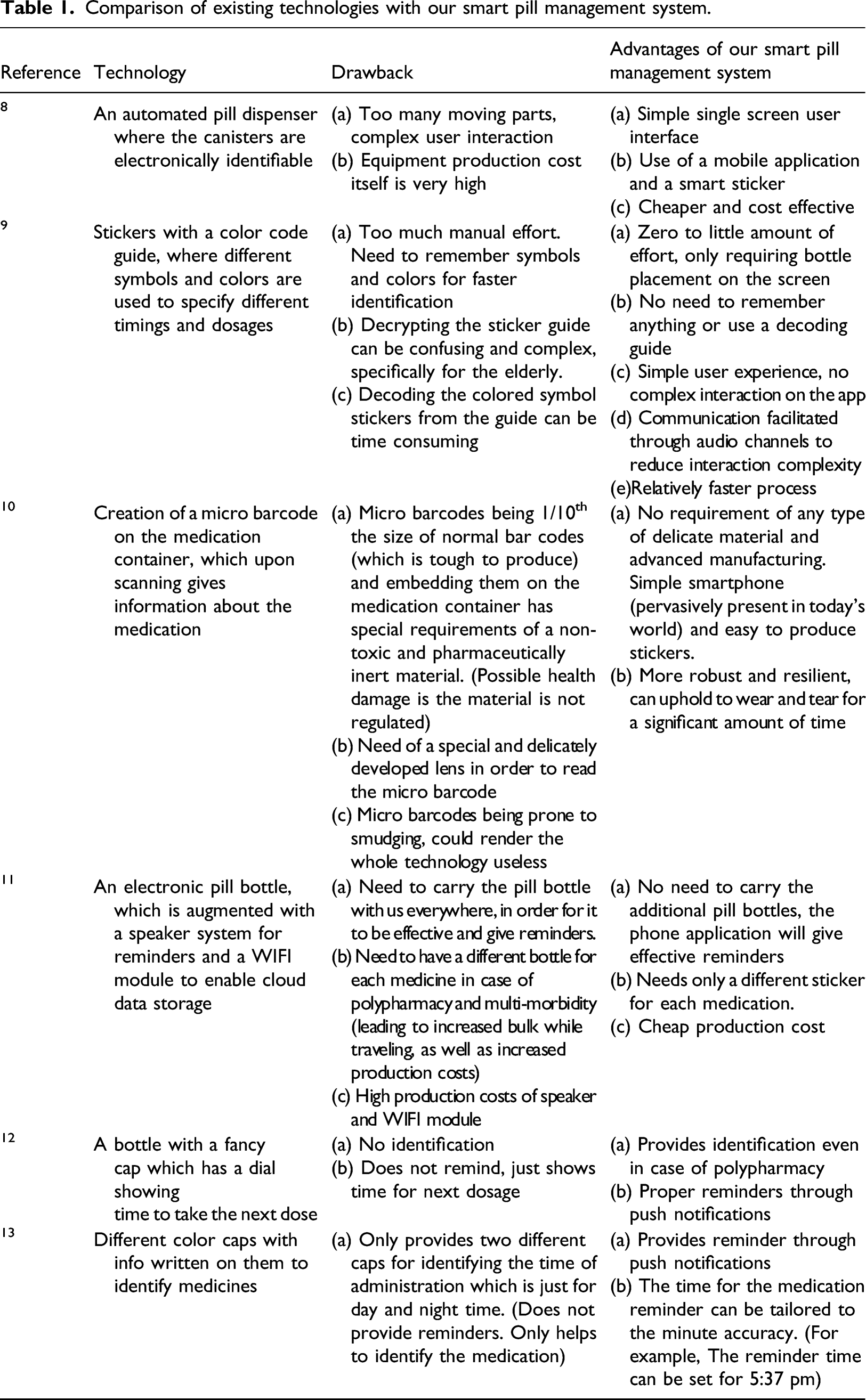
Comparison of existing technologies with our smart pill management system.
The development of the pill management system can be broken down into two modules. The first being the development of conductive ink stickers and the second, being development of the mobile application. Both modules work coherently to produce a seamless pill management environment as shown in Figure 1. The flow of the smart pill management system.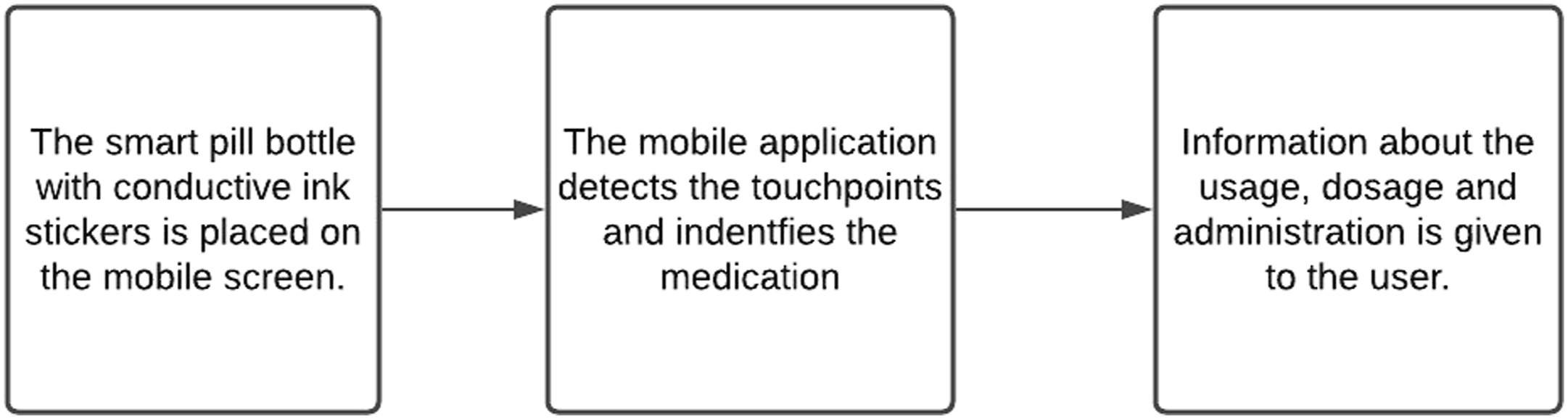
Development of conductive ink stickers
The display on any touch screen device is capable of detecting the touchpoint of our finger due to capacitive difference generated by our finger upon touching the screen. We applied the same technique of generating the capacitive difference using conductive ink pads on the sticker. The touchpoints produced by which act exactly like a finger touch on the screen. Most modern smartphone devices are capable of detecting multiple touchpoints. Similarly, our stickers are incorporated with different combinations of multiple conductive inks pads as shown in Figure 2(a). The Smart Pill sticker (a) and its augmentation on the pill container (b).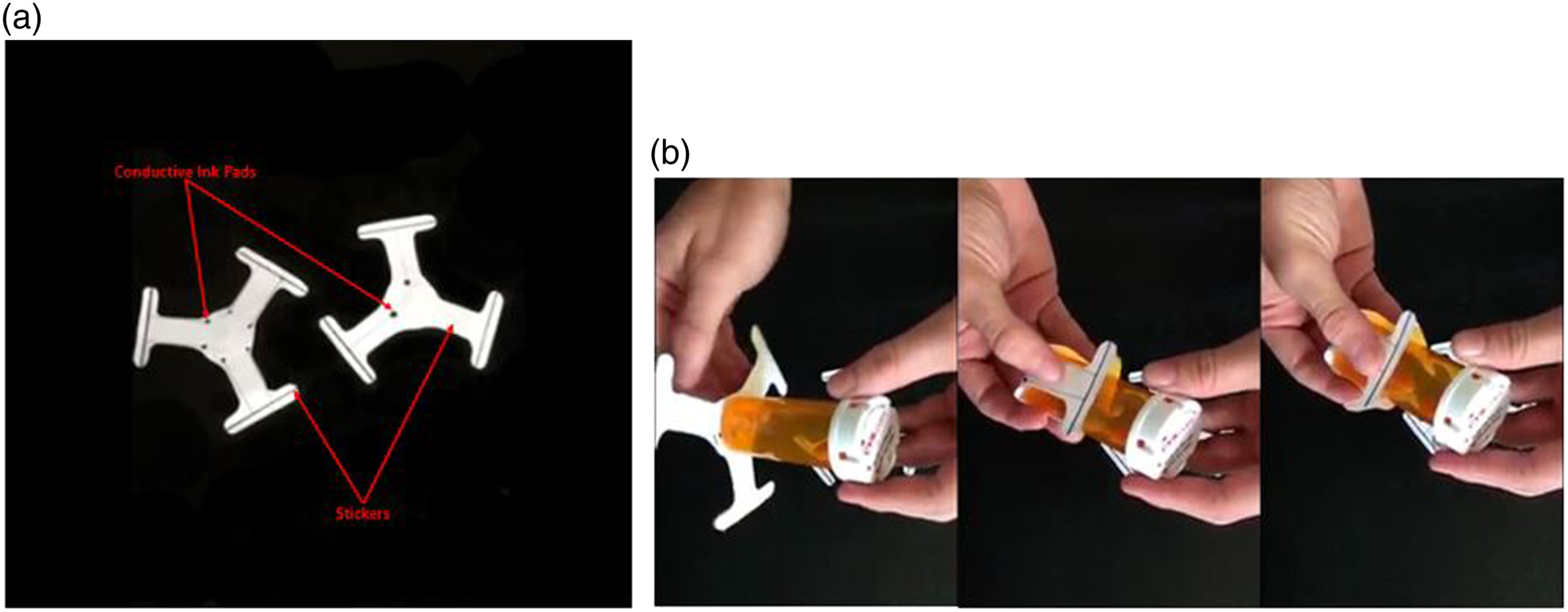
Each sticker has a unique set of combinations of both—the number of conductive ink pads on it, and the distance between them. The conductive ink pads create a combination of touchpoints on the capacitive touch screen as shown in Figure 2(a). These stickers have a different number of conductive ink pads at different distances. The number as well the Euclidian distance between the touchpoints are calculated by the mobile application and uses them an identification mark for that particular pill container. These stickers are then attached to the pill container as shown in Figure 2(b). This converts a normal pill container into a smart one and further, compatible with our pill management system. The sticker resembles the shape of a fan with three blades and the size can be varied based on the surface it needs to be attached. It can be attached on any different kinds of pill containers such as vials, ampoules, blister packs, and sachets by folding up the ends based on the shape of the container. The central part of the stickers become the identification mark of the medication once the container is placed on the mobile screen. The conductive ink in the stickers works indefinitely until critically damaged.
Development of the mobile application
The development process of the mobile app involved usage of a technology called React Native.
14
It is compatible with Android and iOS smartphones from base versions. The mobile app was built in the debugging mode with an iterative testing methodology to ensure a seamless experience for the user. The app can be installed by simply accessing the android application package available freely on the following online portal: https://github.com/wimpywarlord/Medix. Once the installation request is accepted, the app will automatically install itself on the user’s smartphone as shown in Figure 3(a), and the user is prompted to enter information (Figure 3(b)). App installation (a) and fields for medication information set up in the app (b).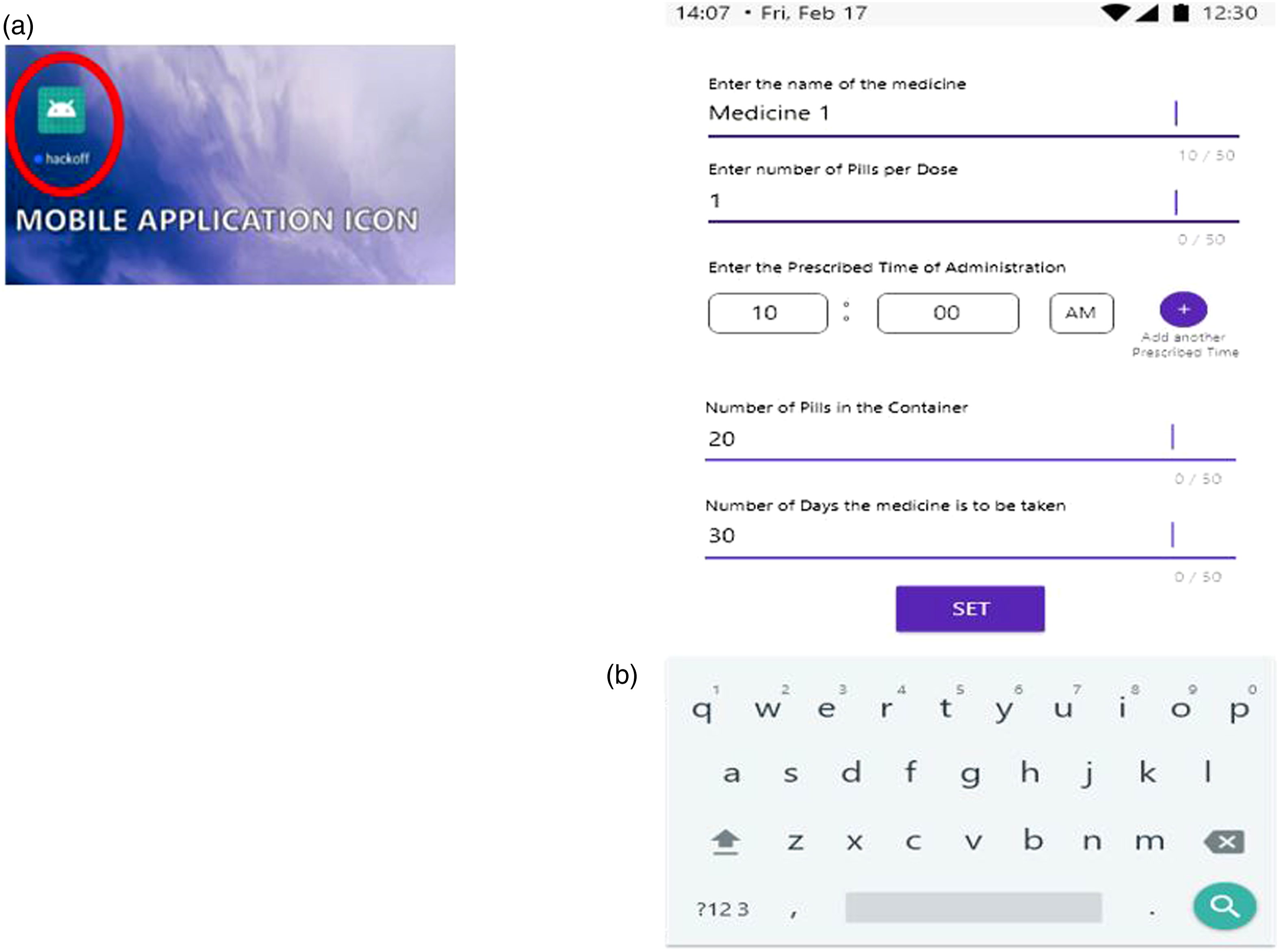
The app was designed with a straightforward user interface made by keeping in the mind the ease of use of the elderly. The first and only page in the application asks you to place the pill container on the screen. When the pill container is placed on the screen, the app detects a combination of touchpoints on the screen generated by the stickers containing the conductive ink pads. If this particular combination is identified for the first time, the user is prompted to enter the name of the medicine, the prescribed dosage, and the time of intake as shown in the Figure 3(b). This information is only asked once during the first time the medication is being used. Further, each time the pill container is placed on the mobile screen, it is identified and the usage information is displayed. This helps the user to choose the right medication without any confusion among many containers, by simply placing them on the mobile screen. They also get information about the correct dosage which ensures proper administration of the medicine. The mobile app also offers to track remaining pills and helps order more pills automatically if the stock is low. The mobile application utilizes audio as well as visual channels to communicate with the user and provides ample and sufficient instructions such that the user understands the straightforward usage. The user can be provided with as many such stickers as needed, and these stickers provide the features to perform effective pill management.
The technology after being built was stress-tested on various devices and under different situations and circumstances to make the technology full proof. We conducted various testing procedures to ensure our proposed system is compatible across a plethora of devices.
Development and testing of sticker enabled pill containers
To get a comprehensive understanding and to produce a full proof technology, we conducted thorough testing. To test the amount of data that can be encoded within the sticker, the following setup elements were used—copper touch points (8 mm x 8 mm squares), copper capacitance sink, cardboard base, 50 g weight, and common mobile devices Figure 4(a). The test was primarily aimed to check the density of data encoded before ghost points (touch-points becoming undetectable) come into the picture, as represented in Figure 4(b). Further, we also determined how accurately most screens detect the distance between touchpoints, also represented in Figure 4(b). Conductive ink pads create touch points on the touch screen of mobile phone and Capacitive touch displays as explained by Barett et al.
15
(a) Conductive ink pads on the smart pill stickers generating interactive communication on the touch screen of mobile phone. (b) Capacitive touch displays.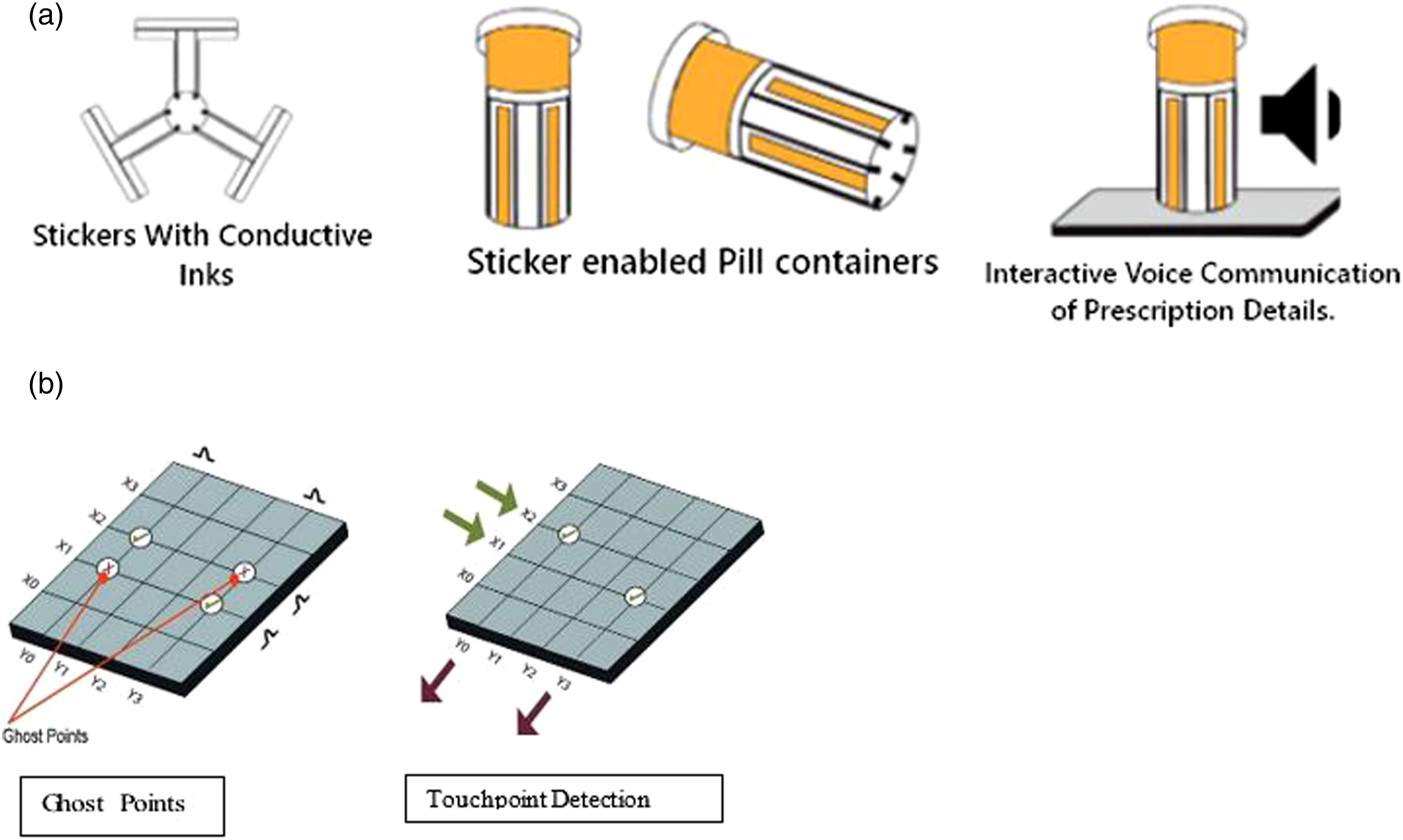
A debugging app, showing the number of touches and the distance between two touches, was installed on each mobile device, based on the Ohmic-touch principle by Ikematsu et al. 16 The cardboard base was then fitted with copper touchpoints and a capacitance sink which was placed on the mobile device along with weights. The number of touches and distance were measured 17 and compared, and the same procedure was repeated for a different combination of distance and touches. We performed the following four experiments to study—Basic detection; Electrode grid spacing; Conductive ink pad size and distance ranges; and Touchpoint count.
Basic detection
We tested our conductive ink enabled sticker technology with ten different devices having a capacitive multi-touch display, ranging from a screen size of 640 x 1136 pixels to 2048 x 1536 pixels. While all the devices use the same underlying principle, we expected variations in results because of the wide range of manufacturers, screen sizes, and pixel densities. 18
Electrode grid spacing
We analyzed electrode grid spacing of the various multi-touch devices having a capacitive touchscreen, to study the alikeness in their hardware characteristics and analyze the variation in electrical characteristics of these devices. The probe was attached to a minute strip of conductive material placed on the touch screen surface of each device. An oscilloscope was attached to the conductive material, and the duration of the signal was recorded from the single drive electrode present on the screen of the devices.
Conductive ink pad size and working range
We varied the size of the conductive ink pad by altering the length (or radius) of the conductive material, which comes in contact with the capacitive screen. Conductive ink pads of varying lengths and radius were tested on the ten devices. Pads had radii ranging from 2 to 5 mm with 1 mm intervals. The length of conductive ink enabled stickers ranged from 5 to 40 mm, and the radii of circular ring markers ranged from 10 to 60 mm. The distance between any two pads placed on the screen was at least 10 mm on the touch screen. Each conductive ink enabled sticker was placed onto the touchscreen at least twenty times, and then the hit percentage was calculated by counting the number of times all the pads were detected on the touch screen divided by the total number of times it was placed on the screen. 19
Touchpoint count
Capacitive touch screen displays show variations in the number of simultaneous touch points that it can detect. 20 A conductive ink sticker requires at least two pads to detect the pill container correctly. On simultaneous touches, the upper cap limits the number of conductive ink pads that can be placed on the screen. However, considering only five pads and the distance between the pads to be a minimum of 10 mm, the number of possible combinations is more than 10000 for a mobile screen size having a multi-touch capacitive display.15,20 We calculated the touchpoint count by detecting the touchpoints on the touch screen.
Mobile app development and testing
The mobile app detected the touchpoints on the mobile screen and calculated the distance between the points so as to identify the corresponding pill container. Interaction with the user was done using an audio mode so as to keep the usage as simple as possible; this was achieved by the use of text to Speech Application Programming Interface (API).21,22 Finally, in case of a low supply of medicine, the user interface (UI) path automation technique was used to automatically place an order for the user. React native allowed us to build a native cross-platform mobile application with a robust architecture.
Results
Our pill management system demonstrated detection of the pill container when placed on a mobile screen. The conductive ink creates a unique touch pattern which is detected on the mobile screen. It is analyzed by the mobile application, holding the information of the corresponding medicine assigned to that specific touch pattern, and the user is provided with the medicine and its dosage details.
Basic detection
We placed a sticker with three conductive ink enabled pads (three 8 mm conductive ink impressions forming a circular ring) on each device for ten seconds. We found that the markers were detected instantly on all the devices; the detection persisted when the finger was lifted by the user. Thus the concept worked for most of the touch screen displays equipped with capacitive screens.20,23
Electrode grid spacing
The hardware had a spacing of approximately 5 mm between all the electrodes; the variation in hardware from various manufacturers was less than expected, which was similar to the findings by Voelker et al. 20
Conductive ink pad size and working range
Rings and vertical strips made up of cardboard having conductive ink enabled pads on the bottom were used for this experiment. Pads having a radius greater than 3 mm had a detection rate of 100%; below the radius of 3 mm, the detection was not stable if markers were left on the screen untouched without applying any external pressure. Rings and vertical strips with multiple conductive ink pads had a detection rate of 95%, tested with over five pads attached to the bottom of the ring as well as a vertical strip. If the number of pads was reduced to three, then the detection rate was 100%. For all the tests we had used circular pad shapes, experimenting with pad shapes. We found that it led to improper functioning of the touch detection algorithms, limiting the conductive ink enabled sticker pads to round shapes. 20
Touchpoint count
The pill container in this study had two touchpoints. The mobile application detected ten simultaneous touchpoints.
Mobile application
The resulting mobile application was named “Medix” specially designed for the smart pill container. The user interface of the mobile app is shown in Figure 5(a). (a) Screenshots showing app user interface, (b) notifications for reminders, and (c) low supply of medicine (c).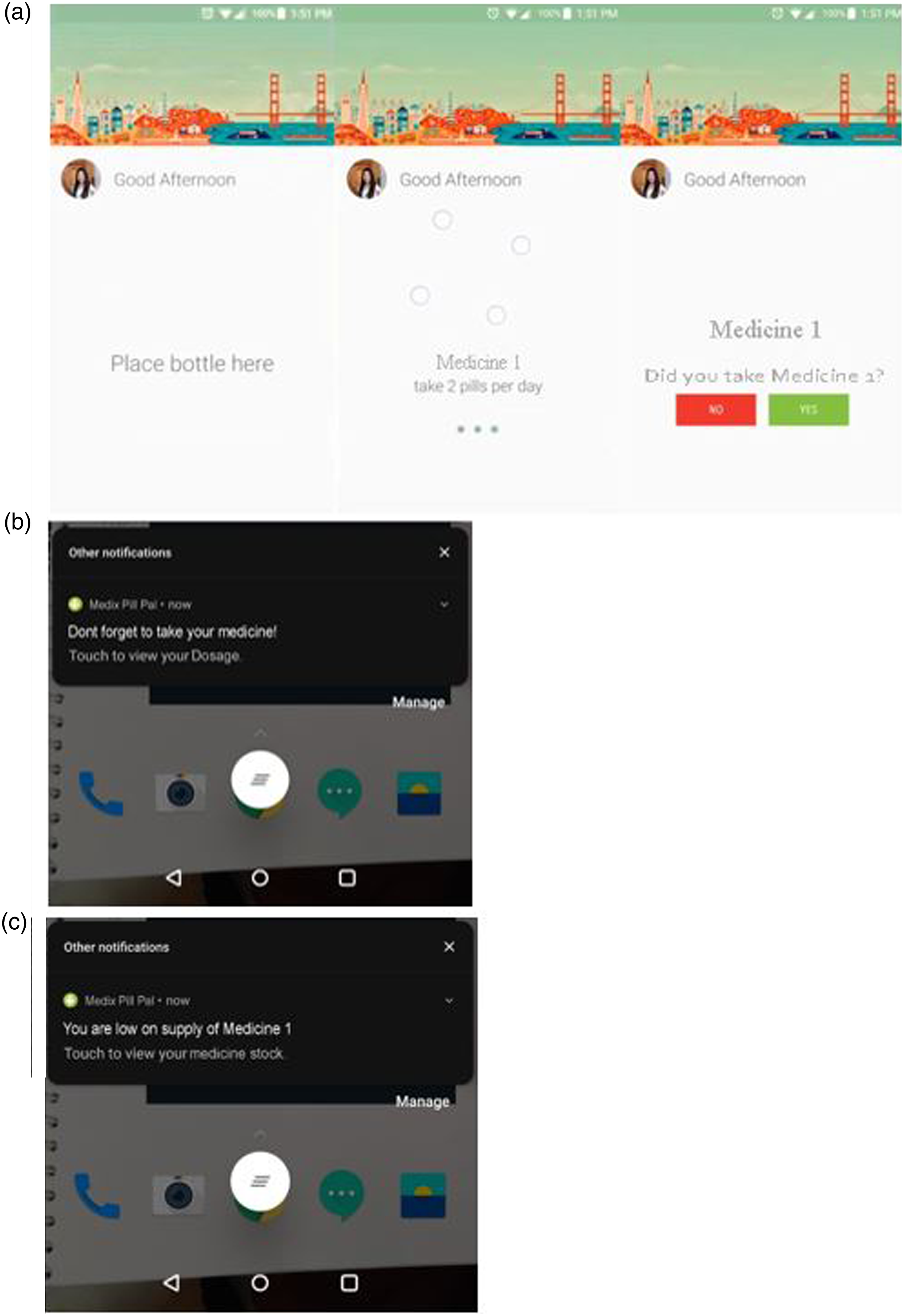
Another feature offered by our proposed pill management system is the reminder of taking the medicines on-time by means of smartphone notifications. The user is allowed to set the reminder when he is using the system for the first time. The user receives a push notification as a reminder at the correct time, this allows the user to timely administer the medicine as shown in Figure 5(b). In addition, the app also helps to indicate when the supply of the pills are low and notifies the user to order more pills (Figure 5(c)). The screenshots of the app during pill detection are described in Figure 6. Mobile app detection of the smart pill sticker enabled container placed on the screen. (a) Detection of pill container 1. (b) Detection of pill container 2. (c) Detection of pill container 3.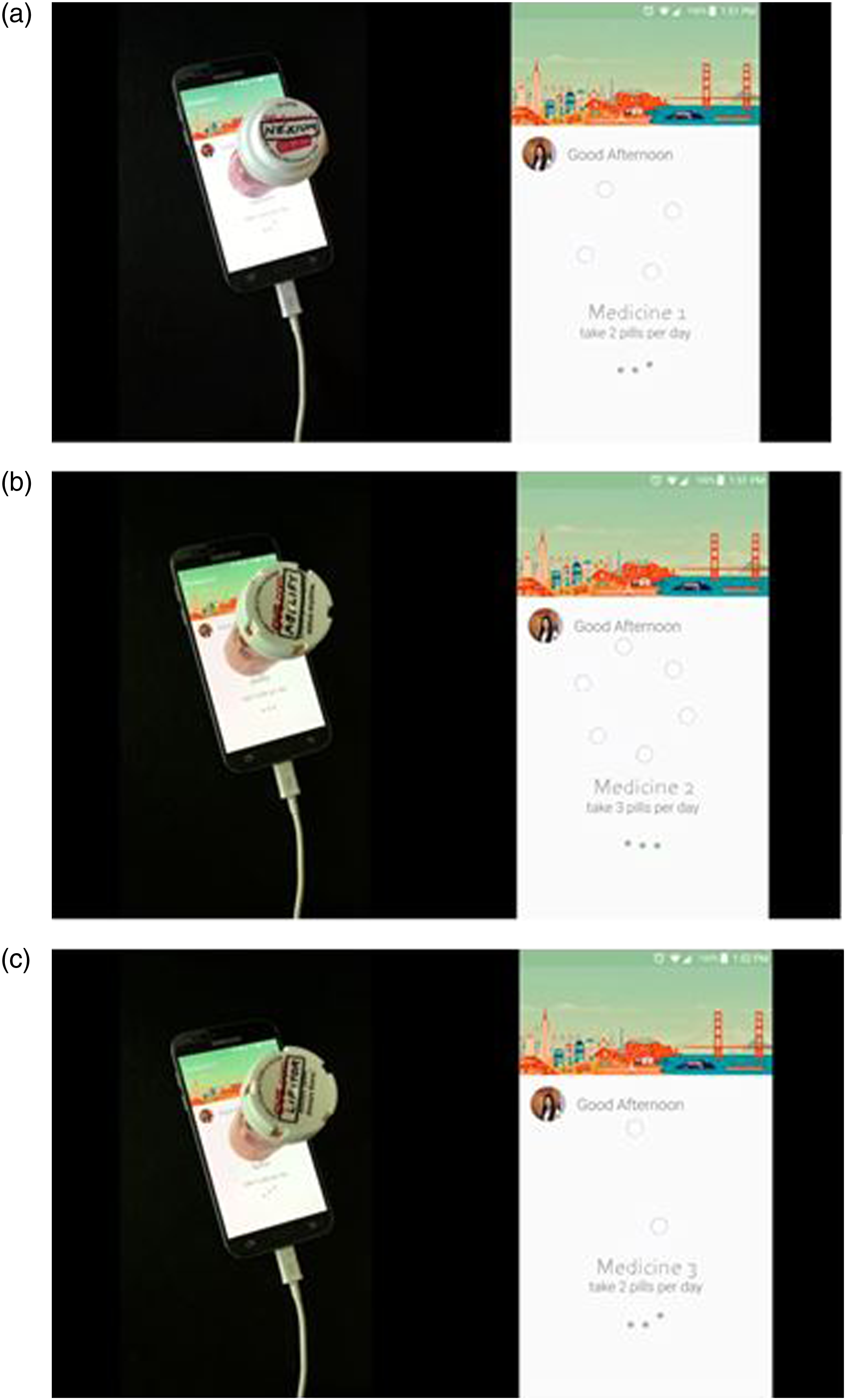
Discussion
This paper describes the process of development of the smart pill container and the corresponding mobile application. The solution was developed for pill management with an aim to overcome the drawbacks of existing technologies while serving the purpose of efficient management of medications, especially among older age groups.
Moreover, it has been augmented with features such as track keeping, reminding, and reordering medications such that the user never runs out of stock. This intuitive pill management comes with no overhead cost or any unnecessary effort. We hope that these smart pillboxes enable researchers, developers, and inventors to discover a new domain with copious potential and lead to the budding of future technologies.
Our pill management system attempted to reduce most of the shortcomings of current tools by using a mobile application with recognition and segregation abilities. Our conductive ink enabled stickers are portable, affordable and no special equipment is required. Pill reminders are tools that can help create custom alarms to remind about the time for medication, and also dosage through digital display in some systems.12,24 However, they do not identify the container through which the pill is to be taken, which is overcome by our application that reminds as well as identifies the pill container. In our smart pill system, the medication name and dosage are displayed as well as delivered in speech form, which makes it more convenient for the older age groups, who tend to have vision problems. 25 Bar codes have been placed on pill bottles, which need to be scanned to get information on medication and dosage. 26 Similarly, RFID tags are placed on bottles to store the identity. 27 However, having special RFID tag readers at hand or focusing on the bar code and scanning can be cumbersome for individuals with visual disabilities. The smart pill system simply requires placing the pill container on the screen and gives the user all the necessary information without any hassle or any special equipment. Timer medicine caps are digital timers with a countdown running, equipped with a digital display and buttons, which tracks the previous and next dosage. 28 These require a battery and have limited compatibility with specific pill bottles. Furthermore, too many parts can cause complex user interaction and a high production cost leading to limited usage among older adults. 8 Our conductive ink enabled stickers do not require a battery or internet connection after first installation of the app and are compatible with all pill bottles. Thus, our smart pill management system is affordable, easy to use, requires no special equipment. Although there have been stickers or bottle caps with different color codes and symbols guiding different time and dosage, they require decoding and decrypting of these codes.9,13 This can be cumbersome for the elderly who might already have cognition issues. Our pill management system does not require such efforts and provides a simple user experience. A few innovative solutions are starting to emerge in the market, such as wearable smart glasses which utilize advanced machine learning and artificial intelligence methodologies to visually identify the medicine when viewed through the smart glasses. 29 However, it requires an internet connection to work since all data is store in the cloud, and it has a battery component that poses a lifespan chokepoint, also the smart glasses focus only on visually impaired patients and ignores the use for the general public. Further, tools using delicate technologies can be prone to damage, 10 and those with high production costs 11 can also limit acceptance of the technology among older adults. Thus, our smart pill management system is unique in different aspects such as simple user interface, cost-effectiveness, no special technical requirement or need to remember color codes or combinations, ability to set up timely reminders, communication facilitated through audio channels, and also does not create a bulk storage making it convenient to carry during traveling.
Our technology necessitates the need for a touch screen device with an Android or iOS bootup; however, the increasing usage of mobile phones are in favor of the proposed application. Moreover, the proposed application poses a minimal yet considerable threshold of knowledge required about the usage of smartphones. This threshold familiarity about the usage of smartphones is at times, found to be absent in the elderly. Hence special steps are taken to keep the use of the application very straightforward. Moreover, the number of times the stickers touches the mobile screen cannot be used to count the number of pills remaining in the container, accurately. This can pose a risk of losing a pill or using a wrong number of pills per day may affect this number. Although, an audio/graphic confirmation has been included in our system where the mobile application confirms with the user regarding consuming the pill, the chances of miscount reduces however can still persist, especially in case of patients with cognitive impairments. However, the current audio feature is limited to English language, which poses a limitation for those who are more accustomed to their regional language. Additionally, we can offer a feature where the user has the ability to edit the inventory manually as well. For cases when the user losses the pill or eats more and later realizes it.
Our future steps in development of the smart pill management system would be to include machine learning, to learn consumption patterns in order to personalize notifications and medication recommendations. Second, we plan to include a market place within the mobile application to ensure easy restocking of medicine in case of low stock. Another important future task would be to offer a feature that supports audio communication across various languages. Further, during the usage we also aim to add analytics and statistics on the timely intake of medications, number of missed doses, and other such parameters which might prove useful to monitor the recovery and aid self-health management. Finally, a future design would include adding our conductive ink sticker concept on medicine sachets and other container types.
Conclusions
Our smart pill management system presents a novel use of touchpoint technology. Our system seems to be an efficient pill management tool among the older age groups. We present an attempt to resolve the issue of managing poly-pharmacy, especially among the elderly, who face most health problems and require assistance for the timely and right dosage of medications. Further, being easy to use, affordable, and compatible with simple equipment, our system shows feasibility in implementation. Future implementation studies are required among the elderly to reveal the full potential of the smart pill management system in healthcare.
Footnotes
Acknowledgments
We are thankful to the Ministry of Science and Technology (MOST) and Taipei Medical University, Taiwan for providing the necessary funding to carry out this research work.
Author contributions
Conceptualization-GK, KS, SSA; Data curation-GK, KD, DP; Formal analysis-GK, KD, DP; Funding acquisition-SSA; Investigation-GK, KD, DP; Methodology-GK, KD, DP, SSA, KS; Project administration-KD, SSA; Resources-KS, KD; Software GK, KD, DP; Supervision-KS, SSA, SM; Validation-KS, SSA, SM; Visualization-GK, KD, DP; Roles/Writing—original draft-GK, KD, DP; Writing—review and editing-KS, SSA, SM.
Declaration of conflicting interests
The author(s) declared no potential conflicts of interest with respect to the research, authorship, and/or publication of this article.
Funding
This work was supported in part by Ministry of Science and Technology, Taiwan (grant numbers 108-2221-E-038-013, 110-2923-E-038-001-MY3); Taipei Medical University, Taiwan (grant numbers 108-3805-009-110, 109-3800-020-400); Ministry of Education, Taiwan (grant number 108-6604-002-400); Wanfang hospital, Taiwan (grant number 106TMU-WFH-01-4).
