




Abstract
This study modelled factors that predict fake news sharing during the COVID-19 health crisis using the perspective of the affordance and cognitive load theory. Data were drawn from 385 social media users in Nigeria, and Partial Least Squares (PLS) was used to analyse the data. We found that news-find-me perception, information overload, trust in online information, status seeking, self-expression and information sharing predicted fake news sharing related to COVID-19 pandemic among social media users in Nigeria. Greater effects of news-find-me perception and information overload were found on fake news sharing behaviour as compared to trust in online information, status seeking, self-expression and information sharing. Theoretically, our study enriches the current literature by focusing on the affordances of social media and the abundance of online information in predicting fake news sharing behaviour among social media users, especially in Nigeria. Practically, we suggest intervention strategies which nudge people to be sceptical of the information they come across on social media.
Introduction and background
Social Network Sites (SNS) has been shown to be the fastest and most convenient online platform used to search for and circulate information on specific issues. 1 It is also primarily used to address and confirm specific rumours and facts among other users during uncertain situations. 1 Nevertheless, it has some adverse effects because not all messages circulating on SNS are guaranteed to be true. It has been found that one of the consequences of this platform is that it permits people to receive unconfirmed information which tends to be deceptive and detrimental. 2 It has been revealed that that social media is a powerful medium for the circulation of large volume of non-supervised journalistic content, 3 empowering a misinformation phenomenon and thus provoking the possibility of manipulating the public’s perception of the reality through spread of fake news. 4 Fake news is defined in this study as false information intentionally produced by people with personal or malicious agendas that disregard or misrepresent evidence, which is then diffused unintentionally by internet users. 5
Evidence has shown that the emergence of COVID-19 as a global pandemic has brought with it an unprecedented amount of fake news which threatens global well-being. 6 It has been remarked that the world is fighting infodemic along with the pandemic. The abundance of imprecise, ambiguous, and inaccurate information during COVID-19 resulted in information overload and accelerated health anxiety and the sharing of incorrect information.7,8 For example, seven false health advice claims have been identified in relation to COVID-19. Some of the false claims included taking a saline solution of warm water, salt, or vinegar as a remedy for COVID-19 and drinking warm water frequently to flush the virus down to the stomach. 9 Further misinformation includes conspiracy theories about the virus being created as a biological weapon in China to claims that coconut oil kills the virus. 10 Misinformation of this sort may cause people to turn to ineffective (and potentially directly harmful) remedies, as well as to either overreact (e.g., by hoarding goods) or, more dangerously, underreact (e.g., by deliberately engaging in risky behaviour and inadvertently spreading the virus). 12
As social media amplifies the spread of news, and people read news through links shared on social media, 12 understanding the role that social media plays on the sharing of misinformation is essential. 13 In this view, studies on fake news sharing about the COVID-19 pandemic is emerging. Research has stated that the spread of fake news could be attributed to the increase in the use of social media platforms for information sharing. 14 Additionally, it has been observed that the excessive flow of COVID-19 information is a major cause of the spread of COVID-19 fake news. 15 Entertainment and self-promotion has been found to promote misinformation regarding COVID-19. 13 Additionally, it has also been found that a person’s trust in online information and perceived information overload are strong predictors of unverified information sharing on COVID-19. 8 Results from a related study also showed that altruism was the most significant factor that predicted fake news sharing of COVID-19. 16 In the same study, it was found that social media users’ motivations for information sharing, socialisation, information seeking, and pass time predicted the sharing of false news about COVID-19. Another research has revealed that cultural factors, demand pressure for information during the crisis, the easiness of information dissemination via social networks, marketing incentives and the poor legal supervision of online contents contribute to fake news sharing on COVID-19. 17
Building on the above existing works, we maintain that the affordance social media provide, and the abundance of COVID-19 message will affect the circulation of fake news among Nigerians. Therefore, we propose a conceptual framework combining two theories; affordance theory and the cognitive load theory to test how information sharing, status seeking, self-expression, online information trust, information overload and news-find-me perception predict fake news sharing on COVID-19. While information sharing, 16 online information trust and information overload 8 have been linked to COVID-19 fake news sharing, self-expression, news-find-me perception and status seeking have been underexplored. Adding these factors to the already established factors will contribute to the literature on fake news sharing as well as help policy makers in curbing the spread of fake news. Moreover, re-examining information sharing, online information trust and information overload will substantiate the outcome of past researches in a different context (Nigeria). This is necessary as most research on fake news have focused on western world. 18 More studies have been recommended to contribute to the factors that lead to fake news sharing during this pandemic, especially from developing countries that have witnessed a growing number of cases of COVID-19. 16 Nigeria is used in this study for two reasons. Firstly, studies relating to fake news sharing is just emerging,16,19,20 suggesting a dearth of research. Secondly, it was observed that in Nigeria, due to the recent outbreak of COVID-19, social media activists, influencers and self-styled warriors are using their social media platforms and fringe websites to proliferate misinformation and propagate conspiracy theories. 21 It has also been shown that so-called experts have proffered cures such as constant sex or sitting in the sun or have claimed that African blood is immune to the coronavirus. 22 All these suggest the increasing amount of fake news being circulated in Nigeria, which requires further investigation.
Our goal is twofold. Firstly, we examine how social media enhance its users’ capability to seek status, share information and express themselves online which in turn lead to fake news sharing. Secondly, we investigate the extent that news-find-me, information overload and online information trust affect fake news sharing on social media. Therefore, we sought to answer the following research question: RQ1: Do social media affordance and online information abundance predict fake news sharing related to COVID-19 on social media?
Research Model and Hypotheses development
It has been shown that the affordance of social media provide along with the abundance of information on COVID-19 contributes to fake news circulation.8,13 Drawing from this postulation, we adopted the affordance theory and the cognitive load theory to explain fake news sharing about COVID-19. Specifically, status seeking, information sharing, and self-expression were categorised under the affordance theory, while online information trust, news-find-me perception and information overload were categorised under the cognitive load theory.
The affordance theory
The affordance theory was introduced in 1966 by a psychologist James Gibson, who described it as the possible actions that an actor may take in a given situation. For example, a door handle can be used to open a door and as well used as a clothing stand. Affordances as argued by Gibson, 23 are independent of the actor’s ability to recognise them. In response to this view, Norman 24 reconceptualise the affordance lens to focus on only the actions which an individual realises to exist. In doing so, affordances were tied to the objectives, values, thoughts, and capabilities of individuals. We adopted the postulation of Norman, 24 who categorise affordance into (a) technical affordances, which is the opportunities that social media platforms provide; (b) individual affordances, the opportunities given to the individual; and (c) contextual affordances, the opportunities provided by the context of COVID-19 pandemic. With regards to technological affordance, it has been shown that social media allow users to read and share news as well as information. 13 Research has also shown that via social media, people promote themselves (status seeking), 12 which falls under the individual affordance. Furthermore, there is evidence to show that COVID-19 pandemic resulted to a scenario where several news emerged relating to the virus, policies, recommended health measures and various others, providing contextual affordances to share, comment and express oneself. 13 Steaming from these streams of investigations, the constructs information sharing, 12 self-expression 25 and status seeking 12 are likely to be salient in explaining misinformation.
Information sharing
Social media provide the opportunities for information sharing. 12 As such, information sharing stems from the need to offer information to others on social media. 12 It has been reported that social media platforms enable the circulation of false content online. 26 With the affordance provided by social media, sharing news or information has become easier as people can take part in the creation and dissemination of information. 27 It was found that the affordance social media provide has resulted to misinformation circulation to be positively associated with the desire to disseminate information. 28 It was also found by the same authors that false stories on social media are shared for informational reasons than for entertainment. Since social media provide avenue to share news instantly without much get keeping, it has been found that people often share news and information without authenticating it as they may believe it to be factual. 29 The chances to share news or information as soon as they receive it is provided to users by social media. This sharing behaviour may be more pronounced when driven by fear and anxiety. 8 The spread of fake news could be attributed to the increase in the use of social media platforms for information sharing. 14 It has been observed that the excessive flow of COVID-19 information on social media is a major cause of the spread of COVID-19 fake news. 15 Thus, we contend that due to the affordance social media provide which enables the easy sharing of information, the numerous messages on COVID-19 already on social media as well as the tension and anxiety, people will rarely authenticate information before sharing. We also reasoned that at this time of the pandemic where everyone desires to be a reporter due to the opportunities provided by social media, the tendency of verifying messages before sharing is unlikely. Therefore, we proposed that:
Status Seeking
In this study, we referred to status seeking as the ability of social media to permit people to share news to attain status within their network. It has been found that social media enable individuals share contents to gain recognition.12,30 It has also been suggested that social media allow people to contribute to their society, which finally offers them a sense of self-importance and self-status. 30 It was discovered that the affordance social media provide has encouraged people to use such medium to seek status. 31 Thus, evidence suggests that the desire for status seeking is the strongest predictors of news sharing on social media, 32 however, when individual reputation is at stake, they will be more mindful of what they share. 33 This indicates that status seeking is associated with building a positive image before others, and sharing fake news can damage users image. 33 Najmul Islam et al. 32 argued that social media users that are moved by the desire to seek status online because of the affordance provided by the medium, would be more cautious not to circulate misinformation on COVID-19, as that may end up ridiculing themselves in the case the news, they shared was fake. Thus, we hypothesised the following:
Self-expression
Evidence has shown that self-expression values are at an all-time high, and social media is increasingly offering the avenue for people to express themselves. 34 The self-expression relates to the need for expression of oneself. 25 In this current study, self-expression involves social media ability to permit expressing one’s feelings, thoughts, or ideas pertaining COVID-19. It has been shown that social media enabling self-expression leads to unintentional fake new sharing. 28 This is consistent with a recent research which argued that the affordance of self-expression on social media encourages people to disseminate false information.35,36 Drawing from these pieces of literature, we argue that the affordance social media provide which permits people to freely express their views regarding the COVID-19 pandemic could lead many to share unverified information. This has resulted to millions of tweets and post on the pandemic which have turned out to be false. 37 We thus proposed that:
Cognitive load theory
Cognitive load in this study signify the amount of information a functional memory can hold in a given period. It has been shown that the human working memory has limited capacity, which could be overloaded if presented with too much information. 38 By implication, the human brain can only process small amount of information at a time and as such, large amount of information make learning and acquiring the knowledge difficult for humans. 38 Evidence has shown that the CLT has been predominantly used in instructional science and learning, to understand human ability to obtain knowledge in a given situation.39,40 However, recent years have witnessed its usage in online environment such as social media, where there is an abundance of information, which could be too much for the human cognitive circuit to process resulting to cognitive load.8,13
Cognitive overload has been proven to decrease social trust among people, 41 and humans overloaded by information are likely to make careless decisions as they are unable to process surrounding information and experience less self-control. 41 Fake news sharing has been shown to be one of the careless decisions associated with cognitive overload.8,13 This indicates that when people are overwhelmed with information from social media, they could share certain information without completely processing it due to influx of additional information. The constructs of information trust and information overload has been shown to be salient in explaining misinformation decisions.8,33 We contribute to these streams of researches by proposing that the news-find-me perception could as well predict misinformation sharing. As such, the role online information trust, information overload and news-find-me perception has in predicting fake news sharing regarding COVID-19 was tested in this study.
Trust in online information
Trust has been defined as an implicit set of beliefs that the other party will refrain from opportunistic behaviour and will not take advantage of a situation. 42 In this study, trust is investigated in the specific context of information on social media platforms. It has been argued that trust frequently acts as a mental shortcut and provide social media users with an excessive amount of security towards information on social media which might possibly lead them to disregard the presence of fake news. 43 Evidence has shown that a large amount of fake news has been propagated in social media more than real news that is supported by journalistic ethics and rigour. 44 The fake news that is being spread resembles real news to an extent that it is now difficult to differentiate both. 45 Consequently, researchers have shown that individuals who have high trust for online information have higher likelihood of spreading real news, in the process also propagate fake news and misinformation.33,45 Supporting this view, a recent study found that online information trust increases the sharing of unverified COVID-19 information among citizens of Bangladesh. 8 Drawing from these literatures, we argue that with the abundant of information on COVID-19 both real and fake, there is high probability that individuals with higher trust for online information might have more tendency to consume and further share fake news. Consequently, we propose the following hypothesis:
Information overload
It has been proven that an enormous volume of information can be rapidly produced and circulated on social media. 46 Information overload is described as a situation whereby the amount of the information people are exposed to surpasses the level they can effectively handle.47,48 During the COVID-19 pandemic, there was enormous and abundant of information on social media which lead to potential information overload and triggered a lot of negative behaviour.8,49 It has been shown that when humans are overloaded by information, it leads to fatigue, 50 and once humans are fatigued, it reduces their ability to verify the information they encounter. 8 Relating this to the pandemic, it could be argued that when individuals are overloaded with information, they are less likely to go extra trouble of verifying information sources and this could lead to the consumption and further proliferation of fake news. It has been reported that the pandemic was associated with an infodemic, namely the dissemination of an enormous amount of information coming from different sources and whose foundation is often not verifiable. 51 In this view, a recent research has found an association between information overload and unverified information sharing regarding COVID-19, 8 suggesting that information overload predicted fake news sharing regarding COVID-19 pandemic. Drawing from these postulations, we propose that:
News-find-me perception
Evidence has shown that the importance of social media for finding news has led to the so-called news-find-me perception (NFM perception). The news-find-me perception has been described as the extent to which individuals believe they can indirectly stay informed about public affairs (despite not actively following the news) through general internet use, information received from peers and connections within online social networks. 52 Individuals with the perception of news-find-me have the notion that news will simply find them without seeking for it. It does not mean they are not interested in the happening of the world, but they believe that they do not actively need to seek news because their other media behaviours and social network provide news, they require to stay informed. 52 Prior research has described the NFM perception as the belief that there is no need to actively follow traditional mass media to keep abreast of events, since social media provides the user with relevant information. 53 It has also been argued that individuals who hold the news-find-me perception may believe that social media fulfil their news needs, which might lead them to more consistently turn to social media as a source of news. 53 A recent research has connected the news-find-me perception with incidental news exposure, suggesting that people who believe news will come to them are more likely to get information from social media than other sources, resulting to a large amount of exposure to information. 52 The news-find-me perception has been shown to result to the reliance on self-curated networks and news feeds on social media platforms which lead individuals to perceive that they will get the news that they personally find important. 54 In this view, research has shown that the more an individual rely on SNS platform, the easier it becomes for their conducts and beliefs to be influenced by the “opinion” of others regarding specific issues. 55 Drawing from this premise, we believe that people who regard SNS as their primary source of information or update may presume that information circulated on the platform is trustworthy and reliable. Recent researches found an association between social media usage and misinformation in this era of the COVID-19 pandemic.11,37 Hou et al. 37 found that the higher the frequency in using social media, the higher is the risk perception of COVID-19 virus. Therefore, we anticipate that individuals who highly depend on SNS for information on COVID-19 would be more prone to consume fake news as well as share misinformation. Recent research found that people who predominantly use SNS as a source of information are more likely to get exposed to fake news as well as share fake news. 43 Therefore, the following hypothesis was proposed:
Figure 1 demonstrates our research model based on the theories and hypotheses formulated in this current research.
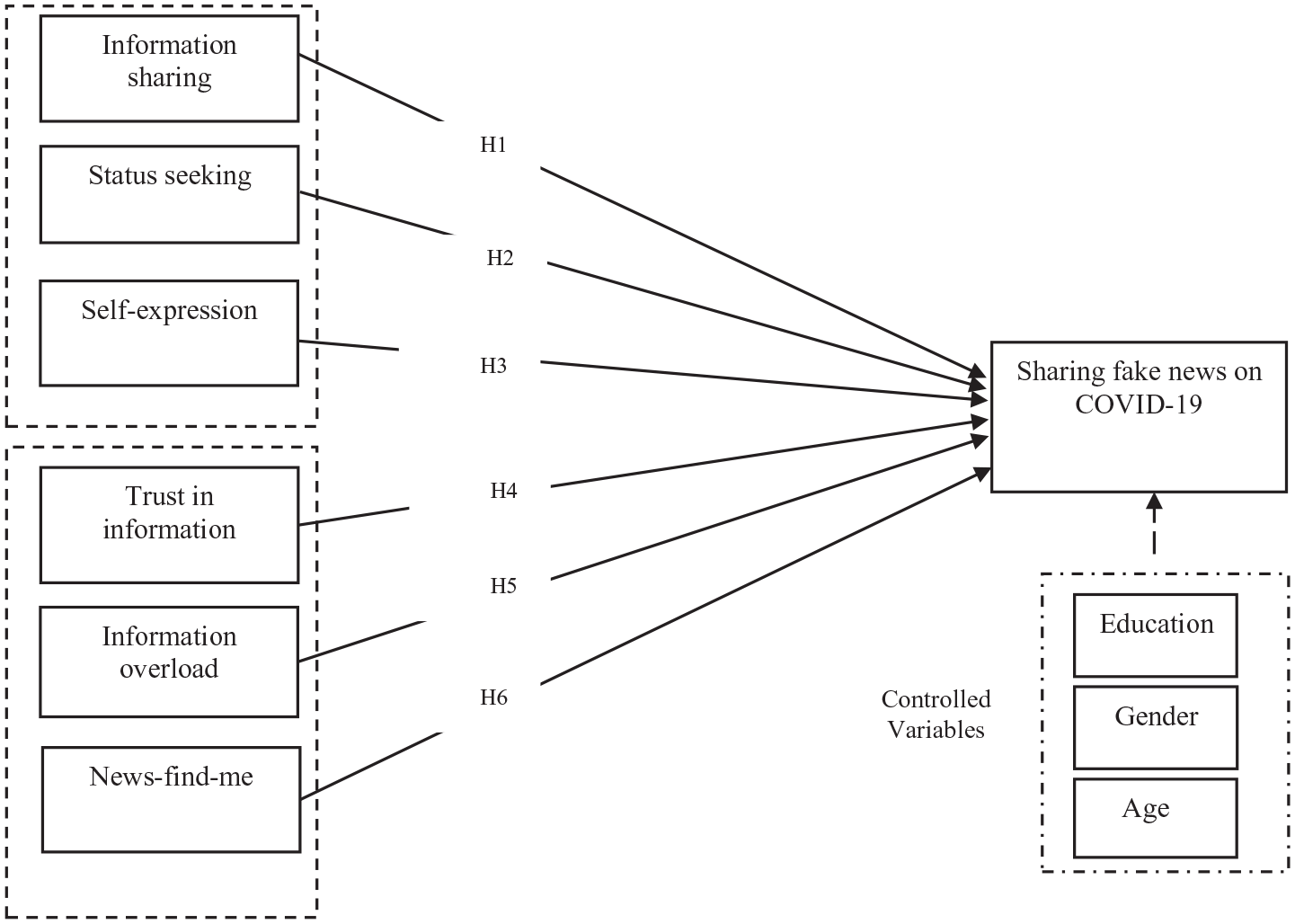
A research model for fake news sharing on COVID-19.
Methodology
Sample and procedure
A survey research design was used to conduct this study. Furthermore, online questionnaire was used as the instrument for data collection. The respondents in this study consisted of social media users from Nigeria aged 18 and above. Our estimated sample size was 385 respondents; which was calculated based on an estimated number of social media users in Nigeria (29.3 million) 56 using the thresholds of 95% confidence level and 5% of confidence interval.We also used the G-power sampling size determinant to realise if the sample size of 385 is adequate. Since our model has six predictors, using G-power with an effect size of 0.15, alpha of 0.05, and a power of 0.8, the minimum sample size needed was only 96. Thus, we can conclude that our study with a sample size of 385, has a power of more than 0.9, is large enough, and the findings can be used with confidence.
We adopted the respondent driven sampling (RDS) chain referrals technique to select the respondents for the study. 57 We used this technique to allow the inclusion of only social media users. We executed the RDS technique by sampling earlier participants referred to as “seeds,” who possessed the characteristics of interest. In this study, social media users were the seeds. The initial seeds were instructed to contact and recruit others from their existing network. Progressively, successive sets of participants then recruited persons from their social network for participation. This process continued until we arrived at the desired number (385) of respondents. The initial seeds mentioned above were recruited via social media advertisement posted on various social media such as Facebook, WhatsApp, Twitter and so on. The data were collected from February 2020 to May 2020, when the outbreak of COVID-19 started becoming worrisome and more cases were reported in Nigeria. 22 We had no issues of missing data as respondents were required to complete all questions. However, if a respondent is not willing to continue the survey, he/she was free to discontinue the survey.
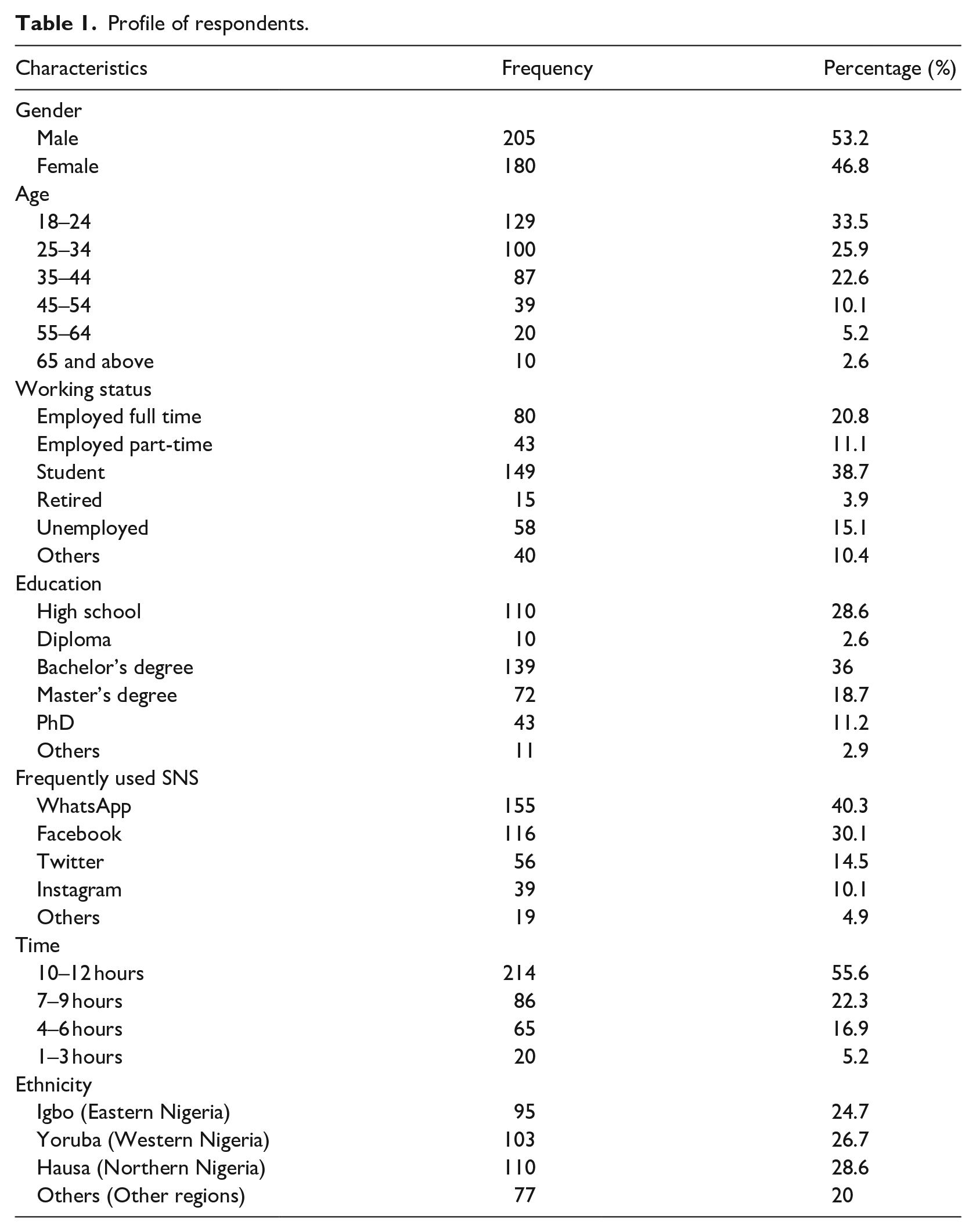
Unlike probability sampling, an online survey is advantageous because it is cost-effective and has no limitations of geographical boundaries. 58 However, an online survey has been shown to have issues of sample bias and generalizability. 59 Therefore, researches recommended the comparing of the study sample with the national demographic statistics,58,60 to reduce bias and demonstrate if a sample represents the population. From the demographic variable in Table 1, it could be deduced that our sample did not differ much with the Nigerian demographic data. For example, evidence has shown that the male population slightly outnumber the female population. Additionally, the Hausa ethnic group have higher number of population, followed by Yoruba and the Igbo. 61 Therefore, we could state that our samples somewhat matches with the Nigerian population and as such, sampling bias has been reduced in this study. 58 Table 1 shows the characteristics of our participants. We realised that the male (53.2%) participants slightly outnumbered the female participants (46.8%). More than half of the entire participants were between the ages of 18-34 (59.4%). In terms of working status, a considerable number of them were students (38.7%), followed by fully employed (20.8%), part-time employed (11.1%), unemployed (15.1%) and others (10.4%). Only a small number of participants reported being retired (3.9%). We observed that those who had High School Certificate (28.6%) and a Bachelor’s Degree (36%) were more than those who had Masters (18.7%), and PhDs (11.2%). While a trivial number (2.6%) reported to have Diploma. Concerning the most used SNS, WhatsApp (40.3%) and Facebook (30.1%) were selected. In this view, more than half of the participants (55.6%) use SNS for about 10-12 hours while only a small number (5.2%) use it for about 1-3 hours. Finally, we realised that more participants from the Northern Nigerian (28.6%) partook in the study. This was preceded by Western Nigerians (26.7%), and Eastern (24.7%) Nigerians. However, a few others from other regions of Nigerians also partook in the survey (20%).
Profile of respondents.
Measures
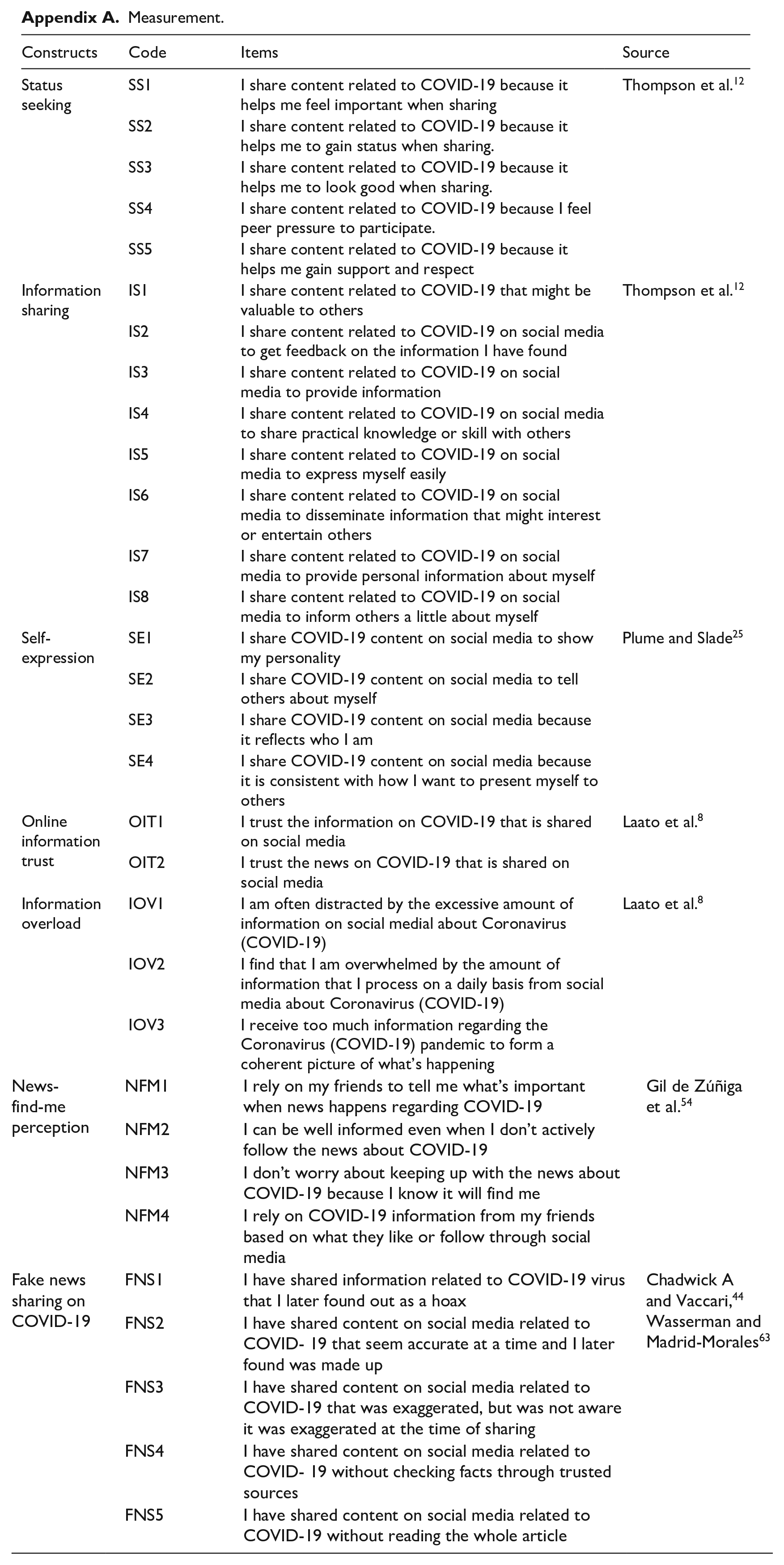
All constructs were measured using a 5-point Likert-type scale, in which one symbolises strongly disagree, and five expresses strongly agree. All the measurement scales used in this study were adapted from prior studies and modified to fit into the context of the research. Status seeking and information sharing were adapted from the study of Thompson et al. 12 To measure self-expressing we adapted items from Plume and Slade. 25 Items for online information trust and information overload were derived from the study of Laato et al. 8 The items for news-find-me perception was adapted from Gil de Zúñiga et al. 53 We derived the items of fake news sharing from prior studies. 62 In appendix A, the items used to measure the constructs and their sources are elaborately demonstrated. We used four experts who are Professors in the field of media and communication to validate our instruments. Two experts were recruited from the Department of Mass Communication, Taraba state University, Jalingo, Nigeria. The other two were recruited from the Department of Mass Communication, University of Nigeria, Nsukka. The experts looked at the clarity of our items, how logical we presented them as well as determined if it fits into the context of our study. To identify further inconsistency or errors, we carried out a pilot study which consisted of (n=30) participants. Using the outcome of the pilot test along with the expert observations we reworded some of our items, leading us to a final clean copy used for the actual data collection.
Data Analysis and Results
We analysed data using descriptive statistical analysis with SPSS version 25. While, the relationship between the variables were tested using structural equation modelling with SmartPLS 3.2.6. The reason for using PLS is related to the exploratory nature of our research. 63 Unlike confirmatory studies where researchers begin with a well-established and rigorously developed baseline model, ours is an incremental study. We build on integrating concepts from prior theories. Since we are in the initial development and assessment phase of theory building, PLS is the best approach.64,65 Another reason we used PLS was that our measurements were not normally distributed; skewness was (β = 6.532, p < 0.01) and kurtosis was (β = 63.328, p < 0.05).
Common method bias
It was necessary to test the potential presence of Common method bias (CMB) before data analysis because responses were collected from only one source. We performed CMB bias using Harman’s single factor test in SPSS version 25. It was noted that a single factor shared over 18.4 % of the total variance which is less than 50 percent threshold value, 45 which indicates that the CMB was not a problem in this study.
Measurement Model
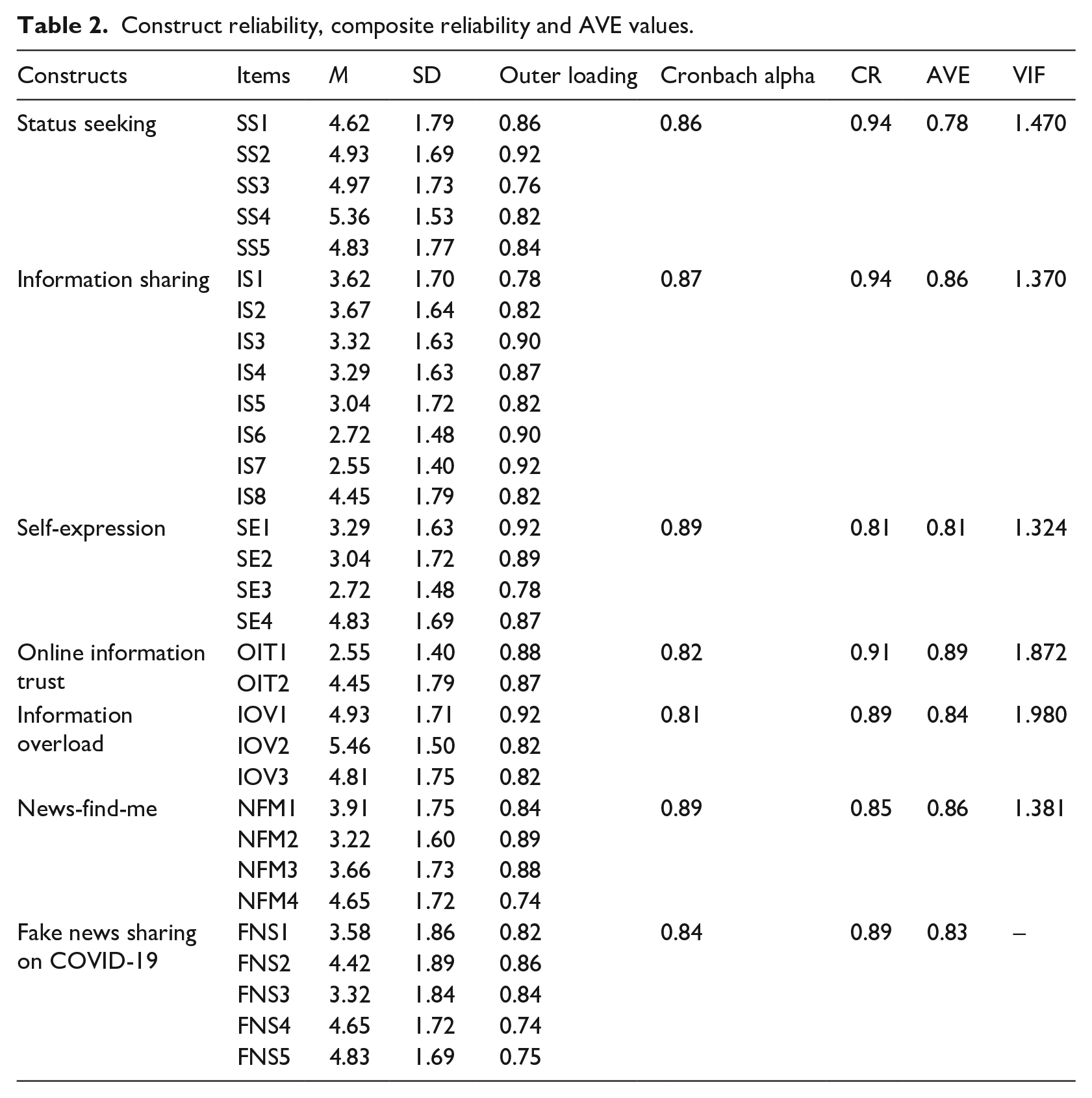
The evaluation of the measurement model was based on reliability tests (internal consistency) and validity tests (convergent validity and discriminant validity and). The internal consistency was measured using composite reliability (CR) and Cronbach’s alpha. The convergent validity was measured through the factor loadings and average variance extracted (AVE).66–69 As shown in Table 2, the composite reliability was above 0.70 and Cronbach’s α exceeded the threshold of 0.70. Furthermore, the factor loadings of each indicator item is over 0.708, 70 and average variance extracted was above 0.50. 70 Thus, our study met the requirement for internal consistency and convergent validity.
Construct reliability, composite reliability and AVE values.
We also assessed the measurement model by conducting a discriminant validity test. Heterotrait–Monotrait ratio of correlations (HTMT) criterion is considered more appropriate due to criticism of the Fornell–Larcker criteria by different researchers. 66 Discriminant validity is confirmed if the value is less than 0.85 or 0.90. 71 Table 3 shows that all values are less than 0.90. Therefore, all the measures in our model demonstrated excellent psychometric properties.
Discriminant validity Heterotrait–Monotrait (HTMT).
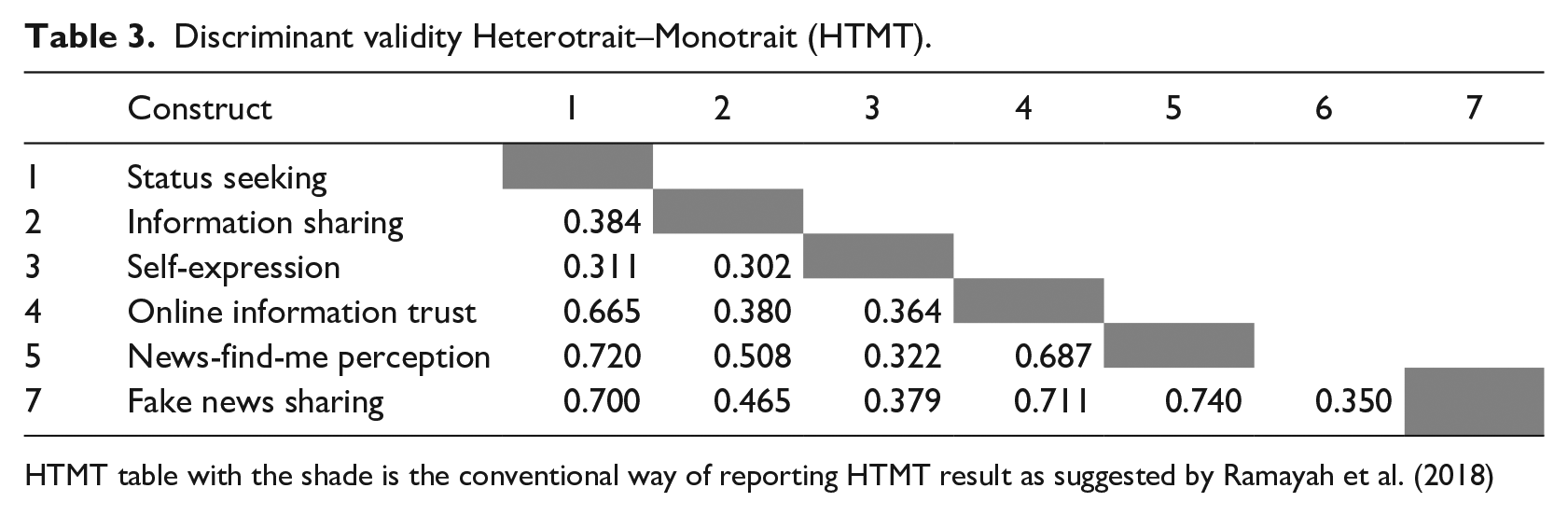
HTMT table with the shade is the conventional way of reporting HTMT result as suggested by Ramayah et al. (2018)
Structural Model
In assessing the structural model, a few steps need to be taken. Firstly, we assess collinearity. All the inner VIF value were below the threshold of 5, 72 suggesting that collinearity is not an issue in our model 63 (See Table 1). The next step is to assess the significance and relevance of the structural model relationships. According to Hair et al. 72 the key criteria for evaluating the structural model is to examine the t values, path coefficient (β values), effect size (f2), predictive relevance (Q2) and coefficient of determination (R2). A 5000 resample bootstrapping procedure with 5% significance level (one-tailed) was used to test the significance of the hypotheses.
Table 4 and Figure 2 revealed a significant positive relationship between news-find-me perception and fake news sharing related to COVID-19 pandemic (β = 0.622, p < 0.001), this supports H6. The result also supports a positive relationship between information overload and fake news sharing related to COVID-19 pandemic (β = 0.412, p < 0.001). Thus, supporting H5. The result reports a positive association between trust in online information and fake news sharing related to COVID-19 pandemic (β = 0.398, p < 0.001), lending support to H4. We also found a positive relationship between status seeking and fake news sharing related to COVID-19 pandemic (β = 0.339, p < 0.01). This is contrary to our expectations, which suggest status seeking having negative relationship with fake news sharing. As such, H2 was not supported. Furthermore, the positive link between self-expression and fake news sharing related to COVID-19 (β = 0.214, p < 0.05) as well as information sharing and fake news sharing (β = 0.212, p < 0.05) was established. This supports H3 and H1 respectively. Additionally, the results indicated that our control variables gender and age have no significant effect on fake news sharing. However, education exert influence on fake news sharing (β = -0.321, p < 0.01).
Structural model results.
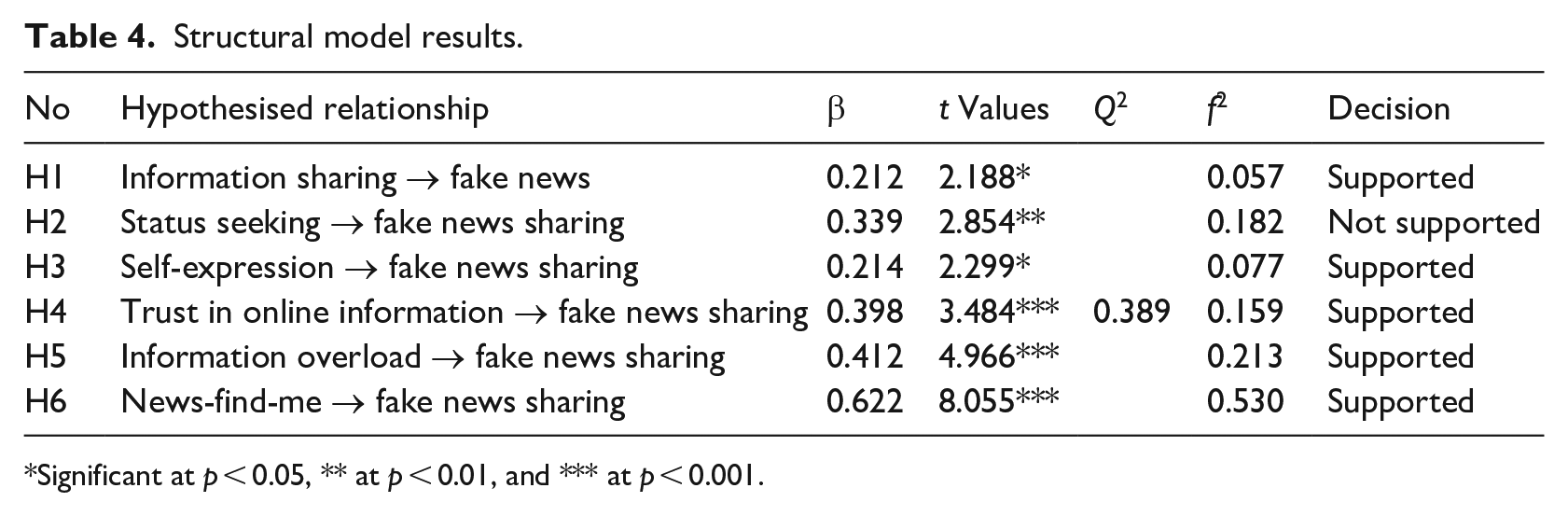
Significant at p < 0.05, ** at p < 0.01, and *** at p < 0.001.
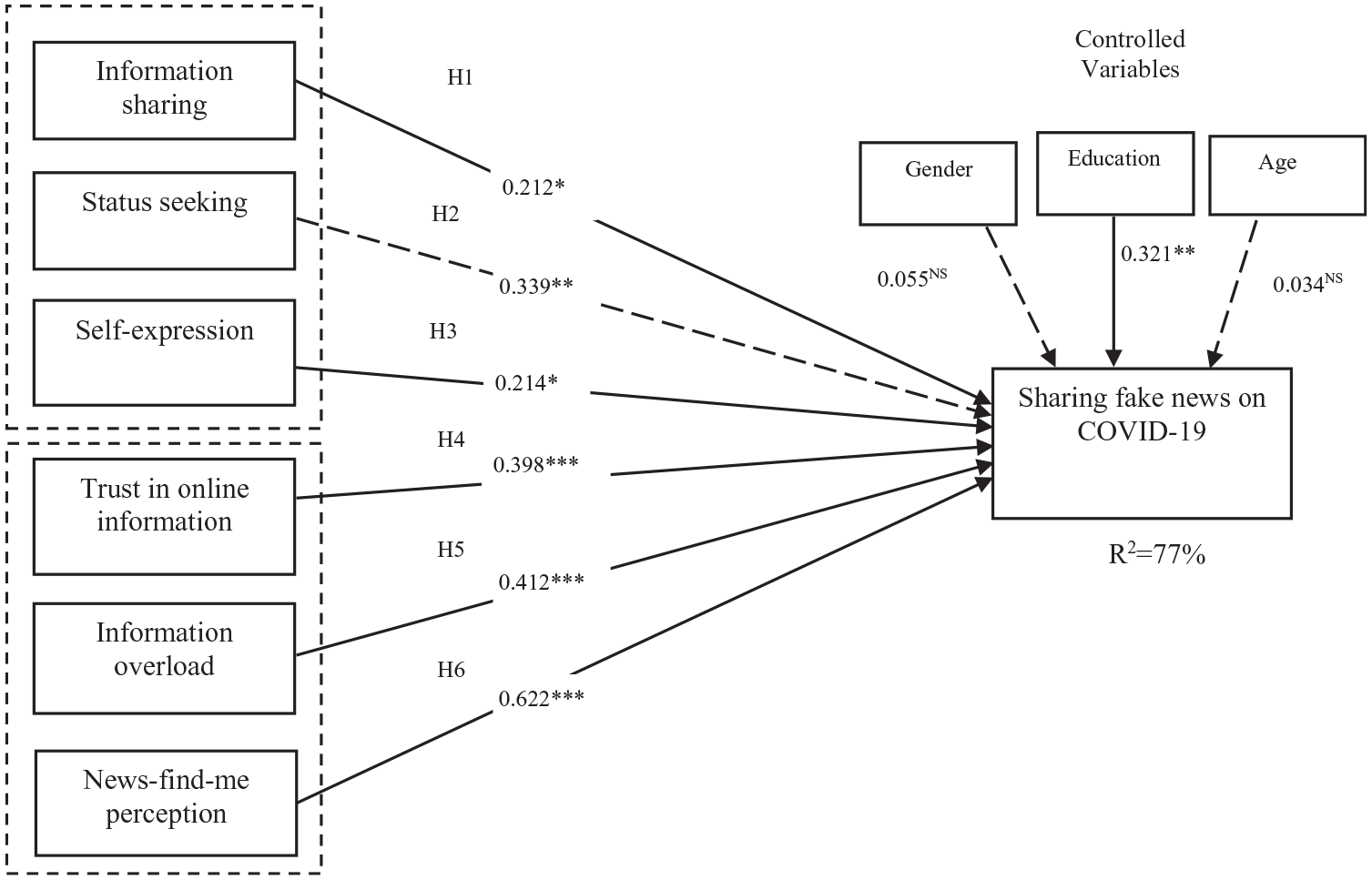
Structural model for fake news sharing.
Having assessed the coefficient of determination of the endogenous constructs, the next criterion assesses the effect size (f2). 64 The threshold of 0.02, 0.15, and 0.35 have been proposed as small, moderate and large effects, respectively. 73 Results indicate that the effect sizes (f2) for the five relationships are all achieved from small to large effect size. Finally, we look into endogenous latent variable’s reflective nature, cross-validated redundancy measure (Q2) is used to evaluate the model’s predictive relevance.74,75 Henseler and Sarstedt 76 stated that when Q2 value (s) is found greater than zero, it is considered that the model has a predictive relevance. Therefore, the predictive relevance Q2 assessment showed that the Q2 of fake news sharing was (Q2 = 0.389 > 0), suggesting that the research model has excellent predictive relevance. Overall, our model explains 77% of the variance in people’s intention to share fake news related to COVID-19 pandemic. This variance is termed ‘substantial.’ 68
Discussion of Findings
Two theories (affordance and cognitive overload) were integrated in this study to explore the antecedents of fake news sharing related to COVID-19 pandemic in Nigeria. We tested the influence of status seeking, information sharing, self-expression, trust on online information, information overload and news-find-me perception on fake news sharing behaviour related to COVID-19 pandemic using sixth direct hypotheses. The outcome of this study provides valuable insights on the influence of social media affordance and information abundance on fake news sharing related to COVID-19 on social media platforms in Nigeria.
Our result shows that the news-find-me perception was the strongest predictor of fake news sharing related to COVID-19 pandemic among Nigerian social media users. This outcome implies that Nigerian social media users who perceived that the news will find them via their friends, news feeds, and etc (instead of them looking for the news), have the higher tendency to encounter false information, which in turn leads to the spread of misinformation. The news-find-me perception has been connected with incidental news exposure, suggesting that people who believe news will come to them are more likely to get information from social media than other sources, resulting to a large amount of exposure to information. 52 We posit that incidental news exposure is causing fake news spread on social media. Consistent with our view, an association between social media usage and misinformation in this era of the COVID-19 pandemic was found in past studies;11,37 suggesting that the higher the frequency in using social media, the higher the tendency of sharing fake news online. Through this outcome, we have extended prior studies that examined the news-find-me perception concept in the political context52 –54,77 by testing it in the COVID-19 health crisis.
Furthermore, we found a positive relationship between information overload and fake news sharing related to COVID-19 pandemic. This was the second most significant factor that leads to fake news sharing among social media users in Nigeria. This is not surprising as recent evidence suggest that during the COVID-19 pandemic, there was enormous and abundant of information on social media which led to potential information overload and triggered a lot of negative behaviour.13,49 It has been shown that when humans are overloaded by information, it leads to fatigue, 50 and once humans are exhausted, it reduces their ability to verify the information they encounter. 8 In other words, when individuals are overloaded with information, they are less likely to go extra trouble of verifying information sources and this could lead to the consumption and further proliferation of fake news. 51 We find support for this assertion as our findings suggest the influential role of information overload in predicting fake news sharing among social media users in Nigeria.
Past research suggests that individuals who have high trust for online information have higher likelihood of spreading real news,33,45 but in the process they may involve in spreading fake news unintentionally. It was found that online information trust increases the sharing of unverified COVID-19 information. 8 This indicates that people who regard SNS as their primary source of information may presume that information circulated on the platform is trustworthy and reliable, and hence they tend to share whatever information they found on social media. We found support for this claim as our findings suggest a positive association between trust in online information and fake news sharing related to COVID-19 pandemic among Nigerian social media users. This was the third most significant factor that predicted fake news sharing. Evidence from past research shows that when messages come from religious leaders, friends and families, Nigerians tend to believe it without questioning its authenticity. 78 It is possible that many social media users received information from close ties without much verification during the health crisis, leading to fake news proliferation related to the pandemic. Hence, we suggest that trust has harmful effect in this context. In line with past studies,33,45 we suggest that people are less likely to verify information that they trust online and this lead to further proliferation of misinformation on social media.
A negative association between status seeking and fake news sharing was hypothesised in this study. However, our result suggests that status seeking leads to fake news sharing behaviour related to COVID-19 pandemic. This was the fourth most significant factor that predict fake news sharing behaviour. A possible explanation to this is that social media allows it users to develop popularity, hence encouraging social media users to show that they are knowledgeable on some preventive tips and precautionary measures. They would like to be the first to share information to prove to their peers that they are knowledgeable. Our finding contradicts past research which asserts that status seeking lead to less sharing of misinformation. This is because self-promotion is associated with building a positive image before others and sharing fake news can damage users image. 33 In line with our result, Najmul Islam et al. 13 found a positive relationship between self-promotion and fake news sharing regarding COVID-19. Our results extend past studies that found mixed findings about the effect of status seeking on news sharing behaviour12,79,80 by specifically examining its effects on fake news sharing. We suggest that in the process of seeking status online, social media users may forfeit the authentication behaviour in order to seek status through likes, shares, retweet and comments from their online social networks.
We anticipated a positive relationship between self-expression and fake news sharing related to COVID-19 pandemic, and our findings endorsed it. It was the fifth most significant predictor of fake news sharing among social media users in Nigeria. What this outcome signify is that social media has become a platform for its users to express themselves, and this emerging culture has led to higher likelihood of fake news sharing as they want other people know their opinions and views on the pandemic. Consistent with our result, it has been shown that self-expression on social media leads to unintentional fake new sharing. 28 This is consistent with a recent research which argued that the affordance of self-expression on social media encourages people to disseminate false information. 35 It has also been shown that people share misinformation mainly to obtain other’s opinions, to express their own opinions, and to interact with others. 36 In this study, we assert that social media intensifies self-expression about the pandemic, and this contributes to the spread of COVID-19-related fake news on the platform.
The sixth and least most significant factor found associated with fake news sharing was information sharing. This outcome infers that the affordance of information sharing on social media leads to the circulation of fake news in the process. As the platform allows users to instantly provide information to the public, they pay less attention to the accuracy of the information when sharing it online. It has been reported in one recent research that during the period of the pandemic, Nigerians would want to be the first to provide information regarding safety tips and how to cope with the virus 16 which ended up with misinforming the public. The ‘me first syndrome’ attitude in sharing information about the pandemic was found prevalent in the context of Nigeria and it has caused an increase in the dissemination of false information about COVID-19. 19 Since sharing news on social media has become easier as people can take part in the creation and dissemination of information, 27 we attest that this situation leads to the increase in fake news sharing in the online environment
In this study, we found that gender and age have no significant effect on fake news sharing. This is strange as studies have shown that gender and age significantly predict fake news sharing.62,81,82 However, we believe that contextual factor might have influenced this outcome. We reason that, in the Nigerian context, fake news sharing has become normalized in the society and afflicted all walks of life regardless of age categories or gender. Nevertheless, we found that education exerts influence on fake news sharing. A closer look at the data suggests that those with lower educational qualification tend to share fake news more than individuals who have higher education. Scholars emphasize on the ability of social media users to distinguish between what is real and what is fake 33 because fake news creators tend to exploit the non-intellectual characteristics of some people. 83 For social media users to determine if the information they received is true or false, an expert judgement of content is needed. 84 Our study, hence, reiterates the fact that less educated people are more prone to disseminate fake news on social media.
Conclusion
Based on our findings, we conclude that news-find-me perception, information overload, trust in online information, status seeking, self-expression and information sharing predicted fake news sharing related to COVID-19 pandemic among social media users in Nigeria. Greater effects of news-find-me perception and information overload were found on fake news sharing behaviour as compared to trust in online information, status seeking, self-expression and information sharing. This outcome has some theoretical and practical implications, as demonstrated below.
Theoretical Implications
Our study contributes to knowledge in several ways. The most noteworthy contribution is the integration of the affordance theory and the cognitive load theory to understand fake news sharing. Using these theoretical lenses, we found positive effects of news finds me perception, information overload, trust in online information, status seeking, self-expression and information sharing on the sharing of COVID-19-related fake news. Our findings extend the literature of fake news sharing behaviour8,16,33,43,45,84 by focusing on the platform itself as the provider of a wide range of open opportunities and abundance of information for consumption. Most past studies pay attention to the source or the sharer of information in order to understand why people share fake news, and in doing so they relied on theories like uses and gratification theory (U&G) and social capital theory (SCT).16,19 Less attention has been given to the affordance of social media and the abundance of information available online.
To our knowledge, only few studies have used the affordance theory to understand fake news sharing. For example, Najmul Islam et al. 13 used the affordance theory to show that self-promotion, entertainment, exploration, and religiosity predict fake news sharing. We extend the application of the theory by introducing other aspects of social media affordances, such as information sharing, status seeking and self-expression, leading to fake news proliferation on this popular platform. On the other hand, Laato et al. 8 used the cognitive load theory to examine the role of online information trust and information overload have on unverified news sharing. We extend this application by adding the news find me perception, a situation whereby social media users strongly believe that certain information will reach them without necessarily searching for it, as one of the predictors to fake news sharing on social media.
Our discovery of the strong influence of news-finds-me on fake news sharing brings fresh insight to the understanding of fake news sharing behaviour. Most of the studies that examined the news find me perception have focused on political context52 –54,77 to understand its influence on political knowledge, political interest, and voting. We, therefore, extend past research by demonstrating the role of news find me perception in the context of fake news sharing. Another important finding is the significance of information overload in predicting the sharing of COVID-19-related fake news. Our result reinforces the notion which suggest that when individuals are overloaded with information, they are less likely to go extra trouble of verifying information sources and this could lead to the consumption and further proliferation of fake news.49 –51 Additionally, results on trust on online information having a positive connection with fake news, suggesting that individuals who have high trust for the information found on social media have higher inclination to be exposed to fake news as well as propagate fake news. This outcome reinforces past researches that examined the role of online information trust on fake news sharing.8,33 In this study, we find strong support for cognitive overload theory in explaining fake news sharing on social media.
Our findings are also supportive of the affordance theory. We found significant influence of status seeking, self-expression and information sharing on fake news sharing. Unlike past research that treat these factors as user motivations,12,79 we chose to look at them as opportunities that social media platform provide to its users. We assert that the opportunities provided by social media to seek status, express oneself and share information have encouraged people to share more fake news. The findings provide new perspectives for understanding the predictors of fake news sharing on social media. Lastly, our focus on users of social media in a developing country such as Nigeria alone is a significant contribution to the growing stream of studies since there are rare studies in this region. Thus, focusing on this region that is less well studied offer the opportunity of introducing future investigations in various geographies, which could result in a more global and dependable outcome. This is exclusively valuable since there is now a growing usage and dispersion of social media in developing nations.
Practical implications
Based on our findings, we suggest intervention strategies which nudge people to be mindful of the information they come across on social media. Firstly, with regards to news-find-me perception, social media users should try and seek information and filter them before sharing, rather than over rely on the assumption that news will find them. This attitude demonstrates over reliance on social media as a source of information. Secondly, our results showed a positive association between information overload and fake news sharing. We call on relevant authorities to inform the public on the right way to tackle the pandemic as well as remind the public on the essence of consuming appropriate information they come across.
Thirdly, our results showed support for trust on online information and fake news, suggesting that users who are moved with the desire to trust information they encounter on social media have higher inclination to get exposed to fake news as well as share fake news. As such, social media users are encouraged to be sceptical of the information they get exposed to on social media. There are a lot of news that are unverified on social media regarding the COVID-19 pandemic, thus, social media users should not just blindly trust information but rather attempt to authenticate information before sharing. We further encourage social media users to always examine the news shared no matter who shares it. Fourthly, we found a link between status seeking and fake news sharing. Social media user’s status and reputation in online social groups can be sustained if they are mindful of what they share. It has been shown that people share news for status seeking, 12 we, therefore, urge users to double-check what they convey to avoid dampening their reputation. Fifthly, self-expression predicted fake news sharing. We are not telling social media users not to express themselves but being mindful of what is shared while expressing oneself should be a priority to avoid disseminating fake news in the process.
Lastly, the link between information sharing and fake news sharing was established in this study. This suggests that social media provide the affordance for information sharing. There is the need for regulatory control of social media platforms to some extent, particularly during a crisis such as COVID-19 global pandemic. Overall, we call on health care providers and the Nigerian government to provide relevant information on this current pandemic. That is, correct information should be shared widely to the public domain through various conventional and online media. This will lessen the spread of fake news on the concocted cure and prevention tips found online. Accurate information is required at this time because tackling the virus requires everyone to follow medical advice; therefore, without clear and immediate action to refute misinformation online, the COVID-19 pandemic will be much more challenging.
Limitation and Suggestions for Further Studies
Though this study contributes to new insight by establishing the antecedent of fake news sharing on COVID-19, yet, the study suffers from some limitations that also indicate important future research areas that could be pursued further to enrich our understanding. This study was undertaken in the context of the COVID-19 pandemic as well as drew its sample from only one country (Nigeria). Nevertheless, the findings may be generalised to other nations as the issue of fake news on the COVID-19 pandemic has also become a global issue. Moreover, this study has answered a recent call which suggests that authors should look beyond researching fake news from the US and UK contexts. 85 We recommend future researchers to recruit social media users from other countries. Additionally, a comparative analysis of fake news sharing across countries would yield a very interesting outcome that could help policy makers.
Another limitation of this study is that we can only conclude base on the factors we have identified and analysed. There are other factors such as peer influence, social comparison and so on. Therefore, future researchers could examine fake news sharing related to COVID-19 using other measures. Our model lacked a mediating variable, it is possible introducing a mediator would have shown a more complex model that increases our understanding of fake news sharing. This limitation could be taken up by future researchers. While this study sheds light on the motivations behind the spreading of false information, it does not highlight how one can detect false information. This proposes further suggestions for follow-up research using these factors in an attempt to detect and limit or possibly eradicate the spreading of false information across social media platforms. Despite the limitations of this research, it has broadened our understanding of fake news sharing among social media users. It has also contributed to the growing body of fake news studies by exploring an under explored region which is Nigeria. Furthermore, we believe the outcome of this study will help policy makers draw up measures that could assist in curtailing the spread of fake news sharing in Nigeria.
Footnotes
Appendix
Measurement.
| Constructs | Code | Items | Source |
|---|---|---|---|
| Status seeking | SS1 | I share content related to COVID-19 because it helps me feel important when sharing | Thompson et al. 12 |
| SS2 | I share content related to COVID-19 because it helps me to gain status when sharing. | ||
| SS3 | I share content related to COVID-19 because it helps me to look good when sharing. | ||
| SS4 | I share content related to COVID-19 because I feel peer pressure to participate. | ||
| SS5 | I share content related to COVID-19 because it helps me gain support and respect | ||
| Information sharing | IS1 | I share content related to COVID-19 that might be valuable to others | Thompson et al. 12 |
| IS2 | I share content related to COVID-19 on social media to get feedback on the information I have found | ||
| IS3 | I share content related to COVID-19 on social media to provide information | ||
| IS4 | I share content related to COVID-19 on social media to share practical knowledge or skill with others | ||
| IS5 | I share content related to COVID-19 on social media to express myself easily | ||
| IS6 | I share content related to COVID-19 on social media to disseminate information that might interest or entertain others | ||
| IS7 | I share content related to COVID-19 on social media to provide personal information about myself | ||
| IS8 | I share content related to COVID-19 on social media to inform others a little about myself | ||
| Self-expression | SE1 | I share COVID-19 content on social media to show my personality | Plume and Slade 25 |
| SE2 | I share COVID-19 content on social media to tell others about myself | ||
| SE3 | I share COVID-19 content on social media because it reflects who I am | ||
| SE4 | I share COVID-19 content on social media because it is consistent with how I want to present myself to others | ||
| Online information trust | OIT1 | I trust the information on COVID-19 that is shared on social media | Laato et al. 8 |
| OIT2 | I trust the news on COVID-19 that is shared on social media | ||
| Information overload | IOV1 | I am often distracted by the excessive amount of information on social medial about Coronavirus (COVID-19) | Laato et al. 8 |
| IOV2 | I find that I am overwhelmed by the amount of information that I process on a daily basis from social media about Coronavirus (COVID-19) | ||
| IOV3 | I receive too much information regarding the Coronavirus (COVID-19) pandemic to form a coherent picture of what’s happening | ||
| News-find-me perception | NFM1 | I rely on my friends to tell me what’s important when news happens regarding COVID-19 | Gil de Zúñiga et al. 54 |
| NFM2 | I can be well informed even when I don’t actively follow the news about COVID-19 | ||
| NFM3 | I don’t worry about keeping up with the news about COVID-19 because I know it will find me | ||
| NFM4 | I rely on COVID-19 information from my friends based on what they like or follow through social media | ||
| Fake news sharing on COVID-19 | FNS1 | I have shared information related to COVID-19 virus that I later found out as a hoax | Chadwick A and Vaccari, 44 Wasserman and Madrid-Morales 63 |
| FNS2 | I have shared content on social media related to COVID- 19 that seem accurate at a time and I later found was made up | ||
| FNS3 | I have shared content on social media related to COVID-19 that was exaggerated, but was not aware it was exaggerated at the time of sharing | ||
| FNS4 | I have shared content on social media related to COVID- 19 without checking facts through trusted sources | ||
| FNS5 | I have shared content on social media related to COVID-19 without reading the whole article |
Funding
The author(s) received no financial support for the research, authorship, and/or publication of this article.
