



Abstract
Background
Self-harm is a major public health concern, and the internet presents challenges and opportunities for prevention. Understanding experiences of engaging with self-harm content is critical for improving online safety. However, existing research has primarily focused on adolescents, and there is a need to examine whether established findings extend across the life course.
Objective
This study aimed to explore user motivations and deterrents for posting and responding to online self-harm content among both adults and adolescents.
Methods
We analysed qualitative data from a national online survey of UK-based participants aged 16 to 65+ (N = 194). The survey included open-text questions on experiences of posting and responding to online self-harm content. Data were analysed using content analysis.
Results
Motivations for posting self-harm content were complex and multifaceted, with social and intrapersonal functions evident across both adolescents and adults. Seeking help and support from others was the most common motivation for posting, while venting negative emotions was described more frequently by adolescents. Concern about triggering others was the most common deterrent to posting. Responding to self-harm content was primarily motivated by a desire to support others, particularly among adults, although some younger users were driven by a desire to exert corrective action. The main reason for not responding to self-harm content was a felt lack of emotional capacity to engage with this material.
Conclusions
This study extends existing research by demonstrating that common motivations and deterrents for engaging with online self-harm content are evident beyond adolescence and across the life course. Findings highlight the importance of age-inclusive user education initiatives and practitioner assessments, and caution against blanket restrictions on self-harm content that may unintentionally limit access to peer support.
1. Introduction
Self-harm is a major public health concern, and the rise of the internet presents unique challenges and opportunities for prevention. 1 Self-harm related internet use is a common phenomenon, 2 particularly among young people and those who self-harm. 3 The term refers to engagement with online content and communities that centre, either explicitly or implicitly, around self-harm. Online self-harm content includes visual and descriptive material that is hosted on social media platforms and online forums (see e.g., refs. 4–9). Understanding user experiences of posting and responding to online self-harm content is critical for supporting those at risk of self-harm and improving online safety.
Existing research has found that the functions of posting and responding to online self-harm content are complex. It is widely recognised that engaging with this content serves multiple social and intrapersonal goals5,10–13 that vary between and within users over time. 14 One of the main motivators is to gain peer support, both day-to-day and in moments of crisis, and this is particularly salient for those who have experienced stigma or challenges accessing mental health services offline. 10 Social motivations for posting self-harm content also include providing support to other users and raising awareness on behalf of self-harm communities. 12 Research has also highlighted the intrapersonal functions of engagement when the purpose is to regulate distress, accumulate positive emotions, or facilitate self-expression.11,12
However, previous research on this topic has been limited. First, studies have focused predominantly on the experiences of adolescents (e.g., refs. 5, 10, 12, 13 and 15 for an exception see Ref. 14); consequently, little is known about the range of user experiences across the life course. This represents a significant gap as research shows that social media use is highly prevalent among adult populations, particularly on platforms such as Facebook and YouTube16,17. 1 Secondly, many studies have employed interview-based research designs with small and highly selective samples (e.g., Ref. 5, 12, 13 and 15). While this has generated rich insights, additional research is needed to corroborate these findings and broaden our understanding of this phenomenon across diverse and hard-to-reach groups. Finally, research has primarily centered around user needs and motivations when posting or responding to self-harm content, overlooking the influence of deterrence on the decision-making process.
This study addressed these limitations by using qualitative data from a national survey to explore experiences of engaging with online self-harm content among both young people and adults. The aim was to examine the functions of these online activities across age groups, as well as the factors that deter users from engaging with certain types of content. By examining experiences across adolescents and adults, this study clarifies how motivations and deterrents operate across the life course. Expanding our understanding of these user behaviours is critical for informing clinical practice and developing effective policies and tools to keep users of all ages safe online.
2. Methods
This study uses data from a national UK-based survey that aimed to explore user experiences of engaging with self-harm and suicide-related online content. This anonymous, self-completed online survey used a mixed methods design, incorporating fixed-choice and open-ended questions to collect rich data on experiences of content engagement. The study was approved by the Middlesex University Psychology Department Research Ethics Committee (reference: 17869). All research materials and procedures were developed in partnership with Samaritans and the University of Birmingham Institute for Mental Health Youth Advisory Group of young people with lived experiences of mental health challenges. The reporting of this study was informed by the Standards for Reporting Qualitative Research (SRQR) 19 guidelines.
2.1. Recruitment and materials
The survey recruited a purposive sample of 706 UK-based participants aged 16 and above between June 2021 and January 2022. Participants were self-selecting, and they were recruited through adverts placed on social media platforms and online forums as well as via networks within third sector organizations (e.g., lived experience panels and newsletters). Recruitment strategies involved partnering with organizations working with men and ethnic minority groups to reach marginalised communities and enhance the diversity of the sample. Although self-harm affects diverse populations in distinct ways, these groups are underrepresented in existing research. Written informed consent was obtained from all participants prior to their participation in the study.
This paper presents an analysis of qualitative data from the 194 participants who responded to open-text questions about posting and responding to online self-harm content. All available responses were included in the analysis. For the purposes of analysis, participants aged 16-24 years were classified as adolescents, and those aged 25 years or older were classified as adults (for justification, see Ref. 18). Participants were asked whether they had ever (i) posted about their own experiences or images of self-harm, and (ii) responded to other people’s posts about self-harm. Open-ended responses allowed participants to elaborate on their experiences and they were prompted to describe the nature of the content, their motivations for engagement, and any conditions for responding. Quantitative data were also collected on sociodemographic characteristics, history of non-suicidal self-harm, and self-harm related internet use. The exact wording of these questions is presented in Appendix 1.
By employing open-ended questions, the survey provided rich qualitative insights into complex and poorly understood issues that disproportionately affect vulnerable and marginalized groups. The large-scale survey design also allowed us to capture a much broader range of experiences than traditional interview-based studies and the anonymity is likely to have encouraged honest and open responses. 20 The benefits of using free-text qualitative data are well-established and these data are commonly used to illuminate emerging issues where there is limited prior research.21,22
2.2. Data analysis
Quantitative data were analysed in Stata MP 18.0. Descriptive statistics were used to summarise participant characteristics and to examine the prevalence of posting and responding to online self-harm content across age groups.
Qualitative data were managed using Microsoft Excel and analysed using inductive content analysis, 23 which facilitated the identification and quantification of patterns in the data. Open-ended responses were coded for experiences of posting and experiences of responding to online self-harm content. An initial coding framework was developed and refined through an iterative process by independent raters. Coding was conducted collaboratively by LK, CH, and LM, with regular consensus meetings to determine the final coding scheme. Analyses of subthemes by age group were descriptive, and formal statistical comparisons were not conducted given the exploratory nature of these analyses and small cell counts. Illustrative quotes are presented in the results section alongside participants’ age group and gender to give context to the data.
3. Results
3.1. Participant characteristics
Participant characteristics (N = 194).

Prevalence of posting and responding to online self-harm content, by age group (N = 194).
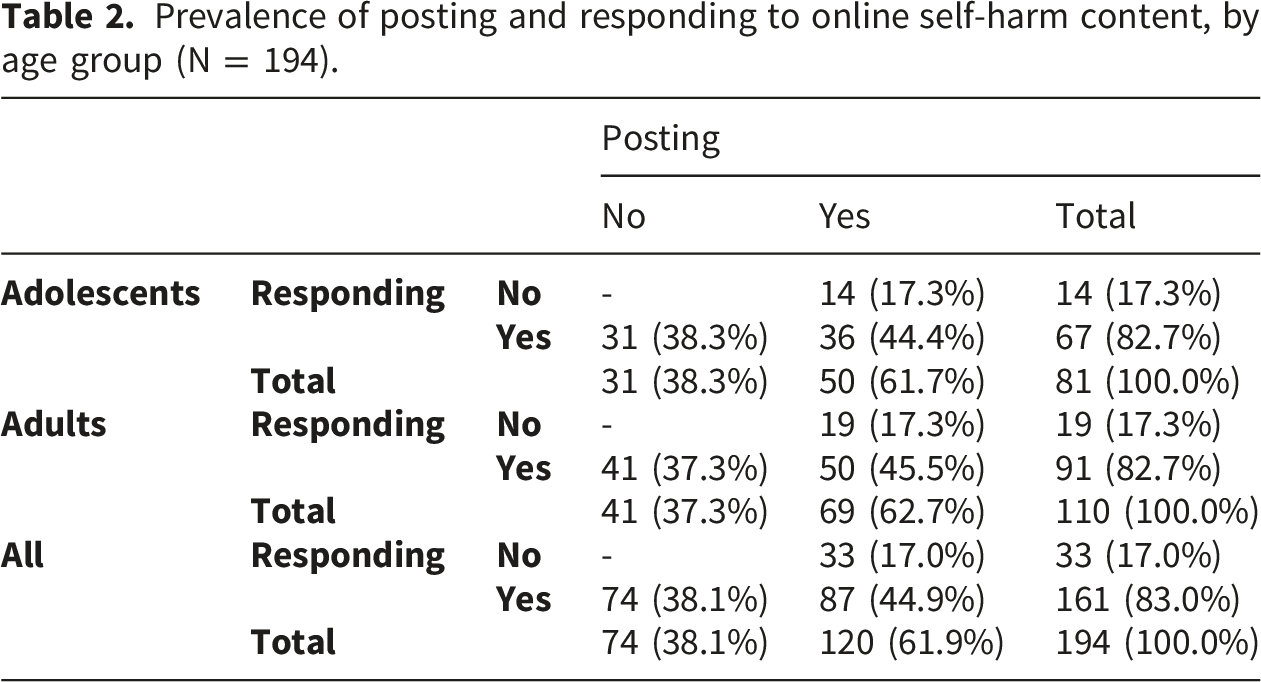
In addition, the prevalence of posting and responding to self-harm content was similar across age groups. Both adolescents (aged 16-24) and adults (aged 25+) reported comparable levels of posting and high levels of responding, indicating that engagement is not limited to younger users. This pattern is expected given that the sample was restricted to individuals who shared free-text responses to these items.
3.2. Experiences of posting self-harm content
Content analysis: frequency of subthemes related to motivations for posting self-harm content by age group (N = 114).

*Multiple themes could be coded within a single response and frequencies do not necessarily sum to the total number of participants. Some participants did not record their age.
3.2.1. Social functions
The first category of motivation for posting self-harm content online was inherently social. The most common reason for posting was to seek help and support from other users (n = 21; 18.4%). This motivation was evident among both adults and adolescents, with several participants describing sharing text-based posts asking for emotional support in support groups or recovery forums, either immediately before or following acts of self-harm. Although accessing peer support was often a preventative measure that helped users avoid self-harm, it could also reduce feelings of shame in the aftermath: “I have posted in online support groups, either because I want to harm and need distraction/support or because I’ve harmed and am feeling ashamed and just need some understanding and support.” (Female, aged 40-49)
It is clear that posting images of self-harm served an important help-seeking function. Some participants described sharing images of self-harm as a “cry for help” but this was not always effective: “I posted a photo of a huge bruise on my knee with my very freshly scarred forearm resting on it, as a cry for help that was never answered pretty much.” (Female, age 20-24)
In addition, some participants sought medical advice from other users following incidents of self-harm. Photos of self-harm were particularly likely to serve a help-seeking function among users who shared this content when they were concerned they may need medical attention: “I also posted a photo to get support as I thought something needed stitches. It could have been stitched but also could be cared for at home and so some people from the community helped me care for it.” (Female, age 16-19)
Another common reason for posting self-harm content among both adults and adolescents was to connect with others and find a sense of belonging (n = 20; 17.5%). Many participants expressed a desire to feel “less alone” or “understood” by others who shared similar experiences. For some users, particularly those who were younger, posting images of self-harm was an important way of demonstrating and/or seeking belonging to an online community: “[I] posted what I did and a few times a picture, I was 13 and already was in an instagram community of self harmers, I felt a community.” (Female, aged 16-19) “When I was 14/15 I would post images of fresh self harm to relate to these others posting them. No one in my real life knew about the self harm at this time so I would post photos to get support from others in the same situation. I never felt like I fitted in anywhere and this dark side to Instagram was where I felt loved and cared for.” (Female, aged 16-19)
As shown by this quote, support and belonging needs often co-existed, and the motivations for posting self-harm imagery online were complex and multifaceted.
In addition to seeking support, several participants were motivated by a desire to support others by sharing personal insights or encouragement (n = 7; 6.1%). This highlights the reciprocity of peer support in online communities that centre around self-harm. These participants shared advice on seeking help and alternatives to self-harm such as “using ice cubes or drawing on yourself” (Female; aged 16-19). At times, this practical advice was blended with broader messages around hope and recovery: “I have spoken about self harm recovery - for example methods people can use to *stop* self harming like using temporary tattoos of butterflies and putting them where you feel the urge to harm yourself. I have also spoken about how to support someone else who is self harming.” (Female, aged 16-19)
The final social function of posting was to raise awareness and reduce stigma around self-harm (n = 10; 8.8%), a motivation described more frequently by adults. Some participants reported sharing their experiences to commemorate awareness days (e.g., World Mental Health Day), fundraise for self-harm projects, or raise awareness of self-harm within their profession: “A lot of young people think a history of self harm means they can’t become doctors so I have posted before about my experiences to say it hasn’t been a limiting factor in my career.” (Female, aged 30-39)
It is notable that these participants were typically older and they appeared to be driven by a desire to inform and educate other users.
3.2.2. Intrapersonal functions
The second category of motivation for posting self-harm content online was intrapersonal (i.e., relating to internal thoughts and feelings). Among both adults and adolescents, the most common reason was to document personal experiences of self-harm, which often involved sharing struggles or updates on their mental health journey (n = 30; 26.3%): “[I] posted experiences of mental health episodes or how low I’ve been feeling, often to document how I have felt or where I felt failed. How bad things got and how much I regret so much happening.” (Female, aged 20-24)
These posts were often deeply personal, particularly among younger users, with several using social media platforms like a “journal” or “private diary”. Some participants also wanted to share positive recovery stories and celebrate milestones such as the number of days they had been “clean”. Due to the personal nature of these posts, many individuals preferred to share their experiences on private accounts or accounts dedicated to recovery or mental health. This suggests that motivations for posting self-harm content online may influence platform privacy choices for users, and the presence of an audience may be less relevant for satisfying intrapersonal needs.
Another reason for posting self-harm content was to vent strong negative emotions and relieve emotional pressure (n = 11; 9.6%), a motivation described more frequently by adolescents than adults. Venting was often a private activity that was described as being confined to anonymous or password-protected accounts. The solitary nature of this practice is captured by one individual’s description of “venting into the void” to release frustration that would otherwise have led to self-harm: “I’ve vented on Twitter during nasty episodes before, but usually about my headspace and my thoughts, rather than bragging or describing anything I might have done to myself - often I’ll vent to the void of Twitter (since no one really follows me or reacts to my posts) in order to get out the frustration I would otherwise inflict on myself.” (Female, aged 30-39)
However, the dynamics of venting were complex, and this intrapersonal function co-existed with the interpersonal function of help-seeking for some participants: “I would have written text posts on more anonymous sites (i.e. ones where my identity is not known and I don’t engage with people I know in my ‘real’ life) just venting or expressing frustration with myself for things I have done to harm myself, sometimes just to get it out and clear my head but also sometimes to see if anyone reaches out with advice or to say something supportive.” (Female; aged 20-24)
Finally, several participants shared self-harm content to explore and understand their own feelings and experiences (n = 6; 5.3%). These posts were often creative, taking the form of poetry, blogs, essays, and detailed captions accompanying images: “I would never post images of fresh self-harm, although sometimes photos of old scars. I would write long captions though about how I was feeling and often saying if I had self harmed and how.” (Female; aged 20-24)
Accordingly, these posts appear to have been a sense-making activity that helped users to articulate complex internal emotions that were challenging to express verbally.
3.2.3. Deterrents to posting
The final theme captures deterrents that prevent users from posting self-harm content online. Although participants were not expressly asked about deterrents, several reported that they refrain from posting graphic or distressing content due to their fear of triggering others (n = 5; 4.4%): “Recently in real-life I’ve been dealing with additional sudden stress and I’ve engaged in self harm less than a week ago and at the time when I started I did seriously consider posting the images of the self harm online, but then I thought what if someone like myself sees that and then they get negatively affected?” (Male, aged 20-24)
These participants felt a sense of social responsibility to protect other users and avoided sharing images that were, as one participant put it, “too high a risk” and unlikely to be helpful. Notably, this awareness was not limited to older participants and many young users demonstrated significant digital literacy and metacognitive skills: “I’ve only ever shared my experiences with other people. I would never dream of sharing a picture or a video, because I don’t feel it helps anyone.” (Female, aged 16-19)
Other participants refrained from posting self-harm content in certain types of online spaces due to privacy concerns (n = 4; 3.5%). These participants only posted in private or anonymous spaces to protect their identity or avoid engaging with people they knew offline. This suggests that the fear of judgment and stigma from others may be an important deterrent to posting self-harm content online.
3.3. Experiences of responding to self-harm content
Content analysis: frequency of subthemes related to motivations for responding to self-harm content by age group (N = 156).

*Multiple themes could be coded within a single response and frequencies do not necessarily sum to the total number of participants. Some participants did not record their age.
3.3.1. Help and support other users
The primary motivation for responding to self-harm content was to help and support other users. This motivation was described more frequently by adults, and support was often practical (n = 25; 16.0%) and included encouraging the poster to seek help or signposting them to resources. Some participants also provided guidance on wound care or liaising with mental health professionals: “Sometimes friends post on private twitter accounts about harm minimisation or about bad experiences with healthcare professionals. Some of them are younger than me and struggle to advocate for themselves when they are in crisis so if I feel able to I will respond with support, advice on wound care and sometimes offer to help advocate for them. Others have also helped me in this way in response to posts on private social networks e.g. private twitter accounts.” (Female, aged 25-29)
In addition, many participants provided emotional support (n = 86; 55.1%) by encouraging the poster to “stay strong” or offering space to chat. As one individual explained, interacting with posts on private social media networks was preferable to directly messaging users who may not have the capacity to respond: “We are always careful about what we post and understand that we respond when we feel able to - in this way it is better than messaging someone directly when they may not have the capacity to help at that time if they have their own struggles to deal with.” (Female, aged 25-29)
However, not all forms of help and support were positive, with one participant explaining that in certain communities members could actively support self-harming behaviours: “It was when I was younger 14/15 and I felt part of a community. We all self harmed and so we would all like each other’s posts. I now feel very guilty and uneasy about that time period.” (Female, aged 16-19)
This highlights the potential unintended effects of self-harm communities whereby the perceived short-term benefits may result in long-term harm.
3.3.2. Engagement and connection
The second motivation for responding to self-harm posts centered around engagement and connection. Some users felt compelled to respond to self-harm content when this material resonated with them (n = 17; 10.9%). The relatability of posts triggered an emotional response that prompted some participants to reach out to the poster: “[I] respond if I feel emotion … If I see myself in what they’ve said or done.” (Female, aged 40-49)
These participants empathised with the experiences of other users and often wanted to provide reassurance that they were not alone and it was possible to overcome self-harm. Some participants presented themselves as recovery success stories and shared their experiences to give hope to others: “I’m pretty successful these days, and I like to reassure others that there’s more ways out of this. When you’re a cutter or have an ED [eating disorder] or a suicide survivor there’s a lot of commentary that these illnesses are often fatal, but I like to show that there can be serious success after recovery. Relapse isn’t guaranteed.” (Female, aged 30-39)
In addition, a small number of participants responded to self-harm content because they wanted to connect with similar others (n = 3; 1.9%). For example, one individual described tentatively interacting with self-harm posts to seek out other users who could provide mutual support: “When I was younger it was almost in an exploratory way to see if anyone would reach out if they were going through the same thing and we could support one another.” (Female, aged 25-29)
3.3.3. Corrective action
The third motivation for responding to self-harm posts was to exert corrective action. Several participants, primarily adolescents, reprimanded the poster when they felt that the content was inappropriate or harmful to others (n = 5; 3.2%). This was particularly the case when the content was likely to be viewed by young or vulnerable people: “I usually dm [direct message] them to tell them that it isn’t appropriate to put xyz on social media for young teens/children to easily see.” (Female, aged 16-19)
Others publicly expressed their disapproval by leaving comments, with one participant sharing their desire to “shame” users who post a large volume of self-harm content: “If they’re constantly posting literally 1000 plus showing their marks and making TikToks for the views I shame them.” (Female, aged 16-19)
A small number of participants directly asked the poster to remove content they believed to be harmful (n = 3; 1.9%). This was primarily for safety and ethical reasons, and participants of various ages assumed moderator roles to police the online environment: “[R]ecently I responded to someone describing a really intense form of self harm … telling them to delete the video because it was teaching people how to harm themselves, I still self harm but I’m mature enough to see the harm that talking about it in graphic detail can do to vulnerable people.” (Female, aged 16-19)
However, many users preferred not to engage with the poster directly and instead reported harmful content to administrators or platforms for removal (see section 3.3.4).
3.3.4. Reasons for not responding
The final theme captures reasons for not interacting with self-harm content online, and these patterns were comparable across adults and adolescents. Engagement was often triggering, and several participants cited their feeling of a limited emotional capacity to engage (n = 12; 7.7%). These individuals were unlikely to respond if they were either “in a bad headspace” themselves or concerned about making things worse for others: “If I’m not in a safe place myself - e.g., I’m having urges - I am less likely to respond because I don’t feel that I have the capacity to give enough of what other people need.” (Female, aged 30-39)
Some participants lacked the energy needed to respond as they found interacting with other users around self-harm was “very stressful and draining” (Female, aged 20-24). This was particularly the case when they were navigating their own challenges or did not know the person offline. One individual avoided interactions around self-harm because they were afraid of attracting attention to their past and another was concerned about the impact on algorithms driving future content recommendations. Consequently, these users prioritised self-care and took active steps to protect themselves from harmful interactions online.
For some users, the decision to respond depended on the type of post (n = 5; 3.2%) or their relationship with the poster (n = 2; 1.3%). Some avoided responding if they felt the poster was “attention-seeking” and this was particularly the case when the poster had shared images of self-harm: “I am more likely to respond when someone wrote a post about how they were feeling or how they felt like they wanted to self harm, or they just had self harmed, or they were suicidal. I do not like responding if it is a picture because this feels more attention seeking.” (Female, aged 25-29)
Some participants would only respond if they knew the poster personally, possibly because they felt more invested or better placed to provide support: “If it is someone I know I will do my best to DM them so I can understand what’s going on and try and listen.” (Female, aged 20-24)
Finally, several participants preferred to report self-harm content they found harmful or triggering (n = 8; 5.1%). This was particularly the case for graphic content and content that promoted self-harm: “I don’t engage with graphic content like pictures of cuts or descriptions of self harm, unless I am reporting them.” (Female, aged 16-19)
4. Discussion
This paper has provided insights into experiences of posting and responding to online self-harm content among young people and adults. It explored user motivations and deterrents for creating and interacting with online self-harm content, and found these were broadly comparable across both adults and adolescents. These findings complement existing research and have implications for the regulation of the technology industry and the prevention of self-harm.
The current study found that a major motivation for posting and interacting with online self-harm content among both adults and adolescents was to seek or provide peer support. This finding corroborates the large body of research that highlights the central role that socially rooted goals play in initiating and sustaining self-harm related internet use (see e.g., refs. 5, 6, 10–14). The transactional giving and receiving of peer support is well-established, 24 and this emotional reciprocity is central to the formation and maintenance of supportive online communities around self-harm. 10 Even online activities which are widely perceived to be universally harmful, such as posting graphic images or videos of self-harm, are often intimately connected to support seeking and this may be the only way for certain users to communicate their distress. 10 The findings in the current paper demonstrate that the social dynamics of self-harm related internet use are not limited to adolescents and remain salient throughout the life course. This has significant implications for regulation and clinical practice which are discussed below.
In addition to seeking and offering peer support, motivations for posting self-harm content focused on self-expression and also raising awareness. We found that many adults and adolescents wished to document their self-harm journey online, which often involved using social media platforms like a private diary. While some participants shared positive content and celebrated significant recovery milestones, others used these spaces as a forum for “venting” their challenges and frustration (see also refs. 12 and 14). Accordingly, these findings underscore the need for regulators and technology companies to balance competing interests around safety and self-expression. Likewise, we found that many participants, particularly those who claimed they no longer self-harmed, sought to adopt an advocacy role online and share their experiences to raise awareness and reduce stigma (see also Ref. 12). It is notable that motivations for posting self-harm content were often overlapping and multifaceted, with social and intrapersonal functions coexisting for many participants.
Moreover, user motivations for posting self-harm content influenced their platform privacy choices. While users who sought connection and belonging generally preferred public online communities, those who were using self-expression as a way to regulate their emotions tended to gravitate toward private or anonymous spaces which offered greater control. Whereas the use of public posts aligns with social goals of seeking support and belonging, private sharing facilitates emotional exploration in a contained environment.
This study also shed light on deterrents to posting online self-harm content. Some participants refrained from posting graphic images of self-harm as they felt that exposure could be harmful for other users. These participants demonstrated a form of digital citizenship whereby they assumed responsibility for other users and acknowledged the negative impact their content could have on the broader community. A similar phenomenon was observed in Haime et al.’s (2024) study 14 and there are parallels with research that has found users attach trigger warnings to their content to protect other users.10,12 By modelling ethical online practices, these users contribute to the creation of safer and more supportive online environments. These insights highlight the potential of user education initiatives for further enhancing digital literacy skills and encouraging socially responsible content creation.
While the primary reasons for responding to self-harm content were to provide support and emotional reassurance, some adolescent participants were motivated by a desire to exert corrective action. This involved reprimanding the poster or requesting removal, either privately or publicly, when content was perceived to violate norms or standards established by the particular community. This sense of ‘guardianship’ and collective responsibility underscores the digital responsibility felt by many users, some of whom reported self-harm content they perceived to be harmful to site or platform moderators. Previous research has examined the self-moderating nature of online self-harm communities,25,26 and effective content moderation is essential for ensuring safe spaces for users online (e.g. Ref. 27). However, there are concerns around the risks for informal community moderators, many of whom have lived experience of self-harm, and whose willingness and ability to moderate may fluctuate alongside their own mental health. 28 Moreover, the self-policing nature of online communities may harm other users who experience a lack of consistency in how informal moderators respond and interact with community members. 25
Creating a sustainable culture of support and empowering users to respond effectively when others display signs of distress are critical for the prevention of self-harm. Our findings indicate that decisions not to respond to self-harm content were often driven by users’ emotional capacity at the time and concerns about making the situation worse. This perceived responsibility for the original poster may contribute to the emotional burden of peer support, particularly given that many supporters are managing their own mental health challenges. Previous research has highlighted the burden that peer support can place on supporters,10,13 with studies showing that supporters may experience increased distress following interactions, 29 whilst recipients report feeling better. 30 Psychoeducational tools and platform-level interventions that provide guidance on effective responses and emphasise signposting to professional support may help to reduce this burden while maintaining supportive online environments. Developing and evaluating such interventions represents an important priority for future research.
4.1. Limitations
While this study has captured a broad range of experiences across age groups, it is important to acknowledge two limitations. First, the national survey recruited a purposive sample, and the participants were mainly linked to organizations connected to self-harm dialogue. Despite implementing multiple strategies to increase recruitment among men, around two-thirds of the sample identified as female. Although this gender imbalance is common in research on self-harm and mental health (see e.g. Ref. 31), it is possible that we overlooked important nuances of self-harm related internet use among men. It is also possible that survey respondents were more likely to be those with positive experiences of engagement, as relatively few participants reported posting graphic imagery or instructions for how to self-harm more severely. This may be due to the self-selecting nature of the sample and the underrepresentation of individuals who engage with self-harm content but do not identify as part of online support cultures. Identifying and exploring motivations and deterrents among these high-risk groups continues to be a major priority for future research.
Secondly, the use of open-ended survey questions to elicit information about self-harm related internet use can be limited (see generally Ref. 32). Whilst many participants shared long and detailed responses, some provided brief or superficial answers that lacked the depth typically observed in interviews. The survey-based design also meant that researchers could not request clarification or follow up on ambiguous or incomplete responses. Despite this, the benefits of using open-ended survey questions to capture a broad range of experiences around sensitive topics remain significant. Because the qualitative data were derived from free-text survey responses rather than iterative qualitative interviews, saturation was not formally assessed.
4.2. Implications and future research
This study has extended existing research on the functions of posting and responding to online self-harm content, as well as the factors that deter engagement, by demonstrating that these patterns are evident among both adults and adolescents. There are three major practical implications for policymakers, practitioners, and industry leaders:
This study also highlights priorities for future research. First, there is a clear need for more in-depth research on motivations and deterrents for posting high-risk self-harm content. There is also a broader need for research that better represents male participants and individuals from minority ethnic groups. Secondly, future research should investigate the decision-making processes that underpin self-harm related internet use. While the motivations driving online activities are well-established, relatively little is known about how these behaviors are guided and controlled. This work could build on existing models of action decision-making 33 and these findings would have significant implications for prevention. Finally, more research is needed to explore how self-harm related internet use can be effectively managed across the life course. This research should explore the factors that increase users’ abilities to manage their online experiences and disengage from harmful content and interactions.
5. Conclusion
This study has extended existing research on self-harm related internet use, demonstrating that the social and intrapersonal functions of posting self-harm content online are not limited to adolescence and apply across the life course. While these motivations are often overlapping and multifaceted, they may also inform users’ platform privacy choices. We also identified deterrents to posting self-harm content which highlight the importance of digital citizenship and the potential for user education initiatives to minimise related harms. Although motives for responding to self-harm content were largely supportive, some users were driven by a desire to exert corrective action to protect and safeguard their wider online communities. The fact that these users personally intervened suggests that more needs to be done at the platform-level to ensure effective and appropriately sensitive content moderation, as well as to improve awareness of formal reporting mechanisms. Finally, the reasons for failing to respond largely centred around a felt lack of emotional capacity on the part of participants, which highlights potential barriers to intervention. However, this also raises important questions about systemic responsibility for supporting users on these platforms. These findings can inform practical recommendations for policymakers, practitioners, and the technology industry.
Supplemental material
Supplemental material - Motivations and deterrents for posting and responding to online self-harm content: A qualitative survey study
Supplemental material for Motivations and deterrents for posting and responding to online self-harm content: A qualitative survey study by Laura Kennedy, Anna Lavis, Rachel Winter, Ian Marsh, Dafni Katsampa, Ciara Harris, Lydia Grace, Lisa Marzano in DIGITAL HEALTH.
Supplemental material
Supplemental material - Motivations and deterrents for posting and responding to online self-harm content: A qualitative survey study
Supplemental material for Motivations and deterrents for posting and responding to online self-harm content: A qualitative survey study by Laura Kennedy, Anna Lavis, Rachel Winter, Ian Marsh, Dafni Katsampa, Ciara Harris, Lydia Grace, Lisa Marzano in DIGITAL HEALTH.
Footnotes
Acknowledgments
We are greatly indebted to the hundreds of people who generously shared their time, stories and experiences with us. This programme of research was commissioned and funded by Samaritans. We are grateful to Jacqui Morrisey and the wider Samaritans’ Online Excellence Programme Team for all their support with the research.

Ethical considerations
The study was approved by the Middlesex University Psychology Department Research Ethics Committee (reference: 17869). All research materials and procedures were developed in partnership with Samaritans and the University of Birmingham Institute for Mental Health Youth Advisory Group of young people with lived experiences of mental health challenges.
Consent to participate
Written informed consent was obtained from all participants prior to their participation in the study.
Author contributions
LM designed the survey and conducted the initial analysis, in consultation with all co-authors and particularly with assistance from DK (for survey design) and CH and LK (for coding and analysis). LK conducted additional analyses and drafted the manuscript. AL was PI on the overall programme of work, which was funded by Samaritans and supported by LG at Samaritans. All authors contributed to interpreting the data and edited the manuscript.
Funding
The authors disclosed receipt of the following financial support for the research, authorship, and/or publication of this article: This survey was part of a larger study (‘Self-harm and Suicide Content Online: Understanding What Makes Content Harmful and to Whom’), which was commissioned and funded by the Samaritans’ Online Excellence Programme and was led by Dr Anna Lavis at the University of Birmingham.
Declaration of Conflicting Interests
The authors declared no potential conflicts of interest with respect to the research, authorship, and/or publication of this article.
Data Availability Statement
Raw data are not publicly available as they include qualitative quotes that could compromise the privacy of research participants. Non-identifiable data may be made available to researchers upon reasonable request, subject to a data access agreement.
Rights retention statement
For the purpose of open access, the authors have applied a Creative Commons Attribution (CC BY) licence to any Author Accepted Manuscript version arising from this submission.
Supplemental material
Supplement material for this article is available online.