




Abstract
This article presents the development and implementation of a monitoring system for patients with chronic hypertension. Technological advances in wireless communication are increasingly used today to send and receive information through smartphones. This also applies to devices for measuring blood pressure, which can be efficiently integrated with smartphones. Telemedicine is used in a variety of health fields, and in the past 5 years, it has extended its reach to the online monitoring of patients. The objective of this study is to create an integrated system capable of conducting the follow-up, through mobile communication (smartphones), of patients with chronic diseases such as hypertension. An iHealth equipment certified by the Food and Drug Administration is used. The blood pressure values from users are uploaded via Internet and stored in an integral system for processing. The monitoring system developed not only informs users about their disease status but also sends them alerts generated during monitoring. This work uses the telecommunication technology existing through smartphones. The integrated system developed ensures the follow-up of the blood pressure of a large number of users. In addition, this system can be further applied to diseases such as diabetes and metabolic syndrome. The system developed was easy to use and efficient to monitor patients with chronic diseases such as high blood pressure.
Introduction
In the last decade, the number of tools and software has grown exponentially, broadening the scope of information and communication technologies (ICTs). This increase has also brought about advances in different health fields in terms of prevention, diagnosis, treatment and monitoring, as well as in health management. These advances result in low costs and enhanced efficacy in the health system.1–3
The health system comprises a variety of products and services such as mobile apps, telemedicine and portable monitoring devices attached to the clothing and accessories used by people, Big Data, support systems for clinical decision-making and the Internet of Things (IoT), among others.4,5
These new trends imply a radical transformation in health, which makes it necessary to achieve more efficiency and safety in health systems, as well as professionals able to handle data and integrate them into the system. 6 Therefore, a health monitoring system would help both people and health care providers obtain relevant information to establish a diagnosis and treatment for diseases.7,8
For example, after a medical appointment, the health professional gives the patient a prescription for the control of a disease: “You need to take this prescription.” “How many times do I have to take it?” asks the patient. “As many times as you feel it necessary.” “How often?” “Very often. Every day.”
The absence of information about the patient’s activities at home, work, and so on impedes to conduct an analysis of his or her response to the treatment prescribed. 9
In this study, an intelligent system was designed and implemented to monitor blood pressure readings. 10 This system supports the work of health care professionals in that it collects and analyzes information relevant to the diagnosis and treatment of their patients, allowing the prevention and early detection of chronic diseases associated with high blood pressure.11–13
Methodology
The monitoring system developed consists of a software (or application) integrated to communication applications for the monitoring of the user’s blood pressure, as described in Figure 1. Once programmed, the monitoring system works automatically. The parameters are set based on the requirements of the health professionals, which enables a very good follow-up of patients. 14 The system is also autonomous, since this indicates patients to take their blood pressure through a phone call. 15 Then, the patient measures his blood pressure with the respective device and pressure values are recorded and sent automatically to the monitoring system from the patient’s smartphone. Afterward, an automatic verification algorithm for information delivery notifies the patient that information was satisfactorily received. 16 When pressure readings are received by the monitoring system, they are assessed immediately to determine on what blood pressure range the patient is. If the patient is within a range that implies risk to his health, the monitoring system will call him or his relatives and will alert health professionals, who should take the measures necessary to minimize this health risk.17,18

Monitoring system scheme.
From the moment the monitoring system receives the blood pressure reading from a patient, medical staff will be able to access this information at any time to check and analyze the blood pressure history of patients. 19 This way, it is possible to follow up all patients and, if necessary, to modify the frequency at which patients need to take their blood pressure, considering the time frames of days or weeks required to conduct a more extensive study.20–22
The monitoring system interacts with the following communication systems: the mobile network—through smartphones, the public switched telephone network (PSTN)—from which responses are sent to the mobile phone network, and the data network—where the monitoring system and a communication server (Asterisk) are hosted.23,24
Hypertension
Hypertension (HT) or high blood pressure is a condition that implies a major risk of cardiovascular events, as well as the decrease in the functionality of several organs. 25
HT is usually associated with the following:
Diabetes mellitus;
Coronary artery disease (CAD);
Chronic heart failure (CHF);
Cardiovascular accident (CVA);
Transient ischemic attack (TIA);
Peripheral arterial disease;
Chronic kidney disease;
Metabolic syndrome.
Persistent HT is considered a risk factor for the following:
Heart attack;
Heart failure;
Artery aneurysm.
Risk factors are classified into modifiable and non-modifiable factors. These categories correspond to the variables that affect HT and the ranges of high blood pressure.
Non-modifiable risk factors for HT are the following:
Sex/age: male >55 years; female >65 years;
First-degree relatives with a history of cardiovascular disease before 50 years of age.
Modifiable risk factors for HT are the following:
Smokers: yes or no;
Total cholesterol;
Obesity: body mass index (BMI) >30 kg/m2;
Physical inactivity: How many times does the patient exercise per week?
Stress: yes or no;
Microalbumin: yes or no.
Blood pressure
Blood pressure is divided into systolic blood pressure (SBP) and diastolic blood pressure (DBP), as shown in Table 1.
Blood pressure diagnosis.

HT algorithm
To reach a precise diagnosis and develop an algorithm for HT, a decision-making table is created, which covers all the risk factors and clinical variables associated with this condition, as shown in Table 2.
Hypertension decision-making.
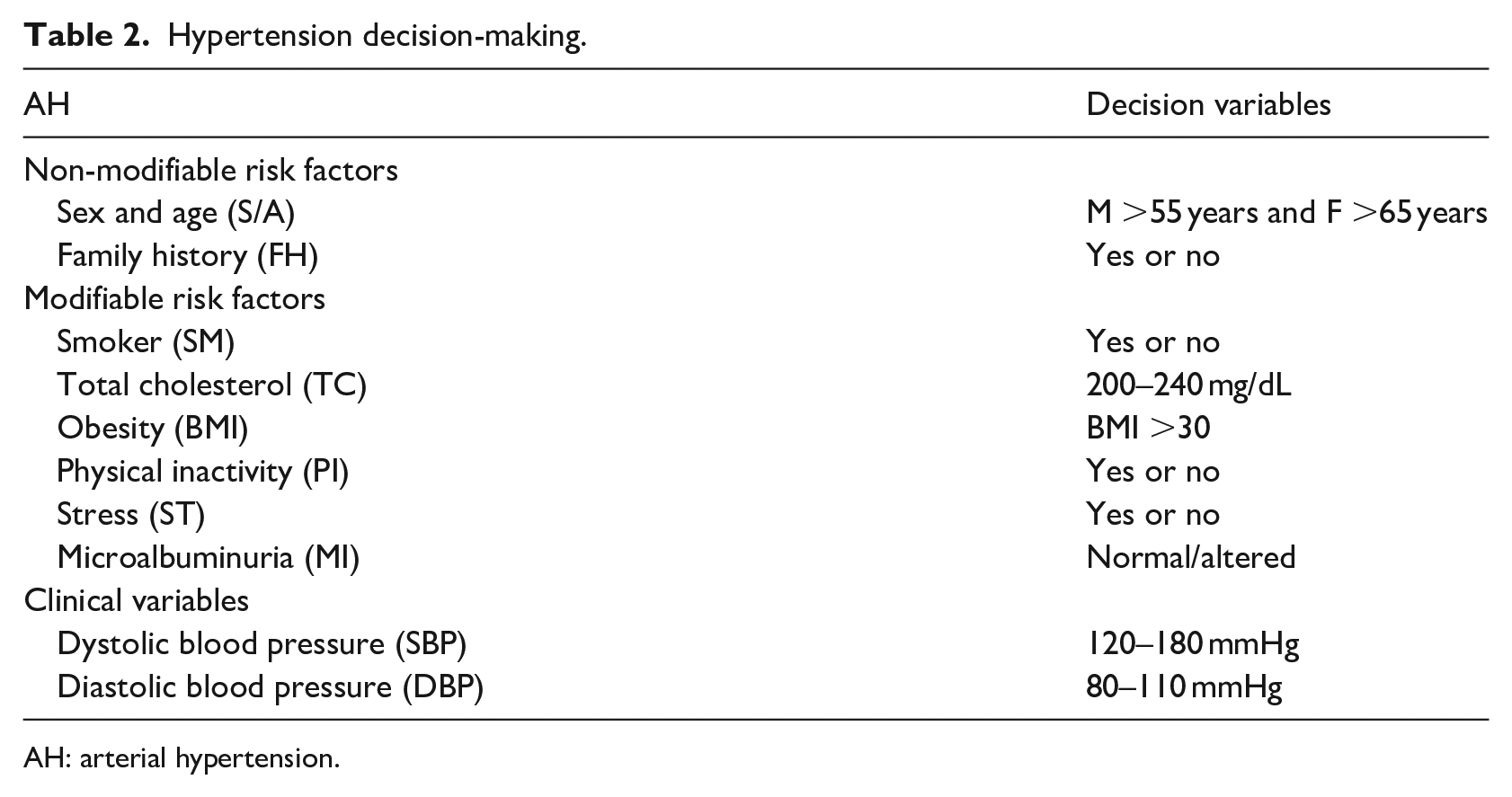
AH: arterial hypertension.
The criteria presented in Table 2 can be specified through the following equations:
Equation (1): non-modifiable factor (NMF) for HT

Equation (2): modifiable factor (MF) for HT

This result is a product of the sum of non-modifiable and modifiable factors (NMF + MF), and the diagnosis criteria are shown in Table 3. The values “1” and “0” are assigned to each MF if these are positive or negative for the disease, respectively.
HT’s decision criteria.

HT: hypertension; MF: modifiable factor; NMF: non-modifiable factor.
The diagnosis algorithm is built by associating the risk factors with the clinical variables for HT, which are shown in Table 2. Figure 2 represents the arterial hypertension (AH) algorithm.

AH algorithm.
Connectivity
Characteristics of the HT equipment
The equipment used is from the brand iHealth, which supplies devices for measuring blood pressure that are certified by the Food and Drug Administration (FDA). These devices can connect to the Internet through a mobile phone (wirelessly) and also through a station denominated “Dock.” 26
The application programming interface (API) of iHealth allows for the integration of applications developed by third parties. 27 The API provided by the manufacturer permits the connection between the application developed and data from users, which are gathered in three steps:
Record;
Authentication;
Requirements.
These steps need to be carried out in the manufacturer’s website. After this, authentication codes are generated to authorize the application to obtain records from different devices. With this information, the application developed collects the data necessary for the analysis and sends responses to the user. 28
At this step, two activities are conducted in parallel:
Data are entered to the database of the developed system.
Access is requested (Access Token) via URL.
When authorization is granted, the tables of the database are accessed to consult the iHealth system on a daily basis. This daily consultation generates personalized data for each user with an existing account, which are recorded on the table IH_AppList through Access Token and UserID. It must be noted that the procedure is necessary to ensure the reliability of the information and is only performed once. To retrieve the user’s information, a request sequence is sent and a XML user sequence is resent.
This information allows data collection in order to execute the application. After this, the application is ready to execute the algorithm.
Hypertext Preprocessor application
The application developed in the open code language Hypertext Preprocessor (PHP) has several files that contain programs for the proper operation of the monitoring system, which are directly related to the algorithm described in section “HT algorithm.” 29 In Figure 3, the details about the structure of the database are described. It is noteworthy that the monitoring system has been developed to admit millions of records; therefore, its potential is only limited by data storage capacity.30,31

Database structure.
Communication system
The application used for developing Asterisk, which consists of a free software that operates efficiently as a telephone exchange and that allows the development of additional integration applications, can be connected to a limited quantity of telephones depending on the quantity of E1 digital transmission lines or grids. In this work, the monitoring system is integrated to Asterisk to register user information and communicate the application of output registers.
The communication system interacts with the algorithm, and the results of the latter depend on the information input. To this end, the system will automatically call patients to inform them about their health status and indicate them how to proceed in case of altered blood pressure. In parallel, the system issues an alert by calling the registered relatives and health care professionals.
Results
Several tests were conducted on the monitoring system, such as registering users and entering blood pressure (SBP and DBP) values automatically to the database.
According to the parameters for the analysis of blood pressure, results were satisfactory. All the registered users were notified about their health status immediately after their blood pressure data were entered. It must be noted that the system keeps a historical record that allows it to analyze precisely the exact behavior of the user’s blood pressure.
The monitoring system meets the expectations, since the phone calls to different patients followed the schedule made smoothly. As requested by medical staff, the phone calls made in the different tests were scheduled for all mornings and afternoons, which allowed a strict control of the health status of the patients. It was verified online that phone calls were made according to the schedule, as shown in Figure 4.

Phone call monitor.
Information from 42 patients was recorded, totaling 1176 blood pressure readings. Based on this information, a history of their blood pressure behavior was obtained, enabling the medical staff to analyze their health status and prescribe the medication necessary for each patient. The information about all patients was stored in an Excel spreadsheet or graphically according to the requirements, as may be seen in Figures 5 and 6, respectively.

Blood pressure readings from one patient.

History of patient’s blood pressure.
Figure 6 shows 14 days of readings from one patient. These records correspond to the measurement of blood pressure twice per day. Each reading was assessed by the monitoring system which, through phone calls, informed the patient his blood pressure and the actions to be undertaken if this was out of normal ranges.
Discussion
The remote monitoring system developed for chronic diseases such as high blood pressure provides precise and reliable information, which allows us to observe the behavior of the disease online and to take immediate action. Over the past years, communication systems have witnessed significant advances that allow the development of reliable applications for remote monitoring. Telemedicine is used every day in a wide variety of medical fields. This arouses the interest of health care professionals, who consider telemedicine a support for the diagnosis of a number of diseases, especially for chronic diseases that have long duration and that are an issue for private and public health systems.
Through monitoring, our system detected the behavior of patients’ blood pressure in a more precise and real way, detecting its variations throughout a day. Similarly, health care professionals can examine the patient’s disease course at any moment.
Current online monitoring systems for chronic diseases are not widespread in the market, mainly due to the technological sophistication and certification these devices need. At the same time, these devices display communication technologies that wirelessly upload information to the database. The results for our system were positive, since its application considerably reduced visits to the hospital. In addition, some patients indicated that the system was easy to use. Furthermore, they were treated at home and were allowed to carry out their routines.
Conclusion
This study addressed the design and implementation of a support system for patients with chronic HT. To this end, open code programming languages were used, as well as free software, wireless communication through 3G/4G cellphones and FDA-certified devices to measure blood pressure.
The support system is autonomous thanks to the design and programming of an algorithm to monitor blood pressure, which receives information sent by the monitoring device connected to the user. Once data are collected, the system analyzes through an algorithm that contains the parameters for different ranges of blood pressure. With this information, an automatic response is generated and a voice message is sent to the user’s cellphone, thereby ensuring the required feedback. This integrated support system facilitates the monitoring of the blood pressure of a large number of users. In addition, the system could be used for other diseases such as diabetes and metabolic syndrome.
However, we must bear in mind that this system does not substitute health care professionals, but it does provide support for the control and reduction of diseases associated with high blood pressure.
From the results of the implementation of this support system, we conclude that the integration of new physiological variables for monitoring is feasible. This will broaden the scope for the early detection of chronic diseases, which could result in a reduction in their frequency.
Footnotes
Declaration of conflicting interests
The author(s) declared no potential conflicts of interest with respect to the research, authorship and/or publication of this article.
Funding
The author(s) disclosed receipt of the following financial support for the research, authorship and/or publication of this article: This work was supported by Proyecto Fortalecimiento USACH (USA1799_UC123012) and Vicerrectoría de Investigación, Desarrollo e Innovación of the Universidad de Santiago de Chile, Chile.
