




Abstract
This study combined conceptual frameworks from health information seeking, appraisal theory of emotions, and social determinants of health literatures to examine how emotional states and education predict online health information seeking. Nationally representative data from the Health Information National Trends Survey (HINTS 4, Cycle 3) were used to test the roles of education, anxiety, anger, sadness, hope, happiness, and an education by anxiety interaction in predicting online health information seeking. Results suggest that women, tablet owners, smartphone owners, the college educated, those who are sad some or all of the time, and those who are anxious most of the time were significantly more likely to seek online health information. Conversely, being angry all of the time decreased the likelihood of seeking. Furthermore, two significant interactions emerged between anxiety and education levels. Discrete psychological states and demographic factors (gender and education) individually and jointly impact information seeking tendencies.
The rise of the Internet has given Americans unparalleled access to health information. Nearly three-quarters of Internet users have sought health information online in the past year. 1 Online health information seeking can translate into important health outcomes, from an increased likelihood of making an appointment with a healthcare provider 2 to gains in knowledge, improved social support, enhanced coping abilities, and stronger self-efficacy.3–5 Certain factors are strongly linked with online health information seeking. For example, people with at least a high-school degree are more likely than those without it to seek health information online and to follow-up with a medical professional. 1
Beyond demographics, emotions can influence people’s motivation to seek health information. 6 The psychological function of emotion is to motivate people to take action. 7 Knowledge alone, though helpful, is not enough for people to change health-related behaviors. 8 As such, multiple health information seeking theories, such as the Theory of Motivated Information Management, 9 the Risk Information Seeking and Processing Model, 10 and the Planned Risk Information Seeking Model, 11 include one emotion, anxiety/fear, in their models.
While researchers have examined potential psychological motivators of seeking, such as anxiety, and surveys have established demographic characteristics of those likely to seek health information online, additional work is needed to integrate these perspectives (demographic and psychosocial). Studying additional emotional states besides anxiety would likewise advance the literature. Analyses testing the interaction between emotions and demographic factors like education could then be used to improve interventions aimed at encouraging productive online health information seeking. It could also help healthcare providers better understand which patients will seek health information online, and which may need additional support. This may be especially true given that people differ in terms of digital literacy, which is one’s ability to effectively function in a digital environment by understanding and using information from different digital sources. 12 Some individuals might be interested in seeking out additional information, but may not know how to get the information they desire or may not be equipped to assess the authenticity of that information. Additionally, such analyses could help those designing health websites tailor information to different demographic groups as well as use real-time affective assessments 13 to tailor results based on users’ emotional states.
In this study, we use a nationally representative sample to assess the role of multiple emotions and demographics (specifically, education level) in motivating online health information seeking. We first discuss our two variables of interest (emotions and education level) separately and offer hypotheses and research questions related to those before advancing to consider how these two variables may interact to influence online health information seeking.
Affective states are strong motivators of health-related behavior 14 and often are better predictors of behaviors, including online health information seeking, than many cognitive predictors.15,16 Appraisal theory of emotion posits emotions arise from automatic cognitive appraisals of how a particular situation will impact the individual involved such that each emotion is differentiated from another by its specific pattern of appraisals.17,18 Automatic appraisals of goal relevance, goal congruency, ego-involvement, agency, coping potential, and uncertainty distinguish discrete emotions (e.g. anxiety, anger, hope) from each other. 17 Combinations of automatic appraisals, in turn, motivate different types of behavior (e.g. avoiding a threat for anxiety but approaching an opportunity for hope).
These appraisals help humans make sense of their environments and motivate action.17,19 Many models of health information seeking include some type of emotion as a predictor.10,11 However, researchers often measure emotion as negatively valenced affect or just anxiety. 11 Some work has compared positive and negative emotions as potential motivators of information seeking, 20 little research closely examines the unique contributions of different discrete emotions in connection with health information seeking. A recent experiment based on appraisal theory found that online health information can spark different discrete emotional responses, including interest, inspiration, hope, and fear. 21 However, this experiment only examined influenza-related seeking and did not use a representative sample to establish a broader phenomenon.
The differences between discrete emotions are important to understand because, according to appraisal theory, different emotions are associated with unique action tendencies.7,17,22 Action tendencies are behavioral motivations to take a certain type of action. 23 Different action tendencies associated with discrete emotions can help researchers connect Internet users’ feelings to their potential for health-related online searching. As Nabi 24 states, “the discrete perspective is more progressive in that it better captures the implications of motivational forces on human action and interaction, and thus is more proximally related to the outcomes of interest” (p. 158). By using appraisal theory’s discrete approach to emotion, we may better predict which situations will spur information seeking. Moreover, this approach to studying emotions underscores the fact that people experience a range of emotions, 25 sometimes simultaneously, 26 with different behavioral implications, making it important to look at multiple potential emotional reactions when trying to understand user behavior.
Below, we discuss the conceptual properties of different discrete emotions as well as their potential relationships to online health information seeking behavior.
Anger occurs when we believe someone has injured us or someone we care about. 17 Basically, we get angry when blocked from achieving our goals, and this anger motivates us to change our situation. 7 Unlike other negative emotions associated with avoidance, anger is associated with approach motivation. Feeling angry encourages individuals to move toward whatever is making them angry and to remove or harm it.22,27,28 If an individual perceives an important health goal to be blocked by another person (for instance, a doctor is unhelpful during a visit), she could turn to the Internet to overcome this obstacle.
The core relational theme of sadness is an irrevocable loss and a sense of helplessness. 29 Sadness typically occurs when we experience the absence of a desired reward. 17 While it may be a painful emotion to experience, sadness serves an important adaptive function: It helps people adjust to loss by sparking introspection and reflection. 25 As such, the action tendency of sadness is a lack of physical activity; sad individuals expend less energy than normal. 30 Feeling sad results in a self-focused state where one thinks about ways to cope. 25
Despite the lack of motivation to take physical action, sadness can be motivational. Raghunathan and Pham 31 found that feeling sad primed participants to develop an implicit goal to replace the reward lost when the sadness began. Sad participants were more likely to choose high-reward-high-risk options when placed in trade-off situations than did anxious participants. Sadness also serves as a learning function because the emotion signals to an individual that his or her plan has failed and perhaps a new plan is needed. 32 These findings suggest sad individuals may turn to the Internet to search for a way to replace whatever is lost without expending much physical energy. However, it is also possible that sad individuals may spend more time introspecting than going online to wade through the potentially overwhelming amount of health information.
Hope may motivate health information seeking because it infuses individuals with positive future expectancies, elevated coping potential, and the tendency to pursue a desired goal. 33 Uncertainty appraisals are a key component of hope.17,34 If outcomes were certain, one would not be hopeful. In one of the few empirical tests of the effects of positive emotions on information seeking intentions, Yang and Kahlor 20 found the experience of positive affect encouraged college students to avoid climate change information, while negative affect drove information seeking about this impersonal risk. However, the researchers’ measures of positive and negative affect combined multiple discrete emotions, each with differing sets of action tendencies, into single dimensions. This grouping of emotions could mask unique effects of discrete emotions. 35 In a study of intentions to seek information about the H1N1 flu vaccine, Allen Catellier and Yang 36 found that an index of positive emotions, which included measures of hope, optimism, and enthusiasm, did positively predict seeking intentions. Although that study did not directly test hope as an individual, discrete emotion, it did take place in a health-related context and provides an impetus for further tests of hope’s role in information seeking.
Happiness is another positive emotion that could influence health information seeking behavior because it motivates people to approach situations. 37 Lazarus 17 posited that happiness occurs when we are “gaining what we desire. Put differently, happiness occurs when we think we are making reasonable progress toward the realization of our goals” (p. 267, emphasis in the original). Happiness may motivate someone to look for more information on how to stay happy, particularly if an individual’s happiness is tied to health-related goals. However, happiness also signals that an individual is safe, which could blunt the desire to seek information about health threats. Moreover, mood management theory suggests that individuals in a positive emotional state try to maintain that state, 38 and searching the Internet could potentially dampen happiness. 39
While there are conceptual reasons to suspect discrete emotions may motivate or demotivate online health information seeking, existing work has not made clear which emotions will have which associations. Therefore, we propose a research question:
RQ1: What is the relationship between hope, anger, sadness, and happiness and online health information seeking?
In addition to these four emotions, anxiety is another emotion particularly relevant to information seeking. Appraisal theorists argue it arises from appraisals of uncertainty and low coping potential, with its core relational theme being the facing of an uncertain, existential threat. 17 Furthermore, So 40 posits that anxiety reflects a susceptibility to loss, one that can motivate individuals to take health-related actions. Researchers have found positive correlations between anxiety and health information seeking,11,33 including online seeking.2,41 Following this tradition, we suspect similar results:
H1: Anxiety will be positively related to online health information seeking.
In addition to emotions, socioeconomic status (SES) is an important factor to consider in developing models to predict online health information seeking because low SES has repeatedly been tied to poor health outcomes.42,43 Research has found that people of low SES may be less likely to be up to date on preventative healthcare, including cholesterol measurement, pap smears, mammograms, and flu shots. 44 Education, in particular, is one of the most commonly used indicators of SES 45 and is the focus of the present inquiry. More highly educated individuals may have both the cognitive and material resources to spend more time seeking health information online.46,47 Additionally, research has found that education is associated with increased skills for using digital technologies (e.g. saving files, navigating the Internet) and for processing content (e.g. choosing sites to seek information, evaluating sources). 48 It is also important to note that lower SES is also tied to the digital divide, which is the inequity in who has access to the Internet. One study 49 found that individuals with less formal education were more likely to seek health information offline than online. Therefore, we propose the following hypothesis:
H2: People with higher education will be more likely to search for online health information than those with lower education.
Examining both emotions and education as possible predictors of online health information seeking then begs the question as to if or how the two might interact. While the first four emotions (hope, anger, sadness, and happiness) are understudied in this context, existing research on anxiety and health suggests that it might interact with education to influence seeking. The term “worried well” came to describe frequent users of the healthcare system who were healthy but extremely anxious about their health status, constantly looking for potential warning signs of disease. 50 Researchers continue to be concerned that many efforts to catch disease in its early stages are more likely to reassure these “worried well” than change the trajectory of disease. 51 Given the increases in healthcare costs and growing complexity of the healthcare system, 52 it seems likely that only those with the health knowledge, time, and money (i.e. the educated and/or wealthy) would be able to spend time worrying and frequently visiting healthcare providers. This juxtaposition of high anxiety and having ample resources could carry over to seeking health information online, particularly given the greater access to the Internet had by those with higher education. 53 Research also suggests that the anxiety-seeking relationship is not always a linear one. A survey of adults aged 50–75 years found that those who worried the most about cancer fell into the category of not seeking information at all or of being very avid seekers, 54 suggesting that another variable, perhaps education level given its connection with health-related resources, could moderate the relationship between anxiety and health information seeking. Therefore, we propose another hypothesis:
H3: Anxiety and education will interact such that those of higher socioeconomic status and higher anxiety will be more likely to seek online health information.
Methods
To assess the proposed research question and hypotheses, we used data from the 2013 Health Information National Trends Survey (HINTS 4, Cycle 3). 55 More than 3000 people (n = 3185) completed the questionnaire after four mailings. The first mailing was sent to 28,798 households and included a US$2 pre-paid monetary incentive. Only non-respondents received subsequent mailings with a final response rate of 35.19 percent. The dependent variable assessed respondents’ use of the Internet to seek online health information for themselves. The prompt asked “In the last 12 months, have you looked for health or medical information for yourself?” Respondents replied either “yes” or “no.” Of the 2265 people who answered the question, 80.22 percent responded “yes.”
Independent variables
Five discrete emotional states were assessed: anxiety (M = 2.32, standard deviation (SD) = 1.00), hope (M = 3.52, SD = 1.07), anger (M = 2.18, SD = 0.78), sadness (M = 2.12, SD = 0.88), and happiness (M = 3.74, SD = 0.76). For each, respondents were asked “In the past 30 days, how often have you felt [emotion]?” They responded either “all of the time,” “most of the time,” “some of the time,” “a little of the time,” or “none of the time.” These items were recoded so that higher values (5 = all of the time) represented more of the emotion and lower values (1 = none of the time) less of the emotion.
Education was assessed by asking “What is the highest level of school you completed?” with four response options: Less than high school (9.59% of the 3096 respondents who answered this question), high school graduate (22.58%), some college (30.14%), or college graduate or more (37.69%). In order to test the predicted interaction between anxiety and education level, we generated an interaction term by multiplying the two categorical versions of each variable together, for a more straightforward interpretation of the interaction based on each category of each variable.
Potential control variables
We included potential covariates in our analyses to assure our results were driven by theoretically guided predictor variables. General health was assessed by asking respondents “In general, would you say your health is: excellent, very good, good, fair, or poor?” Of the 3780 respondents who responded to that question, 9.15 percent reported being in excellent health, 28.78 percent thought their health was very good, another 29.76 percent reported being in good health, 11.43 percent in fair health, and 2.57 percent in poor health. We also included gender (male or female; 61.42% of the 3103 who answered the question being female), age (M = 54.68 years, SD = 16.47 years, for the 3082 respondents who answered that question), and two dummy coded variables for African-American race (20.23% of 2891 respondents) and for living in a Hispanic household (15.69% of 3185 respondents). Additionally, easy access to Internet-enabled technology may explain patterns in online information seeking. Therefore, we included having access to a tablet (34.13% of 3115 respondents) or smartphone (48.86% of 3115 respondents) as two additional covariates.
Data analysis
We analyzed the data using STATA 14, which has the capacity to compute jackknife replication samples, resulting in a weighted sample generalizable to the US population. The first multivariate logistic regression included only potential control variables (gender, Black race, Hispanic ethnicity, age, and general health). The subsequent multivariate logistic regression included all control variables significant in the first regression as well as the education and emotion variables.
Results
In the first multivariate logistic regression to test for potential control variables, gender (odds ratio (OR) = 1.63, p < .01, confidence interval (CI) = 1.18, 2.28), having a tablet (OR = 1.64, p < .05, CI = 1.07, 2.49), and having a smartphone (OR = 1.76, p < .05, CI = 1.07, 2.90) were significant predictors of online health information seeking (see Table 1). Therefore, those variables were included in the final logistic regression; the others were dropped.
Logistic regression with potential control variables predicting online health information seeking.
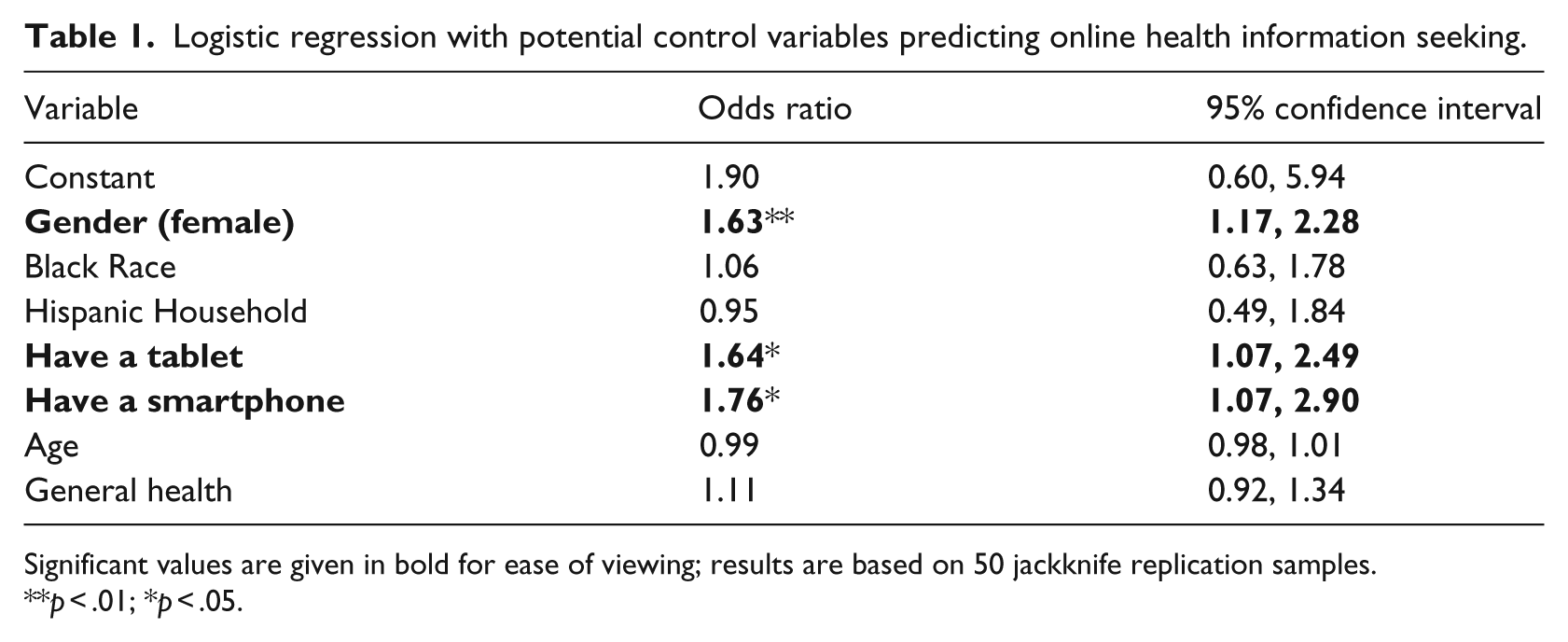
Significant values are given in bold for ease of viewing; results are based on 50 jackknife replication samples.
p < .01; *p < .05.
Covariates and the predictor variables (i.e. education level, hope, anger, sadness, happiness, anxiety, and education level by anxiety) were entered into the final regression equation simultaneously. This method allowed for an evaluation of the contribution of predictor variables over and above covariates. 56 Table 2 reports the results of the multiple logistic regression predicting online health information seeking in the past year. This analysis included 2080 participants and was generalizable to a population of 169,272,498, thanks to the jackknife replication samples. Variables that significantly (p < .05) predicted online health information seeking were gender (OR = 1.49, p < .05, CI = 1.04, 2.13), having a tablet (OR = 1.78, p < .01, CI = 1.17, 2.71), feeling angry all the time (OR = 0.01, p < .05, CI = 0.00, 0.32), feeling sad some of the time (OR = 2.70, p < .05, CI = 1.20, 6.07), and feeling sad all of the time (OR = 14.85, p < .05, CI = 1.06, 207.27). Having a smartphone (OR = 1.54, p = .08, CI = 0.95, 2.48), having a college degree or higher education (OR = 4.77, p = .08, CI = 0.85, 26.90), and being anxious most of the time (OR = 5.08, p = .08, CI = 0.80, 32.19) were marginally significant (p < .10) predictors of online health information seeking. These findings offered partial support for H1’s prediction that anxiety would positively associate with online health information seeking and H2’s statement that those with more education would be more likely to search.
Final logistic regression predicting online health information seeking.
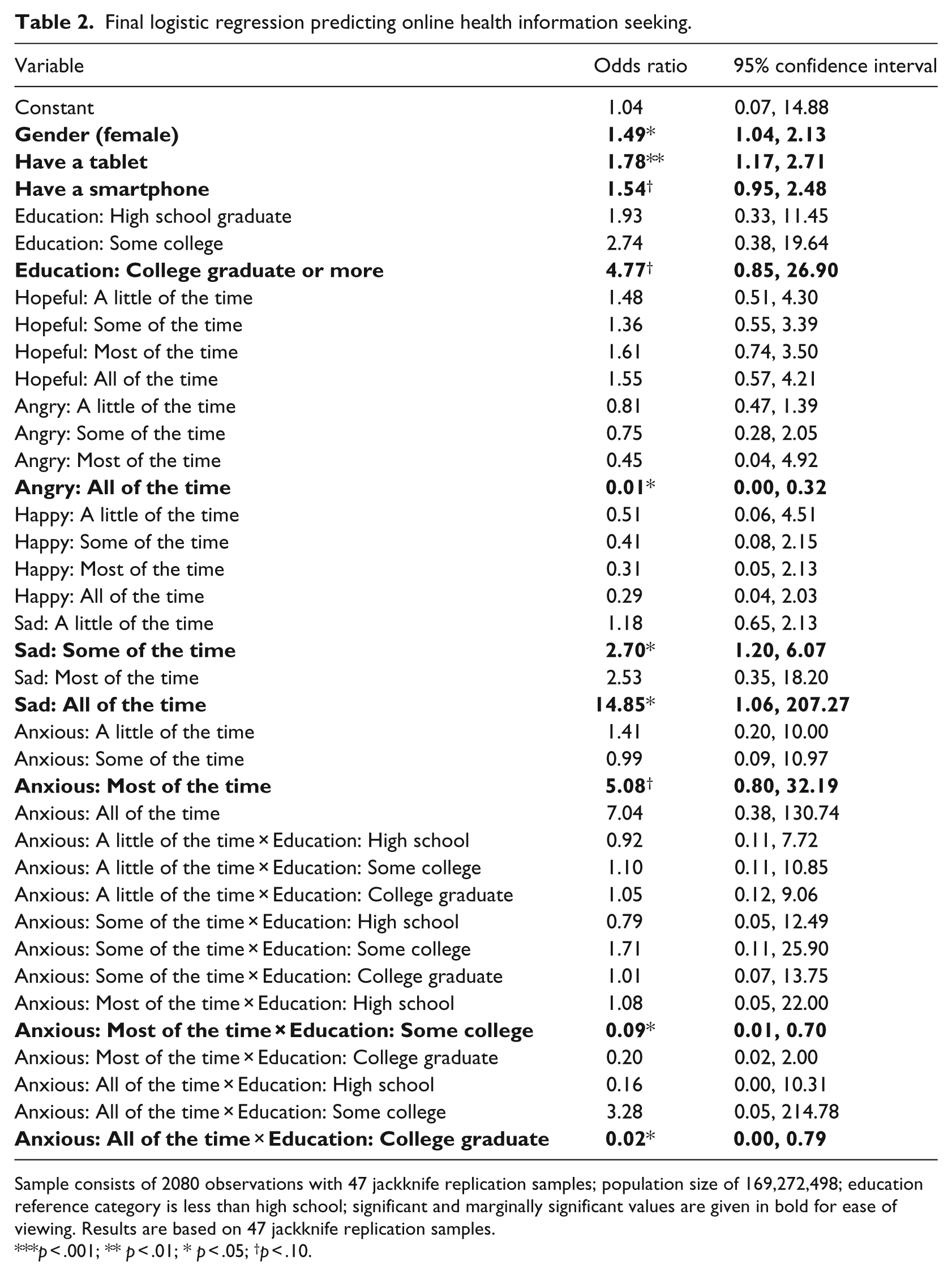
Sample consists of 2080 observations with 47 jackknife replication samples; population size of 169,272,498; education reference category is less than high school; significant and marginally significant values are given in bold for ease of viewing. Results are based on 47 jackknife replication samples.
p < .001; ** p < .01; * p < .05; †p < .10.
Combined, these significant and marginally significant predictors suggest that women, those who own a tablet, those who own a smartphone, those with a college education, those who are sad some of the time or all of the time, and those who are anxious most of the time are significantly more likely to seek health information via the Internet than are others. Conversely, being angry all of the time decreases likelihood of seeking.
Furthermore, two significant interactions emerged. Those who reported being anxious most of the time and who had some college experience were significantly less likely to search (OR = 0.09, p < .05, CI = 0.01, 0.70). Also, those who reported feeling anxious all of the time and were a college graduate were significantly less likely to search (OR = 0.02, p < .05, CI = 0.00, 0.79). These interactions were in the opposite direction predicted by H3, which posited that the anxious and highly educated would be more likely to search.
Discussion
Our analyses revealed a number of interesting findings. Education and emotions were both significantly related to seeking. As predicted, highly educated individuals were more likely to search online for health information. However, the finding was not as strong as one might have expected, given the wealth of previous findings along these lines. It may be that easier access to the Internet is beginning to encourage greater online seeking.
As for discrete emotional predictors (the focus of RQ1 and H1), sadness and anxiety promoted online searching while anger inhibited it. While all three are negative emotions, they worked in different directions, underscoring the utility in studying specific emotions instead of lumping negative or positive emotions together. 24 Sadness is typically thought to promote apathy, but the aspect of it that motivates reflection and introspection 31 may be what promotes seeking—it takes little energy to type on a smartphone.
The positive emotions in the study (hope and happiness) were not associated with online information seeking. Online health information seeking may be viewed as a source of negative emotions that discourages happy individuals from dampening their mood. However, the uncertainty appraisals associated with hope make it surprising that it would not be associated with online health information seeking. Perhaps, hopeful individuals used their extra motivation to directly contact healthcare providers instead of searching online.
Our results also partially replicated previous findings on the positive relationship between anxiety and online health information seeking. 2 However, it would be unwise to purposefully elicit anxiety in patients to promote seeking, as anxiety is associated with heart disease, asthma, and arthritis, among other ailments. 57 And, anxiety from online health information seeking has been associated with decreased patient satisfaction with doctor consultations. 41 Additional work is needed to clarify how much anxiety is beneficial for information seeking and behavior change purposes. Future work could test how health status might interact with anxiety and education to impact these outcomes, too.
The significant interactions revealed that the most educated and most anxious participants were actually less likely to have used the Internet in the past year to search for health information. One possible explanation is that this group has the resources to immediately go to a doctor if they have health concerns. Moreover, it is possible that the highly educated and anxious spent considerable time in the past searching for health information online and found it unreliable, so they stopped the behavior. Supporting this idea, a qualitative study of individuals aged 50 years and older found that participants were well aware of potential problems with health information available online, and would, therefore, ask their physicians about the credibility of health information they found online before trusting it. 58 Educated and anxious individuals in the HINTS dataset may have relied more on in-person medical consultations to get answers.
Additionally, we found that being female and owning a tablet or smartphone was associated with online health information seeking. In general, women are more likely to use healthcare services, 59 and the Internet serves as an easily accessible extension of traditional healthcare. The practical utility of seeking health information online is enhanced by owning mobile devices. Healthcare providers could ask patients about device ownership as a way to assess their potential health information seeking habits. Health website designers should make sure content is mobile friendly.
This study should be interpreted in light of its limitations. The dichotomous dependent variable may be masking more nuanced relationships between it and predictor variables. Additionally, single-item measures were used and the emotion states were not directly connected to health issues but therefore could have been caused by a variety of situations. Future work could employ measures with stronger psychometric properties and ask more specific questions as to why individuals think they are experiencing certain emotions. However, the generalizability of this study makes the results an important starting point for more detailed explorations. This work presents an initial effort in integrating demographic and psychological perspectives on online health information seeking with a generalizable dataset, which in turn can inform theory and practice.
Conclusion
Understanding the factors associated with online health information seeking is an important pursuit for those hoping to improve public health and health-related online interfaces.3–5 These results could help online system designers and healthcare providers understand which users or patients are more likely to seek information and which may need additional prompts before they start seeking. Online search engines dedicated to supplying users with credible health information could be created using emotion-recognition technology. 13 Such systems could use this technology to identify if a user is likely to continue searching or instead needs additional information emailed because his or her emotional state indicates that he or she will stop searching soon. Additionally, healthcare providers could take advantage of these findings by discussing the perils of certain websites to patients with less education and those who are sad or anxious (who may spend more time searching online). In sum, the present findings, based in theory and practically important, represent an empirical basis for extending work on online health information seeking to include emotional and demographic considerations, as well as the interactions of the two.
Footnotes
Acknowledgements
The authors would like to thank the National Cancer Institute for making the Health Information National Trends Survey (HINTS) publicly available for researchers like them to use.
Declaration of conflicting interests
The author(s) declared no potential conflicts of interest with respect to the research, authorship, and/or publication of this article.
Funding
The author(s) received no financial support for the research, authorship, and/or publication of this article.