




Abstract
The aim of the study is to evaluate the availability and accuracy of the existing Italian-language medical information about living donor kidney transplantation on YouTube®. For each video, several data were collected, and each video was classified as “useful,” “moderately useful” and “not useful.” Globally, the search resulted in 306 videos: 260 were excluded and 46 included in the analysis. The main message conveyed by the video was positive in 28 cases (60.9%), neutral in 16 (34.8%) and negative in 2 (4.4%). The mean amount of visualizations was 3103.5 (range: 17–90,133) and the mean amount of “likes” 2.7 (range: 0–28). Seven videos (15.2%) were classified as “useful,” 21 (45.7%) as “moderately useful” and 18 (39.1%) as “not useful.” This study showed that a very few videos in Italian about living donor kidney transplantation are available on YouTube, with only 15 percent of them containing useful information for the general population.
Introduction
To date, it is well known that kidney transplantation improves both the quantity and quality of life in end-stage renal disease patients compared with hemodialysis, 1 and living donor kidney transplantation (LDKT) shows increasingly better results compared to cadaveric donors. LDKT, indeed, has increased the number of organs available for transplantation, thus shortening the relevant waiting lists and has improved the post-transplant outcomes by reducing graft failure and extending graft survival. 2 Furthermore, LDKT provides a greater assurance of transplantation before dialysis than the deceased organ donation, thus reducing dialysis-related complications and costs, 3 and gives the opportunity to plan the surgical procedure, thus permitting to optimize the recipient’s conditions. Moreover, LDKT has shown to result in better patient and allograft outcomes compared to deceased donor transplant, 4 and longitudinal studies report lower perioperative mortality rates and no renal deterioration in donors. 5
In Italy, approximately 1700 kidney transplantations are performed annually, with less than 15 percent of LDKT. 6 Moreover, considering that the current national waiting list includes more than 6500 end-stage kidney disease patients, there is a clear organ shortage crisis. 6 Since the little number of LDKT performed could be also related to a lack of knowledge among the general population,7,8 sharing information and awareness on this topic is a critical goal for the Public Health community.
To date, the Internet represents the largest and most-widely used source of medical information among the general population and chronic disease patients. 9 YouTube® is a video-sharing web service that has rapidly become a popular Internet-based mass media, also in the field of health-related contents. Previous studies have documented the availability on YouTube of health-related videos on different topics such as immunization, 10 human papilloma virus vaccination, 11 dialysis 12 and organ donation, 13 but no previous study has analyzed the available YouTube contents on LKDT.
The aim of this study is to evaluate the availability and accuracy of the existing Italian-language medical information about LDKT on YouTube and to analyze the user’s feedback on the contents and quality of such videos.
Methods
A web search was performed on the YouTube web page (www.youtube.com) on 25 June 2015. The searched keywords were “transplantation,” “donation,” “donors,” “kidney” and “living.” The results of the search were sorted by relevance, which is the default setting of the website. Videos in Italian language only were included. Some videos were excluded for lack of relevance with the aim of the study and for not being in Italian. Duplicated videos were also excluded.
Videos were evaluated in duplicate independently by two authors (G.S. and M.A.), resident doctors in Public Health with experience in health education and health promotion, and disagreements were resolved by discussion with a third author (F.B.), university researcher in Public Health with experience in health promotion and e-health. Videos’ evaluation was discussed with a fourth author (A.A.), full professor of Medical Genetics and chief director of the Regional Centre for Transplantations. Data were entered into an electronic Excel® spreadsheet designed ad hoc for the purposes of this study, including all data collected.
For each video, the following data were collected: video title, URL, upload source, upload date, video length, number of views, number of “likes” and “dislikes,” along with type of video (classified according to the main aim of the video, as follows: educational video, medical video, surgical technique video, journalism, personal experience and so on), target audience and main message conveyed. Similar to Keelan et al., 10 the main message was classified as positive if the video supported LDKT, portraying it positively (e.g. described LDKT as a social good or described the benefits and safety of LDKT), as negative if the video portrayed LDKT negatively (e.g. emphasized the risk of complications, advocated against organ donation, supported theories of conspiracy or collusion between supporters of LDKT and the organ illegal commerce) and as neutral when it was not possible to identify a message since the video contained a debate or was nonpartisan.
Each video was then evaluated for the presence or absence of information on 13 critical content domains: the presence of institutional or hospital address and reference, to provide a reference point for patients and their relatives; pre-transplant donors’ medical evaluation description; pre-transplant recipients’ medical evaluation description; living donor transplantation advantages over cadavers donation; possibility of pre-dialysis transplantation; surgical technique; possibility of laparoscopic nephrectomy; presence of an interview of a physician, of another health-care worker, of a donor or a recipient; legislation rules; and possibility of Samaritan donation. Depending on the weighting of the 13 items, these were given different scores (from 0.5 to 2 points); each item was scored on the basis of the presence in the video, that is, not mentioned (zero points), mentioned briefly (half score) or mentioned in detail (total score). By calculating the total score, each video was classified as “useful” (>5 points), “moderately useful” (>2–⩽5 points) and “not useful” (⩽2 points).
Statistical analysis
Descriptive statistical analysis was performed using frequencies and percentages for the categorical variables, mean with standard deviation and minimum–maximum values for quantitative variables. In order to evaluate the different video characteristics between groups (useful, moderately useful and not useful videos), the chi-square test was used, with Fisher’s correction when needed, for categorical variables. For continuous measures, one-way analysis of variance models were used to determine relationships with video groups. The statistical significance level was set at p ⩽ 0.05. Statistical analyses were performed with STATA 11. No ethical approval was required for this study.
Results
The search globally resulted in 306 videos. Of them, 260 were excluded because relating to cadaveric organ transplantation (n = 74) or transplantation of organs other than kidney or organ transplantation in general (n = 83), because they were in languages other than Italian (n = 3) or for being completely inappropriate for the purpose of the study, that is, relating to topic unrelated to kidney transplantation (n = 100). Thus, 46 videos were included in the analysis (Figure 1).
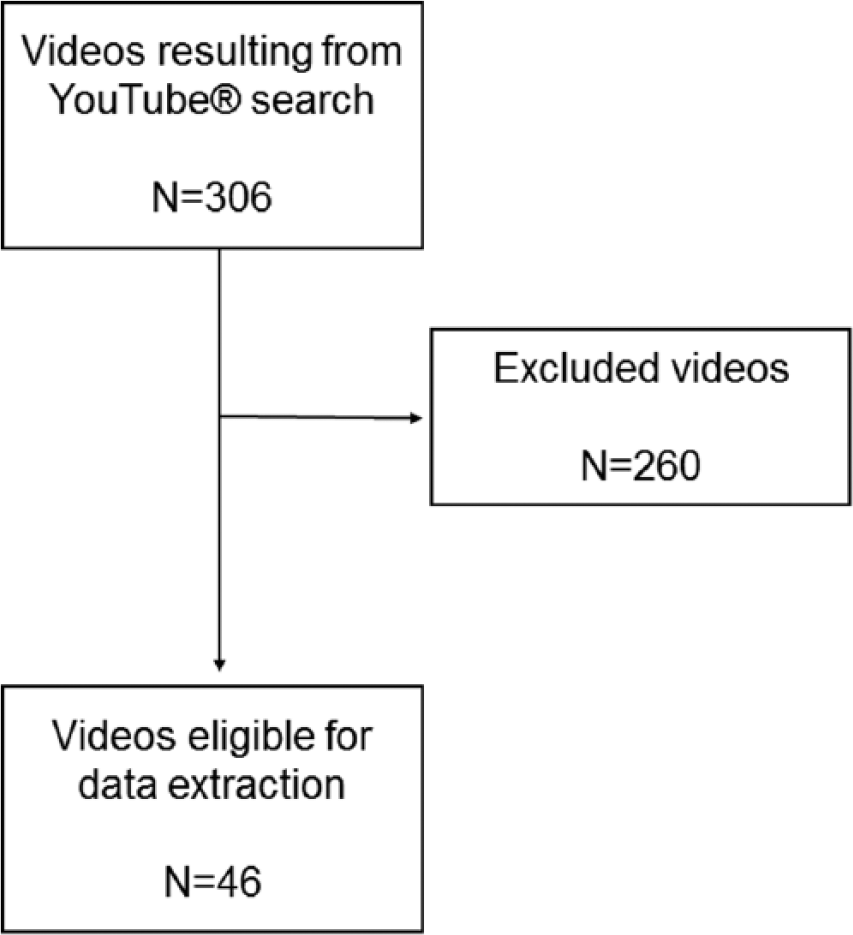
Flowchart detailing the video selection process.
Videos had been uploaded between December 2007 and October 2015, 25 of them (54.3%) between 2013 and 2015. The mean video length was 574 ± 717 s (range: 56–3431 s); using the length categories of YouTube, there were 17 short videos (i.e. <240 s), 22 medium videos (i.e. 240–1200 s) and 7 long videos (i.e. >1200 s).
Videos had been uploaded by a local or web-based television channel in 21 cases (45.7%), by a national TV channel in 6 (13.0%; 5 videos by the Italian National public TV channel and 1 by a private television), by a university in 5 cases (10.9%), by an individual in 6 (13.0%), by an hospital in 4 (8.7%) and by a scientific society in 4 (8.7%). The videos were classified as journalism in 23 cases (50%), surgical technique documentation in 7 (15.2%), personal experience in 6 (13.0%), educational video in 5 (10.9%), medical or scientific in 1 (2.2%) and “other” in 4 (8.7%; more specifically, a politic message in 1 case and a computer game in 3 cases). The main source of information in the mentioned videos was classified as medical in 30 cases (65.2%), patients’ personal experience in 6 (13.0%), journalism in 5 (10.9%) and as “no recognizable source” in 5 (10.9%). The most common target of the videos was the general population in 36 cases (78.3%), physicians and health-care professionals in 7 cases (15.2%) and adolescents and young adults in 3 cases (6.5%). The main message conveyed by the video was classified as positive in 28 cases (60.9%), neutral in 16 (34.8%) and negative in 2 (4.4%). With regard to the viewers’ appreciation of the videos, the mean amount of visualizations was 3103.5 ± 13,270.3 (range: 17–90,133), with 34 videos (73.9%) having less than 1000 visualizations. The mean number of “likes” per video was 2.7 ± 5.1 (range: 0–28) while for “dislikes” was 0.5 ± 1.5 (range: 0–9).
The usefulness criteria of contents are shown in Figure 2. Mean usefulness score was 2.9 ± 2.2. Globally, 7 videos (15.2%) were classified as useful, 21 (45.7%) as moderately useful and 18 (39.1%) as not useful.
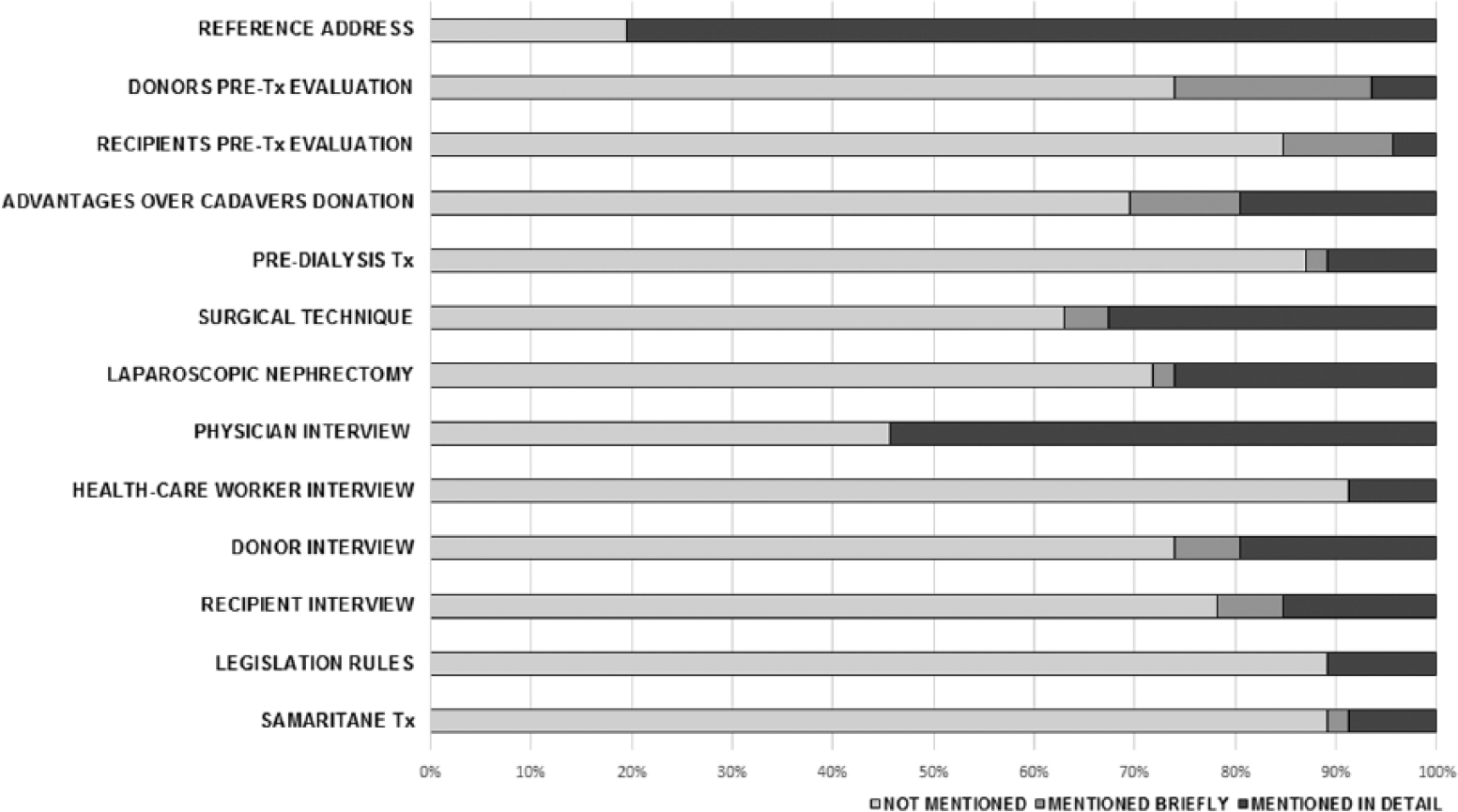
Usefulness contents. Data are expressed as absolute number (N = 46).
The three categories of videos (useful, moderately useful and not useful) showed statistically significant differences in the length of video, the uploading source, type of video, video target and main message, as reported in Table 1.
Usefulness videos’ content among video categories.
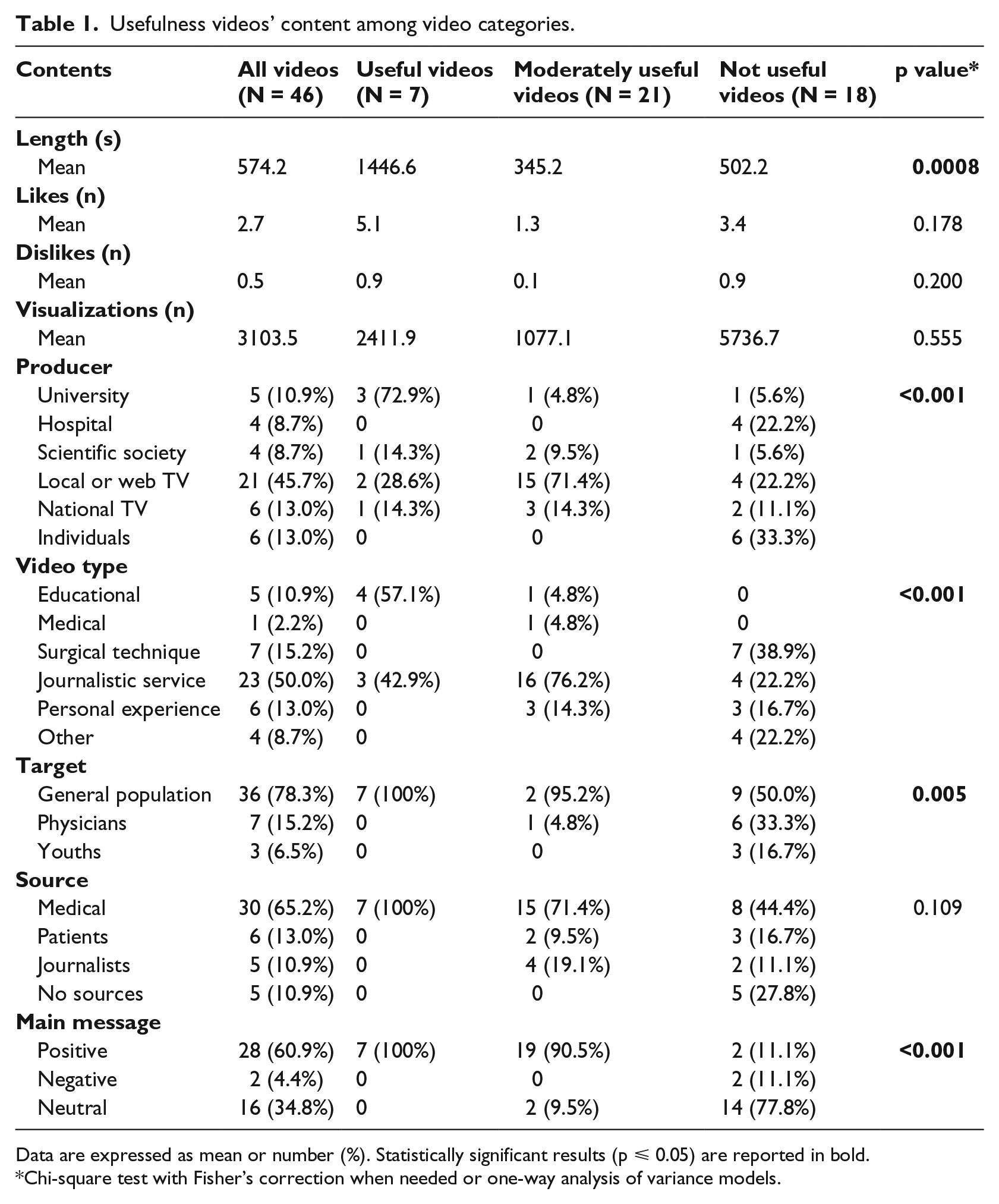
Data are expressed as mean or number (%). Statistically significant results (p ⩽ 0.05) are reported in bold.
Chi-square test with Fisher’s correction when needed or one-way analysis of variance models.
Discussion
In this study, we aimed not only to evaluate the availability of Italian-language videos about LDKT on YouTube but also to analyze the user’s feedback on such videos. Unfortunately, we found not only a scarce amount videos but also a small number of median views per video, thus suggesting a poor interest in this topic. The lack of interest mirrors the fact that despite the well-known advantages of LDKT, it still represents a small portion of kidney transplants: 36 percent of the kidney transplantations performed in 2009 in the United States 14 and less than 15 percent of 1699 performed in Italy in 2014. 6 The reasons for the underuse of LDKT are various, including both patients’ lack of knowledge about living transplantation and difficulty to identify willing and eligible donors.7,8
Several studies have shown that potential kidney transplant recipients tend to be reluctant to ask relatives for an organ,15,16 and this reluctance might represents actually the main barrier to LDKT.17–19 Moreover, most potential donors simply do not know the possibility of living donation: a study based on 78 kidney donors pointed out that only 34 percent of them already knew LDKT before the recipient was diagnosed with kidney disease, while 53 percent of them when the recipient was already in a state of advanced chronic kidney disease. 20
Therefore, it seems to be evident that the need exists to better and properly inform both the potential recipients and the potential donors about LDKT. The use of mass media and educational videos in this topic has been previously studied. Schweitzer et al. 21 first reported in 1997 an increase in living donor rates through a family education program, and Connelly et al. 22 in 1999 demonstrated an increase in donation rates among potential donors exposed to a video featuring living donors and recipients. Alvaro et al. 19 focused on kidney donation among Hispanics by means of 30-s television ads and 60-s radio ads, demonstrating that post-intervention group showed significantly more favorable behavioral intentions to become kidney donors than control group. More recently, an educational intervention based on a 5-min iPod video proved to increase the participants willing to donate organs. 23
Among mass media, the Internet represents to date the largest and most-widely used source for medical information: in North America, 74 percent of adult population use Internet daily, with 80 percent of users searching for health-related information, 24 while in Europe, Andreassen et al. 25 reported a rate of 71 percent of health-related seeking in Internet users. In Italy, a multicenter survey highlighted that 65 percent of respondents used Internet, with 57 percent of them using it to search health-related information. 9
YouTube is a free web service where subscribers can upload videos and share them with a very large number of viewers. Although it represents a leading audiovisual information center of medical-related videos, its freely accessible nature allows the dissemination of misleading information:26,27 since videos are uploaded on YouTube with no quality control, health-related videos can contain erroneous and even harmful information. 28
Previous studies have documented the availability on YouTube of health-related videos on different topics such as immunization, 10 human papilloma virus vaccination, 11 basic life support, 26 dialysis 12 and organ donation. 13 Unfortunately, the authors have reported that misleading videos represent an important portion and that they frequently generate more interest compared to scientifically accurate videos.10,29,30 In 2007, the first study by Keelan et al. 10 about immunization on YouTube found 48 percent of videos classified as positive, compared to 32 percent negative and 20 percent ambiguous; in that study, negative videos had a higher mean star rating and more views compared to positive videos. Lee et al. 31 found 56.5 percent of videos regarding gallstone disease to be misleading, and Steinberg et al. 29 found a fair or poor information content in 73 percent of videos focused on prostate cancer. Also, YouTube videos have been reported to show more pro-smoking than anti-smoking content 27 and to portray negatively the papilloma virus vaccination in 25 percent of cases. 11 Garg et al. 12 found only 58 percent of 115 videos on dialysis to be useful and reported that useful videos showed lower viewership per day compared to misleading videos. However, organ donation seems to be positively portrayed on YouTube: Tian 13 reported that 96 percent of the videos were positively framed for organ donation, and Chen et al., 24 by analyzing videos about heart transplantation founded 63 percent of those containing useful information.
In this study, we found only 15 percent of videos to be useful, that is, to contain clear and correct information about LDKT, thus suggesting an important need of knowledge sharing among the general population. In our results, we found that useful videos were significantly different compared to moderately and not useful videos: the first ones were frequently uploaded by a university or a scientific society, had a medical main source and conveyed a positive message in all cases, while moderately and not useful videos were uploaded by different subjects and frequently portrayed a neutral or even negative message about LDKT. More specifically, the two videos with a negative message pointed out the phenomenon of the organ illegal commerce that may be misleading for the general population.
The principal limit of this study is related to the main feature of YouTube, which is a continuously changing source of information, deeply depending on the research time and date. Thus, since our study is based on the YouTube material available on a given date, it should be considered as a snapshot of the available information on YouTube. Furthermore, this study is limited to the videos in Italian, thus providing a national point of view.
In summary, this study showed that a very few videos in Italian about LDKT are available on YouTube, with 15 percent of them containing useful information for the general population. Since the gap between demand and supply for transplantation organs continues to grow, mass media might be very useful in promoting organ donation. The advantages of the web-based video interventions include low cost, brevity and capacity of real-time updates; thus, YouTube could be used as a very effective resource to share information with minimal costs. Since to support the promotion of the correct use of e-health is a critical function of Public Health, 9 the results of this study encourage to more carefully monitor the information on LDKT conveyed by YouTube videos and to support the production and sharing of high-quality videos.
Footnotes
Acknowledgements
This article has been presented as oral presentation at the 48th National Congress of the Italian Society of Hygiene, Preventive Medicine and Public Health (October 2015, Milan, Italy). This article has not been submitted for publication nor has it been published in whole or in part elsewhere. The research does not involve human participants or animals, and no informed consent was needed.
Declaration of conflicting interests
The author(s) declared no potential conflicts of interest with respect to the research, authorship and/or publication of this article.
Funding
The author(s) received no financial support for the research, authorship and/or publication of this article.