




Abstract
Serious games (exergames) have the potential to be effective for postural balance and increasing muscle strength. Several games have been developed to increase physical fitness and balance among older adults. However, it is unclear to which degree usability and acceptability of exergames for older adults have been evaluated. The aim of this study was to summarize usability evaluation and acceptability of studies in older adults. We conducted a scoping review on studies focusing on usability of exergames for older adults. The result shows that older adults consider usability and acceptability of exercise video games good. The review shows that longitudinal studies mainly use off-the-shelf exergame and evaluated game effectiveness and acceptability, whereas cross-sectional studies focus on interactional experience. Studies varied in their approaches to measure usability and acceptability of exergames for older adults. There is a need for a systematic developmental approach to involve older adults in development of exergames for longitudinal studies.
Introduction
In the last decade, there has been great development in health technology systems designed primarily for physicians and other healthcare management professionals. Now, there is an increasing interest in empowering users through technology. There has been a rapid growth in the use of interactive health video games to encourage people doing physical activities. 1 The combination of exercise through interactive video games is known as exergaming. Although the use of exergames is gaining pace, the adoption might not be similar across different age groups, and particularly older adults may face challenges different from younger groups of gamers. Exergames are not only used as a fun exercise but can also be used for training and rehabilitation of physical function in older adults. 2 Research in elderly care and use of exergames has great potential to generate new knowledge. The knowledge includes importance of generating movements through exergame use, increasing muscle mass and strength for older adults, and new opportunities for socializing through exergame use. This new knowledge will generate evidence-based practice in using game technologies for exercises.
Exergame or exergaming is a new term introduced by the developers and researchers to couple physical activity with video games. The general use of video games may also involve games that do not require physical activity, although exergames have been used frequently to refer to the games that focus on physical activity through video games. Previously, the use of term “active video games” was introduced in 1982. 3 For example, Atari Joyboard, created in 1982, was a balance board controller that emulated the experience of slalom skiing. Powerpad, by Bandai, was a floor mat game in which players would step on large buttons to control gameplay. 3
The number and portion of older adults are increasing in the years to come, while the portion of working part of the population decreases. With advancing age, muscle weakness, problems with postural balance, loss of self-confidence, anxiety, and depression increase, with a concomitant increase in disease and injuries that require medical attention. In order for older adults to use exergames, technology must be usable and acceptable to them. Therefore, the usability of exergames needs to be assessed in samples of older people.4,5
To our knowledge, there has not yet been published a review study focusing on usability evaluation user acceptability of exergames for older adults. In a related study, Matthew 6 conducted a scoping review of exergaming technologies in adults with disabling conditions with focus on usability and utility of games. The study recommends that randomized controlled trials be conducted with a long-term follow-up for adults with systemic disabling conditions. The study also recommended that multidisciplinary collaborations among exercise physiologist, behavioral scientist, rehabilitation scientist, and neuromotor control experts are needed to advance the field. Barry et al. 7 evaluated the safety, feasibility, and effectiveness of exergaming as a rehabilitation tool in people with Parkinson’s disease (PD). The study measured feasibility through comparison of performance in gameplay before and after exergaming intervention. In a recent systematic review, Hawley-Hague et al. 8 focused on older adults’ perception of information and communications technologies (ICT). Usability and reliability were considered important factors for older adults’ perception and adoption of ICT. However, the review focused was on general ICT and older adults’ perception and not particularly on usability of exergame technologies.
Review studies of exergames have generally focused on effectiveness of exergames and not on usability and acceptability of games. For example, Peng et al. 9 conducted a systematic review and found games as an effective tool to significantly increase physical activity or exercise attendance. Henderson et al. 10 evaluated the effects of interactive video gaming in stroke rehabilitation. A recent scoping review focused on the use of exergames in rehabilitation; however, the review did not look into the usability aspect of exergames. 11
Commitment to usability evaluation in product design and development offers enormous benefits, including greater user experience (UX) and prolonged use of systems. Usability is defined in the ISO 9241-11 as “the extent to which a product can be used by specified users to achieve specified goals with effectiveness, efficiency, and satisfaction in the specified context of use.” 12 The general definition of usability focuses on having a product or system that allows users to achieve goals. The International Organization for Standardization (ISO) definition of usability focuses on effectiveness, efficiency, and satisfaction in the use of the technology. Efficiency is related to the degree to which users can complete their tasks. Effectiveness is related to the degree of accuracy with which users complete their tasks. Satisfaction is the extent to which the expectations are met. These three components are generally used to measure the general usability of a system.
A number of theories have been used to assess the acceptability of technology. For example, self-efficacy theory is used for perceived capability for learning or performing actions at designated levels. 13 The unified theory of acceptance and use of technology (UTAUT) and Technology Acceptance Model (TAM) are used to predict and explain the intention in terms of the user behavior.14,15 Theory of planned behavior (TPB) foresees and explains the human behavior in specific context. 16 Among all theories of acceptance, TAM is a widely used model to measure the acceptability of how users come to accept and use a technology.14,15 It is important to assess both usability and acceptability in a separate manner. Theories of acceptability generally focus on behavioral and predictive aspect of acceptability and diagnose design problem before users have experience with a system. Whereas in usability evaluation, the issues are identified after users have used the system.
Usability and acceptability of technology have been measured through a number of models and methods. TAM includes the attributes: perceived usefulness, ease of use, and behavioral intention of use. For usability, generally System Usability Scale (SUS) is used to measure the usability. 17 SUS is a 10-item scale which is used to measure the usability of a system. Studies also apply Usefulness, Satisfaction, and Ease of use (USE) questionnaire to measure the usability through usefulness, satisfaction, and ease of use. 18 For usability of technology, ISO 92141 is used to measure the usability. 12 Besides ISO model to measure usability, five common attributes of usability are memorability, errors, efficiency, learnability, and satisfaction.19,20
Existing review studies mainly focused on systematic reviews on the possible effect of exergaming with particular user groups, such as users with disabilities and stroke patients. However, there is no review that focused on usability and acceptability of exergames with older adults. If exergaming is to be used for prolonged use by the elderly, acceptability and usability of the exergames need to be evaluated.
The central question that this scoping review attempts to answer is, “which aspects of usability and user acceptance have been assessed in the literature of exergames for older adults and what are the results?” More specifically, the review aims are as follows: (1) What theories and methods have been used to evaluate exercise games? (2) What aspects of usability and acceptability are evaluated? (3) What are the outcomes of the usability and acceptability of exergames? (4) What games, game technologies, and exercises have been used in studies?
Methods
A scoping review involves the synthesis and analysis of the existing research literature with the aim of providing greater conceptual clarity about a specific phenomenon. 21 The use of exergame is a new area of research. We expected publication of articles in recent years. However, we did not determine any timeframe for review articles because we know when exergame usability became focus point in the research.
Search keywords and databases
We searched for relevant search terms, “exercise,” “game,” and “aged,” in three databases: (1) PubMed, (2) Scopus, and (3) Engineering Village (EI Village) for (INSPEC, Compendext and NTIS). We chose PubMed because it covers a variety of medical informatics, sports science, geriatric, and human motor movement studies. Scopus and EI Village, on the other hand, cover studies in the fields of computer science, interaction design, and human–computer interaction (HCI). The combination of these three databases covered a variety of studies in medicine and technology. We used the key terms or related terms for the different databases. We also used Google Scholar to identify relevant articles. Additionally, we also looked into the references of included studies to find relevant studies. Figure 1 illustrates the key terms and related terms for this review.
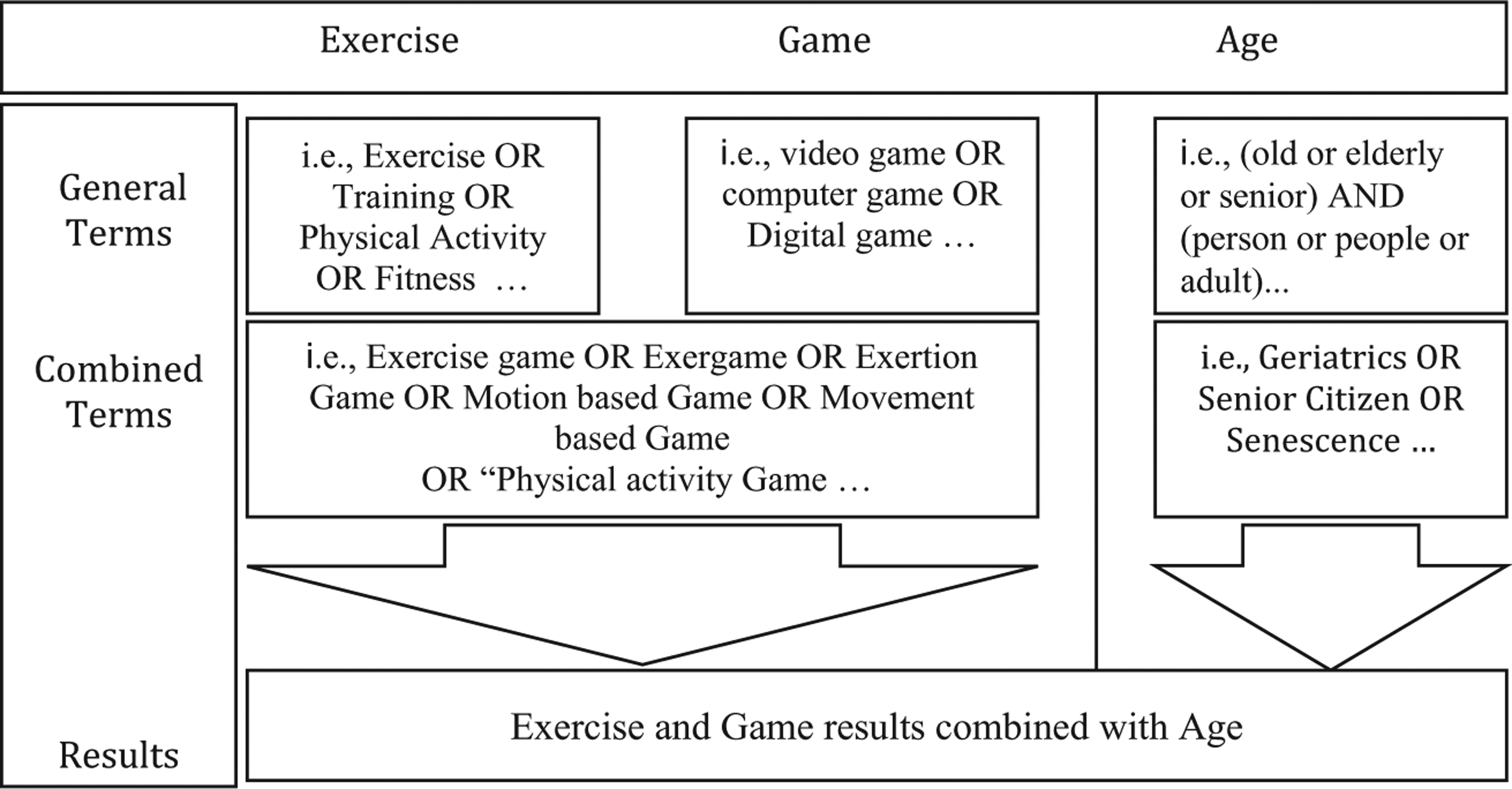
Search keywords to find relevant studies.
Inclusion and exclusion criteria
We defined different inclusion and exclusion criteria to limit the search to those studies that are the main focus of this review. Inclusion criteria were as follows: (1) age criteria: subjects above the age of 55 years; (2) use of game technology, including systems such as Xbox and Wii systems. The game technologies could also include sensors that can be attached to the body to play a game. We included interactive video game–based training, social video game with full-body movements, and full-body motion control games. In addition, we also included games that use screen projections or TV for doing exercise. (3) Whole body movements: study should describe exercises related to the whole body or weight-bearing exercises. (4) Study outcome focuses on assessment of technology, such as usability, acceptance, and preference.
Studies were excluded if (1) they focused only on cognition and were wheelchair or sitting activities, (2) they were not peer-reviewed studies, (3) they focused on the development of algorithms for game technology without testing the technology with senior adults, and (4) they were not published in English.
Abstracts were screened independently by two researchers each. In case there was no consensus made on the basis of abstract, one of the researchers screened the full-text review of this study. Subsequently, included papers were independently assessed in full text by two reviewers each. Disagreement about eligibility of a paper was resolved by a third reviewer’s assessment of the paper.
A first literature search was undertaken in April 2013, and later search was updated on 21 August 2014. In this search, we targeted studies focusing on exercise and video games in older adults. A comprehensive list of keywords was taken from previous literature and from suggested Medical Subject Headings (MeSH) terms. (MeSH is a comprehensive controlled vocabulary for the purpose of indexing journal studies and books in the life sciences.)
The use of valid and reliable outcome measures reduces the likelihood of detection bias. 22 In this review study, we included studies with outcome measure of usability. The strict inclusion and exclusion criterion also filtered studies that did not fulfill the requirements for the review.
Data sorting and analysis
A scoring sheet was developed on a Microsoft Excel for the full-text review. Data were sorted in categories, including participants (population, main selection criteria, number of Ss, completed, and participants age), study (methodology, location, and focus), game technologies and exercises (gaming system, games, exercise, playtime, frequency and duration), and measure of user evaluation (theory or model, user evaluation measures, and results).
For data analysis in studies, we started to look for attributes of usability that are described in ISO standards for usability.12,17,18 We added those attributes that studies stated which contributed toward usability. The qualitative usability feedback was sorted according to the positive aspects of exergames usability, negative aspects of exergames usability, and natural aspects. Furthermore, the usability acceptability issues were derived from the qualitative feedback in each study.
For methodology, we defined a study as following a mixed methods approach if the study combined quantitative evaluation, such as survey and questionnaire, with qualitative observations and feedback. For analysis, we divided studies into two sections: cross-sectional studies and longitudinal studies. This division provides a better understanding of how the focus of studies changes between cross-sectional and longitudinal studies.
Results
The first literature search was undertaken in April 2013. Our literature search revealed 1019 studies. We removed 504 studies because these studies were duplicated in two or more databases. Furthermore, 22 documents were removed because these represented the prefaces of conference proceedings or books. After screening title and abstracts of remaining 493 articles, against inclusion–exclusion criterion, 16 studies were selected for full review.
The most common reason for exclusion of studies was because 209 studies did not focus on whole body movement and only focused on cognitive training and upper body movement. A total of 143 studies were excluded because these studies used the general technologies and not the game technologies. Another 124 studies were excluded because studies did not focus on assessment of technology, such as usability, acceptance, and preference. Another 59 studies did not fulfill the age criteria.
A second round of searches was conducted on 21 August 2014. A total of 484 new studies were found and 203 studies were removed because of duplicates. The title and abstract of 283 studies were reviewed and 3 new studies were found for full-text analysis. A total of 19 studies were selected for full-text review (Figure 2).
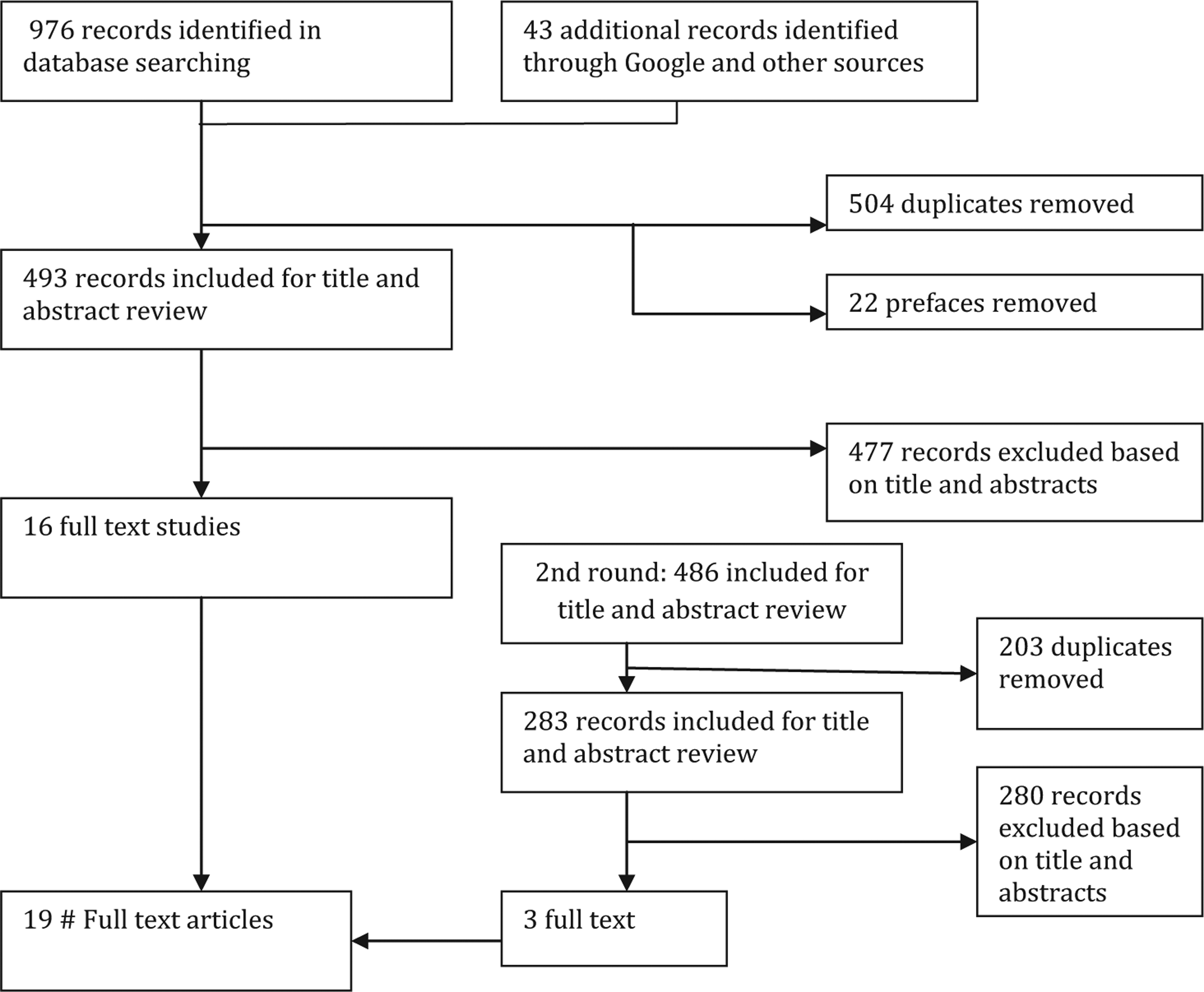
Flowchart of included studies.
At the time of search, no timeframe for review articles was included. The result shows that reviewed studies were only published between 2009 and 2014. This indicates that user evaluation of full-body game technology for older adults is a relatively new area of research.
Characteristics of participants
The included studies had on average 35 older adults (standard deviation (SD): ±9.31; range: 7–309 participants). For the studies, the average age of participants was 73 years (SD ± 8.0).
Some of the studies did not clearly provide the information of older adults. For example, one of the studies 23 divided participants into age groups (i.e. in age of 60s, 25%; in age of 70s, 60%), while two other studies24,25 did not mention the average age but reported the total number of participants above the age of 73 years 24 and range of participants’ age (66–88 years). 25
The population of the viewed studies was mainly independent community-dwelling older adults and people living in residential homes. The majority of studies included healthy adults.4,24,26–31 One of the studies 32 recruited healthy adults who had fallen at least once in the previous year, but without any injury. Two studies25,33 involved a combination of healthy adults and residents in nursing homes and community dwellers. One study 34 included old veterans without visual impairments and no physical disability, and another study 35 included stroke survivors. One study included participants who were referred for rehabilitation who were able to use Wii games.
Use of theories and models
Five of the studies used attributes of theories and models to explain the results of the studies. In addition, the studies used components of these models and theories to explain the results. TAM was the most frequently used theory. Notably, the main reason for using the TAM was that it identified a list of attributes that could be important for technology acceptance and use. Table 1 shows the theories and models that were used in the studies.
Theories and models mentioned or used in the studies of exergames.
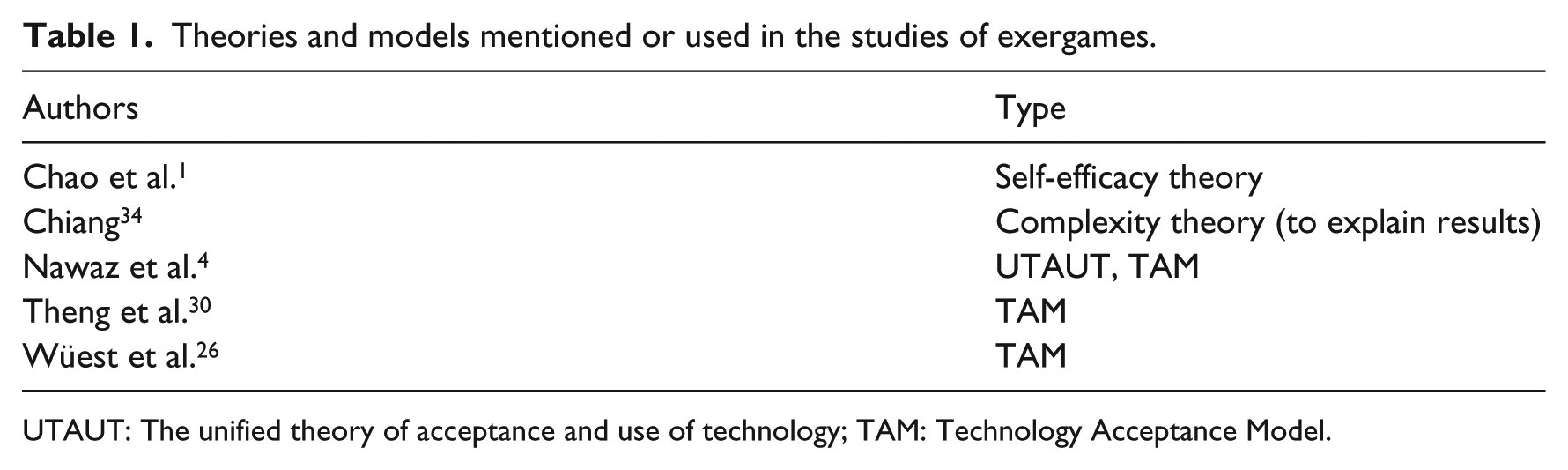
UTAUT: The unified theory of acceptance and use of technology; TAM: Technology Acceptance Model.
All studies used theories in different ways. Chao et al. 1 integrated self-efficacy theory into Wii Fit exergames in order to strengthen an individual’s level of confidence to exercise. Chiang 34 used complexity theory to explain the degree of agreement and certainty between simple and chaotic situations in gameplay. Theng et al. 30 used TAM constructs to illustrate the relationships of the factors within the TAM model. Wüest et al. 26 used TAM questionnaire to evaluate participants’ perceived acceptance of the intervention post-training. Nawaz et al. 4 used constructs of TAM and UTAUT to explain users’ feedback in accordance with the constructs of theories.
Studies methodologies
This scoping review revealed that a number of methods have been used to assess the usability of exergames for older adults. A number of studies4,24,29,30,36 used a mixed methods approach. Within the mixed methods approach, studies used qualitative interviews, surveys, observations, focus groups, field interviews, and ethnography. Aarhus et al. 24 combined an ethnographic approach, which the researchers were in charge of, with physiotherapeutic tests, which staff at the local senior center carried out. Nawaz et al. 4 combined SUS, card-ranking with playing, and assessing UX of games and interviews with older adults, while other three studies29,30,36 combined testing with administrated interviews with older adults.
Five of the studies25,26,28,33,37 used usability as a main method to conduct their studies. Hashimoto et al. 25 used oral questions for usability, but no details were provided in the manuscript about the questionnaire. Wüest et al. 26 measured usability on TAM constructs—perceived ease of use, perceived usefulness, attitude toward using, and behavioral intention to use. Billis et al. 28 used survey questions and interviews, whereas Gerling et al.33,37 used positive and negative affect schedule (PANAS) questionnaire and game experience questionnaire with interviews.
Three of the studies34,35,38 used only a qualitative approach to evaluate the acceptance of the technology. Within qualitative methods, these studies used observations, information conversations, interviews, and field notes. Four of the studies were conducted as clinical trials.1,31,36,39 In these clinical trials, Chao et al. 1 used interview and survey to measure the usability. Graves et al. 31 used survey, and Jorgensen et al. 39 conducted randomized controlled trial, using survey and combining with interview on phone.
Use of games and exercises
On average, each study used 2.47 games (SD: ±1.54; range: 1–6 games). Five of the studies used balance games.1,24,34,36,39 Three of the studies used ski games24,33,39 and yoga.28,31,34 Three of the developed games evaluated a number of sports and customized games. For example, Kang et al. 23 used the following six games: perfect 10, tight rope tension, penguin slide, standing, rowing, and squad. Wuest et al. 26 used the following five games: scarecrow, tractor driver, fruit catcher, worm hurdler, and mixing soup. Uzor and Baillie 32 used five games which include the following: pigeon express, river gem, panda peak, horse hurdle, and virtual physiotherapist.
The participants performed a variety of exercises (Table 2). Most of the studies focused on balance exercises.1,24,25,33,34,38,39 On average in each study, participants conducted approximately 1.75 exercises (SD: ±1; range: 1–4 exercises). The exercises included the following: walking, balance, stretching, acrobat, muscle strength, yoga, stepping, train stance, weight shifting marching, knee bending, and dancing.
Exercises and use of games platforms.
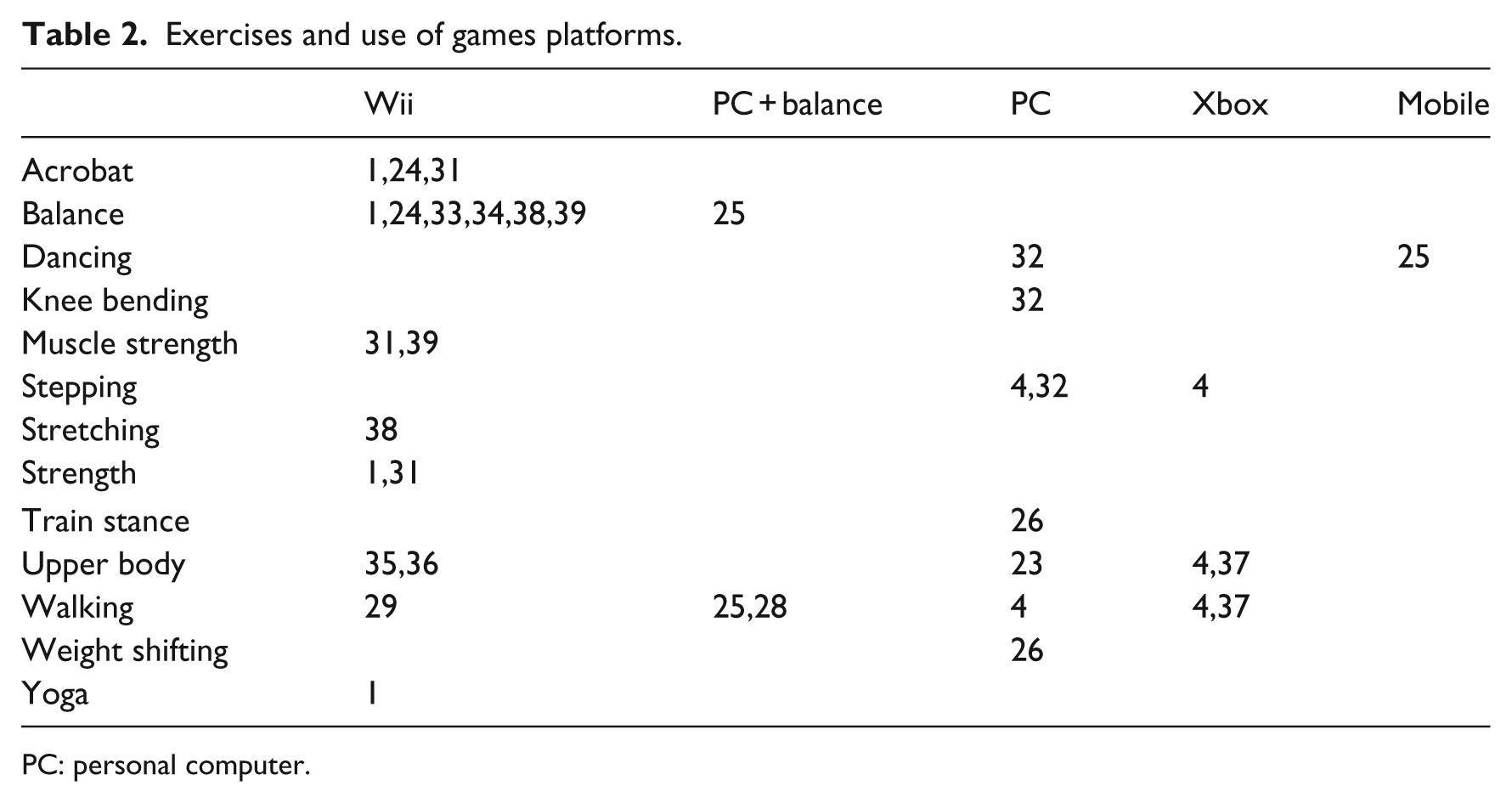
PC: personal computer.
Platforms of exergames and development stages
Table 3 shows that 12 of the studies used the Wii gaming system in their studies. One of the studies developed a new Wii exercise game; another study developed a personal computer (PC) game and used Wii balance board. Two studies4,37 evaluated off-the-shelf Xbox Kinect games. Most of the newly developed games used a PC platform for development and evaluation. These studies used a Windows operating system to run the gaming systems and attached external sensors to detect the movements. The sensing hardware technology included time of flight camera, Kinect camera, press and release step pads, and the Wii balance board. External sensing hardware was also used among the studies which used a PC to run the games. For example, Kang et al. 23 used big trackball, Kim 29 used hand controller and footboard, Uzor and Baillie 32 used inertial sensors, Hashimoto et al. 25 used balance board, and Wüest et al. 26 used force platform and camera. Graf et al. 35 used Nintendo Wii, Sony’s Eye Toy, and TV with camera. Uzor and Baillie 32 used platform specially designed with wireless inertial sensors, a laptop computer with inertial sensor. One study 4 used Xbox and PC platform in exergames. Nawaz et al. 4 used Kinect Xbox platform, PC platform SilverFit, and mat attached to PC for dance dance revolution.
Evaluations and platform usage.
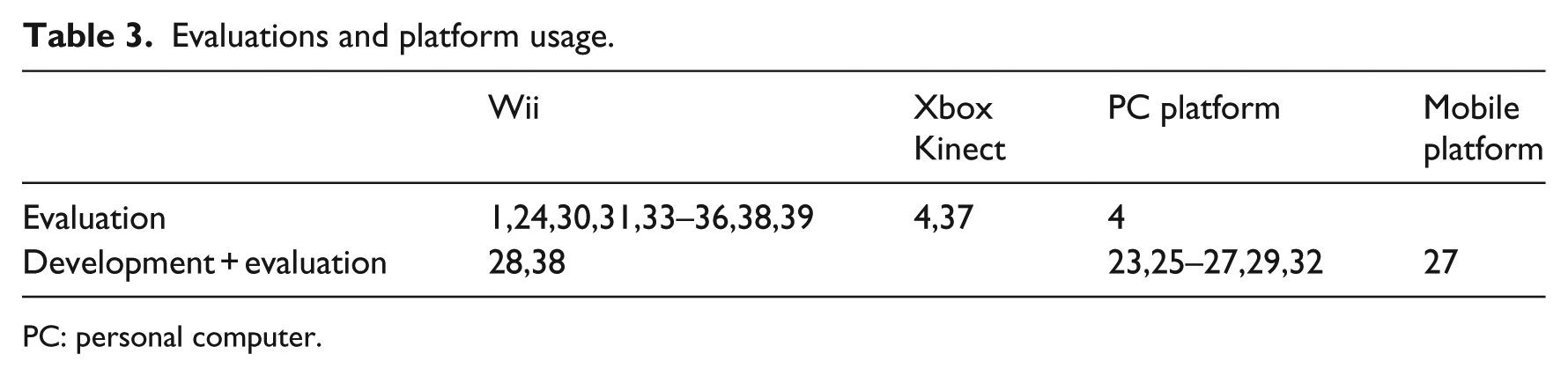
PC: personal computer.
Outcome measures in studies
Most studies focused on acceptability and effectiveness of exergames. On average, the studies focused on 2 aspects within the usability of exergames with a range of 1–3 aspects, in order to calculate the focus across different studies. Figure 3 shows that the main focus of the studies of exergames was on the acceptability of the exergames.1,4,24,26,30,32–34 Effectiveness or efficacy of exergames in older adults was the second biggest focus of the studies.1,26,28,29,32,36,39 No study used an efficiency measure to evaluate exergames.
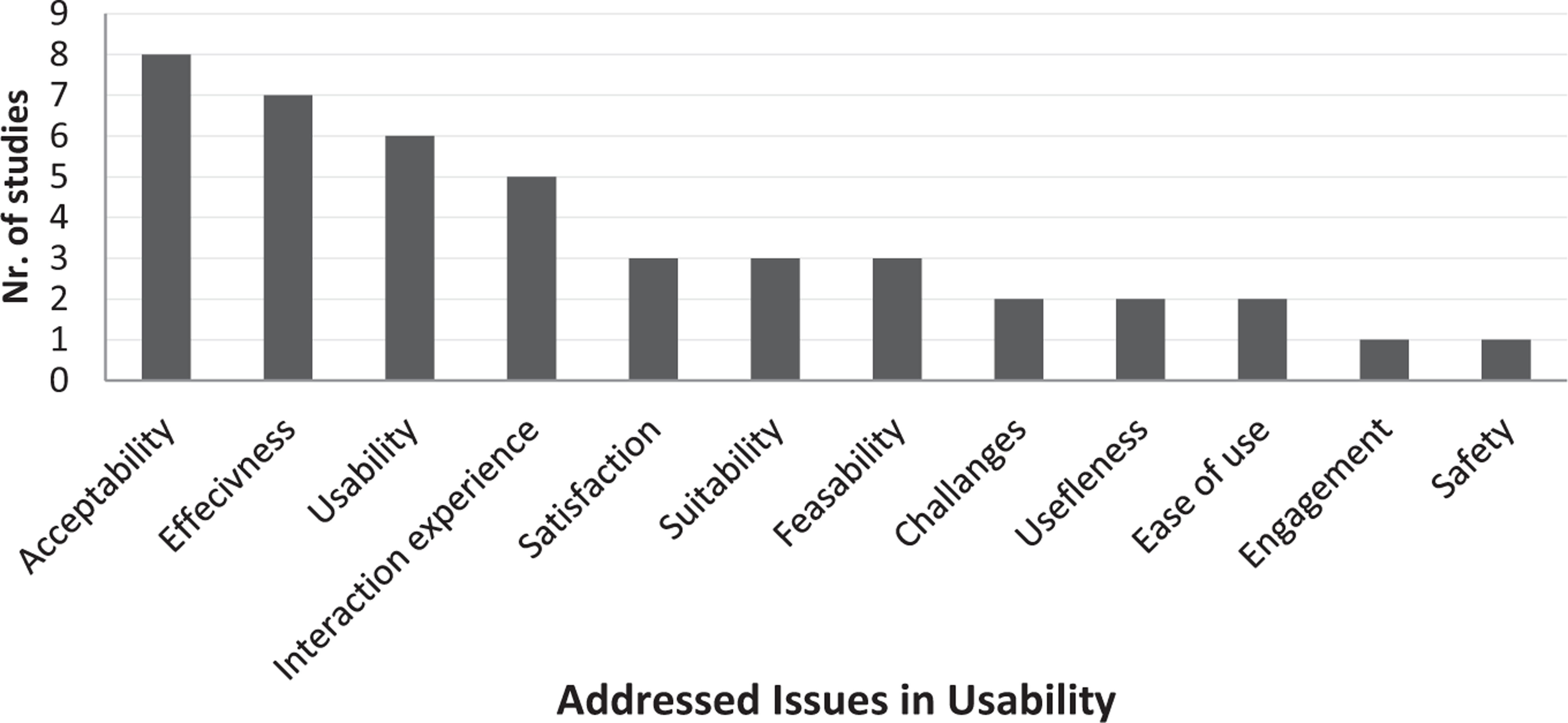
Addressed issues in studies.
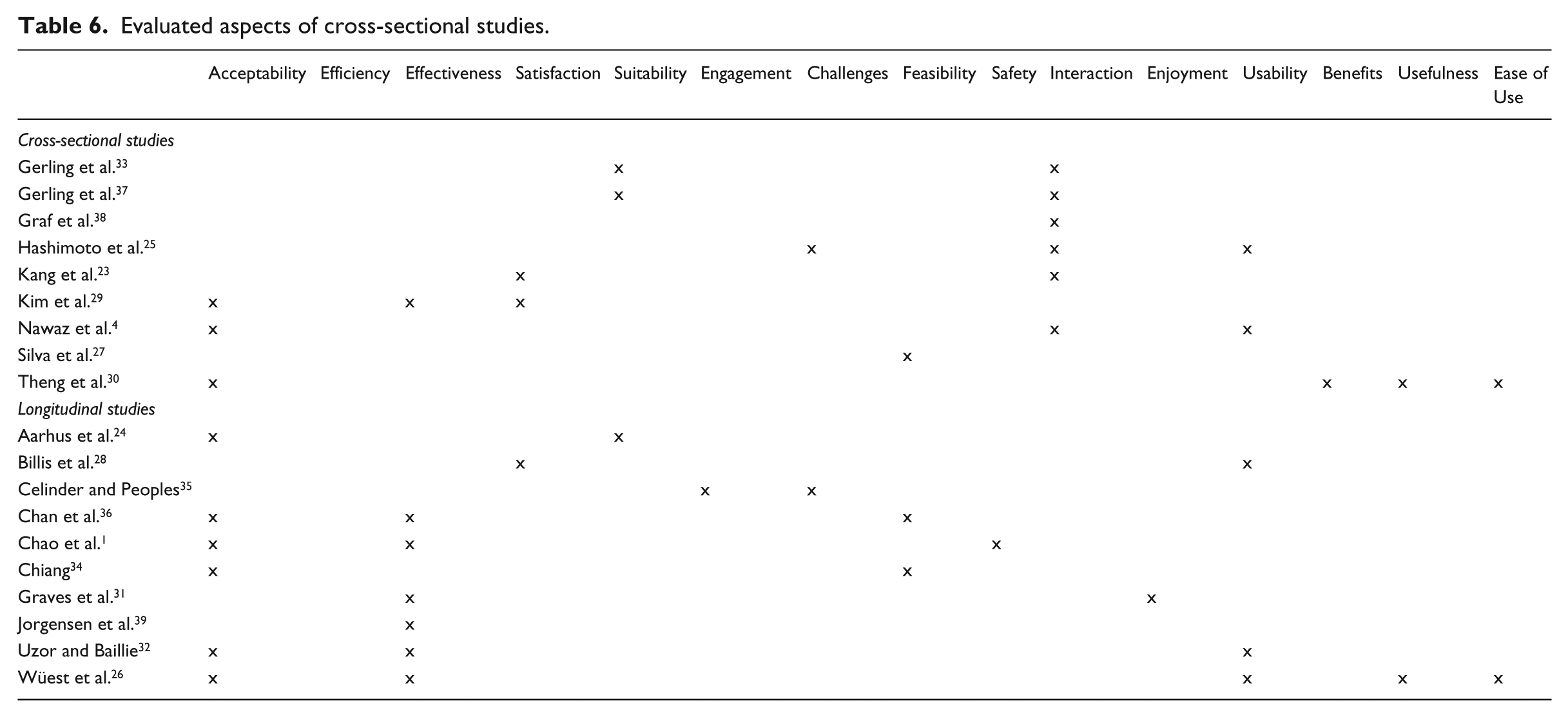
Half of the studies were longitudinal and the other half of the studies consisted of cross-sectional studies. Figure 3 provides an overview of all studies and shows how each study focused on one or more issues within these studies of exergames. First three columns (efficiency, effectiveness, and satisfaction) contain typical measures of usability that are described in ISO-9241-11. 12 Remaining set of the columns are derived from the studies.
Cross-sectional studies outcomes
Many of the cross-sectional studies evaluated the interactional experience4,23,25,29,33,37,38 of exergames in older adults, as shown in Table 4. These studies focused on how users interacted with the games and what experiences these games provided to the participants. All the studies that focused on understanding users’ interactional experience mainly used a qualitative approach. The experience of the users was measured through experience questionnaire, 33 SUS, 4 and PANAS questionnaire. 37 Kang et al. 23 focused on the interactional experience and found that majority of participants (60%) reported overall satisfaction with sensory-gateball game system. Hashimoto et al. 25 measured the interactional experience through efficiency of handled operations. Hashimoto et al. 25 found that there was no difference between time for handled operation for older and young adults at easy level. However, elderly people were less efficient in doing operation when game was played at hard level (p < 0.05). Nawaz et al. 4 used UX as umbrella term to measure the usability, interactional experience, and acceptability of exergames. This study used TAM for qualitative themes and quantified usability through SUS. Nawaz et al. 4 found that older adults had better experience of SilverFit (SUS = 87.0 ± 11.1) exergame because it was developed specifically for older adults. Kim et al. 29 expressed that 89.4 percent of the participants were happy with interactional experience and wanted to play the game again. Gerling et al. 33 stated that older adults found the interactional experience as fun to use Wii games. However, the users of SilverFit board found it difficult to use and instructions to be too fast. In another study, Gerling et al. 37 focused on overall completion of gestures for interaction and found that 54.17 percent of gestured were completed.
Cross-sectional study objectives, games, and results.

ANOVA: analysis of variance; DDR: dance dance revolution; GEQ: game experience questionnaire; PU: perceived usability; PB: perceived benefits; PANAS: positive and negative affect schedule; SD: standard deviation; TAM: Technology Acceptance Model; SUS: System Usability Scale; UX: user experience.
Besides interactional experience, studies focused on variety of aspects such as effectiveness, satisfaction, acceptability, suitability, challenge, feasibility, enjoyment, and usability. Regarding the usability, Theng et al. 30 used USE questionnaire and found that game realism had significant effect on perceived usability (p = 0.004). Graf et al. 38 mainly focused on motivational factors for using game technologies for full-body exercise and provided eight motivation factors: competition, socializing, adventure, relaxing, expressiveness, fitness, body awareness, and sports.
Studies varied in their choice of platform. Three studies used Wii platform,30,33,38 two of the studies used PC-based games with sensory device and trackball and footboard.23,29 Other studies used variety of combinations, such as Kinect, balance board with PC, and SilverFit rehabilitation system, 4 and PC and Wii balance board. 25 One study used Microsoft Kinect. 37 Study of Silve 27 used a DDF smartphone system.
Longitudinal studies outcomes
Longitudinal studies mainly focused on effectiveness1,26,32,36,39 and acceptability1,24,26,32,34,36 of exergames for older adults, as shown in Table 5. Four studies evaluated both effect and acceptability of the exergames.1,26,32,36
Longitudinal study objectives, games, and results.

6MWT: 6-min walk test; BBS: Berg Balance Scale; BMI: body mass index; BS: Borg Scale; COPD: chronic obstructive pulmonary disease; FFA: fit for all; FES: Falls Efficacy Scale; FIM: Functional Independence Measures; FOF: Fear of Falling; OEE: Outcome Expectations for Exercise Scale; OT: occupational therapy; PACES: Physical Activity Enjoyment Scale; RFD: rate force development; SEE: Self-Efficacy for Exercise Scale; SD: standard deviation; SUS: System Usability Scale; TAM: Technology Acceptance Model; TUG: time up and go.
Longitudinal studies mainly focused on effectiveness.1,26,32,36,39 Chao et al. 1 measured the effect of exergames on balance and found that there was a significant improvement in balance (Berg Balance Scale (BBS): −14; range: 0–56; efficacy p = 0.017) following the 8-week program. Furthermore, Chao et al. 1 stated that 71 percent of older adults found game experience as enjoyable and showed interest in exercising with Wii games. Wüest et al. 26 focused on technology acceptance after 12 weeks of using exergame. The outcome on 7-scale measure was perceived ease of use = 5.9 (SD: ±1.7), perceived usefulness = 6.4 (SD: ±1.0), attitude toward using exergames = 6.5 (SD: ±1.1), and behavioral intention to use exergames = 6.0 (SD: ±1.3). Uzor and Baillie 32 found that exergame groups have reduced their fear of falling after 12 weeks of exercise (p = 0.097); the older adults rated the exergame usability very high (SUS = 89.6). Chan et al. 36 measured Borg Scale (BS) and Functional Independence Measures (FIM) of older adults. After playing exergames in eight sessions, most (83%, or 25 of 30) of the older adults wanted to continue exergames, and almost all (97%, or 29 of 30) of the participant considered exergames suitable for them. The FIM outcome showed that exergame group had significantly high FIM than in historic controls (p = 0.05). Jorgensen et al. 39 reported that after playing exergames for 10 weeks, there was positive effect on time up and go (TUG) < 0.05. Jorgensen et al. 39 also reported that there was high motivation to play exergame at weeks 5 and 10; however, significance was not tested.
In longitudinal studies, there was no single way to measure the acceptability and usability of exergames. Two studies26,32 used questionnaire of TAM, whereas one study used a questionnaire of attitude toward Wii games. 36 One study used exergame experience questionnaire that involved questions related to acceptability. 1 Two of the studies did not use a questionnaire; instead, these studies relied on ethnographical observations and qualitative users’ feedback.24,34 Billis et al. 28 measured usability and satisfaction of the game through Physical Activity Enjoyment Scale (PACES).
Generally, the effect on physical function was measured through a test of balance, the BBS,1,26 the BS measuring self-reported intensity. 36 Wüest et al. 26 measured effect through BBS, short physical performance battery (SPPB), and Gait analysis. Besides the exergame effect on physical function, studies also used other measure to calculate the effect of exergames. For example, Graves et al. 31 measured effect of exergame through energy expenditure. Jorgensen et al. 39 measured the effect of exergames through prolonged motivation to play exergames in home and senior centers. Uzor et al. 32 measured effectiveness exergame by combining physical function and adherence, functional walking speed, and fear of falling.
Most of the longitudinal studies1,24,31,34–36,39 (7 of 10) used Wii platform for their studies. From these longitudinal studies, half of the studies used off-the-shelf Wii exergames and used it in the studies, whereas one study specially designed game with wireless inertial sensors which are connected to laptop computer. 32 Two studies used fit for all (FFA) and force platform, respectively.26,28
Concerning the amount of playtime in longitudinal studies, users played exergames on average 26.62 sessions (SD: ±6.10), for 36.11 min (SD: ±19.96 min), except the study by Chan et al., 36 which conducted 8 sessions for 10 min, and Graves et al., 31 which conducted only 2 sessions for 10 min.
Positive aspects of exergames
We enlist usability issues on the basis of qualitative feedback that is reported in different studies:
Immediate feedback. The game should provide immediate feedback to older adults. Feedback should be provided in the form of scores, audio as well as visual form.24,34
Competition. The exergames should provide competition among the players. The competition environment can be created through comparison of scores and comparison of attendance of participants if exergames is used in intervention program.24,31,34
Social interaction. The exergames should provide opportunity of social interaction. The social interaction helps to exchange tips of getting higher score or better movements.4,24,31
Challenge. The exergames should provide challenge. Challenge helps older adults feel satisfaction when passing stages. 34
Close to grandchild. Game narrative should have common topics to share with grandchildren. 34
Play together. Exergame should encourage older adults to play together in groups. 24
Body awareness. Exergame should provide older adults with body awareness. 38
Emphasis on positive feedback. Exergames should emphasize on positive feedback. 27
Critical aspects of exergames
From critical perspective, studies reported that users do not like the following aspects in exergames:
Avoid speed and complexity. Exergames should avoid speed and complexity at the same time.24,34
Avoid showing personal data on screen. Creating a personal profile in the exergames shows personal data such as body mass index (BMI) and the center of gravity by conducting balance tests. Such form of personal data should be avoided in multi-player settings. 24
Absence of native language. Absence of native language can demotivate older adults because interactional experience of older adults goes down. 24
Facilitating conditions. Exergames require physical space to be used. Exergames should clearly state how much space is required to setup and play game. 4
Setup support. Inadequate setup support demotivates older adults to use exergames in home setting; therefore, exergames should provide help and assistance to setup exergames.4,34
There are some aspects of exergames which are identified as positive and critical at the same time. For example, an animated character in game can be used as feedback of performance for the older adults. 24 On the other hand, the character can also distract during the exercise tasks. In these cases, users’ preferences can be utilized to enable or disable type of a feedback.
Discussion
This scoping review aimed to provide an overview of aspects of usability and acceptability of exergames and to explore how different aspects of exergames evaluation have been measured and what were the results of the studies. We reviewed 19 studies of exergames for older adults that assess usability and acceptability on exergames. The studies were mainly published between 2009 and 2014 which shows that usability evaluation and acceptability of exergames among older adults are relatively new field of research.
Use of theories and methods in studies of exergame usability
The full-text review revealed that exergame studies did not use lots of theories for conducting studies of exergame usability. The use of theories in usability becomes handy because theories provides with a handle to conduct studies. These handles are the components of the theory that are further investigated to understand the users’ perspective on a particular phenomenon. While looking into the results, it becomes clear that studies used mainly TAM.4,26,30 While using TAM provides quantitative measures to conduct usability assessment, it does not look in depth concerning the emotional design 40 for visceral, behavioral, and reflective aspects of design when looking into the usability. Looking into the emotional design within exergame usability can provide users’ experiential understanding of exergame usability.
The use of method reveals that mixed method approach was used by number of studies to conduct usability of exergames.4,24–26,28–30,33,36,37 It was interesting to find that five of the studies25,26,28,33,37 considered usability as their main method for studies. However, usability is a process that includes a number of evaluation methods such as prototyping, heuristic evaluation, and task analysis. To ensure what usability evaluation method studies have followed, the future studies need to specify usability inspection method instead of generalizing usability as a method for conducting exer-games evaluation.
Evaluated aspects of usability and acceptability
The reviews show that studies have used variety in terms of their focus for usability and acceptability of exergames among older adults, and studies used their own interpretation toward usability and acceptability of exergames. In terms of evaluated aspects of usability, the longitudinal studies focused on usability and acceptability aspect and combined it with effectiveness of exergames on physical function. Acceptability as a general aspect of usability was outlined well by the studies, and the studies used TAM to evaluate acceptability. The effectiveness of exergames was measured through known measures such as BS, BBS, and FIM.
Cross-sectional studies have used commonly used approaches for measuring usability such ease of use, interactional experience, and satisfaction (Table 6). However, the interactional experience in the usability of exergame did not have unified understanding between the studies. For example, Gerling et al. 33 refer to interactional experience as general game experience, whereas Kang et al. 23 focus on interactional experience in terms of the color, menu, and typography experience of games. The evaluated aspects of usability should use a similar approach of the evaluation. For example, in case of feasibility of the study, two studies focused on fun 36 and enjoyment 1 while one study 27 used observations to know whether game is feasible for user. In terms of exergame satisfaction, exergame studies should clarify what studies mean by satisfaction. For example, one study 28 asked users to rate gameplay satisfaction (1–50), while another study 23 assessed game design satisfaction on a scale from very likely to very unlikely.
Evaluated aspects of cross-sectional studies.
Outcomes of the usability and acceptability
The studies of exergames usability found that exergames usability and acceptability among the older adults were perceived well. The longitudinal studies also assessed the effect of exergames. Studies generally reported positive effect of exergames in terms of TUG and FIM. The usability in terms of SUS was reported good when value varied between 87 and 89 on 0–100 scale. It was interesting to know that usability in terms of SUS was considered moderate usable when SUS was 69. 4 While comparing the outcome of usability in terms of SUS, games interface generally has better score in comparison with other interfaces such as interface of mobile phones and websites which vary between 66 and 69. 41 Some of the studies reported the outcome of the usability in terms of positive aspects of exergames usability and the negative or concerning issues in terms of exergames usability. It will be interesting to look further in each of the aspects and see how it varies between users’ groups with different priorities. Theses priorities may include balance training, cognitive training, or upper body training or full-body training.
In terms of acceptability of exergames, most of the studies were conducted in assistive living labs, rehab center, welfare center, or usability lab. Only two studies32,34 were conducted in residential homes. Participants of the studies in assistive and facilitative environment found the exergames acceptable. It will be interesting to research how users’ perception about acceptability of exergames changes when these games are played independently in home or assistive living of older adults without supervised environment. Similarly, the outcome of interactional experience and satisfaction most of the studies reported that older adults enjoyed exergames experience. Testing exergames independently in unsupervised setting will help in generalizing the result of exergames usability.
Use of gaming platforms, games, and exercises
There was a clear indication that choice gaming platform varied between longitudinal and cross-sectional studies. Longitudinal studies mainly relied on Wii platform and used off-the-shelf exergames for their studies, whereas cross-sectional studies used a variety of platforms and did not rely on a single platform. One of the reasons that Wii platform is used in longitudinal studies is because studies wanted to measure the effect of exercise, and acceptability of developed exergames is measured during or after the study, whereas cross-sectional studies which used PC platform tried to involve users in the development phase of the exergames. The future studies should involve older adults in the start of the development process, and after the game has been developed, it should be used for a longitudinal study to measure the effect of the exercise. Concerning the use of gaming platforms, balance games require users to stand on a balance board.25,28 However, Xbox technology uses three-dimensional (3D) camera and it does not require balance board or pressure sensitive mat for games inputs.
In terms of exercises, most of the studies conducted balance exercises. Most of the balance exercises used table tilt balance game and Ski Salomon. Regarding game usage within the context of usability, it might be a good idea to use a variety of games to see which one is more usable. However, in terms of the effectiveness of exergames, use of many games may not indicate which games were more effective.
Conclusion
This review presents pragmatic evidence regarding the focus of game usability for full-body movement among older adults. This study concludes that there is single approach that is followed to assess usability of exergames among older adults. The studies that used SUS have reported results using the scale of SUS. However, the use of TAM varied in studies. Some studies reported the significance for the constructs of the TAM, whereas other used the constructs of TAM for qualitative themes.
Use established usability questionnaire and mixed methods
Most of the studies evaluated usability through mixed method approach by combining observation and interview with usability questionnaires. Generally, studies had their own understanding of what usability meant in this study. In addition to the general constructs of usability (usefulness, usability, ease of use, acceptability, and satisfaction), studies used constructs such as engagement, benefits, safety, challenge, and enjoyment to evaluate the usability of exergames. The future studiers need to follow established usability evaluation procedures to quantify the results through questionnaire and provide insights through qualitative feedback.
Involvement of older adults in development of exergames for longitudinal studies
There was inconsistency concerning development and/or evaluation of the gaming systems. Those games that were develop as part of the studies generally used PC platform, whereas Wii platform was mainly used for evaluation and not many games were developed and evaluated in Wii. It further provides a detailed narrative on the usability aspects of exergames for older adults. The future studies should involve elderly adults in the start of the development process, and after the game has been developed, the game should be used for a longitudinal study to measure the effect of the exercise. The scientific examination of exergames through the lens of HCI and movement sciences provides a relevant and important platform for research.
Footnotes
Declaration of Conflicting Interests
The author(s) declared no potential conflicts of interest with respect to the research, authorship, and/or publication of this article.
Funding
The author(s) disclosed receipt of the following financial support for the research, authorship, and/or publication of this article: The research leading to this study has received funding from the European Union Seventh Framework Programme (FP7/2007-2013) under grant agreement FARSEEING no. 288940.