




Abstract
Virtual Reality (VR) offers cost-efficient and effective tools for spatial 3-dimensional neuroanatomy learning. Enhancing users-system relationship is necessary for successful adoption of the system. The current study aimed to evaluate students’ acceptance of VR for neuroanatomy. An exploratory qualitative case study based on Unified Theory of Acceptance and Use of Technology (UTAUT) framework carried out at the Department of Neuroscience, Karolinska Institutet, Sweden. Participants in this study were students participating in a VR session, followed by a semi-structured interview. Deductive framework analysis employed to retrieve students’ perspective and experience. A total of six undergraduate and 13 postgraduate students participated in this study. The following UTAUT constructs validated to be significant: Performance Expectancy, Effort Expectancy and Facilitating Conditions. System usability, depth of lesson and hardware optimizations are among concern for further improvements. In conclusion, students are accepting VR as a neuroanatomy learning resource. The findings of this research highlight the importance of system performance and user-centred approach in technology development for educational purposes.
Keywords
Introduction
Learning is about how individual perceive and understand context by making interpretation which involves mastery of abstract principles, validating evidence, recalls information, acquire methods, techniques, and approaches. Educational psychology textbooks often define learning as a relatively permanent change of behaviour, knowledge and thinking skills affected by the exposure of experience. 1
Teaching and learning at universities continuously integrate sophisticated Information, Communication and Technology (ICT) as supportive educational tools for personalized learning experiences. 2 Technology enhanced learning beneficial to improve skills acquisition, particularly for critical thinking and empowering individuals in maximizing their potentials. 3 Technology encourages students to pursue passions and personal interest by practicing exploration and research in a lifelong learner perspective. 4
Virtual Reality (VR) could augment traditional teaching, amid increasing cost of cadaveric specimens and its decreasing supply. 5 Potential benefits of VR in medical training are demonstrated in various studies, including resident education,6,7 spine surgery.8–10 Tumor resection, 11 endoscopic nasal surgery, 12 and cerebral aneurism. 13 VR simulators confirmed to promote mastery of psychomotor skills, safety, and cost of practice as a foundational part of clinical training.
Introducing innovative ICT into the learning processes does not guarantee the use of the technology. Identifying factors affecting the acceptance of technology is essential for the development of educational policies. Understanding the multiplicity of factors that influence the acceptance and use of technology could lead to proper decision making and enhance the learning process. 14
Venkatesh (2003) created Unified Theory of Acceptance and Use of Technology (UTAUT) by comprehensively examining eight models and theories in the context of information systems. The synthesis tried to explain technology acceptance and further adopted the conceptual and experimental similarities of the models and theories. 15 UTAUT focuses on users’ intention in the use of ICT technology, followed by subsequent use behaviors.
Failure widespread adoption VR is reported across different educational settings. 16 In medical education institutions, the introduction of VR is relatively new. Particular in neuroanatomy course the VR utilization remains infrequent. Lack of studies and research within this area lead to minimum exploration about students’ view, VR effectiveness, and characteristics that drive technology acceptance. The aim of this study is to measure undergraduate and postgraduate students' acceptance of using neuroanatomy VR system at the Department of Neuroscience, Karolinska Institutet, Sweden based on UTAUT framework.
Methods
Setting and participants
Qualitative research design approach was chosen for this study to explore constructs of the user acceptance, provide insights into the system pitfall as well as identifying positive aspects of the system. The study carried out at the Department of Neuroscience, Karolinska Institutet, Sweden, between December 2022 to May 2023. Initially, series of public exhibition were organized for undergraduate students enrolled in neuroanatomy course to experience the VR. Prior to VR use, students were informed about the research and invited to participate. A total of 108 students have tested the VR, but inadequate participants were recruited from the convenience sampling methods.
In addition, a non-probability sampling technique was implemented to facilitate in-depth, idiographic understanding about the users’ acceptance. A homogenous, purposive sampling method was employed to recruit participants in this research. The method is based on established criteria which describe participants’ characteristics. The characteristics of the participants were: (1) enrolled in undergraduate medicine/the global master’s program, (2) undergraduate students registered in neuroanatomy course or master’s student with medical background and (3) experience VR system for neuroanatomy learning.
Ethical consideration
The current study conforms to Ethical Principles for Medical Research Involving Human Subjects and ICMJE Recommendations for the Conduct, Reporting, Editing, and Publication of Scholarly Work in Medical Journals. An exemption for ethical review was granted as the current study did not collect any sensitive, personal identifiable information.
Data collection
Interview questions.
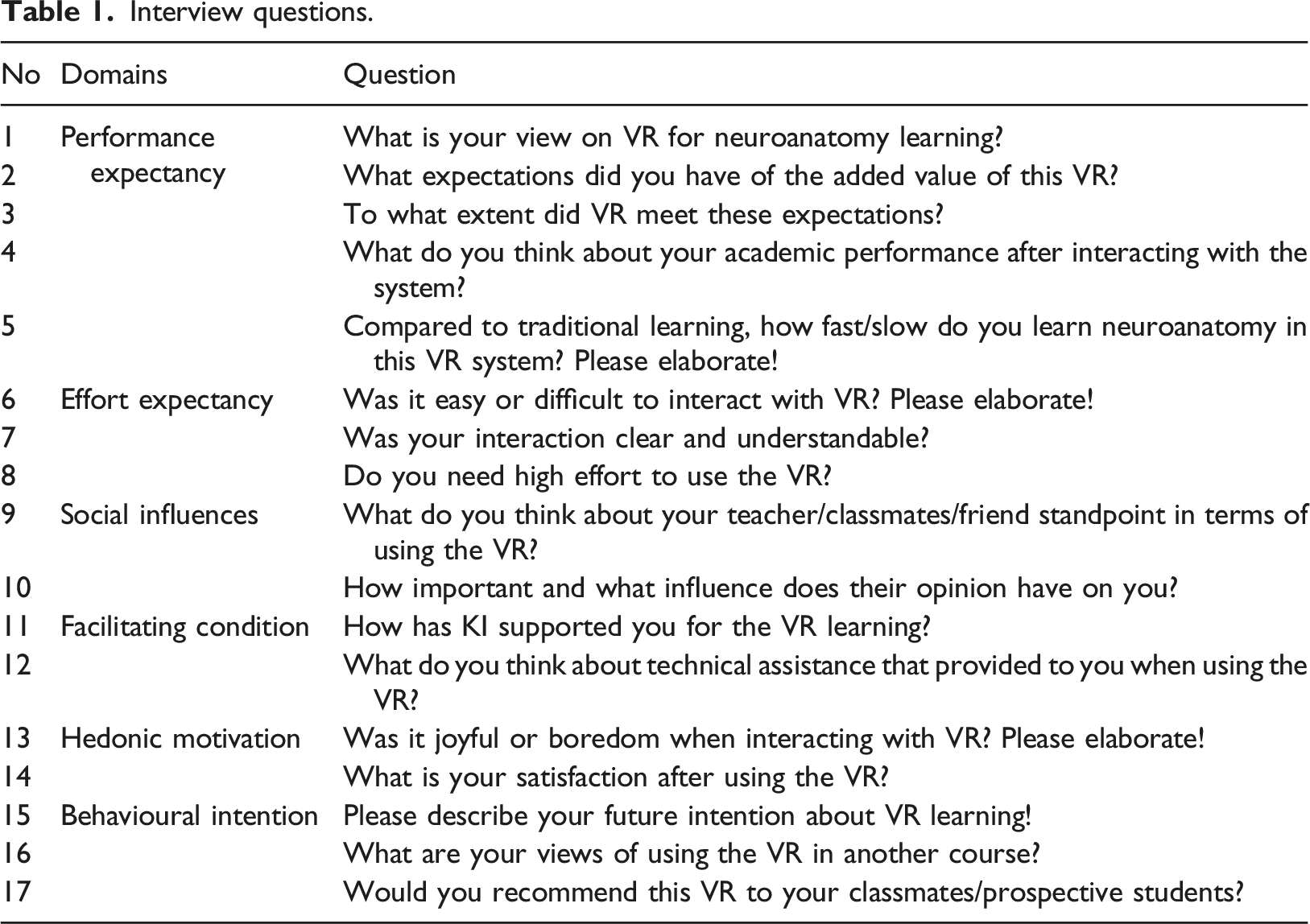
Data analysis
The framework analysis, characterized by structured analysis process was implemented in this study. Initially, key concepts of the UTAUT identified as the coding category. Operational definitions of each category derived from the UTAUT definition. Participant’s excerpt from the interview highlighted to and coded based on the predetermined category.
Results
Key study participants’ profile.
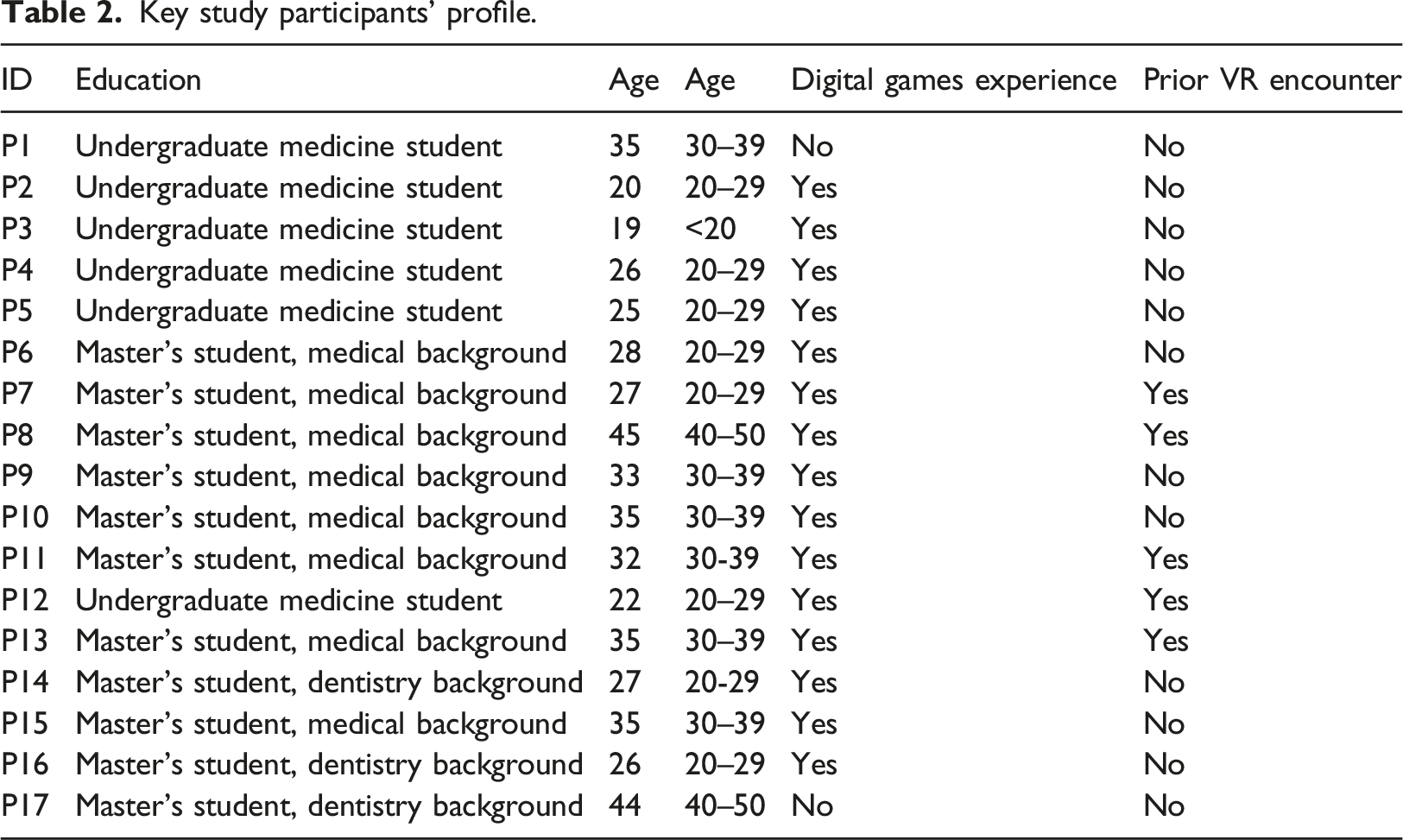
Performance expectancy
All of the participants were optimistic that neuroanatomy VR offers learning advantages. It includes the novel way of interaction, fun learning episodes, anatomical structure manipulation ability, and 3D immersive visualization. Compared to traditional learning which relies on two-dimensional printed or digital materials, VR is favorable. “Well, I haven’t really thought about it that much, but based on today, I would say it's a, it’s a really cool technology. I think it it might be great for, for, for visualizing and learning. I think we have, you know what visible body is?…. So we use visible body quite much, but I think like looking at it in in virtual reality can give you more of an understanding of how things look in in 3D, especially well maybe especially with neuroanatomy where things go in and out of the skull base and how they interact with each other...” (P12)
In terms of added value, participants’ expectations were varied. Freedom to determine vantage points, more in-depth lesson materials and vivid views of the 3D models are among positive aspect of current VR. In general, participants acknowledged that VR has met their expectations. Despite there are few aspects to improve, VR offers aditional value to enhance students’ learning. “To some extent, yes. But I think it can be improved, like for example it will be much better if each part can be rotated or picked up umm differently and it will be helpful if each part of the neural anatomy part that we are viewing, we can, like, maybe click on them and then some explanation or labels will pop out. So to some extent it meets my expectation, but it can sure it can be improved much more.” (P7)
Regarding participants academic performance, VR considered beneficial to improving knowledge, but limited learning episode may influence this aspect. The learning outcomes in neuroanatomy specified, students to retrieve, recall, recognize or demonstrate understanding through one or more forms of explanation. Students expressed that multiple VR sessions are necessary throughout the course, or on a weekly basis to enable them gaining maximum benefits. “I think it helped me, so I guess I’m I had the better performance, academically speaking. I don’t know if I would have gotten the same score at the test if I wouldn’t have done this because it helped me see the structures in a different way so I can understood them better. So, I liked it. I I think it helped my performance.” (P2)
A common view amongst interviewees was that VR could accelerate learning journey in neuroanatomy. Nevertheless, students quite unsure about how VR expedite their learning pace due to short time experience. Lessons learned from the VR are considered meaningful to enrich students’ prior knowledge, thus potentially accelerate their educational journey. “I think it will be, I predict that it will be a little a little faster because you cut out a bit of the work we usually have when studying anatomy, which is looking at the pictures in the book and reading and trying to visualize the the organ in 3D and there are many features and so I think the VR system can definitely improve the speed of learning anatomy and neuroanatomy, specifically for sure.” (P11)
Effort expectancy
The majority of interviewees reported that interaction with VR is straightforward and effortless. First time users experienced difficulties at the beginning, but swiftly accustomed to the system environments. Issues related to users’ interaction and understandability within virtual reality were prominent from the interview. “Well, because it was my first time using VR. Uh, it was difficult in the beginning until I started to understand and get the hum of it. Uh, initially it was difficult, but after a while when I got used to it, it was easy.” (P4)
No severe adverse effects, nor exhaustion were reported. Interaction with VR require minimal effort. Once the users are familiarized, most of them independently explore the system without additional support. Onboarding sessions are beneficial for both novice and experienced users. Otherwise, written guidelines or pre-recorded tutorials could serve as additional resources. “My effort? no. It’s a minimal effort for me, that's. Just, as I mentioned, just a quick rundown of what the controls do and you should be able to manage the system.” (P13)
Social influence
Some participants belief that age may influence teachers’ viewpoint in terms of VR use in academic settings. Old generation educators accustomed with traditional teaching delivery methods are assumed to discourage the use of novel resources such as VR. On the contrary, younger age groups of teachers are predicted to be more accommodating. When participants were asked about their friends’ perspective, the majority recalls frequent peers’ suggestions. “Maybe VR is not for everybody because since I think it's still, a relatively new technology, some people are not familiar with it, and maybe the teacher or the older people will prefer the traditional method and learning by the book or buying the looking at the real models maybe some of my friends will also prefer watching videos, but I'm sure that there are people that will prefer VR because of the way we can view the part that we are studying in three dimension. (P7) “They liked it, I when I asked them. So I think that it's a it's a good tool. My friends and my friends’ group really liked it and really wanted to implement it in the in the teaching in the lessons.” (P2)
Facilitating condition
The university initiative in emphasizing VR resources for learning was deemed inadequate. VR hardware availability and system accessibility are among the anticipated support from the university, in addition to incorporating VR in the curricular contents. “We have digital models, a 3D models online. I think the school has paid for them already and we use them in some of our courses and not so much yet, but in the future, I think. So we have something called Visible Body that we already used. …. It's more than I expected, but I don't know if it's sufficient. I would say it's sufficient.” (P5)
Technical support for neuroanatomy VR deemed excellent. Intense support may be provided for students with technological difficulties, but providing printed tutorials or pre-recorded guidance is assumed to be sufficient for majority of users. “I received technical support because you were present there and you were telling me what to do and and it’s kind of supportive, yeah.…. The only problem that I wasn't being able to solve is some of them like the interaction between, the interaction between the stuff, the things that you see, you cannot grab them. You cannot go back and some of the visual feedbacks are missing, something like that.” (P10)
Hedonic motivation
In general, participants rated their VR interaction as pleasant experience. On the other hand, two broad satisfaction ranges were identified from the interview: satisfied and moderately satisfied. Several factors are associated with users’ satisfaction, including integration of VR to the educational course, feature optimization, prolonged duration, usability issues and hardware-related concerns. “Yeah, I mean I I thought it was extremely fun because, yeah, it was my first time using a real VR headset, so it was naturally, it was quite fun.” (P3) “I’d say 10 out of 10. Not in particular (dissatisfaction, author). Again, again, it would have been fun if they would have incorporated it more. Uh, in the course as uh, rather than just it being a part of a research program, but I guess it's in development right now. So maybe in the future.” (P4) “Well, if I rate out of 10, I would say 6.5 to 6 out of 10. ….. If if you provide some visual feedback and if you could provide some tooltips and if you can provide some more information on what to do and like guiding the user what to do, something like that like like a words tips, I would say it would be very good tool, yeah.” (P10)
Behavioral intention
Majority of the participants argued that they are going to employ VR in future education, while two participants seemed hesitant. Students agreed that VR could be implemented in another medical courses. Lesson that characterized with spatial awareness, organs structures, and procedural knowledge are highly relevant for future VR contents. “Well, I mean let’s just say that if I'm given the given the opportunity to use VR to learn. I would take it because I really I like VR, I like it as a system and I like it as a concept for the future learning. So if I’m given the chance, given the chance to use VR to learn, I'm going to take that chance because I think it it has massive potential in regards to learning how how much time it will take to get to a level where VR can complement or even, even the let's call, remove other aspects of normal learning. I don’t know how much I can take, but, but yeah.” (P3)
No conflicting discourses reported in correlation with endorsing VR for prospective students or classmates. Despite the current state of VR system remaining at preliminary version, it does not inhibit participants in suggesting the resources to the other students due to multitude of benefits that VR may offer for anatomy learning. “I think if if it would be met the, not just having just visual cues, having like the audio cues you remember about the specific the because if it’s going to have extra time to just set up with, I mean, set up the system and just have pictures in front of you, or have the object in front of you. I would highly recommend it if there was a way to know more about a certain object, not just labels and the pictures and that just visualization, so that's what I would that's how I would recommend it. If the completed product had more knowledge for the users.” (P13)
Discussion
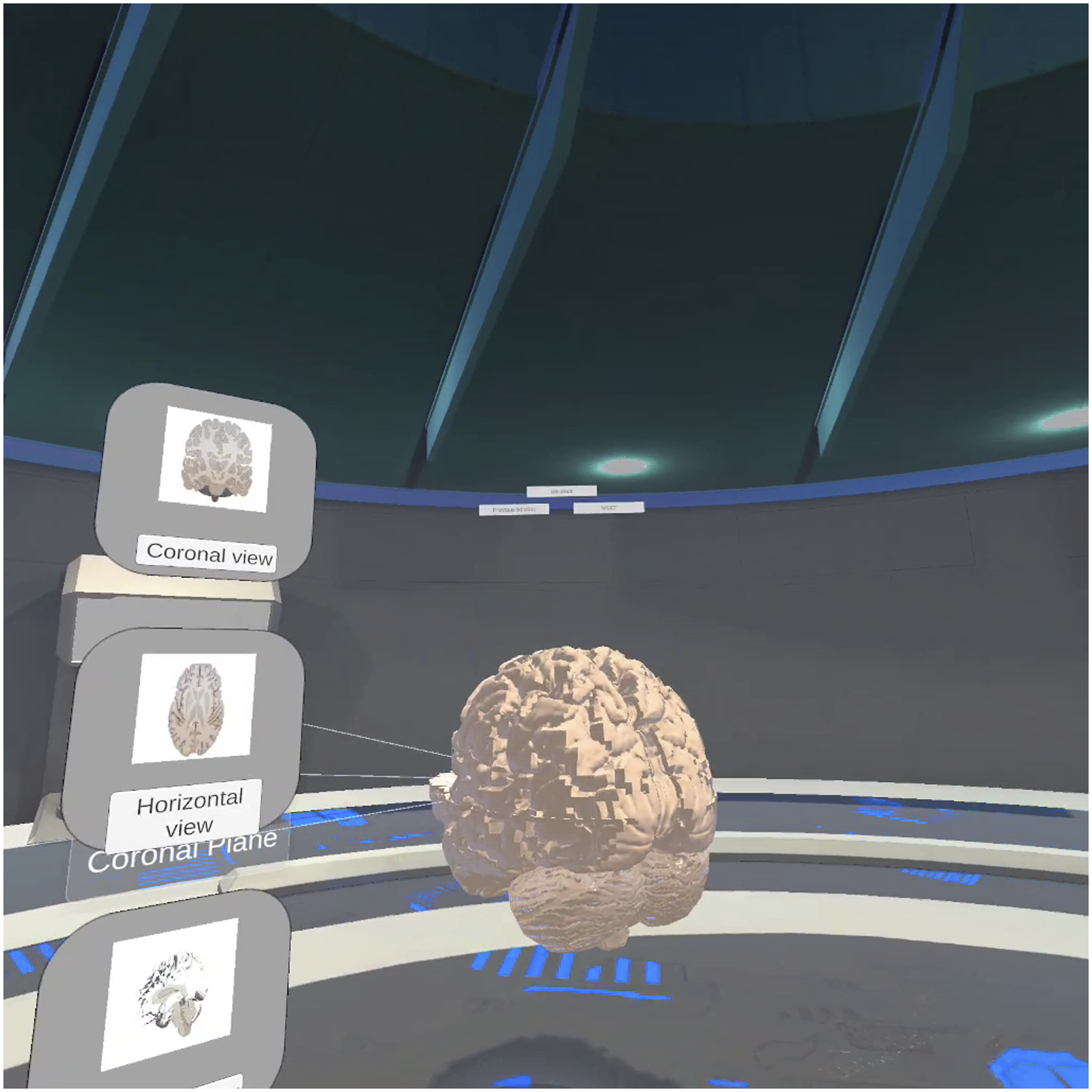
Participants in this study generally accept neuroanatomy virtual reality as a learning resource, endorsed by the ability to visualize spatial 3D views of anatomical objects and manipulate the object position.17–20 Overall, the VR system allowed users to view, recall, comprehend and understand neuroanatomy objects. However, usability issues prevent the users from exploring the whole system contents. Mitigating technical problems associated with the system could enhance users’ learning journey in achieving desired learning outcomes (Figures 1 and 2). Main menu of the VR system. A brain model with floating labels.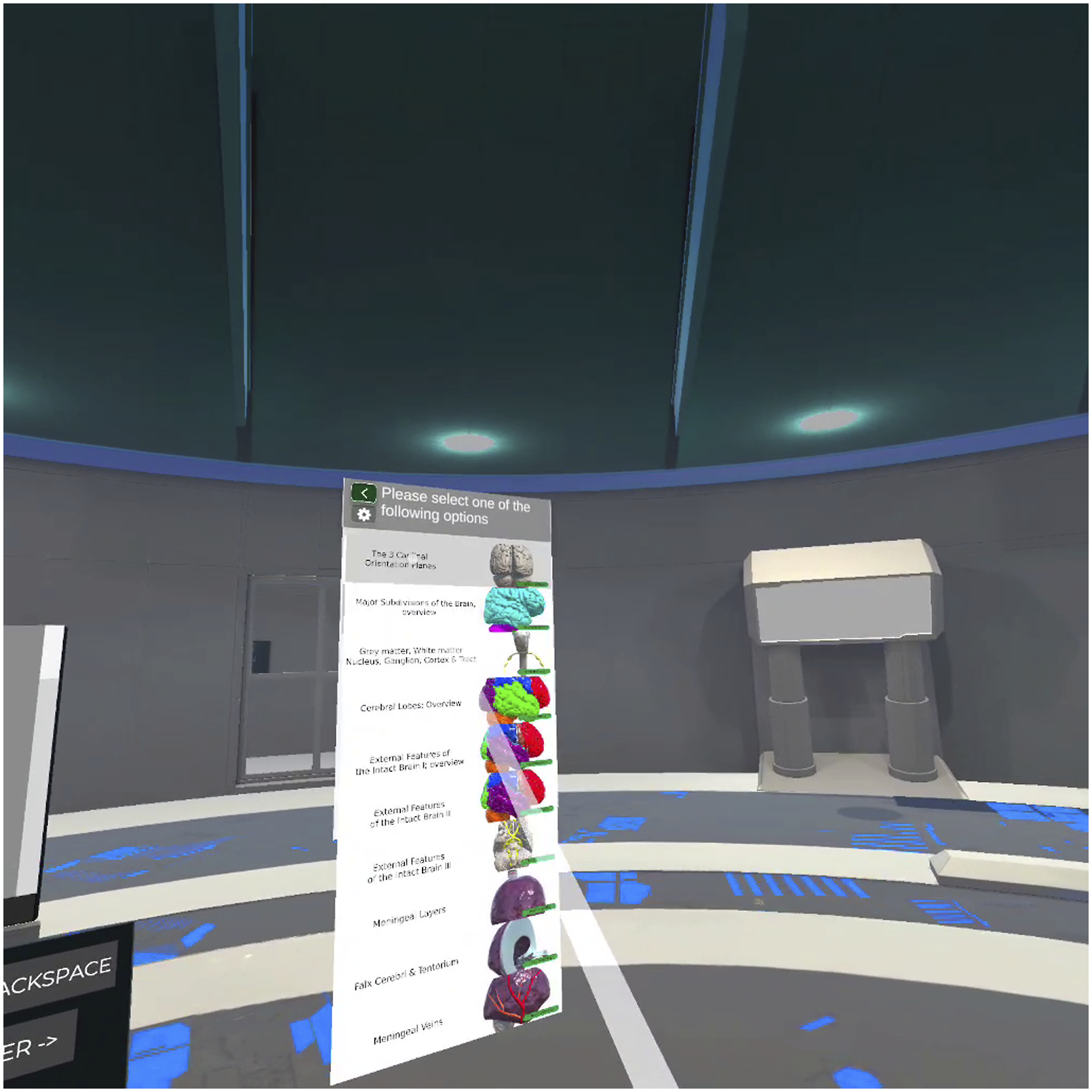
In regard to performance expectancy, users’ assessed VR has met their expectations. A variety of validations have been identified, signifying this novel technology has the ability to improve users’ academic performance. Nevertheless, the current study did not evaluate users’ academic achievement in association with VR learning due to time constraints. Excerpt from the participants indicating optimism that VR potentially speeds up learning. Various comparative studies confirmed that VR enhanced learning achievements versus traditional learning.21–23 Notwithstanding, participants in this study agreed that VR could not serve as standalone resource for neuroanatomy, but more of a complimentary source in addition to lecturers, laboratory, and printed sources.
Prior studies have noted that the sum of effort in using a technology is inversely proportional to users’ acceptance.24–26 In this study, similar findings were reported. Effortless interaction and understandability of the lesson’s materials became key indicators for the users in accepting VR technology. Ding (2022) suggested ensuring portability of VR devices while maintaining level of immersion and interaction within virtual environments. With respect to using VR for personal learning, purchasing HMD was not considered among the participants in this study due to the price affordability.
Social influence constructs measure users’ perception toward others' recommendation in using the system. The current study assessed teachers’ and peers' influence to the users. Participants of this study highlighted that teachers’ standpoint in suggesting VR as an educational resource were subject to the age group and digital literacy. In addition, peers’ interaction for neuroanatomy learning was expected by the students, where giving recommendation to use the system likely to occur. However, those suggestions were not taken immediately. The users appreciated others’ recommendations but remain count on individual decisions in using VR. Centennial generations are less prominent to the need of instructor of peer influence.
In the past years, growing interest of utilizing in higher education virtual reality has been reported. It may be offered as an embedded curricular activity or accessible from certain units at the discretion of students. 25 In this study, VR is available within the Department of Neurology and accessible upon students request throughout their courses. Overall, institutional support in using VR for neuroanatomy is deemed adequate. Participants acknowledged the university initiatives and efforts despite also mentioning several areas that need to be improved.
In provisioning VR for neuroanatomy learning, technical infrastructure is available to support the system use. It includes the HMDs, software, network connection, room allocation and designated agent. Therefore, perceived availability of assistance during system issues encounters or hardware-related problems is essential. Provision of training, documents guide or technical specifications necessary to ensure that users are reassured during their VR experience. 27 If necessary, knowledgeable individuals with the VR system should be assigned to manage inextricable cases that may emerge.
University studies in general expect students to be self-directed learners. It implies that the teacher and institutions serve as facilitators to stimulate learning. One interesting finding of this study is that, despite students did not fully considering their peers recommendation in using VR, they expect group interaction during the learning sessions. Joyful experience listed as prerequisite for neuroanatomy learning, in which group facilitated sessions allow students to interact and share their knowledge.
With respect to the initially released version of the application, it was found that users’ satisfaction of VR ranges from moderately satisfied to satisfactory. Factors influencing users’ satisfaction in this study were prior experience, personal expectancy, hardware specifications and system performance. Successful implementation of VR demands integration of the influencing factors at the time of design, development, and system adoption. Therefore, to improve users’ satisfaction of neuroanatomy VR it features continuous iterative process involving end users.
In the final part of the interview, participants were asked about their intention to use VR. Positive impression toward future VR use associated with certain criteria. Furthermore, use behaviour is linked to the direct influence of facilitating conditions and behavioural intention. Nevertheless, their intention to use VR for future education is contingent on the system state. A fully operational system, bugs-free VR application is one of the anticipated products for enhancing learning. Perhaps, the most striking finding is that VR claimed to be highly appropriate for entertainment, not an educational resource.
Beyond neuroanatomy, medical education could take advantage of VR. Visual based lessons and procedural knowledge are among frequently suggested domains. Numerous studies in medical and health education fields have introduced VR, despite remaining in piloted phase. Recent advance development of technology motivates researchers and educators in applying VR to various fields, not merely exclusive to university studies but learning institution in general.
All the participants agreed to recommend this neuroanatomy VR for their classmates or prospective students. It can therefore be assumed that motivational factors among participants were intense. Participants’ behavioural intentions are directly influenced by performance expectancy, effort expectancy and social influence. In this context, VR system fulfil users’ needs and expectations, therefore advocating them in rendering recommendation for others.
The current study is subject to several limitations. First, the number of participants and chosen sampling method in this study could limit the amount of gathered information. Second, at the time of VR interaction, participants’ experience was not standardized in terms of duration and group dynamic. The degree of experience perceived by participants in this study could affect their acceptance of VR. Third, this study did not incorporate system metrics and logs, which may provide meaningful insights related to user experience.
Conclusion
In conclusion, this study has evaluated that identified constructs from UTAUT that are important for students’ acceptance of VR for neuroanatomy learning. Despite students’ behaviour and perception are positive in terms of employing VR for learning modality in neuroanatomy course, the evidence from this study suggests that usability issues, system performance and depth of lesson are affecting their acceptance. Addressing concerns that emerge from this study is essential to achieve successful implementation of the system for learning resources and enhance the users’ acceptance.
Footnotes
Acknowledgements
The authors thank Tobias Karlsson for his support in recruiting the participants in this research; as well as students from Undergraduate Medicine and Global Master’s Programme who have participated in this evaluation study.
Author’s contributions
All authors contributed to the study conception and design. Material preparation and data collection were performed by Dimas S.E.W. Sumunar. Initial data analysis was carried out by Dimas S.E.W. Sumunar and validated by Natalia Statakharou and Nadia Davoody. The first draft of the manuscript was written by Dimas S.E.W. Sumunar and all authors commented on previous versions of the manuscript. Review and editing was conducted by Natalia Statakharou and Nadia Davoody. All authors read and approved the final manuscript.
Declaration of conflicting interests
The author(s) declared no potential conflicts of interest with respect to the research, authorship, and/or publication of this article.
Funding
The author(s) disclosed receipt of the following financial support for the research, authorship, and/or publication of this article: The ENTICE was Co-funded by the Erasmus+ Programme of the European Union and a Knowledge Alliances for higher education Project (612444-EPP-1-2019-1-CY-EPPKA2-KA). Dimas S.E.W. Sumunar was awarded a scholarship from Indonesia Endowment Fund for Education (LPDP) number S-1876/LPDP.4/2021.
