




Abstract
This article reports the results of a case study of the consequences of mobile device use for the work practices of operating room nurses. The study identifies different patterns of mobile technology use by operating room nurses, including both work-related and non-work-related use. These patterns have multiple consequences for nurses, such as improvements in information access, e-learning and work-related communication, as well as a perceived increase in distractions from the collaborative work. We conceptualize these consequences in terms of three level effects and explain how we find both positive and negative consequences on the third level. On the positive side, improvements were found in how nurses spent their unoccupied time during the stable parts of operations, contributing to their well-being and job satisfaction. A negative consequence was the perceived increase in distraction from the collaborative operating room work practices.
Keywords
Introduction
Over the past decade, we have seen a proliferation of mobile technology in healthcare, for seeking out clinical information, communicating with colleagues, e-learning, taking pictures and videos. 1 In a 2013 survey of 1063 healthcare practitioners, 86 percent reported using smartphones for professional purposes. 1 The use of tablets and smartphones accounts for more than 40 percent of a typical clinician’s digital time at work, 1 some US medical schools require students to use a mobile device2,3 and almost 50 percent of mobile apps target physicians and medical students. 4
The adoption and use of mobile devices are sometimes found to produce beneficial effects for the quality of care in terms of increased efficiency of communication, reduced time spent on searching information, flexible access to patient information and decrease in the number of errors.5–10 On the other hand, there are also concerns over potential problems that might be created by mobile devices, with the problem of distraction quite often mentioned.11–14 However, current research provides little information with regard to such unintended consequences of using mobile technology in clinical practices, instead focusing mostly on evaluating the efficiency gained with the use of mobile devices 7 or implementation processes. 8
Our study aims at identifying both intended and unintended effects of the introduction and use of mobile devices on healthcare work practices, using the case of the use of mobile devices by operating room (OR) nurses. This setting is particularly suitable for our research question for several reasons. First, in spite of strong debates concerning the use of mobile devices inside the OR,15–17 only few empirical studies have been conducted on this question. Second, the work of OR teams is collaborative, and it is important to study how this collaboration is potentially affected by the use of mobile devices. 18 Finally, our focus on nurses provides additional insight that goes beyond the dominant groups researched (physicians) and hence complements the studies of the effects of mobile technology on the work practices in healthcare.18,19 Our study identifies different patterns of mobile technology use by OR nurses, including both work-related and non-work-related use. We identify three specific concerns regarding the possibly distracting nature of mobile device use, and three justification strategies used by nurses to account for their mobile device use inside the OR. By doing this, we respond to the calls by health informatics researchers to provide in-depth explorations of multiple contradictory issues of technology introduction and capture how participants perceive and make sense of the technology introduced in their work.7,8,18,19
Mobile devices in healthcare work: the need to study use and unintended consequences
Research has documented various consequences of mobile devices for healthcare professionals’ work practices, like benefits in terms of productivity, communication, information access, decrease in medical errors and improved patient care.7,9,10,20 Reviews on the topic, however, conclude that, paradoxically, most studies on the consequences of mobile devices introduction provide insufficient insight into how mobile devices are actually used by healthcare professionals in situ. In other words, previous studies rarely consider important contextual elements of work practices that are being impacted by mobile devices, particularly ignoring questions of where exactly mobile device use occurs in the hospital and whether the devices are actually used in the way that was expected.7,9,21 Reporting the actual consequences of mobile device use, including unintended ones, however, is essential. Some selected studies show that, like other technologies in other settings, mobile devices in healthcare are often used in ways that are not exactly in line with designers’ and implementers’ intentions. For example, despite the fact that tablet computers are intended to be used for “bedside care,” studies show that physicians choose to use these devices away from the patient, in the corridor of the ward, 22 thereby missing out on the opportunity to both directly input and view data at the point of care. 9
One of the unintended and rarely considered consequences of mobile device use is the issue of distractions that mobile devices can represent to the tasks the healthcare workers are involved in. Distractions are instigated by activities or stimuli that are irrelevant to the task yet compete with this task for a person’s attention. Thus, they divert a person’s attention from the focal task, causing cognitive interference since they draw on the same cognitive resources that are required for that task.23,24 As a consequence, a person who is distracted is less involved in the focal task and the people with whom that task is performed. The issue of distractions caused by mobile devices has been raised as a concern in the discussions about mobile devices use by the medical professionals in the popular literature11–14,17 and in some academic publications,15,16 but did not yet receive enough attention in a broader academic literature estimating the impacts of mobile devices on healthcare work. There are some descriptive data estimating the magnitude of the phenomenon: in a survey of 439 cardiopulmonary bypass technicians, 55.6 percent admitted using a mobile phone during surgery, 7.3 percent acknowledged that this use negatively affected their clinical performance and 33.7 percent said they had seen another co-worker during a surgery distracted by their behavior. 16 The findings of this survey have also generated heated debates among OR practitioners.15,17 There are some calls for regulations, but evidence on the possible distracting effects of mobile devices in healthcare is barely sufficient to make informed managerial decisions. Therefore, empirical exploration of the effects of mobile devices on the work practices of OR teams is called for.
Methods
Our study was conducted at the department of anesthesiology and operative care at a large urban academic hospital in the Netherlands. From 2010, all OR assistants (anesthetic and surgical assistants) were provided with a mobile device (iPod Touch), purchased through their personal learning and development budget. The aim of this project was to provide OR assistants with easy, portable access to work-related information, such as surgical instrument lists and instructions to prepare for specific surgeries. By 2012, around 180 OR employees (approximately 90%) were using mobile devices, providing an ideal setting for this study. The employees used a special “learning and development budgeting scheme” to pay for the mobile devices, which increased their feeling that it was a personal device and it was allowed for them to use it flexibly. The guidelines of the iPod use provided by the hospital were minimal and included basic policies such as obligatory password protection and the obligation not to distribute any hospital-related information outside the hospital.
The study reported here was part of a larger investigation. The findings of this article rely on the data obtained through observations of OR teams’ work practices and semi-structured interviews. OR staff was shadowed over 16 full-working days in February–April 2012, 10 full days in July–August 2012 and 5 full days during March 2013. The aim of the observations was to capture in rich detail the OR assistants’ work practices and to observe the extent, location, frequency and type of iPod use during the everyday work practices and any effects of such use on work processes. The observations were further supplemented with semi-structured interviews with 35 OR assistants. During interviews, assistants were asked to describe their experiences with mobile devices used in the OR and voice any concerns. Interviews lasted between 20 and 90 min and were recorded and transcribed. In addition, we distributed a survey among the OR personnel, filled in by 17 OR assistants, in which we asked them to describe three advantages and three disadvantages of the iPod in an open format.
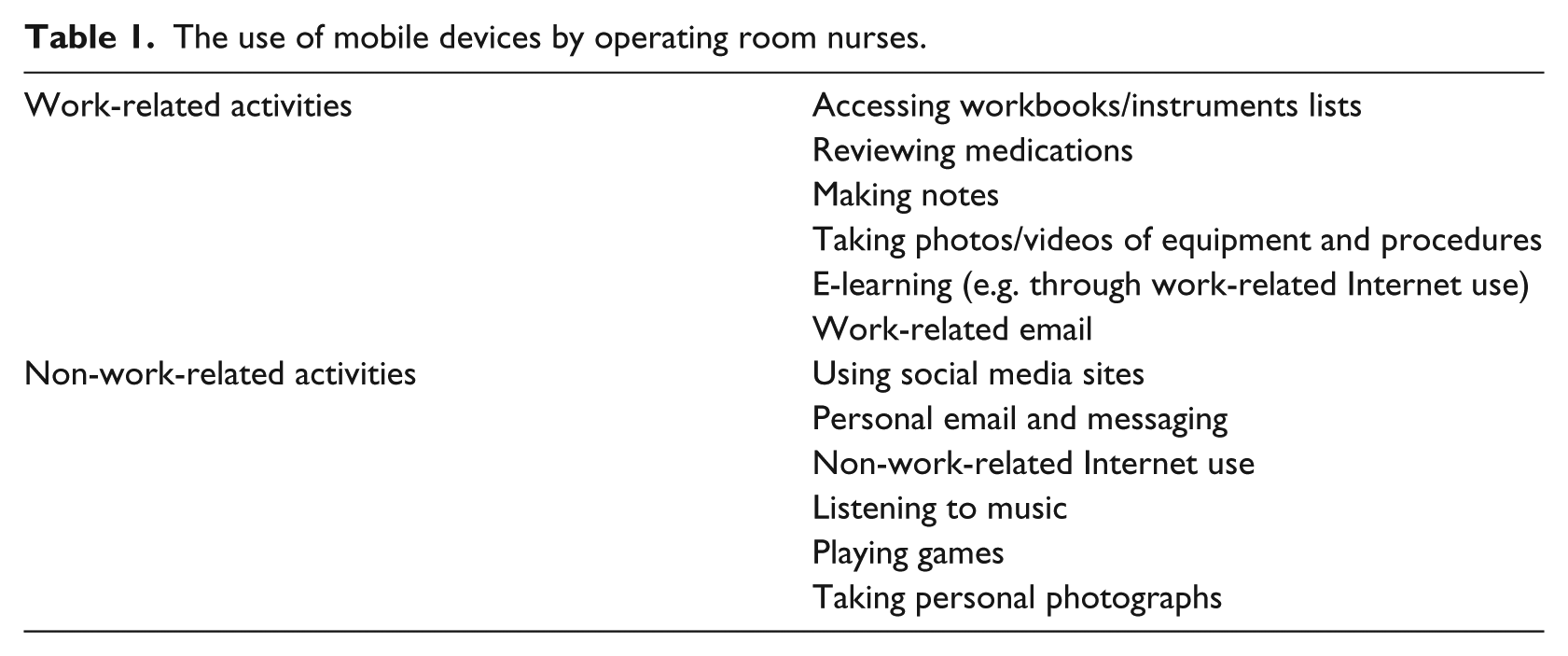
Interview transcripts, field notes and answers to the open questions of the survey were analyzed inductively. We first identified how the iPod was used and classified this use into various activities (Table 1) and then we focused on the statements respondents made about the consequences of iPod use for their work. Based on that, several types of consequences were distinguished (e.g. saving time, enhancing communication, increasing distractions). Comparing the uses and consequences with each other, we noticed that the respondents voiced concerns regarding distractions and interruptions in their collaborative work. This topic therefore became the focus of our study and we went back to the literature to read about the nature of distractions and interruptions in healthcare work25–29 to zoom in on it as a possible consequence of mobile device use. Given that these concerns were pronounced in our data, we decided to focus our study on the topic of unintended consequences, and distractions in particular, and see how our case could complement the research on distractions and interruptions in healthcare.25–28
The use of mobile devices by operating room nurses.
For further discussion of our findings, it is important to clarify the distinction between the two roles that OR assistants can take in surgery: scrub and circulating nurse. Where the scrub nurse is sterile, close to the operating table and directly involved in the surgery, the circulating nurse is non-sterile, not directly involved in the surgery, providing a bridge between the operating table and rest of the hospital. It is necessary to understand that OR assistants normally switch between performing scrub and circulating duties—with an average of two to four surgeries each day, role switching occurs once or twice a day. It is also important to note that the collaboration between these nurses strongly relies on implicit coordination: a circulating nurse is supposed to follow and anticipate how the surgery is proceeding, anticipating on the scrub’s needs and dynamically adjusting his or her individual work practices to fulfill those needs. There are periods during the surgery (usually the middle part) when the circulating nurses are on a “stand-by” mode when their efforts are not directly required by the team. During these periods, circulating nurses usually conduct various activities not directly related to the ongoing surgery, such as cleaning up, preparing for subsequent procedures, reading or sitting next to the team observing the surgery. The introduction of the iPods provided circulating nurses with opportunities to use this stand-by time for other tasks, for which they previously had to go out of the OR (e.g. emailing).
Findings
Frequent iPod use by nurses was observed in multiple locations of the hospital—in the halls, storage rooms when collecting equipment and instruments, instrument preparation rooms, break rooms, as well as inside the ORs during surgery. The iPod use was observed during almost every surgery, but was limited to those team members who are non-sterile—the circulating nurses—and to the periods during the surgery when circulating nurses were on stand-by mode and their efforts were not directly required by the operating team. Devices were set aside while handing instruments, adjusting equipment, touching and working with the patient and when other activities required the circulating nurses to use both hands.
The aim of introducing the iPods was to improve OR nurses’ access to information—mainly instrument lists to help prepare for surgeries. Significant time and effort savings were attributed to a PDF reader application (GoodReader®), which also allows users to make annotations—a function useful to highlight preferences of particular surgeons, record notes for specific procedures and personalize the layout. Also, downloadable medical apps were used to check unknown medications. Nurses used Internet to check unknown abbreviations, read and learn more about specific procedures or instruments. Furthermore, the nurses started to utilize the camera function to record specific arrangements of instruments on the table, or configuration of equipment, to learn and remember new or specific procedures. The camera also started to be used to take pictures of broken equipment to communicate problems to technicians or the sterilization unit, and when surgeons asked OR assistants to take a picture of something medically interesting discovered during the surgery.
The email function offered by the iPod also allowed instant and easy sharing of visual or written information with other staff members, also often from inside the OR. Email was used by nurses to read newsletters from management, to coordinate shifts with other nurses and to exchange the minutes of meetings. Combined with the capability to easily transmit pictures made on the spot, the email function thus significantly enhanced the communication capabilities of nurses and the quality and quantity of information received. Therefore, the device served both as a personal information device and as a coordination tool enhancing the ability to communicate and coordinate across boundaries.
Overall, OR assistants described the mobile devices as extremely useful for their work. We found many other examples of work-related use, and the benefits these devices gave: saving time, being better prepared for surgeries, improving learning, supporting knowledge transfer, facilitating external memory building and helping nurses in their interaction with surgeons and other colleagues. In all, 85 percent of the interview respondents stated that they enjoyed these benefits. In terms of ranking the benefits, the answers of 17 respondents to the open survey questions about advantages of iPod are illustrative: the use of protocols, also as intended by initiators, was the one most often mentioned as being the primary reason for using the device (14 out of 17 respondents reported this benefit), followed by email (13 respondents) and the ability to look up information on the Internet needed for doing surgery (10 respondents). Less often mentioned benefits were the ability to have a telephone book with the surgeons’ numbers (2), placing orders for equipment (1) and having larger audience to reach through email (1).
Next to this work-related use of iPods, our study also uncovered that the devices were used for non-work-related and sometimes recreational purposes, such as personal email, Facebook™, messaging friends and family, music, games, taking and sharing personal pictures. Typical activities in terms of work-related and non-work-related use of iPods are shown in Table 1.
Given the standards of sterility and division of work tasks between the OR nurses, inside the OR only circulating nurses were found to use the device for non-work-related purposes, and only during periods of time when they were on stand-by mode and their efforts were not directly required by the team. Generally, non-work-related iPod use was considered somewhat inappropriate and was perceived to potentially negatively affect the collaboration in the OR. In the survey responses, distraction was the most often mentioned disadvantage of iPod use: 9 out 17 respondents mentioned concerns regarding their partners paying less attention during surgery. Other disadvantages mentioned in the survey were the decrease in social contact due to absorption in the iPod during the break times spent in cafeteria (mentioned by three respondents) and colleagues playing games on the iPod (three respondents). These responses are indicative of instances where non-work-related iPod use was considered inappropriate and creating tensions. This led us to explicitly address these issues in our interviews. Concerns with distractions were mainly expressed by nurses when they were reporting their opinions from the standpoint of being a scrub nurse, the team member directly involved in the surgery and who were not using the device themselves at that particular moment. Analyzing the opinions expressed in the interviews, we identified three areas of concern with the potential distractions caused by iPod use: distraction from core clinical tasks, distraction from collaboration and distraction from learning (Table 2).
Concerns over distractions caused by mobile devices.
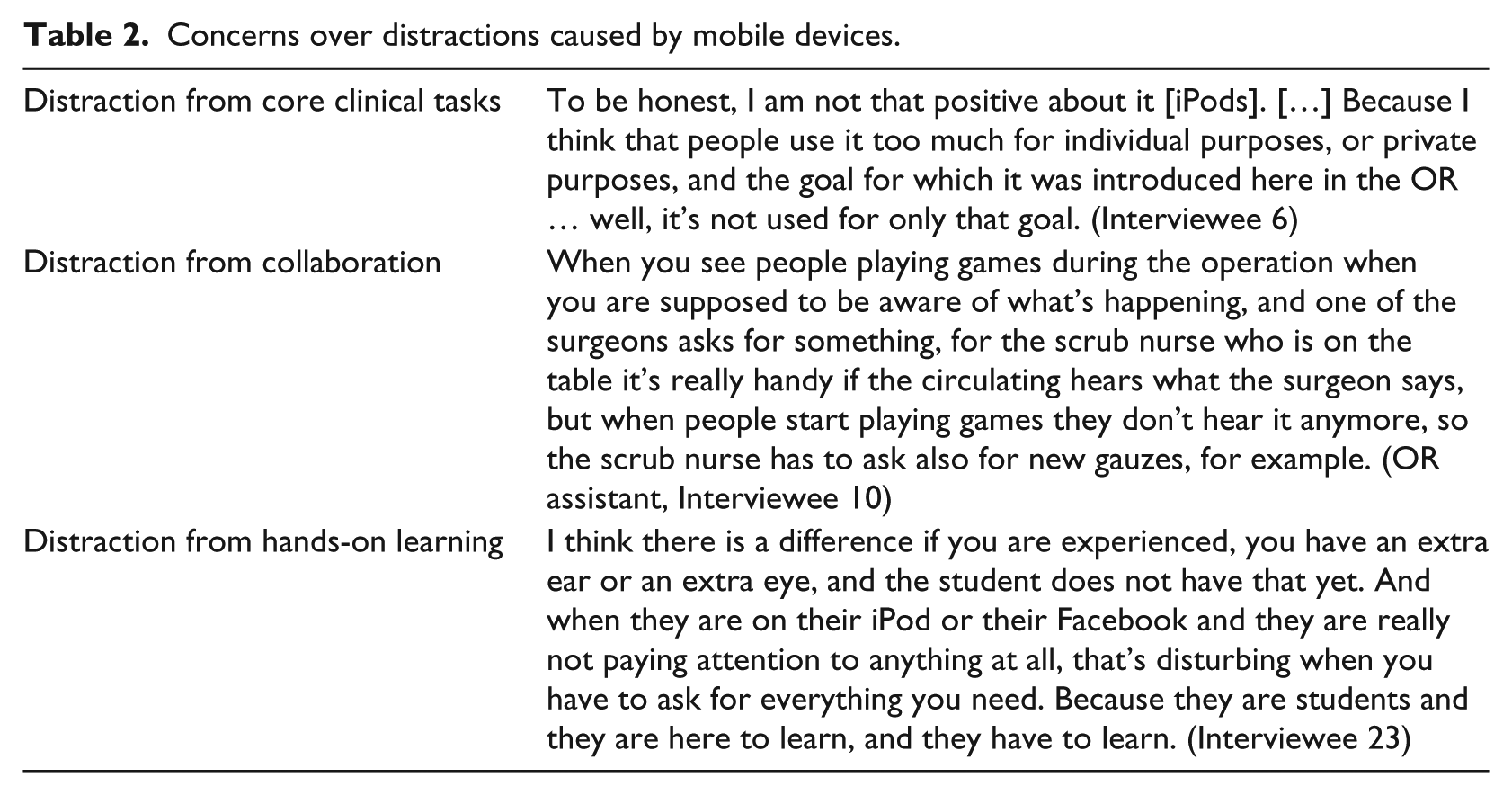
Scrubs had concerns that iPods were a source of potential distraction from core clinical tasks. Scrubs feared that if users were too preoccupied with their iPods, their audiovisual reaction time to work-related duties might be impaired: A lot of people also discovered that you could use Facebook on it, and also games and stuff […]. I don’t like it when they do it a lot, because they are attached to the thing, and I feel that when you are in the hospital, or actually when you are in the OR, and you are doing something on your iPod, whatever it is, you will be distracted from the process, and it takes longer to react on the things that are happening. (Interviewee 12)
Another concern mentioned was that the use of the devices by circulating nurses negatively affected the implicit coordination that characterizes OR team collaboration. Examples were given where the circulating nurse might act distracted by an iPod causing delays in response time, leading to annoyance and distraction of the scrub nurse: Yeah, some people do it a little too often. And you need to ask three times when you need something. That’s not how it supposed to be. Yeah, it happens. And I don’t think it’s good that people bring their mobile devices to the OR. (Interviewee 14)
There were also specific concerns over the iPod use creating distraction from learning by junior trainee OR staff. In the OR, much learning comes from observation and shadowing senior staff and there was a concern that if circulating nurses were too preoccupied with an iPod, then educational opportunities might be missed. Quotations relating to these areas of concern are presented in Table 2.
Analyzing nurses’ responses about their own non-work-related use of iPods and the issue of distractions, we identified that nurses used three justification strategies to account for their iPod use: analogical reasoning, justifying through work value and justifying through work skills (Table 3). By employing these justification strategies, nurses emphasized that the use of mobile devices did not have negative consequences for their clinical duties or their level of attention in general, that it did not produce any problems of distraction to the teamwork in particular, and that this non-work-related use could still be considered beneficial for their work practice.
How users justify their mobile device use in the operating room.
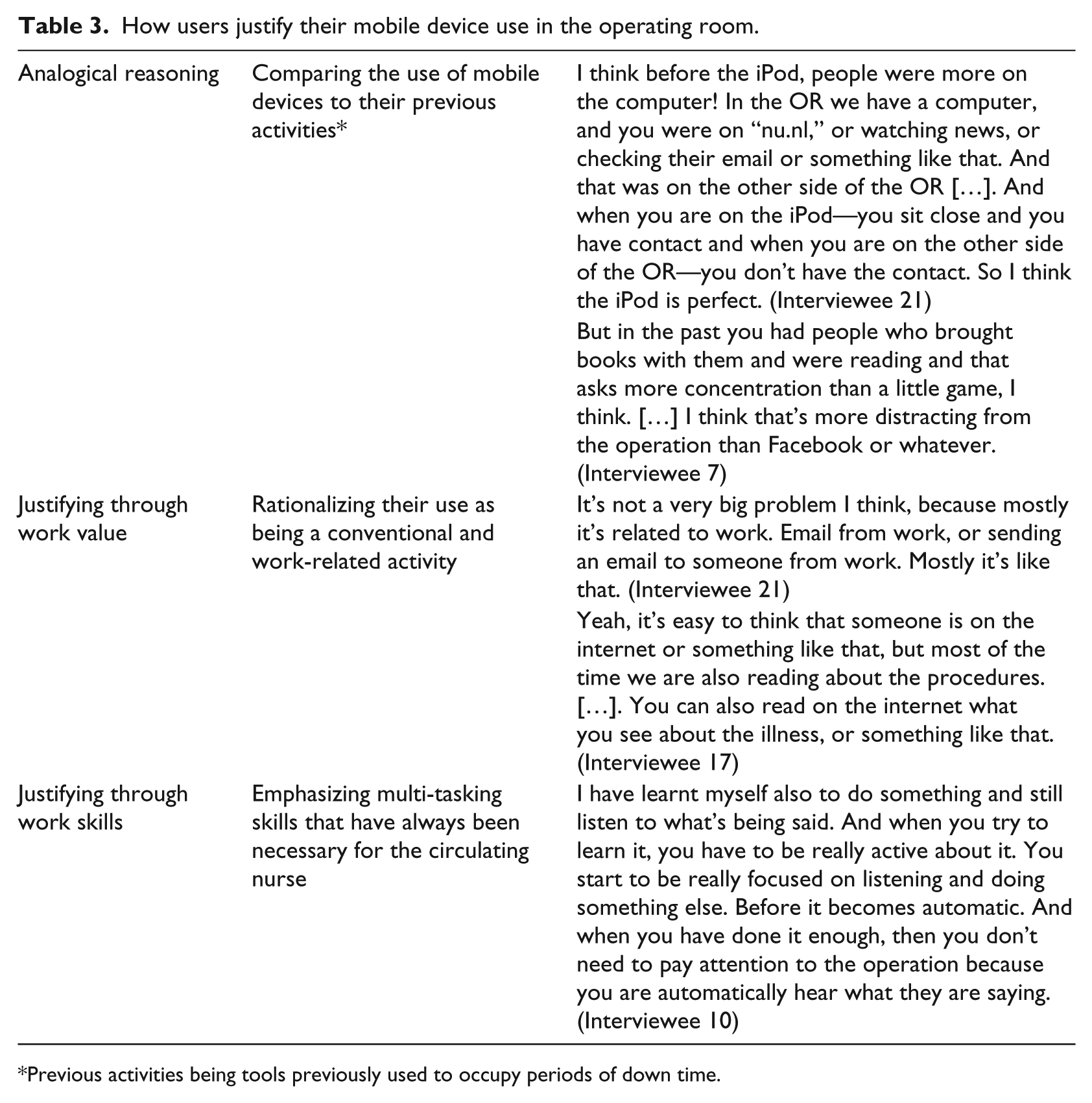
Previous activities being tools previously used to occupy periods of down time.
Discussion
To our knowledge, our study is the first to provide a qualitative assessment of the effect of mobile device use on OR work practices. Mixed methods allowed us to identify both intended and unintended consequences. We found that mobile devices allow easy information access, e-learning and work-related communication (enhanced by imaging and improving cross-functional coordination, with technicians and surgeons), but at the same time are sometimes perceived as creating distractions from the collaborative OR work. More specifically, we identified three areas of concern in relation to possible distracting effects of mobile devices: distraction from core clinical tasks, distraction from collaboration and distraction from learning. Because the mobile device use simultaneously provided many work-related benefits related to efficiency for circulating nurses (the users of the devices), these respondents emphasized advantages over disadvantages. At the same time, because scrub nurses (as non-users) were mainly confronted with disadvantages in terms of distraction, they emphasized concerns over the benefits.
To make sense of these contradictory opinions on distractions, Jett and George’s 30 work on different kinds of interruptions is useful. For the activities of circulating nurses, the distraction caused by the use of iPod serves as a useful break: “anticipated or self-initiated time away from performing work to accommodate personal needs and daily rhythms” which have mainly positive outcomes for the employee, serving a “recreational or rejuvenating function” (p. 498). The positive outcomes of such breaks are especially high in the cases of more routine or monotonous work, 31 which is often the case for circulating tasks during standard operations. In addition, this break allowed circulating nurses to switch to other work-related activities, leading to more efficient use of their time and contributing further to the feelings of higher self-efficacy at their jobs.
For the scrub nurses, the use of iPods primarily was seen primarily to be a distraction—another type of interruption discussed by Jett and George. 30 Distractions are more often associated with negative consequences for the person being distracted and this is exactly what the respondents implied in our case describing how they viewed circulating nurses using their iPods.
Our findings provide insight into the nature of distractions and interruptions in the OR. Most previous research on interruptions in the OR focuses on the surgical (sterile) team and tends to disregard circulating nurses and their work. Although interruptions are found to be hazardous for the surgical team, for the circulating nurse the effects of being distracted are likely more complex. In our study, circulating nurses reported that they felt they utilized their unoccupied (stand-by) time during surgery more efficiently using a mobile device. This allowed them to be more informed about work, and at the same time provided some relief from the mechanical and routine work. In their justification strategies they implied, as mentioned by Jett and George, 30 that because some activities become mechanical and automatic with time, having some distractions might be beneficial. If the circulating nurse intersperses mechanical tasks with reading about the procedure, this distraction may actually enhance their productivity, hence an area for further study.
In sum, our exploration showed that introduction of mobile devices into the work of OR nurses had multiple effects on work practices, which can be conceptualized in terms of multiple-level effects of information and communication technologies (ICTs) in line with the logic suggested by Sproull and Kiesler 32 and Rennecker and Godwin. 33 First-level effects concern anticipated efficiency gains or productivity gains that justify an investment in new technology—in our study, such effects were visible in the improvements in information provision through the accessibility and portability of information. Second-level effects are the unanticipated consequences of ICTs, which arise from emergent responses of users to ICT and the improvised repertoires of use. 34 In our study, second-level effects included improvements in connectivity through email, improvements in personal planning and enhanced personal learning. In addition to these two levels which are directly related to the various uses of ICT, our study also revealed a third-level effect—an indirect organizational consequence of information technology (IT) use, such as the concerns with distractions as reported by the scrub nurses. Interestingly, the third-level effects also included positive effects in terms of improvements in how OR nurses spent their otherwise unoccupied (stand-by) time, contributing to their well-being and job satisfaction. Hence, the third-level effects stemming from the somewhat controversial non-work-related use of the technology simultaneously had both a positive and negative nature—the phenomenon recognized in the Information Systems literature as paradoxes or “Janus faces” of mobile technology.35,36
On the whole, our in-depth account helps to obtain a more nuanced picture of mobile technology’s consequences for OR nurses’ work. In addition, it sheds additional light on multiple faces of interruptions showing that we need to view interruptions in healthcare in context, that is recognize when, how, why and for whom these interruptions occur and with what consequences.
There are a number of limitations to this study. First, by design (exploratory and qualitative), we are unable to establish an exact causal link, that is, estimate the magnitude of effect of mobile device use on distraction and possible consequences. Future studies could use our results to formulate hypotheses and test them in quantitative (e.g. experimental) research to uncover causal relationships and also estimate which consequences are more important for nurses and why. Second, our analysis relies on qualitative data obtained through interviews and observations; hence, our findings are of an indicative nature, and obviously, more research is needed to confirm these emerging patterns. Another point to raise is that we studied the devices provided by the hospital and not the personal mobile devices that were the subject of research in the existing health informatics literature on interruptions. 16 Future research can explicitly focus on identifying the fact that the devices are personal or provided by organization—might have an effect on the consequences of their use. 36
Footnotes
Declaration of Conflicting Interests
The author(s) declared no potential conflicts of interest with respect to the research, authorship, and/or publication of this article.
Funding
The author(s) disclosed receipt of the following financial support for the research, authorship, and/or publication of this article: This project was funded by the Netherlands Organisation for Scientific Research.