




Abstract
Public healthcare organisations are moving towards the use of new technologies to automate and improve their internal processes in order to increase the effectiveness and efficiency of their use of resources. The aim of this research is to tackle the systematic evaluation of an experience of integrating information in a healthcare organisation, paying attention to the implications that this entails. The results show that the integration of the information in the hospital results in higher levels of quality. This study contributes a vision of interrelated work, in which tasks are shared and aims are jointly established.
Keywords
Introduction
The lack of integration of information systems in hospitals – a consequence of using numerous systems and applications – tends to produce data redundancy and overlapping functionalities. This makes the coordination of organisational processes difficult. 1
In recent years, healthcare organisations have been using new technologies to automate and improve their clinical and business processes. They have increased their interest in investing in tools that prioritise the integration of clinical, organisational, and management processes. 2
With the incessant improvement of computer and information technology, these technologies have been widely deployed in the medicine manufacturing industry and reveal a great potential for improving efficiency as well as quality. Enterprise application integration in the medicine manufacturing industry is meant to solve the information sharing and interaction between different application systems. 3
A proliferation of literature has emerged offering new organisational and systems models directed at establishing rationalised services and streamlined organisational structures. Some of the global forces driving the development of integrated systems include the fragmentation of the healthcare system. The main reason for this is that a lack of data integration poses a barrier to effective data reporting and analysis. 4
Organisations that go beyond core system integration will be poised to take market share by virtue of having flexibility to exploit new opportunities and adapt to complex and changing business demands.
Two domains – the clinical and financial – have long coexisted within the walls of the nation’s healthcare facilities. Yet, despite their close proximity, these two worlds traditionally have had little direct communication with each other, tending instead to focus on their separate responsibilities for delivering healthcare. Billers work independently of caregivers and bedside staff members have little concern for the daily activities of back-office personnel. 5
Sooner or later, all expenditures and billings recorded on the clinical side of a healthcare organisation end up in the financial department. Too often, though, clinical and financial applications operate independently of one another, and early attempts to integrate these disparate systems seldom guaranteed the timely collection and transfer of necessary information. 6
To succeed under managed care, healthcare organisations must integrate clinical and financial information. This integration can help minimise financial risk by improving the ratio of costs to clinical outcomes. This clinical–financial integration will require healthcare organisations to improve outcome measurement and cost accounting systems and use tools such as computer-based patient records to more clearly identify the interventions that produce excellent outcomes at minimal cost. 7
Health departments are increasingly recognising the value of sharing information not only between multiple programmes, but also with private sector providers, policymakers, and the public. 8 The integration of an organisation’s transactional functions allows it to have a unified data system instead of a group of isolated applications that offer fragmented data, as well as counting on updated information. This accelerates the communication flow and drives the organisation’s internal collaboration. At the same time, it facilitates the decision-making process.
The literature on management in the healthcare sector supports the application of integrated information systems in healthcare organisations. These contribute to the improvement of processes and the reduction of operational costs. 9
According to Nicolau, 10 enterprise resource planning (ERP) systems are well accepted in hospitals insofar as they provide direct benefits in daily work and facilitate tasks; that said, there also tend to be hostile reactions to ERP systems, because they introduce control mechanisms into daily work and usually require prominent process re-engineering.11,12
The limitations of achieving the integration of different functions in a healthcare organisation are both technical and organisational. 13 This is the reason why partial integration processes are frequently carried out.
Hospitals are complex and multifunctional institutions, 14 and as a result, they require sophisticated clinical and management integration. There are two major approaches to carrying out the integration of information in hospitals: complete and partial. 15 Complete integration means incorporating the clinical, administrative, and financial modules into a single system with different applications, such as the admission and discharge of the patients, wards with first aid kits, and pharmacy billing. This kind of integration means process re-engineering and produces important organisational changes that affect both the working of a hospital and the control that comes from having centralised information. For Anderson, 16 this sort of integration tends to produce rejection from all the personnel – both carers and non-carers – who are usually reluctant to change their way of working or believe that control by their superiors can cause problems for them. For their part, Soh and Sia 17 argue that this method of implementing an ERP may not be valid for the concrete case of hospitals because of the need to use specific tools and carry out process re-engineering. However, this method of integration means efficacy and efficiency for hospital management, which compensates for the outlay. 18
On the other hand, partial integration consists of using the ERP system’s administrative and financial modules and connecting them to a series of specific applications: radiology, laboratory uses, and so on. This means, for example, computerising patients’ histories and thus obtaining an electronic clinical history for each patient. For the medical and nursing staff, this integration is an important foundation for clinical decision-making, as information can be captured in real time and can be obtained anywhere (in the doctor’s office, the operating theatre, the intensive care unit, etc.). Unlike complete integration, there is no thorough process re-engineering and therefore it is not necessary to modify the working methodology substantially although it still means a greater degree of control.16,19 This raises the question of whether perceiving that centralised information can be used to establish control mechanisms could generate rejection although the personnel’s work procedures will be maintained and improvements in the available information will be achieved.
Systems are being developed along this line in which healthcare information is at least partly integrated with economic–financial information, such as that carried out in the Alcorcón Foundation University Hospital (HUFA). However, in parallel to this implementation, evaluation processes are necessary. These allow the identification of the new systems’ contributions to the organisation. The success of health information technologies should be evaluated by developing specific tests of evolutionary fitness, 20 as most evaluations are conducted from the point of view of the system’s efficiency and evidence is only gathered once it has been implemented. This is why they have various deficiencies, for example, the lack of a comparison between the situation before and after the implementation, that is to say, a ‘pre-versus-post’ implementation evaluation.21–24
This research tackles the systematic evaluation of an experience of information integration in a health organisation, HUFA, paying attention to the implications that this entails. The aims of this article are as follows:
The success of the integrated system depends on the ERP users’ attitudes towards the system. Therefore, the first objective is to evaluate the users’ attitude towards the integrated system and its perceived value.
The integrated system should improve the usefulness of the information, making it more accessible, reliable, and timely. Therefore, the second objective is to identify the changes in the flows of information and improvement in decision-making with the new system.
The structure of this article is as follows: the next section analyses the role of ERP systems as tools for integrating business data and presents the evaluation framework. We then describe our research methodology and present the data analysis and results. We conclude with a summary of the findings and their implications.
Background
For Newell et al., 25 ERP systems represent a new class of information system that is designed to help integrate all the key areas of activity of a company, particularly the financial, productive, and human resource functions. The appearance of ERP marked a trend towards the acquisition of standardised information systems, rather than tailor-made systems designed to meet the specific needs of a particular organisation. 26
As a consequence of their division into functional areas, traditional information systems focused on supporting each functional area and only rarely ensured that data flowed smoothly between the different functional areas. This was aggravated by the fact that the information systems of each area had, in many cases, been developed independently, with data formats that were incompatible or did not meet the information needs of the rest of the processes of the business. 27
An ERP system overcomes these disadvantages by integrating the information from the different departments and subsidiaries of the company into one single database accessible to the whole organisation. 28 When a piece of data is entered into the ERP system by any organisational unit, it is immediately available for use by the rest of the company’s organisational units. In respect to this key feature, Gattiker and Goodhue 29 state that this integration brings about an improvement in the flows of information between the various organisational units and reduces administrative costs, as fewer tasks have to be performed to obtain any particular piece of information.
Thus, for a large multinational firm, an ERP system essentially represents a means of homogenising the work procedures utilised by its units, 30 which should lead to greater agility in responding to market demands and reduced inventory levels. 31 However, it is necessary to understand the impact that individual, group, organisation, and national culture variables have on how the process of implementing ERP systems unfolds and what may contribute to its final outcome.32,33
Botta-Genoulaz et al. 34 carried out a review of the literature on ERP systems during the period 1996–2004, in which they report an increased number of studies published in recent years and identify different categories in the functions of the area of interest of these studies:
Implementation of ERP systems. This category includes those studies associated with the various stages in the implementation of an ERP system, the problems associated with the process of implementation, the conditions necessary for the process to be successful, and the reasons why the process sometimes ends in failure.
Optimisation of ERP systems. The idea underlying this type of study is that the process of implementation does not end when the system is first put into effective operation; in the post-implementation period, it is essential to analyse the activities that the system is intended to support in order to optimise the system and thus obtain the expected competitive advantages.
Management by means of the ERP system. These studies focus on considering the ERP system as a management tool, describing the changes that take place in the management of companies that install an ERP system against other aspects that do not change as expected.
ERP software. These are studies that approach the topic from the systems perspective, in which various analyses are made of the aspects associated with the processing of information, the inter-operation of the ERP system with the other systems in use in the organisation, and the adaptation of standard systems to the individual needs of a company.
ERP and the management of the supply chain. These studies analyse the use of ERP systems in the context of companies that form an integral part of an existing supply chain.
Of the five categories of study identified, we consider the aspects associated with the process of implementing the ERP system, particularly in a large complex organisation, to be crucial. Serious problems can arise in organisations with highly differentiated cultural areas; often such areas have traditionally had a high degree of autonomy, with independent information systems and independent control over the interests of their area. Hospitals are one example of such organisations. In these sectors, the success of the implementation process depends largely on the top management giving continuous active support to the project and on the commitment of managers to the concept of integrating functions and improving operating processes. 35 Achieving the participation, collaboration, and acceptance of all the members of the organisation is, without a doubt, one of the principal factors that are critical for the successful implementation of an ERP system. Akkermans and Van Helden 36 state that, during the process of implementation, interdepartmental collaboration and communication will be reinforced if the top managers, the project managers, and the software suppliers all demonstrate a positive attitude. In many cases, the tasks of leadership are particularly important and delicate, 37 as the introduction of the ERP system into the company will modify the procedures within the company and the job functions of some of the employees, at all levels, will change.
Thus, if the anticipated restructuring that will be required is not properly taken into account in the process of designing the ERP, 38 when the time comes to carry out the campaign of awareness and training needed, the process of implementation could lead employees to adopt postures of resistance to the change; this may arise for fear of the unknown or simply due to the sensation of displacement that some members of the organisation will feel.
However, difficulties arise when the management wishes to extend the scope of the information system to include all the information that is generated in the hospital. In effect, a hospital needs an integral system of analysis, planning, and control that allows the procedures that have to be applied to the patients to be planned and executed in parallel with the provision of the capacity required. 39 On this point, according to Khoumbati et al., 13 studies have to be carried out in hospitals to determine how to increase the capacity of the existing information systems at the same time as reducing the costs of integrating information.
Integration brings with it an improved flow of information between units. 29 The implementation of ERP enables a firm to reduce the transaction costs of the business and improve its productivity, customer satisfaction, and profitability. 40 A number of empirical studies demonstrate the positive relationship between expenditures on technology and operational improvements.41,42 More specifically, findings regarding ERP systems indicate their transactional effectiveness, 43 as they provide databases that are more accessible and which therefore reduce general administration costs while boosting efficiency. 44 Furthermore, ERP systems have been shown to reduce the time required to complete business processes and help organisations share information,45,46 facilitating an integrated and coordinated workflow.
The aim of previous research has focused on exploring the critical factors related to the success and failure of the ERP implementation process.35,47–51 These critical factors include top management support, user training and education, change management, business process re-engineering, and effective communication.48,52–54
These critical success factors are helpful and appropriate in explaining both the initial failure and the eventual success of the implementation. 36 However, making an ERP system work is more than an issue of technical expertise or social accommodation: it is an on-going, dynamic interaction between the ERP system, different groups in an organisation, and external groups such as vendors, management consultants, and shareholders. 55 ERP systems might be implemented successfully from a technical perspective, but their success depends on the ERP users’ attitudes towards the system.56,57
Therefore, the evaluation of the success of these integrating technologies is a research question that should be addressed. In order to carry out a systematic evaluation of the integrated system implemented in HUFA, we will use the conceptual framework developed by King and Rodriguez 58 (Figure 1).
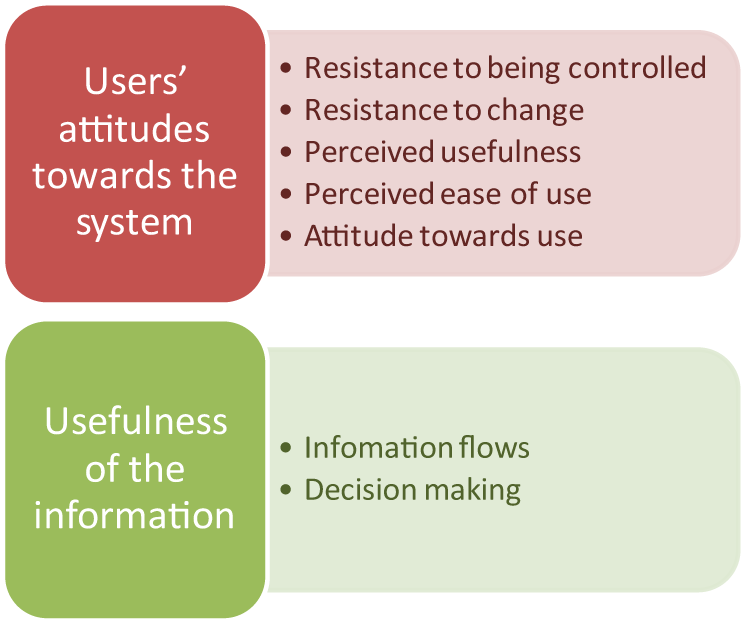
Conceptual framework.
They propose that the comprehensive evaluation of a management information system must take into account two fundamental aspects. The first is to determine how the new system has affected the users’ attitudes and the value that they perceive in it. The second refers to the usefulness of the information. At the same time, the evaluation tries to identify the extent to which the new system has improved the quality of the decision-making process. This is both in the sense of altering the decision-making process itself because of managers having higher-quality information and in the sense of proposing new problems or situations due to having information that did not exist before the implementation of the new system. In other words, it concerns how the new system has improved the managers’ use of information, making it more accessible, reliable, and timely.
The implementation of ERP systems in HUFA
Designing, implementing, and using an ERP system constitute a complex task that cannot be fully understood on its own; it must be analysed within the context of a business environment.32,59 Contrary to other empirical research methods, case studies make it possible to analyse contemporary phenomena in their real context, when the demarcations between the two are not very clear and when multiple evidence sources are used; 60 this has been recommended in order to increase the contact between research and the reality of the business world.15,61 Furthermore, the case study has been recommended as the ideal research methodology for gaining a better understanding of complex phenomena,62,63 and the implementation of an ERP system in an organisation with sharply divided functional areas and professional cultures is a very complex phenomenon. Moreover, case studies allow researchers to produce emergent theory in areas in which knowledge gaps still exist. 64
Research on ERPs based on survey studies has previously been used to identify ERP success factors and provide statistics on ERP adoption and benefits.65,66 On the other hand, case study research has explored the nature and role of these ERP success factors.67,68 However, since public hospitals’ characteristics differ from those of other organisations, these studies may not fully explain the implementation process in public hospitals. For that reason, we chose to carry out in-depth case study research to provide insight into the implementation process and use of ERP systems in public hospitals, which might not be possible with other methods. 69 In order to lend validity to our data, this study used the triangulation method recommended by Yin. 70 Therefore, multiple techniques were used to collect data for this study:
Two surveys were conducted at two moments in time to identify how both the users’ attitude and the perceived value had evolved.
Informal conversations with personnel from different areas were held away from the work environment in a relaxed setting to avoid more official behaviour that might have affected the information (short or insincere replies).
Direct observation of general hospital functioning as well as each of the specific service areas in order to become familiar with its personnel, peculiarities, management, and so on. These observations were mostly carried out during the morning hours, as this is when the hospital is most active.
Context – the integration of information in HUFA
Due to the informational nature of this study, the selection of the unit to be studied was not random, but specific in nature. 71 This case study was carried out in HUFA due to its public nature, as well as its autonomous administration and economic management departments; its directors showed interest in seeking efficient solutions to assist in decision-making. HUFA, assigned to the Madrid Health Service, was founded under Law 15/1997, of 25 April, which deals with new ways of managing the National Health System. It started operations in December 1997 and currently serves a population of more than 250,000 inhabitants.
Practically from the beginning, the members of the Foundation were convinced that the hospital needed an ERP. Due to this, the integration of clinical and economic-financial information was established as one of the main aims in the strategic plan for information systems.
The HUFA Information System currently has three major modules, interconnected via a series of interfaces (Figure 2).
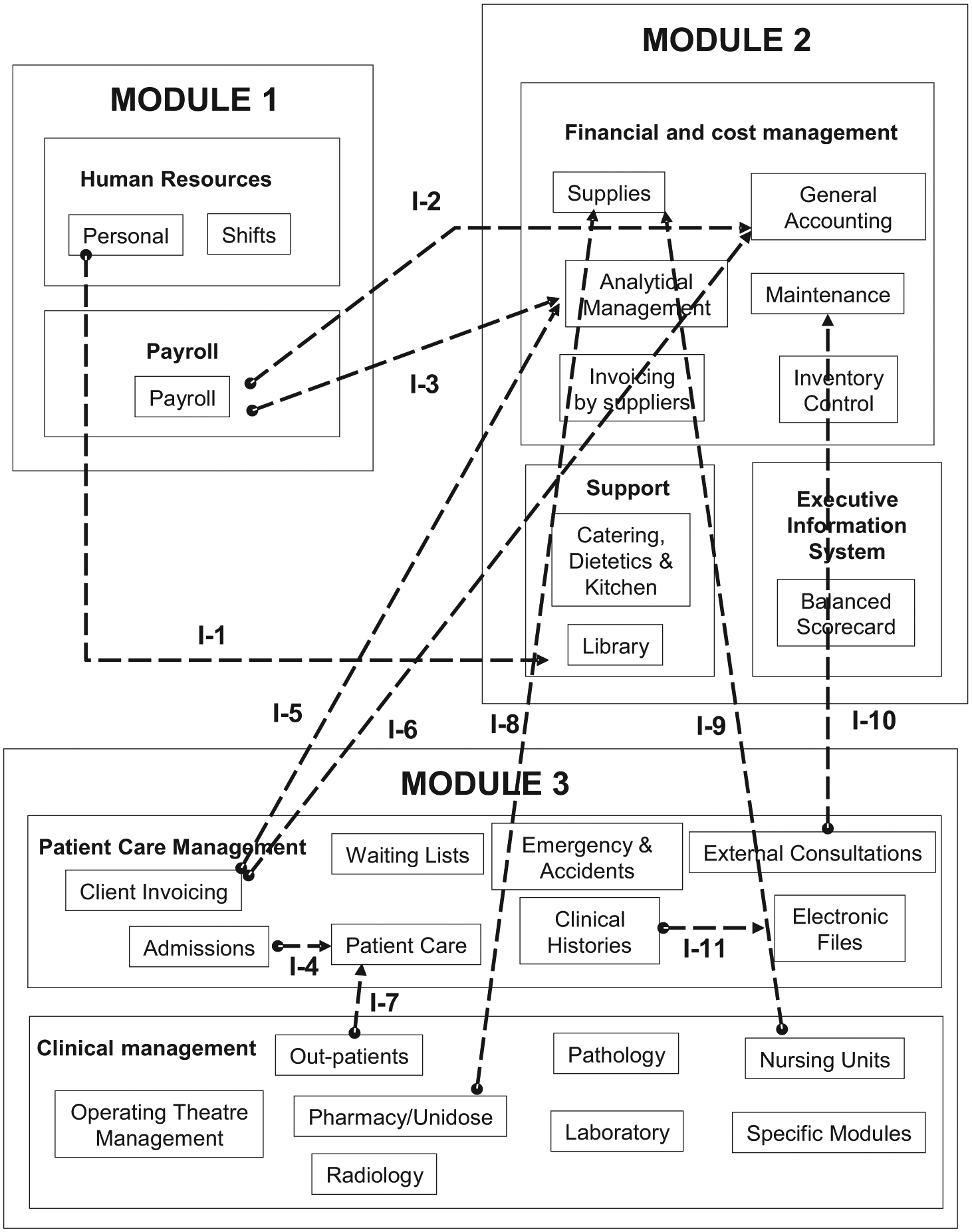
The health information system at HUFA.
The functions included in each module and the 11 applications are as follows:
Module 1. Human Resources (Personnel Management and Management of Shifts) and Payroll.
Module 2 (SAP R/3). Financial and Cost Management (Supplies, General Accounting, Analytical Management and Management of Costs, Payment of Suppliers’ Invoices, Inventory Management, and Maintenance), Supporting Services (Catering, Dietetics, and Kitchen), and the Executive Information System.
Module 3. Patient Care Management (Admission of In-patients, Waiting Lists, Emergencies and Emergency Boxes, External Consultations, Electronic Clinical History, and Invoicing to the Customer), and Clinical Management (Management of Operating Theatres, Radiology, Outpatients, Ward Control Points, Control Infrastructure, Generation of Medical Reports, Pharmacy, Pathology and Nursing Units, Document Manager, Medical Protocols, and the Laboratory).
SAP is the world’s largest ERP manufacturer. SAP’s traditional ERP solution, named R/3, provides ERP functionalities that help businesses to manage areas such as product planning, purchasing, warehousing, transportation, and human resources. HUFA tries to resolve this complexity from a technological perspective using a sophisticated set of interfaces. Although all interfaces were considered when the system was designed, not all were developed. In particular, the interfaces connecting Modules 2 and 3 were not utilised. These interfaces would allow the Invoicing module to be related to General Accounting and Analytical Management and are fundamental to the correct integration of information between Modules 2 and 3.
To develop its activity, HUFA is financed by the Madrid Health Service and regulated by an agreement signed by both parties. Additionally, the hospital provides healthcare to third parties who are required to pay, such as collaborating and private entities (mutual companies), private insurance entities (traffic accidents), and individuals. Moreover, to contribute to the operation of the Foundation’s typical activities, HUFA provides services for collaborations that correspond to sums received from sponsors and business collaborators. These are mostly for clinical trials.
Regarding HUFA’s non-healthcare service provision, there is a payment for the assignment of the Foundation’s physical spaces for exploitation by third parties of different businesses, such as the restaurant or employee cafeteria, as well as the income from different courses provided by the Foundation. To sum up, HUFA’s service provision gives rise to different billable elements which can be classified according to the following typology:
Patient with patient guarantor;
Patient with private guarantor;
Patient with firm guarantor;
Firm.
Implementation of the integrated system in HUFA
For those responsible for managing the HUFA, the information systems are a set of procedures and functions directed towards the collection, production, assessment, storage, recovery, and distribution of items of information within the organisation, and which are oriented towards promoting the flow of these items from the points where they are generated to the final intended recipients. Therefore, the information systems should be an integral part of HUFA’s corporate strategy, as today all organisations are information-based.
The managers think that the management of information is one of the bases on which the organisation operates (in addition to its human and financial resources) and that the incorporation of technology is essential in order to handle the information adequately, not only at the strategic and tactical levels to serve as the support for decision-making, but also at the operating level to facilitate daily clinical activity.
The implementation of the healthcare and financial information project in HUFA has allowed the healthcare activity, supported by the clinical information systems (so-called SELENE), to be connected to the hospital’s SAP R/3 through the hospital’s billing tool, which is called AURORA.
This last tool will enable the hospital to reduce its transaction costs and improve its productivity by reducing the time it takes to complete some business processes and by helping users to share information.
A differentiated file structure has been defined according to the typology of bills in the hospital and for each one of them. These files are transmitted through the HUFA information system.
The integration process begins when a bill is generated in the AURORA system, as a file is automatically created with the text structure defined and a file with the image of the bill. Once the directory has produced the file, it makes a call via an event to an SAP R/3 job. This validates the file, records the document, and attaches the image of the bill to the account document or produces a file with the error log. This is notified via a warning sent to the email client of the assigned users.
As a result, to achieve the integration of the healthcare and economic information in the hospital, it is compulsory to establish agreements and restrictions between the two systems in order to homogenise the structure of the data coming from the different applications.
From these restrictions and from the records of the healthcare activity corresponding to ‘Financier’ (Private, Social, Muface – one of the most important private health insurance firms for civil servants in Spain – International Agreements, etc.) and ‘Area’ (Emergencies, Hospitalisation, Outpatients, etc.) in SAP R/3, the economic record of the service provided is obtained. In this record, the cost centre or the project Personnel Expenditure Projection (PEP) assigned is obligatorily reported in each bill. The PEP elements are objects to which the budget is assigned, having an availability control when recording or committing expenditure. In this way, it can be assured that more is not spent than is received for the activity carried out.
The centre to which the cost is assigned corresponds to the structure of the Homogeneous Functional Groups (HFGs) approved in HUFA.
On the other hand, the management of the research projects in HUFA requires information to be obtained about collections and payments related to the projects that are carried out in the hospital and that are managed in SAP R/3 via the PEP elements.
In both cases, the master data at the centre of the PEP cost or element correspond to a single table that is kept in SAP R/3. This is updated in real time via another interface between the two systems. A second table is used for the billing of non-healthcare activities. This has, according to the kind of ‘firm’ bill issued, the type of value-added tax, the account, and the allocation to the corresponding cost centre or PEP element.
Results: evaluation of the integrated system
Users’ attitudes and perceived value
A field study was conducted in HUFA to compare users’ attitudes and their perceived value of the system. The study was carried out with all the users of this new interface connecting Modules 2 and 3. Two surveys were carried out at two moments in time to identify both how the users’ attitude and how the perceived value had evolved. The data of the first survey were gathered in September 2011, before the integration of the economic–financial and healthcare information was undertaken. The second survey took place in April 2013, once the integration was complete. On both occasions, the response rate obtained was 80 per cent, with a total of 59 valid responses in each case.
The questionnaire included the items related to a series of constructs that allow the evaluation of the users’ attitudes and perceived value of the system. These are described in Table 1. The theoretical constructs were designed from previous research by Carr et al., 72 Davis,73,74 Davis et al., 75 Dasgupta et al., 76 Mathieson, 77 and Moore and Benbasat. 78 The items that make up each of the constructs were quantified via a 7-point Likert scale, in which 1 meant ‘completely disagree’ and 7 ‘completely agree’.
Constructs and items.
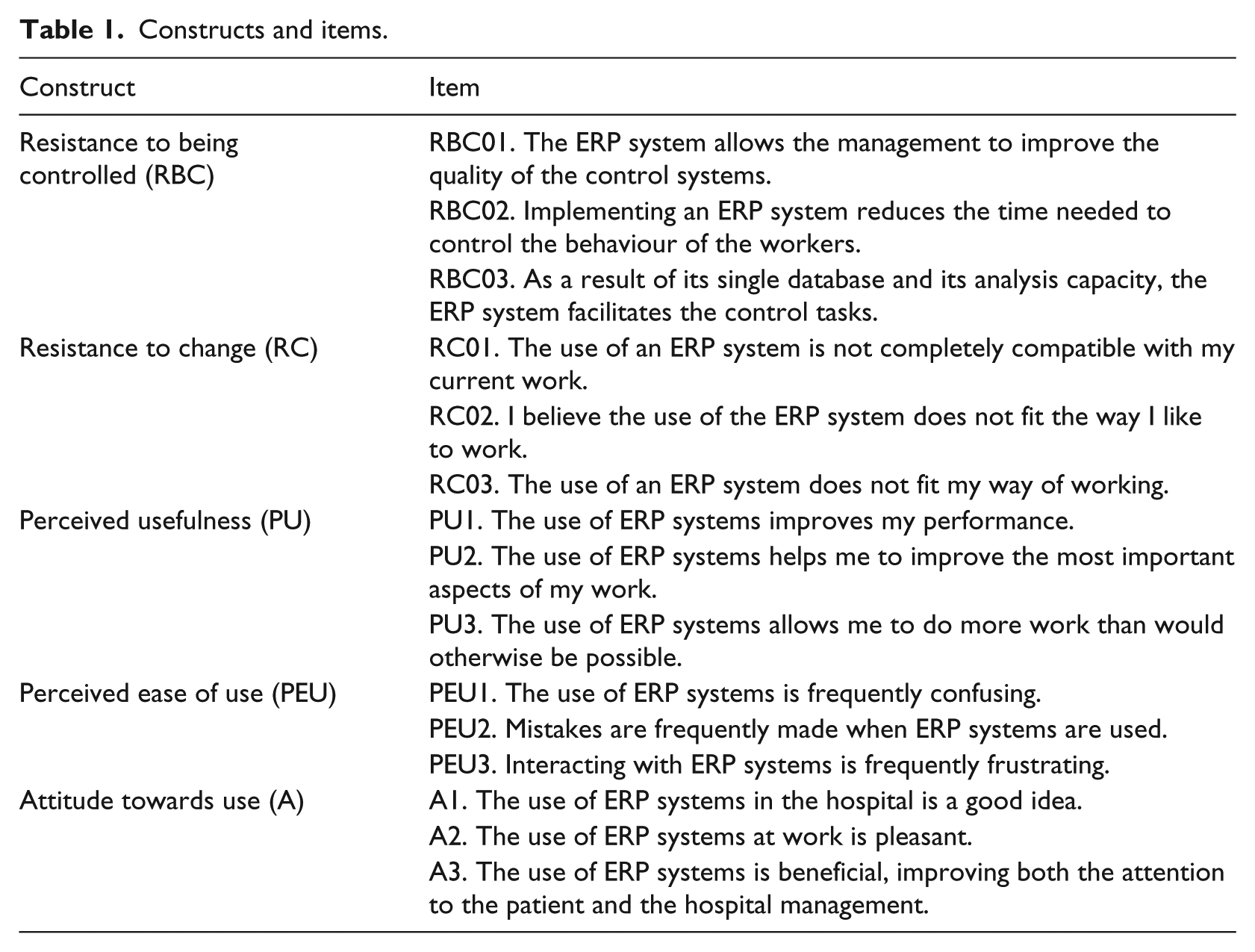
Once the data had been obtained, the results of the two surveys were compared using Student’s t-test.79,80 The results obtained are shown in Table 2.
Results.
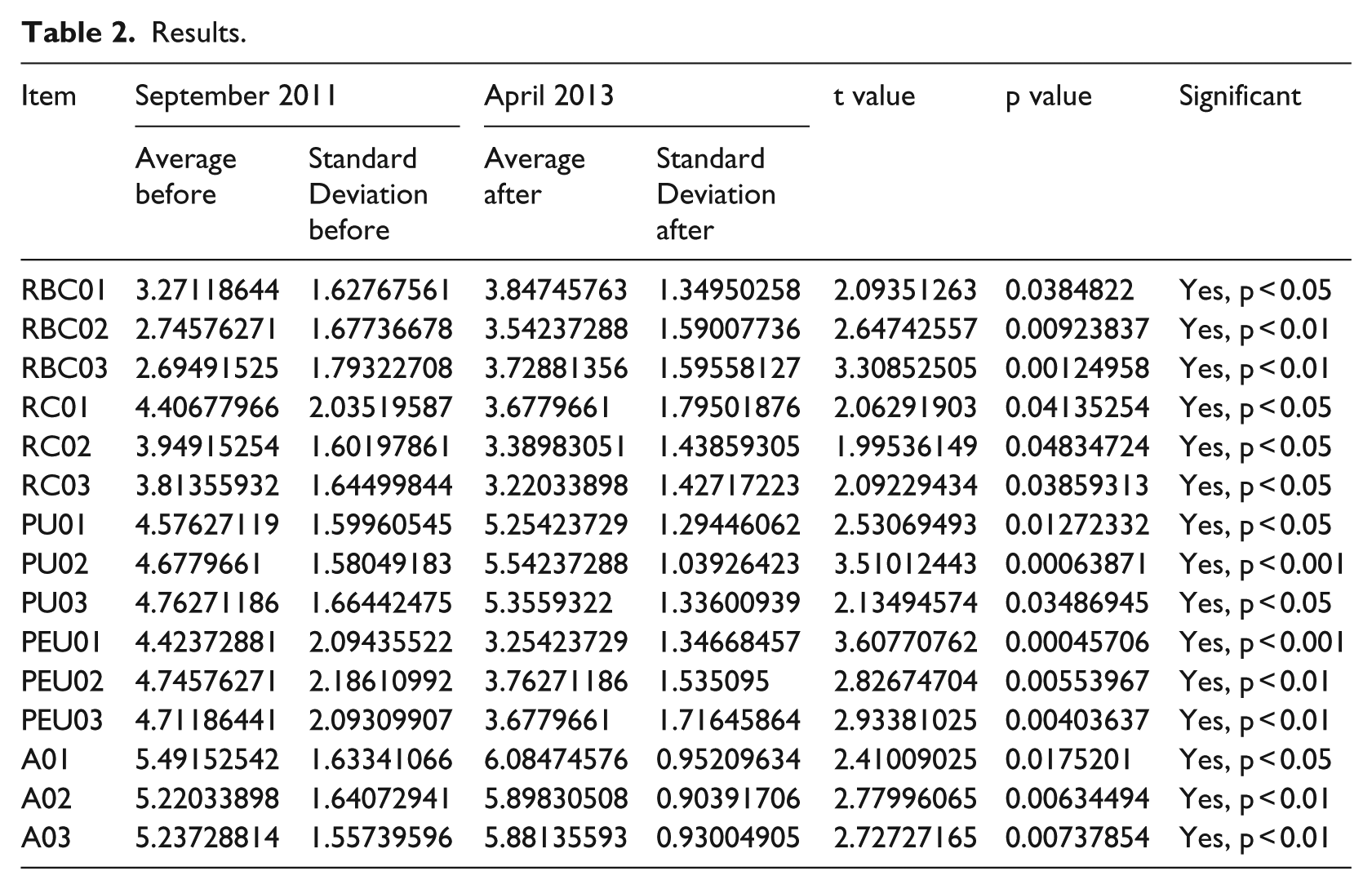
The results (resistance to being controlled (RBC1), p < 0.05; RBC2, p < 0.01; RBC3, p < 0.01) confirm that RBC is a significant factor in evaluating the users’ attitudes and their perceived value of the system. The study shows that RBC varies according to the progress in the project’s implementation. After the implementation of the project in the hospital, the average values of each item show an increase with respect to the first consultation, which was carried out in the tool’s pre-implementation phase. The comparison of the results obtained in the two phases confirms that as the implementation of an integrated information system advances, there is a progress in the reduction of time spent controlling the workers, the quality of the information improves, and the tasks and control systems are facilitated. The users consider the lack of compatibility of the system with their tasks, preferences, and ways of working to be significant (RC01, p < 0.05; RC02, p < 0.05; RC03, p < 0.05). The item resistance to change (RC) shows a decrease in its values between the periods compared. The average of the results obtained in September 2011 and April 2013 varies considerably in the samples observed. As the project advances, the users perceive a greater fit between the new system’s tools and their needs.
Measuring specific variables related to the users’ attitude towards the new system (A) – such as in the case of perceived usefulness (PU) and perceived ease of use (PEU) – has allowed the users’ emotional values to be incorporated into this study.
The results of the users’ perceptions of the system’s usefulness show a significant relationship (PU01, p < 0.05; PU02, p < 0.01; PU03, p < 0.05). Thus, the users’ perceptions of the usefulness of the new information system are consolidated as an influential factor in the employees’ attitude regarding the introduction of innovations into the hospital’s information system.
The study’s findings show an average increase in the PU values of the items consulted (PU01, PU02, and PU03) between the periods compared. This result upholds the idea that with the consolidation of the implementation of the project, the users perceive improvements in performance and in the main aspects of their work. This brings about a reduction of their RC, as has been commented previously.
The PEU results adjust to the standard proposed by the model (PEU01, p < 0.01; PEU02, p < 0.01; PEU03, p < 0.01), while the decrease in the value of the items is broadly noted in the comparative data between the two periods. The users appreciate the improvements achieved with the new tool, as using the new application has allowed them to reduce the errors in their daily work. After the implementation and experiencing the new system, the users feel greater satisfaction and are clearer about the new system’s advantages.
Finally, the results note a significant increase related to the users’ attitude. Once the system had been implemented, the users were satisfied with the benefits it had brought them in their daily work, as well as with the improvements that it offers to the organisation as a whole (strategic planning and results obtained by the hospital, work atmosphere, etc.).
The results show that one of the key factors for the implementation process to be satisfactory is the users’ attitudes and their perceived value of the new system.
The answers on the users’ behaviour and emotiveness towards the innovations of the information systems are a critical factor to be taken into account in any implementation project. The positive attitude detected in the second period of the project increases the willingness to use the tool.
This study has allowed the verification of the hypothesis that, through their behaviour, users’ attitudes play an important role in the implementation process of any technological innovation.
Management of the information and improvement in decision-making
The plan to open the hospital relied on the implementation of management strategies focused on improving efficiency. The ERP system was opted for as being the most suitable for providing computer support to the organisation. It is clear that in the investments carried out by the hospital since its inauguration, priority has been given to the implementation of new technologies and the development of applications and tools. These allow the integration of processes that are clinical, organisational, and related to hospital management.
From the beginning, HUFA was conceived as a modern organisation with a system that integrates clinical and economic–financial information:
The integrated system […] was a hospital ambition; in other words, it was a priority to have an integrated management system providing information. (Nursing) … when I started, the Foundation was quite clear that it wanted an integrated management system; this was evident from the outset. (Economic–Financial)
The decision was considered justified because, based on experience, the members initially comprising HUFA were firmly convinced that it would be very positive to be able to integrate different department data; therefore, they decided unanimously to do so.
From the outset, three factors were decisive in settling on installing the ERP system:
To stop using isolated information systems. ‘The Foundation’s members were a bit tired of having different information systems, each managed by independent persons or businesses with little or no contact between them’ (Economic–Financial).
Involve clinics in management. ‘… clinical management – that is, the involvement of the clinic in running the hospital with set objectives, not in the role of top management, but as an active participant in achieving the goals set by those in charge …’ (Nursing).
Use the hospital as a political point of reference to demonstrate that self-management is indeed possible ‘… HUFA was the Government’s flagship at the time; I think that after 10 years, most of the government has changed, yet we are still here; in other words, we were on the right path …’ (Nursing).
As the hospital was new, so were its staff and its work arrangement. Setting up an integrated information system as well as the necessary tools to prepare data was not problematic, at first, and to a point management viewed it as a challenge:
The need for integrated information was not evident until we had it. (Medical) I come from a hospital in which information systems were practically not used. When I got here to all of this I said, ‘This is great – I love it!’. (Nursing)
As the hospital is practically new, HUFA’s Accounting and Treasury Department is practically automated and almost all the processes are computerised. It has a digital system for issuing and receiving bills, which is available online.
The solution adopted in HUFA implies the use of financial and administrative modules, but keeps the specific applications that have traditionally been utilised in the healthcare industry. In this case, it works with SAP R/3 connected to specific healthcare applications that contain economic information through interfaces. For this reason, it does not have modules that are unified in a single platform. This is what is known as a partial solution.
There is an access to the clinical episodes, which are subject to monetary compensation through the integration of the healthcare activity with billing.
The implementation of this innovation is integrated with the hospital’s ERP and its main contributions to the information management are detailed below. Thus, the renovation of the receiving, recording, and validation processes of the bills received; automating the comparison of the prices of the orders to suppliers with what these suppliers bill; the reconciliations of the units of goods received with the units billed; and the recording (entering) in the bill’s data system have contributed the following advantages:
The management of the different formats of documents of bills received in accordance with the precise financial, legal, and accounting requirements.
The conversion of paper into digital images. The bill’s image is exportable and is available throughout the bill’s processing. It integrates the bill’s digital image with the accounting record in the hospital’s ERP.
It captures the information of any kind of bill at the level of lines of detail, allowing the automatic reconciliation with the order and the delivery note without the user’s intervention.
Regarding the bills issued, the implementation of this research project of integrating healthcare and financial information has allowed the hospital to establish a gateway between AURORA, the billing tool of the healthcare activity (SELENE), and the hospital’s economic information system, SAP R/3.
Concerning the capturing, recording, and exactitude of the information, the main advantages in the implementation of this tool are as follows:
An increase in capacity and shorter response–reaction times in the seeking, recording, collection, and payment of bills.
An increase in the efficiency of the handling process of bills that have been issued, the elimination of bills in paper archives, the introduction of single data from a single module, and the automatic posting of the bills.
Improvements in the access to information, and the synchronisation and updating of information simultaneously in all the related areas. There is a link from the SAP R/3 system to each posted document.
The reduction of errors.
With the solution adapted by the hospital – based on the SAP R/3 connection with specific healthcare applications – the information is totally integrated. This accelerates the flow of information and drives internal collaboration. For example, it decreases the response time for solving any problem related to the information transmitted. Furthermore, the personnel are more committed to a real-time philosophy, as they have less repetitive work, have digitalised information, and do not have to carry out tedious paper archive searches.
Moreover, the connection of the data between the different functions developed in the hospital facilitates the analysis of the information for decision-making. The integration makes it possible to optimise the process of obtaining information. In the past, this used to be extremely complex and laborious due to the time needed to acquire solid and connected information.
On the other hand, the integration of the financial and healthcare information has allowed process re-engineering to be carried out to increase efficiency. Thus, the work procedures have been revised while the resulting tasks have been reassigned along the line discussed by Davenport and Stoddard. 81 This was achieved by taking into consideration the alignment of the technological tools with the organisation’s skills, strategy, and environment. 82
The integration of the information in the hospital has involved the automation of the processes implicated. As a result, numerous routine tasks that the staff performed manually have been suppressed. The integration has allowed the staff involved to be reassigned to other tasks and activities in the hospital with greater value added.
At the same time, with the integration of the information, greater ease and speed in accessing information has been achieved: information is available in real time and the organisational management is more transparent. All this allows not only to increase deficiency in the financial and administrative processes but also to improve efficacy in the decision-making process and the hospital’s corporate process.
There are a number of advantages to amassing information into a single database, all of which favour managing and decision-making. It is evident that
Information can be contrasted and decisions can be made with a feeling of certainty:
The problem in hospitals is that information from different departments (for example, Dermatology, OB/GYN, etc.) is that information is not compared and contrasted. Therefore, the ability to make decisions based on total certainty is always doubtful. On the other hand, once data is integrated, the decision-making process is less risky. (Nursing)
The data obtained are clear and objective:
The biggest benefit of an integrated system is that decisions can be made based on information, rather than suppositions. (Nursing)
Reliability is increased while errors are reduced, which makes it easier to prepare ratios and compare data:
Data obtained from an integrated system are reliable, with a reduced margin of error […] and represent a unique opportunity to control economic and patient information to be able to prepare ratios and comparatives. (Economic–Financial)
Saves time and increases security:
Integrated systems save you from excess work, and provide peace of mind and reliability. (Economic–Financial) … I switch on the ‘on’ button in the morning and can see everything that has occurred. (Nursing)
This is efficient since data are introduced just once and are checked by the internal system controls:
Integration does not only represent efficiency when introducing data, but also ensures solid information, as it can be cross-checked […]. This is great for the Accounting Department. (Accounting)
Doctors and patients also benefit (peace of mind and agility) since patient file management is centralised, providing an electronic clinical history that makes it less likely that tests will be lost (such as analyses, X-rays, etc.). Patient files are lost less frequently, and medication is not incorrectly dispensed as often. Long waits for test results are a thing of the past, even in cases in which several are needed, resulting in considerable savings in consumables:
In this case, having an integrated management system allows us to have most information at hand and to be able to use it in an agile, clear, and connected fashion to handle our patients […]. Doctors and patients do not have to wait for results which are going from one end of the hospital to another, and a great deal is saved in the way of consumables. (Medical)
To sum up, it may be said that the implementation of the integrated information system has allowed HUFA to attain higher quality levels in its service provision. In the hospital’s case, this is centred on the improvement of healthcare service provision.
Conclusion
The presentation of the specific case of HUFA is an example of the integration of different agents of a hospital’s inherent activity, as well as the automation of the processes involved in this integration. The new system in HUFA fosters a cultural change towards interrelated work systems in which tasks are shared and common aims are established. This in turn allows the organisation to improve the quality of the information handled.
Sometimes, it is not easy to deal with this integration process in hospitals because of their organisational issues. The major problems arise in most ERP adoptions because of organisational rather than technical issues, for example, social and cultural barriers and user resistance. Furthermore, the business processes of the company are often substituted for the business processes implemented in the ERP. In hospitals, ERP systems are welcomed as long as they provide direct benefits to users’ work and ease their work practices. At the same time, hostile reactions to the ERP system were evident in HUFA, as it implied control mechanisms of the users’ work and introduced new work tasks previously performed by others.
This study has conducted a systematic evaluation of the solution adopted to carry out integration. The results show how the users’ attitudes and the perceived value of the information system improved overtime. In this particular case, the users do not perceive the higher integration level of the information system to be a negative issue. Therefore, hostile reactions could partially be reduced using the system and by showing that a higher level of integration usually implies a higher level of performance.
On the other hand, the quality of the decision-making process has also improved, both in the sense of altering the decision-making process – due to the managers having higher quality information – and in the sense of being able to pose new problems and situations.
Now that the project is finished, HUFA is continuing to advance towards the design of systems based on the complete integration of information. This last goal would allow HUFA to have a complete description of all its internal and external processes with users, institutions, suppliers, and customers in a common platform.
In this way, all the hospital’s team would function with the same tool. This would allow all the users to be interconnected and the information to be shared through the same tool.
The organisational complexity that is characteristic of hospitals – mainly due to the cultural differences between the different areas – can make advancing down this road difficult. Nevertheless, the need to manage economic resources in an increasingly efficient manner means achieving the complete integration of information through a single platform.
Footnotes
Declaration of Conflicting Interests
The author(s) declared no potential conflicts of interest with respect to the research, authorship, and/or publication of this article.
Funding
The authors received no financial support for the research, authorship, and/or publication of this article.