




Abstract
Healthcare facilities use a number of information system/information and communication technologies. Each healthcare facility faces a need to choose sourcing strategies most suitable to ensure provision of information system/information and communication technology services, processes and resources. Currently, it is possible to observe an expansion of sourcing possibilities in healthcare informatics, which creates new requirements for sourcing strategies. Thus, the aim of this article is to identify factors influencing information system/information and communication technology sourcing strategies in healthcare facilities. The identification was based on qualitative research, namely, a case study. This study provides a set of internal and external factors with their impact levels. The findings also show that not enough attention is paid to these factors during decision-making.
Keywords
Introduction
The focus of this article is information system/information and communication technology (IS/ICT) sourcing strategies, especially factors which influence them in healthcare facilities. An increasing number of sourcing possibilities 1 and a growing outsourcing market (in 2013 Gartner 2 projected a growth of 2.8% and by 2018 a growth of 7.6% is expected with a very important role played by healthcare information systems 3 ) create new needs for modification of sourcing strategies. (The latest market data for the year 2013 have not been published and expectations for 2014 have not been released at the time of writing (Q2/2014). Therefore, the 2014–2017 perspective still remains valid. 2 It should be noted, though, that this data describe the IS/ICT sector in general.)
In healthcare, IS/ICT sourcing strategies are closely connected to information strategies4,5 of each facility. Symbiosis between both strategies is crucial due to the growing importance of IS/ICT. 6
We define a sourcing strategy as a ‘long-term plan of activities whose goal is to propose a concept of IS/ICT sourcing to support the organization’s objectives’. This definition is based on the theory of information strategy
7
and extends the sourcing theory defined as a
business process, which aims to make decisions about which services, processes and resources should be provided internally and which should be provided externally, and further to choose the most suitable service providers, to draft contracts with the providers, to control the services provided and to manage relationships.
4
The question then arises whether two similar organizations should have objectively similar sourcing strategies or whether there are any factors that cause differences in sourcing strategies.
Literature review
On a general level, factors influencing IS/ICT sourcing strategies have been studied and described by several authors. The most significant studies have been by M.C. Lacity et al. Using a multiple case study, they identified a value of IS/ICT and its elements for a given organization, an economic comparison of internal and external options, an organization’s maturity and a degree of integration 8 to be the most important factors influencing sourcing decisions. In their case studies, R. Hirschheimem and M.C. Lacity 9 analysed the following factors: decision scope, an IS/ICT budget holder decision-making processes, an organization size and an expected output of management decisions. If we add indirect studies of factors influencing sourcing decisions,10–13 we can say that on a general level such factors have been sufficiently covered and can be used to create a basic set of factors. A. Ancarani et al. 14 have provided a model and a support tool for healthcare management decision-making (not just for IS/ICT sourcing). Examples of factors affecting these decisions are political preferences, costs reduction, market supply, IS/ICT service importance and a number of IS/ICT services.
Many authors have looked at success and failure factors of individual sourcing forms (outsourcing, multisourcing, etc. 4 ). R. Gonzalez et al. 15 have analysed success factors of outsourcing in Spain. According to their research (a questionnaire survey of 357 IS managers), understanding customer objectives, a choice of providers and the client’s clear idea of what is the desired effect of outsourcing are the most important factors. P. Gottschalk and H. Solli-Sæther 16 have identified 11 factors on the basis of a literature review. Their importance during decision-making in three global companies was analysed. Present core competencies management, stakeholder management and production costs reduction were deemed as the most significant. Researchers also pay attention to relationships between outsourcing service providers and their customers. Due to the fact that relationships between providers and customers have been sufficiently covered 17 and given the aims of this article, they are not discussed at length here, but they were taken into account when creating a basic set of factors, which was then specified for the healthcare environment during the case study.
The current knowledge of factors influencing sourcing strategies is mostly supplied by studies without any industry distinction. According to R. Heeks, 18 recognition of specific factors determines success and failure of healthcare IS/ICT, which can directly influence quality of patient care. 19
Aims of the article
Sourcing strategies in healthcare facilities are affected by a number of specific factors (which are not found or considered significant in other economic sectors) 20 due to healthcare environment specifics; as such they have not yet been sufficiently covered in literature. The main aim of this article is to determine factors influencing IS/ICT sourcing strategies in healthcare facilities. When identifying these factors, specifics of the healthcare environment have been taken into account; so, the identified factors are expected to differ from factors influencing sourcing strategies in other sectors (e.g. banking, telecommunication). This article reflects the current situation in the sourcing strategies research and impacts of the continually expanding possibilities of sourcing in healthcare IS/ICT (see above). The following research questions were posed:
What factors influence sourcing strategies in healthcare facilities?
How strong is the impact of each of the factors on sourcing strategies?
Methods
Qualitative research design
This article is based on a case study, a qualitative research method, due to the need to carry out investigation within the actual healthcare environment to be able to fully understand and verify the defined basic set of factors affecting sourcing strategies from the viewpoint of all stakeholders.
Samples and procedures
The research design and the case study procedures for this article are based on the research design used by M.C. Lacity et al. 8 This approach is based on initial sampling (for this article, we determined an initial set of factors influencing IS/ICT sourcing strategies) and personal interviews with stakeholders to provide specific evidence to identify key factors. The need to investigate factors influencing IS/ICT sourcing strategies within the context of an actual healthcare facility was the most significant reasons for having selected this research design.
A medium-size 21 healthcare facility, a Czech hospital, was selected for this case study. Unfortunately, this healthcare facility did not allow us to publish its name due to data sensitivity. As a result, wherever its name should occur, ‘HOSPITAL’ is used instead. The chosen healthcare facility is a typical Czech medium-size inpatient facility (it meets the conditions of treatment activities diversification and a level of specialization, size, catchment area and ownership): it is a public healthcare facility with the capacity of 444 inpatient beds and with 674 employees (102 doctors). The average annual number of patients is 14,500. The HOSPITAL uses all systems of the traditional healthcare IS/ICT model, 22 which consists of the following: a Hospital Information System (452 users), an Information System for the Radiology Department (180 users), an Operation Support System (102 users) and an Administrative Information System (674 users). Details of the modules in all the systems are shown in Figure 1.
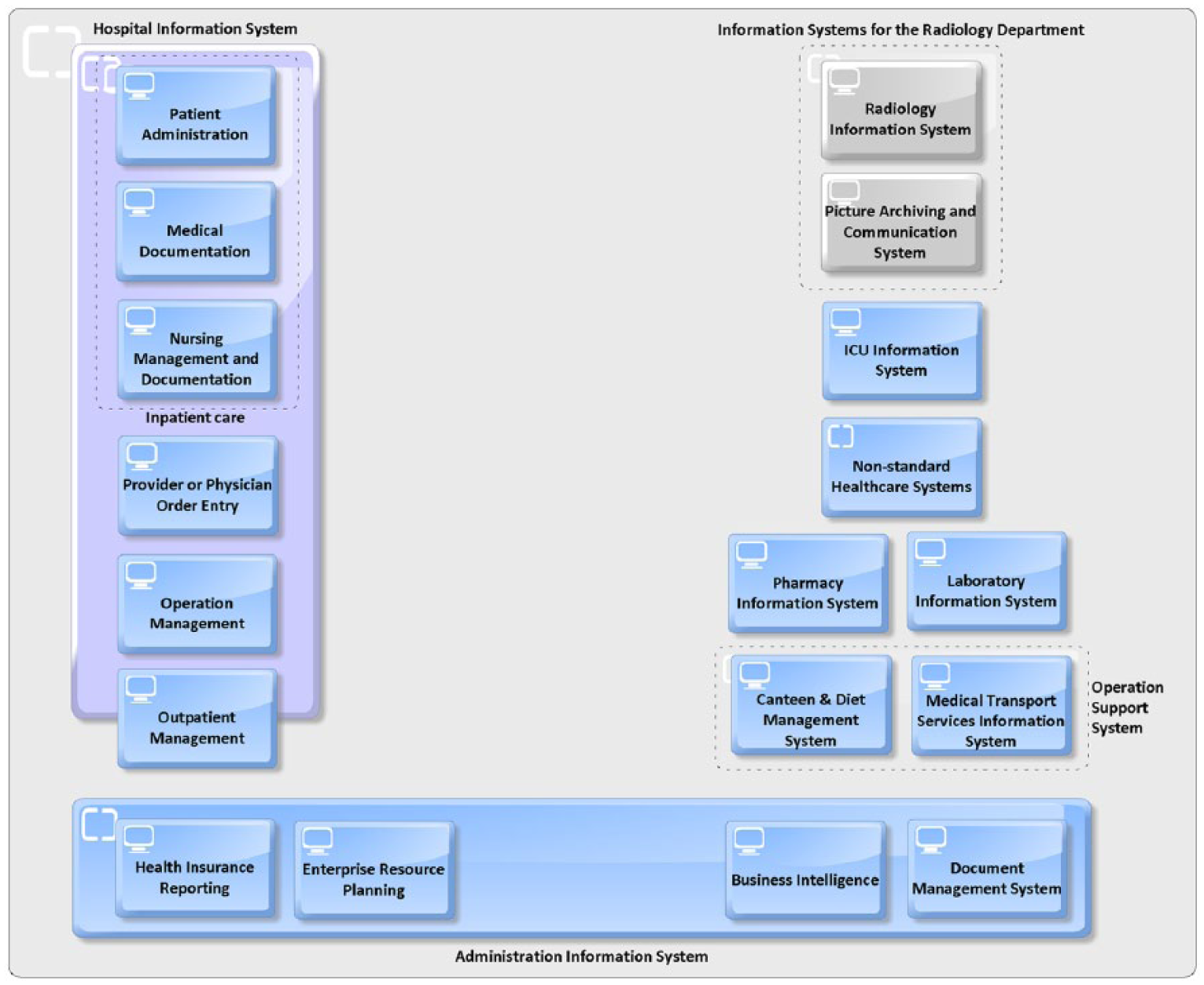
Traditional healthcare IS/ICT model. 22
The stakeholders of this study include patients, the HOSPITAL senior managers and the HOSPITAL staff. They are direct (the senior managers and the IS/ICT executives) and indirect participants (the patients and the staff) in the decision-making process of sourcing strategies. Together, these two groups provide sufficiently divergent views on the whole decision-making process and therefore factors influencing sourcing. During the case study, interviews were conducted. The length of the interviews ranged from 30 min (the indirect participants) to 1.5 h (the direct participants). The beginning of each interview was unstructured to get as much information and opinions as possible, followed by a semi-structured part with the questions drawing on the basic factors influencing sourcing strategies. Other sources of information included several types of sourcing strategies, internal notes, meeting minutes, annual reports and the HOSPITAL’s organizational structure.
This application is fully consistent with the definition of a case study as a qualitative research method.23,24
Results
Healthcare environment specifics
Organizations across industries can be described by the following characteristics: culture, purpose, ownership, size, target market and so on. However, the healthcare sector is different from the commercial (manufacturing) sector due to the following reasons, which have a major impact on IS/ICT. The following list was compiled on the basis of a literature review25–27 and interviews with the HOSPITAL managers during the case study:
Human life;
Highly sensitive data;
Strong regulation;
Huge amounts of data;
Lower expenditure on IS/ICT (as a percentage of revenues) (In his study, L. Karpecki 6 confirms the increasing importance of information systems used in healthcare facilities. These systems are becoming critical for treatment processes. Despite this fact, financial resources are still much smaller than in other sectors (e.g. banking, education or entertainment industry). 27 )
Delay in financial statements;
Costs and revenues of individual cases;
Prejudice.
The identified specifics of the healthcare environment induce differences in IS/ICT sourcing strategies compared to other industries. To ensure efficiency of healthcare IS/ICT management and at the same time follow the legal provisions, the above-mentioned specifics need to be reflected in management and control procedures (and thus, in sourcing strategies). It is especially important to focus in great detail on patient data security, functioning and organization of healthcare facilities and prejudice regarding new technologies. Furthermore, financing from the public budget and related issues also need to be taken into consideration.
Factors influencing IS/ICT sourcing strategies
While identifying factors influencing IS/ICT sourcing strategies, the target sector must be taken into account. As stated in the study, 20 decisions made in healthcare are influenced by different factors than in other sectors. As a result, the above-mentioned specifics of the healthcare environment played a crucial role in the following analysis.
Prior to identifying a specific set of factors influencing IS/ICT sourcing strategies in healthcare facilities, an initial set of factors was determined based on the general literature review to be used as a basis for the case study and especially the interviews. The initial set of factors is not listed due to the research design, scope and aims of this article. The following section contains results of the case study with reference to the most significant literature sources.
In addition to the following factors, it is also necessary to mention cost-benefit analyses which must be done for all sourcing strategy options or their elements during decision-making.4,28 As stated by the Management of Business Informatics (MBI) Model, 28 ‘Any application changes and application operation are associated with certain costs which should not exceed the benefits of the project or application. Therefore, it is necessary to measure and evaluate the costs and benefits’. The growing importance of cost efficiency is also confirmed by a reference model for measuring and analysing costs. 29 Costs of internally provided services should not exceed the costs of services on the IS/ICT market. Due to the described importance of cost-benefit analyses, they are an integral part of any decision-making about sourcing strategies; as a result, we decided to assign them a fixed place above all the other factors and exclude them from the initial set of factors used further in the study.
One of the key factors generally influencing sourcing strategies is IS/ICT objectives, functions and roles.8,30,31 During the case study, it was revealed that this is an overarching factor, which includes many other sub-factors. Despite this characteristic, it is useful to still perceive it as a single factor. The results of the case study confirm the theory of new requirements definition, 32 which defines top-down and bottom-up approaches. Due to the nature of decision-making processes and budget holder in healthcare facilities, it is the top managers who decide about all major investments in healthcare facilities. It is, therefore, more suitable to define two separate factors – patients’ preferences and opinions and doctors’ preferences and opinions – instead of keeping the single factor of new requirements definition methods and procedures.13,33 The stakeholders (the indirect participants in the decision-making process) reflected in these two factors generate new ideas, preferences and requirements in relation to sourcing strategies.
Different groups of stakeholders (from patients to top managers) very often mention different risks in discussions about sourcing strategies. From a more thorough examination, it can be concluded that elements of risk assessment processes, scope and methods9,12 are already included in the above-mentioned factors of patients’, doctors’ and managers’ preferences and opinions. Therefore, risks will not be considered as a separate factor.
Healthcare specifics, services, size and structure are reflected in the following factors: healthcare facility size and structure; maturity, experience, knowledge and skills; and specialization and processes.
Top management of healthcare facilities is the budget holder9,13 of all major investment projects. Within the structure of the case study, the factor of budget holder has been merged with the already mentioned factor of managers’ preferences and opinions. Efficiency of technology acquisition 34 was not found to be a significant factor affecting sourcing strategies in healthcare facilities. Nevertheless, it was indirectly mentioned several times in the context of IS/ICT functions, demands on them and especially efficiency of internal IS/ICT. Although, the top priority is provision of healthcare and quality of patient care, there is continually growing pressure on economic efficiency from top managers.
Due to the healthcare sector specifics regarding legislative requirements and market supply, there is no need to include the factor of access to foreign markets 12 among factors influencing sourcing in healthcare facilities. Healthcare facilities are orientated mainly on domestic markets in both offer and demand. Legislation and regulations constitute a major factor, which must be taken into account in sourcing strategies. Regarding IS/ICT, geographic location of a healthcare facility is an important factor as well. This is not the size of the catchment area or the availability of other healthcare facilities, but rather direct response time of IS/ICT contractors.
Infrastructure is a significant factor mentioned primarily by the IS/ICT staff of the HOSPITAL. It is essential to note that especially infrastructure providing Internet connection (connectivity) to the provider and the factors of IS/ICT formalization and standardization; IS/ICT integration and IS/ICT management methods play a key role in making decision about sourcing strategies.
Indirectly, the district political situation is mentioned by top managers and IS/ICT managers. Political preferences and interests of owners influence healthcare facilities. These affect sourcing strategies indirectly; however, they are reflected in other above-mentioned factors (e.g. in the factor of managers’ preferences and opinions). All stakeholders agree on the need for stable IS/ICT environment providing necessary functionalities. The current trends are seen rather conservatively. It can be said that regarding its ability to embrace innovations and new technologies, the HOSPITAL belongs to the group of early majority and the group of late majority. 35 Penetration level of IS/ICT services on the market is preferred to trends and tendencies in IS/ICT sourcing. 31
The above-mentioned managers’ preferences and opinions 31 mainly include top managers of healthcare facilities who are direct participants in the decision-making process of sourcing strategies. This factor includes the following sub-factors, which form the overall opinion of the management on IS/ICT: responsibility perceptions, expected benefits and outcomes, intention of a particular facility, preferred relationships with suppliers, preferred forms of sourcing, knowledge transfer, requirements for cost-effectiveness of IS/ICT and systematic thinking. It is important to note that the overall opinion also reflects political attitudes of owners of a given facility. The factor of availability of IS/ICT experts is very closely related to the factor of labour costs, which can be divided into existing costs and planned (potential/needed) costs. The factor of frequency and costs of transactions includes all costs associated with changes in sourcing of individual parts of IS/ICT. Due to complexity of transactions in healthcare IS/ICT, their number is very small.
The findings of the case study are summarized in Table 1. The factors are listed in alphabetical order in each group (internal, internal/external and external). This classification into groups is from the perspective of healthcare facilities; internal factors or organization factors arise within the organization and can be directly influenced. External factors come from the external environment and can be influenced only indirectly. Furthermore, each factor is supplemented by a description of its impact on sourcing strategies.
Factors influencing IS/ICT sourcing strategies.
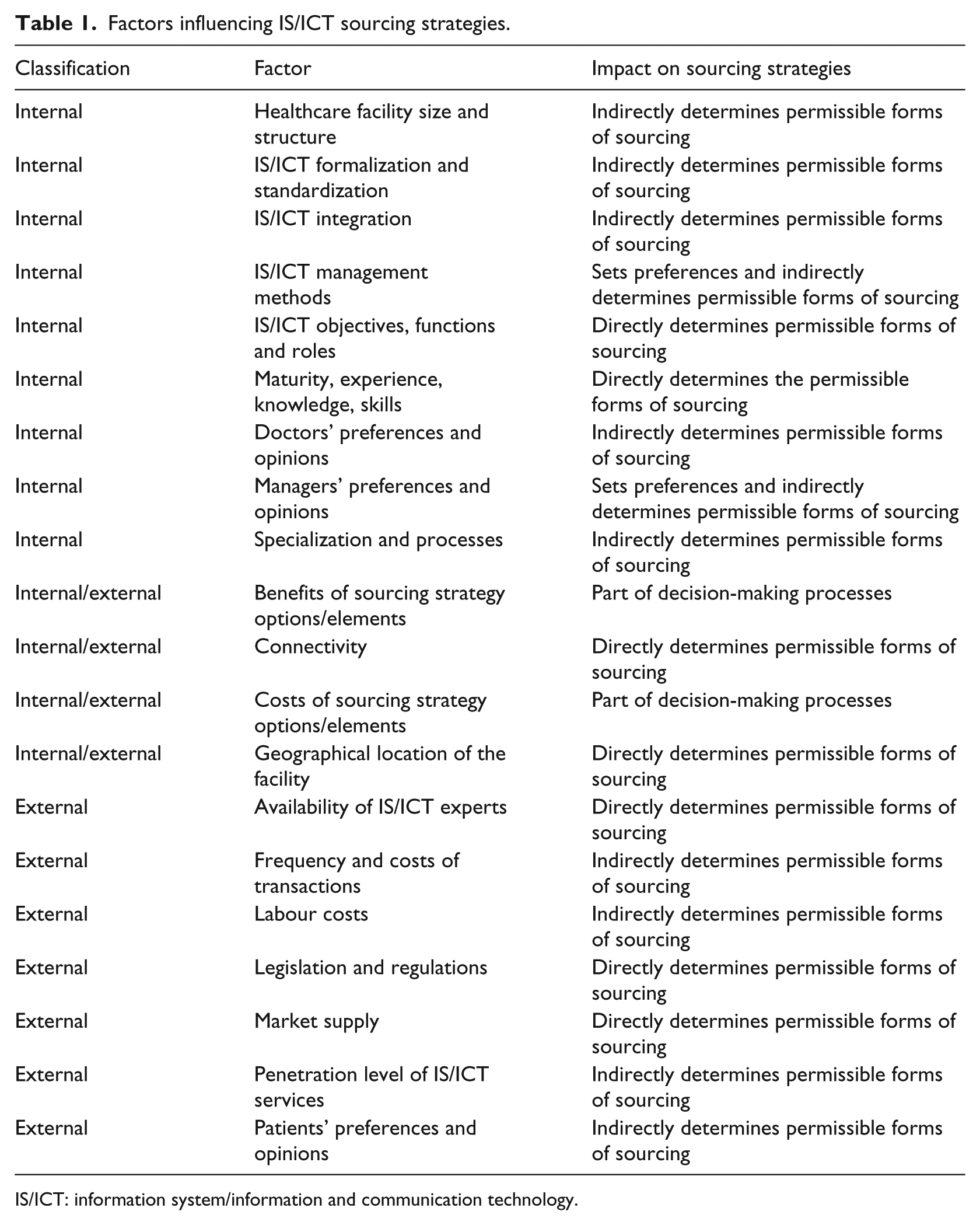
IS/ICT: information system/information and communication technology.
Impact levels of factors influencing IS/ICT sourcing strategies
During the case study, it was possible to discern different views on the individual factors and their importance in the sourcing strategies decision-making process. Importance of a factor in the decision-making process can be understood as a reflection of the extent to which the sourcing strategies are influenced by it. The above-mentioned factors influence the final strategy unevenly, and therefore, it is necessary to determine the extent of their impact and importance.
Further investigation and questioning focused specifically on the factors’ impact. To maintain consistency, the same healthcare facility, data sources and subjects (see the sample and procedures of the case study above) were used. The stakeholders were again divided into two groups: the direct and the indirect participants of the decision-making process. The method of pairwise comparison with matching indifference of factors without elimination36,37 was used to determine the factors’ impact. It is generally recommended to use from 12 to 15 elements for the pairwise comparison method. The number of elements in this study (18) does not exceed the recommended limit too much to require the use of the elimination method. A comparative matrix with descriptions of the individual factors and instructions was distributed to the participants on a paper form. The authors were personally present to oversee the methodological aspects.
In accordance with the pairwise comparison method, each of the elements (factors) was compared with all the others; 1 point was assigned to the winning element, 0 to the defeated one and 0.5 was assigned in case of a tie. Total sums for the categories of direct and indirect participants in the decision-making process are presented in Table 2.
Impact level of factors influencing IS/ICT sourcing strategies.
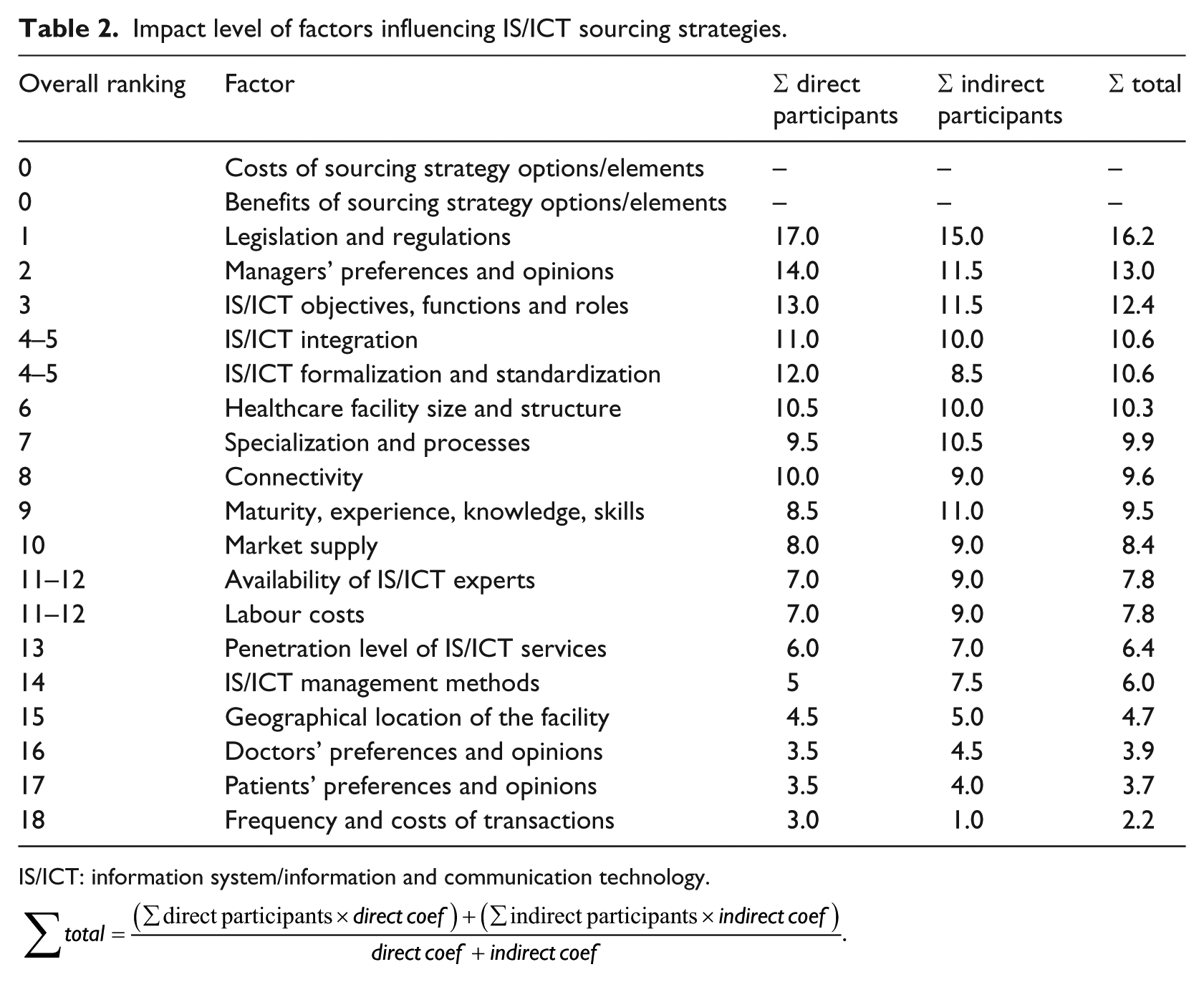
IS/ICT: information system/information and communication technology.
A coefficient of 1.5 was assigned to the overall group result of the direct participants in the decision-making process, because they have direct impact on sourcing strategies. The coefficient for the overall group result of the indirect participants of the decision-making process was set to 1.0, as this group does not influence decision-making directly. Both of them were determined by expert estimation on the basis of behaviour of the direct and the indirect participants during the case study.
The determined order of the factors indicates their impact level. Table 2 contains the factors and the results of the pairwise comparison for each group. In case of equal values, the factors are shown on separate lines; however, the affecting rate is the same. All factors must be taken into account during decision-making. The factors with a high impact level must not be neglected in any case. The consequences would be immediate (e.g. breach of legislation). Omitting the factors with a low impact level will be apparent over the longer term (e.g. views of patients in public healthcare facilities with a catchment area do not immediately cause decline in the number of patients).
Although doctors and consequently also patients are the end users of IS/ICT, the impact of the factors of doctors’ preferences and opinions and patients’ preferences and opinions is low due to the healthcare facility ownership. As indicated above, patients in the given catchment area are not able to change the public healthcare facility easily.
Discussion
IS/ICT sourcing strategies are fully expected to be in accordance with IS/ICT strategies and subsequently with overall strategies of a particular organization. To ensure this compliance over a longer period, they must take into account all the identified factors (see Table 1). According to the results of the study, all factors should be included in IS/ICT sourcing strategies decision-making, but it is necessary to distinguish their impact level (see Table 2). Nevertheless, we admit that some factors may be disregarded with no short-term impact.
The impact level of the factors was determined by the case study in a Czech medium-size inpatient healthcare facility. The results of this article are generally valid for the whole group of public medium-size inpatient healthcare facilities in the Czech Republic. The question, however, arises are the defined factors and their impact levels applicable through different categories of healthcare facilities and countries?
Medium-size inpatient healthcare facilities combine characteristics of both small and large healthcare facilities. M. Potančok 38 argued that common elements of IS/ICT processes can be found within all groups of healthcare facilities. We agree that a general structure of the entire IS/ICT is also consistent among these groups. This state is subsequently transferred to factors influencing sourcing strategies. Therefore, the defined impact levels of the factors influencing IS/ICT sourcing strategies (see Table 2) are highly likely to be valid for all mentioned sizes of healthcare facilities and we expect only small differences. Healthcare facility ownership is more significant and influences the impact levels of the factors more than the size of a healthcare facility. The results of this article apply to public healthcare facilities. Private healthcare facilities emphasize patients’ preferences and opinions as they are real customers; the impact level of this factor is, therefore, higher. On the other hand, private healthcare facilities strive to offer unique solutions and medical equipment, so they belong to the group of innovators or early adopters. This approach decreases the impact level of the factor of market supply and the factor of penetration level of IS/ICT services.
Differences between healthcare facilities on an international level may be much larger due to different legislative requirements, work culture, healthcare processes and so on. Such differences can enable or disable some forms of sourcing strategies and also affect impact levels of factors influencing IS/ICT sourcing strategies.
The stakeholders’ perception and approach to sourcing are secondary, but equally important findings of the case study. The direct participants of the decision-making process correctly perceive different sourcing options. On the one hand, they attempt to select an effective IS/ICT option. But on the other hand, the effort to maximize insourcing because of bias (availability, security risks, etc.) still dominates. This approach leads to many factors being neglected in creating sourcing strategies. The indirect participants mainly take a negative attitude to attempts to outsource IS/ICT. Any transfers to external partners are seen as a risk. The overall results of the case study confirm the lack of coverage of all factors and incomplete work with them during creation of sourcing strategies. As such, they confirm the conclusions of M.L. Diana. 20 Due to the above-mentioned situation, the lack of a systematic approach and the different stakeholders’ perspectives, we suggest more frequent updates and audits of IS/ICT sourcing strategies. Optimally, once a year in contrast to standard recommended periodicity (every 2–3 years 28 ).
The strengths of this article include the depth of the analysis within the case study, inclusion of a medium-size healthcare facility (which combines characteristics of both small and large healthcare facilities) and inclusion of all major stakeholders (direct and indirect participants of IS/ICT sourcing strategies decision-making). A limitation of this article is the environment of the case study, which is tightly bounded. By this article, we would like to initiate verification of the findings in other countries. It is beyond the scope of this article to study interdependencies of the factors influencing IS/ICT sourcing strategies. We are aware of this limitation and we have already begun further research.
Conclusion
Sourcing strategies are used to specify required approaches of IS/ICT services, processes and resources delivery in relation to main objectives and strategies of a given organization. To comply with all requirements for these strategies, it is necessary to reflect factors influencing them.
The aim of this article was to identify and specify which factors influence IS/ICT sourcing strategies in healthcare facilities and determine their impact levels. The conducted research focused specifically on the medical environment, which was documented by a list of specifics. The case study in a medium-size district hospital in the Czech Republic was used to determine factors influencing sourcing strategies. Their impact was measured by contribution of each factor to sourcing strategies. The final set of factors contains 18 factors (internal and external). The most important are legislation, management opinions on IS/ICT and IS/ICT objectives, roles and functions. The case study also showed that direct participants in decision-making do not pay adequate attention to all the factors. We recommended using both the methodology and the findings to set up an efficient and effective sourcing strategy decision-making process.
Applicability of the results is twofold. First, healthcare facility management and IS/ICT specialist are able to streamline decision-making processes by including factors affecting sourcing strategies. The findings of this article could provide sufficient guidance on which factors to consider. Second, results may be used in further research which should focus on verification and generalization including other countries and categories of healthcare facilities. For further development, it is necessary to study interdependencies of the factors (listed above in Table 1) and the impact of the ability to embrace innovations and new technologies on sourcing strategies.
Footnotes
Acknowledgements
The support of the staff and management at all participating hospitals is gratefully acknowledged.
Declaration of conflicting interests
The author(s) declared no potential conflicts of interest with respect to the research, authorship, and/or publication of this article.
Funding
The author(s) received no financial support for the research, authorship, and/or publication of this article.